

|
361 Degrees International Limited (1361.HK): 5 FORCES Analysis [Apr-2026 Updated] |
Completamente Editable: Adáptelo A Sus Necesidades En Excel O Sheets
Diseño Profesional: Plantillas Confiables Y Estándares De La Industria
Predeterminadas Para Un Uso Rápido Y Eficiente
Compatible con MAC / PC, completamente desbloqueado
No Se Necesita Experiencia; Fáciles De Seguir
361 Degrees International Limited (1361.HK) Bundle
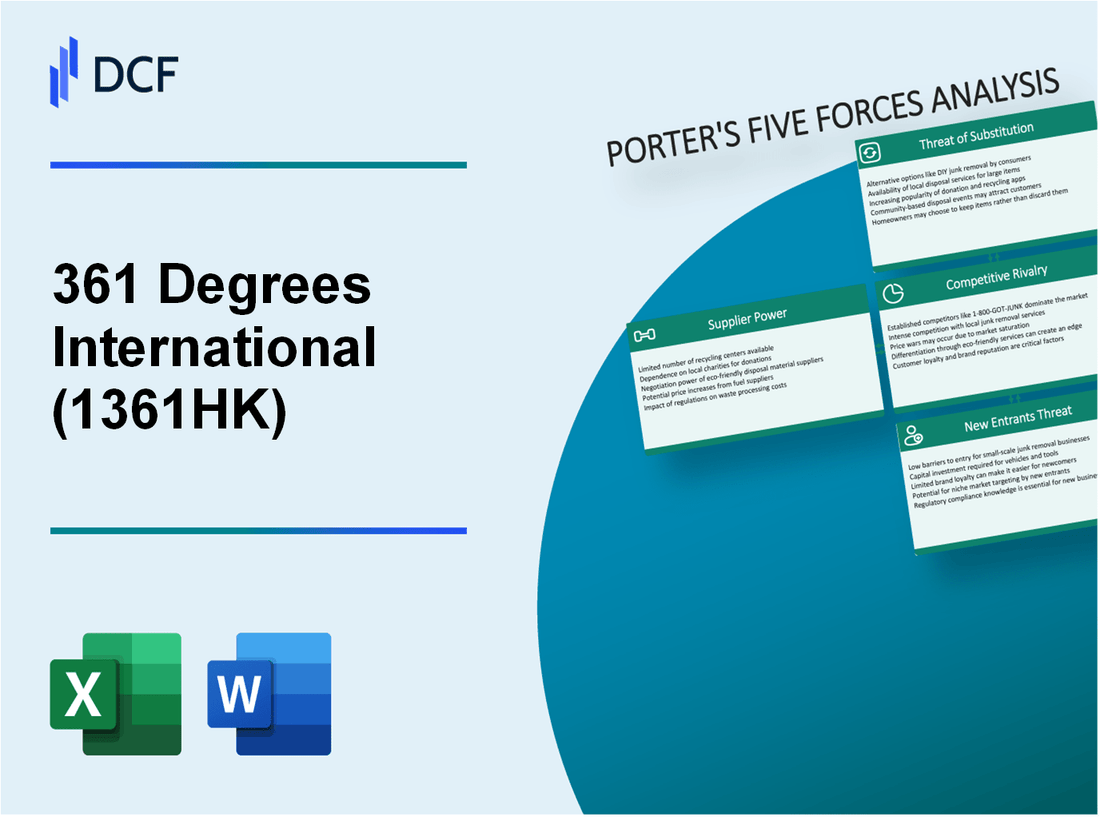
Explore how 361 Degrees International navigates the heat of China's sportswear arena through the lens of Porter's Five Forces-examining supplier leverage, customer dynamics, fierce domestic rivalry, encroaching substitutes, and the real barriers facing newcomers-to reveal why scale, vertical control, and targeted innovation are shaping its competitive edge and vulnerabilities; read on to see which forces propel growth and which could reshape its future.
361 Degrees International Limited (1361.HK) - Porter's Five Forces: Bargaining power of suppliers
Vertical integration limits external supplier influence. 361 Degrees manufactures approximately 45% of its footwear and 35% of its apparel in-house, providing direct control over a substantial portion of production capacity. This in-house production contributes to a gross profit margin of 41.1%, insulating overall profitability from short-term contractor price volatility. No single supplier accounts for more than 10% of total raw material purchases, which constrains individual supplier leverage and reduces the risk of supply-side hold-ups. The company allocates 3.7% of total revenue to research and development (R&D) to develop proprietary materials and production techniques, further decreasing reliance on specialized external inputs. With cost of sales at approximately 58.9% of revenue, management retains flexibility to switch to secondary suppliers if third-party price increases exceed a 5% threshold.
| Metric | Value | Unit/Notes |
|---|---|---|
| In-house footwear production | 45 | % of total footwear |
| In-house apparel production | 35 | % of total apparel |
| Gross profit margin | 41.1 | % |
| Share of revenue to R&D | 3.7 | % of revenue |
| Maximum supplier concentration | 10 | % of raw material purchases per supplier |
| Cost of sales | 58.9 | % of revenue |
| Supplier price hike switch threshold | 5 | % increase |
Raw material commoditization reduces vendor pricing leverage. Core inputs-rubber, cotton and synthetic fabrics-are sourced from a highly fragmented global commodity market where standardization lowers switching costs. The company's annual revenue of RMB 8.42 billion delivers scale-based bargaining power, enabling negotiation of volume discounts and preferential terms unavailable to smaller rivals. 361 Degrees maintains cash and cash equivalents of approximately RMB 3.9 billion, which it can deploy to capture early-payment discounts and secure supply from smaller mills during liquidity tightness in the sector. Trade payables turnover stands at about 145 days, reflecting extended supplier credit utilization that functions as working capital and further weakens supplier bargaining positions. Historical market data indicates global cotton price swings of c.12% are typically absorbed without increasing retail prices by more than c.2% for 361 Degrees, demonstrating pricing resilience afforded by scale and inventory/contract management.
| Commodity | Market structure | Typical price volatility | Impact on retail price |
|---|---|---|---|
| Rubber | Fragmented global suppliers | 8-15% | <2.5% change in retail price when absorbed |
| Cotton | Global commodity market | ~12% | ~2% change in retail price |
| Synthetic fabrics | Large-scale producers, commodity-like | 5-10% | <2% change in retail price |
- Supplier concentration: Low (no single supplier >10%), limiting supplier-specific bargaining power.
- Vertical integration: Moderate-to-high (45% footwear, 35% apparel), reducing external dependency and enhancing margin stability.
- Scale advantages: RMB 8.42 billion revenue and RMB 3.9 billion cash enable volume discounts and early-payment negotiation leverage.
- Working capital strategy: Trade payables turnover ~145 days provides supplier financing benefits and reduces acute price pressure.
- R&D and proprietary inputs: 3.7% of revenue devoted to R&D cuts reliance on specialized external materials and raises switching capability.
361 Degrees International Limited (1361.HK) - Porter's Five Forces: Bargaining power of customers
Targeted demographic focus limits consumer price sensitivity. 361 Degrees concentrates its retail footprint in Tier 3 and Tier 4 cities in China, where over 70% of its 5,734 core brand stores are located. The company positions products with an average selling price (ASP) approximately 30-40% below international brands (e.g., Nike, Adidas), creating a loyal, value-conscious customer base that reduces raw price pressure from end consumers. The 361 Kids segment contributes roughly 24.5% of group revenue and recorded 22.2% year‑on‑year growth, reinforcing brand stickiness among family shoppers.
Customer bargaining power is further mitigated by digital channels and loyalty mechanics: e-commerce now accounts for 23.2% of total sales, enabling the company to exert direct price control and promotional cadence; a membership program with millions of users helps stabilize the effective retail discount rate at about 25%, reducing headline promotional intensity despite low switching costs in apparel and footwear.
| Metric | Value |
|---|---|
| Core brand stores | 5,734 |
| Kids points of sale | 2,545 |
| Share of stores in Tier 3/4 cities | >70% |
| E‑commerce share of sales | 23.2% |
| 361 Kids revenue share | 24.5% |
| 361 Kids YoY growth | 22.2% |
| Average selling price vs. international brands | ~30-40% lower |
| Retail discount rate (stabilized) | ~25% |
Distribution model shifts power to authorized retailers. A sizeable portion of sales flows through authorized distributors managing 5,734 core stores and 2,545 kids' POS; these distributors possess bargaining leverage around assortment and local merchandising. 361 Degrees counters this through disciplined inventory and real‑time retail control.
| Distribution / working capital metric | Value |
|---|---|
| Inventory‑to‑sales ratio (times) | ~4.5x |
| Trade receivables turnover days | 149 days |
| Revenue growth (latest period) | ~21% |
| POS coverage (real‑time) | >90% of stores |
| AG running series gross margin | >40% |
Data‑driven retailer management reduces distributor bargaining power: a real‑time POS system covering over 90% of stores enables monitoring of sell‑through and inventory, allowing the company to direct product mixes and prioritize high‑margin lines (e.g., AG running series maintaining >40% margin). Extended credit (149 days receivables) supports distributor cash flow but represents a tradeoff between channel leverage and working capital strain; inventory discipline (~4.5x) preserves retail health and limits distributor demands for markdowns.
- Value positioning + regional focus → lower consumer price sensitivity and enhanced loyalty.
- E‑commerce + membership scale → direct pricing control and stabilized discounting (~25%).
- Wide distributor network → some intermediary bargaining, mitigated by POS data, product mix control, and extended credit.
- Working capital metrics (149 days receivables, 4.5x inventory) reflect channel support that tempers retailer resistance but increases corporate exposure.
361 Degrees International Limited (1361.HK) - Porter's Five Forces: Competitive rivalry
Competitive rivalry
361 Degrees operates in a highly saturated domestic sportswear market dominated by Anta and Li-Ning, with estimated market shares of approximately 20% and 13% respectively, while 361 Degrees holds roughly 4%. To sustain brand visibility and defend market position, 361 Degrees allocates c.12.6% of revenue to advertising and promotion. The company's inventory turnover is slower than major peers, averaging 93 days, which adds working capital pressure compared with faster cycles of larger rivals. Despite intense competition, 361 Degrees achieved revenue growth of 21% while reporting an operating margin of c.16.4%, reflecting margin pressure from price competition in the mid-range segment. Strategic high-profile sponsorships (e.g., Asian Games) target a regional audience exceeding 1 billion, aiming to amplify brand reach and sales conversion in core regional markets.
| Metric | Anta (approx.) | Li-Ning (approx.) | 361 Degrees |
|---|---|---|---|
| Market share | 20% | 13% | 4% |
| Annual revenue (RMB billion) | 45.0 | 30.0 | 8.42 |
| Advertising & promotion (% of revenue) | 10.0% | 11.0% | 12.6% |
| Inventory turnover (days) | 60 | 70 | 93 |
| Revenue growth (YoY) | 18% | 15% | 21% |
| Operating margin | 20.0% | 18.0% | 16.4% |
| Patents (registered) | 1,000 | 600 | 400+ |
| Typical celebrity endorsement cost (per major athlete, RMB) | 80,000,000 | 60,000,000 | 50,000,000 |
Key competitive dynamics driving rivalry:
- Scale and distribution advantage of Anta and Li-Ning compresses margins for mid-sized players; 361 Degrees faces higher per-unit marketing and channel costs.
- Aggressive promotional activity and periodic price wars in the mid-range segment lower realized ASPs and put pressure on gross margins.
- Slower inventory turnover (93 days) increases markdown risk and financing costs relative to larger rivals with faster cycles.
- High-cost celebrity endorsements and sponsorships create a marketing arms race; costs per major athlete often exceed RMB 50 million, favoring firms with deeper cash flow.
- Regional sponsorships (e.g., Asian Games) are used to scale reach quickly, exposing 361 Degrees to high upfront marketing spend with medium-term ROI profiles.
Product innovation cycles drive market share battles
Technological differentiation in footwear is central to competitive positioning. 361 Degrees has expanded R&D headcount substantially, holds over 400 patents and has launched carbon-plate running shoes to close performance gaps with international benchmarks. Rapid product cycles mean new arrivals frequently represent over 80% of seasonal sales, forcing continuous investment in design, prototyping and Go-to-Market execution. The company has also invested in retail experience upgrades-its "Ninth Generation" store format has reportedly increased sales per square foot by c.15%-as a response to intensified offline competition and omnichannel consumer expectations.
| R&D & product metrics | Data |
|---|---|
| R&D patents (total held) | 400+ |
| Product category: carbon-plate running shoes | Launched (compete with international performance) |
| New arrivals contribution to seasonal sales | >80% |
| Store upgrade impact (Ninth Generation) | Sales/sq ft +15% |
| Impact on group revenue | RMB 8.42 billion (total revenue) |
- Continuous product launches and patent-driven differentiation increase fixed innovation costs and shorten product life cycles.
- Competitors with larger marketing budgets can overshadow product messages through celebrity endorsements costing tens of millions RMB, pressuring 361 Degrees to prioritize high-ROI sponsorships and targeted regional campaigns.
- Operational execution-inventory management, faster replenishment and retail conversion-remains a decisive battlefield where 361 Degrees must improve cycle times to reduce markdown risk and protect margins.
361 Degrees International Limited (1361.HK) - Porter's Five Forces: Threat of substitutes
The rise of lifestyle fashion trends has materially increased the threat of substitutes to 361 Degrees' core performance apparel and footwear business. Non-sporting casual fashion labels and premium outdoor/lifestyle brands have captured an estimated 15% of the traditional sportswear market, driven by athleisure, "Gorpcore" and fashion-led sneaker demand. In Chinese Tier 1 and 2 cities, premium lifestyle/outdoor brands such as Lululemon and Arc'teryx have reported double-digit retail growth (approx. Lululemon +20% YoY, Arc'teryx +15% YoY), shifting discretionary spend away from pure sporting brands and pressuring ASPs across the sector.
361 Degrees maintains a deliberate product mix to insulate against this substitution: approximately 40% of revenue from footwear and 35% from apparel, with the remainder from accessories and licensing. The company has targeted a 20% expansion in "sport-life" crossover lines to capture consumers migrating from professional athletics wear to daily-wear athleisure, while preserving technical performance attributes that fashion brands find difficult to replicate at scale.
| Metric | Value / Estimate | Implication |
|---|---|---|
| Share of sportswear market captured by non-sporting brands | 15% | Material substitution of traditional sportwear demand |
| 361 Degrees product mix (FY recent) | Footwear 40% / Apparel 35% / Other 25% | Footwear-led revenue base supports technical differentiation |
| Casual wear market CAGR (China) through 2026 | 7% CAGR | Long-term competitive pressure from lifestyle segments |
| Planned increase in 'sport-life' lines | +20% | Strategic response to crossover consumer demand |
| Growth at premium lifestyle/outdoor brands (Tier1/2 cities) | Lululemon +20% YoY / Arc'teryx +15% YoY (approx.) | Concentration of premium demand in urban centers |
Key operational and commercial threats from lifestyle substitutes include:
- Margin compression as fashion brands command premium ASPs for athleisure products.
- Channel overlap in omni-channel retail and e-commerce reducing brand differentiation.
- Consumer preference shifts toward brand image and multifunctional daily wear.
Digital fitness alternatives and technology-driven exercise present a complementary but substitutive threat to physical gear purchases. Virtual fitness platforms, app-led training, and game-based exercise reduce frequency and type of equipment purchases; concurrently, the smart wearable market in China is expanding at roughly 18% annually, redirecting consumer spend into connected devices rather than multiple pairs of specialty shoes. High-end basketball and performance running shoes (often priced > RMB 600) now compete with budget home-fitness solutions that offer one-time hardware investment supporting long-term fitness goals.
| Digital / Tech Substitution Metric | Value / Estimate | Notes |
|---|---|---|
| Smart wearable market growth (China) | ~18% YoY | Shifts spend to tech-enabled fitness |
| Increase in marathon participants (China) | +25% | Supports demand for specialized running footwear |
| Estimated impact of second-hand sneaker trading on new premium sales | ≈5% reduction | Premium segment sales leakage to resale marketplaces |
| Typical threshold price for 'high-end' shoes | > RMB 600 | Price point vulnerable to substitution by durable home equipment |
361 Degrees' mitigation efforts against digital and resale substitutes include:
- Maintaining a "running economy" product focus to exploit a 25% surge in marathon participation-emphasizing cushioning, durability and torsional support that software-led fitness cannot substitute.
- Integrating technology into product lines (embedded sensors, app connectivity) to align with the 18% expanding wearables market.
- Pursuing product lifecycle management and limited-edition drops to counter second-hand market leakage estimated at 5% in the premium segment.
- Pricing strategies that preserve accessibility below and above the RMB 600 threshold to segment demand and retain entry-level purchasers.
Overall, the threat of substitutes is high due to secular lifestyle shifts, fast-growing casual wear demand (7% CAGR to 2026), technology-led fitness adoption (wearables +18% YoY) and a growing resale ecosystem. 361 Degrees' defensive posture-product mix discipline (40% footwear / 35% apparel), 20% expansion of sport-life lines, and tech integration-addresses substitution risk but does not eliminate structural market pressures that favor lifestyle and tech-enabled alternatives.
361 Degrees International Limited (1361.HK) - Porter's Five Forces: Threat of new entrants
High capital requirements for brand building act as a material deterrent to new entrants in China's national sportswear market. 361 Degrees invested RMB 1.06 billion in advertising and promotion in the last fiscal year to sustain brand awareness and customer loyalty. A competing brand would typically need an upfront marketing spend in the range of RMB 800 million-1.2 billion over the first 3 years to reach comparable national recognition, alongside establishing a retail network of roughly 2,000-3,000 stores to achieve scale-driven cost parity. Specialized production CAPEX is also significant: a mid-sized midsoles production facility with equipment for high-performance foams commonly exceeds RMB 500 million initial investment, while ongoing R&D for advanced materials (e.g., supercritical foam chemistry) requires multi-year budgets often exceeding RMB 150-300 million.
Established distribution networks create additional structural barriers. 361 Degrees operates 8,279 total points of sale (including kids' outlets), holds long-term mall and wholesale agreements, and maintains a logistics and inventory system that supports a distributor credit cycle of approximately 149 days. Such financial and logistical flexibility enables distributor financing and promotional support that most startups cannot match. The top five domestic brands together control over 50.0% of the market, constraining meaningful market entry to a residual segment often estimated at under 10.0% of the total addressable market for new national brands.
| Metric | 361 Degrees (reported/estimated) | New Entrant Requirement/Barrier |
|---|---|---|
| Annual advertising & promotion spend | RMB 1.06 billion | RMB 800 million-1.2 billion (first 3 years) |
| Retail footprint (points of sale) | 8,279 stores/outlets | 2,000-3,000 stores to reach scale |
| Mid-sized production CAPEX (midsoles) | N/A (company scale) | ≥ RMB 500 million initial CAPEX |
| R&D budget for advanced materials | Company-level advanced materials programs (multi-year) | RMB 150-300 million over several years |
| Distributor credit cycle | 149 days | New entrants typically cannot offer >90 days |
| Top-five domestic brands market share | >50.0% | Available market for new national entrants <10.0% |
| Typical market share of niche new entrants | N/A | <0.5% total market share |
The combined effect of high upfront capital, entrenched retail leases and relationships, supply-chain sophistication and proprietary material technologies elevates the effective barrier to entry. New players face not only cash barriers but also operational and technical hurdles-particularly in achieving comparable product performance and inventory financing.
- Capital: Marketing reserve ≥ RMB 800M-1.2B (3 years) + production CAPEX ≥ RMB 500M.
- Distribution: Need 2,000-3,000 stores and long-term mall relationships to reach comparable presence.
- Supply chain finance: Inability to match 149-day distributor credit weakens new entrants' retail negotiating power.
- Technology & R&D: Advanced materials require RMB 150M-300M+ R&D and proprietary processes for parity.
- Market dynamics: Top five brands control >50% share; realistic upside for new entrants often <10% of TAM.
These barriers ensure that most new market attempts remain small-scale, specialty or regional brands with limited national penetration and sub-0.5% market share unless backed by significant capital, strategic retail partnerships, or unique technological differentiation.
Disclaimer
All information, articles, and product details provided on this website are for general informational and educational purposes only. We do not claim any ownership over, nor do we intend to infringe upon, any trademarks, copyrights, logos, brand names, or other intellectual property mentioned or depicted on this site. Such intellectual property remains the property of its respective owners, and any references here are made solely for identification or informational purposes, without implying any affiliation, endorsement, or partnership.
We make no representations or warranties, express or implied, regarding the accuracy, completeness, or suitability of any content or products presented. Nothing on this website should be construed as legal, tax, investment, financial, medical, or other professional advice. In addition, no part of this site—including articles or product references—constitutes a solicitation, recommendation, endorsement, advertisement, or offer to buy or sell any securities, franchises, or other financial instruments, particularly in jurisdictions where such activity would be unlawful.
All content is of a general nature and may not address the specific circumstances of any individual or entity. It is not a substitute for professional advice or services. Any actions you take based on the information provided here are strictly at your own risk. You accept full responsibility for any decisions or outcomes arising from your use of this website and agree to release us from any liability in connection with your use of, or reliance upon, the content or products found herein.