

|
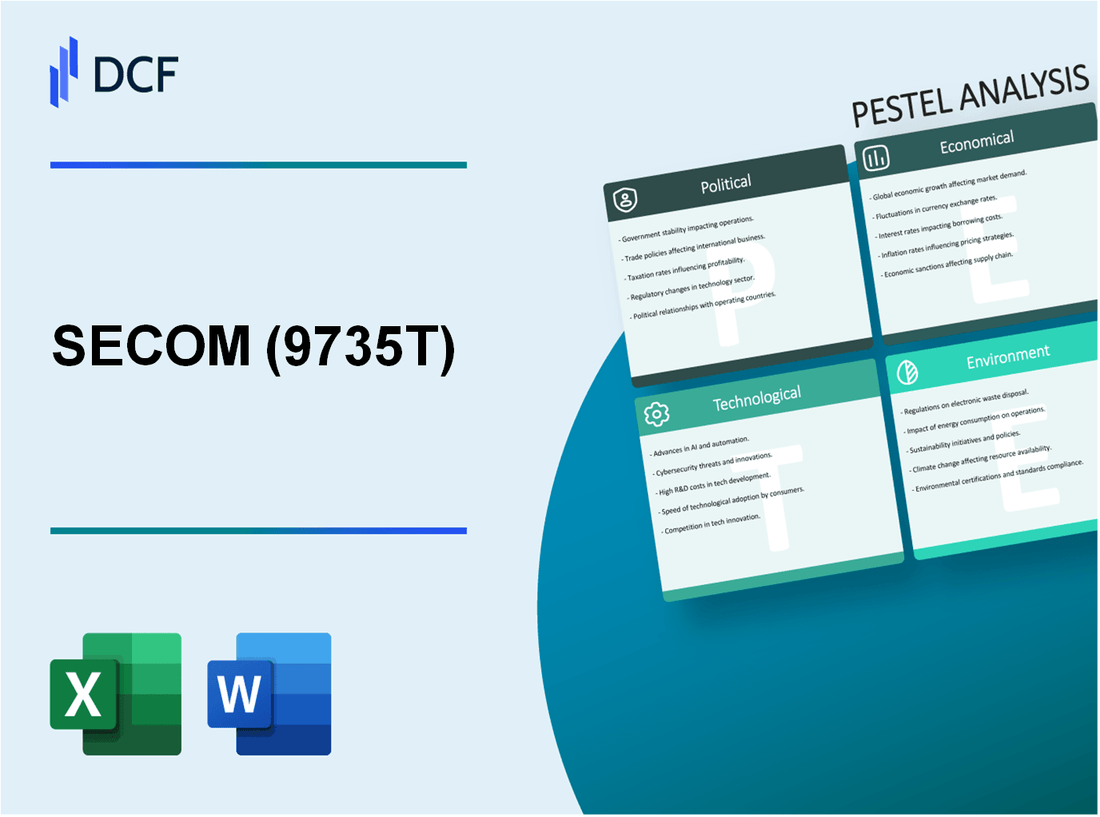
SECOM CO., LTD. (9735.T): PESTLE Analysis [Apr-2026 Updated] |
Completamente Editable: Adáptelo A Sus Necesidades En Excel O Sheets
Diseño Profesional: Plantillas Confiables Y Estándares De La Industria
Predeterminadas Para Un Uso Rápido Y Eficiente
Compatible con MAC / PC, completamente desbloqueado
No Se Necesita Experiencia; Fáciles De Seguir
SECOM Co., Ltd. (9735.T) Bundle
SECOM stands at a rare strategic inflection point: its market-leading tech, deep domestic trust and expanding AI/cybersecurity portfolio position it to capture surging demand from an aging, safety-conscious Japan and record government spending on infrastructure and defense, while ambitious ESG and electrification moves bolster long-term resilience; yet rising labor and compliance costs, a tight talent pool, supply-chain exposure to regional geopolitics and tightening privacy rules create immediate margin pressure and operational risks - making SECOM's next moves on automation, international compliance and strategic sourcing critical to converting opportunity into sustainable growth.
SECOM CO., LTD. (9735.T) - PESTLE Analysis: Political
Defense spending expansion boosts infrastructure security opportunities: Japan's defense budget rose to ¥6.94 trillion in FY2024 (up ~8% year-on-year), with a prioritized allocation toward base, port and cyber resilience projects. This trend increases procurement opportunities for security integrators such as SECOM across physical perimeter systems, secure facility installation and integrated command-and-control centers. Estimated addressable market growth for defense-related private contracts in Japan is projected at 6-9% CAGR through 2028, equivalent to ¥200-¥350 billion incremental spending in security systems.
Public-private partnerships strengthen national resilience efforts: The Japanese government has expanded public-private partnership (PPP) frameworks since 2022 to accelerate resilience upgrades for critical infrastructure (energy, transport, hospitals). SECOM's experience in managed security services positions it to win long-term PPP contracts. Contract tenors commonly range 5-15 years with performance-based payments; average annual PPP security contract values are between ¥50 million and ¥3 billion, with expected pipeline growth of 15-25% annually in priority regions (Tokyo metro, Kansai, Chubu).
24/7 monitoring mandate expands essential infrastructure coverage: Regulatory mandates introduced in 2023 require continuous monitoring and incident reporting for designated 'essential infrastructure' operators (approx. 1,200 entities initially), extending to an estimated 3,500 entities by 2027. Compliance requirements include 24/7 alarm monitoring, on-site rapid response within 30-60 minutes and incident telemetry retention for 5 years. This regulatory shift translates into recurring revenue opportunities: monitoring service ARPU increases of 10-18% and nationwide demand for rapid-response teams estimated at 4,000-6,000 additional deployments per year.
Substantial subsidies support domestic cybersecurity firms: Government subsidy programs (e.g., Ministry of Economy, Trade and Industry: JPY 120+ billion cybersecurity support package 2023-2026) provide grants, tax incentives and R&D credits favoring domestically owned cybersecurity and security technology firms. SECOM can leverage subsidies to offset R&D costs for AI-driven analytics, sensor fusion and secure communications, reducing CAPEX payback periods by 12-24% on qualifying projects. Direct grant sizes vary: ¥5 million-¥500 million per project; tax credits can cover 10-30% of eligible R&D expenditures.
International operations face trade and supply chain policy complexity: SECOM's overseas footprint (Southeast Asia, Hong Kong, Australia) encounters diverse export controls, data localization rules and tariff regimes. Examples: tightened export controls on surveillance tech (Japan updated guidelines 2022; bilateral restrictions with certain countries), and Vietnam and Indonesia introducing local data residency requirements (effective 2023-2025). Such policies can increase compliance costs by an estimated 3-7% of international revenues and lead times for hardware procurement by 4-10 weeks. Risk mitigation requires local partnerships and diversified sourcing; failure to comply can result in fines up to ¥500 million or market access restrictions.
| Political Factor | Policy/Metric | Immediate Impact on SECOM | Estimated Financial Effect (annual) |
|---|---|---|---|
| Defense budget increase | ¥6.94 trillion (FY2024, +8% YoY) | Higher procurement opportunities for secure installations and C2 systems | Additional ¥2-5 billion in contract potential per year |
| PPP expansion | 5-15 year contract tenors; pipeline growth 15-25% p.a. | Long-term managed services revenue and predictable cashflows | Incremental recurring revenue ¥1-3 billion annually |
| 24/7 monitoring mandate | 1,200 entities (2023) → ~3,500 (by 2027) | Increased monitoring subscriptions and rapid-response demand | Monitoring ARPU +10-18%; 4,000-6,000 extra deployments/year |
| Cybersecurity subsidies | ¥120+ billion package (2023-2026) | Lowered R&D cost and accelerated product development | R&D CAPEX payback shortened by 12-24%; grants ¥5M-¥500M/project |
| Export & data regulations | Export controls; data localization in SEA (2023-2025) | Compliance burden, supply chain delays, need for local JV | Compliance cost 3-7% of intl. revenue; fines up to ¥500M |
Key political implications for SECOM:
- Revenue diversification toward government and PPP contracts to capture defense and infrastructure spend.
- Investment in compliance, local partnerships and onshore data centers to manage regulatory fragmentation.
- Prioritize R&D projects aligned with subsidy eligibility (cyber, AI analytics, secure comms) to reduce net development cost.
- Scale monitoring and rapid-response teams to meet 24/7 mandates and contract SLAs; hire/ train estimated 2,000-3,500 personnel through 2027.
SECOM CO., LTD. (9735.T) - PESTLE Analysis: Economic
Higher interest rates and persistent inflation in Japan place upward pressure on SECOM's service pricing and operating costs. Headline CPI in Japan ran roughly between 2.5%-3.5% in 2022-2024, causing wage indexation, supplier price pass-through requests and higher financing costs for growth capital. Increased pricing power for security subscriptions is constrained by competitive market sensitivity to monthly fees; management must balance passing through inflation versus customer churn. Short-term corporate borrowing costs have risen from near-zero to positive territory, increasing interest expense on variable-rate debt and lease liabilities.
Yen volatility raises imported component and equipment costs. The JPY weakened materially versus the USD and other major currencies through 2022-2023 (USD/JPY moved from ~115 to ranges around 150-155 at peak volatility), increasing the JPY cost of imported sensors, cameras, semiconductors and cloud infrastructure denominated in foreign currencies. Exchange swings create forecasting risk for multi-year procurement contracts and capex plans.
Wage inflation is accelerating labor costs, strengthening incentives to automate. Regular wage growth in aggregate private-sector surveys showed base pay increases averaging ~2.5%-3.5% in recent contract cycles; targeted raises in security and nursing-care segments can be higher. SECOM's response includes automation and remote-monitoring investments to offset rising personnel expense and to improve gross margin per customer.
Modest GDP growth in Japan constrains domestic market expansion for security and integrated services. Real GDP growth averaged roughly 1.0%-2.0% annually in 2022-2024; slower expansion in corporate capex and new-build construction limits organic growth opportunities. Market saturation in mature urban segments requires greater focus on higher-value services, cross-selling to existing customers and overseas expansion to sustain revenue growth above domestic GDP.
Electricity cost increases squeeze operating margins, particularly for data centers, monitoring stations and on-premise customer devices. Retail electricity rates for commercial users in Japan rose an estimated 10%-35% from 2021-2023 depending on contract and region due to higher fuel and wholesale prices; continued volatility elevates recurring operating expenses and depreciation of battery/UPS investments.
| Economic Factor | Key Metrics (2022-2024) | Impact on SECOM |
|---|---|---|
| Inflation (CPI) | ~2.5%-3.5% annual | Higher input costs, pressure to raise subscription fees, margin compression if pass-through limited |
| Interest rates | Policy shift from negative/zero to modestly positive; corporate borrowing costs up by ~50-150 bps vs pre-2022 | Increased financing costs for capex and acquisitions, higher lease expense discount rates |
| Yen exchange (USD/JPY) | Range ~115 → 150-155 at volatility peaks | Higher import costs for hardware, FX translational and transactional exposure |
| Wage growth | Base pay rises ~2.5%-3.5%; sector-specific increases higher | Rising personnel expense; accelerates automation and remote-monitoring investment |
| Real GDP growth (Japan) | ~1.0%-2.0% annually | Constrains domestic market expansion; increases focus on service intensification and international markets |
| Electricity prices (commercial) | Increase ~10%-35% vs 2021 | Higher operating costs for monitoring centers, data processing and customer installations |
Operational consequences and responses:
- Pricing strategy adjustments: limited annual subscription increases (typ. 1%-4%) combined with tiered service offerings to protect churn.
- Hedging and sourcing: use of FX hedges, local sourcing and inventory management to mitigate import cost volatility.
- Capex shift: higher investment in automation, AI-based monitoring and remote services to reduce headcount elasticity.
- Cost control: energy-efficiency retrofits, negotiation of longer-term electricity contracts and on-site generation where economic.
- Revenue diversification: focus on cross-sell (security + life services), corporate solutions and overseas markets to offset slow domestic GDP-driven demand.
SECOM CO., LTD. (9735.T) - PESTLE Analysis: Social
Japan's demographic shift toward an older population is a primary social driver for SECOM's service mix. As of 2023, persons aged 65+ represent approximately 29% of Japan's population, creating expanding demand for medical alert systems, remote patient monitoring, in-home care security, and integrated emergency response services. SECOM's healthcare-related revenue streams and IoT-enabled care packages are positioned to capture increased lifetime value per household as aging households prioritize safety and health-monitoring continuity.
Labor market tightness and workforce shortages accelerate SECOM's adoption of automation and AI-driven security solutions. Japan's job openings-to-applicants ratio of ~1.39 (2023) and historically low unemployment (~2.6% in 2023) raise operational costs for labor-intensive services (guarding, installation, patrols), incentivizing investment in robotics, automated patrol drones, AI video analytics, and remote monitoring centers to maintain margins and service coverage.
Urbanization concentrates security demand into megacities where population density elevates asset protection, facility management, and complex building-integrated security needs. Approximately 92% of Japan's population lives in urban areas; megacity clusters in Tokyo, Osaka, and Nagoya create large addressable markets for integrated security, access control, building management, and concierge-type services aligned with SECOM's corporate and residential portfolios.
Public safety perceptions sustain steady domestic demand for security services despite falling overall crime rates. National crime statistics show a long-term decline in many categories, yet surveys indicate persistent public concern about burglary, fraud, and personal safety in public spaces-keeping subscription renewal rates and new client acquisition resilient for alarm monitoring, patrol, and rapid-response services.
Elevated consumer expectations for data privacy and secure handling of personal information shape product design, trust, and compliance costs. High public sensitivity to surveillance and health data requires SECOM to implement strict data governance, privacy-by-design architecture, and transparent consent practices. Failure to meet expectations risks brand damage and contract losses in enterprise and healthcare segments.
| Social Factor | Statistic / Metric | Direct Impact on SECOM | Operational / Strategic Response |
|---|---|---|---|
| Aging population | 65+ share ≈ 29% (Japan, 2023) | Higher demand for medical alert, remote monitoring, home-care security | Expand healthcare IoT, subscription-based monitoring, partnerships with care providers |
| Labor shortage | Job openings-to-applicants ≈ 1.39; unemployment ≈ 2.6% (2023) | Rising labor costs; capacity constraints for human-led services | Scale AI analytics, robotics, remote operation centers to reduce FTE intensity |
| Urbanization | Urban population ≈ 92% (Japan) | Concentrated demand for integrated building and city-scale security | Target megacity projects, smart-building integrations, multi-tenant offerings |
| Public safety concerns | Sustained public concern despite falling crime trends | Stable renewals; premium for rapid-response and visible deterrence services | Emphasize response capability, community programs, brand trust initiatives |
| Data privacy expectations | High consumer sensitivity; strict regulatory environment | Design constraints, compliance costs, reputation risk | Invest in privacy engineering, audits, transparent user controls, certification |
Implications for product and market strategy include:
- Prioritize subscription models for aging-in-place healthcare monitoring to increase recurring revenue and ARPU.
- Accelerate deployment of AI/video analytics and robotics to offset labor shortages and improve unit economics.
- Concentrate sales and service expansion in urban megaregions with bundled offerings for residences and commercial properties.
- Maintain visible, rapid-response capabilities and community engagement to preserve customer trust and churn resilience.
- Strengthen data protection measures and transparent privacy policies to support adoption of surveillance and health-data services.
SECOM CO., LTD. (9735.T) - PESTLE Analysis: Technological
AI analytics and 5G enable real-time, low-false-alarm security
SECOM is integrating edge and cloud AI models with emerging 5G networks to enable sub-50 ms telemetry and video streaming for real-time threat detection. Field pilots report up to 60-80% reduction in false alarms for perimeter and intrusion systems when AI-based video analytics are combined with multi-sensor fusion (video + PIR + acoustic) versus legacy rule-based detectors. 5G-enhanced bandwidth and low latency allow high-resolution video and metadata to be processed on hybrid edge/cloud topologies, enabling faster verification and accelerated operator response times (typical reduction in time-to-verify of 40-70%).
| Capability | Typical Metric | Impact Observed |
|---|---|---|
| AI video analytics | False alarm reduction: 60-80% | Fewer dispatches, lower customer complaints |
| 5G connectivity | Latency: <50 ms; throughput: >100 Mbps | Real-time streaming, remote verification |
| Edge inference | Inference time: 10-200 ms per frame | Lower cloud traffic, privacy-preserving |
Robotics and autonomous patrols scale security coverage
SECOM's deployment of autonomous mobile robots (AMRs) and unmanned aerial vehicles (UAVs) supports routine patrols and incident inspection, increasing area coverage per human guard by an estimated 3-5x and reducing nightly human patrol hours by 30-50% in pilot facilities. Robots equipped with thermal, LiDAR, and 4K imaging enable rapid situational assessment; integrated AI planning reduces false positives from animal/human differentiation. Maintenance and lifecycle CAPEX/OPEX considerations: robotics units often require 5-7 year refresh cycles and generate incremental recurring revenue from monitoring and preventive-maintenance contracts.
- Patrol efficiency increase: 3-5x area coverage
- Nighttime human patrol hour reduction: 30-50%
- Typical robot lifecycle: 5-7 years
IoT integration expands smart home security ecosystems
SECOM's IoT strategy connects door/window sensors, cameras, smart locks, environmental sensors (CO, smoke, flood), and energy-management devices into unified platforms. IoT adoption has driven ARPU uplift in residential segments by ~10-25% through bundled service offerings (security + home automation + elderly care). The company leverages interoperable standards (Zigbee, Z-Wave, Wi‑Fi, Thread) and over-the-air firmware management to scale deployments: typical large-city rollouts exceed 50,000 connected endpoints and generate telematics/usage datasets enabling predictive maintenance and personalized safety notifications.
| IoT Component | Function | Commercial Impact |
|---|---|---|
| Smart locks | Remote access control, logs | Higher ARPU, new access services |
| Environmental sensors | Fire, CO, flood detection | Reduced claim costs, bundling revenue |
| Energy management | HVAC, lighting control | Cost savings, sustainability offerings |
Cybersecurity threats push cloud, Zero Trust, and MFA offerings
Rising cyber threats have forced SECOM to expand secure cloud architectures, implement Zero Trust principles, and promote multi-factor authentication (MFA) across customer and operator access. Incidence of attempted credential compromise and ransomware targeting security and building management systems has increased year-on-year; in response SECOM has accelerated SOC capabilities and adopted automated patching, container isolation, and end-to-end encryption. Adoption metrics: MFA adoption among enterprise clients increased from ~35% to 70% within 24 months in targeted campaigns; SOC-managed detection mean time to detect (MTTD) improvements of 50-65% were achieved via centralized analytics and playbooks.
- MFA adoption increase among enterprise clients: ~35% → ~70%
- SOC MTTD improvement: 50-65%
- Key defenses: Zero Trust, micro-segmentation, automated patching
Quantum-resistant encryption exploration underpins future-proofing
SECOM is researching and piloting post-quantum cryptography (PQC) for key management, device firmware signing, and cloud storage to mitigate future risks from quantum-capable adversaries. Exploratory initiatives include hybrid classical/PQC key exchanges, hardware security module (HSM) upgrades, and participation in industry consortia for standardization. Investment and timeline: internal PQC pilots and vendor evaluations typically span 12-36 months; cryptographic agility roadmaps project full transition readiness within 3-7 years depending on standards maturity. Financial exposure mitigation: preemptive PQC integration reduces potential future re-keying and compliance costs estimated in early studies at millions of USD for large-scale connected-device fleets.
SECOM CO., LTD. (9735.T) - PESTLE Analysis: Legal
Stricter data privacy penalties increase compliance burden. Under the EU GDPR, maximum administrative fines reach up to €20 million or 4% of global annual turnover, whichever is higher. Japan's amended Act on the Protection of Personal Information (APPI) strengthened enforcement and cross-border transfer requirements; while explicit maximum fines are lower than GDPR, administrative orders and reputational damage can lead to multi‑million‑yen remediation costs. For SECOM-handling sensitive personal, biometric and video surveillance data-projected incremental annual compliance costs to meet enhanced data protection standards (legal counsel, DPO staffing, systems upgrades, breach insurance) can range from JPY 200-800 million depending on scope, with single major breach exposure potentially >JPY 5 billion when including fines, remediation, litigation and contract penalties.
Overtime caps raise staffing and automation investment. Japan's 2018 Work Style Reform limits standard overtime to 45 hours/month and 360 hours/year, with permitted exceptions up to 100 hours/month and 720 hours/year under special agreements (subject to strict conditions). Violation penalties include labor inspector sanctions and criminal penalties for egregious breaches. For SECOM's security guard and on‑site staff operations-where shift work is intensive-estimations indicate a need to increase headcount by 8-18% in Japan to maintain coverage without excessive overtime, translating to annual incremental labor costs of approximately JPY 3-8 billion. Alternatively, capital expenditure on automation (robotics, remote monitoring consoles) may require one‑time investments of JPY 1-10 billion depending on scale, with ROI timelines of 3-7 years in pilot scenarios.
Drone and robotics regulations enable controlled aerial/security deployment. National and municipal civil aviation laws (e.g., Japan's Act on Regulation of Land, Air and Water and MLIT guidelines) permit drone BVLOS (beyond visual line of sight) and nighttime operations only with approvals and safety demonstrations; data protection and airspace coordination add further legal conditions. SECOM can deploy security drones and autonomous patrol robots under defined approvals, potentially reducing on‑site manpower by 10-30% in pilot facilities. Expected regulatory compliance costs per deployment (permits, safety case, insurance, geofencing tech) average JPY 5-50 million per site, while liability insurance premiums for aerial operations can increase by 20-60% compared with standard robotics coverage.
Mandatory rest periods raise on-site scheduling and costs. Labor law changes and prefectural guidelines increasingly mandate rest periods between shifts (e.g., recommended minimum 11 consecutive hours in some jurisdictions and EU Working Time Directive-style rest norms for cross‑border operations). For SECOM's 24/7 operations, enforcing mandated rest windows drives scheduling complexity: rostering software upgrades (one‑time JPY 50-150 million) and supplemental staffing costs mean estimated annual payroll increases of JPY 1-4 billion to avoid illegal shift patterns. Noncompliance carries fines, criminal liability for managers in extreme cases, and higher workers' compensation exposure-historical enforcement actions in Japan often result in administrative fines from JPY 300,000 to several million yen per violation plus mandated corrective measures.
Global regulatory complexity elevates compliance spend and governance. SECOM's international footprint (operations and clients across APAC, North America and EMEA) requires adherence to heterogeneous regulations: GDPR (EU), CCPA/CPRA (California with potential fines up to $7,500 per intentional violation), APPI (Japan), China's Personal Information Protection Law (PIPL) with fines up to RMB 50 million or 5% of turnover, and sector‑specific security laws. Centralized governance and country‑specific legal teams are necessary; an internal estimate for a global compliance program (legal staff, external counsel, audits, policy harmonization, cross‑border data transfer mechanisms) is JPY 500 million-2 billion annually. Failure to centralize can result in contract invalidations, cross‑border enforcement actions and cascading financial exposure up to hundreds of millions USD in high‑impact scenarios.
| Legal Issue | Regulatory Detail | Estimated Financial Impact (Annual) | Operational Effect | Recommended Compliance Action |
|---|---|---|---|---|
| Data Privacy Penalties | GDPR (4% turnover/€20M), PIPL, APPI strengthening | JPY 200-800M (routine); breach exposure >JPY 5B | Higher DPO/headcount; encryption & logging upgrades | Global DPO, unified DPIA process, breach playbooks |
| Overtime Caps | Japan reforms: 45 hrs/month standard; exceptions up to 100/720 | Additional payroll JPY 3-8B or automation CapEx JPY 1-10B | Increased hiring or automation; shift redesign | Workforce planning, automation pilots, collective bargaining |
| Drone/Robotics Regulation | MLIT approvals, BVLOS/night ops permits, insurance rules | Permitting + safety JPY 5-50M/site; insurance +20-60% | Enables remote patrols; legal/airspace coordination needed | Permitting program, liability coverage, vendor vetting |
| Mandatory Rest Periods | Labor standards and regional rest recommendations (e.g., 11 hrs) | Roster software JPY 50-150M; payroll increase JPY 1-4B | More complex scheduling; reduced fatigue risk | Roster optimization, fatigue monitoring, hiring buffers |
| Global Regulatory Complexity | GDPR, CCPA/CPRA, PIPL, APPI, sectoral security laws | Compliance program JPY 500M-2B; potential fines up to $100M+ | Need for country-specific policies & contracts | Centralized governance, local legal hubs, regular audits |
- Immediate priorities: appoint cross‑border DPO, map data flows, run DPIAs for video/biometric services.
- Medium term: invest in workforce planning tools, pilot robotics/drone programs with regulatory sandbox partners.
- Long term: centralize compliance budgeting (target JPY 500M-2B/year), harmonize contracts and insurance across jurisdictions.
SECOM CO., LTD. (9735.T) - PESTLE Analysis: Environmental
Fleet electrification and charging infrastructure reduce emissions: SECOM's transition from internal combustion engine (ICE) vehicles to electric vehicles (EVs) for patrol, installation and service fleets can reduce Scope 1 transport emissions by an estimated 40-70% per vehicle depending on electricity grid carbon intensity. As of FY2024 SECOM reports approximately 18,000 service vehicles across Japan; converting 30% (5,400 vehicles) to EVs could cut annual fuel consumption by ~12 million liters equivalent and reduce CO2 emissions by roughly 30,000-45,000 tCO2e annually (assumes 5-8 tCO2e avoided per vehicle-year). Investment requirements for vehicle procurement and charging points are material: estimated CAPEX of JPY 40-80 billion over 5 years for fleet replacement and 10,000+ chargers in regional depots and customer sites.
Climate-driven disaster risk boosts demand for resilience services: Increasing frequency of typhoons, floods and heatwaves in Japan and Southeast Asia is expanding demand for SECOM's security-plus-resilience offerings (backup power, remote monitoring, emergency response). Between 2015-2023, insured natural catastrophe events in Japan grew ~25% in frequency; service call volumes for emergency response have risen ~12% CAGR in regions affected by severe weather. SECOM's revenue exposure can benefit: resilience services unit margins historically 6-9 percentage points higher than baseline alarm monitoring. Scenario modelling indicates a climate-driven uplift of 3-6% incremental service revenue by 2030 under a medium-impact pathway.
Sustainable procurement becomes mandatory, reducing supply chain emissions: Regulatory and customer pressure is moving procurement toward low-carbon materials and suppliers with verified Scope 3 reductions. SECOM's procurement spend on equipment, electronics and construction services totals an estimated JPY 120-150 billion annually; implementing mandatory supplier sustainability standards could reduce supply-chain emissions by 15-30% over a 5-10 year horizon. Compliance and supplier development costs are non-trivial-estimated additional OPEX and one-off audit/IT costs of JPY 1-3 billion annually during rollout-with potential for long-term cost avoidance from energy efficiency.
Renewable energy powering data centers supports ESG ratings: SECOM operates critical monitoring and cloud services that require high uptime and substantial power. Typical small-to-medium monitoring data centers consume 2-6 MW each; assuming SECOM operates 3-6 such sites, annual electricity consumption could be 20-40 GWh. Shifting to 100% renewable procurement (PPA/REC) or on-site solar/battery systems can reduce Scope 2 emissions to near-zero for those facilities and support improved ESG scores (S&P/ISS ESG) and access to green financing. Estimated investment for on-site renewables and resilience (solar + battery) per site: JPY 500 million-2 billion, with payback periods of 6-12 years depending on tariff and subsidy regimes.
Environmental compliance costs impact operating expenses: Stricter emissions, waste and chemical handling regulations increase compliance burden across operations, installations and logistics. For a company of SECOM's scale, annual environmental compliance costs (permits, monitoring, remediation provisions, reporting, carbon pricing exposure) can range from JPY 2-10 billion depending on jurisdictional tightening and carbon pricing scenarios. Under an illustrative carbon price of JPY 10,000/tCO2, residual Scope 1+2 emissions of 100-200 ktCO2e would imply direct costs of JPY 1-2 billion annually unless mitigated by offsets/renewables.
Key environmental metrics and targets for planning:
- Current estimated fleet size: 18,000 vehicles (Japan)
- EV conversion target (illustrative): 30% by 2028 → ~5,400 EVs
- Projected fleet CO2 reduction from EVs: 30,000-45,000 tCO2e/year (for 5,400 EVs)
- Data center electricity use (estimate): 20-40 GWh/year
- Annual procurement spend: JPY 120-150 billion
- Estimated environmental compliance cost range: JPY 2-10 billion/year
| Environmental area | Primary business impact | Estimated financial/operational metric |
| Fleet electrification | Lower Scope 1 emissions; CAPEX for EVs/chargers | 5,400 EVs @ JPY 7-12M each; CAPEX JPY 40-80B; CO2 reduction 30-45 ktCO2e/yr |
| Climate resilience demand | Higher recurring revenue for resilience services | Service revenue uplift 3-6% by 2030; margin premium +6-9 pp |
| Sustainable procurement | Reduced Scope 3 emissions; supplier compliance costs | Procurement JPY 120-150B/yr; rollout OPEX JPY 1-3B/yr |
| Renewable-powered data centers | Lower Scope 2 emissions; better ESG ratings; green financing | Electricity 20-40 GWh/yr; site CAPEX JPY 0.5-2B; payback 6-12 yrs |
| Environmental compliance | Higher operating costs; potential carbon pricing exposure | Compliance costs JPY 2-10B/yr; carbon cost JPY 1-2B/yr @ JPY 10,000/tCO2 |
Disclaimer
All information, articles, and product details provided on this website are for general informational and educational purposes only. We do not claim any ownership over, nor do we intend to infringe upon, any trademarks, copyrights, logos, brand names, or other intellectual property mentioned or depicted on this site. Such intellectual property remains the property of its respective owners, and any references here are made solely for identification or informational purposes, without implying any affiliation, endorsement, or partnership.
We make no representations or warranties, express or implied, regarding the accuracy, completeness, or suitability of any content or products presented. Nothing on this website should be construed as legal, tax, investment, financial, medical, or other professional advice. In addition, no part of this site—including articles or product references—constitutes a solicitation, recommendation, endorsement, advertisement, or offer to buy or sell any securities, franchises, or other financial instruments, particularly in jurisdictions where such activity would be unlawful.
All content is of a general nature and may not address the specific circumstances of any individual or entity. It is not a substitute for professional advice or services. Any actions you take based on the information provided here are strictly at your own risk. You accept full responsibility for any decisions or outcomes arising from your use of this website and agree to release us from any liability in connection with your use of, or reliance upon, the content or products found herein.