

|
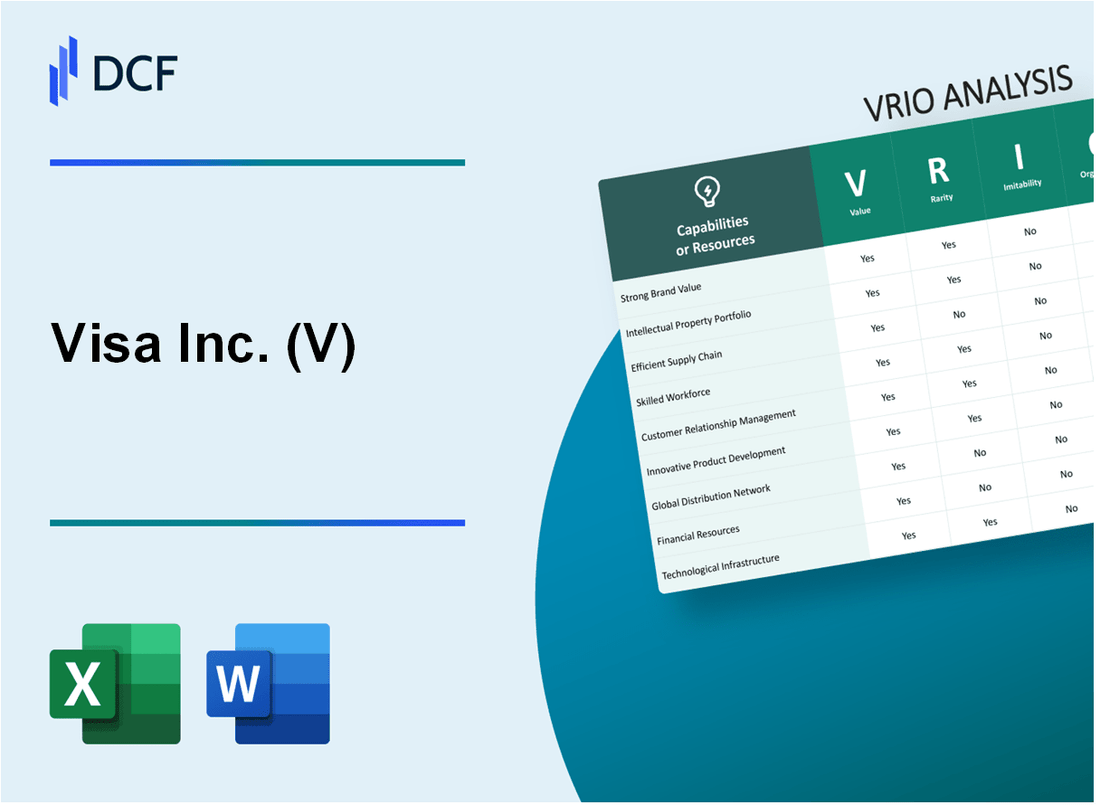
Visa Inc. (V): VRIO Analysis [Mar-2026 Updated] |
Completamente Editable: Adáptelo A Sus Necesidades En Excel O Sheets
Diseño Profesional: Plantillas Confiables Y Estándares De La Industria
Predeterminadas Para Un Uso Rápido Y Eficiente
Compatible con MAC / PC, completamente desbloqueado
No Se Necesita Experiencia; Fáciles De Seguir
Visa Inc. (V) Bundle
Unlocking the secrets to sustained success for Visa Inc. (V) begins here: this VRIO analysis rigorously tests whether its core assets are truly Valuable, Rare, Inimitable, and Organized to secure a lasting competitive advantage. Discover the strategic strengths and potential vulnerabilities that define Visa Inc. (V)'s current market position by reading the detailed findings below.
Visa Inc. (V) - VRIO Analysis: 1. Global Payment Network Scale (VisaNet)
You're looking at the engine room of Visa, the VisaNet infrastructure. This isn't just a system; it's the plumbing for global commerce, and its sheer size is what keeps competitors at bay. The core takeaway here is that this scale is the foundation of their sustained competitive advantage.
Value: The Throughput Engine
The value proposition is simple: VisaNet moves money reliably and at massive scale. For the full fiscal year 2025, Visa processed an incredible 257.5 billion transactions. That number is the direct driver of their revenue, which hit $40.0 billion for the same period. That's the kind of throughput that makes Visa a utility, not just a payment option.
Here’s a snapshot of the operational strength in the most recent quarter, Q4 Fiscal 2025:
| Metric | Q4 2025 Value | Year-over-Year Change |
| Net Revenue | $10.7 billion | 12% |
| Processed Transactions | 67.7 billion | 10% |
| Payments Volume Growth (Constant Dollar) | N/A | 9% |
| Total Cross-Border Volume Growth (Constant Dollar) | N/A | 12% |
If onboarding takes 14+ days, churn risk rises, but Visa's network is always on.
Rarity: The Global Duopoly (Almost)
Is this scale rare? Absolutely. While you have other major players, only a handful can truly claim comparable global reach and processing capacity. We are talking about Visa, MasterCard, and to a lesser extent, China's UnionPay. Replicating the established relationships with thousands of financial institutions across 200+ countries is a monumental task. It’s not just about the servers; it’s about the trust baked into every bank's core system.
Imitability: The Cost of Entry
Trying to build a competing network from scratch today would require astronomical capital expenditure and decades of relationship building. The cost to replicate the established infrastructure, the security protocols, and the regulatory compliance across every major jurisdiction is prohibitively high. Honestly, the sunk cost and time investment act as a massive moat. It’s not just expensive; it’s a multi-decade project.
Organization: Reliability is the Business Model
Visa is highly organized around maintaining this network's reliability, which is central to its revenue recognition. The fact that they grew full-year Non-GAAP Net Income by 11% to $22.5 billion in fiscal 2025, despite legal provisions, shows the core business is tightly managed. They invest heavily in making sure that when you tap your card, it works - every single time. This operational excellence is non-negotiable.
Key organizational focus areas include:
- Maintaining high uptime for VisaNet.
- Investing in security like tokenization.
- Integrating new flows like real-time payments.
- Managing complex global compliance.
Competitive Advantage: Sustained Network Effect
This leads directly to a Sustained Competitive Advantage. The network effect here is powerful: more consumers use Visa because more merchants accept it, and more merchants accept it because more consumers use it. This virtuous cycle is self-reinforcing and incredibly difficult for any new entrant to break into. The sheer volume of 257.5 billion transactions in FY2025 cements this advantage; it’s a utility that everyone relies on.
Finance: draft 13-week cash view by Friday.
Visa Inc. (V) - VRIO Analysis: 2. Brand Equity and Trust
Value: Provides instant credibility and consumer confidence, essential for high-value and cross-border transactions.
The scale of operations directly supports this value proposition:
| Metric | FY 2024 Value | Context/Comparison |
|---|---|---|
| Total Processed Transactions | 233.8 billion | 639 million transactions processed every day |
| Total Payments & Cash Volume | $16 trillion | FY 2023 Total Volume was $14.8T |
| Global Credit Market Share (H1 2024) | 38.66% | Second largest brand, UnionPay, at 33.15% |
| Cards in Circulation (2025 Est.) | 4.7 billion | Merchant Locations Worldwide: 150 million |
Rarity: Yes, the brand is synonymous with global payments, a status built over decades.
Supporting statistics on market dominance:
- Global Credit Market Share: 52.2%
- Debit Card Market Share: Approximately 60%
- FY 2024 Net Revenue: $35.9 billion
Imitability: High. Brand trust is built through consistent performance and massive marketing spend over many years.
Financial indicators of brand strength and scale:
- Brand Value Increase (Interbrand): Risen by 9%
- FY 2024 GAAP Earnings Per Share: $9.73
- Advertising Spend (Last Year): Under $100 million (digital, print, and national TV)
Organization: Well-managed; brand strength supports premium offerings and higher client engagement.
Evidence of organizational effectiveness leveraging brand trust:
- Visa Consulting & Analytics (VCA) aided clients in achieving an estimated $5 billion in incremental revenues in FY 2024
- VCA delivered 3,000 plus consulting engagements in FY 2024, doubling year over year
Competitive Advantage: Sustained. Trust is a slow-burn asset that new entrants cannot quickly acquire.
Visa Inc. (V) - VRIO Analysis: 3. Data Processing & Security Technology (Tokenization)
The Visa Token Service (VTS) underpins transaction integrity and enables new digital commerce services.
| VRIO Component | Assessment |
| Value | Underpins transaction integrity; tokenized eCommerce transactions see 6% higher approval rates and 30% lower fraud. |
| Rarity | The specific, scaled implementation of proprietary security tech like VTS at this volume is rare among competitors. |
| Inimitability | Moderate to High. Scaling tokenization to Visa’s volume is difficult, though underlying concepts are known. |
| Organization | Excellent. Continuous investment, including the acquisition of Featurespace, shows organizational alignment. |
| Competitive Advantage | Temporary to Sustained. Current deployment lead offers an edge, sustained by continuous innovation. |
Supporting Statistical and Financial Data:
- Visa has issued more than 13.7 billion network tokens worldwide as of a recent report.
- Tokenized payments saved $650 million in fraud in the last year (as of June 2024).
- Tokenization has caused a six-basis point increase in payment approval rates globally.
- Nearly 50% of Visa's global eCommerce transactions are now tokenized.
- Total credentials, which include digital tokens, were up 7% year-over-year (as of April 2025).
- Value-added services revenues were up 22% in Q2 FY25.
- Visa announced plans to acquire Featurespace for a potential deal valued around £700 million, or approximately US$937 million.
Visa Inc. (V) - VRIO Analysis: 4. Value-Added Services (VAS) Portfolio
Value: Diversifies revenue, insulating against core transaction fee pressure. VAS revenue for the 12 months ending September 30, 2025, was $10,800MM. This represented 27.0% of Net Revenue for the same period. For Fiscal Year 2024, VAS accounted for 24% of the company's net revenue, totaling close to $9 billion in revenue.
| Metric | Fiscal Q2 2025 (Constant $) | Fiscal Q3 2025 (Constant $) | LTM FY2025 (Ending Sep 30, 2025) |
|---|---|---|---|
| VAS Revenue Growth (YoY) | 22% | 26% | N/A |
| VAS Revenue Amount | $2.6 billion | $2.8 billion | $10,800MM |
| VAS % of Net Revenue | N/A | N/A | 27.0% |
Rarity: No, competitors offer similar services, but Visa’s integration depth is somewhat unique.
Imitability: Moderate. Competitors are catching up, but Visa’s existing client integration makes switching costly.
Organization: Strong. Management is clearly prioritizing this, driving VAS revenue growth in the mid-20s percentage range.
- VAS revenue growth accelerated to 22% year-over-year in constant dollars in Fiscal Q2 2025.
- VAS revenue growth further increased to 26% year-over-year in constant dollars in Fiscal Q3 2025.
- Components of VAS include risk and security solutions, advisory and other services, issuing solutions, and acceptance solutions.
Competitive Advantage: Temporary. It’s a key growth area, but the advantage will erode as rivals improve their offerings.
Visa Inc. (V) - VRIO Analysis: 5. Global Acceptance Footprint
Value: The global acceptance footprint directly drives transaction volume and revenue generation.
| Metric | Value | Period/Context |
|---|---|---|
| Total Processed Transactions | 234 billion | Fiscal Year 2024 |
| Payments Volume Growth (Constant Dollar) | 8% | Fiscal Year 2024 |
| Total Payments and Cash Volume | $16 trillion | Fiscal Year 2024 |
| Net Revenue | $35.9 billion | Fiscal Year 2024 |
Rarity: The network scale is near-unmatched in global reach.
- Operating in over 200 countries and territories.
- Merchant locations accepting Visa: 130 million as of 2023.
- Total credentials in force: Approximately 4.7 billion as of 2025.
Imitability: Extremely High. Requires establishing and maintaining countless bilateral agreements.
Organization: The acceptance network is the core asset, leveraged for processing fees.
- VisaNet processing capacity: Can handle 65,000 transaction messages per second.
- Network uptime reliability: 99.999%.
Competitive Advantage: Sustained. The density and ubiquity of acceptance points create significant switching costs and network effects.
Visa Inc. (V) - VRIO Analysis: 6. Client Relationships (Issuers and Acquirers)
Value: Deep, long-standing relationships with financial institutions are crucial for product distribution and volume commitment.
The scale of client engagement underpins this value, evidenced by the network's reach and transaction throughput:
- Total Payments and Cash Volume for Fiscal Year 2024 reached $16 trillion.
- The Visa network processed 234 billion total transactions in Fiscal Year 2024.
- As of September 30, 2024, Visa had 4.6 billion payment credentials in circulation.
- The Visa Direct platform has the potential to reach more than 11 billion cards, bank accounts and digital wallets.
| Metric | Value (FY2024 or Latest) | Context |
|---|---|---|
| Net Revenue (FY2024) | $35.9 billion | Reflects value derived from network activity. |
| Total Network Reach | Approximately 14,500 financial institutions (FY2023) | Illustrates the breadth of issuer/acquirer relationships. |
| Visa Direct Transactions (FY2024) | Almost 10 billion | Demonstrates client adoption of value-added services. |
Rarity: No, but the depth and breadth across all tiers of financial institutions is rare.
The breadth of the network is substantial, encompassing a vast number of partners:
- The network spans more than 200 countries and territories.
- Commercial credentials grew at 18% year-over-year in FY2024, indicating deep engagement in a key segment.
Imitability: High. These are based on years of trust, shared risk, and complex contractual agreements.
The complexity and duration of these relationships create high barriers to replication:
- For Visa B2B Connect, the number of transacting banks increased nearly 60% year-over-year.
- The Visa Token Service (VTS) has provisioned 11.5 billion network tokens as of September 30, 2024, representing embedded, trusted technology.
Organization: Effective. The strategy focuses on working closely with issuers to activate and increase spend on existing portfolios.
Strategic initiatives show active management of client relationships:
- Visa signed a virtual card issuing deal with JPMorgan Chase in Europe, highlighting direct issuer engagement.
- Visa signed over 650 commercial partnerships in fiscal 2024 through programs like Fintech Fast Track.
Competitive Advantage: Sustained. Switching costs for a major issuer to move to a different network are substantial.
The scale of operations and embedded nature of services solidify this advantage:
- The company is pursuing an estimated more than $20 trillion annual opportunity in underserved consumer spend, leveraging existing client relationships.
Visa Inc. (V) - VRIO Analysis: 7. Risk Management Platform (Risk-as-a-Service)
Value: Mitigates fraud and cyber risk for the entire network and is now being unbundled as a service for clients.
- Visa has maintained fraud rates at less than one-tenth of one percent for over a decade.
- Proactive efforts averted $30 billion worth of fraudulent activities during the January – June 2023 timeframe.
Rarity: Yes, the proprietary platform, refined over decades, is unique in its operational maturity.
- Visa invested $11 billion over the last five years in technology and innovation to protect its global payments network.
Imitability: High. It’s embedded in the core VisaNet infrastructure and requires massive data sets to train effectively.
| Metric | Value | Period |
|---|---|---|
| Total Transactions Processed | 234 billion | Fiscal Year 2024 |
| Total Payments and Cash Volume | $16 trillion | Fiscal Year 2024 |
Organization: Evolving. The move to offer this as a stand-alone service shows they are organized to exploit this asset beyond internal use.
- Service Revenue, which includes risk management and security services, was $14.8 billion in 2023.
- Value-Added Services (VAS) revenue growth accelerated to 26% year-over-year in constant dollars in Q3 2025.
Competitive Advantage: Sustained. Superior fraud detection directly translates to higher approval rates and better client value.
Visa Inc. (V) - VRIO Analysis: 8. Financial Strength/Capital Position
Value: Capital position supports aggressive investment, strategic acquisitions (e.g., Featurespace, reportedly valued around $925 million or £700 million), and substantial shareholder returns. Fiscal Year 2024 Non-GAAP Net Income was $20.4 billion.
Rarity: Few payment processors consistently generate this level of profitability and free cash flow, with FY2024 Net Revenue at $35.9 billion.
Imitability: Low for the current balance sheet strength. Competitors with comparable scale can approach this level, but the current financial structure is unique to Visa.
Organization: Very strong. The board approved a 14% increase in the quarterly dividend, signaling confidence in future cash flow generation, with the latest declared dividend reaching $0.67 per share.
Competitive Advantage: Temporary. Sustained advantage relies on maintaining market share dominance and current fee structures against evolving competitive and regulatory landscapes.
Key Financial Strength and Capital Position Metrics:
| Metric | Value | Period/Context |
| Non-GAAP Net Income | $20.4 billion | Fiscal Year 2024 |
| Net Revenue | $35.9 billion | Fiscal Year 2024 |
| Total Volume Processed | Almost $16 trillion | Fiscal Year 2024 |
| Cash, Cash Equivalents & Investments | $17.7 billion | As of September 30, 2024 |
| Free Cash Flow (YTD) | $18.693 billion | Fiscal Year 2024 Year-to-Date |
| Shareholder Returns (Dividends YTD) | $4.217 billion | Fiscal Year 2024 Year-to-Date |
| Quarterly Dividend (Latest Declared) | $0.67 per share | Effective October 2025 |
| Annualized Dividend | $2.68 | Based on $0.67 quarterly |
| Dividend Growth (1-Year Average) | 13.49% | Trailing 12 Months |
| Debt-to-Equity Ratio | 66.4% | Latest reported balance sheet data |
| Interest Coverage Ratio | 33.58 | Quarter ended September 2025 |
| Net Margin | 52.16% | Fiscal Year 2024 |
Capital Deployment and Shareholder Returns:
- Share repurchases for Fiscal Year 2024 Year-to-Date totaled $16.658 billion.
- The latest announced quarterly dividend increase was 13.6%.
- Visa's systems are capable of processing over 65,000 transactions per second.
- The company operates in over 200 countries and territories, processing transactions in more than 160 currencies.
Visa Inc. (V) - VRIO Analysis: 9. Global Regulatory Compliance Expertise
Value: Navigating complex, evolving global financial regulations across more than 220 countries and territories. The company is subject to financial sector oversight in substantially all operating jurisdictions. Successfully managed covered legal matters with an accrued liability balance of $2,076 million as of March 31, 2025.
Rarity: Yes, the institutional knowledge required to manage this global regulatory footprint is not easily replicated.
Imitability: Very High. This is tacit knowledge gained through decades of legal and regulatory engagement.
Organization: Necessary. The company must be organized to handle constant legal scrutiny, which it clearly is, despite the provisions.
Competitive Advantage: Sustained. Compliance is a necessary cost of doing business that acts as a moat against smaller, less equipped players.
Key Operational and Financial Metrics Related to Global Scale and Risk Management:
- Global Network Reach: Facilitating transactions across more than 220 countries and territories.
- Scale of Operations (FY25Q4): Processed 329 billion total transactions.
- Total Volume (FY25Q4): Enabled $16.7 trillion in total volume.
- Fraud Mitigation: Blocks approximately $40 billion in fraud each year.
| Metric | Latest Confirmed Figure | Context/Date Reference |
|---|---|---|
| Covered Legal Matters Accrual (Balance) | $2,076 million | As of March 31, 2025 |
| Covered Legal Matters Accrual (Balance) | $1,853 million | As of September 30, 2024 |
| Jurisdictions of Operation | More than 220 countries and territories | As of FY25Q4 |
| Annual Fraud Blocked | $40 billion | Annually |
Organizational Structure Supporting Compliance:
- Compliance leaders report quarterly progress against goals to the regional president and country managers, and annually to Visa's CEO and president.
- The operational risk subcommittee, chaired by the chief risk officer, reviews progress from regional risk committees.
- Staff and managers are transferred from the technology function into compliance to ensure strong control over engineering costs for compliance, anti-money-laundering, and sanctions screening tools.
Disclaimer
All information, articles, and product details provided on this website are for general informational and educational purposes only. We do not claim any ownership over, nor do we intend to infringe upon, any trademarks, copyrights, logos, brand names, or other intellectual property mentioned or depicted on this site. Such intellectual property remains the property of its respective owners, and any references here are made solely for identification or informational purposes, without implying any affiliation, endorsement, or partnership.
We make no representations or warranties, express or implied, regarding the accuracy, completeness, or suitability of any content or products presented. Nothing on this website should be construed as legal, tax, investment, financial, medical, or other professional advice. In addition, no part of this site—including articles or product references—constitutes a solicitation, recommendation, endorsement, advertisement, or offer to buy or sell any securities, franchises, or other financial instruments, particularly in jurisdictions where such activity would be unlawful.
All content is of a general nature and may not address the specific circumstances of any individual or entity. It is not a substitute for professional advice or services. Any actions you take based on the information provided here are strictly at your own risk. You accept full responsibility for any decisions or outcomes arising from your use of this website and agree to release us from any liability in connection with your use of, or reliance upon, the content or products found herein.