

|
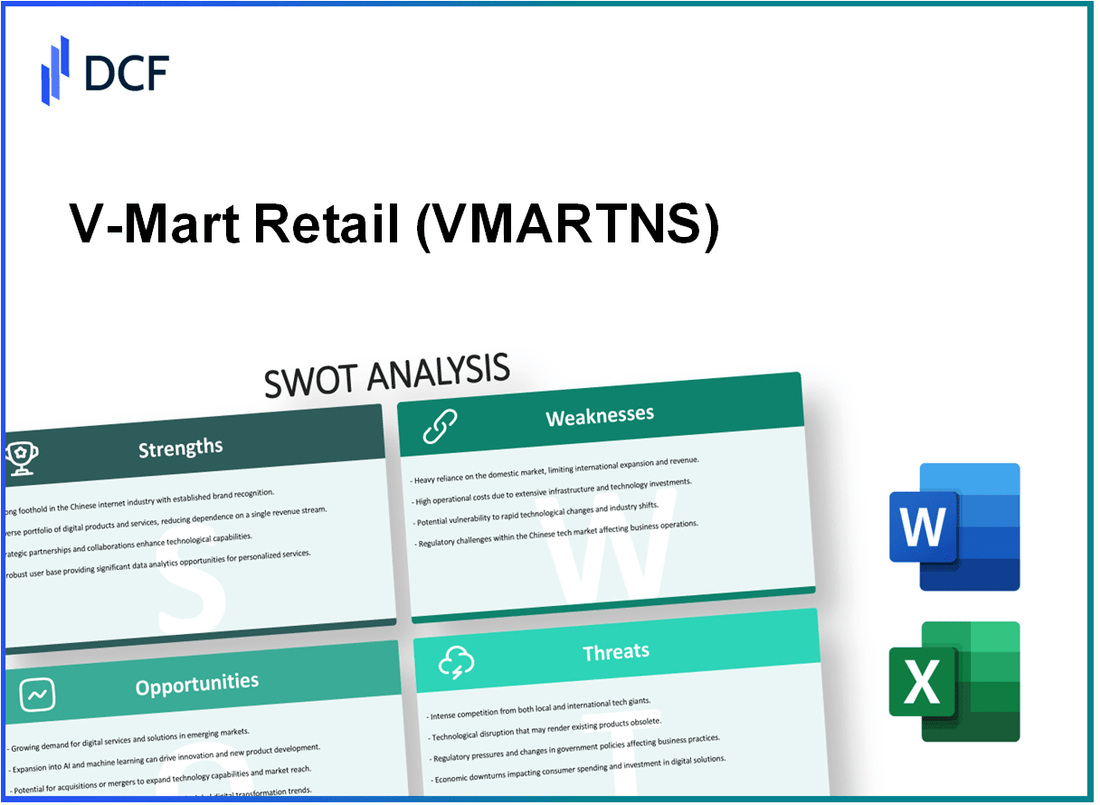
V-Mart Retail Limited (VMART.NS): SWOT Analysis [Apr-2026 Updated] |
Completamente Editable: Adáptelo A Sus Necesidades En Excel O Sheets
Diseño Profesional: Plantillas Confiables Y Estándares De La Industria
Predeterminadas Para Un Uso Rápido Y Eficiente
Compatible con MAC / PC, completamente desbloqueado
No Se Necesita Experiencia; Fáciles De Seguir
V-Mart Retail Limited (VMART.NS) Bundle
V-Mart stands at a pivotal juncture: robust revenue and margin recovery, rapid store expansion in underserved Tier II-III towns, a Gen Z-led traffic surge and a conservative balance sheet give it the firepower to scale, while persistent digital losses, heavy geographic concentration, rising operating costs and fierce competition from deep-pocketed rivals - compounded by climate-driven seasonality and raw-material volatility - could quickly erode gains; read on to see how these forces shape V-Mart's near-term growth and long-term resilience.
V-Mart Retail Limited (VMART.NS) - SWOT Analysis: Strengths
V-Mart's revenue momentum remained robust into FY26 with consolidated top-line growth and same-store sales gains that underpin its competitive positioning in value-fashion retail. In Q2 FY26 the company reported revenue of ₹807 crore, up 22.1% year-on-year from ₹661 crore in Q2 FY25, while same-store sales rose 11% across both V-Mart and Unlimited formats. For the full fiscal year ending March 2025 consolidated revenue reached ₹3,254 crore, a 17% increase versus FY24. Retail space expanded to 4.4 million sq. ft. by late 2025, up from 3.9 million sq. ft. a year earlier, supporting sales density improvements and market reach.
| Metric | Period / Date | Value | Change YoY |
|---|---|---|---|
| Q2 Revenue | Q2 FY26 | ₹807 crore | +22.1% |
| Q2 Revenue (Prior) | Q2 FY25 | ₹661 crore | - |
| Full Year Consolidated Revenue | FY25 (Mar 2025) | ₹3,254 crore | +17% |
| Same-Store Sales Growth | Q2 FY26 | 11% | - |
| Total Retail Space | Late 2025 | 4.4 million sq. ft. | +0.5 million sq. ft. YoY |
Strategic penetration in underpenetrated Tier II and Tier III markets provides a durable moat. As of mid-Q3 FY26 V-Mart operated 549 stores with concentration in high-opportunity states: Uttar Pradesh (158 stores), Bihar (72 stores) and Tamil Nadu (33 stores). In Q2 FY26 the chain added 25 stores while closing only 2 underperforming units, reflecting disciplined expansion. Management guidance targets 75 new store additions in FY26 to deepen reach among an estimated addressable cohort of 100 million customers in smaller towns.
| Geography | Number of Stores (mid-Q3 FY26) | Role |
|---|---|---|
| Uttar Pradesh | 158 | Largest territory; core growth engine |
| Bihar | 72 | High potential underpenetrated market |
| Tamil Nadu | 33 | Southern market foothold |
| Other States | 286 | Distributed presence across Tier II/III towns |
| Total | 549 | Company-wide store count |
Operational efficiency and margin expansion have improved substantially, translating higher top-line into stronger profitability. EBITDA margin in Q2 FY26 reached 8.9%, up 302 basis points from 5.8% in Q2 FY25. Gross margin held at 33.6% supported by a shift to stronger full-price sales and efficient inventory liquidation practices. Losses from the LimeRoad digital segment were cut by 53% to ₹34 million, aiding consolidated margin recovery. Standalone net profit for H1 FY26 jumped 177% year-on-year to ₹33.6 crore, indicating operating leverage as the business transitions toward higher quality earnings.
| Profitability Metric | Reported Value | Period | YoY Movement |
|---|---|---|---|
| EBITDA Margin | 8.9% | Q2 FY26 | +302 bps vs Q2 FY25 |
| Gross Margin | 33.6% | Q2 FY26 | Stable |
| LimeRoad Loss | ₹34 million | Q2 FY26 | -53% YoY |
| Standalone Net Profit (H1) | ₹33.6 crore | H1 FY26 | +177% YoY |
Balance sheet strength supports the company's expansion strategy while limiting leverage risk. As of March 2025 the net debt-to-equity ratio stood at ~0.19 with total shareholder equity of ₹850 crore (₹8.5 billion) and total debt of ₹100 crore (₹1.0 billion) by late 2025. Operating cash flow covered debt obligations by over 450%, enabling annual store CAPEX to be funded primarily through internal accruals. Finance costs fell 4.5% year-on-year in FY25, improving interest coverage and lowering fixed financial burden.
| Balance Sheet Item | Value | Reference Date |
|---|---|---|
| Net Debt-to-Equity Ratio | 0.19 | Mar 2025 |
| Total Shareholder Equity | ₹8.5 billion | Late 2025 |
| Total Debt | ₹1.0 billion | Late 2025 |
| Operating Cash Flow Coverage of Debt | 450%+ | FY25 |
| Finance Costs Change | -4.5% YoY | FY25 vs FY24 |
V-Mart's resonance with Gen Z is a strategic commercial strength that supports sustainable same-store sales growth and increased store footfalls. Gen Z now comprises 30-33% of the customer base (up from 23%), with a conversion rate of 43% as of Q3 FY25. Footfalls grew 40% year-on-year in late 2025, fueled by fast-fashion assortments, digital engagement, and technology-led sourcing and design that maintain a flat average selling price while increasing volume. This demographic shift enables higher frequency purchasing and supports long-term sales per store expansion.
- Gen Z share of customers: 30-33% (vs 23% prior)
- Gen Z conversion rate: 43% (Q3 FY25)
- Footfall growth: +40% YoY (late 2025)
- Average selling price: broadly flat while volumes rising
V-Mart Retail Limited (VMART.NS) - SWOT Analysis: Weaknesses
Persistent losses in the digital marketplace segment remain a material weakness. LimeRoad reported a consolidated loss of ₹3.4 crore in Q2 FY26 despite a 53% year-on-year reduction in losses. Net Merchandise Value (NMV) for the digital segment declined 32% YoY as management shifted focus from scale to profitability. Digital revenue was only ₹10.54 crore in Q3 FY25, a 38% decline versus the prior year. The digital arm continues to depress consolidated margins; consolidated net profit margin stood at -1.09% in Q2 FY26. Management guidance indicates LimeRoad is not expected to reach full break-even until at least late 2026, prolonging cash burn and requiring ongoing capital allocation.
Geographic concentration exposes V-Mart to regional demand shocks. Approximately 45% of stores are concentrated in two states in North and East India, increasing vulnerability to localized economic, climatic and geopolitical disruptions. In Q2 FY26 unseasonal rains in core Puja markets reduced sales in West Bengal and Bihar, and management flagged weak demand sentiment in eastern border areas near Bangladesh. This concentration limits risk diversification and makes company-level performance sensitive to region-specific downturns.
Rising operating costs and employee expenses are pressuring margins. Employee costs increased ~24% YoY in late 2025, driven primarily by minimum-wage hikes across key states. Other operating expenses totaled ₹251.4 crore for the twelve months ending September 2025, reflecting the cost of a large physical network. Annual store expansion of 13-15% further raises rent and utilities. While EBITDA margins have shown improvement, the absolute rise in fixed operating costs increases breakeven sales density requirements; any decline in store footfall could quickly reverse margin gains.
Lower productivity in the Unlimited store format creates a performance gap. Unlimited stores reported sales per square foot of ~₹550 versus ~₹950 for core V-Mart stores - a gap of ~₹400 per sq. ft. Although 12 unprofitable Unlimited stores were closed in the prior year, remaining outlets need significant turnaround work. Average selling price (ASP) in Unlimited declined ~5% in late 2025 due to a merchandise mix shift toward lower-value items, further compressing profitability and highlighting integration challenges for acquired formats.
High inventory levels and elevated working capital requirements constrain liquidity and financial flexibility. Inventory days were 93 as of mid-2025, above management's long-term target range of 87-90 days. The company experienced excess unsold winter inventory in early 2025, necessitating discount liquidation in later quarters. Working capital utilization averages ₹90-100 crore to ₹100-100 crore (₹900-1,000 million) seasonally to support stock. At a scale of 549 stores, inventory management remains capital-intensive and sensitive to fashion-risk, with misreads potentially resulting in significant markdowns and margin dilution.
| Metric | Value | Period / Note |
|---|---|---|
| LimeRoad loss | ₹3.4 crore | Q2 FY26 (53% reduction YoY) |
| Digital NMV change | -32% YoY | Shift to profitability over scale |
| Digital revenue | ₹10.54 crore | Q3 FY25 (-38% YoY) |
| Consolidated net profit margin | -1.09% | Q2 FY26 |
| Store concentration | ~45% | Stores in two states (North & East) |
| Employee cost increase | ~24% YoY | Late 2025 |
| Other operating expenses | ₹251.4 crore | 12 months ending Sep 2025 |
| Store expansion rate | 13-15% annually | Ongoing |
| Sales per sq. ft. (Unlimited) | ₹550 | Late 2025 |
| Sales per sq. ft. (Core V-Mart) | ₹950 | Late 2025 |
| ASP change (Unlimited) | -5% | Late 2025 |
| Inventory days | 93 days | Mid-2025 (target 87-90) |
| Working capital utilization | ₹90-100 crore | Seasonal average (₹900-1,000 million) |
| Store count | 549 stores | Scale as of mid-2025 |
- Digital segment: continued cash burn, delayed break-even (estimated late 2026), limited revenue scale.
- Geographic risk: high concentration (~45% stores) in North & East increases exposure to local shocks.
- Cost pressure: +24% employee costs and ₹251.4 crore operating expenses raise breakeven thresholds.
- Format underperformance: Unlimited format delivers ~₹400 per sq. ft. lower productivity than core stores.
- Working capital: inventory days at 93 and seasonal working capital needs of ₹90-100 crore strain liquidity and elevate markdown risk.
V-Mart Retail Limited (VMART.NS) - SWOT Analysis: Opportunities
Aggressive expansion into South and West India represents a primary growth vector. V-Mart plans to open 75 new stores in FY26 with a significant portion targeted at South India; recent additions include stores in Tamil Nadu and Gujarat where existing store counts are materially lower than northern states. Management guidance targets a 10%-12% annual increase in total retail area, supporting a projected revenue CAGR of ~17% over the next three years. Geographic diversification reduces concentration risk from North India demand cycles and increases access to faster-growing semi-urban markets.
| Metric | Current / Target | Implication |
|---|---|---|
| New stores (FY26) | 75 | Accelerated market entry in South & West |
| Total stores (current) | 549 | Physical footprint to be expanded ~14%+ with 75 additions |
| Retail area growth target | 10%-12% p.a. | Increased revenue per region; market share gains |
| Revenue CAGR (3 yrs) | ~17% | Top-line expansion driven by new stores & SSSG |
The structural shift from unorganized to organized retail is a secular opportunity. India added ~2,500 new organized outlets over the last five years, and V-Mart - with a >100 million customer reach - stands to capture outsized share as consumers in Tier II-IV towns migrate to branded value-fashion formats. Policy tailwinds (GST modernization, compliance-led consolidation) and standardized omnichannel experiences increase the relative competitiveness of organized retailers versus local kirana and apparel stalls.
- Customer base: >100 million (broad reach across semi-urban/rural catchments)
- Organized store additions nationwide (5-year): ~2,500 outlets
- Expected benefit: rising market share in underpenetrated towns
Private label expansion and penetration into higher-margin categories present margin-accretive opportunities. V-Mart's strategy to increase private label mix - which typically yields 5%-10% higher gross margins than third-party brands - aims to lift overall gross margin and EBITDA conversion. Concurrent expansion into beauty & personal care, fashion accessories, and home utility items targets categories with higher purchase frequency and increased wallet share, supporting same-store sales growth in the mid-to-high single digits.
| Category | Current Focus | Expected Margin/Uplift |
|---|---|---|
| Private label | Growing share | +5% to +10% gross margin vs 3rd party |
| Beauty & personal care | Expansion phase | Higher frequency; improves AOV & conversion |
| Accessories & home utility | Newer SKUs | Increases basket size; higher repeat purchase |
Omnichannel integration and digital synergy - termed "omnification" by management - leverages LimeRoad's tech stack integrated with V-Mart's 549-store network to create assisted in-store purchases, click-and-collect, and store-led fulfilment. Using stores as micro-fulfilment centres can materially reduce last-mile cost and inventory days while increasing conversion through personalized in-store digital experiences. Management projects a further 50% reduction in digital segment losses year-on-year in FY26 as integration efficiencies and cross-channel demand uplift take effect.
- Physical stores available for fulfilment: 549
- Digital loss reduction target (FY26): -50% YoY
- Expected benefits: lower delivery costs, higher AOV, improved retention
Favorable macroeconomic tailwinds and early signs of rural recovery underpin demand in V-Mart's core semi-urban/rural markets. Increased infrastructure spending and targeted rural budget allocations are expected to raise disposable income in Tier III-IV towns. With stable inflation and improving consumer sentiment, the company forecasts ~20% overall revenue growth for the full year, driven by stronger rural consumption outpacing urban recovery.
| Macro Indicator | Trend / Impact |
|---|---|
| Rural income & infrastructure spending | Upward - supports higher discretionary spend |
| Inflation | Stable - positive for discretionary purchases |
| Company revenue guidance | ~20% YoY growth (full year outlook) |
Key initiatives to capture these opportunities include targeted store opening cadence in South & West, accelerated private label roll-out with SKU rationalization, deeper LimeRoad-V-Mart technology integration for omnichannel fulfilment, and category expansion into high-frequency items. Execution across these levers is expected to drive margin expansion, revenue CAGR of ~17% (3 years), and full-year growth near 20% driven by rural market recovery.
V-Mart Retail Limited (VMART.NS) - SWOT Analysis: Threats
Intense competition from deep-pocketed conglomerates: V-Mart faces escalating pressure from value fashion brands backed by major Indian conglomerates such as Tata's Zudio, Reliance's Yousta, and Aditya Birla's Style-Up. These competitors have more than doubled their store counts in the last five years, adding approximately 2,500 outlets to the market, intensifying store-level rivalry in V-Mart's core Tier II and III geographies. Larger players often benefit from cheaper capital, broader private label assortments and more extensive supply chain networks, enabling aggressive promotional pricing and faster SKU refresh cycles. To defend market share V-Mart may need to increase marketing spend, expand private-label assortments or offer deeper discounts-pressures that can compress gross and EBITDA margins.
Key competitive metrics:
| Metric | V-Mart (FY25) | Peers (aggregate) |
|---|---|---|
| Store count growth (last 5 yrs) | ~+55% (selective expansion) | ~+100% (~2,500 new stores) |
| Average ticketing strategy | Value fashion, discount-led | Value fashion + aggressive loss-leading |
| Access to capital | Moderate | High (conglomerate-backed) |
Volatility in raw material and cotton prices: Fluctuating costs of cotton and synthetic fibers present a continuous threat to margins. V-Mart's gross margin has been range-bound near 33.6%; any significant spike in global or domestic textile input prices could force retail price increases, risking alienation of price-sensitive 'Value Fashion' customers. The company's limited ability to fully pass on cost increases in a discount-led market means margin contraction is a realistic risk if input inflation persists.
- Gross margin (reported): ~33.6% (recent range-bound level)
- EBITDA sensitivity: A 5% increase in input costs could reduce EBITDA margin by ~100-250 bps, depending on operating leverage and markdown intensity
- Inventory carrying risk: High-cost inputs may accelerate markdown cycles to maintain price points
Impact of climate change and unseasonal weather patterns: Sales are highly seasonal and sensitive to timing/duration of winter and monsoon seasons. In FY25 a truncated winter led to muted January-February sales; late-2025 unseasonal rains disrupted festive buying in eastern regions. Such weather volatility produces inventory mismatches, elevated end-of-season markdowns and occasional 'lost seasons'-all of which impair revenue, cash conversion and working capital efficiency.
| Event | Impact on Sales | Operational consequence |
|---|---|---|
| Truncated winter (FY25) | Muted Jan-Feb sales (-X% YoY in winter wear SKU categories) | Higher markdowns; slower inventory turns |
| Unseasonal rains (late 2025) | Reduced festive footfall in East (notable decline in non-essential apparel) | Stock rebalancing; promotional intensity rose |
Regulatory changes and labor law compliance: The retail sector is prone to frequent regulatory updates-changes in GST administration, state-level minimum wages and proposed policies such as 'one nation, one retail license.' Employee costs increased ~24% in late 2025 for V-Mart as a consequence of regulatory and wage pressures. Further wage hikes or stricter compliance requirements would increase fixed costs and lower operating leverage. Managing compliance across 28 states and Union Territories requires administrative resources and may produce short-term disruption during transitions like GST 2.0.
- Employee cost increase (late 2025): +24% (reported impact)
- Geographic compliance footprint: 28 states + Union Territories
- Potential regulatory shocks: GST structure changes, labor law revisions, license harmonization
Potential slowdown in discretionary consumer spending: V-Mart's core customers-middle and lower-middle-class households-are sensitive to inflation in food and fuel and to rural income cycles. Any macro slowdown, spike in CPI, or erosion in rural demand could reduce purchase frequency for apparel and discretionary categories. Management's medium-term revenue objective of 17-20% growth could be at risk if broad-based demand softens. The stock's high market multiple (P/E >100 as of Dec 2025) implies limited tolerance for earnings misses; a demand-driven revenue shortfall could prompt disproportionate valuation contraction.
| Macro variable | Risk channel | Potential impact on V-Mart |
|---|---|---|
| Inflation (food/fuel) | Reduced disposable income | Lower purchase frequency; SKU downgrades |
| Rural slowdown | Weaker demand in Tier II/III | Revenue growth < target (17-20%) |
| Market valuation (P/E) | High multiple (>100 as of Dec 2025) | High sensitivity to earnings misses; share price volatility |
Disclaimer
All information, articles, and product details provided on this website are for general informational and educational purposes only. We do not claim any ownership over, nor do we intend to infringe upon, any trademarks, copyrights, logos, brand names, or other intellectual property mentioned or depicted on this site. Such intellectual property remains the property of its respective owners, and any references here are made solely for identification or informational purposes, without implying any affiliation, endorsement, or partnership.
We make no representations or warranties, express or implied, regarding the accuracy, completeness, or suitability of any content or products presented. Nothing on this website should be construed as legal, tax, investment, financial, medical, or other professional advice. In addition, no part of this site—including articles or product references—constitutes a solicitation, recommendation, endorsement, advertisement, or offer to buy or sell any securities, franchises, or other financial instruments, particularly in jurisdictions where such activity would be unlawful.
All content is of a general nature and may not address the specific circumstances of any individual or entity. It is not a substitute for professional advice or services. Any actions you take based on the information provided here are strictly at your own risk. You accept full responsibility for any decisions or outcomes arising from your use of this website and agree to release us from any liability in connection with your use of, or reliance upon, the content or products found herein.