

|
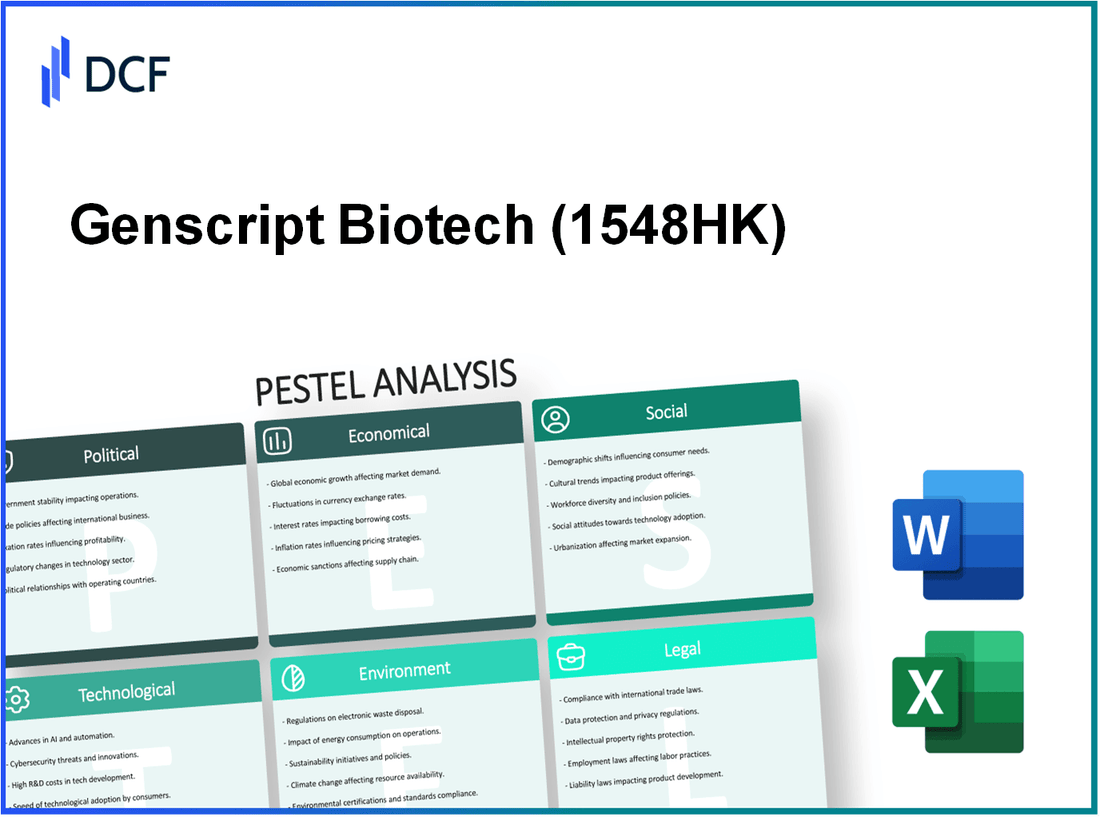
Genscript Biotech Corporation (1548.HK): PESTLE Analysis [Apr-2026 Updated] |
Entièrement Modifiable: Adapté À Vos Besoins Dans Excel Ou Sheets
Conception Professionnelle: Modèles Fiables Et Conformes Aux Normes Du Secteur
Pré-Construits Pour Une Utilisation Rapide Et Efficace
Compatible MAC/PC, entièrement débloqué
Aucune Expertise N'Est Requise; Facile À Suivre
Genscript Biotech Corporation (1548.HK) Bundle
GenScript sits at the intersection of powerful tailwinds - AI-driven protein engineering, broad service diversification, strong domestic policy support and a growing cell-therapy franchise with Legend Biotech - that position it to capture rising demand from aging populations and expanding R&D in Asia; yet its strategic outlook is sharply constrained by geopolitical scrutiny (notably U.S. BIOSECURE rules and tariffs), rising compliance and manufacturing costs, talent shortages and an intensifying patent and regulatory landscape, making successful execution on technology-led expansion, localized manufacturing and strict data/governance controls essential to turn opportunity into sustainable growth while mitigating mounting legal, supply-chain and cyber risks.
Genscript Biotech Corporation (1548.HK) - PESTLE Analysis: Political
The enactment and enforcement of the U.S. BIOSECURE Act and related export-control and foreign-supplier screening measures have increased contract terminations and screening of suppliers. GenScript's U.S.-facing service lines (estimated 30-45% of international service revenue) have experienced additional contract reviews, delayed project starts and in several cases terminated agreements when institutions or federal funding recipients determined vendor risk. Estimated one-off lost contract value in 2023-2024 exceeded USD 20-35 million, while recurring pipeline deferrals affected projected revenue growth by ~3-6% in those markets.
US-China strategic competition constrains government-linked research opportunities. Restrictions and debarments on companies with perceived PRC state ties have reduced GenScript's eligible addressable market for federally funded U.S. programs. Surveyed bid-earlier success rates for government R&D contracts dropped by an estimated 15-25% where national-security clauses applied. This has shifted GenScript's business mix toward private-sector biopharma partners and domestic Chinese institutional customers.
Separate U.S. and Chinese data and cloud "silo" regimes - including requirements for data localization, export controls on biological sequence data, and differing human-subject data standards - have raised compliance and infrastructure costs. Management estimates incremental compliance spend (legal, IT segmentation, certifications, audit) of USD 10-25 million annually to implement dual-environment architectures and to maintain separate SOPs for cross-border projects. Failure to segregate appropriately risks fines, contract loss and reputational damage.
Tariffs and trade measures on Chinese laboratory equipment and consumables have affected GenScript's cost base for reagents, synthesis hardware and imported components. Tariff lines applicable to key inputs have varied but incremental duties and import taxes in recent cycles added roughly 5-12% to landed costs on affected items. For GenScript, where gross margin for certain reagent-heavy service lines is 40-55%, a 5-12% input duty can compress segment gross margins by an estimated 2-7 percentage points absent price pass-through or supply-chain relocation.
China's 14th Five-Year Plan (2021-2025) prioritizes biotechnology as a strategic sector, boosting subsidies, preferential tax policies and market-access support. Central-level initiatives and provincial special funds have mobilized tens of billions RMB (national and subnational programs combined) for biotech industrialization, innovation platforms and biotech manufacturing capacity. Expected policy outcomes relevant to GenScript include:
- Preferential tax and grant support for domestic biomanufacturing facilities (corporate tax holidays or rebates equivalent to 10-20% of eligible capex in some provinces).
- Accelerated approvals and pilot pathways for domestically developed biologics and novel modalities, shortening regulatory timelines by an estimated 6-12 months for qualifying projects.
- Subsidized talent programs and capital support for plug-and-play labs, lowering initial up-front establishment costs by an estimated RMB 5-50 million for larger campus projects.
Political risk matrix (illustrative):
| Political Factor | Specific Impact on GenScript | Estimated Financial/Operational Effect | Likelihood (2024-2026) |
|---|---|---|---|
| BIOSECURE Act / U.S. export controls | Contract terminations, heightened approvals, vendor de-risking | USD 20-35M one-off lost contracts; 3-6% reduced growth in targeted programs | High |
| US-China strategic decoupling | Loss of government-funded R&D pipeline; need to refocus sales | 15-25% lower win rate on gov't bids in constrained markets | High |
| Data localization / dual-silo compliance | Infrastructure duplication, audits, dual SOPs | USD 10-25M incremental annual compliance cost | High |
| Tariffs on Chinese lab imports | Higher input costs for reagents and hardware | 5-12% increase in landed costs on affected inputs; 2-7 ppt margin compression | Moderate |
| China 14th Five-Year Plan subsidies | Grants, tax incentives, accelerated market access for domestic biotech | Potential capex support (RMB millions), faster regulatory timelines (6-12 months) | High |
Strategic implications for governance and operations include rebalancing revenue mix across geographies, strengthening compliance and export-control functions, accelerating localization of sensitive capabilities, and actively pursuing Chinese domestic incentives to offset external-market access constraints.
Genscript Biotech Corporation (1548.HK) - PESTLE Analysis: Economic
US monetary policy and high interest rates increase biotech financing costs. The US federal funds target rate reached a terminal range of roughly 5.25-5.50% in 2023-2024; equivalent global risk-free rate pressure has pushed credit spreads for emerging-market and biotech borrowers higher by an estimated 150-350 basis points versus pre-2021 levels. For Genscript, higher benchmark rates raise the cost of new debt and syndicated facilities and increase the discount rates applied to R&D-stage cash flows used in valuation models.
| Metric | Value / Estimate | Implication for Genscript |
|---|---|---|
| US Fed funds rate (2024) | 5.25%-5.50% | Higher global funding costs; tighter VC and bank financing availability |
| Biotech credit spread increase vs. 2019 | +150-350 bps | Increases borrowing cost for clinical and capex financing |
| Typical debt financing rate for HK/China biotech (2024) | 8%-12% p.a. (senior unsecured/convertible hybrids) | Raises interest expense, reduces NPV of long-term projects |
RMB volatility impacts reported earnings in HKD. The CNY/USD exchange rate ranged approximately 7.1-7.3 through parts of 2023-2024 with intra-year swings of ~3-6%. As Genscript reports in HKD while a large portion of revenue and costs are RMB- or USD-denominated, FX movements create translation gains/losses and affect gross margins - for example, a 5% RMB depreciation versus HKD/USD can reduce RMB-translated revenue by ~5% absent hedging and alter reported operating profit by multiple percentage points depending on currency mix and hedging coverage.
| Currency pair | Range (2023-2024) | Estimated P&L sensitivity |
|---|---|---|
| CNY/USD | ~7.1-7.3 | ~1% change ≈ 0.5-1.0% change in reported HKD revenue (company-specific) |
| CNY/HKD (effective) | variance ~3-6% intra-year | 5% RMB depreciation ≈ -2% to -4% operating margin (if unhedged) |
Global supply chain costs rise for laboratory reagents and logistics. Freight rates (container spot indices) saw periodic spikes in 2021-2023 and settled at levels 20%-60% above pre-pandemic averages in 2023; specialty reagent prices have increased an estimated 5%-15% annually due to raw-material inflation and constrained capacity for high-purity inputs. For Genscript - which sources reagents, consumables and cold-chain logistics internationally - these cost pressures increase COGS and working capital needs, with cold-chain airfreight premiums of 20%-50% during peak periods.
- Reagent cost inflation: estimated +5%-15% YoY (specialty items)
- Cold-chain airfreight premium during peaks: +20%-50%
- Inventory days increase to mitigate supply risk: +10-30 days typical management adjustment
China healthcare spending grows, aligning with domestic R&D investment. Mainland China healthcare expenditure has been expanding at a multi-year CAGR of ~6%-8%; public R&D and biotech support programs allocated tens of billions RMB annually at provincial and national levels (e.g., central government and provincial innovation funds). This macro trend supports demand for recombinant proteins, gene synthesis, biologics development services and contract R&D - core revenue streams for Genscript - and expands the domestic customer base, including biopharma, CROs and hospitals.
| Metric | Recent level / CAGR | Relevance to Genscript |
|---|---|---|
| China healthcare spending CAGR | ~6%-8% (multi-year) | Expanding end-market demand for lab services and biologics |
| Public R&D funding (central + provincial, illustrative) | tens of billions RMB annually (2022-2024 programs) | Supports pipeline funding for domestic partners and collaborative projects |
Wage inflation in China raises high-tech talent costs. Average annual wages in China's technology and life-sciences hubs have been rising at roughly 5%-8% per year; hiring competition for bioinformatics, molecular biology and process development experts has driven senior hire salary bands up by more than 10% in some metropolitan centers. For Genscript, labor cost inflation increases R&D and SG&A expenses, compresses margins unless offset by pricing power, and drives greater investment in automation to improve productivity.
- Estimated wage inflation for biotech talent: +5%-8% YoY
- Senior specialist salary inflation in tier‑1 cities: +8%-15% YoY
- Capex for automation to offset labor cost: one-time investments often 5-10% of annual OPEX
Genscript Biotech Corporation (1548.HK) - PESTLE Analysis: Social
The Sociological dimension for Genscript centers on demographic shifts, public ethics and expectations, investor-driven social responsibility, workforce supply constraints, and evolving work patterns - all directly influencing demand for recombinant proteins, cell therapies, synthetic biology services and contract research business lines.
Aging population drives demand for cell therapies and personalized medicine
Global and regional aging trends create expanding addressable markets for biologics, cell and gene therapies, and precision diagnostics - key areas for Genscript's peptide/protein, CRISPR and cell therapy platforms. Relevant statistics include:
- China: population aged 65+ ~14.9% in 2023 (National Bureau of Statistics / UN DESA).
- United States: 65+ population ~17.2% in 2023 (US Census Bureau).
- European Union: 65+ population ~20.8% in 2023 (Eurostat).
- Global cell & gene therapy market: estimated USD 10.9 billion in 2023 with projected CAGR ~20% to USD ~55 billion by 2032 (industry reports).
Ethical social expectations push higher governance in synthetic biology
Public and institutional expectations for safety, transparency and traceability in synthetic biology and biologics manufacturing are increasing. This raises demand for accredited quality systems, third‑party certifications and rigorous biosafety compliance in contract services.
| Social Expectation | Metric / Data | Implication for Genscript |
|---|---|---|
| Demand for certified manufacturing & oversight | ~70% of large pharma suppliers require ISO/GMP/GLP accreditation (industry surveys) | Higher capex and OPEX to maintain multi-site certifications; premium pricing for accredited services |
| Transparency & traceability | Major customers request electronic batch records and chain-of-custody reporting in >80% of new contracts | Investment in digital QMS and blockchain/LIMS integration |
| Community biosafety concerns | Incidence of local opposition to biotech facilities: increasing media coverage by ~15% year-on-year | Greater stakeholder engagement and PR expenditure; potential permitting delays |
Public concern over gene editing underpins demand for responsible practices
Consumer and patient attitudes toward gene editing and synthetic biology shape regulatory and commercial risk. Representative figures and trends:
- Pew Research (selected jurisdictions): ~60-70% public support for research using gene editing to treat serious diseases; support declines for enhancement applications to <30%.
- Instances of high-profile CRISPR controversies increase media scrutiny and can shift investor sentiment within weeks.
- Demand for demonstrable ethical governance (internal ethics boards, external audits) is now a competitive differentiator in B2B procurement.
Rising emphasis on social responsibility from investors and ESG standards
Institutional capital is increasingly conditioned on Environmental, Social and Governance metrics. Social factors affecting capital access and cost of equity: ESG AUM and investor behavior metrics:
| ESG Metric | 2023 / Recent Data | Relevance to Genscript |
|---|---|---|
| Global ESG-labelled assets | Estimated ~USD 40 trillion in 2023 (Bloomberg / GSIA) | Investor base expects formal S and governance disclosures; influences equity valuation and bond terms |
| ESG reporting uptake | ~80% of large-cap firms publish ESG/Social disclosures (2023 surveys) | Pressure to publish social impact, diversity, and supply-chain labor metrics |
| Social-screening divestment actions | Several sovereign wealth and pension funds enacted biotech-specific screens in the past 3 years | Potential customer and investor exclusions unless S-risks managed and disclosed |
Talent scarcity and remote-work trends shape biotech workforce dynamics
Biotech competes for skilled scientists, process engineers, and regulatory experts. Labor market and hybrid work indicators that affect operational capacity and cost structure:
- Skill shortages: industry surveys report ~55-65% of biotech and CROs experience difficulty hiring R&D scientists and GMP operators.
- Wage pressure: specialized life-science talent wage growth outpaced national averages by ~8-12% annually in 2022-2024 in major biotech hubs.
- Remote/hybrid trend: ~30-40% of non-lab biotech roles remain hybrid or remote post‑pandemic; on-site presence still required for GMP and bench scientists.
- Turnover and training costs: average annual turnover in biotech R&D roles ~15-20%, increasing training and recruitment spend.
| Workforce Factor | Data / Metric | Operational Impact |
|---|---|---|
| Difficulty hiring specialized staff | 55-65% of firms report hiring challenges (industry survey) | Slower project ramp-ups; reliance on contractor/CRO relationships; higher recruitment costs |
| Wage inflation for life-science talent | 8-12% annual salary growth vs national avg | Increases OPEX and pricing pressure for margin maintenance |
| Remote work prevalence | 30-40% of non-lab roles hybrid/remote | Opportunities to hire globally for non-lab positions; need for secure remote collaboration platforms |
| Turnover rate | 15-20% annual turnover in R&D roles | Higher training spend and project continuity risk |
Strategic social levers for Genscript include: enhanced ESG/S disclosures, investment in certified GMP capacity and digital traceability, targeted talent programs (apprenticeships, partnerships with universities), proactive ethical governance, and community engagement to mitigate reputational risk.
Genscript Biotech Corporation (1548.HK) - PESTLE Analysis: Technological
AI accelerates protein design and antibody discovery: Generative models and deep learning reduce design cycles from months to weeks. Internal and partner implementations of AI-driven design platforms can cut candidate screening costs by an estimated 30-50% and speed lead identification by 3-5x. Commercial tools (AlphaFold-style structure prediction, antibody-specific sequence-to-function models) increase success rates in early-stage discovery, with reported improvements in binding affinity prediction accuracy from ~60% to >80% for top models.
Advances in CRISPR base/prime editing boost editing efficiency: Base editing and prime editing technologies increase on-target edit efficiency while lowering indel rates, improving experimental throughput for cell-line engineering and therapeutic validation. Typical editing efficiencies now reach 50-90% depending on target context versus 10-40% for traditional HDR approaches. For Genscript's service lines (gene synthesis and cell services), this translates to higher success per experiment and reduced repeat-work, estimated cost-per-successful-edit reduction of 25-60%.
Digitalization of labs with LIMS, IoT, and blockchain enhances traceability: Adoption of Laboratory Information Management Systems (LIMS), instrument IoT integration, and piloted blockchain for immutable sample histories improves compliance and customer trust. Typical LIMS implementations reduce manual data entry errors by ~70% and shorten sample turnaround by 10-30%. Blockchain pilots for supply-chain provenance can increase premium service uptake among regulated customers by an estimated 5-15%.
| Technology | Primary Benefit | Estimated Impact on Costs/Throughput | Adoption Timeline |
|---|---|---|---|
| AI-driven protein/antibody design | Faster lead discovery, higher hit rates | 30-50% cost reduction; 3-5x speedup | Immediate-2 years |
| CRISPR base/prime editing | Higher edit efficiency, fewer repeats | 25-60% lower cost per successful edit | 1-3 years |
| LIMS + IoT | Traceability, error reduction | 70% fewer data errors; 10-30% faster TAT | 1-4 years |
| Blockchain provenance | Immutable audit trail for samples | 5-15% more premium contracts (pilot stage) | 2-5 years |
| Cloud compute & storage | Scalable genomic workflows | Variable; removes capex spikes, enables rapid scale | Immediate |
| Next-gen synthesis instruments | Faster, cheaper oligo/gene production | 10-40% per-unit cost decline; throughput gains | Continuous (annual upgrades) |
Cloud expansion and data capacity underpin genomic workflows: Large-scale sequencing and proteomics generate petabyte-class datasets; cloud providers and specialized HPC reduce time-to-result. Typical whole-genome sequencing datasets (30x human) are ~100-200 GB raw; population-scale projects and AI model training push storage and egress costs into the hundreds of thousands USD annually for large customers. Cloud adoption enables elastic compute for model training (GPU clusters), lowering time-to-train from weeks to days and supporting tighter SLAs for clients.
Rapid tech obsolescence pressures continual innovation in synthesis tools: Bench-top synthesizers, DNA assembly automation, and next-gen oligo chemistries evolve rapidly, requiring CapEx refresh cycles. Instrument life cycles effectively range 3-7 years; failure to refresh risks higher per-unit costs and reduced competitiveness. For a mid-sized provider, planned capital expenditures for automation upgrades can represent 5-15% of annual revenue to maintain parity with market leaders.
Operational and strategic implications:
- Invest in AI model teams and curated in-house datasets to capture higher-margin discovery work and protect IP-target 10-20% R&D uplift annually.
- Integrate LIMS and IoT across core facilities to meet regulatory customers' traceability needs and reduce error-related rework.
- Prioritize cloud-native architecture for genomics pipelines to scale compute on demand and control capital intensity.
- Allocate a recurring CapEx schedule for synthesis and automation refresh (3-5 year cycles) to avoid obsolescence.
- Offer premium provenance services (blockchain-backed) for regulated markets to capture 5-15% pricing premium.
Genscript Biotech Corporation (1548.HK) - PESTLE Analysis: Legal
Global patent landscape intensifies with high litigation costs, affecting R&D, licensing and market exclusivity for Genscript's recombinant proteins, gene synthesis and cell therapy services. Cross-border enforcement and multi-jurisdiction suits increase legal exposure: typical life‑sciences patent litigations in major jurisdictions commonly incur direct legal and expert costs in the range of USD 2-15 million per case, with total program-level exposure (including settlements, injunction risk and opportunity cost of delayed launches) reaching tens to hundreds of millions for key biologics. Defensive patent portfolios and freedom‑to‑operate (FTO) analyses are increasingly material to transaction valuations and investor risk assessments.
Key measurable indicators:
- Estimated patent litigation cost per major case: USD 2-15 million (direct legal/expert costs).
- Typical FTO and clearance program budgeting for medium-size biologics: USD 200k-1M per asset prior to clinical entry.
- Patent filing volume pressure: global biotech filings rose ~15-25% over the prior five years, increasing prosecution and maintenance spend.
Data privacy regimes constrain data handling across R&D, CRO operations, client databases and cross-border transfers. GDPR (EU), PIPL (China) and HIPAA (US health data) impose differing requirements on consent, retention, breach notification and international transfer safeguards. Non-compliance risk includes fines and operational constraints: GDPR maximum fine up to €20 million or 4% of global annual turnover (whichever higher); PIPL administrative fines up to RMB 50 million or 5% of prior year revenue; HIPAA civil penalties up to USD 1.5 million per violation category annually. "Right to Repair" and equipment access laws emerging in multiple jurisdictions can affect service models for laboratory instruments, reverse logistics and third-party maintenance.
Compliance implications and metrics:
| Regime | Primary legal exposure | Typical penalty/measure | Operational effect |
|---|---|---|---|
| GDPR (EU) | Data processing, consent, international transfers | Fine: €20M or 4% global turnover | Requires EU data localization or SCCs; impact on cloud/analytics |
| PIPL (China) | Personal information and cross‑border rules | Fine: up to RMB 50M or 5% prior year revenue | Need security assessment for outbound transfers; affects China-based sequencing/CRO data |
| HIPAA (US) | Protected health information in clinical/research contexts | Penalties up to USD 1.5M per category annually | Requires HIPAA-compliant tech stack for US clinical data |
| Right to Repair (various) | Access to repair manuals, parts, diagnostic tools | Regulatory mandates vary by jurisdiction | Affects equipment service margins and vendor contracts |
Stricter FDA/EMA cGMP and Annex 1 standards raise compliance costs for biologics manufacturing, plasmid/viral vector production and aseptic fill/finish. Recent Annex 1 revisions (sterile medicinal products) mandate enhanced containment, environmental monitoring, automated controls and single-use technologies where appropriate; FDA has intensified scrutiny on data integrity and supply‑chain control. Upgrading existing facilities to meet revised Annex 1 / cGMP can require capital expenditures typically ranging from low‑seven figures for small suites to tens of millions for multi-product sites. Increased inspection frequency and harsher findings can delay product approvals and create remediation costs.
Quantitative compliance impacts:
- Estimated capex to retrofit a BSL-2/aseptic suite to Annex 1 expectations: USD 1-10 million per suite depending on scale.
- Annual compliance and validation operating spend uplift: commonly +10-30% vs. pre-revision baselines for manufacturing sites.
- Inspection-driven remediation can delay product launch revenue by 6-24 months for affected assets.
Patent expirations invite increased competition from generics and biosimilars, compressing prices and eroding originator margins. For biologics, patent cliffs accelerate entry of biosimilars; within the next 3-7 years a cohort of monoclonal antibodies and recombinant proteins historically comprising multi‑hundred‑million to multi‑billion USD global sales will face biosimilar competition, enlarging market opportunities for contract development and manufacturing organizations (CDMOs) but reducing originator pricing power. Genscript faces both risk (clients' originator revenues fall reducing custom orders) and opportunity (biosimilar developers require gene synthesis, expression optimization, analytical comparability and process transfer services).
Representative figures and trends:
- Global biosimilar approvals and market entrants grew by ~10-15% CAGR over the prior decade; market value of biosimilars projected in the tens of billions USD by mid‑2020s.
- Price erosion post-biosimilar entry: 20-60% reduction in list prices depending on market and procurement dynamics.
- CDMO demand uplift from biosimilar development programs often increases service volume by 15-40% for manufacturing and analytics providers.
Regulatory changes raise requirements for licensing, facility biosafety and dual‑use governance. National and supranational authorities are increasing licensing scrutiny for DNA synthesis, viral vector manufacture, cell and gene therapy vectors and potentially hazardous biological agents. Enhanced export controls, gene‑editing oversight, and mandatory biosafety management systems (e.g., national biosafety laws, OECD guidance alignment) impose administrative burdens, certification timelines and possible restrictions on certain high‑risk activities. Failure to obtain or maintain licenses can lead to suspension of operations, fines and criminal liability in some jurisdictions.
Operational controls and metrics:
| Area | Regulatory trend | Typical requirement | Impact on Genscript operations |
|---|---|---|---|
| DNA/oligo synthesis | Screening & supplier due diligence | Customer screening, denied‑party checks, sequence screening | Increased onboarding time; need for automated screening platforms |
| Viral vectors / gene therapy | Heightened licensing & facility controls | Facility licensing, enhanced biosafety, traceability | Higher capex/OPEX; longer project timelines |
| Export/import controls | Dual‑use scrutiny | Permits, end‑use certifications | Slower cross‑border shipments; compliance staffing |
| National biosafety laws | Mandatory management systems | BSL classification, incident reporting | Operational SOP revisions; insurance cost increases |
Immediate legal mitigation levers include expanded IP prosecution budgets, global data protection officers and cross‑border transfer mechanisms, targeted capex for GMP/Annex1 upgrades, service offerings pivot to biosimilar/CDMO demand, and strengthened licensing/compliance teams to manage sequence screening, export controls and biosafety certification.
Genscript Biotech Corporation (1548.HK) - PESTLE Analysis: Environmental
Net-zero targets and renewables shift facilities' energy profiles. Global and national net-zero commitments (China: peak emissions before 2030, carbon neutrality by 2060) create pressure for life‑science firms to decarbonize. Industry targets commonly aim for Scope 1+2 net‑zero by 2040-2050 and Scope 3 reductions by 2035. For a multinational contract‑research and biologics manufacturer like Genscript, this implies capital investment in on‑site solar/PPA contracts, electrification of process heating, and energy‑efficiency retrofits. Typical capital requirements for mid‑size biotech plants to meet a 40-60% emissions reduction are in the range of USD 2-10 million per facility; projected OPEX reductions from energy efficiency can be 5-15% after implementation.
| Target type | Common industry target | Estimated CAPEX per facility (USD) | Expected OPEX change |
| Scope 1 & 2 net‑zero | 2040-2050 | 2,000,000-10,000,000 | -5% to -15% |
| Renewable energy sourcing | 50-100% via PPAs/onsite by 2030-2040 | 0.5-5,000,000 (PPAs lower upfront) | Varies; long‑term price stability |
| Electrification of heating | Phased 2025-2035 | 1,000,000-4,000,000 | -2% to -10% |
Hazardous waste and water‑use regulations increase operating costs. Stringent Chinese and EU regulations on hazardous chemical disposal, solvent emissions, and wastewater quality raise compliance costs. Typical hazardous waste disposal cost increases have ranged from 10% to 35% over five years in regions tightening regulation. Biotech downstream processes and QC labs generate solvent and chemical wastes; water intensity for typical peptide/protein labs can reach 1-5 m3 of water per kg of product at pilot scale, increasing substantially at larger scales. Non‑compliance fines can exceed USD 100,000 per incident, while routine annual compliance (monitoring, treatment, permits) is often 0.5-2.0% of facility revenue.
- Projected hazardous waste disposal cost change: +10% to +35% over 5 years
- Estimated water intensity: 1-5 m3/kg product (pilot scale); up to 10-30 m3/kg at industrial scale for water‑intensive processes)
- Compliance budget allocation: 0.5%-2.0% of facility revenue annually
Green chemistry initiatives reduce solvent usage and emissions. Adoption of solvent‑minimizing processes, catalyst optimization, and aqueous or enzyme‑based steps can cut solvent consumption by 30-70% in targeted process areas. Implementing green solvent substitution and process intensification commonly yields a 10-25% reduction in volatile organic compound (VOC) emissions within 2-4 years. For Genscript, measurable KPIs could include solvent consumption (L/kg product), VOC emissions (kg CO2e equivalent), and solvent waste sent for incineration (kg/year). Investment in green chemistry R&D and retrofits typically ranges from USD 200,000 to 3,000,000 per program with ROI horizons of 2-7 years depending on scale.
| Green chemistry measure | Typical emission/consumption reduction | CAPEX range (USD) | Payback period |
| Solvent substitution (green solvents) | 30-50% solvent volume reduction | 200,000-1,000,000 | 2-5 years |
| Process intensification (continuous flow) | 40-70% solvent & energy savings | 500,000-3,000,000 | 3-7 years |
| Enzyme catalysis / aqueous routes | 20-60% emissions reduction | 250,000-1,500,000 | 2-6 years |
Climate risks prompt resilience planning for facilities and supply chains. Physical climate risks-flooding, typhoons, extreme heat-threaten R&D sites, manufacturing scales, and cold‑chain logistics. Scenario analysis commonly used in the sector estimates a 2-8% potential revenue at risk for firms without adaptation planning over a 10‑ to 20‑year horizon; direct asset damages from extreme weather events in regional hotspots have averaged USD 1-20 million per major event for industrial facilities. Transition risks (policy, carbon pricing) could add 5-25% incremental costs to energy and logistics by 2030 under moderate carbon pricing scenarios. Resilience measures include site elevation, redundancy in suppliers (≥2 qualified sources per key reagent), diversified logistics routes, and climate‑stress testing of cold‑chain capacity.
- Estimated revenue-at-risk without adaptation: 2%-8% over 10-20 years
- Average direct damage per major extreme event (industrial facility): USD 1-20 million
- Recommended supplier redundancy: ≥2 qualified suppliers for critical inputs
Biotech packaging transitions to biodegradable/recyclable materials. Regulatory and customer pressure are accelerating substitution of multi‑layer plastics and non‑recyclable cold‑chain components with recyclable plastics, mono‑materials, and compostable insulation. Industry pilots report packaging weight reductions of 10-40% and lifecycle carbon reductions of 15-50% when switching to optimized mono‑materials and recycled content. Costs for eco‑packaging can be 5-30% higher per unit initially; economies of scale and design-for-reuse programs can bring parity within 3-6 years. Key KPIs for Genscript include percentage of packaging materials that are recyclable/biodegradable, packaging weight per kit (g), and scope‑3 emissions from packaging (t CO2e/year).
| Packaging change | Typical impact | Initial cost delta | Time to cost parity |
| Mono‑material redesign | -10% to -30% weight; +15%-40% lifecycle CO2 reduction | +5% to +20% | 2-4 years |
| Biodegradable insulation / compostable films | Improves end‑of‑life; CO2 reduction 10%-30% | +10% to +30% | 3-6 years |
| Reusable transport crates & pooling | Waste -50% to -80% for transport packaging | Upfront CAPEX for crates: 50,000-500,000 | 1-4 years |
Disclaimer
All information, articles, and product details provided on this website are for general informational and educational purposes only. We do not claim any ownership over, nor do we intend to infringe upon, any trademarks, copyrights, logos, brand names, or other intellectual property mentioned or depicted on this site. Such intellectual property remains the property of its respective owners, and any references here are made solely for identification or informational purposes, without implying any affiliation, endorsement, or partnership.
We make no representations or warranties, express or implied, regarding the accuracy, completeness, or suitability of any content or products presented. Nothing on this website should be construed as legal, tax, investment, financial, medical, or other professional advice. In addition, no part of this site—including articles or product references—constitutes a solicitation, recommendation, endorsement, advertisement, or offer to buy or sell any securities, franchises, or other financial instruments, particularly in jurisdictions where such activity would be unlawful.
All content is of a general nature and may not address the specific circumstances of any individual or entity. It is not a substitute for professional advice or services. Any actions you take based on the information provided here are strictly at your own risk. You accept full responsibility for any decisions or outcomes arising from your use of this website and agree to release us from any liability in connection with your use of, or reliance upon, the content or products found herein.