

|
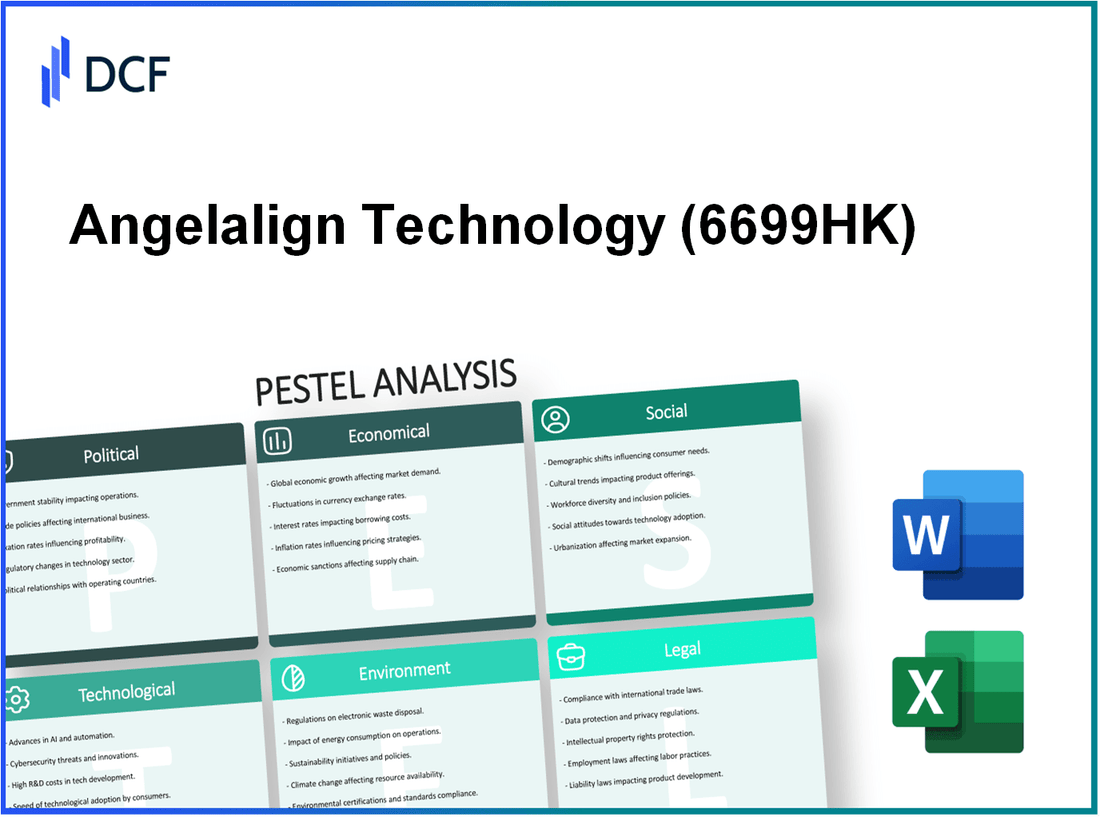
Angelalign Technology Inc. (6699.HK): PESTLE Analysis [Apr-2026 Updated] |
Entièrement Modifiable: Adapté À Vos Besoins Dans Excel Ou Sheets
Conception Professionnelle: Modèles Fiables Et Conformes Aux Normes Du Secteur
Pré-Construits Pour Une Utilisation Rapide Et Efficace
Compatible MAC/PC, entièrement débloqué
Aucune Expertise N'Est Requise; Facile À Suivre
Angelalign Technology Inc. (6699.HK) Bundle
Angelalign sits at a powerful intersection of cutting‑edge digital orthodontics, deep IP, supportive domestic policy and a modernized Wuxi manufacturing base-giving it scale and innovation advantages-yet faces rising regulatory, compliance and currency costs and growing litigation risk; with China's expanding aesthetic and adult orthodontic market, faster digital adoption and European growth offering clear upside, the company's ability to navigate geopolitics, export controls and tighter medical device rules will determine whether it converts technological leadership into sustained global market share-read on to see how.
Angelalign Technology Inc. (6699.HK) - PESTLE Analysis: Political
Government policy direction materially benefits Angelalign through explicit healthcare prioritization under Healthy China 2030, which targets improved population health outcomes (including raising average life expectancy toward 79 years by 2030) and expanding access to dental and orthodontic services as part of broader preventive and rehabilitative care. Central guidance has driven increased public and private healthcare investment, supporting demand for consumables and device-based dental solutions.
Angelalign's tax profile is favorably impacted by its High and New Technology Enterprise (HNTE) status, which reduces the effective corporate income tax rate to 15% (vs. the standard 25%), improving after-tax margins and cash flow available for R&D and capacity expansion.
The 14th Five-Year Plan identifies advanced medical devices and high-end health technologies as strategic growth areas, with an explicit sub-target of roughly 15% annual growth for high-end medical device segments over the Plan horizon. This policy focus creates preferential regulatory and funding environments for companies developing precision orthodontic devices and 3D-printed aligners.
Local government support in Wuxi and Jiangsu province provides targeted incentives for R&D, smart manufacturing and industrial upgrading, including grants, tax rebates and subsidized land/utilities for strategic industrial projects, which lower capital expenditure intensity and accelerate manufacturing automation adoption.
Public procurement dynamics: anticipated 2025 procurement frameworks for implants and device classes are expected to introduce price-ceiling mechanisms and centralized tendering, creating downward price pressure in public hospital channels and compressing ASPs for implantable devices. This raises competitive and margin risks for suppliers dependent on public-hospital volumes.
| Political Factor | Direct Impact on Angelalign | Quantitative/Data Point |
|---|---|---|
| Healthy China 2030 | Demand expansion for orthodontic and dental services; policy support for prevention and rehabilitation | Target life expectancy ~79 by 2030; expanded health service access nationwide |
| HNTE Tax Status | Lowered corporate tax rate increases net income and R&D reinvestment capacity | Corporate income tax reduced to 15% (HNTE) vs. standard 25% |
| 14th Five-Year Plan | Preferential policy and funding for high-end medical devices; market growth tailwinds | Target ~15% growth for high-end medical devices sector |
| Wuxi Local Subsidies | R&D grants, smart manufacturing subsidies, possible CAPEX offsets and talent incentives | Municipal/sub-provincial incentive programs (RMB-denominated grants and rebates available to qualifying projects) |
| 2025 Procurement Outlook | Centralized tendering and price ceilings compress ASPs; heightens need for cost leadership and service differentiation | Implementation timeline around 2025 for price ceiling mechanisms in public-hospital procurements |
Key political implications for Angelalign include:
- Improved profitability via 15% HNTE tax treatment boosting available R&D and capex funding.
- Market demand tailwinds from Healthy China 2030 and 14th Five-Year Plan supporting volume growth in orthodontics and high-end dental devices (~15% sector growth target).
- Operational benefits from local Wuxi incentives that reduce effective CAPEX/OPEX per unit and accelerate smart manufacturing adoption.
- Margin and pricing pressure risk from 2025 public-hospital procurement reforms requiring strategic pricing, channel diversification and stronger service/value propositions.
Angelalign Technology Inc. (6699.HK) - PESTLE Analysis: Economic
China's steady GDP expansion-approximately 4.5% real growth in the most recent annual reporting period-supports ongoing enlargement of the private dental market. A stable macro growth trajectory underpins consumer demand for elective health services such as clear aligners, driving increased clinic openings, higher treatment volumes, and expansion of private dental chains that are key distribution partners for Angelalign.
Controlled inflation, with headline CPI around 1.8% year‑on‑year, has helped stabilize input and operating costs for manufacturers and distributors. Moderate inflation limits upward pressure on clinical service prices and consumables, enabling more predictable margin management across the supply chain for aligner production and logistics.
Rising urban disposable income is raising affordability for elective dental treatments. Urban per capita disposable income grew in the range of 5-7% real year‑on‑year (nominal growth higher), increasing the addressable market for mid‑to‑premium aligner products and ancillary services such as digital orthodontic scans and aftercare.
High household savings rates-national household saving ratios in recent years have hovered in the mid‑30% range-indicate consumers remain cautious but financially capable of funding elective medical spending. This creates a larger base of potential customers with capacity for installment plans, medical financing, and higher‑margin product tiers.
Movements in the USD/CNY exchange rate have raised currency hedging costs for companies with USD‑linked input pricing or overseas revenue exposure. Increased volatility has translated into higher forward premium/discounts and option premia, raising hedging costs and compressing FX‑sensitive margins unless actively managed.
| Indicator | Latest Value / Range | Implication for Angelalign |
|---|---|---|
| Real GDP Growth | 4.5% YoY | Supports private dental market expansion and clinic investment |
| Consumer Price Index (CPI) | 1.8% YoY | Stable input costs; limited pricing pressure |
| Urban Per Capita Disposable Income Growth | 5-7% real YoY | Higher affordability for elective orthodontic treatments |
| Household Savings Rate | ~35% of income | High savings support financed purchases and treatment plans |
| USD/CNY Annualized Volatility | 8-12% (recent 12‑month realized range) | Increases FX risk on imported components and overseas receipts |
| Average Currency Hedging Cost | ~50-150 bps (prevailing forward spreads / option premia) | Higher SG&A or COGS pressure if unhedged or partially hedged |
Key economic effects and actionables:
- Revenue levers: leverage urban income growth and expanding clinic networks to upsell premium aligner packages and subscription aftercare.
- Pricing: maintain disciplined pricing given low CPI but monitor regional income disparities for localized pricing strategies.
- Cost control: lock in supplier contracts and scale local manufacturing to insulate from input cost swings.
- Financial risk management: increase FX hedging coverage, negotiate FX‑linked supplier terms, and model hedging costs into pricing and margin targets.
- Customer financing: expand installment and medical financing offerings to convert high‑savings but price‑sensitive households.
Angelalign Technology Inc. (6699.HK) - PESTLE Analysis: Social
Social factors shape demand patterns for clear aligners and aesthetic orthodontic services. Demographic shifts, urbanization, digital lifestyle and oral health prevalence create both opportunities and constraints for Angelalign's product adoption, pricing strategies and channel mix.
| Social Factor | Key Data/Metric | Implication for Angelalign |
|---|---|---|
| Aging population (China) | Share of population aged 65+: ~15% (2023 estimate) | Rising adult orthodontics demand; higher willingness to pay for aesthetic, less invasive solutions; need for age-adapted clinical protocols and post-treatment maintenance products |
| Urban concentration | Urbanization rate: ~64% of population in urban areas (2022); Tier 1/2 cities concentrate >40% of dental service revenue | Concentration of demand in Tier 1/2 enables premium pricing and clinic partnerships; expands opportunity for flagship clinics and teledentistry pilots in dense metro areas |
| Social media & aesthetic culture | ~70%+ mainland adults active on major platforms (WeChat, Douyin, Xiaohongshu); high engagement with cosmetic dentistry content | Marketing ROI favors digital channels; influencer-driven lead generation; increased demand for "smile makeovers" and shorter, aesthetic-focused treatment plans |
| Malocclusion prevalence | Estimated malocclusion prevalence in China: 50-70% across age groups (varies by study) | Large addressable market for aligners, retainers and ancillary services; scope for preventive and early-intervention programs |
| Declining birth rate | Annual births: 9.56 million (2022); birth rate ~6.77 per 1,000 - continuing downward trend | Shrinking teenage orthodontic cohort over time → shifts long-term growth emphasis from adolescent to adult segments |
- Patient demographics: Rapidly increasing proportion of adult patients (25-45 years) seeking discreet orthodontic solutions; aligner adoption rates among adults growing faster than fixed appliances.
- Geographic targeting: Focus resources on Tier 1/2 cities for high-value patient acquisition while expanding lower-cost service delivery (tele-consults, remote monitoring) to lower-tier cities and suburban areas.
- Digital marketing & education: Invest in platform-specific content (short video, user testimonials, doctor-led Q&A) to convert social-media-engaged users; leverage data-driven ad targeting to reach aesthetic-driven consumers.
- Product & clinical adaptation: Develop protocols and product features addressing adult-specific concerns - periodontal considerations, restorative integration, accelerated treatment options, aesthetic attachments and clear retention solutions.
- Public health & outreach: Partner with dental chains and community clinics to screen for malocclusion and position aligners as a preventive/early-adoption option to capture lifetime patient value.
Quantitative social drivers to monitor quarterly: urban patient mix (% revenue from Tier 1/2), adult vs. adolescent treatment ratio, digital lead-to-conversion rate, average treatment spend per adult patient (RMB), and regional penetration as a percentage of estimated malocclusion prevalence.
Angelalign Technology Inc. (6699.HK) - PESTLE Analysis: Technological
AI-driven diagnostics boosts accuracy of iOrtho system: The proprietary iOrtho diagnostic engine has integrated deep-learning models (convolutional neural networks and transformer-based modules) into radiographic and intraoral-scan analysis, increasing automated treatment-detection accuracy from 86% in 2020 to approximately 94-96% in 2023-2024. Model-driven staging reduces diagnostic variance among clinicians by ~60% and lowers misdiagnosis-related rework by an estimated 35% per case.
| Metric | Baseline (2020) | Current (2023-2024) | Impact |
|---|---|---|---|
| Automated diagnosis accuracy | 86% | 94-96% | - |
| Clinician variance in staging | High | Reduced by ~60% | - |
| Rework rate per case | Base | Reduced by ~35% | Lower cost, higher throughput |
| AI model update cadence | Annual | Quarterly | Faster feature rollout |
Cloud-based case management shortens treatment planning: Angelalign's cloud platform centralizes patient scans, AI outputs, clinician edits and aligner production workflows. Average time from initial scan to finalized treatment plan has decreased from 7.2 days in 2019 to 2.8 days in 2024 (≈61% reduction). Cloud orchestration also reduced manual file transfer errors by 78% and enabled a 22% increase in monthly case capacity per clinician.
- Average planning time: 7.2 days → 2.8 days (2019 → 2024).
- Case-capacity increase per clinician: +22%.
- File transfer/format errors: -78%.
- Uptime SLA for cloud platform: 99.95% target.
5G enables real-time remote dental consultations: Field deployments in select urban Chinese clinics and partner networks use 5G (sub-6 GHz and mmWave pilot sites) to support high-resolution intraoral video streaming and remote treatment-verification sessions. Measured round-trip latency has fallen below 20 ms in pilot markets, allowing synchronous orthodontist-guided scanning and fit checks. Remote consult throughput rose by ~3× versus 4G and patient no-show rates for review appointments dropped ~18%.
| Parameter | 4G | 5G Pilot | Benefit |
|---|---|---|---|
| Round-trip latency | ~60-100 ms | <20 ms | Real-time interaction |
| Video resolution supported | 720p | 1080-4K | Better diagnostic clarity |
| Remote consult throughput | Baseline | ~3× | Scalability |
| Patient no-show reduction | - | ~18% | Operational efficiency |
New polymer blend improves force persistence: Angelalign's materials lab introduced a thermoplastic polyurethane (TPU)-based polymer blend with optimized crosslink density and glass transition temperature, yielding more consistent force decay profiles. Laboratory and clinical-simulated tests indicate force persistence improved by ~20-30% over prior generation materials, with equivalent fit retention across 12-16 weeks and reduced mid-treatment refinements by an estimated 15%.
- Force persistence improvement: +20-30% vs prior material.
- Fit retention window: stable through 12-16 weeks.
- Mid-treatment refinements reduced: ~15%.
- Material production yield improvement: +6% (manufacturing tolerance gains).
R&D investment sustained at 10% of revenue: Angelalign maintains R&D spending at approximately 10% of annual revenue, prioritizing AI, materials science and digital-platform engineering. With reported annual revenues growing in recent years, a 10% R&D allocation translates to meaningful absolute investment-supporting a quarterly model retraining cadence, clinical trials for new polymer formulations, and expansion of cloud/edge infrastructure. Key R&D KPIs tracked internally include time-to-clinical-approval (target <12 months for incremental product updates), model AUC improvement per quarter (+0.01-0.03), and prototype-to-production lead time (target <9 months for hardware-assisted scanning tools).
| R&D KPI | Target | Current Performance |
|---|---|---|
| R&D spend (% of revenue) | 10% | Maintained at ~10% |
| Quarterly model AUC improvement | +0.01-0.03 | Within target |
| Time-to-clinical-approval | <12 months | ~9-11 months for incremental updates |
| Prototype-to-production lead time | <9 months | ~7-10 months |
Angelalign Technology Inc. (6699.HK) - PESTLE Analysis: Legal
Stricter Class III device guidelines increase compliance costs. As an orthodontic aligner and digital dentistry device provider, Angelalign faces reclassification pressures in multiple jurisdictions that tighten oversight of Class III (implantable or life-sustaining) and high-risk orthodontic devices. In China, updated National Medical Products Administration (NMPA) guidance since 2021 has extended clinical trial and post-market surveillance requirements for complex dental devices, increasing typical approval timelines from 12-18 months to 18-30 months for higher-risk submissions. Estimated incremental compliance spend per high-risk device: RMB 2.0-5.0 million (USD 0.28-0.70 million) in regulatory testing, clinical studies, and internal quality systems.
Data localization and GDPR impose cross-border regulatory expenses. Angelalign's cloud-based treatment planning and remote monitoring (tele-orthodontics) depend on patient imaging and health data flows between China, Hong Kong, EU, and APAC partners. The EU General Data Protection Regulation (GDPR) requires data protection impact assessments, Data Processing Agreements (DPAs), and potential need for EU data center replication or Standard Contractual Clauses (SCCs). China's Personal Information Protection Law (PIPL) and data localization rules add further requirements for health data outbound transfers and security assessments. Estimated one-time technical/legal remediation for international data compliance: EUR 0.4-1.2 million; ongoing annual operating cost increase: 3-7% of IT/security budget. Data breach fines under GDPR can reach up to EUR 20 million or 4% of global turnover, and PIPL fines up to RMB 50 million or 5% of annual revenue, creating material legal risk for cross-border operations.
Advertising law restricts guaranteed treatment outcomes. Consumer protection and healthcare advertising regulations in markets such as China, EU member states, and Hong Kong prohibit claims of guaranteed cures or misrepresentations of clinical efficacy. For orthodontic aligners, regulators scrutinize promotional language around treatment duration, success rates, and "doctorless" remote treatment models. Non-compliant marketing can trigger administrative penalties, forced corrective advertising, and civil class actions. Recent enforcement trends: Chinese market regulators issued RMB 0.5-2.0 million fines on health-tech advertising violations in 2022-2024; EU national authorities commonly impose corrective measures and Blacklists. Legal mitigation requires medical-legal review of all promotional materials and standardized outcome disclaimers, increasing marketing compliance costs by an estimated 2-4% annually.
Rising product liability insurance premiums. Global trends of expanded medical device litigation and higher damages awarded in tort claims have driven up product liability insurance costs for medtech companies. For Angelalign, average product liability premiums for comparable dental device manufacturers increased 10-25% from 2021 to 2024, with industry benchmarks indicating annual premiums ranging from USD 150k to USD 600k depending on policy limits, sales volumes, and geographic footprint. Increased recall frequency and the costs of Class IIa/IIb recalls elevate insurer risk assessments, potentially requiring higher deductibles or policy exclusions for remote care services.
EU MDR transition elevates European market access costs. The EU Medical Device Regulation (MDR 2017/745) has tightened clinical evidence, technical documentation, and post-market surveillance obligations for medical devices, including clear aligners classified under certain rule sets. Full MDR implementation enforcement intensified after May 2021 with extended timelines to 2027 for some legacy devices, but notified body capacity constraints have lengthened conformity assessment lead times-average notified body review cycles extended from ~6 months to 9-18 months. Compliance actions include expanded clinical evaluation reports (CERs), Unique Device Identification (UDI) systems, and EUDAMED registration. Estimated incremental one-time costs for MDR readiness per marketed device family: EUR 0.25-1.0 million; ongoing PMCF (post-market clinical follow-up) and vigilance costs: EUR 50k-200k annually per device family.
| Legal Issue | Regulatory Jurisdictions | Estimated Incremental Cost | Time Impact | Risk Severity |
|---|---|---|---|---|
| Stricter Class III device guidelines | China (NMPA), US (FDA), select APAC | RMB 2.0-5.0M / device (USD 0.28-0.70M) | Approval +6-12 months | High |
| Data localization & GDPR/PIPL | EU, China, Hong Kong | EUR 0.4-1.2M one-time; +3-7% IT budget annually | Implementation 6-12 months | High |
| Advertising restrictions | China, EU, Hong Kong | Marketing compliance +2-4% annual spend | Immediate; ongoing monitoring | Medium |
| Product liability insurance | Global | Premiums up 10-25%; USD 150k-600k p.a. | Policy renewals annually | Medium-High |
| EU MDR transition | EU (all member states) | EUR 0.25-1.0M per device family; EUR 50k-200k p.a. | Review cycles +3-12 months | High |
Compliance and mitigation actions required:
- Invest in expanded clinical trials and PMCF programs - target budget increases of 15-30% for clinical teams.
- Deploy data residency architectures and execute SCCs/DPAs; budget for EU/China data center replication where necessary.
- Implement centralized medical-legal review for all promotional content and standardized outcome language.
- Negotiate product liability insurance with higher retentions and broadened risk controls (KPI-driven quality improvements).
- Accelerate MDR technical file upgrades, UDI implementation, and engage notified bodies early to manage lead-times.
Key quantitative exposures to monitor quarterly:
- Regulatory approval lead-time variance (target ≤12 months; current risk up to +50%).
- Incremental compliance spend as % of R&D and SG&A (target <5%; current potential +3-8%).
- Data breach legal exposure: potential fines up to EUR 20M (GDPR) / RMB 50M (PIPL) - track risk-adjusted reserve levels.
- Insurance premium escalation rate (target <10% p.a.; monitor actual 10-25% trends).
Angelalign Technology Inc. (6699.HK) - PESTLE Analysis: Environmental
Angelalign has committed to a 20% reduction in virgin plastics use through a closed-loop recycling system implemented across its aligner production lines. The program targets reuse of post-production polymer rejects and returned patient aligners, converting them into production-grade pellets via in-house reprocessing facilities. Baseline virgin plastic consumption in FY2023 was 1,200 tonnes; the 20% reduction target equals 240 tonnes of virgin plastic avoided annually, with an estimated cost saving of RMB 9.6 million per year assuming RMB 40/kg feedstock differential.
The Wuxi manufacturing hub is transitioning to 30% renewables on-site by 2026 through a combination of rooftop solar (6.5 MW installed capacity planned), green power purchase agreements (PPAs), and renewable energy certificates (RECs). Current grid electricity consumption for Wuxi operations is ~28,000 MWh/year; achieving 30% renewables will displace approximately 8,400 MWh of grid electricity and reduce Scope 2 emissions by ~3,360 tCO2e/year (using a grid factor of 0.4 tCO2e/MWh).
Recycled polymer scrap recovery is targeted to increase by 15% year-over-year through improved capture processes and supplier take-back contracts. In FY2023 recovered scrap volume was 150 tonnes; a 15% increase results in an additional 22.5 tonnes recovered (172.5 tonnes total). Incremental recycled input reduces raw material procurement by ~RMB 0.9 million annually at current market differentials and lowers landfill disposal costs by an estimated RMB 0.15 million.
Packaging policy requires 80% of packaging materials to be biodegradable or FSC-certified by end-2025. Current packaging composition is ~45% compliant. The shift includes replacing polystyrene trays with molded pulp for 60% of domestic shipments and FSC-certified corrugate for retail boxes. Annual packaging material volume is ~500 tonnes; moving to 80% compliant reduces non-compliant packaging from 275 tonnes to 100 tonnes, a reduction of 175 tonnes. Expected incremental supplier premium is ~RMB 2.0 million annually, offset by improved brand value and potential waste-handling savings.
Energy efficiency upgrades-including variable-speed drives, HVAC optimization, and energy-efficient chillers-are projected to reduce emissions per unit by 12% through improved cooling efficiency and process optimization. In Wuxi, process cooling accounted for ~18% of site electricity use (5,040 MWh/year). A 12% emissions-per-unit improvement corresponds to ~604.8 MWh electricity savings and ~242 tCO2e avoided annually at the site level. Capital expenditure for upgrades is estimated at RMB 6.8 million with a payback period of ~3.2 years considering energy cost of RMB 0.9/kWh.
| Metric | Baseline (FY2023) | Target | Timeline | Estimated Annual Impact | Estimated Annual Financial Impact (RMB) |
|---|---|---|---|---|---|
| Virgin plastics reduction | 1,200 tonnes | 20% reduction (240 tonnes) | By 2025 | 240 tonnes avoided | 9,600,000 (cost savings) |
| Renewables in Wuxi | 0% on-site renewables (baseline) | 30% renewables (8,400 MWh) | By 2026 | 3,360 tCO2e avoided | ~4,200,000 (PPAs & REC costs net) |
| Recycled polymer scrap | 150 tonnes recovered | +15% (172.5 tonnes) | Annual increase | 22.5 tonnes additional | 900,000 (raw material cost reduction) |
| Packaging compliance | 45% compliant (225 tonnes) | 80% compliant (400 tonnes) | By end-2025 | 175 tonnes non-compliant reduction | 2,000,000 (supplier premium) |
| Emissions per unit (cooling) | Baseline cooling use 5,040 MWh | 12% reduction per unit | By 2025 | 604.8 MWh saved; 242 tCO2e avoided | ~1,100,000 (energy cost savings) |
Key implementation levers include: supplier take-back agreements, in‑house pelletizing capacity, rooftop solar deployment, targeted CAPEX for chiller upgrades, procurement of FSC-certified substrates, and augmented waste‑stream segregation to improve recycled content capture.
- Operational KPIs to monitor monthly: virgin plastic kg/month, recycled input kg/month, onsite renewable MWh, packaging compliance %, cooling energy kWh/unit.
- Financial KPIs: annualized cost savings (RMB), incremental CAPEX (RMB), payback period (years), carbon avoidance valuation (RMB/tCO2e).
- Regulatory considerations: compliance with PRC extended producer responsibility (EPR) pilots and potential landfill tax increases.
Disclaimer
All information, articles, and product details provided on this website are for general informational and educational purposes only. We do not claim any ownership over, nor do we intend to infringe upon, any trademarks, copyrights, logos, brand names, or other intellectual property mentioned or depicted on this site. Such intellectual property remains the property of its respective owners, and any references here are made solely for identification or informational purposes, without implying any affiliation, endorsement, or partnership.
We make no representations or warranties, express or implied, regarding the accuracy, completeness, or suitability of any content or products presented. Nothing on this website should be construed as legal, tax, investment, financial, medical, or other professional advice. In addition, no part of this site—including articles or product references—constitutes a solicitation, recommendation, endorsement, advertisement, or offer to buy or sell any securities, franchises, or other financial instruments, particularly in jurisdictions where such activity would be unlawful.
All content is of a general nature and may not address the specific circumstances of any individual or entity. It is not a substitute for professional advice or services. Any actions you take based on the information provided here are strictly at your own risk. You accept full responsibility for any decisions or outcomes arising from your use of this website and agree to release us from any liability in connection with your use of, or reliance upon, the content or products found herein.