

|
Alibaba Group Holding Limited (BABA): VRIO Analysis [Mar-2026 Updated] |
Entièrement Modifiable: Adapté À Vos Besoins Dans Excel Ou Sheets
Conception Professionnelle: Modèles Fiables Et Conformes Aux Normes Du Secteur
Pré-Construits Pour Une Utilisation Rapide Et Efficace
Compatible MAC/PC, entièrement débloqué
Aucune Expertise N'Est Requise; Facile À Suivre
Alibaba Group Holding Limited (BABA) Bundle
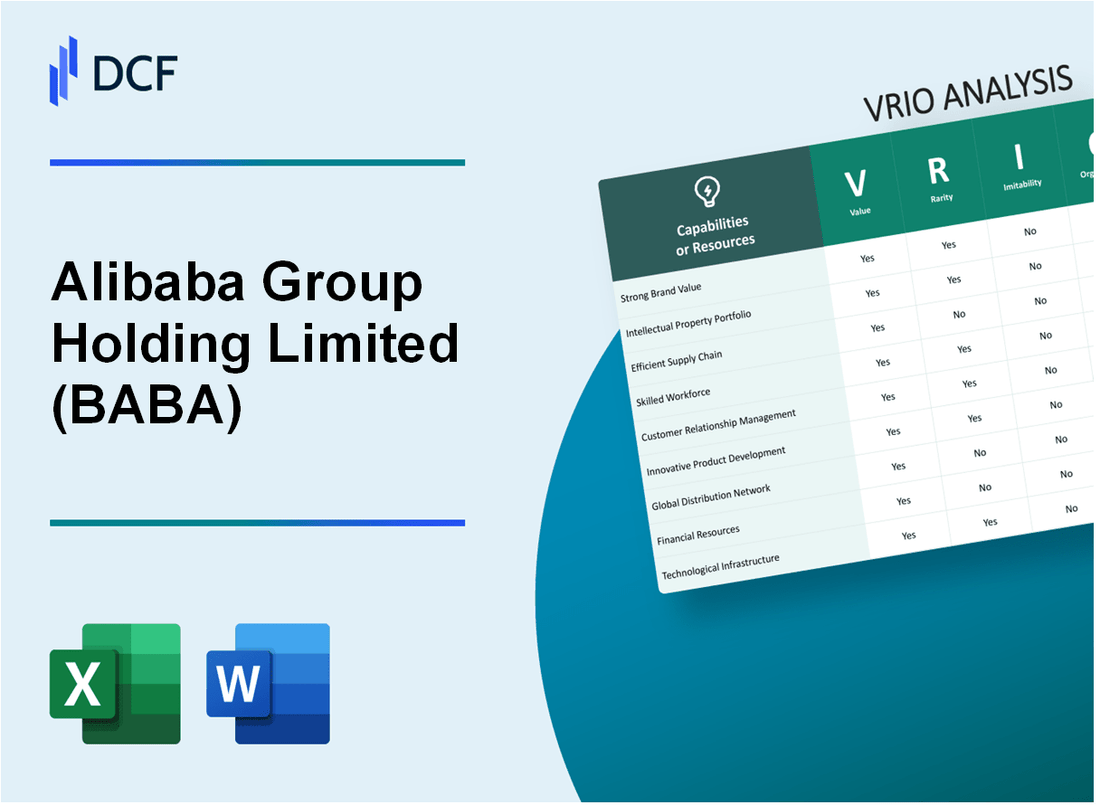
Unlocking the secret to Alibaba Group Holding Limited (BABA)'s long-term success hinges on its core resources. This VRIO analysis, distilled in the key takeaways of &O4&, rigorously tests its Value, Rarity, Inimitability, and Organization to determine its true competitive edge. Dive in now to see precisely where Alibaba Group Holding Limited (BABA) stands against the competition.
Alibaba Group Holding Limited (BABA) - VRIO Analysis: 1. AI-Driven Cloud Intelligence Group Dominance
You’re looking at the engine room of Alibaba Group Holding Limited’s future growth, and frankly, the numbers from the September 2025 quarter are compelling. The Cloud Intelligence Group isn't just growing; it's accelerating and is now the clear domestic leader in the AI infrastructure race. This segment’s performance is the key to understanding BABA’s next chapter.
Value: Core Growth Engine with AI Fuel
The Cloud Intelligence Group is delivering tangible, high-velocity revenue, making it the company’s primary growth driver. For the quarter ending September 30, 2025, this segment posted revenue of RMB 39.82 billion, reflecting a strong 34% year-on-year increase. This growth is directly tied to the increasing adoption of AI-related products, which have now seen triple-digit expansion for nine consecutive quarters. That kind of top-line momentum is what institutional investors look for when assessing long-term enterprise value.
Here’s the quick math on its growing importance:
- Cloud revenue share of total group revenue increased from 12.5% to 16.1% in one year.
- AI-related products are contributing an expanding share of external customer revenue.
- The segment’s performance is offsetting weaker areas in the broader group.
Rarity: Dominant Market Position
Rarity in this space isn't about having a cloud; it’s about having the scale to compete on AI infrastructure, and Alibaba has that rare position in Mainland China. The company commands a 35.8% market share in China's cloud sector, which is a rare feat, as this share exceeds the combined total of its next three competitors. Few, if any, domestic players possess this combination of established infrastructure scale and deep, proprietary AI model integration, such as the Qwen large language model (LLM).
Imitability: High Barrier to Entry
Trying to replicate this advantage is incredibly expensive and time-consuming. Imitation is difficult because it requires massive, sustained capital expenditure (CapEx) and deep, proprietary R&D in foundational models. Over the last four quarters leading up to the September 2025 quarter, Alibaba deployed roughly 120 billion yuan specifically toward AI and cloud infrastructure. Furthermore, the company has announced plans to invest 380 billion yuan in AI and cloud infrastructure over the next three years, suggesting the current pace is seen as necessary, not optional. What this estimate hides is the sunk cost in talent acquisition and model training that took years to build.
Organization: Aggressive Strategic Alignment
The organization is clearly structured around maximizing this advantage. Alibaba is aggressively prioritizing and investing capital into this segment as its primary future focus, even at the expense of short-term profitability. The CFO even suggested the initial 380 billion yuan investment plan might be insufficient to meet customer demand. This level of commitment signals that resources, from executive attention to free cash flow, are being channeled here.
Here is a breakdown of the competitive assessment:
| VRIO Dimension | Assessment | Key Supporting Data (2025 Fiscal) |
| Value | Yes | 34% YoY Cloud Revenue Growth in Q3 2025; Revenue of RMB 39.82 billion. |
| Rarity | Yes | 35.8% market share in Mainland China's cloud sector. |
| Inimitability | Difficult | Approx. 120 billion yuan CapEx deployed over the last four quarters for AI/Cloud. |
| Organization | High | Aggressive 380 billion yuan three-year investment plan announced. |
| Competitive Advantage | Sustained | Market leadership combined with full-stack AI integration (e.g., Qwen LLM). |
The combination of market leadership, massive CapEx barriers, and clear organizational focus points toward a Sustained Competitive Advantage. The moat is being actively deepened right now, not just maintained. If onboarding takes 14+ days for new enterprise AI clients, churn risk rises, but the current growth suggests fulfillment is keeping pace with demand.
Finance: draft 13-week cash view by Friday, specifically modeling the impact of the accelerated AI CapEx run-rate.
Alibaba Group Holding Limited (BABA) - VRIO Analysis: 2. Massive Domestic E-commerce User Base & Monetization
Value: Provides a stable, high-volume revenue base from Taobao and Tmall, with customer management revenue growing 12% in the March 2025 quarter.
The core domestic e-commerce segment demonstrated sustained monetization effectiveness in the quarter ended March 31, 2025.
| Metric | Value (RMB) | Value (USD) | Year-over-Year Change |
| Customer Management Revenue (TTG) | 71,077 million | 9,794 million | +12% |
| China Commerce Retail Revenue | 95,581 million | 13,171 million | +8% |
| 88VIP Members (as of March 2025) | Surpassing 50 million | N/A | Double digits |
Rarity: No; while large, scale is not unique, but the depth of merchant/user data is hard to match domestically.
The scale of the user base provides a foundation for data-driven monetization strategies.
- Taobao and Tmall had monthly active users (MAUs) of over 800mn.
- The 88VIP membership base, representing the highest spending cohort, grew to over 50 million in the March 2025 quarter.
Imitability: Moderate; competitors like JD.com and Pinduoduo are strong, but replicating the sheer user count takes time.
The established network effect and accumulated user data present a significant barrier to immediate replication by rivals.
- The user base size, with over 800mn MAUs, represents years of network effect accumulation.
- Customer management revenue growth of 12% in the March 2025 quarter indicates continued monetization power over this base.
Organization: Moderate; the focus is shifting to user experience to defend against aggressive competition, showing organizational adaptation.
Organizational efforts are directed towards enhancing the value proposition for both consumers and merchants to maintain engagement.
- Customer management revenue growth was supported by the impact of software service fees and increasing penetration of the AI-powered marketing tool, Quanzhantui.
- Investments in user growth and experience drove growth in new consumers and order volume for Taobao and Tmall Group (TTG).
Competitive Advantage: Temporary; it's a strong position, but intense competition means this advantage needs constant, costly defense.
The advantage is sustained by ongoing, significant investment, as evidenced by the increased focus on user experience and AI-driven tools.
Alibaba Group Holding Limited (BABA) - VRIO Analysis: 3. Global Logistics Network (Cainiao)
Value
Enables competitive cross-border and domestic fulfillment. Cainiao achieved annual revenue of 101,272 billion yuan in the fiscal year ended March 31, 2025, driven by its international logistics business, supporting the entire ecosystem.
Rarity
Yes; the scale of its global e-Hubs and its long-standing goal for global deliveries within 72 hours is unique among Chinese tech firms. The network covers nearly 200 countries and regions, with deep operations in 50 countries.
Imitability
High; building out physical assets like overseas warehouses and autonomous vehicle fleets is capital-intensive and slow. The infrastructure scale is significant:
| Asset Category | Metric | Data Point |
| Global Reach | Countries/Regions Covered | Nearly 200 |
| Sorting Infrastructure | Overseas Sorting Centers | 18 |
| Warehousing | Overseas Warehouses (Number) | Over 40 |
| Warehousing | Cross-border Logistics Warehouse Area | Exceeding 3 million square meters |
| Air Freight Capacity | Chartered Flights/Space Weekly | Approximately 170 |
| Volume Handled | Daily Cross-border/International Packages (FY2024) | Over 5 million |
Organization
High; the 2025 restructuring clarified its mandate to focus purely on logistics operations and scaling assets globally. This involved a strategic shift:
- The objective was to become a 'real logistics company, one that focused on logistics operations.'
- Logistics teams servicing AliExpress and domestic supply chain solutions were transitioned to the Alibaba Ecommerce Business Group and Taobao and Tmall Group, respectively.
- This move positioned Cainiao to concentrate on scaling its logistics assets and expanding its global reach, with internationalization and technology as core development directions.
Competitive Advantage
Sustained; logistics infrastructure is a physical barrier to entry that few can overcome quickly. The network includes e-Hubs in strategic locations such as Liège, Kuala Lumpur, and Hong Kong, integrating cargo terminals, customs clearance, and sorting functions.
Alibaba Group Holding Limited (BABA) - VRIO Analysis: 4. International Digital Commerce Reach (AIDC)
Value: Provides crucial diversification, with Alibaba International Digital Commerce Group (AIDC) revenue growing 29% to RMB 132.3 billion in FY 2025.
Rarity: Moderate; while many firms are global, AIDC's specific strength in key regions like Europe and the Gulf is noteworthy.
Imitability: Moderate; establishing local supply chains and brand trust (like AliExpress Choice) is a slow, localized process.
Organization: High; the segment is clearly focused on improving unit economics and driving profitable growth internationally.
Competitive Advantage: Temporary; growth is fast, but profitability remains a challenge against well-funded rivals.
The operational focus on efficiency within AIDC is evidenced by recent financial performance:
| Metric | Latest Reported Quarter (Q2 FY2026, ended Sept 30, 2025) | Previous Year Quarter (Q2 FY2025, ended Sept 30, 2024) |
|---|---|---|
| AIDC Revenue | RMB 34.8 billion (approx. $4.89 billion) | RMB 31.6 billion (approx. $4.43 billion, calculated from 10% growth) |
| Revenue Growth (YoY) | 10% | N/A |
| Adjusted EBITA | RMB 162 million (approx. $23 million) | Loss of RMB 2.91 billion (approx. $400 million) |
| AliExpress Choice Unit Economics | Continued improvement | Improved on a sequential basis (as of Q ended Dec 31, 2024) |
Key operational and geographic reach statistics include:
- AliExpress covered over 200 countries and regions worldwide as of March 31, 2025.
- AIDC continued to invest in select European markets and the Gulf region to acquire users as of the quarter ended December 31, 2024.
- The segment narrowed its loss to approach breakeven in the quarter ended June 30, 2025.
Alibaba Group Holding Limited (BABA) - VRIO Analysis: 5. Proprietary AI Foundation Models (Qwen)
The Qwen family of proprietary AI Foundation Models represents a critical component of Alibaba's future strategy, leveraging significant investment and rapid adoption to build competitive barriers.
The Qwen models are central to the AI-driven strategy, evidenced by substantial financial acceleration within the Cloud Intelligence Group.
- Cloud revenue for the quarter ending September 2025 surged by 34% year-over-year, reaching 39.8 billion yuan.
- Revenue from external cloud customers increased by 29% year-over-year in the same quarter.
- AI-related product revenue has sustained triple-digit year-on-year growth for nine consecutive quarters.
The commitment to a fully open-sourced, full-stack model suite of Qwen's performance level is rare outside of a few global technology leaders, demonstrated by its rapid uptake.
| Metric | Data Point |
|---|---|
| Enterprise Adoptions (Model Studio) | Over 90,000 since launch. |
| DingTalk Corporate Users | Over 2.2 million accessing Qwen-powered services. |
| Open-Source Downloads (Total) | Over 600 million downloads for the Qwen family. |
| Code Generation Market Share (Qwen3-Coder) | Captured 20.7% of OpenRouter market share within weeks of launch. |
Developing state-of-the-art foundation models requires immense, specialized talent and compute power, reflected in Alibaba's capital commitments.
- Alibaba pledged to invest at least 380 billion yuan over three years in advancing its cloud computing and AI infrastructure.
- The Qwen series includes models ranging from 0.5 billion to 110 billion parameters.
- The company has fostered an ecosystem through ModelScope, which now serves over 18 million users and hosts 100,000 models.
The company is clearly aligning its entire strategy around the deployment and adoption of Qwen, integrating it across its ecosystem.
- The Qwen family is the bedrock of Alibaba Cloud's Model-as-a-Service (MaaS) concept.
- Xiaomi integrated Alibaba Cloud's models into its AI assistant, Xiao Ai, for image generation and comprehension across its latest smartphone range and smart electric vehicle.
- Over 1 million corporate and individual users have used Qwen on Model Studio since its launch.
Proprietary, high-performing, and widely adopted open-source models create a powerful lock-in effect for cloud customers and establish Alibaba as a key player in democratizing AI access.
Alibaba Group Holding Limited (BABA) - VRIO Analysis: 6. Ecosystem Integration & Platform Scale
Value: The unified network of B2B (Alibaba.com), C2C (Taobao), and B2C (Tmall) platforms creates network effects and data synergy.
Rarity: Moderate; while the scale is massive, the integration across these distinct models is what sets it apart from pure-play competitors.
Imitability: High; the trust and transaction history built over two decades across these varied platforms is nearly impossible to replicate.
Organization: Moderate; the focus is on core businesses, but the underlying strength is the interconnectedness of these legacy platforms.
Competitive Advantage: Sustained; the sheer breadth of market coverage across the retail spectrum is a deep, structural advantage.
The scale of the integrated commerce ecosystem is quantified by the following metrics:
| Platform Segment | Metric | Latest Reported Figure |
|---|---|---|
| Taobao and Tmall Group (China Commerce Retail) | Revenue (Q2/26) | RMB 132,578 million |
| Taobao and Tmall Group (China Commerce Retail) | Year-over-Year Revenue Growth (Q2/26) | 15.5% |
| Taobao (C2C/B2C) | Projected Third-Party Sales GMV (2024) | $723.8 billion to $762.0 billion |
| Tmall (B2C) | Projected Third-Party Sales GMV (2024) | $682.7 billion to $714.1 billion |
| Alibaba.com (B2B) | Projected GMV (2024) | $60 billion (up 20% from $50 billion in 2023) |
| Alibaba Ecosystem (Total) | Annual Active Consumers (FY2022) | 1.31 billion |
The interconnectedness drives specific user and growth metrics across the ecosystem:
- Taobao and Tmall’s 88VIP members, a key consumer cohort, reached 46 million as of the quarter ended September 30, 2024.
- The Quick Commerce Business within the China E-commerce Group reported revenue growth of 60% in Q2/26.
- The Alibaba International Digital Commerce Group (AIDC) marketplaces saw combined orders increase by 20% for the quarter ended March 31, 2024.
- AIDC revenue grew 29% year-over-year to RMB 31.7 billion ($4.5 billion) for the quarter ended September 30, 2024.
- Total GMV transacted in the Alibaba Ecosystem was RMB 8,317 billion (US$ 1,312 billion) for fiscal year 2022.
Alibaba Group Holding Limited (BABA) - VRIO Analysis: 7. Aggressive Capital Return Program
Value
The program signals management confidence and targets income-focused investors through substantial capital deployment. For the fiscal year ended March 31, 2025, the company repurchased a total of 1,197 million ordinary shares (equivalent to 150 million ADSs) for a total of US$11.9 billion across U.S. and Hong Kong markets.
| Metric | Amount/Value |
|---|---|
| Total Share Repurchase (FY2025) | US$11.9 billion |
| Ordinary Shares Repurchased (FY2025) | 1,197 million |
| Remaining Repurchase Authorization (as of 3/31/2025) | US$20.1 billion |
| Outstanding Ordinary Shares (as of 3/31/2025) | 18,474 million |
Rarity
While share buybacks are common among large-cap firms, the scale of commitment is notable. The repurchase activity for the full fiscal year ended March 31, 2025, resulted in a 5.1% net reduction in outstanding ordinary shares after accounting for shares issued under the ESOP.
Imitability
This is a financial policy decision supported by significant free cash flow, not an inimitable operational asset or technology. The ability to execute such a program is directly tied to cash richness, which can be matched by cash-rich peers in the sector.
Organization
The execution demonstrates clear financial prioritization, evidenced by the regular declaration and payment of dividends alongside the buybacks. The Board authorized a significant capital return structure, including recent dividend actions:
- Cash Dividend declared for June 2025: $1.03 per ADR.
- Special Cash Dividend declared for June 2025: 95¢ per ADR.
- Latest dividend (HKEX listed) as of December 6, 2025: 1.95 HKD.
Competitive Advantage
The program provides a temporary boost to Earnings Per Share (EPS) and supports the stock price, but it does not fundamentally alter the long-term competitive positioning derived from core business assets like the Taobao or Tmall marketplaces or Alibaba Cloud.
Alibaba Group Holding Limited (BABA) - VRIO Analysis: 8. Quick Commerce Strategic Land Grab
Value: Drives user engagement and stickiness across the core e-commerce apps, with revenue surging 60% year-over-year in Q3 2025.
The segment's revenue reached $3.2 billion in Q3 2025.
| Metric | Value | Period/Context |
|---|---|---|
| Quick Commerce Revenue | $3.2 billion | Q3 2025 |
| Quick Commerce Revenue Growth | 60% | Year-over-Year in Q3 2025 |
| China E-commerce Group Adjusted EBITA Change | -76% | Q3 2025 due to Quick Commerce investment |
| Total Company Income from Operations Change | -85% | Year-over-Year in Q3 2025 |
| Total Company Revenue | $34.8 billion | Q3 2025 |
Rarity: Low; instant retail is a competitive battleground across all major Chinese tech firms right now.
Imitability: Low; competitors are also burning cash to achieve similar speed and scale in this area.
Organization: High; the company is explicitly choosing cash burn now to achieve a target GMV of 1 trillion yuan ($140 billion) in three years.
- The projected annualized incremental Gross Merchandise Value (GMV) target from quick commerce is 1 trillion RMB within the next three years.
- Sales and Marketing (SNM) expenses dramatically increased to RMB 66,496 million in Q3 2025.
- This SNM spend represented 26.8% of revenue in Q3 2025, up from 13.7% the prior year.
- The company announced a commitment of RMB 50 billion ($7 billion) for food delivery and quick commerce subsidies.
- Rival Meituan saw its operating profit drop by 98% in its latest quarter due to competitive spending.
Competitive Advantage: Temporary; this is a pure investment phase where the advantage goes to whoever can sustain the subsidy the longest.
Alibaba Group Holding Limited (BABA) - VRIO Analysis: 9. High Governance Maturity/Financial Discipline
Value: Enhances investor trust and reduces the cost of capital, reflected in a calculated SAAS Integrity Score of 0.86 for FY 2025 reporting. The Weighted Average Cost of Capital (WACC) as of December 05, 2025, was calculated at 7.98%.
| Metric | Value | Period/Date |
|---|---|---|
| Calculated SAAS Integrity Score | 0.86 | FY 2025 Reporting |
| Weighted Average Cost of Capital (WACC) | 7.98% | December 05, 2025 |
| Corporate Governance Rating (Scale 1-5) | 4.6 | vs. Industry Average of 3.2 |
| FY2024 Free Cash Flow | US$21.6 billion | Fiscal Year Ended March 31, 2024 |
| FY2024 Share Repurchases | US$12.5 billion | Fiscal Year Ended March 31, 2024 |
Rarity: Moderate; while not unique, achieving a high score in a complex reporting environment shows strong internal controls. The company achieved a top 5 out of 5 rating in investor communications and rights protection.
Imitability: Moderate; the specific SAAS framework is proprietary, but the underlying discipline can be adopted by others.
Organization: High; the focus on transparency and AI-driven anomaly detection in reporting shows a mature organizational commitment to governance. This commitment is evidenced by:
- Independent Board Members comprising 64% of the board, compared to the 58% industry average.
- Audit and risk oversight controls rated 4/5, above the top quartile industry score.
- AI-related product revenue maintaining triple-digit year-over-year growth for the sixth consecutive quarter as of the quarter ended December 31, 2024.
- Announcement of a total of US$4.6 billion in dividends for fiscal year 2025.
Competitive Advantage: Temporary; strong governance is necessary but rarely a primary driver of market outperformance unless governance failure is a major risk.
Disclaimer
All information, articles, and product details provided on this website are for general informational and educational purposes only. We do not claim any ownership over, nor do we intend to infringe upon, any trademarks, copyrights, logos, brand names, or other intellectual property mentioned or depicted on this site. Such intellectual property remains the property of its respective owners, and any references here are made solely for identification or informational purposes, without implying any affiliation, endorsement, or partnership.
We make no representations or warranties, express or implied, regarding the accuracy, completeness, or suitability of any content or products presented. Nothing on this website should be construed as legal, tax, investment, financial, medical, or other professional advice. In addition, no part of this site—including articles or product references—constitutes a solicitation, recommendation, endorsement, advertisement, or offer to buy or sell any securities, franchises, or other financial instruments, particularly in jurisdictions where such activity would be unlawful.
All content is of a general nature and may not address the specific circumstances of any individual or entity. It is not a substitute for professional advice or services. Any actions you take based on the information provided here are strictly at your own risk. You accept full responsibility for any decisions or outcomes arising from your use of this website and agree to release us from any liability in connection with your use of, or reliance upon, the content or products found herein.