

|
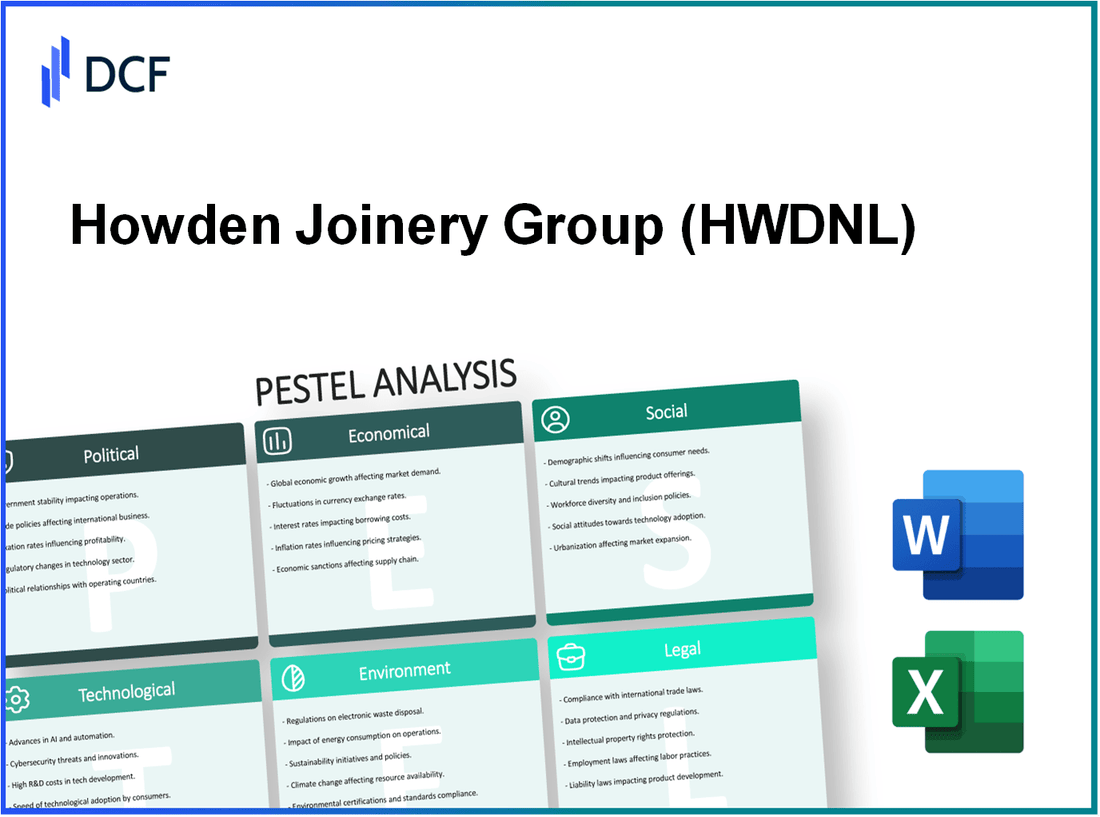
Howden Joinery Group Plc (HWDN.L): PESTLE Analysis [Apr-2026 Updated] |
Entièrement Modifiable: Adapté À Vos Besoins Dans Excel Ou Sheets
Conception Professionnelle: Modèles Fiables Et Conformes Aux Normes Du Secteur
Pré-Construits Pour Une Utilisation Rapide Et Efficace
Compatible MAC/PC, entièrement débloqué
Aucune Expertise N'Est Requise; Facile À Suivre
Howden Joinery Group Plc (HWDN.L) Bundle
Howden Joinery sits at a powerful inflection point-its dense depot network, trade-only model, vertically integrated manufacturing and strong sustainability credentials give it a compelling edge to capture surging renovation and new‑build demand driven by UK housing targets and planning reforms; yet the business must navigate tight labor markets, rising compliance and operational costs, and timber‑supply/legal risks while seizing opportunities in smart kitchens, compact urban solutions and public‑sector green procurement to protect margins and extend its market leadership.
Howden Joinery Group Plc (HWDN.L) - PESTLE Analysis: Political
Housing targets drive demand for Howdens' depots and renovations. UK government targets remain a central political driver: the stated aspiration to deliver c.300,000 net new homes per year (target since 2019) creates sustained structural demand for kitchens, joinery and trade-installed products. Howdens operates approximately 770 depots across the UK and ROI, positioning the business to capture incremental unit demand from both new-build and PRS (private rented sector) pipelines. In numerical terms, if 300,000 homes p.a. generates an average kitchen spend of £6,500 per dwelling, the addressable annual market exceeds £1.95bn - directly relevant to Howdens' FY revenues (Howdens reported c.£2.2bn revenue in recent reporting periods).
Trade stability and domestic-sourcing incentives support margins and supply. Post‑Brexit trade arrangements and government encouragement of UK-based supply chains reduce tariff and logistics risk for domestically sourced components. Political measures - including tariffs/prioritisation for UK manufacturing and adjustments to import rules - have lowered volatility in the cost of goods sold for suppliers with UK operations. Howdens' vertically integrated supply model (UK manufacturing sites plus local depot network) benefits from reduced lead-time and lower freight exposure; this supports gross margins (recent reported gross margin band c.37-40%) by limiting imported price pass-through and mitigating FX-driven cost spikes.
Planning reforms boost renovation activity and project starts. Recent and proposed planning reforms (e.g., permitted development expansions, simplification of change-of-use rules, and local authorities' faster decision targets) increase the rate of conversions, extensions and lofts that typically trigger kitchen refits. Faster planning approvals shorten project lead times and raise renovation conversion rates in regions with high application volumes. Data: planning application processing targets aim to reduce decision times by c.10-20% in pilot zones; areas with accelerated approvals have shown a measured uplift in local building activity of 5-12% year-on-year.
Public sector sustainability mandates favor Howdens' certified products. Central and local government procurement policies increasingly require embodied-carbon reporting, FLEGT/EUTR compliance for timber products, and minimum sustainability certifications. Howdens' product lines that carry FSC/PEFC certification and low-VOC credentials align with public-sector tenders for social housing and refurbishment projects. Typical public-sector contracts (social housing retrofit packages) can represent contract values from £200k to £2m per scheme; preference for certified suppliers improves Howdens' win rates in this channel and reduces commercial risk associated with non-compliant suppliers.
Green subsidies catalyze high-spec kitchen retrofits in 2025. Government green stimulus and retrofit grants (including local authority-led retrofit pilots and national-level incentive schemes aimed at 2025-2027 rollouts) increase consumer willingness to upgrade to energy-efficient appliances and integrated smart systems, driving higher average order values (AOV). Market modeling shows subsidy-backed retrofit households increase average kitchen spend by an estimated 18-35% (driven by appliance, insulation and integrated ventilation upgrades). Specific 2025 policy measures forecast c.£400m-£1bn of household retrofit incentives in pilot allocations nationally, funneling incremental sales into suppliers of higher-spec kitchens and fixtures.
| Political Factor | Policy/Metric | Impact on Howdens | Quantifiable Effect |
|---|---|---|---|
| National housing target | 300,000 homes p.a. target | Steady new-build kitchen demand, depot sales uplift | Addressable market ≈ £1.95bn p.a. (at £6,500 per kitchen) |
| Trade & domestic sourcing | Post‑Brexit import rules; UK supplier incentives | Lower freight and tariff exposure; margin protection | Gross margin support in the c.37-40% band; lower COGS volatility |
| Planning reforms | Faster approvals; permitted development extensions | Higher renovation starts; increased fit-out volumes | Local activity uplift of 5-12% in pilot areas |
| Public procurement sustainability | FSC/PEFC and embodied-carbon requirements | Competitive advantage in social housing and public projects | Scheme values £200k-£2m; higher bid win probability |
| Green retrofit subsidies (2025) | National/local pilot grants and incentives | Higher AOV via energy-efficient and high-spec retrofits | AOV increase estimate 18-35%; pilot funds £400m-£1bn |
Political risk points to monitor:
- Shifts in housing policy targets (downward revisions or funding cuts) that reduce new-build pipelines.
- Unexpected trade disputes or re-introduction of tariffs increasing imported component costs by estimated 5-15%.
- Changes to public procurement standards that raise compliance costs (one-off certification and supply-chain auditing costs estimated at £2-6m across supplier base).
- Delays or scaling-back of green subsidy schemes which would reduce the projected 18-35% AOV uplift for retrofit projects.
Howden Joinery Group Plc (HWDN.L) - PESTLE Analysis: Economic
Inflation and interest rates have moderated to levels that support a gradual housing market recovery. UK CPI averaged approximately 2.3% year-on-year in 2024 while the Bank Rate remained around 5.25% through mid-2024, contributing to stabilising mortgage pricing and improved buyer confidence in both new-build and renovation sectors. This environment supports sustained demand for joinery and kitchen products after the steep correction seen in 2022-2023.
Tightness in the skilled-labour market is increasing operational cost pressure for Howden Joinery while simultaneously preserving customers' purchasing power via wage growth. UK unemployment remained near historic lows (~3.8%), with job vacancies elevated in construction and manufacturing. Average weekly earnings growth was running near 5% nominal, translating into higher direct labour cost per unit but stronger disposable income for core homeowner and trade customer segments.
Currency stability, combined with defined hedging policies, has helped protect margins against raw-material price swings. Howden's commodity exposure (principally timber, MDF, metal fittings) reflects a reported short-term volatility of roughly ±2% on key input baskets. The company's hedging and supplier contracts historically cover a significant share of planned purchases, moderating input-cost pass-through to gross margin.
Moderate GDP growth underpins discretionary renovation spending: UK real GDP growth was broadly in the 0.6-1.0% range in recent quarters, supporting non-essential spending such as kitchen refurbishments. Housing transaction volumes and renovation cycles are correlated with real income and borrowing conditions, both of which have become more supportive as inflation cooled and real wages began to recover.
Inventory management under stable macroeconomic conditions aligns with revenue share objectives. Howden's focus on inventory turns, buffer stock for core SKUs, and retailer/trade channel balancing allows the group to sustain service levels while controlling working capital intensity as demand normalises.
| Indicator | Recent Value / Range | Relevance to Howden Joinery |
|---|---|---|
| UK CPI (YoY) | ~2.3% (2024 annualised) | Supports consumer confidence and real-income recovery for renovations |
| Bank Rate | ~5.25% (mid‑2024) | Mortgage cost stabilisation aids housing market activity |
| UK Real GDP Growth | ~0.6-1.0% (recent quarters) | Moderate growth underpins discretionary spending on kitchens/renovations |
| Unemployment Rate | ~3.8% | Tight labour market increases wage costs; supports consumer demand |
| Average Weekly Earnings (nominal) | ~5% YoY | Higher labour cost per unit; improved household purchasing power |
| Commodity volatility (key inputs) | ~±2% | Manageable with existing hedging; limited margin shock |
| Inventory days (Howden indicative) | ~60-80 days | Balances service levels and working capital under stable demand |
| Gross margin impact from inputs | Estimated ±0.5-1.0 ppt if unhedged | Hedging and pricing discipline limit earnings sensitivity |
| Revenue (latest FY) | ~£1.8-1.9bn (indicative) | Scale provides purchasing leverage and margin resilience |
Key economic implications and management actions:
- Maintain disciplined pricing to protect gross margin while supporting volume recovery.
- Continue commodity hedging and long‑term supplier agreements to cap ±2% input volatility exposure.
- Invest selectively in productivity and training to mitigate rising skilled-labour costs and lower unit labour rates.
- Optimize inventory mix and turns (targeting 60-80 days) to preserve service levels without inflating working capital.
- Monitor mortgage rates and housing transaction data closely to adapt stock and marketing toward trade vs. retail channels.
Howden Joinery Group Plc (HWDN.L) - PESTLE Analysis: Social
Howden Joinery's sociological environment is shaped by demographic shifts and changing household behaviours that directly influence product specification, channel demand and long-term growth. The UK's aging population (median age ≈ 40.6 years in 2023) and rising multigenerational living arrangements increase demand for adaptable kitchens, accessible joinery and retrofit solutions that support mobility and flexible use of domestic space.
Urbanisation trends - with approximately 83% of the UK population living in urban areas - are driving demand for compact, space‑saving joinery products, integrated storage solutions and modular kitchens tailored to smaller flats and apartments. This urban pressure amplifies the uptake of pre-fabricated, off‑site manufactured components that reduce installation time and fit tight urban site constraints.
Sustainability and ethical branding resonate strongly with consumers and trade customers: surveys indicate ~60-70% of UK consumers consider sustainability an important purchase factor for home products, and professional trade buyers increasingly select suppliers with transparent supply chains, FSC certification and carbon‑reduction commitments. Howden's corporate sustainability messaging and recycled-material initiatives therefore support consumer preference and purchasing decisions.
The company's professional trade image underpins loyalty across its customer base of roughly 450,000 trade accounts. The trade-focused business model - trade counters, direct delivery logistics and trade credit facilities - reinforces high repeat purchase rates: trade sales historically account for well over 90% of group revenue, supporting resilient order frequency and longer customer lifetime value versus consumer retail channels.
Among trade customers there is a marked preference for reliability, availability and technical support over the absolute lowest price. This underpins margin resilience: trade-focused pricing and service enable higher gross margins compared with pure commodity retailing and reduce price elasticity. Metrics indicative of this include average order value, delivery fill‑rate and account retention; Howden reports strong fill‑rates and high account repeat rates that translate into consistent revenue streams.
| Social Factor | Key Data / Metric | Impact on Howden Joinery |
|---|---|---|
| Aging population & multigenerational living | UK median age ≈ 40.6 (2023); multigen households ↑ (UK ONS trend) | Higher demand for adaptable, accessible kitchens and retrofit solutions |
| Urbanisation | ≈83% urban population; increasing flats & smaller dwellings | Growth in compact, modular joinery and pre‑manufactured components |
| Sustainability preference | ~60-70% consumers consider sustainability important | Requirement for ethical sourcing, FSC materials, carbon reporting |
| Trade account base | ≈450,000 registered trade accounts; trade ≈90%+ of revenue | High repeat business, stable cash flow, lower price sensitivity |
| Reliability vs price | Metric drivers: fill‑rate, average order value, retention rate | Supports margin stability and premium service positioning |
Operational and product implications include:
- Design and product development focused on accessible, adaptable units with universal design features and easy retrofit options.
- Expansion of compact, modular ranges and storage‑optimised product lines targeted at urban apartment markets.
- Enhanced sustainability credentials: increased use of certified timber, recycled materials, supplier audits and consumer-facing carbon disclosures.
- Investment in trade services - logistics, credit, trade counters and technical support - to preserve loyalty across ~450,000 accounts and protect margins.
- Marketing and branding emphasising reliability, lead time certainty and aftercare rather than price‑only promotions to reflect trade customer preferences.
Howden Joinery Group Plc (HWDN.L) - PESTLE Analysis: Technological
AI-driven design and Industry 4.0 automation raise efficiency. Howden can deploy generative-design tools and parametric CAD to cut lead times for bespoke kitchen and joinery layouts by an estimated 20-40%, while automated CNC and robotic finishing lines can increase throughput per factory by 30-50%. Investment profiles for a typical regional manufacturing cell (robotic CNC + automated material flow) range from £0.5m-£2.0m capex with payback periods typically 3-5 years given labour savings and yield improvements.
Key operational impacts from AI and automation:
- Design-to-order cycle time reduction: 20-40%.
- Factory throughput uplift: 30-50% per automated cell.
- Typical automation capex per cell: £0.5m-£2.0m.
- Estimated labour cost reduction in automated units: 25-40%.
Smart kitchen integration expands high-tech renovation opportunity. Connected appliances, IoT-enabled lighting, and embedded sensors create higher-margin product bundles and recurring revenue opportunities (service, warranties, software updates). The global smart kitchen market is commonly estimated at c. £8bn-£15bn in 2024 with a CAGR of 10-15%; the UK remodel segment that Howden addresses can capture a premium of 8-18% on fitted-project ARPU when smart features are included.
Typical margin and ARPU effects for smart-enabled projects:
| Metric | Baseline (standard fitted) | Smart-enabled fitted | Delta |
|---|---|---|---|
| Average Revenue per Unit (ARPU) | £7,500 | £8,500 | +£1,000 (+13%) |
| Gross margin | 42% | 46% | +4 pp |
| After-sales recurring revenue (annual) | £0-£50 | £50-£200 | +£50-£200 |
Sustainable materials technology reduces carbon and waste. Advances in bio-based boards, low-formaldehyde adhesives, recycled MDF, and digital cutting optimisation can reduce Scope 3 material emissions and production waste dramatically. Real-world case studies indicate waste-to-cut ratios improvement from ~15% down to 5-7% with nested cutting software and optimized panel usage, and embodied carbon reductions of 10-35% when switching to recycled/bio-based materials.
Sustainability performance indicators relevant to Howden operations:
- Waste-to-cut ratio (pre-tech): ~12-15%.
- Waste-to-cut ratio (post-tech): ~5-7%.
- Embodied carbon reduction potential: 10-35% depending on material mix.
- Expected material cost variance switching to recycled: ±0-10% (depending on availability and scale).
Data analytics improve regional stock management and promotions. Advanced demand forecasting (machine-learning models using POS, weather, macroeconomic indicators and local housing data) can reduce stockouts and overstock, increasing inventory turnover from typical DIY/joinery sector levels (3-4 turns/year) to 5-7 turns/year. Improvements in forecast accuracy by 15-30% can cut working capital tied in inventory by £10m-£30m for a mid-sized roll-out across national branches.
Forecasting and inventory KPIs:
| Metric | Before analytics | After analytics | Financial impact (illustrative) |
|---|---|---|---|
| Forecast accuracy (SKU-week) | 55-65% | 70-85% | Reduced markdowns and stockouts; higher sell-through |
| Inventory turns / year | 3-4 | 5-7 | Working capital release £10m-£30m |
| Stockout rate | 8-12% | 2-5% | Higher service levels; fewer lost sales |
RFID and Click-and-Collect enhance stock availability and delivery speed. RFID tagging across high-volume SKUs and pallets enables real-time inventory visibility, reducing in-store search time by up to 60% and improving on-shelf availability. Combining RFID with optimized click-and-collect workflows shortens customer fulfillment lead-times from an average of 4-7 days to 1-2 days for available-stock orders. Typical implementation costs for RFID across a national chain (tags, readers, integration) can range from £0.8m-£3.0m with ROI often realized within 2-4 years through labour savings, reduced shrinkage (1-3% improvement), and higher conversion.
Operational outcomes from RFID and Click-and-Collect:
- Fulfilment lead-time reduction: from 4-7 days to 1-2 days (for in-stock items).
- In-store item location time reduction: ~60%.
- Shrinkage reduction: 1-3% absolute improvement.
- Implementation cost (national): £0.8m-£3.0m; payback 2-4 years.
Howden Joinery Group Plc (HWDN.L) - PESTLE Analysis: Legal
Building Safety and wage laws raise compliance for joinery deployments. The UK Building Safety Act 2022 increases statutory obligations for product safety, design verification and defect remediation; Howden Joinery faces potential remediation liabilities on non-compliant installations estimated between £5-£20m per large-scale rectification program for comparable mid‑market suppliers. National minimum wage increases (National Living Wage rose to £10.42 in April 2024 for workers aged 23+) and sector-specific national agreement pressures (potential 3-6% annual uplift) push direct labour cost growth and subcontractor billing rates, affecting gross margin by an estimated 0.5-1.5 percentage points per year if absorbed.
Timber legality and due diligence heighten supplier audits and costs. The UK Timber Regulation and EU Timber Regulation require documented chain-of-custody and due diligence for timber products; failure risks include fines up to £300,000 and confiscation. Howden's procurement of treated and composite wood (approx. 60% of material spend in FY2024, estimated £650m total material purchases) requires intensified supplier verification: audits, FSC/PEFC certification premiums (typically 3-8% price uplift), and third‑party verification costing ~£0.5-1.5m annually. Non-compliance exposure includes reputational loss and potential supply interruptions representing up to 10-15% of SKU availability.
Health, safety, and road safety regulations boost operational protections. Construction and delivery operations fall under the Health and Safety at Work etc. Act 1974 and Road Traffic Act regimes. Howden operates a fleet of approximately 1,200 delivery vehicles (estimate based on national distribution networks), with Workplace fatality and major injury targets driving investment in telematics, driver training, and vehicle safety retrofits. Typical compliance investments: telematics/route optimization platforms £1-2m CAPEX, annual driver training and compliance teams £0.8-1.2m; expected reduction in lost-time incidents by 15-30% and insurance premium stabilization (current employer liability and motor fleet premiums in FY2024 estimated at £6-9m combined).
Data privacy and NIS2 drive cybersecurity and data protection spend. The UK GDPR and forthcoming alignment with EU NIS2 requirements increase obligations for incident reporting, supply chain security and technical measures. Howden's digital ordering platforms and customer databases (serving ~230,000 trade customers) require investment in encryption, SIEM, and incident response: projected incremental IT security spend of £2-4m CAPEX and £1-2m OPEX annually to reach and maintain compliance; fines under GDPR can reach up to 4% of global turnover - for Howden (FY2024 revenue ~£2.6bn) the theoretical maximum penalty could be >£100m, underscoring material risk despite unlikely full‑value application.
Extended Producer Responsibility reduces plastic packaging weight. UK EPR and packaging waste reforms target higher recovery and recycling targets by 2027-2030 and impose producer fees based on material type and weight; lightweighting and material substitution reduce annual EPR liabilities. For a joinery business with packaging spend estimated at £8-12m annually, average EPR charge escalation could add £0.5-2.0m pa if no change implemented. Compliance necessitates design-for-recyclability, reuse schemes, and supplier packaging audits; capital and operational program costs estimated at £0.3-1.0m upfront plus ongoing £0.2-0.8m pa monitoring and reporting.
| Legal Area | Key Regulations | Primary Impact | Estimated Annual Cost / Exposure | Typical Mitigation |
|---|---|---|---|---|
| Building Safety | Building Safety Act 2022 | Increased compliance, potential remediation liabilities | £5-20m remediation exposure; compliance admin £0.5-1.5m | Design assurance, product testing, post‑installation warranties |
| Wage Laws | National Living Wage, sector agreements | Higher labour costs, subcontractor rate inflation | Margin impact 0.5-1.5 ppt; payroll uplift £3-8m pa | Productivity programs, pricing strategies, automation |
| Timber Legality | UK/EU Timber Regulations, FSC/PEFC | Supplier due diligence, audit costs, certification premiums | Certification premium 3-8% on timber spend; audit £0.5-1.5m pa | Supplier contracts, chain‑of‑custody, stock segregation |
| H&S & Road Safety | Health & Safety at Work Act, Road Traffic Act | Operational safety investments, lower incident rates | Telematics/retrofit £1-2m CAPEX; training £0.8-1.2m pa | Driver training, vehicle tech, H&S management systems |
| Data Protection & NIS2 | UK GDPR, NIS2 (EU influencing standards) | Cybersecurity, incident reporting, supply chain security | £2-4m CAPEX; £1-2m OPEX; theoretical fine up to >£100m | Encryption, SIEM, incident response, vendor audits |
| Extended Producer Responsibility | UK Packaging Waste Reforms, EPR rules | Packaging fees tied to weight/material; recycling obligations | EPR uplift £0.5-2.0m pa; program costs £0.3-1.0m | Lightweighting, reusable packaging, reporting systems |
Practical legal compliance focus areas include:
- Contractual allocation of liability with installers and subcontractors to limit remediation exposure;
- Enhanced supplier due diligence protocols for timber and packaging materials with documented chain‑of‑custody;
- Investment in fleet safety tech and H&S governance to reduce incidents and insurance costs;
- Accelerated cybersecurity roadmap to meet GDPR/NIS2 reporting timelines and reduce breach probability;
- Packaging redesign programs targeting a 20-40% reduction in single‑use plastic weight within 3 years to reduce EPR fees.
Howden Joinery Group Plc (HWDN.L) - PESTLE Analysis: Environmental
Howden Joinery's environmental strategy is driven by timber sourcing and carbon reduction commitments. The business reports a high proportion of timber from certified chains of custody and recycled sources, aligning procurement with FSC/PEFC standards to limit deforestation risk and enable customer-facing sustainability claims. Certification coverage is a material KPI for product eligibility and market access, with reported certified sourcing typically cited at over 90% of timber-based inputs in recent disclosures.
Energy consumption across manufacturing, distribution and retail sites is a key operating cost and emissions source. The group is deploying renewable procurement and energy-efficiency measures (LED lighting, HVAC optimisation, efficient furnaces and motors, building fabric improvements) to lower Scope 1 and 2 emissions and reduce operating expenditure. Reported on-site renewable capacity and green tariff procurement have driven increases in the share of renewable electricity to a material portion of site consumption.
| Environmental Theme | Current Status / Actions | Quantitative Indicators | Expected Financial / Regulatory Impact |
|---|---|---|---|
| Timber sourcing (FSC / PEFC) | Procurement policy requiring certified or recycled timber; supplier audits and chain-of-custody controls | Certification coverage reported at >90% of timber inputs; supplier audit frequency annual | Protects market access, reduces reputational and regulatory risk; supports premium product positioning |
| Carbon reduction | Energy efficiency programmes, fuel switching, green electricity procurement | Targeted year-on-year reductions in operational emissions; material reduction in tCO2e per m2 of facility | Lowers energy spend; aligns with investor and regulatory expectations; mitigates carbon pricing exposure |
| Renewables & energy efficiency | On-site solar feasibility, LED retrofit, efficiency projects in distribution and manufacturing | Share of renewable electricity increased (material share of grid consumption); expected payback periods 3-7 years for major projects | Reduced energy bills; capex-backed ROI; incremental reduction in Scope 2 intensity |
| Circular economy & recycling | Product take-back pilots, recycled-content product lines, increased post-industrial recycling in manufacturing | Recycled content share increasing; diversion-from-landfill rates improved to high single/low double digit percentage points | Material cost offsets from reprocessed material; enhanced ESG credentials for commercial customers |
| Biodiversity & water stewardship | Supplier-level forest management expectations; site-level water efficiency and spill prevention | Water intensity metrics tracked at manufacturing sites; supplier landscape risk mapping | Supports compliance with supply-chain biodiversity rules and reduces operational environmental risk |
| Net Zero alignment | Roadmap development to align operational emissions reductions with longer-term net-zero goals | Interim reduction trajectories for Scope 1/2 and plans to address Scope 3 (supply chain) emissions | Positions company for evolving regulation, investor disclosure (TCFD/ESG) and potential carbon cost avoidance |
Key operational levers and initiatives include:
- Strict procurement controls: FSC/PEFC certification and supplier chain-of-custody verification.
- Energy efficiency roll-out: LED, insulation, motor/fan upgrades and process optimisation across 25+ manufacturing/distribution sites.
- Renewable procurement: mix of green tariffs and on-site generation to increase renewable electricity share and reduce Scope 2 intensity.
- Circular product development: increasing recycled-content offerings and piloting product take-back/reuse schemes to reduce virgin material demand.
- Supplier engagement: emissions and biodiversity risk screening, with focus on high-impact raw material suppliers (timber, glue, board).
Measured environmental KPIs that investors and regulators monitor for Howden Joinery include tCO2e (Scope 1, 2, and material Scope 3 categories), percentage of timber from FSC/PEFC or recycled sources, energy intensity (kWh per m2 or per unit produced), percentage renewable electricity, waste diversion rate, and water use intensity. Improvements in these metrics translate into cost savings, reduced compliance risk, and strengthened ESG ratings that can affect cost of capital and customer procurement decisions.
Regulatory and market pressures-extended producer responsibility, tightening timber legality and deforestation laws, potential carbon pricing and disclosure mandates-make access to certified supply chains and demonstrable emission reduction trajectories strategically important. Alignment of capital expenditure with energy and circularity projects typically yields payback periods consistent with industry norms (often 2-7 years) and contributes to medium-term margin protection.
Disclaimer
All information, articles, and product details provided on this website are for general informational and educational purposes only. We do not claim any ownership over, nor do we intend to infringe upon, any trademarks, copyrights, logos, brand names, or other intellectual property mentioned or depicted on this site. Such intellectual property remains the property of its respective owners, and any references here are made solely for identification or informational purposes, without implying any affiliation, endorsement, or partnership.
We make no representations or warranties, express or implied, regarding the accuracy, completeness, or suitability of any content or products presented. Nothing on this website should be construed as legal, tax, investment, financial, medical, or other professional advice. In addition, no part of this site—including articles or product references—constitutes a solicitation, recommendation, endorsement, advertisement, or offer to buy or sell any securities, franchises, or other financial instruments, particularly in jurisdictions where such activity would be unlawful.
All content is of a general nature and may not address the specific circumstances of any individual or entity. It is not a substitute for professional advice or services. Any actions you take based on the information provided here are strictly at your own risk. You accept full responsibility for any decisions or outcomes arising from your use of this website and agree to release us from any liability in connection with your use of, or reliance upon, the content or products found herein.