

|
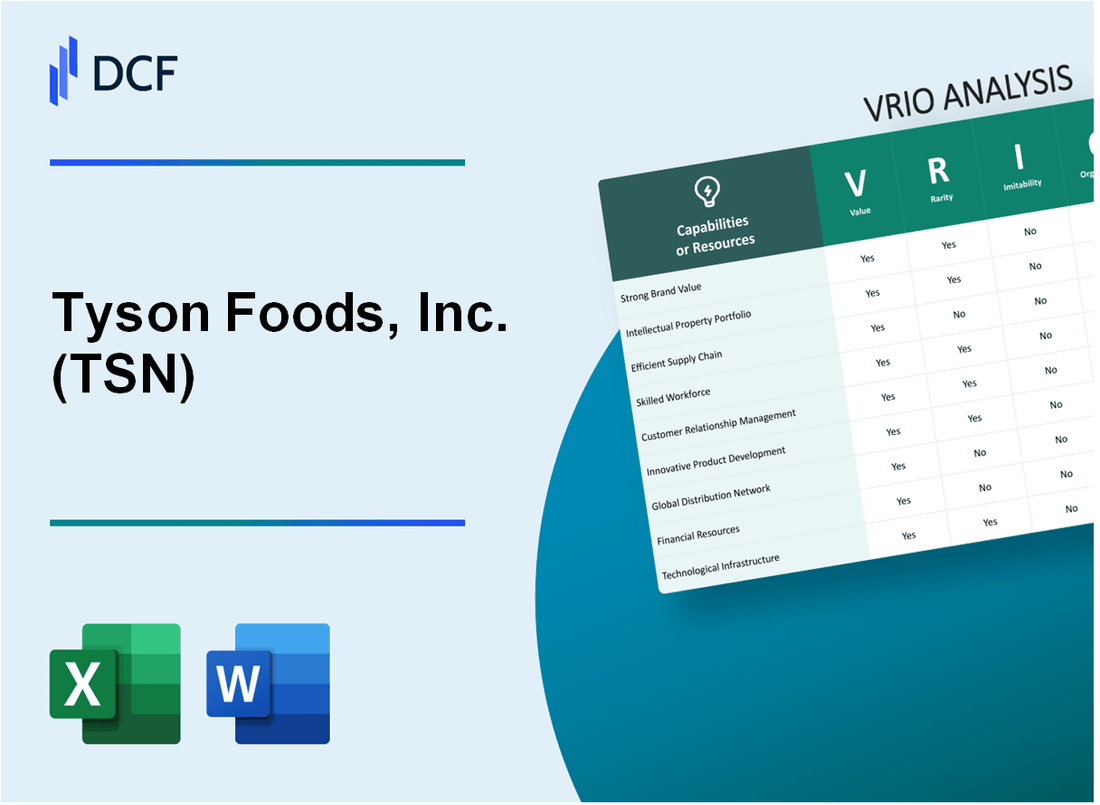
Tyson Foods, Inc. (TSN): VRIO Analysis [Mar-2026 Updated] |
Entièrement Modifiable: Adapté À Vos Besoins Dans Excel Ou Sheets
Conception Professionnelle: Modèles Fiables Et Conformes Aux Normes Du Secteur
Pré-Construits Pour Une Utilisation Rapide Et Efficace
Compatible MAC/PC, entièrement débloqué
Aucune Expertise N'Est Requise; Facile À Suivre
Tyson Foods, Inc. (TSN) Bundle
Unlock the secrets to Tyson Foods, Inc. (TSN)'s market position with this razor-sharp VRIO analysis. We've dissected its core competencies against the criteria of Value, Rarity, Inimitability, and Organization to deliver a distilled summary of its true competitive advantage. Don't just wonder what makes Tyson Foods, Inc. (TSN) tick - read on to see the definitive verdict on its sustainability.
Tyson Foods, Inc. (TSN) - VRIO Analysis: 1. Massive Multi-Protein Production Scale
You’re looking at the core engine of Tyson Foods, and it’s all about sheer size and breadth across chicken, beef, and pork. This massive, integrated scale is what lets them reliably supply the biggest retailers and foodservice operators in the country, which is non-negotiable for those massive contracts. For fiscal year 2025, the company pulled in total sales of $54.44 billion, demonstrating the sheer volume they move through their system. That’s the baseline for value here.
The value is clear: you can’t be a top-tier supplier without the capacity to deliver consistently across the board. Consider the segments: chicken revenue alone hit $16.837 billion in FY 2025, and pork sales were $5.781 billion for the year. This multi-protein footprint is what makes them a one-stop shop, something few others can claim with the same footprint.
Is this scale rare? Honestly, yes, when you look at the trifecta. While competitors like JBS S.A. are huge, Tyson’s established, deeply embedded position as one of the largest processors across all three core proteins in the U.S. is defintely rare. Replicating the physical plant footprint, the dedicated breeder flocks, and the feed mill network isn't a quick project; it takes decades and billions in capital investment. For instance, their annual capital expenditures for FY 2025 were $978 million, showing the ongoing investment required just to maintain, let alone build, this infrastructure.
The organization around this scale is where the real management skill shows. The multi-protein, multi-channel portfolio acts as a natural hedge against segment-specific volatility. We saw this play out clearly in fiscal 2025 when the beef segment struggled significantly, posting an expected adjusted operating loss around $(426 million) for the year. Still, the overall company posted adjusted operating income of $2.287 billion, thanks in part to strength elsewhere. That ability to absorb a major segment loss while maintaining overall profitability speaks volumes about how the pieces are managed together.
This leads directly to a sustained competitive advantage. The barrier to entry - the capital required to build out the processing plants, secure the supply chains, and establish the distribution network - is simply too high for most rivals to match quickly. It’s not just about money; it’s about time and entrenched relationships. This scale is a moat.
Here is the quick math on the VRIO assessment for this core resource:
| VRIO Dimension | Assessment | Justification/Data Point |
|---|---|---|
| Value | Yes | Enables high-volume supply for major contracts; FY 2025 Sales: $54.44 billion. |
| Rarity | Yes | One of the largest processors across all three major proteins (beef, pork, chicken) in the U.S. |
| Imitability | Costly/Difficult | Replication requires decades and billions in capital; FY 2025 CapEx was $978 million. |
| Organization | Organized | Multi-protein structure hedges segment volatility (e.g., offsetting beef losses with chicken strength). |
| Competitive Advantage | Sustained | Scale is too large and capital-intensive for rapid matching by rivals. |
What this estimate hides is the complexity of managing the supply chain when one segment, like beef, is facing tight cattle supplies, which management expects to continue into 2026. Still, the structure is sound.
Finance: draft 13-week cash view by Friday.
Tyson Foods, Inc. (TSN) - VRIO Analysis: 2. Iconic Branded Portfolio Equity
Value: Drives premium pricing power and consumer loyalty, especially in the Prepared Foods segment. The portfolio includes three of the top 10 protein brands.
Rarity: Moderate. Other large food companies possess strong brand portfolios; however, the specific depth across breakfast (Jimmy Dean) and deli (Hillshire Farm) is a distinguishing factor. Market share in core branded lines such as its namesake products, Jimmy Dean and Hillshire Farm, remains at historically high levels as of February 2024.
Imitability: High. Brand equity is established over decades of consistent quality and marketing investment; competitors cannot replicate this trust rapidly. The group president for prepared foods stated a focus on balancing price and volume growth to maximize the value of the branded portfolio.
Organization: High. Management actively leverages brand equity for product introductions. The Prepared Foods segment is integral to overall company performance.
Competitive Advantage: Temporary. Brand loyalty is subject to erosion from sustained quality issues or disruptive competitive innovation.
The financial performance of the segment housing these key brands provides context for the value derived:
| Metric | Latest Reported Period (FY 2025) | Prior Period (FY 2024) |
| Prepared Foods Annual Sales | $9.93 billion | $9.851 billion |
| Prepared Foods Quarterly Sales (Q4) | $2.546 billion | $2.472 billion |
| Prepared Foods Quarterly Adjusted Operating Income (Q4) | $189 million | $205 million |
Supporting statistical data related to the branded portfolio and segment performance includes:
- Prepared Foods segment sales in the third quarter of 2024 were $2.43 billion.
- In the first quarter of 2024, the prepared food segment volume rose by 2.5%.
- Total Company Adjusted Operating Income for Fiscal 2024 was $1,820 million.
- Total Company Adjusted Operating Income for Fiscal 2025 was $2,287 million.
Tyson Foods, Inc. (TSN) - VRIO Analysis: 3. Unparalleled National Cold-Chain Distribution Network
Value
Ensures product availability and freshness across virtually every U.S. grocery store, club, and foodservice outlet, which is a non-negotiable for major customers like Walmart (18.7% of FY 2025 sales).
Rarity
The density and sophistication of the logistics network, especially the cold chain, are unmatched in the U.S. protein sector.
- Weekly processing capacity: 155,000 cattle, 461,000 pigs, 42,000,000 chicken.
- Total production sites: 201 production sites.
Imitability
Building out this physical infrastructure, including specialized trucking fleets and warehouse capacity, is a massive, long-term undertaking.
| Asset Component | Metric | Value |
|---|---|---|
| Existing Cold Storage Divested | Sale Price | $247 million |
| Existing Cold Storage Divested | Capacity (Cubic Feet) | Approx. 49 million |
| New Automated Capacity Secured | Investment by Lineage (Estimated) | Over $740 million |
| New Automated Capacity Secured | Capacity Addition (Cubic Feet) | More than 80 million |
Organization
This network is the backbone that allows the company to execute its multichannel strategy effectively.
- Expected annual cost savings from cold storage network evolution: around $200 million.
- Employees transitioning to Lineage as part of warehouse sale: More than 1,000.
Competitive Advantage
Sustained. The physical network itself creates a significant barrier to entry.
| Financial Metric | Fiscal Year/Period | Amount |
|---|---|---|
| Total Company Sales | FY 2025 (Forecast) | $54 Billion |
| Total Company Sales | Year Ended (Latest Reported) | $54.44bn |
| Projected Net Sales Growth | New Financial Year | 2-4% |
Tyson Foods, Inc. (TSN) - VRIO Analysis: 4. Deep Vertical Integration Control
Value: Provides control over product quality, reduces reliance on spot market sourcing for live animals, and allows for cost optimization from farm to fork.
Rarity: Moderate. Some competitors are vertically integrated in specific proteins, but Tyson’s integration across all three is comprehensive.
Imitability: High. Requires owning or contracting massive feed mills, hatcheries, processing plants, and transportation assets.
Organization: Moderate. While it offers control, it also exposes the company to biological risks like avian flu, which management must constantly mitigate.
Competitive Advantage: Sustained. The sunk costs in physical assets lock in the advantage.
The scale of physical assets underpinning the integration is substantial:
| Protein Segment | Weekly Processing Capacity | Number of Facilities | Key Integrated Assets Mentioned |
| Beef | 155,000 Head | 11 | Processing Plants |
| Pork | 451,000 Head | 6 | Harvesting and Fabricating Plants |
| Chicken | 42,000,000 Head | 167 | Processing, Feed Mills, Grain Elevators, Broiler Hatcheries |
The company produces approximately 20% of the beef, pork, and chicken consumed in the US. The investment required to replicate this network represents significant sunk costs.
- Total Company Fiscal 2023 Revenue was $52.88 billion.
- Fiscal 2023 Capital Expenditures were expected to be approximately $2.3 billion.
- The Beef segment accounted for approximately 40% of Fiscal 2025 sales, which were projected at $54 Billion.
- The company reported a GAAP net loss of $648 million for fiscal 2023.
- Tyson’s Chicken segment facilities include rendering facilities, blending mills, feed mills, grain elevators, and broiler hatcheries.
Tyson Foods, Inc. (TSN) - VRIO Analysis: 5. Value-Added Product Development Engine
Value: Allows the company to capture higher margins by transforming commodity cuts into premium, convenient items (e.g., seasoned beef, specialty chicken), helping offset tight livestock supplies in FY 2025.
Rarity: Moderate. Many food companies do this, but Tyson’s ability to scale these specialized lines rapidly is a strength.
Imitability: Moderate. Competitors can copy recipes, but scaling production to meet national demand takes time and capital investment.
Organization: High. This focus drove the Prepared Foods segment to its highest fill rates since 2013.
Competitive Advantage: Temporary. It’s a continuous innovation race driven by consumer trends.
The focus on value-added products is evidenced by the segment's financial performance and outlook:
- Tyson holds the number one brand position in value-added chicken across both retail and food service.
- For the twelve months ended September 27, 2025, the Prepared Foods segment generated an Adjusted Operating Income (AOI) of $913 million.
- The segment's Adjusted Operating Margin for the twelve months ended September 27, 2025, was 9.2%.
- In fiscal 2024, the Prepared Foods segment's AOI growth was over $100 million compared to the five-year average (FY '19 to '23), and its share of overall profitability increased from a quarter to a half.
- The company is 'reinvesting a portion of these benefits' into its value-added chicken portfolio.
| Metric | Latest Reported Period (Twelve Months Ended Sept 27, 2025) | Prior Period (Twelve Months Ended Sept 28, 2024) |
|---|---|---|
| Prepared Foods Adjusted Operating Income (millions) | $913 | $905 |
| Prepared Foods Adjusted Operating Margin (Non-GAAP) | 9.2% | 9.2% |
The company's capital deployment supports this engine, with expected capital expenditures between $700 million to $1.0 billion for fiscal 2026, which includes investments in profit improvement projects. For fiscal 2024, capital expenditures were between $1.2 billion and $1.3 billion, including spending for product innovation.
The outlook for the segment further underscores its importance:
- Fiscal 2025 guidance midpoint anticipates AOI between $900 million to $1.1 billion.
- Fiscal 2026 anticipated adjusted operating income is projected to be between $950 million to $1,050 million.
Tyson Foods, Inc. (TSN) - VRIO Analysis: 6. Global Market Access and Sales Footprint
Value: Diversifies revenue streams away from domestic cycles and taps into growing international protein demand, with sales in approximately 140 countries in fiscal 2024.
Rarity: Moderate. While many large firms export, Tyson’s established processing and sales infrastructure in key regions like Asia is a significant asset. Key international markets include Australia, Canada, Central America, Chile, China, the European Union, the United Kingdom, Japan, Mexico, Malaysia, the Middle East, Singapore, South Korea, Taiwan and Thailand.
Imitability: High. Requires navigating complex international trade regulations, tariffs, and establishing local customer relationships. Tyson acquired operations in Thailand, the Netherlands and the United Kingdom from Brazilian food company BRF in 2019 to expand its value chain in the Asian and European markets.
Organization: High. Management actively uses this reach to balance domestic softness, though they are focused on operational execution globally. The company employed approximately 138,000 team members globally as of September 28, 2024, with approximately 18,000 in other countries. For fiscal 2025, the company anticipates improved results from its foreign operations on an adjusted basis.
Competitive Advantage: Sustained. Regulatory and logistical knowledge in 140 markets is hard-won.
The global sales footprint is quantified by the following financial metrics:
| Metric | Fiscal Year 2024 Amount (USD) | Fiscal Year 2023 Amount (USD) |
|---|---|---|
| Total Company Sales | $53,309 million | $52,881 million |
| Sales to Customers in Foreign Countries | $7.8 billion | $7.6 billion |
| Export Sales from the United States | $5.2 billion | $5.1 billion |
| International/Other Segment Sales | $2,353 million | $2,515 million |
Tyson Foods' international presence is supported by specific operational and strategic activities:
- Tyson Foods sold products in approximately 140 countries and regions in fiscal 2024.
- The company completed the acquisition of European and Thai businesses from BRF in 2019, including processing facilities in the Netherlands and the United Kingdom.
- For fiscal 2025, the company reported total sales of $54,441 million.
- The company's adjusted operating income for fiscal 2025 is anticipated to be between $1.8 billion and $2.2 billion, with expectations for improved results from foreign operations on an adjusted basis.
Tyson Foods, Inc. (TSN) - VRIO Analysis: 7. Advanced Supply Chain Digitization & Automation
Value: Drives operational efficiency, reduces labor dependency, and improves responsiveness, contributing to the 26% rise in adjusted operating income to $2,287 million in FY 2025.
Rarity: Moderate. Investments in AI-driven tools and automation are becoming standard, but Tyson’s specific deployment pace is a current edge.
Imitability: High. Requires significant, ongoing capital expenditure (planned CapEx of $1.0 billion to $1.2 billion for FY 2025) and specialized tech partnerships.
Organization: High. The company is actively shifting capital to these profit enhancement projects.
Competitive Advantage: Temporary. Technology adoption is a constant arms race; what’s cutting-edge today is standard tomorrow.
The commitment to digitization and automation is evidenced by substantial, multi-year capital allocation toward profit improvement projects.
| Fiscal Year | Automation Investment (USD) | Projected Labor Reduction (Positions) |
|---|---|---|
| FY 2021 | $70 million | 150 |
| FY 2022 | $540 million | 1,100 |
| FY 2023 | $340 million | 900 |
| Final Year of Program | $400 million | 1,000 |
The company leverages venture capital, with Tyson Ventures investing more than $100 million since its inception in 2016 in new technologies for improved food production and supply chain enhancements.
Specific technological deployments and focus areas include:
- Leveraging GS1 Standards, particularly GS1-128 barcodes, for case-level traceability, enabling accurate invoicing for variable-weight products and faster product recalls.
- Engaging with startups such as Pactum AI, a Software-as-a-Service solution for automating supplier negotiations through AI-driven processes.
- Partnering with SnoFox, a software platform focused on optimizing system performance, maintenance activities, and energy usage for industrial refrigeration.
- Past productivity programs aimed to realize more than $1 billion in recurring savings, with $250 million expected from digital technologies like artificial intelligence and predictive analytics.
Tyson Foods, Inc. (TSN) - VRIO Analysis: 8. Strong Balance Sheet and Liquidity Position
Value: Provides a crucial cushion against the industry's inherent commodity price volatility and allows for strategic capital deployment, with total liquidity at $3.7 billion as of September 27, 2025. This level is maintained above the minimum liquidity target of $1.0 billion.
Rarity: Moderate. Competitors are also large, but Tyson’s deleveraging efforts have been significant. Long-term Debt decreased from $9,713 million as of September 28, 2024, to $7,921 million as of September 27, 2025, representing a year-over-year reduction of approximately 18.45%.
Imitability: Moderate. Competitors can improve cash flow, but achieving this specific liquidity level and debt reduction trajectory takes time and disciplined financial management.
Organization: High. Management’s focus on operational execution has improved profitability, supporting this financial strength, evidenced by the expected adjusted operating income growth for fiscal 2025.
Competitive Advantage: Sustained. The current balance sheet strength, reflected in key ratios, provides a durable safety net against market fluctuations.
Key Balance Sheet and Liquidity Metrics as of Latest Reporting Periods:
| Metric | Amount (As of Sept 27, 2025) | Reference Date/Period |
|---|---|---|
| Total Liquidity | $3,729 million | September 27, 2025 |
| Cash and Cash Equivalents | $1,229 million | September 27, 2025 |
| Revolving Credit Facility Availability | $2,500 million | April 2030 Maturity |
| Current Debt | $909 million | September 27, 2025 |
| Long-Term Debt | $7,921 million | September 27, 2025 |
| Debt to Equity Ratio | 0.5361 | September 30, 2025 |
| S&P Adjusted Leverage (Debt/EBITDA) | 2.3x | Fiscal 2025 |
Management's commitment to financial discipline is further highlighted by specific actions and targets:
- The company entered into a new $2.5 billion revolving credit facility in April 2025, maturing in April 2030.
- The current ratio stood at 1.6 to 1 at September 27, 2025.
- The company expects net interest expense to approximate $395 million for fiscal 2026.
Tyson Foods, Inc. (TSN) - VRIO Analysis: 9. Segmented Operational Focus
Value: Allows specialized management teams to focus on the unique dynamics of beef, pork, chicken, and prepared foods, leading to targeted improvements, like the strong performance in the Chicken segment, which posted an adjusted operating income of $368 million on a record net operating margin of 9.1% in fiscal first quarter 2025.
Rarity: Low. Most large food processors use some form of segmentation.
Imitability: Low. It’s a standard organizational structure for a diversified manufacturer.
Organization: High. The structure enables clear accountability, though it also highlights segment-specific weaknesses, like the beef segment's expected loss. The Beef segment recorded an adjusted operating loss of $426 million for the full fiscal year 2025.
The operational segmentation allows for distinct performance tracking across the portfolio:
| Segment | Latest Reported Revenue | Latest Reported Operating Income (Adjusted) | Latest Reported Margin (Adjusted) |
|---|---|---|---|
| Chicken | $4.065 billion (Q1 FY2025) | $368 million (Q1 FY2025) | 9.1% (Q1 FY2025) |
| Pork | $1.617 billion (Q1 FY2025) | $59 million (Q1 FY2025) | N/A |
| Prepared Foods | N/A | $234 million (Q1 FY2025 Adj.) | N/A |
| Beef | $5.49 billion (Q4 FY2025) | ($94 million) (Q4 FY2025 Adj. Loss) | -1.6% (Q4 FY2025 Adj.) |
The company's total revenue for the twelve months ending September 30, 2025, was $54.441B.
The structure is critical for managing the current supply environment and driving future efficiency:
- Automation investment plans totaled more than $1.3 billion over three years, targeting cumulative savings of more than $1 billion by fiscal 2024.
- The Danville, Virginia, cooked-chicken facility utilizes technology expected to increase efficiency by up to 30% over existing plants and cut labor requirements by about 20%.
- Cattle supplies are expected to remain tight as the company moves into 2026, with an anticipated adjusted operating loss for the Beef segment between $400 million and $600 million for fiscal 2026.
- The company anticipates total company adjusted operating income of $2.1 billion to $2.3 billion for fiscal 2026.
You need to keep pushing the automation investments; that’s where the next leg of margin improvement will come from, especially as cattle supplies stay tight into 2026. Finance: draft 13-week cash view by Friday.
Competitive Advantage: None. This is a necessary organizational capability, not a source of advantage itself.
Disclaimer
All information, articles, and product details provided on this website are for general informational and educational purposes only. We do not claim any ownership over, nor do we intend to infringe upon, any trademarks, copyrights, logos, brand names, or other intellectual property mentioned or depicted on this site. Such intellectual property remains the property of its respective owners, and any references here are made solely for identification or informational purposes, without implying any affiliation, endorsement, or partnership.
We make no representations or warranties, express or implied, regarding the accuracy, completeness, or suitability of any content or products presented. Nothing on this website should be construed as legal, tax, investment, financial, medical, or other professional advice. In addition, no part of this site—including articles or product references—constitutes a solicitation, recommendation, endorsement, advertisement, or offer to buy or sell any securities, franchises, or other financial instruments, particularly in jurisdictions where such activity would be unlawful.
All content is of a general nature and may not address the specific circumstances of any individual or entity. It is not a substitute for professional advice or services. Any actions you take based on the information provided here are strictly at your own risk. You accept full responsibility for any decisions or outcomes arising from your use of this website and agree to release us from any liability in connection with your use of, or reliance upon, the content or products found herein.