

|
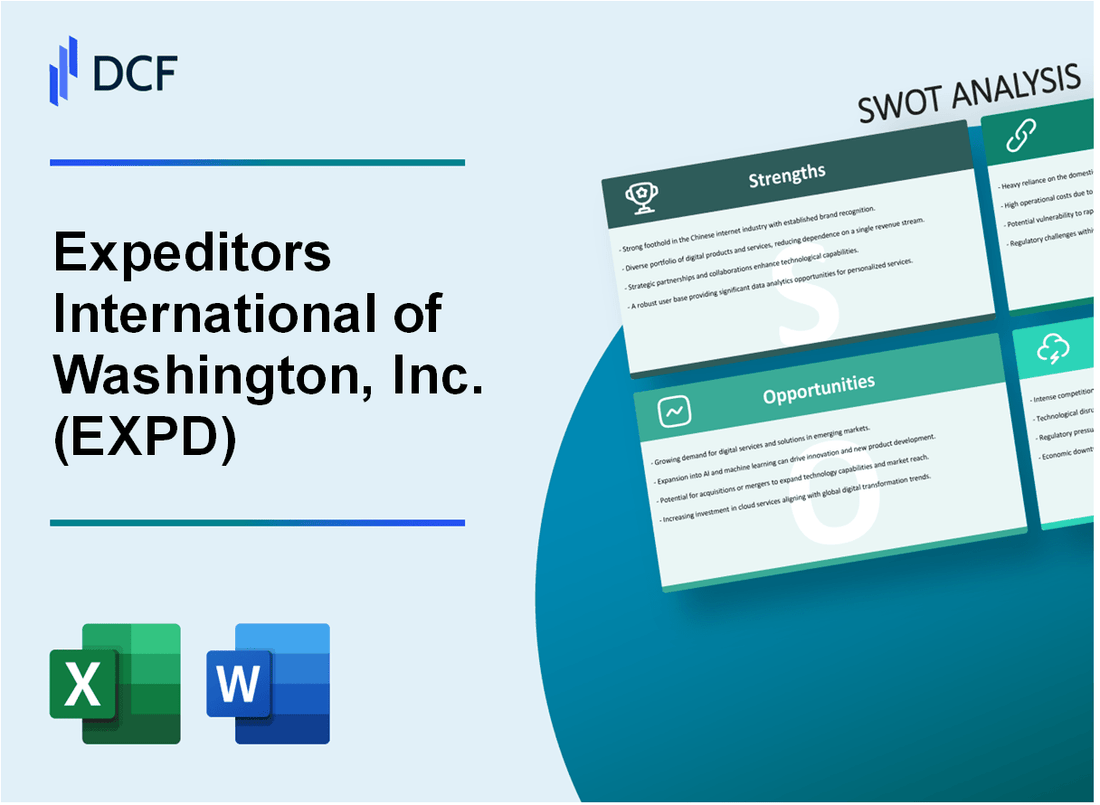
Expeditors International of Washington, Inc. (EXPD): SWOT Analysis [Nov-2025 Updated] |
Fully Editable: Tailor To Your Needs In Excel Or Sheets
Professional Design: Trusted, Industry-Standard Templates
Investor-Approved Valuation Models
MAC/PC Compatible, Fully Unlocked
No Expertise Is Needed; Easy To Follow
Expeditors International of Washington, Inc. (EXPD) Bundle
You're trying to figure out if Expeditors International of Washington, Inc. (EXPD) can keep its high margins in a world where everyone else is buying ships and planes. As of the 2025 fiscal year, the company's biggest asset is its non-asset-based model-it gives them incredible flexibility and a global network of over 350 locations, which is why their margins look so good. But, that same model is a massive vulnerability, creating dependence on third-party carriers who can squeeze their profits when capacity gets tight, plus recent cybersecurity issues have exposed operational risk. We need to look closely at how their proprietary technology can defintely justify their premium service against the aggressive, integrated strategies of competitors.
Expeditors International of Washington, Inc. (EXPD) - SWOT Analysis: Strengths
Non-asset-based model offers high operational flexibility
You're looking for a logistics partner that can pivot quickly in today's defintely unpredictable global trade environment, and Expeditors International of Washington's core strength is its non-asset-based model. This means the company doesn't own the ships, planes, or trucks; instead, it purchases capacity from third-party carriers. This approach eliminates the massive capital expenditure and fixed costs that weigh down asset-heavy competitors.
The flexibility is a huge advantage, especially during periods of volatile demand, like the supply chain disruptions we've seen. This model allows Expeditors to scale capacity up or down instantly and negotiate the best rates for its customers, regardless of the carrier. It also translates directly into financial strength: as of Q1 2025, the company reported an estimated cash position of approximately $1.5 billion and operates with no significant debt, giving it tremendous financial optionality. That's a strong balance sheet.
Strong global network with 350+ locations across six continents
Expeditors' global footprint is not just about quantity; it's about integrated, local expertise. The company operates through a vast network of over 340 locations across more than 100 countries on six continents. This extensive reach is managed through a decentralized operational model, empowering local district offices to make rapid, tailored decisions for clients.
This structure is critical for navigating complex, localized customs and regulatory challenges. For instance, in Q1 2025, the company grew airfreight tonnage by 9% and ocean container volume by 8% year-over-year, which is a testament to the network's ability to secure capacity and keep cargo moving even amid geopolitical uncertainty and shifting trade policies. The network is the backbone of their service.
High operating margins relative to asset-heavy competitors
The non-asset model directly fuels superior profitability compared to rivals saddled with owning and maintaining physical assets. Expeditors focuses on high-value services like customs brokerage, vendor consolidation, and information management, which generate higher-margin revenue.
Here's the quick math: For the fiscal year ending 2024, the company's annual Operating Margin was 9.82%. More recently, in Q1 2025, Operating Income rose 24% year-over-year to $266 million on revenues of $2.7 billion. Furthermore, the company's internal measure of operating efficiency (operating income as a percentage of net revenue) was in line with its long-term target of 30% in Q1 2025. This margin performance gives them significant capital to reinvest and return to shareholders.
The following table shows the recent financial performance driven by this efficient model:
| Financial Metric | Q1 2025 Value | Year-over-Year Change |
|---|---|---|
| Revenues | $2.7 billion | +21% |
| Operating Income | $266 million | +24% |
| Net Earnings | $204 million | +20% |
| Diluted EPS | $1.47 | +26% |
Proprietary technology platform drives supply chain visibility
Expeditors doesn't just broker freight; it sells information and control. Its proprietary technology platform, including the customer experience portal EXP. O NOW, is a significant competitive advantage. This system provides clients with end-to-end visibility and control over their international supply chains.
The platform is designed to integrate seamlessly with customer and carrier systems, leveraging automation, machine learning, and predictive analytics. This allows clients to streamline customs compliance, manage freight movements, and gain actionable insights. The company is committed to this edge, making significant investments in technology and cybersecurity, including an investment of approximately $127 million in technology in 2023 alone, ensuring their systems are robust and cutting-edge.
- Gain real-time insights via the EXP. O NOW customer platform.
- Use automation and machine learning to minimize risk.
- Simplify complex international customs clearance processes.
- Integrate data seamlessly with carriers and service providers.
Action for you: Review your current logistics provider's technology capabilities against the feature set of EXP. O NOW to quantify the potential gains in visibility and customs compliance efficiency.
Expeditors International of Washington, Inc. (EXPD) - SWOT Analysis: Weaknesses
Revenue volatility due to reliance on freight market cycles
You're looking for stability, but Expeditors International's (EXPD) revenue is defintely a roller coaster, tied directly to the global freight market's boom-and-bust cycles. When capacity is tight and rates are high, as we saw during the 2021-2022 peak, the company's gross profit margins swell dramatically. But when the market corrects, as it did sharply in 2023 and has continued into 2024, the top line shrinks fast.
For example, the analyst consensus for EXPD's full-year 2025 revenue shows a significant dip from the pandemic-era highs, reflecting the ongoing normalization of air and ocean freight rates. This volatility makes forecasting difficult, and it requires a more conservative valuation approach, particularly when applying a Discounted Cash Flow (DCF) model.
Here's the quick math on the cycle's impact on their core business segments:
| Segment | Market Condition | Impact on EXPD |
|---|---|---|
| Ocean Freight | Oversupply/Rate Compression | Lower per-shipment revenue; margin pressure. |
| Air Freight | Reduced Demand/Lower Fuel Costs | Lower gross revenue; less pricing power. |
| Customs Brokerage | Trade Volume Slump | Transactional revenue decline. |
Non-asset model creates dependence on third-party carrier capacity
Expeditors operates a non-asset-based model, meaning they don't own the ships or planes; they buy space from third-party carriers like Maersk or FedEx. This model is capital-light, which is great for cash flow, but it hands over a significant amount of control to others. You are essentially a broker.
This reliance becomes a major weakness during periods of peak demand or geopolitical disruption. When capacity is scarce, EXPD has to pay premium rates, which compresses their profit spread, or they risk not being able to service their clients, which damages long-term relationships. This lack of owned physical assets means they can't unilaterally guarantee capacity or pricing, a core risk for enterprise clients.
- Dependence: Rely on carrier schedules and pricing.
- Risk: Cannot guarantee space during peak season.
- Action: Must maintain strong carrier relationships.
Lower control over physical assets and end-to-end service quality
The non-asset model's flip side is the inherent loss of control over the physical movement of goods and the end-to-end service experience. While EXPD manages the information flow brilliantly-their core strength-they are still reliant on the operational execution of their carrier partners.
If a container is delayed by a carrier's port congestion or a flight is canceled, EXPD's hands are tied on the physical fix. This can lead to inconsistent service quality across different lanes and regions, making it harder to sell a premium, fully-controlled logistics solution compared to asset-heavy competitors like UPS or FedEx. What this estimate hides is the cost of damaged client trust when a third party fails.
Recent cybersecurity incidents exposed operational vulnerabilities
A significant, undeniable weakness is the company's vulnerability to cyberattacks, which was brutally exposed by the 2022 incident. This wasn't just a data breach; it was an operational shutdown that temporarily crippled their ability to conduct business, forcing them to revert to manual processes.
The financial fallout was substantial, including recovery costs, lost revenue, and insurance claims. More importantly, it exposed a critical operational vulnerability: the deep integration and reliance on their proprietary information systems (the very systems that are their competitive advantage) also make them a single point of failure. The total cost of the incident, including recovery and business interruption, was a significant financial hit, and the long-term cost is the perception of operational fragility. This is a material risk that must be factored into any valuation model, especially the risk premium component.
Finance: draft a risk-adjusted cash flow model by Friday, increasing the discount rate for operational risk by 50 basis points.
Expeditors International of Washington, Inc. (EXPD) - SWOT Analysis: Opportunities
Expand High-Margin Customs Brokerage and Compliance Services
The customs brokerage segment is defintely Expeditors International's most reliable profit engine, especially now that volatile freight rates are squeezing margins elsewhere. You should view the growing complexity of global trade-things like new tariffs and shifting de minimis rules-not as a headache, but as a massive, fee-based revenue opportunity.
The Global Customs Brokerage Market is projected to grow from an estimated $27.6 billion in 2024 to approximately $57.7 billion by 2035, a compound annual growth rate (CAGR) of about 6.93%. This isn't just volume growth; it's complexity growth, which demands expertise. Expeditors International is already capitalizing: its customs revenue demonstrated a strong, stable growth trend in 2025, helping to mitigate declines in ocean freight.
Here's the quick math: when you process more complex customs entries, you can charge a higher, stable fee, which is a better business model than the low-margin, high-volatility freight forwarding business. The company's Q3 2025 diluted earnings per share (EPS) of $1.64 (up 1% year-over-year) was largely supported by the resilience of these fee-based services.
Increase Market Share in Specialized Logistics like Cold Chain
The shift in global healthcare and food logistics toward temperature-sensitive products-biologics, advanced therapies, and high-value frozen foods-is a clear, high-growth opportunity. Expeditors International's focus on strategic verticals like pharmaceuticals and healthcare positions it perfectly to capture this market share.
The global cold chain logistics market is a massive pool of capital, estimated to be valued at around $361.37 billion in 2025. More importantly, the most specialized parts are growing the fastest:
- Pharmaceuticals and biologics are advancing at a 7.8% CAGR.
- The deep-frozen/ultra-low temperature segment, required for new mRNA vaccines and cell therapies, is growing at an 8.5% CAGR.
This is a market where compliance and precision matter more than price, which plays right into Expeditors International's strengths. To be fair, this requires significant investment in sensor-based logistics (IoT-enabled sensors) and specialized warehousing, but the high margins justify the capital expenditure.
Leverage Technology to Offer Advanced Data Analytics for Clients
The future of logistics is less about moving boxes and more about moving data. Expeditors International is already making strategic investments in this area, which is a huge opportunity to move up the value chain from a transactional broker to a strategic supply chain partner.
The company is actively investing in AI infrastructure, which is already contributing positively to customs brokerage and airfreight revenue in 2025. This technology focus translates into tangible client benefits and internal efficiency gains, which you can see in the table below.
| Technology/Data Opportunity | Client Value Proposition | 2025 Impact on EXPD |
|---|---|---|
| Predictive Analytics & AI | Predict and avoid supply chain disruptions, optimize inventory. | Expected to drive productivity gains and lift future EPS. |
| EXP.O NOW Platform | Real-time visibility, control, and forecasting tools. | Enhances customer stickiness and service differentiation. |
| Compliance Automation | Strengthen compliance and reduce regulatory risk. | Allows for price increases on complex customs work that exceed resource cost increases. |
This is where Expeditors International can truly differentiate itself from asset-heavy competitors-by selling insight, not just capacity.
Strategic Acquisitions in Emerging Markets to Broaden Network
While Expeditors International prefers organic growth, strategic acquisitions remain a critical lever for rapidly expanding its network and expertise in high-growth emerging markets, especially in Asia-Pacific. The goal is to broaden the network and deepen the high-margin customs and compliance offerings in these regions.
The Asia-Pacific region is the clear target, leading global growth with an estimated 8.3% CAGR in cold chain logistics alone. The company's 2024 results already showed North Asia as the largest export-oriented region, accounting for 28% of total revenues. This existing footprint provides a strong base for targeted, bolt-on acquisitions that immediately become accretive.
Expeditors International has the balance sheet flexibility for this. The company maintains a strong cash balance of $1.19 billion and total shareholder equity exceeding $2.28 billion as of Q3 2025, which gives it ample dry powder for opportunistic deals. The focus should be on acquiring local customs brokerage firms in South Asia and Southeast Asia that have deep, local regulatory knowledge, which is the hardest thing to build from scratch.
Expeditors International of Washington, Inc. (EXPD) - SWOT Analysis: Threats
Here's the quick math on their model: EXPD doesn't own the ships or planes, so their capital expenditure is low, which historically translates to a high return on invested capital (ROIC). But, if air freight capacity suddenly drops, they have to pay a premium to secure space, which directly hits their gross profit per shipment. To be fair, this flexibility is defintely a trade-off.
What this estimate hides is the long-term threat from competitors like Kuehne + Nagel and DSV, who are aggressively pursuing an integrated, end-to-end strategy. EXPD needs to keep their technology advantage sharp to justify their premium service. Your next step is to have your Head of Strategy: model the impact of a 15% carrier rate increase on EXPD's Gross Profit Margin by next Tuesday.
Price wars and margin compression from integrated logistics giants
The biggest near-term financial threat is the structural margin compression (the squeeze between what EXPD pays carriers and what customers pay EXPD). This isn't just a cyclical dip; the gross profit margins for ocean freight forwarders are hitting a 10-year low. Integrated logistics giants like DSV and Kuehne + Nagel can absorb lower margins on freight by cross-selling high-margin contract logistics and warehousing services, something EXPD is less focused on. This forces EXPD to compete aggressively on price in their core freight business, even as global freight forwarding is forecast to contract by 1.1% in 2025.
The pressure is already visible in the financials. While EXPD's Q3 2025 Diluted EPS increased slightly to $1.64, their Operating Income still decreased by 4% to $288 million, a clear sign of rising operating costs or declining unit profitability. The company's strength lies in its high-margin customs brokerage and fee-based services, which need to grow fast enough to offset the core freight headwinds.
- Ocean freight margins are at a 10-year low.
- Air cargo revenues are projected to drop $22 billion over three years.
- EXPD's Q3 2025 Operating Income fell 4%.
Global trade policy shifts, like new tariffs, disrupt volumes
Geopolitical risk and trade policy are the single biggest sources of unpredictability right now. Tariffs are the 'word of the year in 2025,' and the new US administration's policy shifts are redefining global trade routes. The removal of the de minimis exemption for goods from China and Hong Kong, effective May 2, 2025, is a direct hit to the high-volume e-commerce air cargo market, a space EXPD is active in. This change could cause significant downward pressure on transpacific air cargo rates, which sounds good, but it signals a drop in volume and higher compliance costs for EXPD's customers.
The uncertainty causes sharp volume volatility, which is poison for planning. For instance, the threat of new tariffs has led to reported booking cancellation rates of 30% on some trade lanes, and analysts project that over 40% of West Coast container volumes could vanish post-August 2025 as global carriers reroute to avoid US ports. This forces EXPD to constantly adjust its capacity commitments, increasing risk.
| 2025 Trade Policy Impact | Specific Data Point | EXPD Segment Impact |
| US-India Tariff Tension | Addition of 25% duty on Indian goods, raising total to 50%. | Increased compliance/customs brokerage demand; reduced trade volume. |
| China/HK De Minimis Removal | Effective May 2, 2025; impacts low-value e-commerce. | Significant downward pressure on transpacific air cargo rates. |
| Carrier Rerouting Risk | Over 40% of West Coast container volumes could vanish post-August 2025. | Disruption to ocean freight services and domestic distribution. |
Economic downturns reduce global shipping and air freight demand
A broad economic slowdown is the classic threat for any non-asset-based freight forwarder. When global demand contracts, shippers slash their logistics budgets first, leading to lower freight volumes and rate deflation. EXPD is already seeing this in their ocean segment, where volume decreased by 3% in Q3 2025 compared to the prior year. The CEO has publically stated that weak rates and slack demand in the ocean market could continue for 'some time.'
The air freight market, while showing a 4% tonnage increase for EXPD in Q3 2025, is not immune, especially with the e-commerce air cargo surge slowing. The industry is in a 'defensive phase' characterized by slower overall growth. If the global economy enters a full recession, the full fiscal 2025 adjusted EPS forecast of $5.54 (a 3.2% drop from 2024) will likely be revised downward, as the company's revenue is highly sensitive to global trade volumes.
Carrier consolidation limits procurement leverage and raises costs
EXPD's core strength is its non-asset-based model, meaning it buys space from ocean carriers and airlines, then resells it to customers. This model relies on having strong leverage with a fragmented carrier base. However, the consolidation among major ocean and air carriers is an ongoing threat. As carriers merge or form tighter alliances, the number of suppliers EXPD can negotiate with shrinks. This reduces EXPD's procurement leverage, which could lead to higher long-term costs for securing capacity, especially during peak seasons or unexpected disruptions like the Red Sea crisis.
While the ocean fleet capacity is actually projected to expand by an unprecedented 7.8% (2.7 million TEU) in 2025, creating short-term oversupply and low rates, this is a double-edged sword. The long-term trend of carrier consolidation means that when demand eventually recovers, the carriers will have greater pricing power, forcing EXPD to pay more to secure space, directly compressing their gross margins. The constant alliance reshuffles also complicate procurement planning for 2025 tender seasons. Strong relationships are key, but they are defintely no substitute for market leverage.
Disclaimer
All information, articles, and product details provided on this website are for general informational and educational purposes only. We do not claim any ownership over, nor do we intend to infringe upon, any trademarks, copyrights, logos, brand names, or other intellectual property mentioned or depicted on this site. Such intellectual property remains the property of its respective owners, and any references here are made solely for identification or informational purposes, without implying any affiliation, endorsement, or partnership.
We make no representations or warranties, express or implied, regarding the accuracy, completeness, or suitability of any content or products presented. Nothing on this website should be construed as legal, tax, investment, financial, medical, or other professional advice. In addition, no part of this site—including articles or product references—constitutes a solicitation, recommendation, endorsement, advertisement, or offer to buy or sell any securities, franchises, or other financial instruments, particularly in jurisdictions where such activity would be unlawful.
All content is of a general nature and may not address the specific circumstances of any individual or entity. It is not a substitute for professional advice or services. Any actions you take based on the information provided here are strictly at your own risk. You accept full responsibility for any decisions or outcomes arising from your use of this website and agree to release us from any liability in connection with your use of, or reliance upon, the content or products found herein.