

|
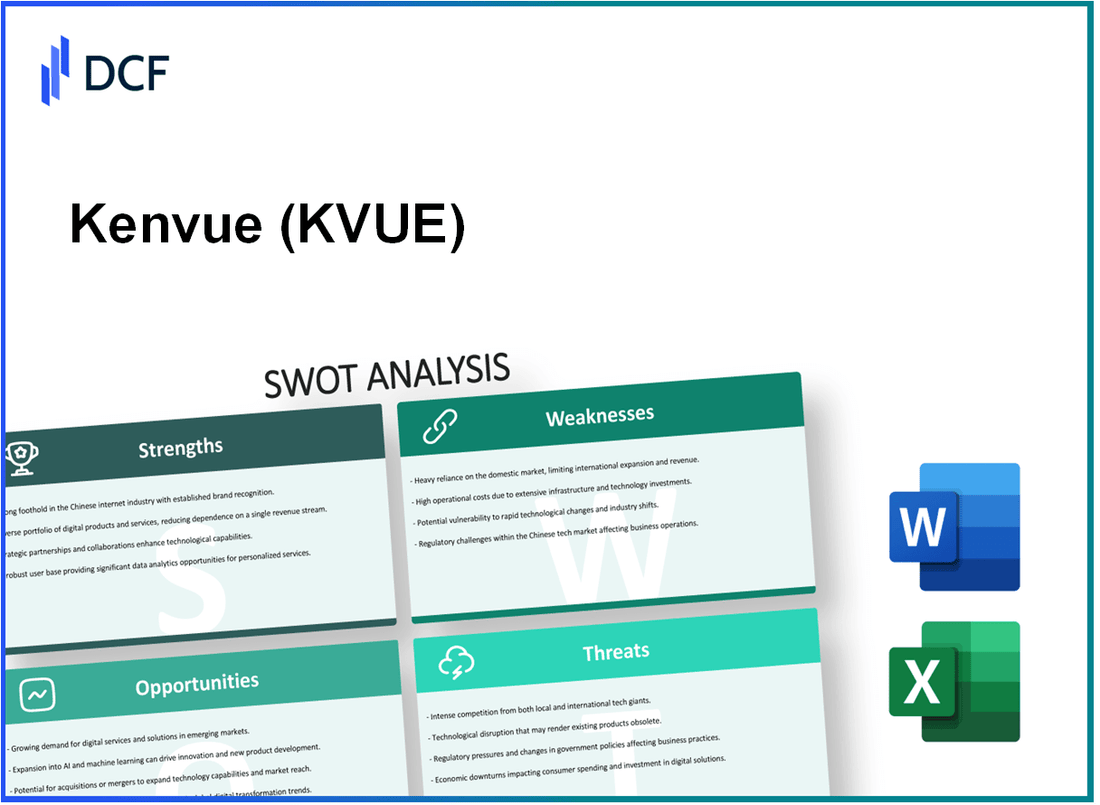
Kenvue Inc. (KVUE): SWOT Analysis [Apr-2026 Updated] |
Fully Editable: Tailor To Your Needs In Excel Or Sheets
Professional Design: Trusted, Industry-Standard Templates
Investor-Approved Valuation Models
MAC/PC Compatible, Fully Unlocked
No Expertise Is Needed; Easy To Follow
Kenvue Inc. (KVUE) Bundle
Kenvue sits on a powerful portfolio of iconic, high‑margin brands and strong cash generation that give it pricing power and room to invest, yet its growth is stalled by weak volumes, legacy litigation and leadership uncertainty; execution on digital commerce, emerging‑market expansion and portfolio optimization could reaccelerate revenue, but intense competition, regulatory scrutiny, macro headwinds and supply‑chain volatility make the path forward precarious-read on to see how Kenvue can convert strengths into durable growth while managing outsized risks.
Kenvue Inc. (KVUE) - SWOT Analysis: Strengths
Kenvue maintains a dominant market position as the world's largest pure‑play consumer health company by revenue, generating approximately $15.46 billion in annual net sales in fiscal 2024. The portfolio is anchored by category leaders-Tylenol, Neutrogena and Listerine-which collectively supported a quarterly gross profit of $2.23 billion. In the United States, Neutrogena reclaimed the number one face care brand position across online and offline channels by late 2024, reflecting substantial brand equity and consumer loyalty. Scale enables pricing power and resilience through macroeconomic volatility, contributing to an adjusted gross profit margin of 60.4% versus peers such as Procter & Gamble at 51.2%.
Kenvue's margin profile and operational efficiency have improved materially since independence. Adjusted gross profit margin expanded by 200 basis points to 60.4% during the first full year as an independent entity, supported by the 'Our Vue Forward' cost program targeting $350 million in annualized savings by 2026. Supply chain and procurement optimization helped offset inflationary pressures and supported a net income margin near 10.6% in Q3 2025. Operational independence is evidenced by exiting over 85% of Transition Service Agreements (TSAs) with Johnson & Johnson across 50 countries, enabling reinvestment in brand building and innovation.
Financial strength is reflected in robust cash flow generation and disciplined capital allocation. Free cash flow approximates 70% of EBIT, supporting liquidity and shareholder returns. As of September 2025, cash and cash equivalents totaled $1.14 billion, up from $1.07 billion in the prior quarter. The company targets a consistent dividend yield of ~3.86% and manages leverage conservatively with a debt/EBITDA ratio of 2.1 and EBIT covering interest expenses 7.8 times. Kenvue's cash generation capacity underpins funding for $1.4 billion of debt maturities through 2026 while executing the 'Extraordinary Powers' growth strategy.
Kenvue benefits from global reach and diversified revenue streams that mitigate regional risk. The company operates in over 165 countries with thousands of employees. In 2024, Aveeno was expanded into 12 Central European markets, contributing to mid‑single‑digit organic growth in EMEA. The Self Care segment posted 0.3% organic sales growth in difficult quarters, while Essential Health and Skin Health & Beauty provide multiple volume‑led growth avenues for 2025.
| Metric | Value | Period / Note |
|---|---|---|
| Annual Net Sales | $15.46 billion | Fiscal 2024 |
| Quarterly Gross Profit | $2.23 billion | Single quarter (reported) |
| Adjusted Gross Profit Margin | 60.4% | First full year independent |
| Peer Gross Margin (P&G) | 51.2% | Comparative benchmark |
| Net Income Margin (Q3 2025) | 10.6% | Reported quarter |
| Our Vue Forward Savings Target | $350 million | Annualized by 2026 |
| Cash & Cash Equivalents | $1.14 billion | September 2025 |
| Free Cash Flow | ~70% of EBIT | Ongoing performance metric |
| Debt / EBITDA | 2.1x | Leverage metric |
| Interest Coverage (EBIT / Interest) | 7.8x | Coverage ratio |
| Dividend Yield | ~3.86% | Targeted payout |
| Debt Maturities | $1.4 billion | Through 2026 |
| Geographic Presence | 165+ countries | Global footprint |
| TSAs Exited | 85%+ | Across 50 countries |
| Aveeno New Markets | 12 countries | Central Europe expansion, 2024 |
- Iconic, category‑leading brands driving pricing power and premium shelf placement
- High adjusted gross margins (60.4%) and improving profitability
- Structured cost savings program with $350M target and supply chain efficiencies
- Strong free cash flow (~70% of EBIT) enabling dividends and debt management
- Conservative leverage (2.1x debt/EBITDA) and robust interest coverage (7.8x)
- Broad global footprint (165+ countries) and diversified segment mix
- Operational independence: >85% TSAs exited, enabling strategic autonomy
- Committed innovation and marketing reinvestment supporting a 40% increase in new product launches planned for 2025
Kenvue Inc. (KVUE) - SWOT Analysis: Weaknesses
Kenvue has exhibited sluggish organic sales growth and recurring volume declines that undermine top-line momentum. Net sales rose only 0.1% for full-year 2024, while sales for the twelve months ending September 2025 declined 2.93%. Organic sales growth was negative: a 1.2% volume decline in 2024 offset much of the benefit from price increases. In H1 2025 organic sales contracted by 4.2%, driven primarily by soft seasonal demand for allergy and sun care products in North America. The Skin Health & Beauty segment showed acute weakness with a 4.8% organic sales decline in early 2025. Reliance on price increases to offset volume shortfalls risks alienating cost-sensitive consumers and compressing long-term demand elasticity.
Key sales and volume metrics:
| Metric | Period | Value |
|---|---|---|
| Net sales growth | Full year 2024 | +0.1% |
| Net sales growth | 12 months ending Sep 2025 | -2.93% |
| Organic volume change | 2024 | -1.2% |
| Organic sales change | H1 2025 | -4.2% |
| Skin Health & Beauty organic change | Early 2025 | -4.8% |
High operational costs and margin compression have limited the company's ability to convert gross margin improvements into stronger operating profitability. Adjusted operating income margin declined from 22.4% in 2023 to 21.5% in 2024, despite some gross margin gains, due to elevated brand investment and infrastructure spending tied to establishing a standalone corporate structure. Total operating expenses rose from $6.13 billion in 2023 to $7.12 billion in 2024. Selling, general, and administrative (SG&A) expenses remain approximately 40% of revenue, constraining leverage on the income statement. The company also flagged a $150 million gross tariff impact expected in 2025, adding near‑term margin pressure. Net income declined materially, falling 38.1% from $1.66 billion in 2023 to $1.03 billion in 2024.
Financial expense and margin highlights:
| Item | 2023 | 2024 | Change |
|---|---|---|---|
| Adjusted operating income margin | 22.4% | 21.5% | -0.9 ppt |
| Total operating expenses | $6.13 billion | $7.12 billion | +$0.99 billion |
| SG&A as % of revenue | ~40% | ~40% | Stable (elevated level) |
| Expected tariff impact | - | $150 million (2025) | Adverse |
| Net income | $1.66 billion | $1.03 billion | -38.1% |
Exposure to significant legacy litigation liabilities remains a material risk to cash flows, reputation, and investor sentiment. Post-spin litigation primarily involves talc-related claims and Tylenol safety allegations. In April 2024 a jury awarded $45 million in a mesothelioma case with Kenvue found 70% liable for damages alongside Johnson & Johnson. The company faces a UK lawsuit comprising roughly 3,000 claimants alleging asbestos contamination in baby powder and over 500 Tylenol-related suits alleging neurodevelopmental harm are in appeals, creating ongoing legal and settlement uncertainty. These legal exposures have correlated with share-price weakness-Kenvue's stock declined approximately 27.27% year-over-year as of October 2025.
Legal exposure snapshot:
| Liability | Scale / Count | Recent outcome / status |
|---|---|---|
| Mesothelioma jury award | 1 case | $45 million award (Apr 2024); Kenvue 70% responsible |
| UK baby powder claims | ~3,000 claimants | Active litigation; potential material settlement exposure |
| Tylenol neurodevelopmental suits | 500+ suits | Appeals pending; uncertain outcomes |
| Share price impact | 12-month change | -27.27% as of Oct 2025 |
Leadership instability and strategic uncertainty have compounded operational challenges. The company has undergone significant executive turnover, including appointment of an interim CEO and recruitment of a new CFO within the same year. The board initiated a 'strategic alternatives review' while activist investor Starboard Value and others have taken stakes and pressed for accelerated change. These dynamics contribute to a lack of long‑term clarity on portfolio strategy, potential disruptions to execution, and short-term pressure to deliver results. Kenvue's share price reached a 52-week low of $15.46 in late 2025 amid these governance and strategic concerns.
- Executive turnover: interim CEO appointed; new CFO hired within the year.
- Board actions: strategic alternatives review ongoing.
- Investor activism: Starboard Value stake and pressure for faster change.
- Market reaction: 52-week low of $15.46 in late 2025.
Kenvue Inc. (KVUE) - SWOT Analysis: Opportunities
Acceleration of digital and e-commerce initiatives represents a major runway for Kenvue. Digital sales currently account for an estimated 6-9% of Kenvue's total revenue versus 12-20% for best-in-class consumer health and beauty peers, indicating a material gap. The August 2025 appointment of a Chief Technology & Data Officer signals prioritization of cloud modernization, unified data lakes and AI tooling to drive personalised marketing, assortment optimization and supply-chain responsiveness. By applying AI-driven consumer insights Kenvue targets reduction of new product time-to-market by 15-25% and a 10-30% improvement in digital marketing ROI through better targeting and creative optimisation. Global e-commerce growth for health & beauty, projected at ~10-12% CAGR through 2028, opens a pathway to higher-margin direct-to-consumer (DTC) sales and subscription offerings that could lift gross margins by 200-400 basis points compared with retail channels.
| Metric | Current Estimate (2025) | Peer Benchmark | Target / Opportunity |
|---|---|---|---|
| Digital / e‑commerce share of revenue | 6-9% | 12-20% | Grow to 15%+ within 3 years |
| Projected e‑commerce CAGR (health & beauty) | - | 10-12% (global) | Capture sustained high-growth channel |
| Expected improvement in digital marketing ROI | - | - | 10-30% via AI personalisation |
| Gross margin uplift (DTC vs retail) | - | - | +200-400 bps |
Key execution priorities for digital expansion include:
- Invest in first‑party data capabilities and privacy‑compliant identity graphs to improve targeting.
- Scale DTC platforms, subscription programs and marketplace partnerships to diversify channel mix.
- Implement AI for assortment, pricing and churn prediction to increase AOV and lifetime value (LTV).
Expansion into high‑growth emerging markets offers a second major opportunity. Asia Pacific and Latin America are targeted to offset slow growth in North America and Western Europe. Rising middle‑class penetration and premiumization trends are pushing per‑capita spend on personal care upward; market forecasts show APAC personal care spend growing at ~6-8% CAGR and LATAM at ~5-7% CAGR over 2025-2030. Kenvue's plan to launch ~40% more innovations in 2025 versus 2024 with specific "premium" and "entry price point" SKUs is designed to capture both aspirational buyers and mass segments. The appointment of a Group President for Asia Pacific supports localized brand, pricing and distribution strategies to recover fast‑growth share lost during prior go‑to‑market disruptions in China.
| Region | Projected CAGR (2025-2030) | Strategic Focus | Potential Impact |
|---|---|---|---|
| Asia Pacific | 6-8% | Premiumization, localized assortments, e‑commerce & modern trade | +0.5-1.5 ppts to company organic growth if market share gains achieved |
| Latin America | 5-7% | Attractive entry price points, portfolio affordability | +0.3-1.0 ppts to organic growth |
| Middle East & Africa | 4-6% | Selective premium & niche launches | Longer-term upside; lower immediate contribution |
Actions to capture emerging market growth:
- Accelerate localized NPD and flexible pricing strategies to match regional affordability curves.
- Expand omnichannel distribution: modern trade, e‑commerce marketplaces and micro‑retailing partnerships.
- Build manufacturing or co‑packing flexibility to shorten lead times and reduce duties/costs.
Strategic portfolio optimization and selective divestitures represent a third opportunity to sharpen focus and deploy capital more efficiently. Kenvue's strategic alternatives review can identify underperforming or non‑core "Essential Health" brands for sale, potentially improving adjusted operating margin by 150-300 basis points through a mix of margin mix improvement and simplified operations. Proceeds from divestitures could be used to accelerate debt reduction (reducing annual interest expense) or to fund tuck‑in acquisitions in higher‑growth preventive care and digital health segments, where valuations remain attractive for bolt‑on capabilities (e.g., telehealth, diagnostics, wellness platforms).
| Initiative | Potential Financial Impact | Capital Deployment Options |
|---|---|---|
| Divest non‑core brands | 150-300 bps margin improvement; one‑time cash inflow | Debt reduction, share repurchase, M&A |
| Portfolio focus on Tylenol, Neutrogena, Johnson's | Higher average category margins; improved multiple | Reinvestment in marketing and R&D |
| Tuck‑in acquisitions (preventive care) | Accelerate revenue growth; diversify offering | Fund from divestiture proceeds or cash flow |
Recommended portfolio actions:
- Conduct rigorous SKU‑level profitability reviews and identify 10-20% of SKUs or brands for divestiture or discontinuation.
- Prioritise M&A targets that add digital health, diagnostics, or subscription capabilities with payback within 3-5 years.
- Use divestiture proceeds to knock down net leverage toward targeted covenant thresholds and improve credit metrics.
Capitalizing on the preventive care consumer trend is a fourth strategic opportunity. Kenvue's August 2025 consumer trends report found 88% of global consumers believe personal care routines positively impact health, with especially strong adoption among Gen Z and Millennials. The company's 2025 innovation pipeline - ~40% more launches versus 2024 - is skewed toward everyday preventive solutions (e.g., skincare with SPF/antioxidants, OTC products for daily maintenance, wellness supplements). Positioning flagship brands as science‑backed preventive solutions can increase purchase frequency and basket size; early interventions suggest repeat purchase uplift of 10-25% for preventive positioning versus reactive messaging.
| Consumer Insight | Company Response | Expected Outcome |
|---|---|---|
| 88% believe routines improve health | Pipeline focused on preventive daily solutions | Higher engagement and frequency; +10-25% repeat purchases |
| Higher preventive interest among Gen Z / Millennials | Targeted marketing and product formats (trial sizes, subscriptions) | Improved LTV and lower CAC over time |
| 40% increase in NPD (2025 vs 2024) | Premium & entry-level preventive SKUs | Capture new buyers and premiumize core franchises |
Go‑to‑market levers for preventive care:
- Reframe marketing around daily health outcomes, supported by clinical claims and real‑world evidence.
- Deploy sampling, subscription bundles and loyalty programs to accelerate trial and retention.
- Partner with digital health platforms and wellness influencers to drive credibility with younger cohorts.
Kenvue Inc. (KVUE) - SWOT Analysis: Threats
Intense competition from private labels and global peers Kenvue faces fierce competition from both large-scale global players like Haleon and Procter & Gamble, as well as increasingly popular private-label brands. As inflation pressures household budgets, many consumers are switching to less expensive store-brand alternatives for staples like pain relievers and sunscreens. This 'trading down' behavior directly threatens Kenvue's volume growth, as seen in the 3.3% volume decline reported in the second quarter of 2025. Competitors with larger R&D budgets or more agile digital marketing strategies may also erode Kenvue's market share in the highly competitive Skin Health & Beauty category. Failure to maintain a distinct 'science-backed' value proposition could lead to further commoditization of its core product lines.
- 3.3% volume decline - Q2 2025
- Private label share gains in OTC and skincare categories: estimated +150-200 bps in key markets (2024-2025)
- R&D spend of top global peers (FY2024): P&G ≈ $3.5B, Haleon ≈ $600M vs. Kenvue estimated lower absolute spend
Adverse macroeconomic and geopolitical conditions The company's global operations are highly sensitive to foreign currency fluctuations, with a projected 3% headwind to top-line revenue in 2025 due to a stronger U.S. dollar. Geopolitical tensions and trade disputes also pose a risk, as evidenced by the $150 million estimated impact from tariffs on the company's 2025 financial outlook. Ongoing economic uncertainty in China has already led to destocking activities and shipment timing shifts, resulting in a 4.0% drop in net sales during key quarters. High interest rates also increase the cost of refinancing the company's $8.6 billion in long-term debt, potentially squeezing net income. These external factors are largely outside of management's control but can significantly derail the company's 'Extraordinary Powers' growth targets.
- FX headwind to revenue: ~3% projected for 2025
- Tariff-related impact: ~$150 million (2025 estimate)
- China net sales effect: -4.0% in affected quarters
- Long-term debt outstanding: $8.6 billion
- Interest rate sensitivity: refinancing risk given higher global rates (2024-2025)
Escalating regulatory and safety scrutiny Consumer health companies are subject to rigorous oversight from bodies like the FDA and EMA, where any change in safety labeling can have immediate financial impacts. For example, renewed safety concerns regarding Tylenol's active ingredient have rattled investor confidence and led to a 16% drop in share price in October 2025. Regulatory changes in the UK or EU regarding chemical compositions in skincare could force expensive product reformulations or lead to temporary market exits. The company must also navigate complex environmental regulations related to plastic packaging and sustainable sourcing, which can increase production costs. Any perceived failure to meet these evolving standards could result in heavy fines and permanent damage to brand reputation.
- Share price volatility: -16% observed October 2025 after safety concerns
- Potential reformulation cost ranges: estimated $20-$200 million per major brand depending on scale and geography
- Environmental compliance investments: capex and opex increases projected +1-2% of COGS in high-regulation jurisdictions
Volatility in raw material and supply chain costs Kenvue remains vulnerable to fluctuations in the prices of raw materials, energy, and logistics, which can quickly erode the gains made through its productivity initiatives. While the company has achieved a 200-basis-point improvement in gross margins, a sudden spike in commodity prices could reverse this trend in 2025. Supply chain disruptions, whether from labor strikes or natural disasters, pose a constant threat to the company's ability to meet consumer demand for seasonal products. The complexity of managing a global supply chain with over 2,000 transition service exits increases the risk of operational bottlenecks. If Kenvue cannot pass these rising costs on to consumers through pricing, its adjusted operating income margin will likely continue to contract.
| Risk Driver | Recent Metric / Exposure | Potential Financial Impact |
|---|---|---|
| Commodity price spikes | Gross margin improvement: +200 bps (recent) | Could reverse margin gains; swing of -100 to -300 bps depending on commodity |
| Logistics & energy costs | Global freight volatility; higher fuel surcharges (2024-2025) | Incremental COGS pressure: estimated $30-$120 million annually under stress scenarios |
| Supply chain complexity | >2,000 transition service exits ongoing | Operational bottlenecks; lost sales risk estimated up to $100-$250 million in peak disruption |
| Labor strikes / natural disasters | Regional exposure in manufacturing and distribution hubs | Production stoppages and expedited logistics costs could add $10-$50 million per incident |
Disclaimer
All information, articles, and product details provided on this website are for general informational and educational purposes only. We do not claim any ownership over, nor do we intend to infringe upon, any trademarks, copyrights, logos, brand names, or other intellectual property mentioned or depicted on this site. Such intellectual property remains the property of its respective owners, and any references here are made solely for identification or informational purposes, without implying any affiliation, endorsement, or partnership.
We make no representations or warranties, express or implied, regarding the accuracy, completeness, or suitability of any content or products presented. Nothing on this website should be construed as legal, tax, investment, financial, medical, or other professional advice. In addition, no part of this site—including articles or product references—constitutes a solicitation, recommendation, endorsement, advertisement, or offer to buy or sell any securities, franchises, or other financial instruments, particularly in jurisdictions where such activity would be unlawful.
All content is of a general nature and may not address the specific circumstances of any individual or entity. It is not a substitute for professional advice or services. Any actions you take based on the information provided here are strictly at your own risk. You accept full responsibility for any decisions or outcomes arising from your use of this website and agree to release us from any liability in connection with your use of, or reliance upon, the content or products found herein.