

|
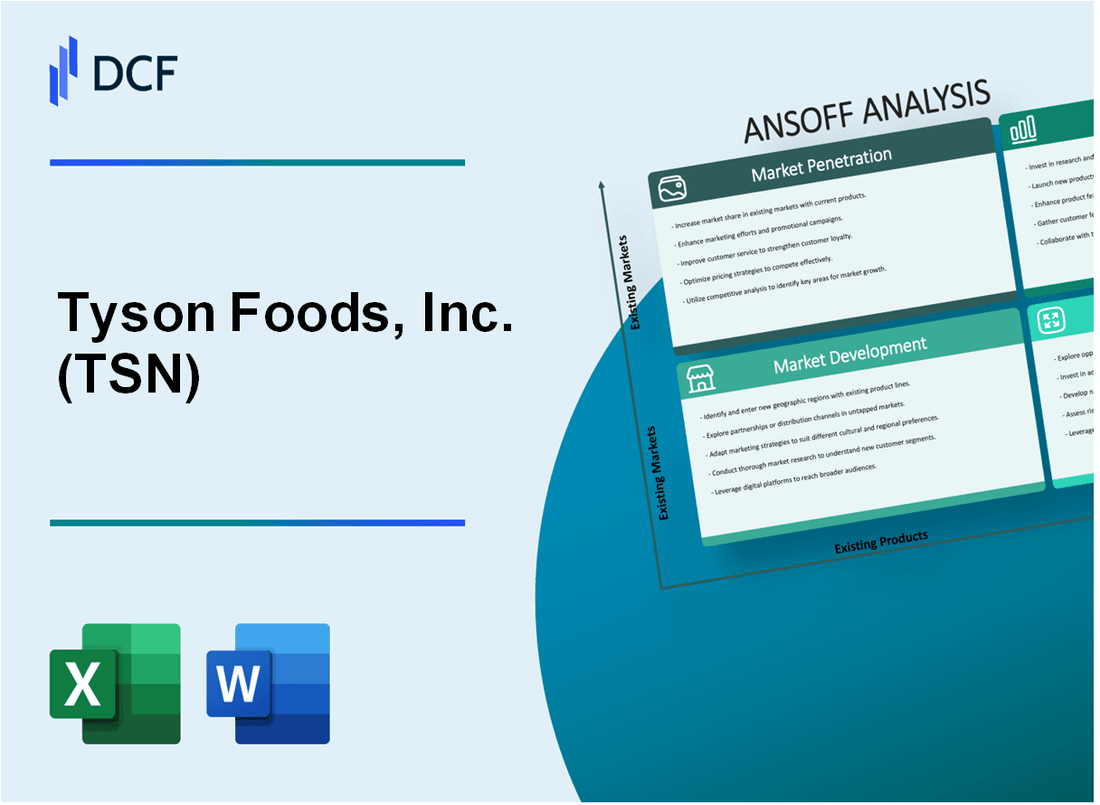
شركة تايسون فودز (TSN): تحليل مصفوفة أنسوف |
Fully Editable: Tailor To Your Needs In Excel Or Sheets
Professional Design: Trusted, Industry-Standard Templates
Investor-Approved Valuation Models
MAC/PC Compatible, Fully Unlocked
No Expertise Is Needed; Easy To Follow
Tyson Foods, Inc. (TSN) Bundle
في العالم الديناميكي لإنتاج البروتين والابتكار الغذائي، تقف شركة Tyson Foods على مفترق طرق التحول الاستراتيجي، حيث تستخدم مصفوفة Ansoff القوية كبوصلة للتنقل في المناظر الطبيعية المعقدة للسوق. ومن خلال الاستكشاف الدقيق للمسارات من اختراق السوق إلى التنويع الجريء، لا تتكيف الشركة مع تفضيلات المستهلكين المتغيرة فحسب، بل تعيد تشكيل مستقبل استهلاك البروتين بشكل استباقي عبر الأسواق العالمية. يكشف هذا المخطط الاستراتيجي عن رؤية تايسون الطموحة لتجاوز معالجة اللحوم التقليدية، واحتضان الابتكار التكنولوجي، والاستدامة، واتجاهات المستهلك الناشئة بدقة محسوبة وروح المبادرة.
شركة تايسون فودز (TSN) - مصفوفة أنسوف: اختراق السوق
توسيع قنوات التوزيع لمنتجات اللحوم الموجودة
تعمل شركة Tyson Foods في 31 ولاية ولديها 139 منشأة إنتاج. وفي السنة المالية 2022، حققت الشركة 53.7 مليار دولار من إجمالي الإيرادات. يمتد توزيع منتجات اللحوم إلى أكثر من 130 دولة حول العالم.
| قناة التوزيع | اختراق السوق | مساهمة الإيرادات السنوية |
|---|---|---|
| محلات البقالة | 78% من إجمالي مبيعات اللحوم | 24.3 مليار دولار |
| مطاعم | 22% من إجمالي مبيعات اللحوم | 11.8 مليار دولار |
زيادة الإنفاق التسويقي
خصصت شركة Tyson Foods مبلغ 412 مليون دولار أمريكي لتغطية نفقات التسويق في عام 2022، وهو ما يمثل 0.77% من إجمالي الإيرادات.
- ميزانية تسويق خط إنتاج البروتين المتميز: 89 مليون دولار
- الاستثمار في التسويق الرقمي: 63 مليون دولار
- الإنفاق الإعلاني للعلامة التجارية: 146 مليون دولار
تنفيذ الحملات الترويجية المستهدفة
معدل الاحتفاظ بالعملاء: 68%. عضوية برنامج الولاء: 2.3 مليون عضو نشط.
تحسين استراتيجيات التسعير
| فئة المنتج | متوسط السعر | القدرة التنافسية في السوق |
|---|---|---|
| منتجات الدجاج | 3.45 دولار/رطل | 2-5% أقل من أسعار المنافسين |
| منتجات لحوم البقر | 7.20 دولار/جنيه | 3-4% أسعار تنافسية |
تعزيز قنوات البيع المباشرة للمستهلك
نمو المبيعات عبر الإنترنت: 22% في عام 2022. إيرادات التجارة الإلكترونية: 1.2 مليار دولار.
- مستخدمو المنصات الرقمية: 1.7 مليون
- تنزيلات تطبيقات الهاتف المحمول: 980.000
- متوسط قيمة الطلب عبر الإنترنت: 87 دولارًا
شركة تايسون فودز (TSN) - مصفوفة أنسوف: تطوير السوق
فرص التوسع الدولي في الأسواق الناشئة
أعلنت شركة تايسون فودز عن مبيعات دولية بلغت 5.2 مليار دولار أمريكي في السنة المالية 2022. ومن المتوقع أن ينمو استهلاك البروتين العالمي بنسبة 14% بحلول عام 2030، حيث تمثل الأسواق الناشئة 70% من هذا النمو.
| المنطقة | نمو الطلب على البروتين المتوقع | إمكانات السوق |
|---|---|---|
| آسيا والمحيط الهادئ | 18.5% | 127 مليار دولار |
| الشرق الأوسط | 15.3% | 42 مليار دولار |
| أمريكا اللاتينية | 16.7% | 89 مليار دولار |
استهداف شرائح العملاء الجديدة
من المتوقع أن يصل سوق البروتين النباتي إلى 85.6 مليار دولار أمريكي بحلول عام 2030. وينمو قطاع المستهلكين المهتمين بالصحة بنسبة 8.5% سنويًا.
- حصة سوق البروتين النباتي: 4.2% من إجمالي سوق البروتين
- يمثل المستهلكون الذين يركزون على الصحة 62% من مستهلكي البروتين
- مبيعات منتجات البروتين البديلة: 7.4 مليار دولار في عام 2022
الشراكات الدولية الاستراتيجية
تعمل شركة Tyson Foods حاليًا في 25 دولة ولديها 79 منشأة إنتاج على المستوى الدولي.
| منطقة الشراكة | قنوات التوزيع | قيمة الاستثمار |
|---|---|---|
| الصين | 12 شبكة بيع بالتجزئة | 340 مليون دولار |
| البرازيل | 8 شبكات توزيع | 275 مليون دولار |
| المكسيك | 15 قناة للبيع بالتجزئة | 210 مليون دولار |
توسيع عرض المنتج
تقدر قيمة السوق العالمية لتجهيز اللحوم بـ 1.2 تريليون دولار بمعدل نمو سنوي 6.3%.
- ميزانية تطوير المنتجات الجديدة: 124 مليون دولار في عام 2022
- الاستثمار في البحث والتطوير: 3.7% من إجمالي الإيرادات
- متغيرات المنتجات الدولية: 42 عرضًا جديدًا
استراتيجية منصة التجارة الإلكترونية
من المتوقع أن تصل مبيعات الأغذية العالمية عبر الإنترنت إلى 360 مليار دولار بحلول عام 2025.
| قناة التجارة الإلكترونية | حجم المبيعات | معدل النمو |
|---|---|---|
| الموقع المباشر | 215 مليون دولار | 22.5% |
| منصات الطرف الثالث | 167 مليون دولار | 18.3% |
| تطبيقات الهاتف المحمول | 93 مليون دولار | 15.7% |
شركة تايسون فودز (TSN) – مصفوفة أنسوف: تطوير المنتجات
تقديم المزيد من خطوط إنتاج البروتين النباتي والبديل
استثمرت شركة Tyson Foods 150 مليون دولار في مشاريع البروتين البديل في عام 2022. ووصل سوق البروتين النباتي إلى 7.1 مليار دولار في عام 2022، مع نمو متوقع إلى 15.8 مليار دولار بحلول عام 2027.
| خط المنتج | حصة السوق | الإيرادات |
|---|---|---|
| مرفوع & المنتجات النباتية ذات الجذور | 3.2% | 85 مليون دولار |
| النقانق النباتية Aidells | 2.7% | 62 مليون دولار |
تطوير منتجات اللحوم العضوية المتميزة
ونما قطاع اللحوم العضوية بنسبة 10.4% في عام 2022 ليصل إلى 3.6 مليار دولار. حقق خط اللحوم المتميز من تايسون إيرادات بقيمة 275 مليون دولار.
- زيادة خط إنتاج الدجاج العضوي بنسبة 12.7%
- توسعت منتجات لحوم البقر الممتازة بنسبة 8.5%
أنشئ حلولاً مبتكرة وجاهزة للطهي لوجبات البروتين المريحة
تبلغ قيمة سوق البروتين المريح 12.4 مليار دولار في عام 2022. وقد حقق قطاع الوجبات الجاهزة في تايسون إيرادات بقيمة 1.2 مليار دولار.
| فئة المنتج | حجم المبيعات | نمو السوق |
|---|---|---|
| أطقم الوجبات المجمدة | 42 مليون وحدة | 7.6% |
| عبوات البروتين المطبوخة مسبقاً | 58 مليون وحدة | 9.3% |
توسيع عروض منتجات اللحوم المستدامة والصديقة للبيئة
يقدر سوق البروتين المستدام بمبلغ 4.8 مليار دولار في عام 2022. وخصص تايسون 200 مليون دولار لتطوير البروتين المستدام.
- خفض انبعاثات الكربون بنسبة 13.5% في إنتاج البروتين
- تنفيذ تقنيات الحفاظ على المياه في 67% من المرافق
الاستثمار في البحث والتطوير في مجال تقنيات البروتين
وصل الاستثمار في البحث والتطوير إلى 325 مليون دولار في عام 2022. وزادت ميزانية ابتكار تكنولوجيا البروتين بنسبة 18.6% عن العام السابق.
| مجال التركيز على البحث والتطوير | الاستثمار | النتيجة المتوقعة |
|---|---|---|
| البروتين القائم على الخلايا | 95 مليون دولار | تطوير النموذج التجاري |
| تقنيات تخمير البروتين | 78 مليون دولار | إنشاء تنسيق بروتين جديد |
شركة تايسون فودز (TSN) - مصفوفة أنسوف: التنويع
الاستثمار في التكامل الرأسي من خلال الاستحواذ على شركات التكنولوجيا الزراعية
استثمرت شركة Tyson Foods 150 مليون دولار في رأس المال الاستثماري من خلال Tyson Ventures في عام 2018. واستحوذت الشركة على حصة أقلية في شركة Future Meat Technologies، وهي شركة إسرائيلية ناشئة متخصصة في اللحوم المستنبتة، في عام 2021.
| فئة الاستثمار | المبلغ | سنة |
|---|---|---|
| تخصيص رأس المال الاستثماري | 150 مليون دولار | 2018 |
| الاستثمار في تقنيات اللحوم المستقبلية | حصة الأقلية | 2021 |
استكشف تقنيات إنتاج البروتين المستدامة والشركات الناشئة
استثمر تايسون في شركة Memphis Meats، وهي شركة تكنولوجيا اللحوم القائمة على الخلايا، بمبلغ لم يكشف عنه في عام 2018.
- استثمرت في تقنيات البروتين البديلة
- التركيز على أساليب إنتاج اللحوم المستدامة
- ملتزمون بالحد من الأثر البيئي
تطوير خطوط إنتاج الأغذية الغذائية والوظيفية
أطلقت تايسون منتجات البروتين النباتي التي حققت مبيعات بقيمة 406 مليون دولار في عام 2020.
| فئة المنتج | إيرادات المبيعات | سنة |
|---|---|---|
| منتجات البروتين النباتية | 406 مليون دولار | 2020 |
التوسع في قطاعات الخدمات الغذائية وتكنولوجيا الأغذية ذات الصلة
أعلنت شركة Tyson Foods عن إيرادات إجمالية بلغت 47.05 مليار دولار أمريكي في عام 2021، مع استثمارات كبيرة في الحلول الغذائية القائمة على التكنولوجيا.
إنشاء مشاريع مشتركة استراتيجية في مجالات البروتين والابتكار الزراعي الناشئة
وشكل تايسون مشروعًا مشتركًا مع شركة Protix الهولندية في عام 2018 لتطوير تقنيات بروتين الحشرات.
- استكشاف مصادر البروتين البديلة
- الاستثمار في التقنيات الزراعية المبتكرة
- إنتاج البروتين المستدام المستهدف
Tyson Foods, Inc. (TSN) - Ansoff Matrix: Market Penetration
Market Penetration for Tyson Foods, Inc. (TSN) centers on deepening market share within existing product categories and geographies, primarily by increasing sales velocity of established brands.
For branded chicken, the strategy involves increasing promotional spend to capitalize on the segment's strong performance, which delivered an adjusted operating income (AOI) of $1.48 billion for fiscal year 2025, up from $1.02 billion in fiscal year 2024. This push is supported by consumer data showing Tyson branded frozen value-added chicken grew by 8.7 percent over the 13 weeks ending in September 2025, significantly outpacing the overall food and beverage retail volume decline of 1.5 percent in the same period.
Aggressively targeting competitor shelf space in the US retail frozen aisle is being executed through product innovation that resonates with current consumer trends. The Caseyville expansion, a $180 million investment, is specifically designed to boost the distribution of US snacking and breakfast items under the Hillshire Farm and Jimmy Dean brands. This facility expansion aims to increase automation and production capacity for these grab-n-go formats.
The struggling Beef segment requires optimization through restructuring to stem financial bleed. The segment posted an adjusted operating loss of $426 million for the full fiscal year 2025, widening from a $291 million loss in the prior year. The prompt targets stemming the $1.14 billion fiscal 2025 loss, which aligns closely with the unadjusted loss reported for the segment. Restructuring includes closing the Lexington, Nebraska beef facility and converting the Amarillo, Texas facility to a single, full-capacity shift.
Driving foodservice volume growth involves offering new, convenient formats of existing products to national chains. This aligns with the trend where 80% of independent operators planned menu changes or additions in 2025, and consumers order new or unique items more than 25% of the time. Tyson Foodservice is concentrating on versatile menu solutions that work across all dayparts.
Here's a quick look at the key financial context for these market penetration efforts in fiscal 2025:
| Metric | Value (Fiscal 2025) |
| Chicken Segment Adjusted Operating Income (AOI) | $1.48 billion |
| Beef Segment Adjusted Operating Loss | $426 million |
| Beef Segment Sales | $21.6 billion |
| Total Company Revenue | $54.44 billion |
| Caseyville Expansion Investment | $180 million |
The specific actions for Market Penetration include:
- Increasing promotional spend to drive volume for existing branded chicken products.
- Aggressively targeting competitor shelf space with value-added frozen items, evidenced by 8.7% growth in branded frozen value-added chicken retail volume.
- Utilizing the $180 million Caseyville expansion to increase distribution of snacking and breakfast items.
- Completing Beef segment restructuring, including plant closures, to reduce the $426 million adjusted operating loss.
- Partnering with national chains to introduce new, convenient formats for foodservice volume growth.
The fourth quarter of fiscal 2025 saw the Beef segment post an adjusted operating loss of $94 million, compared to a $71 million loss the prior year, even as sales grew to $5.49 billion from $5.26 billion due to price increases. The company expects the Beef segment to post an adjusted operating loss between $400 million and $600 million for fiscal 2026.
Tyson Foods, Inc. (TSN) - Ansoff Matrix: Market Development
You're looking at how Tyson Foods, Inc. can push its existing products into new territories, which is the core of Market Development. This strategy leans heavily on the company's current financial muscle and established international footprint.
Accelerate expansion of branded, fully-cooked chicken products into new Asian markets like Vietnam or Indonesia.
Tyson Foods, Inc. has already established a presence in Asia, with operations including fully-cooked chicken plants in Malaysia, Thailand, and four in China. The strategic importance of Asia is clear, as the company noted that 64% of expected global protein consumption growth through 2030 is anticipated to come from this region. This focus aligns with the company's past international segment growth target of an annual compounded rate between 18% and 20% over a three-year period announced in December 2021.
Establish new distribution partnerships in Europe to capitalize on the existing fully-cooked chicken plant investments there.
The company's existing European footprint includes fully-cooked chicken plants, established partly through the acquisition of operations in the Netherlands and the United Kingdom from the Brazilian food company BRF. This existing infrastructure is a platform to build upon for new distribution agreements.
Export high-margin Prepared Foods brands, like Jimmy Dean and Hillshire Farm, to Canada and Mexico.
The Prepared Foods segment, which houses these high-margin brands, is expected to generate an adjusted operating income between $950 million and $1.06 billion for fiscal 2026. While the company sold its manufacturing facilities in Mexico in 2014 for $575 million, re-entering or expanding in that market with high-margin branded goods represents a clear Market Development path. Domestically, a recent $180 million investment in the Caseyville, Illinois, facility is boosting production for these exact brands, creating capacity for potential export growth.
Leverage the $3.7 billion liquidity position (as of September 27, 2025) for strategic international joint ventures.
The financial capacity to pursue international joint ventures is substantial. As of September 27, 2025, Tyson Foods, Inc. reported total liquidity of $3.7 billion. This strong cash position supports aggressive moves abroad. For context on the overall business scale, full fiscal year 2025 sales reached $54.44 billion.
Target new US regional grocery chains where current distribution is weak for core protein products.
Market Development isn't just international; it's about new domestic channels too. The company's overall sales for the full fiscal year 2025 were $54,441 million. The strategy here is to penetrate areas where the core protein products-beef, pork, and chicken-are currently underrepresented in the retail landscape.
Here's a look at the financial context supporting these strategic moves:
| Financial Metric | Amount/Value | Date/Period |
| Total Liquidity | $3.7 billion | September 27, 2025 |
| Full Fiscal Year 2025 Sales | $54.44 billion | Fiscal Year 2025 |
| Prepared Foods Segment Adj. Operating Income Projection | $950 million to $1.06 billion | Fiscal Year 2026 |
| Caseyville Facility Expansion Investment | $180 million | Announced August 2025 |
| Mexico Facility Sale Proceeds (Historical Anchor) | $575 million | 2014 |
The Market Development focus requires deploying capital efficiently to capture growth in under-tapped geographies and channels. The company's operational strengths in specific segments provide the necessary product base:
- Chicken segment adjusted operating income projection for fiscal 2026 is $1,250 million to $1,500 million.
- Pork segment adjusted operating income projection for fiscal 2026 is $950 million to $1,050 million.
- The company anticipates total company adjusted operating income between $2.1 billion and $2.3 billion for fiscal 2026.
Tyson Foods, Inc. (TSN) - Ansoff Matrix: Product Development
You're looking at where Tyson Foods, Inc. (TSN) is putting its development dollars to work, moving beyond just selling more of what they already have. This is about creating entirely new offerings within existing markets, which is a key lever for growth when you're already a giant with fiscal 2025 sales hitting $54,441 million.
Expand the successful Hillshire® Snacking Dips platform, launched in 2025, with new flavor profiles and larger formats.
The initial Hillshire Snacking Dips platform, which hit shelves in 2025, already targets the convenience trend. Each single-serve package delivers 6 grams of protein. The next step is scaling this success with new flavor combinations and formats, aiming to capture more of the grab-and-go snack occasion.
Introduce premium, seasoned, and marinated pork offerings to mirror the value-added strategy in Chicken.
This mirrors the success seen elsewhere in the portfolio. For instance, in the second quarter of fiscal 2025, the Pork Segment saw adjusted operating income jump 67% year-over-year, marking its strongest second quarter result in three years. This value-added push is critical, especially when you see the Prepared Foods Margin expand by 50 basis points year-over-year in that same quarter. The Chicken Segment also showed strength, posting its best second-quarter adjusted operating income since fiscal 2016.
| Segment | Fiscal 2025 Q2 Adjusted Operating Income Performance |
| Chicken | Best Q2 performance since fiscal 2016 |
| Pork | Increased 67% (strongest Q2 in three years) |
| Prepared Foods Margin | Expanded by 50 basis points year-over-year |
Invest a portion of the $700 million to $1.0 billion projected 2026 capital expenditure into R&D for new prepared meals.
Tyson Foods, Inc. projects capital expenditures for fiscal 2026 to fall between $700 million to $1.0 billion. A specific allocation of this budget must be directed toward Research and Development, focusing on the prepared meals category to drive that value-added mix. Remember, the company was targeting 50% of its volume as value-added by the end of fiscal 2024, so continued R&D investment is the mechanism to push that percentage higher.
Launch a line of high-protein, ready-to-eat meals targeting the growing health-conscious consumer segment.
This directly addresses evolving consumer focus. The Hillshire Snacking Dips already feature 6 grams of protein per serving, setting a precedent for protein content in new ready-to-eat formats. The goal is to capture more of the consumer base prioritizing protein in their diets, which CEO Donnie King noted was a focus following the first quarter of 2025 results.
Develop new, lightly breaded and tenderloin chicken products for both retail and foodservice channels.
This involves product innovation within the core Chicken segment, which is a major component of the business. The total company generated an adjusted operating income of $2,287 million in fiscal 2025, with the Chicken segment being a significant contributor. Developing new, convenient formats like lightly breaded items helps capture more foodservice volume and retail share, moving beyond commodity sales.
Finance: finalize the 2026 R&D budget allocation proposal by end of Q1 2026.Tyson Foods, Inc. (TSN) - Ansoff Matrix: Diversification
You're looking at how Tyson Foods, Inc. (TSN) can expand beyond its core meat processing business, which posted total sales of $54.441\text{B}$ in fiscal year 2025. Diversification means new products in new markets, which is where the risk-and the potential reward-really sits.
Acquire a mid-sized, established plant-based protein company to immediately enter the $5.36 billion US plant-based meat market.
You're targeting the US plant-based meat space, which is projected to be worth around $5,356.6\text{ million}$ in 2025. Tyson Foods, Inc. is already listed as a key player in this market, likely through its existing brands. Acquiring an established mid-sized firm gives you immediate shelf space and customer recognition, bypassing the initial product development hurdle. The total US plant-based meat market was valued at USD $3.4\text{ Billion}$ in 2024.
Launch a new brand of sustainable, insect-based protein ingredients for the pet food or aquaculture feed market.
This move targets B2B supply chains rather than direct consumer retail, focusing on feed components. The global demand for protein is expected to double by 2050, with about $60\%$ of the volume growth projected to come from Asia. This strategy leverages Tyson Foods, Inc.'s scale in protein processing for a novel input material.
Enter the functional food space by developing protein-fortified supplements or beverages under a new wellness brand.
This is a product development play into the consumer health segment. For context on the core business performance, Tyson Foods, Inc.'s total company adjusted operating margin for fiscal 2025 was $4.1\%$, with adjusted earnings per share (EPS) at $\$4.12$. Developing a wellness brand requires significant marketing spend to establish trust in a new category, but it taps into the trend of consumers seeking functional benefits from their food.
Establish a completely new, non-meat food processing operation in a high-growth emerging market like India.
Tyson Foods, Inc. has prior experience here; back in 2008, the company took a $51\%$ stake in Godrej Foods, Ltd., forming Godrej Tyson Foods, with initial expected annual sales around US$50\text{m}$. That venture saw Tyson sell its $49\%$ stake in August 2024, making Godrej the full owner. Still, the international segment is a focus, with the company having invested in seven new international plants, six of which are in Asia, as of 2023 data.
Invest in cellular agriculture (cultivated meat) technology to secure a long-term position in alternative protein production.
Tyson Foods, Inc. has already made moves here through Tyson Ventures. In 2018, the venture capital arm co-led a $\$2.2\text{ million}$ seed investment in Future Meat Technologies, an Israeli company focused on cell-cultured meats. This investment was one of several into the space, including an investment in Memphis Meats in 2018. This positions Tyson Foods, Inc. for future technology shifts, even if the initial financial outlay was relatively small compared to core operations.
Here's a quick look at some of the relevant financial and market figures associated with these diversification vectors:
| Metric / Market Segment | Value / Amount | Year / Context |
| Tyson Foods, Inc. (TSN) FY 2025 Sales | $54.441\text{B}$ | Fiscal Year 2025 |
| US Plant-Based Meat Market Projection | $5,356.6\text{ million}$ | 2025 Estimate |
| Tyson Ventures Cellular Ag Investment | $\$2.2\text{ million}$ | Seed round in Future Meat Technologies (2018) |
| Godrej Tyson Foods Initial Annual Sales Expectation | US$50\text{m}$ | Initial projection for India JV (2008) |
| Tyson Foods FY 2025 Adjusted EPS | $\$4.12$ | Fiscal Year 2025 |
| Tyson Foods FY 2025 Adjusted Operating Margin | $4.1\%$ | Non-GAAP, Fiscal Year 2025 |
The company's largest customer, Walmart Inc., accounted for $18.7\%$ of consolidated sales in fiscal 2025. Finance: draft 13-week cash view by Friday.
Disclaimer
All information, articles, and product details provided on this website are for general informational and educational purposes only. We do not claim any ownership over, nor do we intend to infringe upon, any trademarks, copyrights, logos, brand names, or other intellectual property mentioned or depicted on this site. Such intellectual property remains the property of its respective owners, and any references here are made solely for identification or informational purposes, without implying any affiliation, endorsement, or partnership.
We make no representations or warranties, express or implied, regarding the accuracy, completeness, or suitability of any content or products presented. Nothing on this website should be construed as legal, tax, investment, financial, medical, or other professional advice. In addition, no part of this site—including articles or product references—constitutes a solicitation, recommendation, endorsement, advertisement, or offer to buy or sell any securities, franchises, or other financial instruments, particularly in jurisdictions where such activity would be unlawful.
All content is of a general nature and may not address the specific circumstances of any individual or entity. It is not a substitute for professional advice or services. Any actions you take based on the information provided here are strictly at your own risk. You accept full responsibility for any decisions or outcomes arising from your use of this website and agree to release us from any liability in connection with your use of, or reliance upon, the content or products found herein.