
|
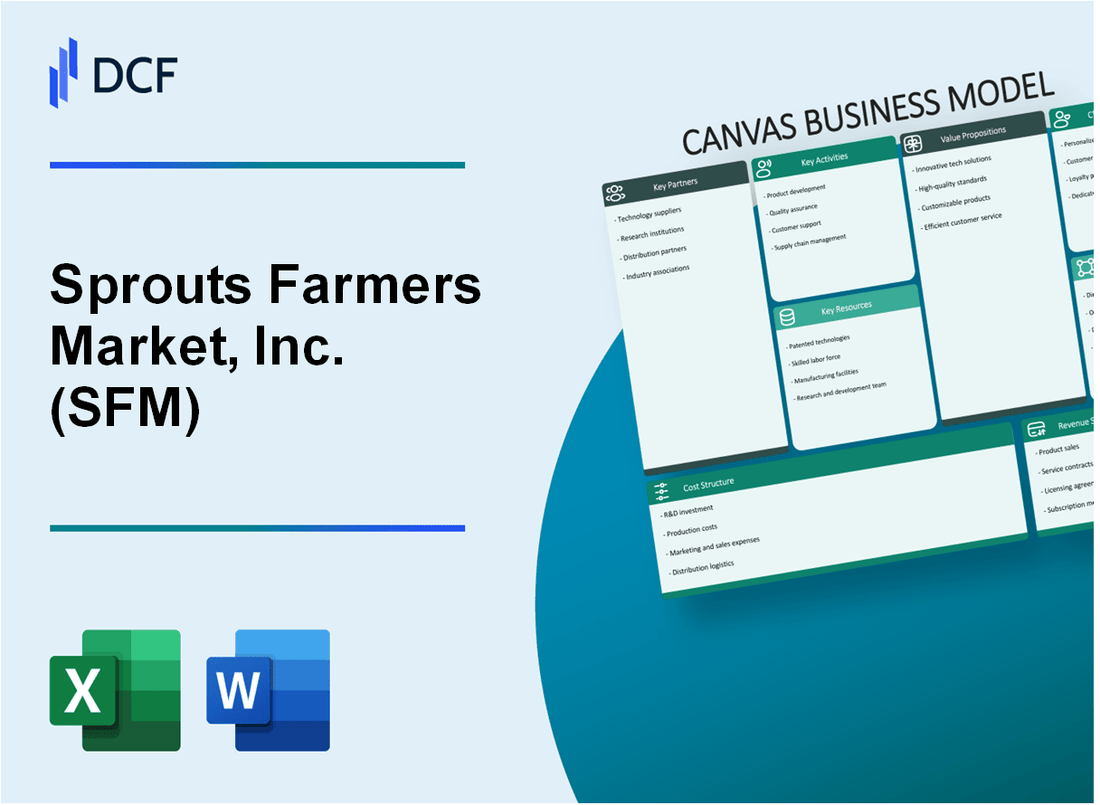
Sprouts Farmers Market, Inc. (SFM): Business Model Canvas |
Fully Editable: Tailor To Your Needs In Excel Or Sheets
Professional Design: Trusted, Industry-Standard Templates
Investor-Approved Valuation Models
MAC/PC Compatible, Fully Unlocked
No Expertise Is Needed; Easy To Follow
Sprouts Farmers Market, Inc. (SFM) Bundle
In der dynamischen Landschaft des gesundheitsbewussten Lebensmitteleinzelhandels erweist sich Sprouts Farmers Market als eine transformative Kraft, die frische Bio-Angebote mit einem innovativen Geschäftsansatz verbindet, der bei modernen Verbrauchern, die Wellness und nachhaltige Ernährung suchen, großen Anklang findet. Durch die sorgfältige Ausarbeitung eines einzigartigen Geschäftsmodells, das lokale Beschaffung, wettbewerbsfähige Preise und ganzheitliche Einkaufserlebnisse in den Vordergrund stellt, hat sich Sprouts eine besondere Nische im umkämpften Lebensmittelmarkt geschaffen und lockt Gesundheitsbegeisterte und umweltbewusste Käufer an, die sich nach mehr als nur Essen sehnen – sie streben nach einer Lifestyle-Revolution.
Sprouts Farmers Market, Inc. (SFM) – Geschäftsmodell: Wichtige Partnerschaften
Lokale und regionale Landwirte für die Beschaffung frischer Produkte
Im Jahr 2024 bezieht Sprouts seine Produkte von etwa 1.200 lokalen und regionalen Landwirten in 23 Bundesstaaten. Das Unternehmen unterhält direkte Partnerschaften mit über 300 Bio-Bauernhöfen.
| Kategorie „Partnerschaft“. | Anzahl der Partnerschaften | Jährlicher Beschaffungswert |
|---|---|---|
| Lokale Bio-Bauernhöfe | 312 | 287,5 Millionen US-Dollar |
| Regionale Produktlieferanten | 890 | 425,3 Millionen US-Dollar |
Lieferanten von Bio- und Naturlebensmitteln
Sprouts unterhält strategische Partnerschaften mit über 500 Bio- und Naturkostlieferanten im ganzen Land.
- Auf die Top 10 der nationalen Bio-Lieferanten entfallen 35 % der gesamten Beschaffung von Naturprodukten
- Durchschnittliche Dauer der Lieferantenbeziehung: 4,7 Jahre
- Einhaltung der Nachhaltigkeitsstandards durch Lieferanten: 92 %
Vertriebs- und Logistikpartner
Sprouts arbeitet mit sieben Hauptvertriebszentren und zwölf externen Logistikanbietern zusammen, um den Lieferkettenbetrieb zu verwalten.
| Logistikpartner | Lagerkapazität | Jährliches Transportvolumen |
|---|---|---|
| C.H. Robinson | 380.000 Quadratfuß | 1,2 Millionen Paletten |
| XPO Logistik | 425.000 Quadratfuß | 1,5 Millionen Paletten |
Technologieanbieter für E-Commerce und Bestandsmanagement
Sprouts investiert jährlich 42,3 Millionen US-Dollar in Technologiepartnerschaften für die digitale Infrastruktur.
- SAP für Enterprise Resource Planning
- Oracle Cloud für die Bestandsverwaltung
- Instacart für die Online-Lebensmittellieferung
Nachhaltige Landwirtschafts- und Wellness-Organisationen
Sprouts unterhält Partnerschaften mit 18 nationalen Nachhaltigkeits- und Wellnessorganisationen.
| Organisation | Partnerschaftsfokus | Jährliche Investition in die Zusammenarbeit |
|---|---|---|
| Bio-Handelsverband | Bio-Zertifizierungsstandards | 1,2 Millionen US-Dollar |
| Amerikanische Herzvereinigung | Ernährungs-Wellness-Programme | $850,000 |
Sprouts Farmers Market, Inc. (SFM) – Geschäftsmodell: Hauptaktivitäten
Betrieb von Einzelhandels-Lebensmittelgeschäften
Im vierten Quartal 2023 betreibt Sprouts Farmers Market 399 Geschäfte in 23 Bundesstaaten. Jährliche Ladenfläche: ca. 30.000 Quadratmeter pro Standort. Gesamtverkaufsfläche: 11,97 Millionen Quadratfuß.
| Metrisch | Wert |
|---|---|
| Gesamtzahl der Geschäfte | 399 |
| Staaten betrieben | 23 |
| Durchschnittliche Ladengröße | 30.000 Quadratfuß |
Produktbeschaffung und Qualitätskontrolle
Jährliches Beschaffungsbudget: 4,3 Milliarden US-Dollar. Anteil Bio-Produkte: 40 %. Anzahl direkter Lieferantenbeziehungen: 1.200+.
- Bio-Produktbeschaffung von lokalen und regionalen Bauernhöfen
- Strenge Qualitätskontrollprotokolle
- Anforderungen an die Nachhaltigkeitszertifizierung
Bestandsverwaltung
Lagerumschlagsrate: 13,5 Mal pro Jahr. Jährlicher Lagerwert: 312 Millionen US-Dollar. Technologieinvestitionen in Bestandsverfolgungssysteme: 18,7 Millionen US-Dollar im Jahr 2023.
| Bestandsmetrik | Wert |
|---|---|
| Fluktuationsrate | 13,5x |
| Jährlicher Lagerwert | 312 Millionen Dollar |
| Technologieinvestitionen | 18,7 Millionen US-Dollar |
Kundenerlebnis und Merchandising
Mitgliedschaft im Kundenbindungsprogramm: 18,6 Millionen Mitglieder. Durchschnittlicher Transaktionswert: 38,50 $. Wöchentlicher Kundenverkehr: 1,2 Millionen.
- Personalisiertes Einkaufserlebnis
- Produktvorführungen im Geschäft
- Fokus auf Gesundheits- und Wellnessprodukte
Marketing- und Werbekampagnen
Jährliche Marketingausgaben: 127 Millionen US-Dollar. Budget für digitales Marketing: 42 % der gesamten Marketingausgaben. Social-Media-Follower: 1,4 Millionen auf allen Plattformen.
| Marketingmetrik | Wert |
|---|---|
| Jährliche Marketingausgaben | 127 Millionen Dollar |
| Prozentsatz des digitalen Marketings | 42% |
| Social-Media-Follower | 1,4 Millionen |
Sprouts Farmers Market, Inc. (SFM) – Geschäftsmodell: Schlüsselressourcen
Umfangreiches Netzwerk an Lebensmittelfachgeschäften
Im vierten Quartal 2023 betreibt Sprouts Farmers Market 388 Geschäfte in 23 Bundesstaaten. Die Filialpräsenz des Unternehmens umfasst:
| Region | Anzahl der Geschäfte |
|---|---|
| Westküste | 156 |
| Südwesten | 87 |
| Süden | 68 |
| Südosten | 47 |
| Mittlerer Westen | 30 |
Starker Markenruf bei natürlichen und biologischen Lebensmitteln
Kennzahlen zum Markenwert für Sprouts Farmers Market:
- Markenbekanntheit: 68 % bei gesundheitsbewussten Verbrauchern
- Kundenbindungsrate: 52 %
- Social-Media-Follower: 1,2 Millionen
Qualifizierte Arbeitskräfte mit Fachwissen in den Bereichen Ernährung und Einzelhandel
Zusammensetzung der Belegschaft ab 2023:
| Mitarbeiterkategorie | Anzahl der Mitarbeiter |
|---|---|
| Gesamtzahl der Mitarbeiter | 16,500 |
| Mitarbeiter auf Filialebene | 14,200 |
| Unternehmensmitarbeiter | 2,300 |
Fortschrittliche Lieferketten- und Bestandssysteme
Kennzahlen zur Lieferkette und Bestandsleistung:
- Lagerumschlagsquote: 12,5x
- Durchschnittliche Lagerdauer: 29 Tage
- Investitionen in die Supply-Chain-Technologie: 24,3 Millionen US-Dollar im Jahr 2023
Eigene Produktauswahl und Private-Label-Angebote
Leistung von Private-Label-Produkten:
| Produktkategorie | Jahresumsatz | Marktanteil |
|---|---|---|
| Bio-Produkte der Marke Sprouts | 327 Millionen Dollar | 18% |
| Natürliche Produkte der Marke Sprouts | 214 Millionen Dollar | 12% |
Sprouts Farmers Market, Inc. (SFM) – Geschäftsmodell: Wertversprechen
Frische, hochwertige Bio- und Naturlebensmittel
Im vierten Quartal 2023 bot Sprouts in seinen 385 Filialen 14.500 Bio- und Naturprodukte an. Das Unternehmen erzielte einen Jahresumsatz von 6,2 Milliarden US-Dollar, wobei der Verkauf von Bio-Produkten 42 % des gesamten Lebensmittelumsatzes ausmachte.
| Produktkategorie | Prozentsatz des Umsatzes | Jahresumsatz |
|---|---|---|
| Bio-Produkte | 23% | 1,426 Milliarden US-Dollar |
| Natürliche Lebensmittel | 19% | 1,178 Milliarden US-Dollar |
Wettbewerbsfähige Preise für gesundheitsbewusste Verbraucher
Der durchschnittliche Preis für Bio-Produkte ist im Vergleich zu traditionellen Lebensmitteleinzelhändlern 15–20 % niedriger. Sprouts erzielt eine Bruttomarge von 31,2 % und bietet gleichzeitig wettbewerbsfähige Preise.
Große Auswahl an speziellen Diätprodukten
- Glutenfreie Produkte: 2.300 einzigartige SKUs
- Vegane Produkte: 1.800 einzigartige SKUs
- Keto-freundliche Produkte: 1.500 einzigartige SKUs
Lokale und nachhaltige Lebensmittelbeschaffung
Im Jahr 2023 bezog Sprouts 35 % der Produkte von lokalen Landwirten im Umkreis von 500 Meilen um die Filialen und investierte 412 Millionen US-Dollar in lokale Agrarpartnerschaften.
Ganzheitliches, auf Wellness und Ernährung ausgerichtetes Einkaufserlebnis
| Kennzahlen des Wellness-Programms | Daten für 2023 |
|---|---|
| Wellness-Club-Mitglieder | 2,3 Millionen |
| Durchschnittliche Wellness-Programmausgaben pro Mitglied | $487 |
Sprouts Farmers Market, Inc. (SFM) – Geschäftsmodell: Kundenbeziehungen
Personalisierte Treueprogramme
Sprouts Farmers Market betreibt die Sprouts Market Corner Rewards-Programm, die im Jahr 2023 etwa 16,5 Millionen aktive Mitglieder hatte. Das Treueprogramm generiert 70 % des gesamten Transaktionsvolumens durch digitale und physische Karteninteraktionen.
| Programmmetrik | Daten für 2023 |
|---|---|
| Aktive Mitglieder | 16,5 Millionen |
| Transaktionsvolumen über Prämien | 70% |
| Durchschnittliche Ersparnisse für Mitglieder | 425 $ jährlich |
Digitales Engagement durch mobile App und Website
Die digitalen Plattformen von Sprouts verzeichneten im Jahr 2023 8,2 Millionen aktive digitale Nutzer, wobei die Downloads mobiler Apps im Jahresvergleich um 22 % stiegen.
- Downloads mobiler Apps: 3,6 Millionen
- Einzigartige monatliche Besucher der Website: 4,6 Millionen
- Einlösungsrate für digitale Coupons: 45 %
Ernährungsberatung und Produktschulung im Geschäft
Sprouts beschäftigt 250 engagierte Ernährungsspezialisten in 400 Filialen und bietet personalisierte Gesundheits- und Wellnessberatung an.
| Bildungsdienst | Kennzahlen für 2023 |
|---|---|
| Ernährungsspezialisten | 250 |
| Filialstandorte | 400 |
| Kostenlose Ernährungsberatung | 52.000 jährlich |
Community-orientierte Marketinginitiativen
Sprouts investierte im Jahr 2023 12,3 Millionen US-Dollar in lokale Community-Marketing-Programme und unterstützte damit 1.875 lokale Landwirte und nachhaltige Produzenten.
- Lokale Produzentenpartnerschaften: 1.875
- Community-Marketing-Investition: 12,3 Millionen US-Dollar
- Lokale Event-Sponsorings: 425
Reaktionsschnelle Kundendienstkanäle
Sprouts verfolgt einen Multi-Channel-Kundenserviceansatz mit einer Kundenzufriedenheitsbewertung von 92 % im Jahr 2023.
| Servicekanal | Antwortmetriken |
|---|---|
| Telefonsupport | Durchschnittliche Wartezeit: 2,7 Minuten |
| E-Mail-Support | Antwort innerhalb von 24 Stunden: 96 % |
| Reaktion in den sozialen Medien | Durchschnittliche Antwortzeit: 3,2 Stunden |
| Kundenzufriedenheit | 92% |
Sprouts Farmers Market, Inc. (SFM) – Geschäftsmodell: Kanäle
Physische Einzelhandelsgeschäfte
Im vierten Quartal 2023 betreibt Sprouts Farmers Market 389 Geschäfte in 23 Bundesstaaten der Vereinigten Staaten.
| Store-Metrik | Daten für 2023 |
|---|---|
| Gesamtzahl der Filialen | 389 |
| Abgedeckte Staaten | 23 |
| Durchschnittliche Ladengröße | 28.000 Quadratfuß. |
E-Commerce-Plattform
Sprouts bietet Online-Shopping über mehrere digitale Kanäle mit Partnerschaften an.
- Instacart-Partnerschaft für die Lieferung nach Hause
- Integration des Versandlieferdienstes
- Präsenz auf dem Amazon Fresh-Marktplatz
Mobile Shopping-Anwendung
Zu den Funktionen der mobilen App von Sprouts gehören digitale Gutscheine und die Integration von Treueprogrammen.
| App-Leistung | Kennzahlen für 2023 |
|---|---|
| App-Downloads | 1,2 Millionen |
| Aktive monatliche Benutzer | 680,000 |
Social-Media-Marketing
Sprouts unterhält eine aktive Social-Media-Präsenz auf mehreren Plattformen.
| Soziale Plattform | Follower-Anzahl (2023) |
|---|---|
| 342,000 | |
| 589,000 | |
| 87,000 |
Direkte E-Mail und digitale Kommunikation
Sprouts nutzt E-Mail-Marketing für Kundenbindung und Werbeaktionen.
- Wöchentliches digitales Rundschreiben
- Personalisierte Werbe-E-Mails
- Kommunikation über Treueprogramme
| E-Mail-Marketing-Metrik | Daten für 2023 |
|---|---|
| E-Mail-Abonnenten | 3,4 Millionen |
| Durchschnittliche Öffnungsrate | 22.5% |
Sprouts Farmers Market, Inc. (SFM) – Geschäftsmodell: Kundensegmente
Gesundheitsbewusste Verbraucher
Im Jahr 2023 legen 63 % der US-Verbraucher beim Lebensmitteleinkauf Wert auf Gesundheit und Wohlbefinden. Sprouts richtet sich mit spezifischen Ernährungsangeboten an diese Zielgruppe.
| Demografisches Merkmal | Prozentsatz |
|---|---|
| Altersgruppe 25–44 Gesundheitsorientierte Käufer | 42% |
| Jährliches Haushaltseinkommen über 75.000 US-Dollar | 55% |
| Gesundheitskonsumenten mit Hochschulabschluss | 48% |
Liebhaber von Bio- und Naturkost
Der Bio-Lebensmittelmarkt erreichte im Jahr 2022 67,18 Milliarden US-Dollar, wobei Sprouts einen bedeutenden Marktanteil eroberte.
- Häufigkeit des Kaufs von Bio-Lebensmitteln: 3-4 Mal pro Monat
- Durchschnittliche Ausgaben für Bio-Produkte: 145 US-Dollar pro Haushalt im Monat
- Hauptkategorien von Bio-Produkten: Obst und Gemüse, Milchprodukte und Fleisch
Umweltbewusste Käufer
67 % der Verbraucher achten beim Lebensmitteleinkauf auf Nachhaltigkeit.
| Nachhaltigkeitsmetrik | Verbraucherprozentsatz |
|---|---|
| Bereit, für nachhaltige Produkte einen Aufpreis zu zahlen | 59% |
| Bevorzugen Sie Geschäfte mit umweltfreundlichen Praktiken | 72% |
Anhänger spezieller Diäten
Wachstum des Spezialdiätmarktes im Jahr 2022: 8,5 % im Jahresvergleich.
- Markt für glutenfreie Produkte: 7,6 Milliarden US-Dollar
- Markt für vegane Produkte: 5,4 Milliarden US-Dollar
- Markt für Keto-Diätprodukte: 4,2 Milliarden US-Dollar
Stadt- und Vorstadtbevölkerung mit mittlerem bis höherem Einkommen
Angestrebter demografischer Einkommensbereich: 75.000 bis 150.000 US-Dollar pro Jahr.
| Einkommenssegment | Marktdurchdringung |
|---|---|
| Städtische Gebiete | 62% |
| Vorstadtgebiete | 73% |
| Durchschnittliches Haushaltseinkommen am Standort des Geschäfts | $98,500 |
Sprouts Farmers Market, Inc. (SFM) – Geschäftsmodell: Kostenstruktur
Ladenbetrieb und -wartung
Im Geschäftsjahr 2023 meldete Sprouts Gesamtbetriebskosten für Filialen in Höhe von 1,52 Milliarden US-Dollar. Die jährlichen Kosten für die Instandhaltung und Belegung der Filialen beliefen sich auf etwa 458 Millionen US-Dollar.
| Kostenkategorie | Jährliche Ausgaben |
|---|---|
| Miet- und Pachtkosten | 312 Millionen Dollar |
| Dienstprogramme | 89 Millionen Dollar |
| Anlagenwartung | 57 Millionen Dollar |
Löhne und Schulung der Mitarbeiter
Die gesamten Arbeitskosten für Sprouts beliefen sich im Jahr 2023 auf 1,1 Milliarden US-Dollar, was etwa 25 % des Gesamtumsatzes entspricht.
- Durchschnittlicher Stundenlohn: 15,23 $
- Jährliche Schulungsinvestition: 22,5 Millionen US-Dollar
- Zuweisung von Leistungen an Arbeitnehmer: 187 Millionen US-Dollar
Bestandsbeschaffung
Die Herstellungskosten (COGS) für Sprouts beliefen sich im Geschäftsjahr 2023 auf 5,84 Milliarden US-Dollar.
| Beschaffungskategorie | Jährliche Ausgaben |
|---|---|
| Bio-Produkte | 1,2 Milliarden US-Dollar |
| Konventionelle Produkte | 890 Millionen Dollar |
| Verpackte Ware | 1,5 Milliarden US-Dollar |
Marketing- und Werbekosten
Die gesamten Marketingausgaben für 2023 beliefen sich auf 78,6 Millionen US-Dollar.
- Digitales Marketing: 24,3 Millionen US-Dollar
- Traditionelle Werbung: 35,2 Millionen US-Dollar
- Werbekampagnen: 19,1 Millionen US-Dollar
Technologie- und Infrastrukturinvestitionen
Die Ausgaben für Technologie und Infrastruktur beliefen sich im Jahr 2023 auf insgesamt 92,4 Millionen US-Dollar.
| Technologie-Investitionsbereich | Jährliche Ausgaben |
|---|---|
| E-Commerce-Plattform | 27,6 Millionen US-Dollar |
| Point-of-Sale-Systeme | 18,2 Millionen US-Dollar |
| Supply-Chain-Technologie | 46,6 Millionen US-Dollar |
Sprouts Farmers Market, Inc. (SFM) – Geschäftsmodell: Einnahmequellen
Lebensmitteleinzelhandel
Im dritten Quartal 2023 meldete Sprouts Farmers Market einen Gesamtnettoumsatz von 1,63 Milliarden US-Dollar. Das Unternehmen betreibt 395 Filialen in 23 Bundesstaaten mit einer durchschnittlichen Ladengröße von etwa 30.000 Quadratmetern.
| Geschäftsjahr | Gesamtnettoumsatz | Umsatzwachstum im gleichen Geschäft |
|---|---|---|
| 2022 | 6,47 Milliarden US-Dollar | 4.2% |
| 2023 | 6,63 Milliarden US-Dollar | 3.8% |
Private-Label-Produktangebote
Eigenmarkenprodukte erwirtschafteten für Sprouts im Jahr 2022 einen Umsatz von rund 500 Millionen US-Dollar, was etwa 7,7 % des Gesamtumsatzes entspricht.
- Über 3.000 Handelsmarken-SKUs in verschiedenen Kategorien
- Handelsmarken-Bruttomarge ca. 35-40 %
Fertiggerichte und Mahlzeitenlösungen
Das Segment Fertiggerichte trug etwa 250 Millionen US-Dollar zum Jahresumsatz bei, wobei der Schwerpunkt auf frischen, verzehrfertigen Mahlzeiten liegt.
Wellness- und Ernährungsproduktlinien
Der Umsatz in der Wellness-Kategorie erreichte im Jahr 2022 etwa 400 Millionen US-Dollar, mit a 5,6 % Wachstum im Jahresvergleich.
| Produktkategorie | Jahresumsatz | Wachstumsrate |
|---|---|---|
| Vitamine & Ergänzungen | 180 Millionen Dollar | 4.2% |
| Natürliche Gesundheitsprodukte | 220 Millionen Dollar | 6.1% |
Online- und In-Store-Vertriebskanäle
Der E-Commerce-Umsatz erreichte im Jahr 2022 180 Millionen US-Dollar, was 2,8 % des Gesamtumsatzes entspricht. Mit 97,2 % blieben die In-Store-Verkäufe der wichtigste Umsatztreiber.
- Online-Verkaufsplattformen: Direkte Website, Lieferpartnerschaften mit Drittanbietern
- Wachstumsrate des digitalen Umsatzes: 12,3 % im Jahresvergleich
Sprouts Farmers Market, Inc. (SFM) - Canvas Business Model: Value Propositions
You're looking at the core reasons customers choose Sprouts Farmers Market, Inc. over the competition, grounded in their late 2025 operational snapshot. It's all about fresh, curated, and accessible healthy food.
Produce-Forward Format
The store design centers on the fresh departments, mimicking a true farmers market setup to drive initial customer engagement and perceived quality. This layout dedicates nearly 40% of store space to fresh produce.
Differentiated Assortment
Sprouts Farmers Market, Inc. emphasizes products aligning with specific dietary needs and quality attributes. The private label, the Sprouts Brand, is a key differentiator, contributing 24% of total sales in the first quarter of 2025. This brand generated $1.7 billion in sales in 2024. The company continues to innovate within these attribute categories:
- >20% Vegan offerings.
- >30% non-GMO selection.
- >45% organic selection.
- >55% gluten-free selection.
The company launched over 7,100 new products in 2024 alone, keeping the assortment fresh.
Healthy Value
The value proposition balances high quality with competitive pricing, evidenced by strong financial performance driven by sales velocity. For the third quarter ended September 28, 2025, net sales totaled $2.2 billion, marking a 13% increase year-over-year. The gross margin for that quarter stood at 38.7%. The full-year 2025 outlook projects total net sales growth of approximately 14%. Here's a look at the financial performance supporting this value delivery:
| Metric | Q2 2025 Value | Q3 2025 Value |
| Net Sales | Up 17% Year-over-Year | $2.2 billion |
| Comparable Store Sales Growth | 10.2% | 5.9% |
| Gross Margin | 38.8% | 38.7% |
| Diluted EPS | $1.35 | $1.22 |
The company ended Q3 2025 with $322 million in cash and cash equivalents.
Experiential Shopping
The physical store environment is designed to feel like an open, easy-to-navigate farmers market, reinforcing the fresh focus. As of September 28, 2025, Sprouts Farmers Market, Inc. operated 464 stores across 24 states. The company has a long-term goal to expand to more than 1,000 locations nationwide. They opened 9 new stores in the third quarter of 2025, contributing to the overall physical presence.
Finance: draft 13-week cash view by Friday.
Sprouts Farmers Market, Inc. (SFM) - Canvas Business Model: Customer Relationships
Sprouts Rewards: National loyalty program for personalized offers and data
The national rollout of the Sprouts Rewards loyalty program commenced in the second half of 2025, following successful testing in 35 stores. As of the third quarter of 2025, the program has fully launched, showing early indications of increased shopping frequency and sales per customer. This program is central to the aspiration of having a very all-embracing loyalty program that accounts for diverse customer dynamics. Before this initiative, only 15% of customers were identifiable.
The relationship is being quantified through key performance indicators:
| Metric | Value/Status (Late 2025) |
| Loyalty Program Status | Nationwide Rollout Complete (H2 2025) |
| Early Test Program Impact | Higher sign-ups, frequent visits, larger baskets |
| Q3 2025 Comp Sales Growth | 5.9% |
| Identifiable Customers (Pre-Loyalty) | 15% |
Personalized Marketing: Using data to drive hyper-relevant product recommendations
The shift in customer engagement strategy moved from paper-based promotions to personalized digital outreach, leveraging data analytics to tailor product offerings. This data-driven approach aims to create a personalized experience and deliver hyper-relevant product recommendations. The digital ecosystem integration supports this, with e-commerce sales jumping 27% in the second quarter of 2025, representing 15% of total sales. In the third quarter of 2025, e-commerce sales accounted for 15.5% of total sales. The focus on loyalty members is showing results, as they demonstrate stronger engagement and higher spending per basket.
High-Touch Service: Knowledgeable team members in specialty departments
Sprouts Farmers Market, Inc. reinforces customer relationships through in-store expertise, particularly in fresh categories. The company is focused on getting merchandising right, with fresh produce being 20% of sales, and organic fresh produce making up 55% to 60% of that fresh category. Furthermore, the Sprouts Brand now accounts for more than 25% of total sales for the quarter.
- Team members provide expertise in specialty departments.
- Focus on fresh product quality, with 80% of stores within 250 miles of a distribution center.
- The company is in-sourcing fresh meat and seafood distribution, starting in Orlando, Florida.
- The overall store count reached 464 locations across 24 states as of Q3 2025.
Sprouts Farmers Market, Inc. (SFM) - Canvas Business Model: Channels
You're looking at how Sprouts Farmers Market, Inc. gets its products into the hands of its health-conscious shoppers. It's a mix of the tried-and-true physical footprint and a rapidly growing digital layer. Honestly, the physical store is still the engine, but the digital side is what's keeping the growth story compelling.
Retail Stores: Primary Channel
The brick-and-mortar presence remains the core channel for Sprouts Farmers Market, Inc. They focus on a curated, fresh-forward experience. As of the end of the third quarter on September 28, 2025, the company operated exactly 464 locations across 24 states. This physical network is key to their brand promise of fresh, natural, and organic food.
The expansion plan is aggressive; they opened 9 new stores in Q3 2025 alone. For the full year 2025, the plan was to open 37 new stores. They are even planning to open more stores in 2026 than they did in 2025, aiming for 10% unit growth by 2027.
Here's a quick look at the physical footprint as of late 2025:
| Metric | Value | Date/Period |
| Total Retail Locations | 464 | Q3 2025 (Sept 28, 2025) |
| States of Operation | 24 | Q3 2025 |
| New Stores Opened (Q3 2025) | 9 | Q3 2025 |
| Planned New Stores (Full Year 2025) | 37 | Full Year 2025 Guidance |
Digital Commerce
Digital commerce, primarily through third-party partners, is a significant and growing piece of the pie. In Q3 2025, e-commerce sales hit 15.5% of total sales, up from 15% in earlier quarters. That's a remarkable 21% year-over-year growth for the channel in Q3 2025. It's defintely not a small add-on anymore.
The company leans heavily on established delivery platforms to execute this. They partner with Instacart, DoorDash, and Uber Eats to get those online orders fulfilled. What's encouraging for the business is that fresh produce maintains the same percentage of the digital basket as it does in-store, showing customer trust in their digital fulfillment for perishables.
The digital channel performance includes:
- E-commerce Sales as % of Total Sales: 15.5% (Q3 2025)
- Year-over-Year E-commerce Growth: 21% (Q3 2025)
- Total Q3 2025 Net Sales: $2.2 billion
- Key Third-Party Partners: Instacart, DoorDash, Uber Eats
Mobile App/Website
The digital interface is where Sprouts Farmers Market, Inc. drives loyalty and direct engagement. They recently rolled out the Sprouts Rewards loyalty program nationwide, and early results show increased shopping frequency and higher sales per customer among enrolled members. This integration is crucial for creating that omnichannel environment where the customer chooses how to shop.
While the focus is on loyalty and coupons, the app is also the gateway for online ordering. Based on estimates from October 2025, the company was seeing approximately 2,333 daily mobile app downloads. This number shows active customer acquisition for their digital tools, which feed into the personalized offers driven by the loyalty program.
Key digital engagement metrics include:
- Loyalty Program: Sprouts Rewards (nationwide rollout)
- Impact of Loyalty: Increased shopping frequency and sales per customer
- Estimated Daily App Downloads: 2,333 (October 2025)
Sprouts Farmers Market, Inc. (SFM) - Canvas Business Model: Customer Segments
You're looking at the core buyers Sprouts Farmers Market, Inc. is targeting as of late 2025. The company is focused on capturing a specific slice of the massive food retail space.
Health Enthusiasts: Core target customer focused on wellness and food provenance
Sprouts Farmers Market, Inc. is positioned to meet the rising demand from consumers focused on wellness. The overall U.S. food-at-home market is valued at approximately $1.6 trillion. Sprouts' specific target customer segment within this market represents about $290 billion of that opportunity. Management reports that their results are driven by effectively engaging with these target customers, who are on their health journey.
Higher-Income Households: Customers less susceptible to economic downturns
The demographic profile for the core Sprouts Farmers Market, Inc. shopper skews toward higher income. This group is considered less susceptible to economic downturns compared to broader consumer bases. Over half of these customers are married or in a relationship, often representing dual-income households.
Natural/Organic Loyalists: Shoppers prioritizing attribute-driven products
Shoppers prioritizing attribute-driven products are central to the business model. The company's attribute-forward products continue to grow faster than the core business. A key indicator of loyalty is the performance of the private label, which management notes shows strong consumer acceptance. The company is actively encouraging farmers to grow more organic product, as organic fresh produce makes up 55% to 60% of the fresh produce sales category, which itself is 20% of total sales.
| Attribute Metric | Value (Late 2025) |
| Sprouts Brand Contribution to Sales | More than 25% or 24% (Q1 2025) |
| Organic Fresh Produce Share of Fresh Sales (Approx.) | 55% to 60% |
| New Attribute Products Planned for 2025 | Over 350 new products planned |
Omnichannel Shoppers: Customers using both in-store and digital delivery
Customers are increasingly using both physical stores and digital channels to shop. E-commerce sales have shown significant acceleration, reflecting a commitment to an omnichannel environment where the customer chooses how to engage. The company is playing the omnichannel game aggressively, supported by partnerships with delivery platforms.
Here's the quick math on digital adoption as of the third quarter of 2025:
- E-commerce sales grew 21% for the quarter.
- Digital sales accounted for 15.5% of total sales for the quarter.
- In Q1 2025, digital commerce growth was 28% year-over-year, representing 15% of total sales.
- The percentage of fresh produce in the digital basket is the same as in the physical store.
Finance: draft 13-week cash view by Friday.
Sprouts Farmers Market, Inc. (SFM) - Canvas Business Model: Cost Structure
You're looking at the core outflows for Sprouts Farmers Market, Inc. as of late 2025. Understanding where the money goes is key to seeing how they manage their growth and margin targets.
Cost of Goods Sold (COGS): Largest cost, driven by fresh produce and specialty sourcing
The cost of the food itself is, predictably, the biggest drain on cash. This is directly tied to their value proposition-sourcing fresh, natural, and organic items. For the twelve months ending September 30, 2025, Sprouts Farmers Market's Cost of Goods Sold hit $5.294 billion. This represented a 14.59% increase year-over-year from the prior period's COGS. To put that in perspective against the prior full year, the annual COGS for 2024 was $4.778 billion.
Here's a quick look at the scale of the largest cost components:
| Metric | Amount (Twelve Months Ending Sept 30, 2025) | Prior Year (2024 Annual) |
| Cost of Goods Sold (COGS) | $5.294 billion | $4.778 billion |
| Selling, General & Administrative (SG&A) | $2.537 billion | (Data not found for 2024 Annual) |
Capital Expenditures: Projected 2025 investment of $230M to $250M for new stores
Sprouts Farmers Market is actively investing in expanding its physical footprint. Management anticipates total capital expenditures for the full year 2025 to be between $230 million and $250 million, net of landlord reimbursements. This budget covers opening the planned 37 new stores for 2025. Year-to-date through the third quarter of 2025, the company had already invested $194 million in capital expenditures. Looking back, the capital expenditures peaked in the last five years in September 2025 at $244.8 million on a last twelve months basis.
Selling, General & Administrative (SG&A): Includes store labor, marketing, and digital spend
SG&A covers the operational costs of running the business, from the people stocking shelves to the spend on digital engagement. For the twelve months ending September 30, 2025, SG&A expenses were $2.537 billion, marking a 15.83% increase year-over-year. In the third quarter of 2025 alone, SG&A expenses totaled $653 million. However, as a percentage of net sales for that quarter, the metric leveraged down to 29.7%, showing some operating leverage despite the increase in absolute dollars. The annual SG&A for 2023 was $2 billion.
Key components driving SG&A include:
- Store labor costs for the growing store base.
- Marketing spend supporting the new Sprouts Rewards loyalty program.
- Expenses tied to new store openings.
- Digital spend supporting e-commerce operations, where digital sales baskets are double the size of in-store purchases via Instacart.
Supply Chain Costs: Investment in self-distribution and logistics infrastructure
To support the fresh focus and drive margin leverage, Sprouts Farmers Market is deepening its control over logistics. This involves significant investment in infrastructure. A key metric here is geographic density; nearly 80% of stores are located within 250 miles of a distribution center, which helps reduce transportation costs. The company is actively transitioning to self-distribution for fresh categories like meat and seafood to improve both freshness and profitability. This continued investment in supply chain capacity is central to their margin enhancement strategy moving forward.
Sprouts Farmers Market, Inc. (SFM) - Canvas Business Model: Revenue Streams
In-Store Product Sales: Primary revenue source from fresh and packaged goods
- Total Net Sales for the third quarter ended September 28, 2025: $2.2 billion.
- Total Net Sales for the second quarter ended June 29, 2025: $2.2 billion.
- Fresh produce accounted for 20% of Sprouts Farmers Market sales in a recent period.
- Organic fresh produce represented between 55% and 60% of those fresh produce sales.
Digital Commerce Sales: Revenue from online orders fulfilled via third parties
- Digital Commerce Sales represented 15.5% of total sales for the third quarter of 2025.
- Digital Commerce Sales represented about 15% of total revenues for the second quarter of 2025.
- Digital Commerce Sales increased 21% year-over-year in the third quarter of 2025.
- Digital Commerce Sales increased 27% year-over-year in the second quarter of 2025.
- Digital Commerce Sales increased 28% year-over-year in the first quarter of 2025.
Private Label Sales: High-margin revenue from Sprouts Brand products
- The Sprouts Brand represented more than 25% of total sales for the third quarter of 2025.
- Private label products accounted for 24% of total sales in the second quarter of 2025.
- The Sprouts Brand contributed 24% of total sales in the first quarter of 2025.
- The Sprouts Brand reached 23% sales penetration in 2024.
- The company launched 300 new private label products in 2024.
Full-Year 2025 Net Sales Growth: Projected at approximately 14%
The full-year 2025 outlook for Sprouts Farmers Market, Inc. includes the following projections:
| Metric | Full-Year 2025 Outlook |
| Projected Net Sales Growth | Approximately 14% |
| Alternative Net Sales Growth Range | 14.5% to 16.0% |
| Projected Comparable Store Sales Growth | Approximately 7% |
| Alternative Comparable Store Sales Growth Range | 7.5% to 9.0% |
| Projected Unit Growth | 37 new stores |
| Projected EBIT | $675 million to $680 million |
Disclaimer
All information, articles, and product details provided on this website are for general informational and educational purposes only. We do not claim any ownership over, nor do we intend to infringe upon, any trademarks, copyrights, logos, brand names, or other intellectual property mentioned or depicted on this site. Such intellectual property remains the property of its respective owners, and any references here are made solely for identification or informational purposes, without implying any affiliation, endorsement, or partnership.
We make no representations or warranties, express or implied, regarding the accuracy, completeness, or suitability of any content or products presented. Nothing on this website should be construed as legal, tax, investment, financial, medical, or other professional advice. In addition, no part of this site—including articles or product references—constitutes a solicitation, recommendation, endorsement, advertisement, or offer to buy or sell any securities, franchises, or other financial instruments, particularly in jurisdictions where such activity would be unlawful.
All content is of a general nature and may not address the specific circumstances of any individual or entity. It is not a substitute for professional advice or services. Any actions you take based on the information provided here are strictly at your own risk. You accept full responsibility for any decisions or outcomes arising from your use of this website and agree to release us from any liability in connection with your use of, or reliance upon, the content or products found herein.