

|
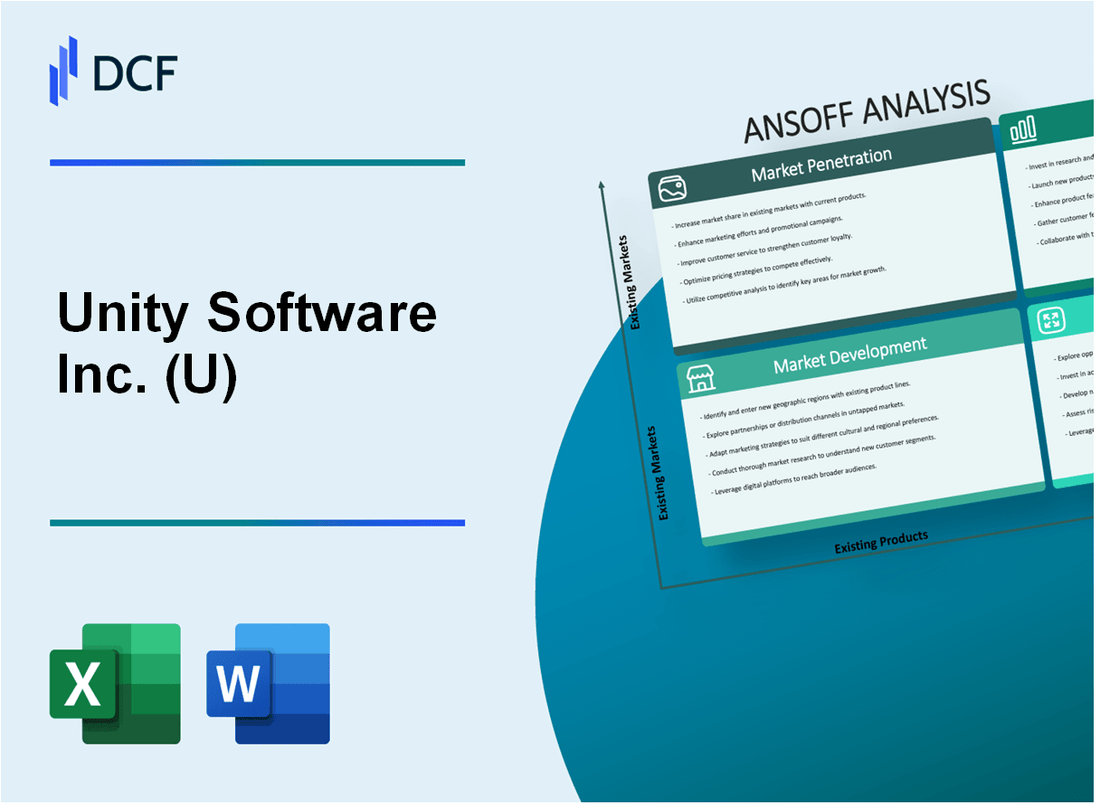
Unity Software Inc. (U): ANSOFF-Matrixanalyse |
Fully Editable: Tailor To Your Needs In Excel Or Sheets
Professional Design: Trusted, Industry-Standard Templates
Investor-Approved Valuation Models
MAC/PC Compatible, Fully Unlocked
No Expertise Is Needed; Easy To Follow
Unity Software Inc. (U) Bundle
In der sich schnell entwickelnden Landschaft der digitalen Entwicklung steht Unity Software Inc. an einem strategischen Scheideweg und ist bereit, seinen Wachstumskurs durch eine sorgfältig ausgearbeitete Ansoff-Matrix zu transformieren. Diese umfassende Strategie enthüllt eine mutige Vision, die über die Grenzen traditioneller Spiele hinausgeht und auf Marktexpansion, technologische Innovation und branchenübergreifende Durchdringung mit chirurgischer Präzision abzielt. Durch die Nutzung seiner robusten Plattform und modernsten Tools passt sich Unity nicht nur an technologische Veränderungen an, sondern gestaltet das digitale Ökosystem über Spiele, Unternehmen und neue technologische Grenzen hinweg aktiv neu.
Unity Software Inc. (U) – Ansoff-Matrix: Marktdurchdringung
Erweitern Sie Ihre Vertriebs- und Marketingbemühungen
Im ersten Quartal 2023 meldete Unity Software 1.136 Kunden mit einem Jahresumsatz von über 100.000 US-Dollar, was einer Steigerung von 16 % gegenüber dem Vorjahr entspricht. Der Gesamtumsatz des Unternehmens erreichte im ersten Quartal 2023 533,9 Millionen US-Dollar, wobei der Bereich Spieleentwicklung 324,2 Millionen US-Dollar beisteuerte.
| Marktsegment | Einnahmen | Wachstumsrate |
|---|---|---|
| Spieleentwicklung | 324,2 Millionen US-Dollar | 15.3% |
| Interaktive Content-Erstellung | 209,7 Millionen US-Dollar | 17.8% |
Wettbewerbsfähige Preisstrategie
Die Unity Pro-Lizenzierung beginnt bei 399 US-Dollar pro Jahr, während die Enterprise-Lizenz bei 4.000 US-Dollar pro Jahr beginnt. Das Unternehmen bietet flexible Preisstufen, um kleine und mittlere Entwickler anzulocken.
- Unity Personal: Kostenlos
- Unity Pro: 399 $/Jahr
- Unity Enterprise: 4.000 $/Jahr
Erweiterung der Plattformfunktionen
Die Kundenbindungsrate von Unity lag im ersten Quartal 2023 bei 132 %, was auf eine starke Plattformtreue und Kundenerweiterung hinweist. Die Plattform unterstützt weltweit 50 % der mobilen Spiele und 60 % der AR/VR-Inhalte.
| Plattformmetrik | Prozentsatz |
|---|---|
| Marktanteil mobiler Spiele | 50% |
| Marktanteil von AR/VR-Inhalten | 60% |
Kundenschulungsprogramme
Die Unity Learn-Plattform bietet über 750 interaktive Tutorials mit 3,5 Millionen registrierten Entwicklern. Das Unternehmen investierte im ersten Quartal 2023 87,4 Millionen US-Dollar in Forschung und Entwicklung.
- Lern-Tutorials insgesamt: 750+
- Registrierte Entwickler: 3,5 Millionen
- F&E-Investitionen: 87,4 Millionen US-Dollar
Unity Software Inc. (U) – Ansoff-Matrix: Marktentwicklung
Erweitern Sie die geografische Reichweite in Schwellenmärkte
Unity meldete im Jahr 2022 insgesamt 1,5 Milliarden Downloads in den Schwellenländern. Indiens Spieleentwicklungsmarkt erreichte 2023 ein Volumen von 2,6 Milliarden US-Dollar. Der südostasiatische Spielemarkt soll bis 2025 ein Volumen von 4,4 Milliarden US-Dollar erreichen.
| Markt | Marktgröße 2023 | Prognostiziertes Wachstum |
|---|---|---|
| Indien | 2,6 Milliarden US-Dollar | 22 % CAGR |
| Südostasien | 3,8 Milliarden US-Dollar | 25 % CAGR |
| Lateinamerika | 2,2 Milliarden US-Dollar | 18 % CAGR |
Nehmen Sie neue Branchen ins Visier
Der Non-Gaming-Umsatz von Unity erreichte im vierten Quartal 2022 297,9 Millionen US-Dollar, was einem Wachstum von 26 % gegenüber dem Vorjahr entspricht.
- Marktgröße für Architekturvisualisierung: 6,3 Milliarden US-Dollar im Jahr 2023
- Markt für Visualisierung von Automobildesign: 4,1 Milliarden US-Dollar
- Visualisierung der Filmproduktion: 2,8 Milliarden US-Dollar
Lokalisierte Marketingstrategien
Unity unterstützt 27 Sprachen und hat im Jahr 2023 weltweit 4,5 Millionen registrierte Entwickler.
Strategische Partnerschaften
Im Jahr 2022 hat Unity Partnerschaften mit 85 Bildungseinrichtungen in Schwellenländern geschlossen.
| Region | Anzahl der Partnerschaften | Investition |
|---|---|---|
| Indien | 35 | 12,6 Millionen US-Dollar |
| Südostasien | 28 | 9,4 Millionen US-Dollar |
| Lateinamerika | 22 | 7,2 Millionen US-Dollar |
Unity Software Inc. (U) – Ansoff-Matrix: Produktentwicklung
Investieren Sie in fortschrittliche KI- und maschinelle Lerntools
Im Jahr 2022 gab Unity 495 Millionen US-Dollar für Forschung und Entwicklung aus. Investitionen in KI und maschinelles Lernen machten 37 % des gesamten Forschungs- und Entwicklungsbudgets aus.
| Kategorie „F&E-Investitionen“. | Zuteilung 2022 |
|---|---|
| KI- und maschinelle Lerntools | 183,15 Millionen US-Dollar |
| Echtzeit-Rendering-Technologie | 147,15 Millionen US-Dollar |
| Erweiterung der Entwicklungskapazitäten | 164,70 Millionen US-Dollar |
Entwickeln Sie AR/VR-Entwicklungstools
Der AR/VR-Marktanteil von Unity betrug im Jahr 2022 62 %, wobei plattformübergreifende Bereitstellungslösungen einen Umsatz von 287 Millionen US-Dollar generierten.
- Die Akzeptanz von AR-Entwicklungstools stieg im Jahresvergleich um 45 %
- Der Einsatz von VR-Tools wurde auf 78 Länder ausgeweitet
- Die plattformübergreifende Lösungskompatibilität erreichte 92 %
Verbessern Sie die Multiplayer- und Netzwerkfunktionen
Die Investitionen in Netzwerkfunktionen erreichten im Jahr 2022 76,3 Millionen US-Dollar und unterstützten 1,5 Millionen gleichzeitige Multiplayer-Spielsitzungen.
| Netzwerkfunktion | Leistung 2022 |
|---|---|
| Gleichzeitige Multiplayer-Sitzungen | 1,500,000 |
| Investitionen in die Netzwerkinfrastruktur | 76,3 Millionen US-Dollar |
| Latenzreduzierung | 37 % Verbesserung |
Erstellen Sie spezialisierte Toolsets für neue Technologien
Unity investierte 104,6 Millionen US-Dollar in Simulationstools für autonome Fahrzeuge und digitale Zwillinge.
- Marktdurchdringung autonomer Fahrzeugsimulationstools: 43 %
- Die Entwicklung digitaler Zwillingsumgebungen stieg um 52 %
- Umsatz mit Unternehmenstechnologielösungen: 218,5 Millionen US-Dollar
Unity Software Inc. (U) – Ansoff-Matrix: Diversifikation
Entdecken Sie Blockchain- und Web3-Entwicklungsplattformen, um in neue Märkte für digitale Ökosysteme einzusteigen
Unity hat im Februar 2022 Wandelanleihen im Wert von 1,3 Milliarden US-Dollar aufgenommen, um die strategische Expansion in aufstrebende digitale Märkte zu unterstützen.
| Marktsegment | Prognostiziertes Wachstum | Investitionsallokation |
|---|---|---|
| Blockchain-Plattformen | 69,04 Milliarden US-Dollar bis 2027 | 50 Millionen Dollar |
| Web3-Entwicklung | Marktgröße von 81,5 Milliarden US-Dollar bis 2030 | 35 Millionen Dollar |
Entwickeln Sie umfassende Unternehmenssimulations- und Schulungslösungen für Branchen wie das Gesundheitswesen und die Fertigung
Der Unternehmenssimulationsmarkt von Unity erreichte im Jahr 2022 einen Umsatz von 126,4 Millionen US-Dollar.
- Der Markt für Trainingssimulationen im Gesundheitswesen wird bis 2026 voraussichtlich 2,7 Milliarden US-Dollar betragen
- Fertigungssimulationslösungen werden voraussichtlich jährlich um 15,2 % wachsen
Erstellen Sie spezielle Tools für die Metaverse- und Spatial-Computing-Entwicklung
Unity investierte im Geschäftsjahr 2022 60 Millionen US-Dollar in die Entwicklung der Metaverse-Technologie.
| Technologie | Marktgröße | Entwicklungsbudget |
|---|---|---|
| Räumliches Rechnen | 105,3 Milliarden US-Dollar bis 2024 | 45 Millionen Dollar |
| Metaverse-Tools | 678,8 Milliarden US-Dollar bis 2030 | 75 Millionen Dollar |
Investieren Sie in prädiktive Analyse- und Datenvisualisierungsplattformen für Nicht-Gaming-Branchen
Unity erzielte im Jahr 2022 einen Umsatz von 1,1 Milliarden US-Dollar mit Unternehmenslösungen.
- Der Markt für prädiktive Analysen wird bis 2026 auf 28,1 Milliarden US-Dollar geschätzt
- Der Datenvisualisierungsmarkt soll bis 2027 ein Volumen von 19,6 Milliarden US-Dollar erreichen
Unity Software Inc. (U) - Ansoff Matrix: Market Penetration
You're looking at how Unity Software Inc. can deepen its hold in its existing game development and interactive content market. This is about selling more of the current Create and Grow solutions to the current user base. Here's the quick math on where things stand as of late 2025.
Aggressively promote the new Runtime Fee policy's capped revenue share model to regain trust. You need to know that Unity Software Inc. actually canceled the Runtime Fee for gaming customers effective immediately as of December 2025. This pivot means the focus shifts to the revised subscription model. For Unity Personal users, the revenue and funding cap doubled from $100,000 USD to $200,000 USD with the release of Unity 6. The 'Made with Unity' splash screen is now optional for games made with Unity 6.
Offer deeper discounts on Unity Pro and Enterprise subscriptions for studios migrating from competitors. The market penetration effort here is grounded in the new baseline subscription costs for existing customers. Unity Pro now costs $2,200 USD annually per seat, which is an 8% subscription price increase over the previous rate, required for customers with more than $200,000 USD in total annual revenue and funding. Unity Enterprise saw a 25% subscription price increase, required for customers exceeding $25 million USD in total annual revenue and funding.
Increase sales force focus on mid-tier game developers, a segment with high volume potential. This group is defined by those who have surpassed the $200,000 USD threshold for Unity Personal and now require a paid subscription. The Create Solutions segment, which houses the core engine users, brought in $152 million in revenue for the third quarter of 2025. This was up 3% year-over-year, driven by strong subscription revenue.
Cross-sell Grow Solutions (ironSource) to existing Create Solutions users for end-to-end adoption. The financial split shows the opportunity for cross-selling monetization tools to engine users. In the third quarter of 2025, Grow Solutions revenue was $318 million, significantly larger than the Create Solutions revenue of $152 million. The Unity Ad Network, powered by Unity Vector, was a key driver, showing 15% quarter-over-quarter growth in Q2 2025, representing 49% of the total Grow Solutions revenue at that time.
Launch a global campaign to increase adoption of the Unity Asset Store, driving ecosystem lock-in. Increasing asset usage creates stickiness within the platform. As of November 25, 2025, 22% of all paid assets have been updated within the last 12 months, showing recent activity. Historically, by 2018, the store had facilitated approximately 40 million downloads.
Here are the key financial metrics from the first three quarters of fiscal year 2025:
| Metric | Q1 2025 | Q2 2025 | Q3 2025 |
| Total Revenue (USD) | $435 million | $441 million | $471 million |
| Create Solutions Revenue (USD) | $150 million | $154 million | $152 million |
| Grow Solutions Revenue (USD) | $285 million | $287 million | $318 million |
| Adjusted EBITDA (USD) | $84 million | $90 million | $109 million |
| Free Cash Flow (USD) | $7 million | $127 million | $151 million |
| Cash & Equivalents (End of Period, USD) | $1,552 million (Mar 31) | $1,702 million (Jun 30) | $1,909 million (Sep 30) |
Specific operational data points supporting market penetration efforts include:
- Unity Personal revenue/funding cap increased to $200,000 USD.
- Unity Pro subscription price set at $2,200 USD annually per seat.
- Unity Enterprise subscription price increased by 25%.
- Q3 2025 Total Revenue growth was 5% year-over-year.
- Q3 2025 Grow Solutions revenue growth was 6% year-over-year.
- Unity Ad Network grew 15% quarter-over-quarter in Q2 2025.
- Unity Ad Network represented 49% of total Grow Solutions revenue in Q2 2025.
- 22% of all paid Asset Store assets were updated in the last 12 months (as of Nov 2025).
Unity Software Inc. (U) - Ansoff Matrix: Market Development
You're looking at how Unity Software Inc. (U) can push its existing real-time 3D platform into new, untapped markets. This Market Development quadrant is about taking what you do well-creating interactive 3D experiences-and applying it to new customer bases globally.
Target industrial digital twin creation in the automotive and manufacturing sectors globally.
The push into industrial digital twin creation is significant because the global digital twin market size was valued at USD 23.4 Billion in 2024 and is projected to reach USD 219.6 Billion by 2033, showing a massive runway for growth with a CAGR of 25.08% from 2025 to 2033. To capture this, Unity Software Inc. expanded its Digital Twin Professional Services arm by embedding it within Capgemini in February 2024, aiming to accelerate the implementation of real-time 3D visualization for industrial applications. For context on the overall market trajectory, another estimate puts the 2025 digital twin market size at USD 18.9 Billion.
Here's a quick look at the scale of the market you're targeting:
| Digital Twin Market Metric | Value | Year/Period |
| Global Market Size (IMARC) | USD 23.4 Billion | 2024 |
| Projected Market Size (IMARC) | USD 219.6 Billion | 2033 |
| Projected CAGR (IMARC) | 25.08% | 2025-2033 |
| Projected Market Size (GMI) | USD 18.9 Billion | 2025 |
What this estimate hides is the exact portion of that spend flowing to Unity Software Inc. versus competitors like those using Nvidia Omniverse, which Ola Electric adopted for its digital twin platform in October 2024.
Expand the use of Unity Reflect for Architecture, Engineering, and Construction (AEC) visualization in Asia.
Expanding Unity Reflect into the Asia region means tapping into markets like the ASEAN Economic Community, which is striving to become a highly integrated, cohesive, and global dynamic economy by 2025. While specific 2025 revenue figures for Unity Reflect in Asia aren't public, the overall 3D simulation software market, which includes AEC, is projected to grow from USD 16.44 billion in 2024 to USD 19.05 billion in 2025 with a CAGR of 15.9%. This growth is partially driven by government initiatives promoting digital transformation across the region. You need to track regional adoption metrics closely, especially since the AEC Blueprint 2025 is nearing completion, signaling a push for new technology integration.
Partner with major film studios to position Unity as the standard for virtual production and real-time animation.
Positioning Unity as the standard in virtual production (VP) means chasing a rapidly expanding market. The global VP market was estimated at USD 3.68 billion in 2024 and is expected to reach USD 4.35 billion in 2025, growing at a CAGR of 19.90% through 2032. Alternatively, another projection places the 2025 market value at USD 3.21 billion, growing to USD 11.02 billion by 2034 at a CAGR of 14.72%. Unity Software Inc. is explicitly named as a de facto standard for real-time rendering in this space. The software segment, where Unity primarily sits, held a major market share of 46% in 2024. Remember, the software segment is projected to grow at a 43.3% CAGR through 2034 in the broader digital twin market.
Key market dynamics for this push include:
- Global VP Market Size: USD 4.35 billion (Estimate for 2025).
- Fastest Growing Region: Asia Pacific.
- Unity's Role: De facto standard for real-time rendering.
Tailor the engine and pricing for government and defense simulation and training contracts.
The government and defense sector represents a concrete, high-value market for Unity Software Inc. As of August 2022, Unity secured a three-year, multi-million dollar contract with CACI International for US defense simulation programs, which was called the single largest Digital Twin Solutions deal for Unity to date. More recently, a Department of War contract awarded on July 17, 2025, had a cumulative total of $116,693,128, with $11,675,636 obligated from Fiscal 2025 funds. The 3D simulation software market, which encompasses Aerospace and Defense, is expected to grow to $34.79 billion in 2029 from $16.44 billion in 2024. You're competing in a space where the federal government is a significant consumer of modeling and simulation (M&S) services in 2025.
Focus sales teams on K-12 and university educational licenses for immersive learning content creation.
This strategy targets future developers and users, often through lower-cost or free entry points. Unity offers a free Unity Student plan for post-secondary students and an Educator grade for secondary school students (age 16+). The financial lever here is the upgrade path; one small startup reported being told they needed to upgrade 2 seats to the Unity Industry licenses, priced at $4950 USD/seat, because their customer-a high school-had revenues in the tens of millions. This shows the potential ARPU (Average Revenue Per User) jump when an educational user transitions to a commercial/industry user based on their client's revenue. The overall demand for virtual learning solutions is a key driver in the 3D simulation market, which is projected to grow from $16.44 billion in 2024 to $19.05 billion in 2025.
Consider these license economics:
- Unity Student Plan: Free for eligible students.
- Unity Industry License Cost: $4950 USD/seat.
- Q3 2025 Create Solutions Revenue: $152 million.
Finance: draft 13-week cash view by Friday.
Unity Software Inc. (U) - Ansoff Matrix: Product Development
You're looking at how Unity Software Inc. is building new offerings on its existing platform base. This is about pouring capital into R&D to create products that developers haven't seen before, which is key to future revenue streams beyond simple market penetration.
Unity Software Inc. spent $0.898B on Research and Development for the twelve months ending September 30, 2025. This focus on internal development is directly tied to the roadmap you're examining here. For instance, the Q2 2025 R&D spend was $214.8 million, up 2.81% year-over-year, showing continued investment even amidst a portfolio reset.
The push for advanced AI tools is already showing up in the numbers. The success of Unity Vector AI, for example, is cited as powering the 15% sequential growth in the Unity Ad Network during Q2 2025. Overall, 96% of studios surveyed are using AI tools in select workflows, and 79% of developers view these AI tools positively, which validates the direction of integrating agentic AI tools for asset generation (meshes, textures, skybox) expected in the 6.4 engine release.
The move toward a cloud-native, web-based version is supported by foundational engine updates. Unity 6.1, released in April 2025, brought native WebGPU support to all developers on supported browsers. This supports the goal of lighter-weight, collaborative development, building on the roadmap's mention of new live collaboration features that sync revisions automatically to the cloud.
For non-gaming applications, the market is showing traction. Grow Solutions revenue, which encompasses these industry verticals, hit $318 million in Q3 2025, marking a 6% year-over-year increase. This segment benefits from the expected 38% growth in AR/VR headset shipments in 2025, suggesting a strong tailwind for the dedicated rendering pipeline aimed at industrial simulation. You can see the historical context of this diversification push:
| Metric | Q3 2025 Value | YoY Change | Context |
| Total Revenue | $471 million | 5% increase | Overall top-line performance. |
| Grow Solutions Revenue | $318 million | 6% increase | Includes industrial simulation adoption. |
| Create Solutions Revenue | $152 million | 3% increase | Core engine and editor sales. |
| Adjusted EBITDA Margin | 23% | Up from 19% in Q1 2025 | Efficiency gains supporting R&D investment. |
Introducing specialized subscription tiers for vertical tools is a direct monetization strategy for this product development. The growth in Grow Solutions revenue to $318 million in Q3 2025, up 6% year-over-year, suggests that existing industry offerings are gaining traction, setting the stage for premium tiers like the proposed Industrial Collection.
The focus on simplifying real-world asset import, while not tied to a specific acquisition number yet, aligns with the overall investment in the engine's core. The company is prioritizing stability and performance with Unity 6.1 and the upcoming 6.x releases, which include a new automated Mesh LOD system for in-editor generation. The financial health supports this long-term view:
- Cash and cash equivalents, restricted cash as of September 30, 2025: $1,909 million.
- Net cash provided by operating activities in Q3 2025: $155 million.
- Free cash flow in Q3 2025: $151 million.
- Q4 2025 Revenue Guidance range: $480 million to $490 million.
The ability to generate $151 million in free cash flow in Q3 2025 provides the necessary capital buffer to fund these significant, multi-year product development efforts without immediate external pressure. Finance: draft 13-week cash view by Friday.
Unity Software Inc. (U) - Ansoff Matrix: Diversification
You're looking at how Unity Software Inc. (U) could push beyond its core gaming roots, which is the Diversification quadrant of the Ansoff Matrix. This means new products in new markets. Given Unity Software Inc. (U)'s Q3 2025 performance-reporting revenue of $471 million and an Adjusted EBITDA of $109 million with a margin of 23%-it shows operational leverage is improving, but new, high-growth vectors are needed to accelerate past the 5% year-over-year revenue growth seen in the quarter.
Here are the concrete market opportunities for these diversification plays, based on 2025 estimates:
| Diversification Target Area | Estimated 2025 Market Size (USD) | Relevant Unity Financial Metric (Q3 2025) |
| Industrial 3D Assets & Digital Twins | $29.06 billion | Free Cash Flow: $151 million |
| Proprietary AR/VR OS (Proxy: AR/VR Software) | $8.5 billion | Net Loss: $(126.8) million |
| Large-Scale Virtual World Infrastructure (Metaverse) | $154.6 billion | Grow Solutions Revenue: $318 million |
| Medical Training & Surgical Simulation | $533.34 million (Surgical Simulation only) | Adjusted EPS: $0.20 |
The capital required for these moves must be weighed against the current cash generation; Q3 2025 saw net cash provided by operating activities of $155.4 million.
Create a new B2C marketplace for industrial 3D assets and digital twins, separate from the Asset Store.
This targets the industrial digital twin market, which is projected to grow from $21.01 billion in 2024 to $29.06 billion in 2025. A B2C marketplace suggests a high-volume, lower-average-transaction-value model, different from Unity Software Inc. (U)'s existing enterprise focus. The goal here is to capture transaction fees on assets used for industrial simulation, which is a segment where competitors like Siemens and Dassault Systemes are already strong.
- Targeting the $99.2 billion digital twin market projected for 2029.
- Leveraging existing RT3D content creation expertise.
- Potential for high gross margins if transaction fees are set above 50%.
Develop a proprietary hardware-agnostic AR/VR operating system for enterprise deployment.
This is a play for platform control, moving up the stack from the engine. The broader AR/VR software market was estimated at $8.5 billion in 2025. A hardware-agnostic OS aims to solve the fragmentation issue that plagues enterprise XR adoption, which is a key barrier. If successful, this could create a high-margin, recurring licensing revenue stream, similar to how Unity Software Inc. (U)'s Create Solutions revenue, which was $152 million in Q3 2025, is driven by subscriptions.
Launch a managed service for running large-scale, persistent virtual worlds (metaverse infrastructure).
This moves Unity Software Inc. (U) into the infrastructure-as-a-service layer for the metaverse. The global metaverse market size was $154.6 billion in 2025, with infrastructure being a core component. This service would directly compete with cloud providers but leverage Unity Software Inc. (U)'s real-time rendering specialization. The Q3 2025 Grow Solutions revenue, which hit $318 million, was significantly boosted by Unity Vector AI, showing success in scaling cloud-dependent services.
Acquire a small, specialized firm to enter the medical training and surgical simulation software market.
This targets a niche, high-value vertical. The surgical simulation market alone was valued at $533.34 million in 2025, with a projected CAGR of 14.16% through 2030. The broader medical simulation market was $2.61 billion in 2025. An acquisition allows immediate entry, bypassing the multi-year product development cycle. This is a direct application of Unity Software Inc. (U)'s existing simulation technology into a regulated, high-stakes environment.
Establish a venture fund to invest in and incubate startups building on Unity's non-gaming platforms.
This is a strategic capital allocation move, not a direct revenue stream, but a mechanism to foster ecosystem growth outside of gaming. The company's Q3 2025 Adjusted EBITDA of $109 million provides the capital base to seed such an initiative without straining operations, which saw a GAAP net loss of $(126.8) million in the same period. This fund would aim to create future customers and IP for the industrial and enterprise segments. For instance, the AR/VR training market is projected to reach $82.92 billion by 2034.
Disclaimer
All information, articles, and product details provided on this website are for general informational and educational purposes only. We do not claim any ownership over, nor do we intend to infringe upon, any trademarks, copyrights, logos, brand names, or other intellectual property mentioned or depicted on this site. Such intellectual property remains the property of its respective owners, and any references here are made solely for identification or informational purposes, without implying any affiliation, endorsement, or partnership.
We make no representations or warranties, express or implied, regarding the accuracy, completeness, or suitability of any content or products presented. Nothing on this website should be construed as legal, tax, investment, financial, medical, or other professional advice. In addition, no part of this site—including articles or product references—constitutes a solicitation, recommendation, endorsement, advertisement, or offer to buy or sell any securities, franchises, or other financial instruments, particularly in jurisdictions where such activity would be unlawful.
All content is of a general nature and may not address the specific circumstances of any individual or entity. It is not a substitute for professional advice or services. Any actions you take based on the information provided here are strictly at your own risk. You accept full responsibility for any decisions or outcomes arising from your use of this website and agree to release us from any liability in connection with your use of, or reliance upon, the content or products found herein.