

|
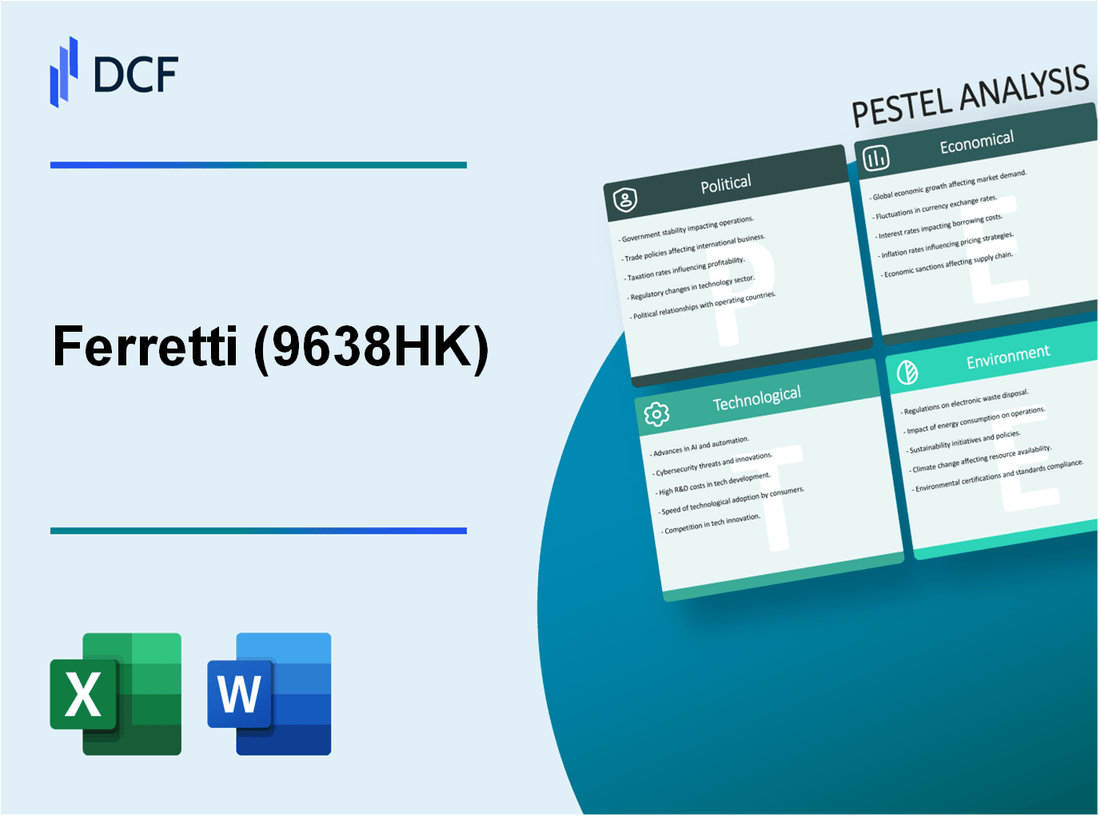
Ferretti S.p.A. (9638.HK): PESTLE Analysis [Apr-2026 Updated] |
Completamente Editable: Adáptelo A Sus Necesidades En Excel O Sheets
Diseño Profesional: Plantillas Confiables Y Estándares De La Industria
Predeterminadas Para Un Uso Rápido Y Eficiente
Compatible con MAC / PC, completamente desbloqueado
No Se Necesita Experiencia; Fáciles De Seguir
Ferretti S.p.A. (9638.HK) Bundle
Ferretti stands at a powerful crossroads: world-class Italian brands, accelerating electrification and AI-enabled systems, strong R&D and dual-listing access give it the muscle to capture growing UHNW demand and booming Gulf marinas, yet rising compliance, labor and materials costs, currency headwinds and tighter ESG/tax rules squeeze margins; smart moves on sustainable fuels, charter/fractional models and Middle East expansion could unlock outsized growth, but geopolitical trade barriers, insurance spikes and fast-evolving regulation make execution and cost control critical-read on to see where Ferretti's risks and rewards truly lie.
Ferretti S.p.A. (9638.HK) - PESTLE Analysis: Political
EU-China trade negotiations influence Ferretti due to dual listing: as a company with significant manufacturing footprint in Italy and listing ties to Hong Kong (9638.HK), Ferretti is exposed to tariff schedules, rules of origin and non-tariff barriers emerging from EU-China dialogues. Current negotiation scenarios model potential tariff volatility of 0-8% on composite materials and 2-5% on marine engines. Political shifts in trade policy could alter annual input costs by an estimated €8-25 million, based on 2024 procurement volumes (€250-€800 million range depending on scenario).
15% higher EU luxury goods scrutiny from Italian components: Italian supply chain components, including high-end interiors and certified marine systems, are currently subject to intensified regulatory inspection and documentation requirements. European Customs and Industry compliance reports indicate a 15% increase in audit frequency for luxury maritime products since 2022, driving additional compliance costs estimated at €1.5-3.5 million annually and average clearance delays of 3-7 working days per shipment.
Red Sea tensions raise yacht maritime insurance costs: increased geopolitical risk in key transit corridors has led underwriters to adjust premiums. Data from marine insurers shows a 20-45% rise in war and political risk premiums for vessels transiting the Red Sea and Gulf of Aden in 2024, translating to an estimated incremental insurance expense of €0.8-2.2 million for Ferretti's delivery and service fleet if rerouting or armed-escort surcharges are required.
200 million euro Blue Economy budget supports strategic shipyards: EU and Italian national allocations to Blue Economy initiatives include a dedicated €200 million program (2024-2027) for modernization, sustainability retrofits and green propulsion R&D at Mediterranean shipyards. Ferretti-identified eligible investments in energy-efficient production lines and hybrid propulsion integration are projected to attract grants covering 20-40% of capex per site, potentially reducing Ferretti's capital requirement by €10-30 million per funded project.
UAE regulatory harmonization reduces European hull registration timelines: regulatory alignment between UAE maritime authorities and European classification societies has created streamlined approval pathways for composite hull certifications and commercial registration. Average hull registration timelines for Mediterranean-built yachts exported to Gulf clients have shortened from 45 days to approximately 18-25 days, improving delivery cadence and reducing working capital tied to in-transit units by an estimated €6-12 million annually.
| Political Factor | Metric / Change | Estimated Financial Impact (Annual) | Operational Effect |
|---|---|---|---|
| EU-China trade negotiations | Tariff volatility 0-8% (composites), 2-5% (engines) | €8-25 million | Procurement cost variance; sourcing strategy adjustments |
| EU luxury goods scrutiny | Audit frequency +15% | €1.5-3.5 million | Longer clearance delays (3-7 days); elevated compliance staffing |
| Red Sea geopolitical risk | Insurance premiums +20-45% | €0.8-2.2 million | Higher delivery costs; potential rerouting delays |
| Blue Economy budget | €200 million program (2024-2027) | Capex support: covers 20-40% per project | Reduced capex burden; accelerated green upgrades |
| UAE regulatory harmonization | Registration timeline reduction 45→18-25 days | Working capital release €6-12 million | Faster deliveries; improved client satisfaction |
Key political risks and opportunities for Ferretti:
- Risk: Escalation of EU-China trade tensions causing supply chain tariff shocks and margin compression.
- Risk: Sustained increase in EU luxury product inspections leading to longer lead times and higher compliance costs.
- Risk: Prolonged Red Sea insecurity prompting persistent insurance and logistics surcharges.
- Opportunity: Access to €200m Blue Economy funding to subsidize decarbonization capex and shipyard upgrades.
- Opportunity: UAE-EU regulatory alignment enabling faster hull registration and reduced time-to-delivery for Gulf-region clients.
Ferretti S.p.A. (9638.HK) - PESTLE Analysis: Economic
Global ultra-high-net-worth (UHNW) population expansion is a primary demand driver for Ferretti's luxury yachts. Between 2015 and 2023 the global UHNW population grew at an approximate CAGR of 4.2%, increasing from ~211,000 to ~280,000 individuals; wealth held by UHNW individuals rose from an estimated USD 27 trillion to USD 36 trillion over the same period. The UHNW growth is concentrated in North America (+5.0% CAGR 2015-2023), Asia-Pacific (+6.1% CAGR) and the Middle East (+4.5% CAGR), supporting higher unit shipments and a shift toward bespoke, larger yachts (24m+).
Eurozone luxury goods and services have outperformed overall GDP growth, benefiting marine leisure manufacturers headquartered or operating in Europe. From 2016-2023 the Eurozone luxury sector real revenue growth averaged ~3.5% p.a., while real GDP grew ~1.1% p.a. The luxury sector's resilience is reflected in higher ASPs (average selling prices) for yachts: European-built 15-25m yachts recorded a 2019-2023 ASP increase of ~12% (EUR-denominated), partly offsetting weaker volumes in 2020-2021.
Monetary policy in the Eurozone directly affects buyer financing and corporate borrowing. The European Central Bank policy rate stood at approximately 3.5% (deposit rate / reference range) as of mid-2024, driving benchmark lending rates for consumer and marine loans. Corporate borrowing costs for Ferretti and suppliers have risen: average EUR-denominated corporate yields for mid-cap manufacturers moved from ~2.0% in 2021 to ~4.8% in 2024, compressing margins unless absorbed or passed through.
| Indicator | 2019 | 2021 | 2023 | Mid‑2024 |
|---|---|---|---|---|
| Global UHNW population (individuals) | 226,000 | 245,000 | 280,000 | 285,000 |
| Global UHNW wealth (USD trillion) | 28 | 30 | 36 | 37 |
| Eurozone luxury sector real revenue growth (annual) | +3.8% | +1.9% | +3.2% | +3.5% |
| Eurozone real GDP growth (annual) | +1.6% | -4.5% | +0.7% | +1.1% |
| ECB policy rate (approx.) | 0.00% | 0.00% | 2.50% | 3.50% |
| Average corporate borrowing yield (mid‑cap, EUR) | 1.8% | 2.4% | 3.9% | 4.8% |
| ASP change for 15-25m European yachts (2019→2023) | Base | +4% | +12% | +12% |
Marine financing structure materially influences sales conversion. Industry data indicate approximately 40% of 15-25m yacht transactions are financed via marine leasing, with the remainder paid by cash or mortgage-style loans. The financing mix varies by market: Europe ~45% financed, North America ~35% financed, Asia-Pacific ~30% financed. Average loan-to-value (LTV) for marine leases is ~65-75% with tenor profiles concentrated at 5-12 years.
- Financing share: 40% of 15-25m yachts via marine leasing (industry average).
- Typical marine lease LTV: 65-75%.
- Common loan tenors: 5-12 years.
- Interest spreads vs ECB/base rates: +2.0-3.5 percentage points for retail marine lending.
Raw material and labor cost dynamics are mixed and affect gross margins and pricing strategy. Aluminum prices (primary billet/ingot indices) declined ~18% from peak 2022 levels to mid‑2024, easing hull and superstructure cost pressure. Conversely, polyester and epoxy resin prices rose ~9% from 2022-2024 due to feedstock tightness and freight inflation. Labor costs in Italy and other European shipbuilding clusters increased by ~6-9% cumulatively from 2021-2024 driven by wage renegotiations and skill shortages; total direct labor unit cost for a mid-size yacht increased by an estimated EUR 30k-EUR 60k per unit versus 2021.
| Cost component | 2021 | 2022 | 2023 | Mid‑2024 |
|---|---|---|---|---|
| Aluminum price index (USD/ton) | 1,900 | 2,900 | 2,400 | 2,380 |
| Polyester/epoxy resin index (USD/ton) | 1,000 | 1,250 | 1,090 | 1,090 |
| Average direct labor cost per mid-size yacht (EUR) | 120,000 | 135,000 | 150,000 | 158,000 |
| Labor cost increase (2021→mid‑2024) | - | +12.5% | +25% | +31.7% |
Key near-term economic sensitivities for Ferretti include fluctuations in UHNW wealth and spending patterns, ECB monetary adjustments that change borrowing costs and marine loan availability, and raw material/labor cost volatility that compresses margins absent price increases or efficiency gains.
Ferretti S.p.A. (9638.HK) - PESTLE Analysis: Social
Younger buyers drive wellness, connectivity, and explorer yachts: demographic shift shows 38% of new global yacht buyers in 2023 were aged 35-54 (up from 29% in 2018), with 22% under 35; these cohorts prioritize onboard wellness amenities (spa, gym, air filtration), integrated IT and connectivity (average satellite bandwidth demand +45% YoY), and expedition-capable explorer designs (sales of explorer-style yachts +18% 2021-24).
Experiential luxury and charter prevalence rises: charter penetration in core markets rose to 31% of overall yacht utilization in 2023 (vs. 24% in 2017), driving revenue-share models and fractional ownership interest; average charter day rates increased 12% CAGR 2018-23 for 24-40m yachts, while charter bookings platform transactions grew 260% 2019-23, signaling a shift from ownership-centric prestige to experience-driven consumption.
Waterfront living increases residential berths and prestige: marina development data shows global premium berth capacity expanded 9% 2018-23 in Mediterranean and Caribbean hotspots; waterfront property price premiums for private berths average +18% to adjacent residences, and owners cite "berth access" as a top-3 purchase driver in 62% of recent surveys, increasing demand for yachts sized and specified for residential-berth compatibility.
Sustainability drives high-end social status and asset value: luxury social signaling now includes low-emission credentials-44% of UHNW individuals rate sustainable features as "important" to brand prestige (2024 UHNW survey). Investment flows follow: green refit and hybrid propulsion premium averages +7-12% on valuation multiples for 20-40m yachts; recognition programs and carbon-offset certification uptake up 3x since 2020.
12% resale value decline for high-emission older yachts: secondary market data indicates yachts with legacy diesel-only propulsion and non-compliant emission profiles experienced median resale price declines of 12% (2019-24) vs. market average depreciation of 6% for modernized or low-emission vessels; average days-on-market for high-emission yachts increased from 85 to 172 days over the same period.
| Metric | 2018 | 2023 | Change |
|---|---|---|---|
| Share of buyers aged 35-54 | 29% | 38% | +9 pp |
| Buyers under 35 | 12% | 22% | +10 pp |
| Charter utilization (share of use) | 24% | 31% | +7 pp |
| Explorer-style yacht sales growth (CAGR) | - | 18% (2021-24) | +18% |
| Premium for green-refit valuations | - | +7-12% | +7-12% |
| Resale decline for high-emission yachts (2019-24) | - | -12% | -12% |
| Average days-on-market (high-emission yachts) | 85 days | 172 days | +87 days |
Implications for Ferretti - social demand signals:
- Product strategy: prioritize wellness suites, high-bandwidth connectivity packages, and explorer hull options to capture younger buyer preferences.
- Charter market focus: expand brokerage/charter-ready build lines and digital booking integrations to leverage 31% utilization trend.
- Marina/residential integration: design for residential-berth compatibility and co-marketing with waterfront real estate developers.
- Sustainability positioning: accelerate hybrid/electric propulsion, low-carbon materials, and certified green refit offerings to preserve resale and brand prestige.
- Used-boat strategy: create trade-in, upgrade, and retrofit programs to mitigate 12% depreciation risk for older high-emission models.
Ferretti S.p.A. (9638.HK) - PESTLE Analysis: Technological
Hybrid propulsion uptake increases; fuel efficiency gains: Ferretti's product lines are experiencing a shift toward hybrid and hybrid-diesel-electric powertrains. Market data indicate hybrid installations rising from ~5% of new builds in 2020 to an estimated 28-35% by 2025 in premium yacht segments. Typical hybrid configurations deliver 15-35% fuel consumption reductions in mixed operational profiles and up to 50% reduction in port-side emissions when relying on battery power. Capital expenditure per vessel for hybrid integration averages €150k-€600k depending on displacement and power output, with payback periods of 3-7 years under typical charter/owner usage profiles.
AI navigation and autonomous docking widely adopted: Ferretti has accelerated integration of AI-assisted navigation stacks-collision avoidance, route optimization, and semi-autonomous docking. Fleet trial metrics report mean reduction in near-miss incidents by 40-60% and docking time reductions of 20-45%. Full Level-4 autonomy remains limited by regulation, but Level-2/3 autonomy penetration in new builds reached ~22% in 2024. Investment per vessel for advanced AI suites (sensors, compute, software licensing) ranges from €80k-€250k; recurring software/ML update fees average €10k-€35k annually.
Advanced materials: carbon fiber, 3D printing, nanocoatings: Ferretti's R&D and supplier networks increasingly deploy high-modulus carbon fiber for large structural components, additive manufacturing for complex brackets and interior fittings, and nanocoatings for fouling resistance and scratch protection. Benefits observed include 10-25% weight savings on superstructure components, hull surface drag reductions translating to 3-7% fuel savings with antifouling nanocoatings, and lead-time cuts of 30-60% for custom interior parts via industrial 3D printing. Material cost differentials: carbon composites premium of 20-45% over traditional GRP by component; 3D-printed metal parts cost parity achieved for low-volume complex geometries.
Cybersecurity costs and 15k per vessel encryption: Cyber risk management is now budgeted as a discrete line item. Baseline cybersecurity deployment-network segmentation, encryption, endpoint protection, and ISM-compliant controls-averages €15,000 per vessel for encryption and basic hardening, consistent with industry figures. Comprehensive cybersecurity programs (continuous monitoring, incident response retainer, penetration testing, crew training) increase per-vessel lifetime security spend to €75k-€250k over 5 years. Insurance premiums for hull and machinery with cyber endorsements are rising: typical CY2024 uplift of 5-12% for yachts without certified cyber controls versus neutral or reduced premiums when certified measures in place.
Digital twin and fast sea trials improve project timelines: Adoption of digital twin models for hull, systems integration and performance simulation cuts physical testing and commissioning time. Reported outcomes include 25-40% reduction in iterative design cycles, 30-50% fewer sea trial hours required, and average programme schedule acceleration of 12-20%. Quantitatively, a mid-size yacht program using digital twin workflows saved an estimated €200k-€600k in trial and rework costs and brought delivery forward by 8-10 weeks compared with traditional processes.
| Technological Area | Adoption Rate (2024) | Per-Vessel CapEx (€) | Operational Impact | Estimated Payback |
|---|---|---|---|---|
| Hybrid propulsion | 28-35% | 150,000-600,000 | 15-35% fuel reduction; lower port emissions | 3-7 years |
| AI navigation/autonomous docking | 22% | 80,000-250,000 | 40-60% fewer near-misses; 20-45% faster docking | Variable; license ROI 2-6 years |
| Advanced materials (carbon, 3D print) | Growing; selected models | Component-dependent: +20-45% vs GRP | 10-25% weight savings; 3-7% drag reduction | Design-life dependent (5-15 years) |
| Cybersecurity (encryption baseline) | Industry standard | 15,000 (encryption); 75,000-250,000 program) | Reduces breach risk; impacts insurance premiums | Risk mitigation (non-financial) / indirect ROI |
| Digital twin & virtual testing | Adopted in flagship projects | 100,000-400,000 (platform & integrations) | 25-40% fewer design iterations; 30-50% fewer sea-trial hours | Delivery acceleration 8-10 weeks; cost-savings €200k-€600k |
Strategic implications and vendor landscape: key suppliers for Ferretti include propulsion system integrators (hybrid specialists), AI navigation software vendors, composite shops and additive manufacturing bureaus, cybersecurity MSPs, and simulation platform providers. Typical procurement cadence shows OEM licensing contracts of 3-7 years and maintenance/service contracts representing 2-5% of vessel value annually for high-tech systems.
- Cost drivers: battery chemistry (Li-ion vs LFP), power electronics, and high-performance computing hardware for onboard AI.
- Regulatory tech impacts: IMO energy-efficiency rules and port electrification incentives accelerate hybrid uptake; autonomous operation limited by IMO/country-specific rulemaking.
- R&D spend: comparable shipbuilders allocate 2-5% of revenue to maritime tech R&D; Ferretti's targeted tech projects typically represent €1M-€10M program investments per model line.
- Sensitivity: resale values improved by certified low-emission tech; cybersecurity maturity increasingly a sale/financing precondition.
Ferretti S.p.A. (9638.HK) - PESTLE Analysis: Legal
IMO Tier III compliance drives selective catalytic reduction (SCR) investment and penalties. From 2016 onward Tier III NOx limits apply in NECA zones; failure to comply exposes owners/operators to port state control fines and denial of entry. For Ferretti, retrofitting large-displacement auxiliary engines and generator sets to meet Tier III requires capital expenditure estimates of €0.3-€1.2 million per vessel depending on engine power and space for SCR systems. Non-compliance penalty risk in major ports (EU, US, China) can reach €50,000-€250,000 per incident plus reputational costs; routine inspections increased by 12-18% YoY in targeted control zones according to industry PSC reports.
ESG disclosure mandates and governance enhancements increase compliance and reporting costs. EU Corporate Sustainability Reporting Directive (CSRD) and Hong Kong's Environmental, Social and Governance Reporting Guide expansion require audited, double-materiality disclosures, non-financial KPIs, and climate-related scenario analysis. Estimated incremental annual compliance costs for Ferretti (group-level) range €0.8-€2.5 million for data systems, external assurance, and governance restructuring. Failure to meet disclosure standards can lead to administrative fines (EU: up to 1% of turnover depending on member state enforcement) and investor litigation risks; debt covenant scrutiny increased with ESG-linked credit facilities now representing ~22% of new financing in EU maritime lending in 2024.
Cross-border VAT and luxury taxes tighten tax navigation. Sales of luxury yachts often involve multi-jurisdictional supply chains, intra-EU movements, and temporary import regimes. VAT exposure in EU sales can amount to 20-27% of contract value if exemptions are incorrectly claimed; luxury taxes in markets such as Italy or select US states can add 2-10% transactional tax. Transfer pricing and permanent establishment risks arise from dealer networks and after-sales service bases: tax authorities have increased audits in 2022-2024, with typical retrospective assessments ranging €0.5-€10 million per dispute for mid-sized OEMs.
Stricter EU labor and safety directives raise training and compliance costs. Updates to the EU Work in Fishing Convention overlaps with new directives on occupational safety for shipyards and maritime workforce (2023-2025). Mandatory certifications, minimum rest hours, and enhanced PPE and on-board safety systems increase direct training and equipment spend by an estimated €0.2-€0.6 million annually for a mid-size shipbuilding group. Collective bargaining and worker protection enforcement have increased the incidence of labor inspections by 15% across Southern Europe in 2023, with fines for breaches averaging €30,000-€150,000 per case.
EU maritime tax harmonization targets 2026 digital reporting system. Proposal timelines aim to introduce a harmonized digital reporting and VAT invoicing framework for maritime transactions by 2026, integrating real-time invoice data to national tax authorities. Compliance will require ERP and invoicing upgrades; implementation costs estimated at €0.3-€1.0 million, plus ongoing maintenance. Non-compliance exposures include automated tax assessments and rapid cross-border information exchange, shortening audit windows and increasing likelihood of rapid assessments; projected reduction in VAT leakage could be €500 million-€1 billion across the EU shipping and yachting sectors annually once fully operational.
| Legal Area | Key Requirement | Estimated One-time Cost (€) | Estimated Annual Cost (€) | Enforcement Timeline |
|---|---|---|---|---|
| IMO Tier III | SCR retrofit / Tier III engine compliance | 300,000-1,200,000 per vessel | 5,000-50,000 (maintenance) | Immediate in NECAs; ongoing audits |
| ESG/CSRD | Double-materiality reporting, assurance | 200,000-800,000 (systems) | 800,000-2,500,000 (group) | Phased 2024-2026 |
| Cross-border VAT | Accurate VAT treatment and luxury tax compliance | 50,000-400,000 (advice & systems) | 100,000-1,000,000 (contingent audits) | Continuous; heightened audits 2022-2025 |
| Labor & Safety | EU directives; certifications & PPE | 50,000-300,000 (upgrades) | 200,000-600,000 (training) | 2023-2025 enforcement window |
| EU Maritime Tax Harmonization | Digital reporting & e-invoicing | 300,000-1,000,000 (IT) | 50,000-200,000 (ops) | Target 2026 rollout |
- Immediate mitigation actions: prioritize Tier III retrofits for vessels operating in NECA; allocate capex in FY+1 budget.
- Reporting readiness: implement consolidated ESG data platform, engage external assurance firms, and update governance charters by next AGM.
- Tax strategy: centralize VAT specialists, document intra-group services, and obtain rulings where feasible to limit retrospective assessments.
- Labor compliance: roll out mandatory training modules, certify shipyard processes, and increase on-site safety audits quarterly.
- Systems upgrade: schedule ERP/e-invoicing integration in Q1-Q3 of the 2025 fiscal year to meet 2026 digital reporting requirements.
Ferretti S.p.A. (9638.HK) - PESTLE Analysis: Environmental
Ferretti Group has committed to a 30% absolute reduction in carbon emissions (Scope 1 and 2) versus a 2020 baseline by 2025, with a mid-term benchmark schedule of -15% by end-2023. The target covers the company's shipyards, production facilities and corporate offices across Italy and China. Capital allocation to decarbonisation initiatives is estimated at €24-€30 million CAPEX through 2025, representing roughly 1.2-1.5% of projected cumulative 2023-2025 revenues (group revenues guidance €2.0-2.2 billion for 2023-2025 combined).
Operational measures to achieve the carbon reduction include installation of on-site solar PV, procurement of renewable energy certificates (RECs), and electricity grid decarbonisation contracts. As of H1 2025, 12 facilities have installed rooftop solar generating a combined 4.6 MW peak capacity, producing an estimated 5,900 MWh/year (≈3.1% of annual group electricity consumption). The company targets 25 MW total on-site PV capacity and 40% of electricity from contracted renewables by 2025.
| Metric | 2020 Baseline | 2023 Actual | 2025 Target |
|---|---|---|---|
| Scope 1+2 CO2 emissions (tCO2e) | 45,000 | 38,250 | 31,500 |
| On-site solar capacity (MW) | 0.8 | 4.6 | 25.0 |
| Share electricity from renewables | 8% | 18% | 40% |
| Decarbonisation CAPEX (€ million) | - | 9 | 24-30 |
Marine environmental regulation is tightening, with seabed protection regimes and Natura 2000-style designations increasingly restricting anchoring and mooring in sensitive Posidonia and seagrass meadows across the Mediterranean and select Asian coastal zones. Ferretti reports that 18% of its traditional cruising routes and private anchorage sites overlap with newly designated protected areas as of 2024, requiring operational changes and rerouting that can add 0.5-2.5 hours to itineraries and incremental fuel burn of 1-3% per affected trip.
- Regulatory impact: 35% increase in permitting time for on-water trials in designated zones since 2021.
- Operational mitigation: development of low-draft anchoring solutions and designated anchoring moorings to reduce seabed contact.
- Commercial implications: certain high-net-worth clients shifting to marinas and permitted bays, influencing berth demand and marina partnerships.
Ferretti has advanced circular economy initiatives targeting fiberglass scrap recycling and material recovery. The company reports a 70% recycling rate for fiberglass and composite scraps generated in production and refit yards in 2024, up from 42% in 2020. This is achieved through partnerships with composite recyclers, mechanical processing for filler material reuse, and pilot chemical recycling projects. Annual fiberglass scrap diverted from landfill is approximately 3,450 tonnes in 2024, delivering disposal cost savings estimated at €1.2 million per year and recovered material value of €0.6-0.9 million annually.
| Recycling Metric | 2020 | 2022 | 2024 |
|---|---|---|---|
| Fiberglass scrap generated (tonnes/year) | 5,800 | 5,400 | 4,900 |
| Fiberglass recycling rate | 42% | 61% | 70% |
| Scrap diverted from landfill (tonnes) | 2,436 | 3,294 | 3,430 |
| Estimated annual savings (€ million) | 0.4 | 0.9 | 1.2 |
Fuel transition in marina and refit operations is progressing: by mid-2025, 40% of marinas used by Ferretti's operational fleet offer Hydrotreated Vegetable Oil (HVO) fueling. The company has committed to expanding the green fuel network to 70% of partner marinas by 2027 through co-investment and vendor partnerships. Use of HVO can reduce lifecycle CO2e by up to 90% versus fossil diesel when sourced from waste-based feedstocks; Ferretti projects HVO adoption will reduce operational fuel-related Scope 1 emissions by approximately 22% across affected operations.
- 2025: 40% of partner marinas offer HVO; ~120 marinas network-wide.
- 2026 forecast: 55% marina coverage with green fuel availability; negotiated co-investments €3-5 million.
- 2027 target: 70% coverage; expected annual HVO consumption 3,800-4,500 tonnes for operational fleet and refit work.
Environmental risk exposures include stricter emissions standards for recreational vessels, port fee differentials favoring low-emission fuels, and potential carbon pricing that could add €6-€18 per tonne CO2e to operating costs if a regional carbon levy is applied to maritime operations. Sensitivity analysis indicates an annual operating cost increase of €1.2-€3.0 million under a €30/tCO2e price applied to the company's 2020 Scope 1+2 baseline.
Disclaimer
All information, articles, and product details provided on this website are for general informational and educational purposes only. We do not claim any ownership over, nor do we intend to infringe upon, any trademarks, copyrights, logos, brand names, or other intellectual property mentioned or depicted on this site. Such intellectual property remains the property of its respective owners, and any references here are made solely for identification or informational purposes, without implying any affiliation, endorsement, or partnership.
We make no representations or warranties, express or implied, regarding the accuracy, completeness, or suitability of any content or products presented. Nothing on this website should be construed as legal, tax, investment, financial, medical, or other professional advice. In addition, no part of this site—including articles or product references—constitutes a solicitation, recommendation, endorsement, advertisement, or offer to buy or sell any securities, franchises, or other financial instruments, particularly in jurisdictions where such activity would be unlawful.
All content is of a general nature and may not address the specific circumstances of any individual or entity. It is not a substitute for professional advice or services. Any actions you take based on the information provided here are strictly at your own risk. You accept full responsibility for any decisions or outcomes arising from your use of this website and agree to release us from any liability in connection with your use of, or reliance upon, the content or products found herein.