

|
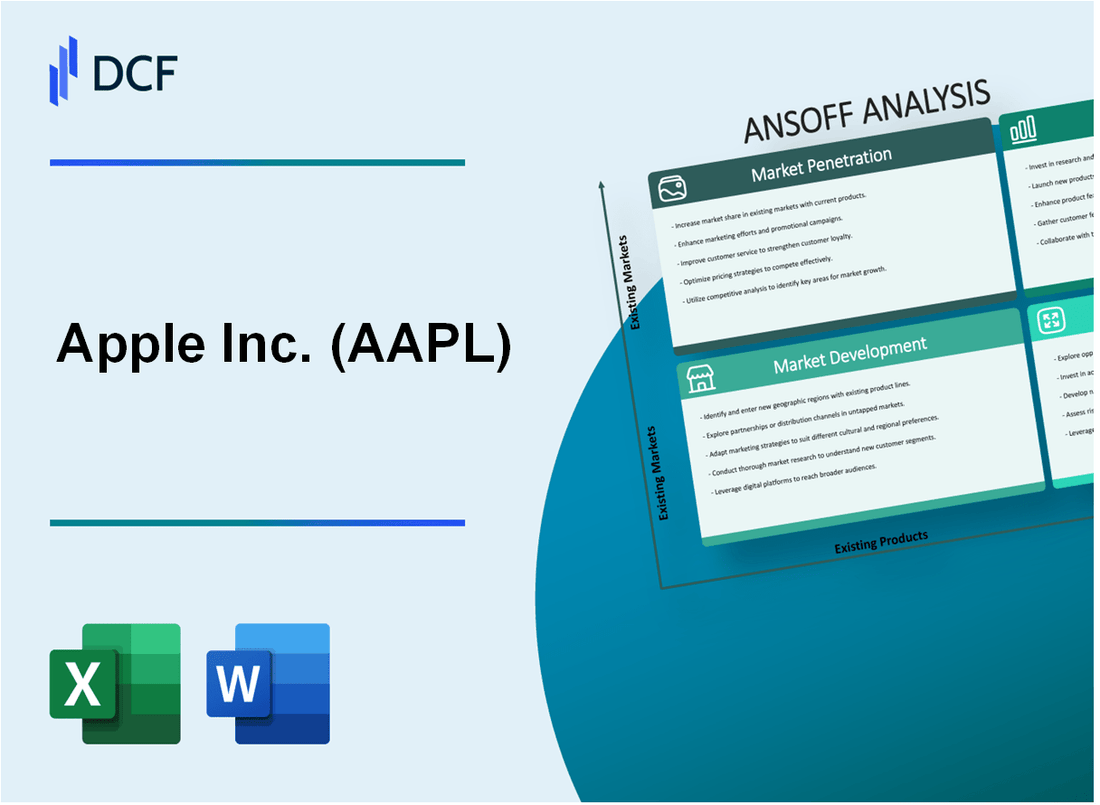
Apple Inc. (AAPL): ANSOFF MATRIX [Apr-2026 Updated] |
Completamente Editable: Adáptelo A Sus Necesidades En Excel O Sheets
Diseño Profesional: Plantillas Confiables Y Estándares De La Industria
Predeterminadas Para Un Uso Rápido Y Eficiente
Compatible con MAC / PC, completamente desbloqueado
No Se Necesita Experiencia; Fáciles De Seguir
Apple Inc. (AAPL) Bundle
You're looking at Apple Inc.'s stock and asking: where does the next wave of growth come from when the iPhone is already everywhere? The strategy is clear: they are executing a classic four-quadrant Ansoff Matrix play, balancing the certainty of their 2.35 billion active device installed base with high-risk, high-reward bets. This means driving Services revenue, which grew 13.51% to $109.16 billion in fiscal year 2025, while simultaneously accelerating market development in places like India, where sales were up 18% year-over-year in the first half of 2025. They are also pouring their $34.55 billion R&D budget into diversification plays like Vision Pro. That's how you manage a $3 trillion company. But the execution must be defintely flawless.
Apple Inc. (AAPL) - Ansoff Matrix: Market Penetration
Market Penetration for Apple Inc. is all about selling more of its current products-iPhone, Mac, and Services-to its massive existing customer base. This is the safest, lowest-risk growth path, focusing on deepening the ecosystem 'moat' and converting hardware users into high-margin, recurring service subscribers. The core strategy in 2025 centers on leveraging the 2.35 billion active installed devices to drive Services revenue and using strategic pricing to capture the entry-level smartphone buyer.
Drive Services revenue growth, which increased 13.51% in 2025, by bundling Apple One.
The primary near-term opportunity is to accelerate the Services segment, which is projected to generate about $108.6 billion in fiscal year 2025, representing an approximately 13% year-over-year increase. We are seeing this growth defintely driven by the bundling strategy, specifically the Apple One subscription. This bundle ties together high-value offerings like Apple Music, Apple TV+, and iCloud+ storage.
The recent price hike of the standalone Apple TV+ subscription to $12.99 per month (as of August 2025) makes the Apple One bundle an even more compelling value proposition. For a customer already paying for two or three services, the bundle's fixed price point-like the Individual plan at $19.95 per month-offers a clear discount while simultaneously locking them into the entire ecosystem. It's a simple math problem that favors the bundle, increasing the customer's lifetime value for Apple.
| Apple Services Financial Snapshot (FY 2025 Data) | Value / Metric |
| Projected FY 2025 Revenue | ~$108.6 billion |
| Q4 2025 Year-over-Year Growth | 15.1% |
| Q1 2025 Quarterly Revenue | $26.3 billion |
| Standalone Apple TV+ Price (Aug 2025) | $12.99 / month |
| Apple One Individual Plan (2025) | $19.95 / month |
Increase iPhone global market share from 19% (Q1 2025) by boosting trade-in incentives in the US and Europe.
To maintain market leadership, especially in mature, high-value markets like the US and Europe, we must convert older iPhone users to the latest models. The global iPhone market share stood at a strong 19% in Q1 2025, a figure we need to expand. The most direct tool here is the Apple Trade In program.
In mid-2025, Apple temporarily increased its iPhone trade-in values in key regions including the U.S., France, Germany, Italy, Spain, and the U.K. While the boost was modest, adding an extra $5 to $30 in credit in the U.S., this small incentive helps overcome the inertia of upgrading. The program is already a significant churn-reduction tool, processing over 12 million devices in the first quarter of fiscal 2025 with an average payout of $312 per device. A frictionless trade-in experience is key to keeping the upgrade cycle moving.
Migrate the active installed base of over 2.35 billion devices to higher-margin Apple Intelligence features.
The active installed base reached a new record of over 2.35 billion devices in Q1 2025. The market penetration strategy is now to migrate as many of these users as possible to the new, higher-margin Apple Intelligence (AI) features. This is a crucial step because the most advanced AI features-like on-device summarization, enhanced Siri, and Writing Tools with ChatGPT integration-are only available on devices with the latest chips (iPhone 15 Pro, all iPhone 16 models, and Macs/iPads with M1 or later).
This creates a powerful forced-upgrade cycle for the hardware business. The rollout is ongoing in 2025, with expanded language support for features like Live Translation and enhanced Siri capabilities scheduled for mid-year, increasing the value proposition for the global user base. The features themselves, requiring up to 7 GB of storage space, also subtly encourage users to upgrade their iCloud+ storage plans, further fueling the Services revenue stream.
Use the budget-focused iPhone 16e to capture entry-level users in mature markets.
The launch of the budget-focused iPhone 16e in Q1 2025, replacing the older iPhone SE line, is a direct market penetration play. Priced aggressively starting at $599, it allows Apple to compete effectively for entry-level buyers, particularly in mature markets where customers may be holding onto older models longer.
The iPhone 16e is a smart move because it still includes the latest A18 chip and supports the full suite of Apple Intelligence features, ensuring a consistent ecosystem experience even at the lower price point. This strategy helped Apple secure the number one position in global smartphone sales in Q1 2025 with a 19% share, demonstrating its immediate impact in driving volume.
Achieve a 90%+ retention rate for the Apple One services bundle through ecosystem lock-in.
Retention is the ultimate measure of market penetration success. While a specific Apple One retention rate is proprietary, the goal is to exceed the already high ecosystem loyalty. The Apple Watch user base, for example, already shows a retention rate of over 89%. The Apple One bundle is the key to pushing this figure past 90% for the services segment.
By making the bundle indispensable-combining utility (iCloud+ storage, which holds your photos and backups) with entertainment (Apple Music, Apple TV+)-the cost and hassle of leaving become too high. This 'switching cost' is the essence of ecosystem lock-in. The continuous addition of new features, like the rumored AI Health Companion, ensures the bundle's value keeps growing, making cancellation an increasingly irrational financial decision.
Apple Inc. (AAPL) - Ansoff Matrix: Market Development
Market Development, for a company like Apple, means taking existing products-the iPhone, Mac, and iPad-and pushing them into new, high-growth geographic regions or entirely new customer segments, like the enterprise market. This is a critical strategy right now, especially as growth in the Greater China segment declined 3.85% to $64.38 billion in fiscal year 2025, forcing a pivot to new frontiers.
The core action is simple: replicate the successful, high-margin ecosystem model in markets where the middle class is rapidly expanding. We're talking about a multi-pronged approach that combines aggressive retail expansion, a supply chain de-risking strategy, and a targeted push into the corporate world.
Accelerate expansion into India, the fastest-growing iPhone market with sales up 18% year-over-year in H1 2025.
India is the single most important market for Apple's near-term volume growth. In the first half of 2025 (H1 2025), iPhone shipments surged by an impressive 21.5% year-over-year, reaching 5.9 million units. This momentum helped push Apple India's total annual sales to a record high of nearly $9 billion in fiscal year 2025 (FY25). This growth is happening because the premium segment-devices over $800-is expanding rapidly, and the iPhone 16 was the most-shipped smartphone model in the country during this period.
The Rest of Asia Pacific segment, which includes India, saw its overall revenue climb 9.91% to $33.70 billion in FY25, making it a key driver offsetting China's slowdown. The strategy here is to pour fuel on that fire.
Open new flagship retail stores in high-potential emerging regions like India and the Kingdom of Saudi Arabia.
To capture the full value of this demand, Apple is shifting from a distributor-led model to a direct-to-consumer experience, which drives higher average selling prices (ASPs) and stronger Services adoption. In India, following the successful 2023 openings, the company plans to launch four new retail stores by the end of 2025. These new locations, including sites in Bengaluru, Pune, and Noida, will solidify the brand's presence in key metropolitan areas.
In the Middle East, the focus is on the Kingdom of Saudi Arabia (KSA), where the Arabic-language online Apple Store launched in the summer of 2025. The physical retail expansion will follow, with the first flagship Apple Store locations starting to open in 2026, including an iconic store planned for Diriyah. This retail push is defintely a long-term play to build brand loyalty and support the Services ecosystem in wealthy, young markets.
Adapt pricing and distribution channels for the iPhone SE and older models to gain volume in Tier 2 cities in Brazil.
In markets like Brazil, local taxes and import tariffs create a significant price barrier. The high cost of the iPhone 16 Pro in Brazil, which is priced at approximately $1,835, makes it about 70% more expensive than the U.S. price. To gain volume in Tier 2 cities-where consumer purchasing power is lower-Apple must aggressively push its more affordable entry points.
This means leveraging the iPhone SE and older generations (like the iPhone 14 and iPhone 15 series) through targeted distribution channels. The strategy must involve a heavy reliance on carrier financing and trade-in programs to bring the effective monthly cost down. While the new iPhone SE 2025 is rumored to see a price increase to around $500, it remains the most critical affordable funnel into the Apple ecosystem for price-sensitive, high-growth regions.
Scale local manufacturing in India to 25% of total iPhone production to mitigate tariffs and lower costs.
The geopolitical and supply chain risks associated with a China-centric model are now a major financial concern, so diversification is a must. Apple's manufacturing shift to India is accelerating far faster than initial projections.
Here's the quick math: By the end of FY25, India is projected to account for 17% to 18% of the global iPhone production volume, up from an estimated 12-14% in FY24. This local assembly is projected to have a freight-on-board (FOB) production value of over $18 billion for the full FY25. While the ambitious target of 25% of global iPhone production is still projected for 2027, the current ramp-up is already providing significant benefits by mitigating import tariffs and strengthening government relations in the region.
Expand enterprise solutions through strategic partnerships, positioning Mac and iPad as business tools.
The enterprise segment is a new market for existing products, a classic Market Development play. Apple is making a concerted effort to position the Mac and iPad as essential business tools, moving beyond their traditional creative and education niches. This is supported by the massive growth in the Services segment, which grew 13.51% to $109.16 billion in FY25, now representing over 26% of total revenue.
The company is launching a revamped partner program in Fall 2025, introducing new categories like 'Apple Business Partner' to strengthen its channel sales to enterprise and small-to-medium business (SMB) customers. This push is already bearing fruit in hardware sales: Mac revenue saw a 12.42% increase to $33.71 billion in FY25, and iPad revenue climbed 4.98% to $28.02 billion. That's a strong signal of corporate adoption driven by the performance and security of Apple silicon (M-series chips).
Here is a quick look at the enterprise-facing hardware performance in FY25:
| Product Segment | FY 2025 Revenue | YoY Revenue Growth (FY24 to FY25) | Strategic Context |
|---|---|---|---|
| Mac | $33.71 Billion | 12.42% | Driven by M-series chip adoption and corporate demand recovery. |
| iPad | $28.02 Billion | 4.98% | Gains from iPad Air and iPad mini, positioning as a mobile business tool. |
| Services (Total) | $109.16 Billion | 13.51% | Provides the high-margin recurring revenue stream that underpins enterprise solutions. |
Next Step: Sales Team, Brazil: Draft a detailed proposal for a 24-month, zero-interest financing program specifically for the iPhone SE and iPhone 15 in Tier 2 Brazilian cities by the end of the quarter.
Apple Inc. (AAPL) - Ansoff Matrix: Product Development
Product Development, the strategy of offering new products to an existing market, is where Apple Inc. (AAPL) consistently drives its premium pricing power and ecosystem stickiness. In fiscal year 2025, this meant not just incremental updates, but foundational shifts in silicon and artificial intelligence (AI) that are designed to force a major upgrade cycle for its massive installed base.
The core of this strategy is leveraging the company's vertically integrated hardware and software stack to deliver features competitors cannot easily replicate. Here's the quick math: Apple's total revenue for FY2025 hit a record $416.16 billion, with net profit soaring to $112 billion, and this product pipeline is what sustains those numbers.
Launch the next-generation iPhone 17 lineup with major camera and battery upgrades for the existing user base.
The iPhone 17 lineup, launched in September 2025, was engineered to spur upgrades among users holding onto older models. The product development focus was on making the standard model a much more compelling device. The iPhone segment remains the largest revenue driver, accounting for roughly half of total sales, and it grew 4.2% in FY2025 to $209.59 billion.
Key hardware improvements targeted the most-used features:
- Camera: The standard iPhone 17 received a significant upgrade to a 48-megapixel ultrawide camera, moving away from the older 12-megapixel sensor for crisper ultrawide shots. The front-facing TrueDepth camera was also upgraded to 24MP.
- Battery: The new models, especially the iPhone 17 Pro Max, were designed to be slightly thicker to accommodate a bigger battery, addressing a primary user pain point. The new Adaptive Power Mode in iOS 26 also uses smart management to extend battery life.
Integrate Apple Intelligence across 100% of product lines for on-device processing by Q4 2025.
The rollout of Apple Intelligence, the company's personal intelligence system, is the single largest product development initiative of 2025. This isn't just a software feature; it requires a new class of hardware with a powerful Neural Engine (NE). The goal is to have Apple Intelligence capabilities on 250 million AI-capable devices by late 2025, which is a staggering scale.
The financial impact is twofold: it drives hardware sales and it fuels the high-margin Services segment, which is projected to add over $5 billion in annualized service revenue from AI-driven features. To be fair, this massive push is expensive; R&D investments are soaring, with Q1 2026 operating expenses (OpEx) projected to be between $18.1 billion and $18.5 billion, an increase largely dedicated to this AI infrastructure.
Introduce the M5-chip updates for MacBook Pro and iPad Pro to drive Mac revenue, which grew 12.42% in 2025.
The introduction of the M5 chip in October 2025 for the 14-inch MacBook Pro and the new iPad Pro was a direct product development move to boost sales in the computing segments. This new silicon is the engine for the AI push, delivering up to 3.5x faster AI performance than the previous generation.
This strategy is working. Mac revenue jumped 12.7% to $8.73 billion in Q4 2025, a clear sign that the M5 update is compelling professional users to upgrade. The M5-powered iPad Pro also saw a huge leap in AI performance, up to 3.5 times faster than the M4 model, positioning the tablet as a true professional computing device.
| Product Line | FY2025 Revenue/Q4 2025 Data | Key Product Development Driver (2025) |
|---|---|---|
| iPhone | FY2025 Revenue: $209.59 billion (+4.2% YoY) | iPhone 17: 48MP Ultrawide Camera, Adaptive Power Mode |
| Mac | Q4 2025 Revenue: $8.73 billion (+12.7% YoY) | M5 Chip in MacBook Pro: Up to 3.5x faster AI performance |
| Services | FY2025 Revenue: Over $100 billion (Q4 margin 75.3%) | Apple Intelligence: Targeting 250 million AI-capable devices |
| Wearables, Home, & Accessories | (Includes Apple Watch, AirTag) | Apple Watch Series 11/Ultra 3: Hypertension Alerts; AirTag 2: 3x UWB Range |
Add advanced health monitoring, like blood pressure sensing, to the Apple Watch Series 11 and Ultra 3.
The Apple Watch Series 11 and Ultra 3, released in September 2025, continue the product development trend of turning the Watch into an essential health device. The new feature is the long-awaited blood pressure monitoring, which works by alerting the user to possible hypertension (high blood pressure, typically over 140/90 mmHg).
This is a smart, empathetic caveat: the watch doesn't give a specific systolic/diastolic reading, but acts as a warning system, prompting the user to see a doctor. This early alert system is a major step forward and is expected to help 1 million people get diagnosed with hypertension in the first year alone.
Release the AirTag 2 with second-generation Ultra-Wideband (UWB) for better tracking range.
The AirTag 2, a product rumored for a mid-to-late 2025 release, is a classic product development move to refresh a high-volume accessory. The core upgrade is the second-generation Ultra-Wideband (UWB) chip, which significantly improves the Precision Finding feature. The existing UWB chip works well, but the new one is expected to triple the tracking range, potentially extending the effective distance to around 60 meters (or 200 feet).
Plus, the new model includes enhanced anti-stalking measures, such as a more tamper-resistant speaker, which is a necessary product refinement based on real-world privacy concerns. This small, defintely useful accessory helps keep users locked into the Find My ecosystem.
Apple Inc. (AAPL) - Ansoff Matrix: Diversification
Diversification, for a company the size of Apple Inc., means moving into entirely new markets with new products, and in 2025, this strategy is less about a single blockbuster and more about building a new, interconnected ecosystem beyond the iPhone. The core risk here is that a new product category, even one as technologically advanced as the Vision Pro, requires significant time and investment to reach mass-market adoption. We're seeing a clear push into spatial computing, smart home control, and leveraging the massive $34.55 billion R&D budget for future non-core ventures.
Establish the Apple Vision Pro as the category-defining spatial computing platform in a nascent market.
The Apple Vision Pro, launched in February 2024 at a premium price of $3,499, was the initial flag plant in the spatial computing market, a true diversification move. However, the near-term reality is challenging. Initial sales forecasts for 2024 were cut significantly, dropping from an expected 700,000-800,000 units to a more conservative 400,000 to 450,000 units. This high-cost, niche adoption means that while the first 11 months may generate around $1.75 billion in revenue, it's a drop in the bucket for a company with Apple's scale. Honestly, the device's weight and battery life issues have led to a pivot, with reports in November 2025 indicating Apple is pausing further Vision Pro updates to shift engineering resources toward lighter, more wearable smart-glass designs. This is a long-game technology bet, not a near-term revenue driver.
Enter the smart home display market with a new 'Command Center' hybrid device to control home automation.
A more immediate diversification opportunity lies in the smart home, a market currently dominated by Amazon and Google. Apple is planning to launch an AI-powered smart home display, internally referred to as a 'Command Center,' as early as March 2025. This device is rumored to feature a six-inch or seven-inch screen, a camera for FaceTime, and will act as a centralized hub for HomeKit devices. It's a direct challenge to the Nest Hub Max and Echo Hub, and Apple is expected to price the base model competitively, likely in the $150 to $230 range. The real opportunity is in the high-end version, which is rumored to include a robotic arm to adjust the screen angle, potentially selling for a premium price of up to $1,000. This is a smart, defensible move to deepen the ecosystem lock-in.
Explore non-core ventures in health technology and robotics, leveraging the $34.55 billion R&D budget.
Apple's commitment to finding its next major product category is best reflected in its immense research and development spending. The annual R&D expenses for the 2025 fiscal year reached a peak of $34.55 billion, a year-over-year increase of 10.14%. This capital is funding highly speculative, non-core ventures like robotics. The company is actively exploring both humanoid and non-humanoid robotic designs for smart home applications. While a full-fledged, mass-produced consumer robot is unlikely to arrive before 2028, the research is focused on creating an AI companion, such as a tabletop robot with a display and a robotic arm, which is a centerpiece of the long-term AI hardware strategy.
Here's the quick math on the investment and timeline for these major bets:
| Diversification Area | 2025 Status/Timeline | Key 2025 Financial/Data Point | Risk/Opportunity |
| Spatial Computing (Vision Pro) | Launched (Feb 2024), Updates Paused | 2024 Sales Forecast Cut to 400k-450k units. | Risk: High price point, low adoption. Opportunity: Platform lock-in for future AR glasses. |
| Smart Home Display ('Command Center') | Rumored Launch (March 2025) | Base Model Price: $150 to $230. | Opportunity: Central hub for HomeKit, immediate revenue stream. |
| Robotics & Health Tech | Early R&D/Proof-of-Concept | 2025 R&D Budget: $34.55 billion. | Risk: Long development cycle (2027/2028+). Opportunity: New multi-trillion-dollar market entry. |
Develop a foldable iPhone form factor to capture the premium, high-growth segment of the smartphone market.
The foldable iPhone is a critical diversification move within the existing smartphone market, targeting the premium, high-growth segment. The US foldable smartphone market is expected to see significant growth of 68% year-over-year in 2025, moving from a niche product to a more mainstream premium format. However, Apple is defintely taking its time to get the technology right. Despite the market momentum in 2025, multiple reports indicate that the foldable iPhone will not launch this year, with a release window pushed to late 2026 or even 2027, possibly as part of the iPhone 18 series. The delay is likely due to technical hurdles like hinge durability, but it means Apple misses out on the 2025 growth wave, letting competitors like Samsung cement their lead in the interim.
Launch the AirTag 2 with Vision Pro integration for AR spatial awareness in new use cases.
A smaller, but strategically important, diversification is the launch of the AirTag 2, rumored for mid-2025. The goal is to tie a low-cost accessory, which currently sells for $29 per unit, directly into the nascent spatial computing ecosystem. The AirTag 2 is expected to feature an upgraded second-generation Ultra Wideband chip, which will provide up to 3x longer range than the original. Crucially, this new chip and the AirTag 2 are rumored to have improved integration with the Apple Vision Pro. This enables new augmented reality (AR) use cases, allowing a user wearing the headset to visually track a lost item, like a wallet or keys, with AR directional arrows overlaid onto the real world. It's a simple, high-volume product that validates the Vision Pro's spatial awareness capabilities.
Next Step: Product Strategy: Finalize AirTag 2 launch date and marketing plan to explicitly feature Vision Pro integration by Q3 2025.
Disclaimer
All information, articles, and product details provided on this website are for general informational and educational purposes only. We do not claim any ownership over, nor do we intend to infringe upon, any trademarks, copyrights, logos, brand names, or other intellectual property mentioned or depicted on this site. Such intellectual property remains the property of its respective owners, and any references here are made solely for identification or informational purposes, without implying any affiliation, endorsement, or partnership.
We make no representations or warranties, express or implied, regarding the accuracy, completeness, or suitability of any content or products presented. Nothing on this website should be construed as legal, tax, investment, financial, medical, or other professional advice. In addition, no part of this site—including articles or product references—constitutes a solicitation, recommendation, endorsement, advertisement, or offer to buy or sell any securities, franchises, or other financial instruments, particularly in jurisdictions where such activity would be unlawful.
All content is of a general nature and may not address the specific circumstances of any individual or entity. It is not a substitute for professional advice or services. Any actions you take based on the information provided here are strictly at your own risk. You accept full responsibility for any decisions or outcomes arising from your use of this website and agree to release us from any liability in connection with your use of, or reliance upon, the content or products found herein.