

|
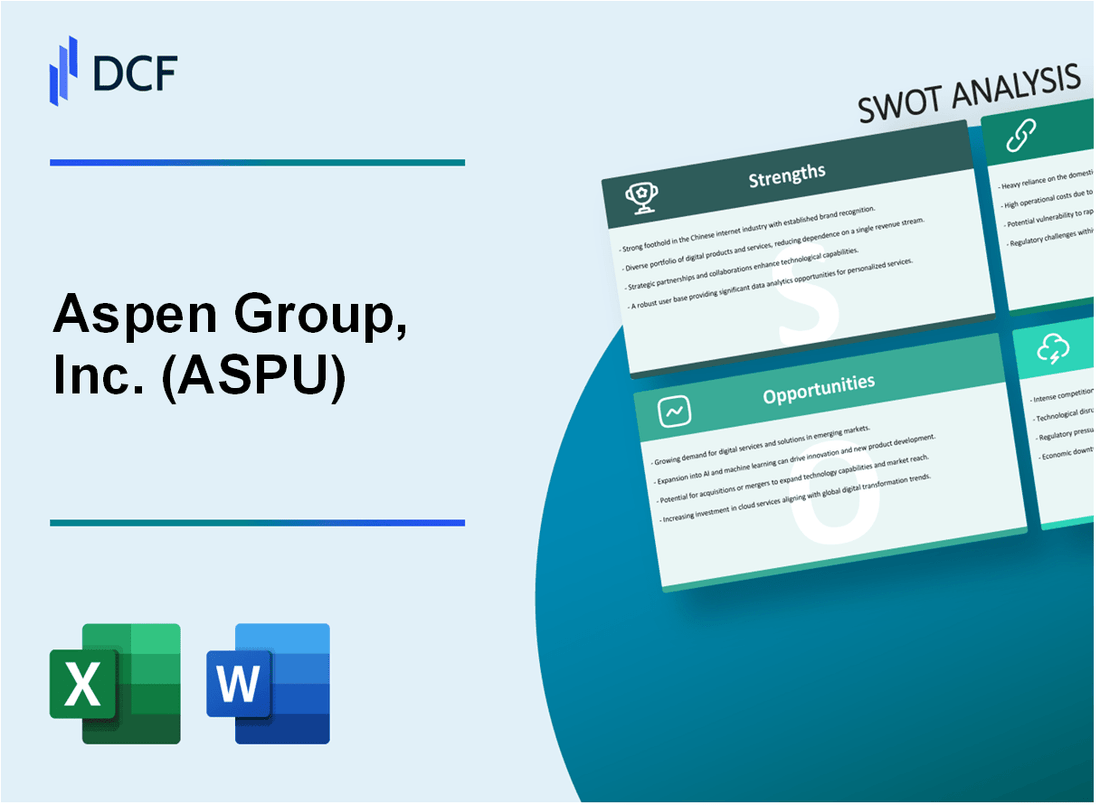
Aspen Group, Inc. (ASPU): Análisis FODA [Actualizado en enero de 2025] |
Completamente Editable: Adáptelo A Sus Necesidades En Excel O Sheets
Diseño Profesional: Plantillas Confiables Y Estándares De La Industria
Predeterminadas Para Un Uso Rápido Y Eficiente
Compatible con MAC / PC, completamente desbloqueado
No Se Necesita Experiencia; Fáciles De Seguir
Aspen Group, Inc. (ASPU) Bundle
En el panorama en rápida evolución de la educación superior en línea, Aspen Group, Inc. (ASPU) se encuentra en una coyuntura crítica, navegando por la dinámica compleja del mercado con su enfoque especializado para la educación profesional. A medida que la demanda de aprendizaje flexible e impulsado por la tecnología continúa aumentando, este análisis FODA integral revela el posicionamiento estratégico de la compañía, destacando sus fortalezas únicas en la educación en enfermería y la educación en la salud al tiempo que examina sinceramente los desafíos y las vías potenciales para el crecimiento en un ecosistema educativo cada vez más competitivo.
Aspen Group, Inc. (ASPU) - Análisis FODA: fortalezas
Enfoque especializado en programas de educación superior en línea para profesionales que trabajan
Aspen Group, Inc. sirve a un mercado objetivo de profesionales que trabajan que buscan opciones de educación flexibles. A partir de 2024, la compañía ofrece programas de grado en línea en múltiples disciplinas.
| Categoría de programa | Número de títulos en línea | Segmento profesional objetivo |
|---|---|---|
| Enfermería | 12 programas en línea distintos | Profesionales de la salud |
| Negocio | 8 pistas de grado en línea | Profesionales corporativos |
| Tecnología | 6 programas de grado en línea | TI y trabajadores técnicos |
Presencia establecida en sectores de enfermería y educación sobre la salud
Los programas de enfermería de la Universidad de Aspen demuestran una importante penetración del mercado:
- Clasificado entre los 15 principales proveedores de educación en enfermería en línea
- Más de 3.500 estudiantes de enfermería activa en 2024
- Acreditación de la Comisión de Educación Colegiada de Enfermería (CCNE)
Modelo operativo delgado con costos generales más bajos
| Métrico de costo | Valor de grupo de Aspen | Comparación universitaria tradicional |
|---|---|---|
| Gastos operativos | $ 22.4 millones (2023) | $ 45-60 millones |
| Inversión de infraestructura física | $ 1.2 millones | $ 15-25 millones |
Plataformas de aprendizaje en línea flexibles y accesibles
Destacados de infraestructura de aprendizaje digital:
- Accesibilidad del curso 24/7
- Sistema de gestión de aprendizaje de móvil compatible
- Tiempo promedio de participación del estudiante: 12.5 horas por semana
- Tecnología de aprendizaje patentada que respalda el 99.7% de tiempo de actividad
Aspen Group, Inc. (ASPU) - Análisis FODA: debilidades
Alcance geográfico limitado y diversidad de programas
A partir de 2024, Aspen Group opera principalmente en 6 estados, con una presencia concentrada en Florida, Texas e Indiana. La compañía ofrece un número limitado de programas académicos, con aproximadamente 20 programas de grado en línea a través de varias disciplinas.
| Presencia geográfica | Número de estados | Ubicaciones principales |
|---|---|---|
| Estados operativos actuales | 6 | Florida, Texas, Indiana, Arizona, Utah, Colorado |
Inscripción relativamente pequeña de los estudiantes
En comparación con las instituciones educativas más grandes, Aspen Group demuestra modestas cifras de inscripción de estudiantes. Para el año fiscal 2023, la compañía informó Inscripción total de estudiantes de 6.700 estudiantes.
| Métrico de inscripción | Total de estudiantes | Comparación con instituciones más grandes |
|---|---|---|
| Inscripción total de estudiantes (el año fiscal 2023) | 6,700 | Significativamente más bajo que los promedios de la universidad nacional |
Dependencia de los ingresos del programa de atención médica y de enfermería
La compañía exhibe una concentración significativa de ingresos en programas relacionados con la salud. Aproximadamente el 65% de los ingresos totales del programa se derivan de las ofertas de grado de enfermería y de atención médica.
- Los programas de enfermería constituyen 45% de los ingresos totales del programa
- Los títulos relacionados con la atención médica contribuyen con un adicional 20% de los ingresos totales
- Potencial vulnerabilidad a las fluctuaciones del mercado de la educación de la salud
Desafíos financieros continuos con rentabilidad consistente
El desempeño financiero indica desafíos de rentabilidad persistente. Para el año fiscal 2023, la compañía informó:
| Métrica financiera | Cantidad | Cambio año tras año |
|---|---|---|
| Pérdida neta | $ 12.4 millones | -15% del año anterior |
| Gastos operativos | $ 98.3 millones | +7% de aumento |
| Ganancia | $ 83.9 millones | +3% de crecimiento |
Los indicadores financieros clave sugieren desafíos continuos para lograr una rentabilidad consistente y mantener un desempeño financiero sostenible.
Aspen Group, Inc. (ASPU) - Análisis FODA: oportunidades
Creciente demanda de opciones de educación superior en línea y flexibles
Según el Centro Nacional de Estadísticas de Educación, la inscripción en línea aumentó en un 14,9% en 2022, con 3.1 millones de estudiantes que toman al menos un curso en línea. Se proyecta que el mercado educativo en línea alcanzará los $ 319 mil millones para 2025, presentando una oportunidad significativa para Aspen Group.
| Métricas de mercado de educación en línea | Datos 2022 |
|---|---|
| Total de estudiantes en línea | 3.1 millones |
| Proyección de valor de mercado (2025) | $ 319 mil millones |
| Tasa de crecimiento anual | 14.9% |
Posible expansión en programas adicionales de grado profesional y técnico
Existen oportunidades de mercado clave en la educación profesional especializada:
- Programas de tecnología y ciberseguridad con el 31% de crecimiento del empleo proyectado
- Se espera que los programas de certificación de marketing digital crezcan un 19% anual
- Programas de ciencia y análisis de datos con salarios medios de $ 100,450
Aumento del mercado para la educación sobre la salud y la enfermería
La Oficina de Estadísticas Laborales de EE. UU. Proyecta un crecimiento del 6% para las enfermeras registradas hasta 2031, con un estimado de 203,200 aperturas de trabajo anualmente.
| Indicadores del mercado de la educación sanitaria | Datos proyectados |
|---|---|
| Crecimiento del empleo de enfermería (2021-2031) | 6% |
| Aperturas anuales de trabajo de enfermería | 203,200 |
| Salario rn mediano | $77,600 |
Potencial para asociaciones estratégicas con organizaciones de atención médica
Las asociaciones de educación sobre la salud representan un Segmento de mercado potencial de $ 2.5 mil millones, con una creciente demanda de programas de capacitación especializados.
Innovación educativa y desarrollo del plan de estudios impulsado por la tecnología
Se espera que el mercado de Edtech alcance los $ 404 mil millones para 2025, con inteligencia artificial en educación que se proyecta crecer a un 45% de CAGR entre 2022-2027.
| Tecnología en el mercado educativo | Valor proyectado |
|---|---|
| Mercado Total de Edtech (2025) | $ 404 mil millones |
| AI en Educación CAGR | 45% |
| Crecimiento de plataformas de aprendizaje virtual | 38% |
Aspen Group, Inc. (ASPU) - Análisis FODA: amenazas
Competencia intensa en el mercado educativo en línea
El mercado educativo en línea muestra una presión competitiva significativa con múltiples jugadores clave:
| Competidor | Cuota de mercado | Inscripción en línea |
|---|---|---|
| Cursera | 36.2% | 77 millones de estudiantes |
| Idacacidad | 12.5% | 22 millones de estudiantes |
| edx | 8.7% | 35 millones de estudiantes |
Cambios regulatorios potenciales en la educación superior
Los riesgos de acreditación incluyen:
- Cambios de políticas potenciales del Departamento de Educación
- Aumento de la supervisión federal
- Requisitos de resultados de estudiante más estrictos
Incertidumbres económicas
Desafíos de inscripción de estudiantes y accesibilidad de la matrícula:
| Indicador económico | 2023 datos | Impacto proyectado |
|---|---|---|
| Deuda estudiantil | $ 1.75 billones | -4.2% de potencial de inscripción |
| Tasa de desempleo | 3.7% | Inversión educativa moderada |
Interrupciones tecnológicas
Tendencias de tecnología educativa emergente:
- Plataformas de aprendizaje personalizadas impulsadas por IA
- Entornos de entrenamiento de realidad virtual
- Sistemas de acreditación de blockchain
Desafíos de reclutamiento de la fuerza laboral de la salud
Potencial disminución de las demandas de capacitación en salud:
| Sector de la salud | Demanda actual | Cambio proyectado |
|---|---|---|
| Programas de enfermería | 721,000 aberturas | -2.5% para 2026 |
| Capacitación médica | $ 68.5 mil millones de mercado | Potencial 3% Contracción |
Aspen Group, Inc. (ASPU) - SWOT Analysis: Opportunities
The core opportunity for Aspen Group, Inc. (ASPU) lies in leveraging its online, affordable model to capture the massive, sustained demand in the U.S. healthcare sector, particularly for advanced nursing degrees. The company's recent focus on efficiency and the merger of its two universities, Aspen University and United States University, creates a streamlined platform ready to scale high-margin programs and pursue strategic growth.
Expand high-margin doctoral programs (e.g., DNP) to improve profitability.
The most immediate and impactful opportunity is to aggressively grow enrollment in high-margin, post-licensure programs, especially the Doctor of Nursing Practice (DNP). This strategy directly capitalizes on the operational efficiencies achieved in Fiscal Year 2025 (FY2025).
Here's the quick math: The company's consolidated gross margin for the full FY2025 was a strong 69%, but the gross margin at United States University (USU), which houses the high-demand Family Nurse Practitioner (FNP) program, was even higher at 74% for Q4 FY2025 and climbed to 76% in Q1 Fiscal 2026 (ended July 31, 2025). This higher margin in advanced nursing programs makes them the defintely profitable growth engine.
Aspen University already offers a Doctor of Nursing Practice (DNP) program, which requires 1,000 hours of clinical practice immersion and has a tuition and fees cost of approximately $28,320. Scaling these DNP and other doctoral programs (like the Doctor of Education and Doctor of Science in Computer Science) will further lift the corporate gross margin above the FY2025 average of 69% by increasing the revenue per student (ARPU) within the existing, now-more-efficient cost structure.
Capitalize on the national nursing shortage driving demand for their degrees.
The ongoing national nursing shortage provides a durable, long-term tailwind for Aspen Group, Inc.'s primary business. This isn't a cyclical trend; it's a demographic reality driven by an aging population and a retiring workforce.
The demand for advanced nursing degrees is particularly acute. The U.S. Bureau of Labor Statistics (BLS) projects that over 193,000 openings for Registered Nurses (RNs) are expected each year through 2032. More specifically, federal authorities project a shortage of 78,610 full-time RNs in 2025. For Aspen Group, Inc., whose student body was 82% degree-seeking nursing students as of October 2023, this translates to a massive, addressable market of working RNs seeking career advancement.
The most significant opportunity is in the Nurse Practitioner (NP) field, which is projected to see a 45% increase in employment from 2022 to 2032. The company's flagship program, the Master of Science in Nursing - Family Nurse Practitioner (MSN-FNP) at United States University, is perfectly positioned to capture this growth.
- U.S. RN job openings projected annually through 2032: 193,100.
- Projected full-time RN shortage in 2025: 78,610.
- Projected employment growth for Nurse Practitioners (2022-2032): 45%.
Potential for strategic acquisitions of smaller, specialized online education providers.
With the company's financial foundation strengthening-evidenced by the full FY2025 net loss narrowing significantly to $1.5 million from $13.6 million in FY2024, and achieving positive net income in Q4 FY2025-there is a clear path back to strategic M&A (Mergers and Acquisitions). The recent internal consolidation, merging Aspen University and United States University in September 2025, is a strategic move to streamline operations and enhance long-term sustainability.
Once the consolidation is complete and the cash flow benefits from the restructuring initiatives materialize, the company can pivot back to external growth. The target should be smaller, specialized online providers that offer non-nursing programs with high lifetime value (LTV) or programs in other high-demand healthcare fields. This approach allows Aspen Group, Inc. to diversify revenue beyond nursing while leveraging its existing education technology infrastructure.
The company has a proven track record, having acquired United States University in 2017. A disciplined M&A strategy, focused on accretive, specialized assets, is the next logical step to drive growth in Fiscal 2026 and beyond, building on the internal efficiencies gained in FY2025.
Increase international student enrollment in non-nursing programs.
The global market represents an untapped opportunity, especially in non-nursing fields like Business and Technology, which are offered by Aspen University. The U.S. market for international students is showing a strong rebound, with total international student enrollment growing by 3% in the 2024-2025 academic year, reaching 1,160,490 students. Undergraduate enrollment growth was even higher at 6%.
Aspen Group, Inc.'s core value proposition-affordable tuition and flexible, 100% online delivery-is highly attractive to international students seeking a U.S. degree without the high cost and logistical hurdles of on-campus residency. The company can leverage its online modality to reach students in markets where the cost of local higher education is prohibitive or where demand for U.S.-style business and technology degrees is high.
This is a low-cost expansion opportunity, as it requires minimal new capital expenditure, only a targeted digital marketing and international recruitment strategy. The focus should be on:
| Target Program Area | Strategic Rationale |
| Business and Technology | Diversifies revenue away from the heavily regulated nursing sector. |
| Education (Ed.D./Ed.S.) | Appeals to international educators seeking U.S. credentials for career advancement. |
| Online Modality | Removes the need for student visas and physical campus presence, lowering entry barriers. |
Aspen Group, Inc. (ASPU) - SWOT Analysis: Threats
Stricter Department of Education (DOE) regulations on for-profit education.
The regulatory environment for for-profit education remains a significant headwind, even with Aspen Group, Inc.'s recent successes in resolving past issues. The core threat isn't just new rules, but the approval process for major strategic moves. You saw this play out when the company had to successfully resolve outstanding regulatory issues in calendar year 2024, including the removal of Aspen University's show cause directive and the transition off the Department of Education's Heightened Cash Monitoring 2 (HCM2) payment method.
Now, a new regulatory hurdle is the planned merger of Aspen University and United States University. This strategic move, announced in September 2025, requires confirmation and/or approval from the Department of Education and accrediting bodies. Any delay or unexpected condition placed on this approval could disrupt operations, stall expected cost efficiencies, and prolong the period of uncertainty. This is a very real, near-term regulatory risk that directly impacts the company's future structure.
Increased competition from non-profit universities expanding online offerings.
The biggest long-term threat is the sheer scale and brand power of non-profit universities entering the online space. Institutions like Southern New Hampshire University, Arizona State University - Online, and Western Governors University are dedicating massive resources to online programs, often under a non-profit banner that carries a stronger public perception than for-profit models.
The numbers show the market preference: in the 2021-2022 academic year, private non-profit institutions awarded 568,582 bachelor's degrees, while for-profit schools conferred only 100,863 undergraduate degrees. That's a huge gap. These non-profit competitors reinvest tuition back into the institution, which often translates to more robust student support and a higher perceived quality, directly challenging Aspen Group, Inc.'s value proposition. They are simply better capitalized for the long game.
Risk of negative publicity impacting student enrollment and brand reputation.
Past regulatory challenges and the resulting negative press have a long tail, directly impacting new student acquisition and overall brand health. The most concrete evidence of this is the decline in the active student body. For the full Fiscal Year 2025 (ended April 30, 2025), the active degree-seeking student body declined 18% year-over-year to 5,809 students. New student enrollments were also down 19% year-over-year in the first quarter of Fiscal Year 2025. While management attributes much of this to a necessary reduction in marketing spend to achieve profitability, the underlying reputational damage from past issues makes a recovery in enrollment harder and more expensive.
Here's the quick math on the enrollment drop:
| Metric | FY 2024 (April 30) | FY 2025 (April 30) | Change |
| Total Active Students | 7,048 | 5,809 | -18% |
| Aspen University (AU) Active Students | 4,559 | 3,375 | -26% |
| United States University (USU) Active Students | 2,489 | 2,434 | -2% |
The 26% drop at Aspen University is a clear sign that the reputational impact is not uniform and hits the most exposed brand hardest.
Rising interest rates making student loan financing more defintely expensive.
The macroeconomic environment is making the cost of attendance for every student more difficult, and that pressure is felt most acutely by students at institutions relying heavily on federal and private loan financing. For the 2024-2025 school year, federal student loan interest rates increased by more than 1% for the fourth straight year.
This means the cost of borrowing is at a decade-high for undergraduate Direct Loans and a 20-year high for graduate and Parent PLUS Loans. Higher rates increase the total cost of a degree, which can deter prospective students, especially in the price-sensitive market that Aspen Group, Inc. targets. The risk is a further contraction in new enrollments as students postpone or abandon education plans due to higher debt burdens. This adds a critical layer of financial stress for your target demographic.
- Higher rates reduce the perceived return on investment (ROI) for a degree.
- Increased monthly payments for borrowers with variable-rate private loans.
- The affordability advantage of Aspen Group, Inc.'s programs is eroded by rising debt costs.
Disclaimer
All information, articles, and product details provided on this website are for general informational and educational purposes only. We do not claim any ownership over, nor do we intend to infringe upon, any trademarks, copyrights, logos, brand names, or other intellectual property mentioned or depicted on this site. Such intellectual property remains the property of its respective owners, and any references here are made solely for identification or informational purposes, without implying any affiliation, endorsement, or partnership.
We make no representations or warranties, express or implied, regarding the accuracy, completeness, or suitability of any content or products presented. Nothing on this website should be construed as legal, tax, investment, financial, medical, or other professional advice. In addition, no part of this site—including articles or product references—constitutes a solicitation, recommendation, endorsement, advertisement, or offer to buy or sell any securities, franchises, or other financial instruments, particularly in jurisdictions where such activity would be unlawful.
All content is of a general nature and may not address the specific circumstances of any individual or entity. It is not a substitute for professional advice or services. Any actions you take based on the information provided here are strictly at your own risk. You accept full responsibility for any decisions or outcomes arising from your use of this website and agree to release us from any liability in connection with your use of, or reliance upon, the content or products found herein.