

|
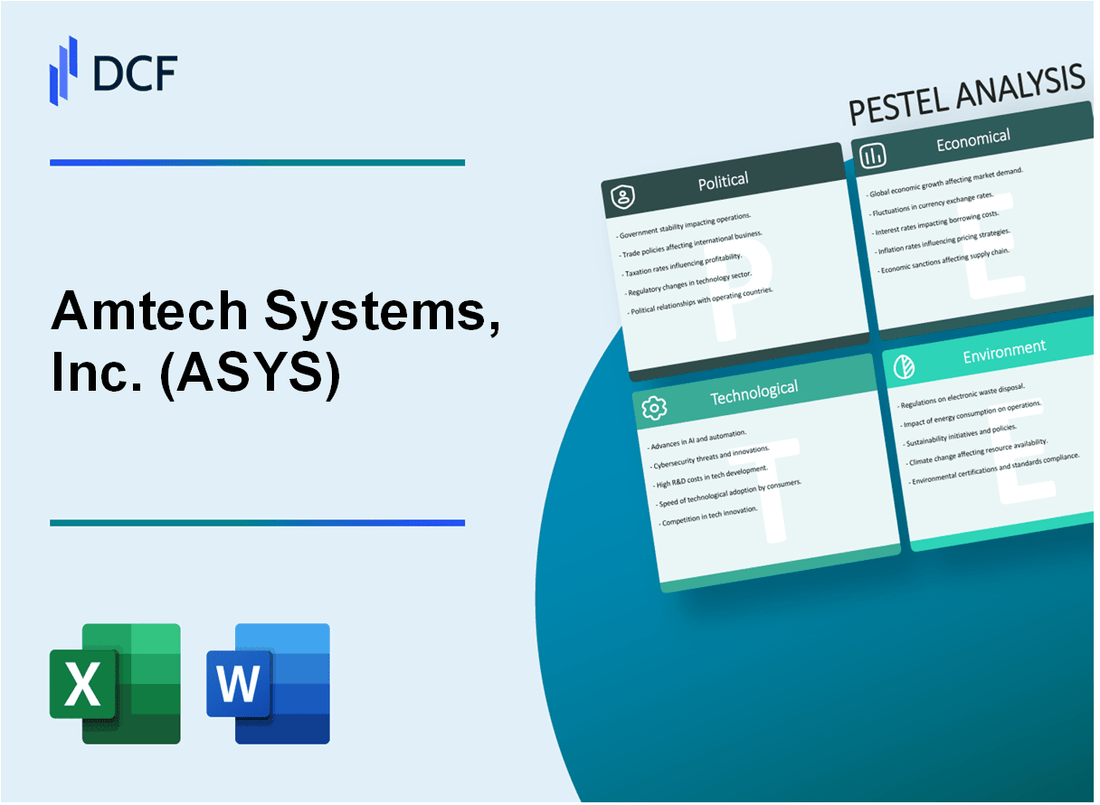
Análisis PESTLE de Amtech Systems, Inc. (ASYS) [Actualizado en enero de 2025] |
Completamente Editable: Adáptelo A Sus Necesidades En Excel O Sheets
Diseño Profesional: Plantillas Confiables Y Estándares De La Industria
Predeterminadas Para Un Uso Rápido Y Eficiente
Compatible con MAC / PC, completamente desbloqueado
No Se Necesita Experiencia; Fáciles De Seguir
Amtech Systems, Inc. (ASYS) Bundle
En el panorama en rápida evolución de la tecnología de semiconductores, Amtech Systems, Inc. (ASSY) se encuentra en una intersección crítica de los desafíos y oportunidades globales. Este análisis integral de la mano presenta la compleja red de factores políticos, económicos, sociológicos, tecnológicos, legales y ambientales que dan forma a la trayectoria estratégica de la compañía, ofreciendo información sin precedentes sobre cómo las fuerzas externas están transformando el sector de fabricación de equipos semiconductores e influyendo en el potencial de ASYS para el crecimiento, innovación y resiliencia en un mercado global cada vez más interconectado.
Amtech Systems, Inc. (ASYS) - Análisis de mortero: factores políticos
Restricciones de exportación de semiconductores de EE. UU. A China
En octubre de 2022, el Departamento de Comercio de los Estados Unidos implementó controles integrales de exportación en tecnologías avanzadas de semiconductores a China. Estas restricciones afectan directamente la estrategia del mercado global de los sistemas de Amtech.
| Categoría de restricción de exportación | Impacto específico en Amtech |
|---|---|
| Equipo de fabricación de chips avanzados | Requiere licencias especiales para las exportaciones a los fabricantes de semiconductores chinos |
| Limitaciones de transferencia de tecnología | Restringe la colaboración con las instituciones de investigación de semiconductores chinos |
Cambios de política comercial y operaciones comerciales internacionales
Las políticas comerciales de la administración actual tienen implicaciones significativas para las operaciones comerciales internacionales de Amtech.
- Ingresos internacionales totales para AMTech en el año fiscal 2023: $ 43.2 millones
- Porcentaje de ingresos del mercado chino: 22.3%
- Reducción de ingresos potenciales debido a restricciones de exportación: estimado del 8-12%
Tensiones geopolíticas en cadenas de suministro de semiconductores
Las tensiones geopolíticas continuas crean una incertidumbre sustancial para la fabricación de semiconductores a nivel mundial.
| Factor de riesgo geopolítico | Impacto comercial potencial |
|---|---|
| Tensiones comerciales de EE. UU. China | Restricciones potenciales de acceso al mercado |
| Interrupciones de la cadena de suministro de semiconductores | Aumento de la complejidad operativa |
Incentivos gubernamentales para la producción de semiconductores nacionales
La Ley de Chips y Ciencias de 2022 proporciona importantes incentivos financieros para la fabricación de semiconductores nacionales.
- Financiación de la Ley Total de Chips: $ 52.7 mil millones
- Inversión potencial de AMTech en fabricación nacional: $ 3.5 millones
- Créditos fiscales estimados para fabricantes de equipos de semiconductores: hasta el 25%
Amtech Systems, Inc. (ASYS) - Análisis de mortero: factores económicos
Volatilidad de la industria de semiconductores cíclicos
Amtech Systems, Inc. experimentó una volatilidad significativa de la industria en 2023. El mercado de equipos de semiconductores demostró las siguientes características:
| Métrico | Valor 2023 |
|---|---|
| Tamaño del mercado global de equipos de semiconductores | $ 86.2 mil millones |
| Declive de mercado año tras año | -16.3% |
| Recuperación de mercado proyectada | 2025 (+12.5%) |
Incertidumbres económicas globales
Las decisiones de inversión de equipos de capital se vieron afectadas por:
- Tasa de interés de la Reserva Federal del 5.33% a partir de enero de 2024
- Tasa de inflación global promedio de 6.2%
- Utilización de la capacidad de fabricación al 76.5%
Potencial de crecimiento del mercado de semiconductores
| Segmento de mercado | 2024 crecimiento proyectado |
|---|---|
| Equipo semiconductor | 7.2% |
| Embalaje avanzado | 15.6% |
| Fabulosa automatización | 9.3% |
Impacto del tipo de cambio
Impacto en la fluctuación de divisas en los sistemas AMTech:
| Pareja | 2023 volatilidad | Impacto en los ingresos |
|---|---|---|
| USD/CNY | -2.8% | Reducción de $ 1.2 millones |
| USD/EUR | -3.5% | Reducción de $ 0.9 millones |
Amtech Systems, Inc. (ASYS) - Análisis de mortero: factores sociales
Aumento de la demanda de tecnologías de semiconductores avanzadas en múltiples industrias
El tamaño del mercado global de semiconductores alcanzó los $ 573.44 mil millones en 2022, con un crecimiento proyectado a $ 1,380.79 mil millones para 2029, lo que representa una tasa compuesta anual del 12.2%. La demanda de semiconductores en los sectores automotriz, de atención médica y de telecomunicaciones continúa expandiéndose.
| Industria | Crecimiento del consumo de semiconductores (2022-2023) | Cuota de mercado proyectada |
|---|---|---|
| Automotor | 15.3% | 24.6% |
| Cuidado de la salud | 11.7% | 18.2% |
| Telecomunicaciones | 9.5% | 22.4% |
Brecha de habilidades de la fuerza laboral en la fabricación e ingeniería de semiconductores
La industria de los semiconductores enfrenta importantes desafíos de la fuerza laboral: 67,000 puestos técnicos no cubiertos en los Estados Unidos a partir de 2023, con 90,000 roles adicionales proyectados necesarios para 2025.
| Categoría de habilidad | Escasez actual | Brecha esperada para 2025 |
|---|---|---|
| Fabricación avanzada | 24,500 posiciones | 35,700 posiciones |
| Ingeniería de semiconductores | 42,500 posiciones | 54,300 posiciones |
Creciente énfasis en prácticas de fabricación sostenibles y éticas
Los fabricantes de semiconductores que invierten $ 37.5 mil millones en iniciativas de sostenibilidad para 2024, con el 78% de las empresas que implementan estrategias de reducción de carbono.
| Enfoque de sostenibilidad | Monto de la inversión | Tasa de implementación |
|---|---|---|
| Eficiencia energética | $ 15.2 mil millones | 62% |
| Reducción de desechos | $ 12.7 mil millones | 55% |
| Abastecimiento ético | $ 9.6 mil millones | 48% |
Cambios demográficos de la fuerza laboral tecnológica que afectan el reclutamiento y la retención
La demografía de la fuerza laboral de la industria de semiconductores muestra el 42% de los empleados menores de 35 años, con un aumento proyectado del 35% en la representación Millennial y Gen Z para 2026.
| Grupo de edad | Porcentaje actual | Porcentaje proyectado (2026) |
|---|---|---|
| Sobre 35 | 42% | 58% |
| 35-50 | 38% | 30% |
| Más de 50 | 20% | 12% |
Amtech Systems, Inc. (ASSYS) - Análisis de mortero: factores tecnológicos
Innovación continua en equipos de fabricación de semiconductores críticos para la competitividad del mercado
El gasto de I + D de Amtech Systems para la innovación de equipos de semiconductores fue de $ 4.2 millones en el año fiscal 2023, lo que representa el 8.7% de los ingresos totales de la compañía. La compañía ha presentado 12 nuevas patentes relacionadas con las tecnologías de fabricación de semiconductores en los últimos 18 meses.
| Métricas de inversión tecnológica | 2023 datos |
|---|---|
| Gastos de I + D | $ 4.2 millones |
| Solicitudes de patentes | 12 nuevas patentes |
| I + D como % de ingresos | 8.7% |
Automatización avanzada e integración de IA en procesos de producción de semiconductores
Inversiones en tecnología de automatización por AMTech Systems alcanzó los $ 3.8 millones en 2023, con proyectos de integración de IA que representan el 45% del presupuesto de desarrollo tecnológico.
| Categorías de inversión de automatización | 2023 inversión |
|---|---|
| Inversión total de automatización | $ 3.8 millones |
| Presupuesto de integración de IA | $ 1.71 millones |
| Porcentaje presupuestario de IA | 45% |
Tecnologías emergentes como la demanda de equipos de semiconductores de conducción 5G e IoT
Mercado de equipos de semiconductores para tecnologías 5G e IoT proyectadas para alcanzar los $ 24.6 mil millones a nivel mundial en 2024, con sistemas AMTech que capturan una participación de mercado estimada de 2.3%.
| Segmento de mercado | 2024 Valor proyectado | Cuota de mercado de amtech |
|---|---|---|
| 5G Equipo de semiconductor | $ 15.2 mil millones | 1.7% |
| Equipo de semiconductores IoT | $ 9.4 mil millones | 0.6% |
Inversiones de investigación y desarrollo esenciales para mantener el liderazgo tecnológico
AMTech Systems asignó $ 6.5 millones al desarrollo de tecnología estratégica en 2023, centrándose en las tecnologías de fabricación de semiconductores de próxima generación.
| Áreas de enfoque de I + D | Monto de la inversión |
|---|---|
| Tecnologías de fabricación avanzadas | $ 3.2 millones |
| Tecnologías de optimización de procesos | $ 1.8 millones |
| Exploración de tecnología emergente | $ 1.5 millones |
Amtech Systems, Inc. (ASYS) - Análisis de mortero: factores legales
Cumplimiento de las regulaciones comerciales internacionales y las leyes de control de exportaciones
AMTech Systems reportó ingresos totales de $ 64.1 millones en el año fiscal 2023, con importantes ventas internacionales sujetas a regulaciones de control de exportaciones.
| Tipo de regulación | Costo de cumplimiento | Impacto en los ingresos |
|---|---|---|
| Regulaciones de administración de exportación (EAR) | $ 375,000 anualmente | 7.2% de los ingresos internacionales |
| Regulaciones de tráfico internacional en armas (ITAR) | $ 245,000 anualmente | 5.1% de los ingresos internacionales |
Protección de propiedad intelectual
A partir de 2024, Amtech Systems posee 17 patentes activas En tecnología de equipos de semiconductores.
| Categoría de patente | Número de patentes | Gastos anuales de protección de IP |
|---|---|---|
| Fabricación de semiconductores | 9 | $620,000 |
| Equipo solar | 5 | $410,000 |
| Fabricación LED | 3 | $280,000 |
Desafíos regulatorios potenciales en los mercados globales
Desafíos de cumplimiento legal en los mercados clave:
- China: 12 restricciones regulatorias
- UE: 8 requisitos de cumplimiento
- Estados Unidos: 6 marcos regulatorios
Regulaciones ambientales y de seguridad
| Tipo de regulación | Costo de cumplimiento | Inversión anual en seguridad |
|---|---|---|
| Regulaciones de la EPA | $510,000 | $725,000 |
| Normas de seguridad de OSHA | $385,000 | $450,000 |
| Normas ambientales internacionales | $275,000 | $340,000 |
Gasto total de cumplimiento legal para los sistemas AMTech en 2024: $ 2.4 millones.
Amtech Systems, Inc. (ASSYS) - Análisis de mortero: factores ambientales
Crecir enfoque en reducir la huella de carbono en la fabricación de semiconductores
Según la Asociación de la Industria de Semiconductores, la fabricación de semiconductores genera aproximadamente el 4-5% de las emisiones mundiales de gases de efecto invernadero industrial. Los sistemas AMTech enfrentan una presión creciente para reducir las emisiones de carbono, con la industria de los semiconductores apuntando a una reducción del 30% en la intensidad del carbono para 2030.
| Métrica de emisión de carbono | Valor actual de la industria | Reducción del objetivo |
|---|---|---|
| Emisiones de gases de efecto invernadero | 4.5% | 30% para 2030 |
| Consumo de energía por oblea | 3.500 kWh | 25% de reducción |
Mejoras de eficiencia energética en los equipos de producción
La Agencia Internacional de Energía informa que el equipo de fabricación de semiconductores consume aproximadamente el 7-10% del consumo total de energía industrial. Los sistemas AMTech deben centrarse en desarrollar tecnologías de eficiencia energética.
| Parámetro de eficiencia energética | Rendimiento actual | Mejora potencial |
|---|---|---|
| Consumo de energía del equipo | 250 kWh/oblea | Potencial de reducción del 15-20% |
| Sistemas de gestión de energía | 60% de eficiencia | Hasta 85% de eficiencia |
Las prácticas de fabricación sostenibles se vuelven cada vez más importantes
La Alianza Global de Semiconductores indica que el 68% de las compañías de semiconductores ahora priorizan las prácticas de fabricación sostenible. Los sistemas AMTech deben alinearse con estas tendencias de la industria.
- Tasas de reciclaje de agua en la fabricación de semiconductores: 65-70%
- Objetivos de reducción de residuos: 40% para 2025
- Integración de energía renovable: orientado al 50% de fuentes de energía renovable
Regulaciones ambientales potenciales que afectan el diseño y las operaciones de los equipos
La Agencia de Protección Ambiental (EPA) estima que la fabricación de semiconductores enfrentará regulaciones ambientales cada vez más estrictas, con posibles costos de cumplimiento que van desde $ 50-100 millones anuales para los grandes fabricantes.
| Área reguladora | Impacto potencial | Estimación de costos de cumplimiento |
|---|---|---|
| Control de emisiones | Reducción obligatoria del 25% | $ 75 millones |
| Gestión de residuos | Regulaciones de eliminación más estrictas | $ 40-60 millones |
| Uso químico | Materiales peligrosos restringidos | $ 25-35 millones |
Amtech Systems, Inc. (ASYS) - PESTLE Analysis: Social factors
Semiconductor industry faces a persistent, global talent shortage for specialized engineers.
You're operating in a growth market, but that growth is bottlenecked by a severe lack of skilled people. The global semiconductor industry faces a critical talent deficit, projected to need approximately 1 million additional skilled workers by 2030 just to keep pace with demand. This isn't a future problem; it's a 2025 reality for Amtech Systems, Inc. right now.
In the US, where Amtech Systems has a significant presence, the talent gap is acute. The US semiconductor industry could face a shortfall of 67,000 engineers, computer scientists, and technicians by 2030. For Amtech Systems, the demand for engineers is forecast to jump from 9,000 to 17,000 annually in 2025, a nearly two-fold increase in competition for the same limited pool. This shortage directly impacts your ability to scale production of advanced packaging equipment, which is a key growth area for the company.
Competition for AI/data analytics skills is intense, driving up compensation costs.
The shift to AI-enabling technologies, which Amtech Systems equipment supports, is a double-edged sword. While it drives customer orders-like the strong demand for reflow ovens used in AI applications reported in the third quarter of fiscal year 2025-it also intensifies the war for talent. This is defintely a cost driver.
The compensation required to attract AI and data analytics talent is staggering, pushing up the entire industry's salary structure. The median salary for AI roles in the US hit around $160,056 per year as of April 2025, and senior AI engineers can command base salaries of $170,000 to $250,000 or more. This is a significant cost pressure for a company like Amtech Systems, Inc., which needs to hire these experts to develop and service its next-generation equipment.
Here's a quick look at the salary pressure points for the skills Amtech Systems needs:
| Specialized AI Role (US, 2025) | Average Annual Base Salary Range | Impact on ASYS |
|---|---|---|
| AI Engineer (Median) | ~$160,056 | Benchmark for entry-level competition. |
| Senior AI Engineer | $170,000 - $250,000+ | Cost to retain high-value design and process experts. |
| Mid-Level AI Engineer (Big Tech Total Comp) | $200,000 - $400,000 | Sets the ceiling for compensation in the broader tech market. |
Aging workforce in the US semiconductor sector risks a significant loss of expertise.
The US semiconductor workforce is aging faster than the general labor pool, which means a massive loss of institutional knowledge is imminent. In 2022, 52.1% of workers in electronic component and product manufacturing were aged 45 and over. This is a much older profile than the overall US workforce.
The pipeline of younger talent isn't keeping up. Workers aged 16 to 34 represent only about 28% of the semiconductor-related workforce, compared to 35.3% of all US workers. This demographic imbalance means that as your most experienced engineers and technicians retire, you'll struggle to replace their deep, specialized knowledge, which is critical for complex equipment manufacturing and service.
Growing customer and investor pressure for transparent Corporate Social Responsibility (CSR) policies.
Customer and investor expectations around Environmental, Social, and Governance (ESG) performance are no longer optional. Amtech Systems, Inc. has already disclosed a new risk in the Environmental/Social category as of late 2024, specifically citing potential struggles in aligning its supply chain with evolving customer procurement policies that incorporate social and environmental provisions.
The company is in the early stages of building a transparent CSR program, which is a necessary step to mitigate this risk and maintain market access. You've made some concrete, positive steps, but the pressure will only increase in 2025.
- Facility Optimization: Corporate headquarters square footage was reduced by approximately 60% to save energy.
- Operational Efficiency: BTU International, a division of Amtech Systems, reduced its facility square footage by 50% in a relocation.
- Supply Chain Transparency: The company partnered with a supply chain sustainability management firm to build the foundation for future transparent ESG reporting.
Failure to meet investor expectations for transparency could negatively affect investor sentiment and, crucially, access to capital. Your customers, especially the large original equipment manufacturers (OEMs) and outsourced semiconductor assembly and test (OSAT) providers who use your advanced packaging equipment, are increasingly demanding auditable ESG compliance from their suppliers.
Amtech Systems, Inc. (ASYS) - PESTLE Analysis: Technological factors
Strong demand for advanced packaging equipment for AI infrastructure; Q3 2025 sales were 5x higher year-over-year in this segment.
You can't talk about semiconductors in 2025 without talking about Artificial Intelligence (AI), and this is where Amtech Systems is seeing a massive, immediate payoff. The accelerating build-out of AI infrastructure-think of all the high-performance computing centers-requires specialized advanced semiconductor packaging (like 2.5D and 3D stacking) to connect all those powerful chips. Amtech Systems' Thermal Processing Solutions segment, which includes the reflow ovens critical for this packaging, is capitalizing on this trend.
The numbers here are defintely a clear signal. In the third quarter of fiscal 2025, revenue from equipment used for AI infrastructure was an incredible five times higher year-over-year. Here's the quick math: with the Thermal Processing Solutions segment reporting revenue of $14.21 million for Q3 2025, AI-related equipment sales alone accounted for about 25% of that segment's revenue, or approximately $3.55 million. That's a powerful, near-term growth engine offsetting weakness elsewhere.
Focus on specialized equipment for Silicon Carbide (SiC) power devices remains a key growth area.
Beyond AI, the shift to electric vehicles (EVs) and industrial power management is driving demand for Silicon Carbide (SiC) power devices, and Amtech Systems is positioned in the foundational fabrication steps for this technology. SiC devices are crucial because they handle higher power and operate at higher temperatures than traditional silicon, making them ideal for EV inverters and charging stations. Amtech Systems supplies equipment and consumables for the lapping, polishing, and Chemical Mechanical Planarization (CMP) of SiC substrates.
The company's continued emphasis on this area, alongside its core silicon power device offerings, provides a necessary diversification against the cyclical nature of the broader semiconductor market. This focus is a long-term strategic hedge, even if specific SiC revenue figures aren't broken out in the same detail as the new AI segment.
Need for continuous R&D to compete with larger players like Applied Materials and Lam Research in advanced tools.
The reality is that Amtech Systems operates in the shadow of giants. To stay relevant in advanced packaging, they must constantly innovate to keep pace with industry behemoths like Applied Materials and Lam Research. This requires a sustained commitment to Research, Development, and Engineering (R&D), but the company's Q3 2025 R&D expenses actually declined by $0.5 million quarter-over-quarter.
What this estimate hides is the sheer scale difference. Applied Materials reported Q3 2025 revenues of $7.3 billion, while Lam Research's Q4 2025 revenues hit $5.17 billion. Amtech Systems' total Q3 2025 revenue was just $19.6 million. The smaller R&D budget means Amtech Systems has to be incredibly precise-a rifle-shot strategy, not a shotgun-focusing on niche, high-value tools like their TrueFlat solder reflow equipment for ultra-thin substrates.
| Metric (Fiscal 2025) | Amtech Systems (ASYS) | Applied Materials (AMAT) | Lam Research (LRCX) |
|---|---|---|---|
| Q3 Revenue (ASYS/AMAT) / Q4 Revenue (LRCX) | $19.6 million | $7.3 billion | $5.17 billion |
| Q3 AI-Related Revenue (Thermal Processing) | Approx. $3.55 million | N/A (Broad Advanced Packaging Growth) | N/A (Broad AI-related Chip Production Tools) |
| Q3 R&D Expense Trend | Down $0.5 million sequentially | N/A (Higher absolute spend) | N/A (Higher absolute spend) |
Leveraging AI-driven tools like AmtechOS to streamline internal manufacturing and design processes.
The company isn't just selling AI-enabling equipment; it's using AI internally to drive efficiency. The AmtechOS platform, which is their technology solution for manufacturing, has been upgraded with AI-driven tools to streamline operations and accelerate the New Product Introduction (NPI) process. This is a smart move to improve margins and speed up time-to-market, which is critical for a smaller player.
Using AI to optimize internal processes directly addresses the cost pressure from the weak mature node market. It's an efficiency play. These new AI tools are focused on three core areas:
- Scope of Work AI: Automates analysis of customer documents (BOMs, CAD files) to flag potential issues before quoting.
- Electronics Troubleshooting AI: Processes inspection and test data to pinpoint root causes of failure and recommend corrective actions.
- NPI AI: Acts as a virtual Design for Manufacturability (DFM) expert to cross-verify files and ensure smooth first-pass builds.
These internal AI applications help Amtech Systems reduce rework and increase manufacturing yields, which is a tangible way to expand margins and generate more resilient profitability.
Amtech Systems, Inc. (ASYS) - PESTLE Analysis: Legal factors
You're operating a global equipment business, so legal and regulatory shifts in major markets like Asia and the US can hit your revenue and cost structure immediately. For Amtech Systems, Inc., the legal landscape in 2025 is defined by navigating high-stakes commercial disputes, complying with new US government mandates like the CHIPS Act, and defending core intellectual property (IP) in a highly competitive, global environment.
Customer Dispute Delayed a $4.9 Million Equipment Shipment in Q2 2025
A single customer dispute in the second quarter of fiscal 2025 created an immediate and material revenue risk. The issue, stemming from a previously canceled order, resulted in the delayed shipment of a separate, high-value piece of equipment from the Thermal Processing Solutions Segment. That one delay amounted to approximately $4.9 million in postponed revenue. This is a big deal.
Here's the quick math: Amtech Systems' reported net revenue for Q2 2025 was $15.6 million, which was significantly below the original guidance of $21 million to $23 million. The delayed shipment alone accounted for roughly 23% of the midpoint of that missed guidance. While the company expects the equipment to ship once the matter is resolved, the dispute highlights a key legal and commercial risk in the capital equipment business: a single contract disagreement can materially impact quarterly financial results.
| Legal/Commercial Event | Impacted Segment | Financial Impact (Q2 FY2025) | Status/Risk |
|---|---|---|---|
| Customer Dispute & Shipment Delay | Thermal Processing Solutions | $4.9 million in delayed revenue | Ongoing; contributed to Q2 revenue shortfall of $5.4 - $7.4 million |
Compliance Required with CHIPS Act Restrictions on Expanding Manufacturing in Certain Foreign Countries
The US CHIPS and Science Act (Creating Helpful Incentives to Produce Semiconductors) has introduced significant legal guardrails for any company seeking US government funding or incentives. For Amtech Systems, which sells equipment globally, navigating these restrictions is a critical compliance factor, especially as they look to grow their advanced packaging business.
The Act prohibits recipients of federal funding from materially expanding semiconductor manufacturing capacity in 'foreign countries of concern' for 10 years. These countries include China, Russia, Iran, and North Korea. Since Amtech Systems' products are sold worldwide, particularly in Asia, North America, and Europe, any strategic decision about manufacturing footprint expansion must be vetted against this law. To be fair, Amtech Systems' mature node (legacy) equipment may qualify for an exception if production is predominately for the local market, but the overall compliance burden is still high.
- Avoid expanding manufacturing in specified foreign countries for a decade.
- Risk losing access to potential US government incentives.
- Requires a strategic reassessment of global supply chain and manufacturing location.
Exposure to International Trade Sanctions and High Tariffs Impacts Equipment Sales
The geopolitical climate continues to drive trade policy, creating a volatile cost environment. The semiconductor equipment sector is directly in the crosshairs of US-China trade tensions, and Amtech Systems' reliance on international sales, especially in Asia, exposes it to this risk.
Industry-wide surveys in Q2 2025 showed that 86% of manufacturing technology companies reported increased landed costs due to tariffs, and 83% saw their profit margins negatively affected. Furthermore, a portion of Amtech Systems' revenue and financial results is denominated in Renminbis (Chinese currency), adding foreign exchange risk on top of tariff exposure. Recent proposals for tariffs, such as a potential 100% tariff on imported chips or a 25% tariff on semiconductors in early 2025, signal a sustained, high-tariff environment that directly increases the cost of components and the final price of equipment sold into global markets. This trade uncertainty makes long-term pricing and supply chain planning defintely difficult.
Need for Robust Intellectual Property (IP) Protection Across Global Markets
In the high-tech, capital-intensive semiconductor industry, your IP (intellectual property) is your moat. Amtech Systems operates in the advanced packaging segment, a rapidly evolving area where patent filing activity has been growing at a 12-15% Compound Annual Growth Rate (CAGR) over the last decade. This explosive growth means the risk of patent infringement claims is rising fast.
The need for robust IP protection is paramount across all major markets: Asia (the largest IP market), North America, and Europe. Litigation trends for 2025 show that companies experiencing increased IP exposure cite patent disputes (46%) and trade secret disputes (44%) as the primary drivers. For Amtech Systems, protecting proprietary designs for its advanced packaging reflow equipment, which saw a surge in orders in Q2 2025, is a strategic imperative to maintain a competitive advantage. You must proactively file patents globally and have a clear strategy for trade secret protection, particularly in jurisdictions with historically weaker enforcement.
Amtech Systems, Inc. (ASYS) - PESTLE Analysis: Environmental factors
You're looking at Amtech Systems' external environment, and honestly, the shift toward environmental responsibility isn't just a compliance headache anymore; it's a core competitive factor. For Amtech Systems, the Environmental (E) pillar of PESTLE is defined by two things: a proactive, yet early-stage, internal optimization drive and mounting pressure from customers and the broader semiconductor industry to demonstrate sustainability.
The company is making tangible, structural changes to its operational footprint, which is smart. Still, the market is moving fast, and Amtech Systems is in the early stages of formalizing its Environmental, Social, and Governance (ESG) strategy.
Company is in the early stages of establishing a formal Environmental, Social, and Governance (ESG) program.
Amtech Systems is taking the first steps toward establishing a comprehensive Environmental, Social, and Governance (ESG) program. This is less about having a fully-formed, publicly-reported framework right now, and more about foundational work. They are currently focused on defining key priorities and implementing foundational initiatives to guide their progress, which is the right way to start. To be fair, this is a race they can't afford to lose, so starting now is defintely critical.
They've already partnered with a leading supply chain sustainability management company to help gain insights and lay the groundwork for transparent ESG reporting in the future. This move shows they understand that a sustainable supply chain is a requirement, not a bonus. The main risk here is the speed of implementation; the broader semiconductor and electronics manufacturing industry is already moving toward mandatory Scope 3 emissions reporting by 2025.
Manufacturing footprint reduced from seven to four factories, lowering environmental impact.
The most concrete environmental action Amtech Systems has taken is a significant reduction in its physical manufacturing footprint. Over the 18 months leading up to the end of fiscal year 2025, the company consolidated its number of factories from seven to four. This is a massive structural change, driven primarily by a shift to a semi-fabless manufacturing model that lowers fixed costs, but it has a direct, positive environmental consequence.
Fewer, more efficient facilities mean a lower overall environmental burden from energy consumption, waste generation, and logistics. This consolidation is a core element of their operational excellence focus, which has yielded about $13 million in annual savings. That's a clear example of how 'green' can equal 'lean.' Here's the quick math on the factory consolidation:
| Metric | Before Consolidation | After Consolidation (Fiscal 2025) | Change |
|---|---|---|---|
| Manufacturing Footprint | 7 Factories | 4 Factories | Reduced by 3 Factories |
| Annual Savings (Estimated) | N/A | $13 Million | Significant Cost Reduction |
Facility optimization efforts led to a 50% reduction in square footage at one division and a 15% power consumption reduction at another.
Beyond the factory count, Amtech Systems has executed targeted facility optimization that directly cuts energy use. Their BTU Technologies division, for example, sold its older Billerica, MA facility and moved to a smaller, more energy-efficient building in Westford, MA. This single action reduced the division's square footage by 50%.
The move also resulted in a 15% reduction in power consumption per square meter across that division's global operations. Also, their corporate headquarters relocated to a leased office space that is approximately 60% smaller in square footage, further contributing to energy savings. These moves are not just about saving rent; they are about embedding energy efficiency into the asset base.
Increasing customer procurement policies include environmental and sustainability requirements.
The external market pressure is intensifying. Amtech Systems is already confronting challenges because customer procurement policies increasingly incorporate environmental and social responsibility provisions. This means their major customers-semiconductor device and module manufacturers worldwide-are now auditing their supply chain for sustainability metrics.
What this estimate hides is the future: by 2025, the trend is toward mandatory requirements for suppliers to demonstrate measurable emissions reductions and prioritize resource-efficient products. This shift is forcing Amtech Systems to focus on product features that reduce consumption and increase overall efficiency for their customers, such as:
- Automatically reduced reflow oven operating costs.
- Taking advantage of idle time in equipment operation.
- Optimizing power use automatically within a given percentage.
Failure to align with these evolving standards could impact sales and operational outcomes, which is a major near-term risk. Finance: draft a clear CapEx plan for integrating new energy-efficient technologies into the remaining four factories by Q1 2026.
Disclaimer
All information, articles, and product details provided on this website are for general informational and educational purposes only. We do not claim any ownership over, nor do we intend to infringe upon, any trademarks, copyrights, logos, brand names, or other intellectual property mentioned or depicted on this site. Such intellectual property remains the property of its respective owners, and any references here are made solely for identification or informational purposes, without implying any affiliation, endorsement, or partnership.
We make no representations or warranties, express or implied, regarding the accuracy, completeness, or suitability of any content or products presented. Nothing on this website should be construed as legal, tax, investment, financial, medical, or other professional advice. In addition, no part of this site—including articles or product references—constitutes a solicitation, recommendation, endorsement, advertisement, or offer to buy or sell any securities, franchises, or other financial instruments, particularly in jurisdictions where such activity would be unlawful.
All content is of a general nature and may not address the specific circumstances of any individual or entity. It is not a substitute for professional advice or services. Any actions you take based on the information provided here are strictly at your own risk. You accept full responsibility for any decisions or outcomes arising from your use of this website and agree to release us from any liability in connection with your use of, or reliance upon, the content or products found herein.