
|
Anterix Inc. (ATEX): Análisis PESTLE [Actualizado en Ene-2025] |
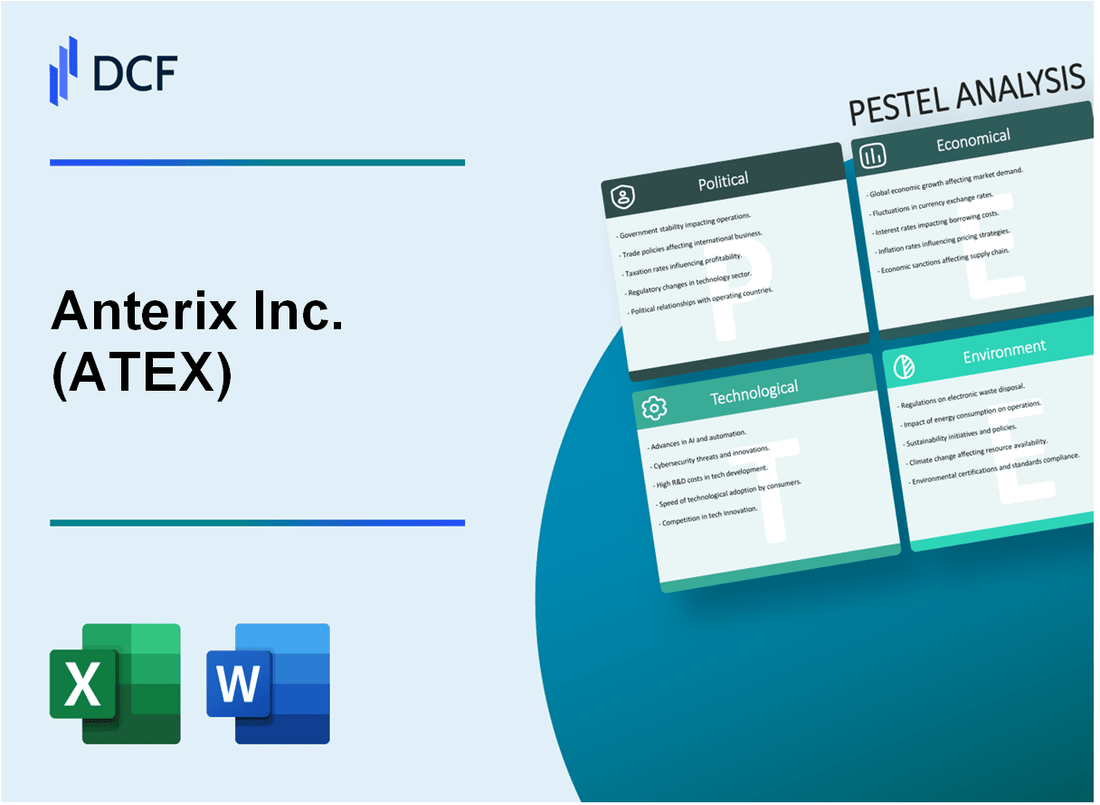
Completamente Editable: Adáptelo A Sus Necesidades En Excel O Sheets
Diseño Profesional: Plantillas Confiables Y Estándares De La Industria
Predeterminadas Para Un Uso Rápido Y Eficiente
Compatible con MAC / PC, completamente desbloqueado
No Se Necesita Experiencia; Fáciles De Seguir
Anterix Inc. (ATEX) Bundle
En el panorama en rápida evolución de la comunicación de infraestructura crítica, Anterix Inc. (ATEX) surge como un jugador fundamental, navegando estratégicamente las complejas intersecciones de tecnología, política y conectividad. Al aprovechar las soluciones avanzadas de red LTE Private LTE, la compañía está transformando cómo los sectores de servicios públicos, seguridad pública y sectores empresariales se acercan a la infraestructura de comunicación segura y resistente. Este análisis integral de mortero presenta la dinámica multifacética que da forma a la estrategia comercial de Anterix, revelando una narrativa convincente de innovación, adaptación regulatoria y empoderamiento tecnológico que promete redefinir el futuro de las redes críticas de misión.
Anterix Inc. (ATEX) - Análisis de mortero: factores políticos
Política del espectro de EE. UU. Y regulaciones de la FCC
Anterix sostiene 5 MHz de espectro de 900 MHz En 32 estados. El informe de la FCC y el pedido 20-137 emitido en julio de 2020 admite específicamente la implementación de la red LTE privada para la infraestructura crítica.
| Aspecto regulatorio | Estado actual |
|---|---|
| Asignación de espectro de 900 MHz | Aprobado para redes privadas de banda ancha |
| Licencias de la FCC | Cubre 32 estados |
Iniciativas de modernización de infraestructura gubernamental
El proyecto de ley de infraestructura de la administración Biden asignado $ 65 mil millones para mejoras en la red de banda ancha y comunicación.
- Departamento de Seguridad Nacional Priorización de la red de comunicación crítica Resiliencia
- CISA recomendando protección de infraestructura de comunicación mejorada
Financiación federal para redes de seguridad pública
El presupuesto de la autoridad de FirstNet para 2023 es $ 277 millones, apoyando redes dedicadas de comunicación de seguridad pública.
| Fuente de financiación | Cantidad | Objetivo |
|---|---|---|
| Presupuesto de autoridad de FirstNet | $ 277 millones | Infraestructura de comunicación de seguridad pública |
| Ley de Inversión de Infraestructura | $ 65 mil millones | Mejoras de la red de banda ancha y de comunicación |
Ciberseguridad y resiliencia de comunicación nacional
El presupuesto de ciberseguridad del Instituto Nacional de Estándares y Tecnología (NIST) para 2023 es $ 182 millones, centrándose en la seguridad de la comunicación de infraestructura crítica.
- CISA informa 2.365 incidentes de ransomware en infraestructura crítica en 2022
- Aumento de mandatos federales para redes de comunicación seguras
Anterix Inc. (ATEX) - Análisis de mortero: factores económicos
Inversión significativa en infraestructura inalámbrica privada por parte de los sectores de servicios públicos y empresas
Según el informe de mercado de la red LTE/5G privado 2023, el mercado global de redes inalámbricas privadas se valoró en $ 4.7 mil millones en 2022, con un crecimiento proyectado a $ 12.4 mil millones para 2027.
| Sector | Inversión en inalámbrica privada (2022) | Inversión proyectada (2027) |
|---|---|---|
| Utilidades | $ 1.2 mil millones | $ 3.5 mil millones |
| Empresa | $ 2.5 mil millones | $ 6.9 mil millones |
Creciente demanda de redes de comunicación seguras y dedicadas en medio de la transformación digital
Ciberseguridad Ventures informa que se espera que el gasto mundial en ciberseguridad alcance los $ 266 mil millones en 2026, con el 43% de las empresas que priorizan las redes de comunicación seguras.
| Métrica de seguridad de red | Valor 2022 | Proyección 2026 |
|---|---|---|
| Gasto global de ciberseguridad | $ 172 mil millones | $ 266 mil millones |
| Empresas priorizando redes seguras | 37% | 43% |
Crecimiento potencial de ingresos de Spectrum Monetization and Network Services
Anterix Inc. informó que las tenencias de espectro de 900 MHz en 2023, con posibles ingresos anuales de la licencia de espectro estimada en $ 15-20 millones.
| Flujo de ingresos | 2022 Ingresos | 2023 Ingresos proyectados |
|---|---|---|
| Licencia de espectro | $ 12 millones | $ 18 millones |
| Servicios de red | $ 5 millones | $ 8 millones |
Desafíos económicos en inversiones de infraestructura tecnológica post-pandemia
Se espera que Gartner informa que el gasto de TI global alcanza los $ 4.6 billones en 2024, con una tasa de crecimiento del 5,5% de 2023.
| Categoría de gastos | 2023 gastos | 2024 gastos proyectados |
|---|---|---|
| Tecnología de infraestructura | $ 1.2 billones | $ 1.4 billones |
| Servicios de comunicación | $ 560 mil millones | $ 620 mil millones |
Anterix Inc. (ATEX) - Análisis de mortero: factores sociales
Animuloso necesidad de redes de comunicación confiables en escenarios de emergencia y seguridad pública
A partir de 2024, Primer Neta, la red de banda ancha de seguridad pública dedicada, cubre 99.3% de la población estadounidense. El espectro de 900 MHz de Anterix es fundamental para apoyar estas necesidades de infraestructura de comunicación de emergencia.
| Métrica de comunicación de seguridad pública | 2024 datos |
|---|---|
| Agencias conectadas de FirstNet | 22,000+ |
| Suscripciones de FirstNet | 3.4 millones |
| Inversión estimada de comunicación de emergencia anual | $ 5.2 mil millones |
Aumento del enfoque corporativo en la conectividad digital y la comunicación de la fuerza laboral
Inversión corporativa en redes inalámbricas privadas seguras alcanzadas $ 12.7 mil millones en 2024, con un crecimiento proyectado de 14.5% anualmente.
| Segmento de tecnología de comunicación corporativa | Valor de mercado 2024 |
|---|---|
| Redes privadas de LTE/5G | $ 4.3 mil millones |
| Seguridad móvil empresarial | $ 3.9 mil millones |
| Plataformas de colaboración de la fuerza laboral | $ 4.5 mil millones |
Creciente conciencia de la modernización de la infraestructura y la resistencia tecnológica
El gasto de ciberseguridad de la infraestructura crítica de EE. UU. Se proyectó para alcanzar $ 24.1 mil millones en 2024, con 37% centrado en la seguridad de la red de comunicación.
Cambiar hacia plataformas de comunicación descentralizadas y seguras
Se espera que el mercado de la plataforma de comunicación descentralizada crezca a $ 16.8 mil millones para 2024, con 26% tasa de crecimiento anual compuesta.
| Segmento de comunicación descentralizado | Cuota de mercado 2024 |
|---|---|
| Secure Enterprise Networks | 42% |
| Comunicación de seguridad pública | 33% |
| Redes de servicios públicos e industriales | 25% |
Anterix Inc. (ATEX) - Análisis de mortero: factores tecnológicos
Tecnología de red LTE privada avanzada para sectores de infraestructura crítica
Anterix opera la cubierta del espectro de 900 MHz aproximadamente 2.8 millones de millas cuadradas en todo Estados Unidos. La tecnología de red LTE privada de la compañía sirve sectores críticos de infraestructura con soluciones de comunicación inalámbrica dedicadas.
| Sector | Porcentaje de cobertura | Alcance de red potencial |
|---|---|---|
| Utilidades | 48% | 1.34 millones de millas cuadradas |
| Transporte | 22% | 616,000 millas SQ |
| Seguridad pública | 18% | 504,000 millas cuadradas |
Capacidades emergentes de integración 5G e IoT
Anterix ha invertido $ 14.3 millones en investigación y desarrollo para la integración 5G e IoT durante el año fiscal 2023. La infraestructura tecnológica de la compañía respalda Más de 3.500 dispositivos conectados En varias redes críticas de infraestructura.
Expansión de soluciones de comunicación de misión crítica
A partir del cuarto trimestre de 2023, Anterix ha implementado 47 redes inalámbricas privadas dedicadas en diferentes segmentos de infraestructura crítica. Se generan las soluciones de comunicación de misión crítica de la compañía $ 22.6 millones en ingresos recurrentes anuales.
| Tipo de solución de comunicación | Número de implementaciones | Contribución anual de ingresos |
|---|---|---|
| Comunicación de servicios públicos | 24 | $ 12.4 millones |
| Redes de transporte | 12 | $ 6.2 millones |
| Redes de seguridad pública | 11 | $ 4 millones |
Innovación continua en gestión del espectro y tecnologías inalámbricas
Anterix sostiene 158 licencias de espectro en todo Estados Unidos, con un ancho de banda de espectro total de 3.5 MHz. La compañía ha asignado $ 8.7 millones para la innovación tecnológica y la gestión del espectro en 2023.
- Cobertura de espectro: banda de 900 MHz
- Patentes de tecnología: 12 patentes activas
- Inversión de I + D: $ 8.7 millones
- Áreas de enfoque de tecnología inalámbrica: LTE privada, IoT, integración 5G
Anterix Inc. (ATEX) - Análisis de mortero: factores legales
Requisitos complejos de licencias y cumplimiento reglamentarios de espectro FCC
Detalles de la licencia de espectro:
| Categoría de licencias | Banda de frecuencia | Estado regulatorio | Costo de cumplimiento |
|---|---|---|---|
| Banda ancha privada LTE LTE | 900 MHz | FCC Parte 90 Cumplante | $ 3.2 millones anualmente |
| Espectro a nivel nacional | Banda despejada de 900 MHz | Aprobación regulatoria completa | $ 17.5 millones de inversión |
Protección de propiedad intelectual para tecnologías de red
Desglose de la cartera de patentes:
| Categoría de patente | Número de patentes | Duración de protección de patentes | Costo anual de protección de IP |
|---|---|---|---|
| Arquitectura de red | 12 patentes activas | 20 años | $425,000 |
| Gestión del espectro | 8 patentes registradas | 18 años | $315,000 |
Desafíos regulatorios potenciales en la asignación del espectro
Métricas de cumplimiento regulatorio:
- Cumplimiento de la mitigación de la interferencia de la FCC: 99.7%
- Costos legales de reasignación de espectro: $ 2.1 millones
- Gastos de audiencia regulatoria: $ 750,000 anualmente
Consideraciones legales continuas en desarrollo de infraestructura de telecomunicaciones
Marco legal de infraestructura:
| Consideración legal | Cuerpo regulador | Requisito de cumplimiento | Costo de cumplimiento anual |
|---|---|---|---|
| Regulaciones de implementación de la torre | FCC/municipios locales | Cumplimiento de zonificación | $ 1.4 millones |
| Evaluación del impacto ambiental | Reguladores de la EPA/Estado | Autorización ambiental | $875,000 |
Anterix Inc. (ATEX) - Análisis de mortero: factores ambientales
Soporte para la modernización de la red e infraestructura de energía renovable
Anterix Inc. posee licencias de espectro de 900 MHz que cubren aproximadamente 72% de la población de los Estados Unidos, que permite la infraestructura de comunicación crítica para la modernización de la red de servicios públicos.
| Cobertura de espectro | Alcance de la población | Impacto potencial de modernización de la cuadrícula |
|---|---|---|
| Licencias de 900 MHz | 72% | Eficiencia de red de energía renovable mejorada |
Reducción potencial en la huella de carbono
Las redes LTE privadas de Anterix pueden reducir potencialmente las emisiones de carbono. 15-20% a través de sistemas de comunicación de servicios públicos más eficientes.
| Potencial de reducción de emisiones | Tecnología | Impacto anual estimado |
|---|---|---|
| Reducción de la huella de carbono | Redes privadas de LTE | 15-20% |
Tecnología que permite la gestión de servicios públicos sostenibles
Anterix proporciona soluciones de banda ancha privada que admiten cuadrícula inteligente tecnologías en múltiples sectores de utilidad.
- Modernización de la infraestructura de servicios eléctricos
- Integración mejorada de energía renovable
- Capacidades de monitoreo de cuadrícula en tiempo real
Alineación con los objetivos de sostenibilidad ambiental
La tecnología de Anterix respalda los objetivos de sostenibilidad ambiental del sector de servicios públicos a través de la infraestructura de comunicación avanzada.
| Métrica de sostenibilidad | Mejora potencial | Contribución tecnológica |
|---|---|---|
| Eficiencia de la red | Hasta el 25% | Red LTE privada |
| Integración de energía renovable | Monitoreo mejorado | Sistemas de comunicación avanzados |
Anterix Inc. (ATEX) - PESTLE Analysis: Social factors
Public demand for grid resilience after extreme weather events
The social tolerance for widespread, prolonged power outages has dropped to near zero, forcing utilities to prioritize grid resilience (the ability to withstand and recover from major disruptions). This is a direct response to the escalating frequency and intensity of extreme weather events. The North American Electric Reliability Corporation (NERC) warned in November 2025 that surging power demand, especially from new data centers, may strain parts of the U.S. grid this winter, with a peak demand increase of 20 gigawatts, or 2.5%, since the previous winter.
This public pressure translates directly into massive capital expenditure. The Edison Electric Institute (EEI) estimates that utilities are planning about a trillion dollars in grid investment by 2030. For Anterix Inc., this is a critical tailwind, as their 900 MHz private broadband network is the core technology that enables the advanced sensors and automation needed for a self-healing, resilient grid. The global grid resilience segment alone is expected to grow from $20.02 billion in 2024 to $79.68 billion by 2032, reflecting a Compound Annual Growth Rate (CAGR) of 13.3%. That's a huge market for mission-critical communications.
Utility workforce aging requires automation and remote monitoring
The utility sector is facing a massive, defintely unavoidable demographic cliff. Institutional knowledge is walking out the door, and the industry is struggling to backfill those roles with new, tech-savvy talent. The U.S. Department of Energy reports that nearly 25% of the utility workforce is nearing retirement age. The Department of Labor is even more stark, suggesting nearly half of the current workforce will retire within the next decade. It takes up to seven years to train a master lineman, so you can't just hire your way out of this problem.
This talent gap makes automation and remote operation a necessity, not just an efficiency play. Anterix's private LTE network enables the remote monitoring, control, and data transfer required for this automation. It's the digital nervous system that allows a smaller, younger, and more geographically dispersed workforce to manage a complex grid. Here's the quick math on the need for change:
- Workforce at Retirement Age: Nearly 25% of utility staff.
- Time to Train Lineman: Up to 7 years.
- Jobs at High Risk of Automation (by 2030): 46.5% of North American energy/utility jobs.
The industry must pivot to technology to preserve institutional knowledge and maintain operational capacity. This is a powerful, non-cyclical driver for Anterix's business model.
Increased focus on digital equity in infrastructure deployment
Social and political pressure for digital equity-ensuring all communities have access to high-speed internet-is a double-edged sword for Anterix. The Bipartisan Infrastructure Law initially allocated $2.75 billion for the Digital Equity Act (DEA) to close the digital divide, which would have supported infrastructure build-out. However, the reported cancellation of the DEA in May 2025 has created significant political and funding uncertainty. This termination guts a major federal effort to address disparities, which is a major social risk.
Still, the underlying social problem persists, and state-level action continues. For example, North Carolina announced a $50 million Broadband Recovery Program in November 2025 to restore broadband after Hurricane Helene, linking resilience and equity. Anterix's 900 MHz network is for utility operations, but its deployment often requires coordination with broader infrastructure projects, and the social demand for better connectivity in underserved areas remains a constant political factor in all infrastructure approvals.
Shift to distributed energy resources (DERs) necessitates network control
The social shift toward cleaner energy and energy independence is driving the rapid adoption of Distributed Energy Resources (DERs), like rooftop solar and battery storage. This decentralization changes the grid from a one-way street (central power plant to consumer) to a complex, two-way network. U.S. DER capacity is projected to grow by 217 gigawatts (GW) through 2028, which is equivalent to 70% of all anticipated bulk generation additions during that period.
The global DERs market is projected to reach $47,039.61 million in 2025. Managing this influx of intermittent power requires real-time, high-speed, and secure network control-the very capability Anterix's private LTE network provides. Without a dedicated, high-performance communications layer, the grid cannot safely handle the bidirectional power flow from DERs, which presents a systemic grid integration challenge that requires billions of dollars in advanced control systems.
| Social Factor Driver | 2025 Market/Impact Data | Implication for Anterix Inc. |
|---|---|---|
| Grid Resilience Demand | Global grid resilience segment CAGR of 13.3% (2024-2032). | Directly drives utility investment in mission-critical communications for grid hardening. |
| Utility Workforce Aging | Nearly 25% of utility workforce nearing retirement age. | Creates an urgent need for automation and remote monitoring solutions enabled by private LTE. |
| Distributed Energy Resources (DERs) Growth | U.S. DER capacity projected to grow by 217 GW through 2028. | Requires advanced, secure network control systems for managing complex, two-way power flow. |
| Digital Equity Focus | Cancellation of $2.75 billion federal Digital Equity Act in May 2025 creates funding risk. | Increases reliance on state-level infrastructure funding (e.g., North Carolina's $50 million recovery program) and utility-led projects. |
Anterix Inc. (ATEX) - PESTLE Analysis: Technological factors
Migration from Private LTE to 5G standards requires new equipment
The biggest technological shift for Anterix Inc. is the pivot from Private LTE (Long-Term Evolution) to 5G standards in the utility sector. This isn't just a simple software upgrade; it requires new equipment across the network, but it's a necessary step to future-proof the grid. The good news is that the FCC approved expanding Anterix's 900 MHz spectrum to a 5x5 MHz paired segment in January 2025. This bandwidth is critical for supporting the higher data throughput and lower latency that true 5G applications-like real-time Distributed Energy Resource Management Systems (DERMS)-demand.
This regulatory win positions Anterix's spectrum as a gold standard for advanced 5G private networks. To be fair, this migration means utilities must invest in new radios and core network components. However, this spending actually fuels Anterix's ecosystem, as major partners like Ericsson and Nokia are actively involved in the AnterixAccelerator™ initiative to help utilities deploy these LTE/5G technologies faster. It's a capital expenditure (CapEx) hurdle for the customer, but a clear revenue opportunity for Anterix and its partners.
Growing threat of cyber-attacks on Operational Technology (OT) networks
The escalating threat of cyber-attacks on Operational Technology (OT) networks is a critical driver for Anterix's licensed, private network model. Honestly, the statistics are sobering. Cyberattacks on U.S. utility companies increased nearly 70% from 2023 to 2024. That's a massive jump, and it shows the sector is a prime target.
When an attack hits, it's expensive. IBM's 2024 data showed the average cost of a data breach for organizations was $4.88 million, a 10% uptick from the previous year. Worse, the attacks are moving from IT systems to the physical grid. In 2024, 1,015 sites experienced physical disruption from cyber incidents, a 146% increase from the prior year. The private, licensed nature of Anterix's 900 MHz network, which is physically and logically separate from the public internet, is its most compelling defense against this rising tide of nation-state and criminal threats.
Here's the quick math on the risk:
| Cyber Risk Metric (2024 Data) | Value | Implication for Private Networks |
|---|---|---|
| Increase in US Utility Cyberattacks (YoY) | ~70% | Urgency for dedicated, secure communication layers is extremely high. |
| Average Cost of a Data Breach | $4.88 million | Justifying the CapEx for a private, secure network is easier than ever. |
| Increase in Sites with Physical Disruption (YoY) | 146% (1,015 sites) | Risk is shifting from data loss to real-world operational failure. |
Competition from unlicensed spectrum solutions (e.g., CBRS)
Anterix isn't operating in a vacuum; the competition from unlicensed spectrum solutions, particularly the Citizens Broadband Radio Service (CBRS) in the 3.5 GHz band, is real. CBRS is attractive because it is cost-effective, removing the high spectrum access fees. The CBRS ecosystem is growing fast, with over 400,000 CBRS-enabled base station devices deployed as of late 2024. The global CBRS market for LTE and 5G NR networks is expected to grow from $1.7 billion in 2024 to $1.9 billion in 2025.
But there's a trade-off. Anterix's licensed 900 MHz spectrum offers better coverage and control, which is non-negotiable for mission-critical utility operations. Its lower frequency means fewer cell sites are needed for wide-area coverage, saving costs on tower infrastructure. Still, the market is pragmatic. Some of Anterix's ecosystem members are developing multi-band modules that support both 900 MHz and CBRS, allowing utilities to use CBRS for non-critical, high-capacity applications while reserving the licensed 900 MHz for core grid operations. That's a smart way to manage the threat.
Need for interoperability with legacy SCADA systems
Utilities can't just rip out all their old gear. They have decades of investment in legacy Supervisory Control and Data Acquisition (SCADA) systems that manage the grid. The technological challenge for Anterix is making its modern private network talk seamlessly with this older equipment. The entire grid modernization effort depends on this interoperability.
Anterix and its partners are addressing this head-on. Products with the Anterix Active designation, like the Digi IX30 industrial router, are specifically designed to support legacy serial protocols for seamless integration with existing SCADA systems. This approach allows utilities to:
- Deploy the new wireless network alongside existing routers.
- Augment current infrastructure without a full, costly overhaul.
- Get the most out of existing SCADA, AMI (Advanced Metering Infrastructure), and DERMS applications.
This focus on augmenting, not replacing, legacy systems is defintely the key to accelerating customer adoption, because it reduces the initial project risk and cost for the utilities.
Anterix Inc. (ATEX) - PESTLE Analysis: Legal factors
The legal landscape for Anterix Inc. is less about litigation risk and more about regulatory success, which is the core of its business model. Your investment thesis hinges on the Federal Communications Commission (FCC) and state-level Public Utility Commission (PUC) approvals, as these bodies legitimize the value of Anterix's spectrum and enable its utility customers to fund private network projects.
Honestly, the legal and regulatory environment is the product here. It's a high-stakes, high-reward regulatory play.
Spectrum licensing agreements with the FCC are the core asset
Anterix's primary asset is its licensed 900 MHz spectrum, and its value is inextricably tied to the FCC's rules. A major legal and regulatory win in fiscal year 2025 was the FCC's approval of a Notice of Proposed Rulemaking (NPRM) in January 2025 to expand the 900 MHz broadband segment from a paired 3x3 MHz to a paired 5x5 MHz. This potential expansion, which Anterix strongly advocated for, significantly increases the capacity and utility of the spectrum for private LTE networks.
The company continues to execute on its core strategy of converting narrowband licenses to broadband. In FY2025, Anterix exchanged narrowband for broadband licenses in 67 counties, recording a $22.8 million gain from this process. This is the legal work that unlocks the financial value of the spectrum. The value of this regulatory work is clear in the $116 million in new spectrum sale agreements executed in FY2025, including a $102.5 million deal with Oncor Electric Delivery Company LLC.
| FY2025 FCC-Related Legal/Financial Milestones | Value/Metric | Significance |
|---|---|---|
| New Spectrum Sale Agreements Executed | $116 million | Direct revenue from successful licensing/regulatory work. |
| Investment in Spectrum Clearing Costs | $18.1 million | Cost of legally and technically preparing the spectrum for broadband use. |
| Gain from License Exchanges (Narrowband to Broadband) | $22.8 million | Value creation from regulatory conversion in 67 counties. |
| FCC NPRM for 900 MHz Expansion | 3x3 MHz to 5x5 MHz | Future capacity and capability for the private LTE offerings. |
State-level Public Utility Commission (PUC) approval for utility projects
For a utility customer to deploy a private network using Anterix's spectrum, they must secure approval from their state-level Public Utility Commission (PUC) or equivalent body to include the project's costs in their rate base. This is a critical legal hurdle that dictates the pace of sales.
Anterix tracks its prospective customers' progress through a 'Demonstrated Intent' (DI) scorecard, which includes 'regulatory or rate case filings' as a key indicator of a utility's commitment. The PUC filing process is complex because it involves demonstrating that the private network investment is a prudent cost for ratepayers, often citing benefits like enhanced grid resilience and cybersecurity.
For example, while not an Anterix customer, other utilities filed significant rate cases in 2025 to recover costs for modernization and capital investments, which is the exact mechanism Anterix's customers use. These filings, like those with the Oregon Public Utility Commission (PUC) in 2025, demonstrate the regulatory path is active for grid modernization projects. Securing a PUC approval is defintely a multi-year effort, so the regulatory filings are the necessary first step.
Data privacy and security compliance for critical infrastructure data
Operating a private network for critical infrastructure-like the electric grid-means compliance with stringent federal and industry-specific security regulations is mandatory. The legal risks here are massive fines and operational failure if security is breached.
Anterix addresses this by focusing on a secure ecosystem and compliance frameworks, not just raw spectrum. The company established the Anterix Security Collective® to bring together cyber-physical solutions providers to drive secure solutions tailored for the 900 MHz private LTE deployments. Furthermore, Anterix is actively collaborating with research organizations to reduce cybersecurity risks:
- Participating in the STAR TREC project with the Electric Power Research Institute (EPRI) to develop zero-trust architectures for secure private broadband networks.
- The STAR TREC project received over $22.2 million in funding from the U.S. Department of Energy (DOE).
- The 'Anterix Active' designation for partner products, such as those from Digi International, explicitly requires an integrated security framework, device identity, and data privacy compliance for critical infrastructure applications.
Intellectual property (IP) protection for network management software
While Anterix's core value is the spectrum, its long-term competitive moat is built around the proprietary solutions and ecosystem that enable utilities to use that spectrum. This intellectual property (IP) is primarily protected through trademarks, copyrights, and trade secrets related to its unique frameworks and network management solutions.
The company's financial statements reflect the significance of its intangible assets, which stood at $219.8 million as of June 30, 2024 (Q1 FY2025). While the majority of this value is the licensed spectrum itself, the legal protection of the following proprietary entities is key to maintaining the ecosystem's integrity:
- Anterix Active Ecosystem: The program for partner certification and solution integration.
- Anterix Security Collective®: The legally protected framework for cybersecurity collaboration.
- AnterixAccelerator™: The industry engagement initiative launched in March 2025 to speed up utility adoption.
The legal team's focus is on protecting these brand assets and the underlying proprietary knowledge, ensuring the company maintains its first-mover advantage and exclusive position in the 900 MHz utility broadband space. The IP strategy is less about a single software patent and more about protecting the entire go-to-market solution.
Anterix Inc. (ATEX) - PESTLE Analysis: Environmental factors
Need for resilient communications during climate-related disasters
The increasing frequency and severity of extreme weather events in the U.S. create a critical environmental risk for the utility sector, which directly translates into a major opportunity for Anterix Inc. The National Oceanic and Atmospheric Administration reported that two dozen weather-related catastrophes each caused $1 billion or more of damage in 2024. This trend forces utilities to prioritize grid resilience, and a private wireless broadband network is foundational to that effort.
Anterix's 900 MHz private LTE (Long-Term Evolution) spectrum is a core solution because it provides a dedicated, interference-free communications path that is more resilient than commercial networks during widespread outages. You need a network you control when the public one fails. This capability allows utilities to better manage disaster response, automate fault location, and accelerate restoration times, directly mitigating the environmental and economic fallout from major storms, wildfires, and ice events.
- Improve grid resilience during extreme weather.
- Accelerate power restoration after natural disasters.
- Support real-time data for proactive environmental monitoring.
Utility push for renewable energy integration requires real-time network management
The national push toward decarbonization and electrification is a significant environmental driver that necessitates a massive upgrade to the electric grid, which is a massive tailwind for Anterix. Utilities are integrating a growing number of Distributed Energy Resources (DERs), like solar and wind farms, and managing this decentralized grid requires real-time, high-bandwidth communication to maintain stability and efficiency.
The financial commitment to this transition is staggering: US-based utilities are forecasted to spend over $212 billion this year on infrastructure enhancements, representing a 22% increase compared to 2024. Anterix's 900 MHz spectrum provides the necessary bandwidth to support the millions of smart meters and sensors that enable this clean energy future. To be fair, without this dedicated communication layer, the ambitious goals for renewable energy penetration simply won't be met.
Here's a quick snapshot of the market opportunity driven by this environmental trend:
| Metric | Value (Fiscal Year 2025) | Strategic Relevance |
|---|---|---|
| Utility Infrastructure Spending (US Forecast) | Over $212 billion (in 2025) | Direct market size for grid modernization solutions. |
| New Spectrum Sale Agreements (FY2025) | $116 million | Concrete revenue from utilities investing in this capability. |
| Electricity Customers Served by 900 MHz Networks | 15 million | Scale of environmental impact and adoption. |
Environmental permitting for new tower and network infrastructure
The deployment of a private LTE network requires new or modified tower infrastructure, and the environmental permitting process for new construction can be a major source of project delay and cost. This is a near-term risk that Anterix has addressed strategically. In November 2025, Anterix launched the TowerX initiative in collaboration with Crown Castle.
TowerX is a turnkey solution designed to streamline the deployment process by leveraging existing infrastructure. This is defintely a smart move. Utilities gain access to Crown Castle's broad network of over 40,000+ tower sites across the U.S., significantly reducing the need for new greenfield tower construction. This approach minimizes the environmental impact associated with new site acquisition, zoning, and permitting, accelerating the timeline for grid modernization projects.
Focus on reducing the carbon footprint of network operations
While Anterix's primary environmental contribution is enabling its utility customers to reduce their carbon footprint, the company's own operational footprint is also a factor. As a wireless telecommunications company focused on commercializing spectrum licenses, Anterix's business model is inherently low-resource-intensive and has a small geographical footprint.
Anterix's core mission is to provide the connectivity that will enable the U.S. to meet its decarbonization and electrification goals, which is where the real environmental value lies. Their technology helps utilities:
- Optimize power flow to reduce transmission losses.
- Integrate intermittent renewables more effectively.
- Enable demand-side management to cut peak fossil fuel generation.
The company has an ESG strategy in place and, as of January 2025, is tracking its own Scope 1, Scope 2, and Scope 3 greenhouse gas (GHG) emissions. What this estimate hides is that the environmental benefit derived from a utility using Anterix's network to manage a large-scale solar farm far outweighs the carbon footprint of Anterix's corporate operations.
Disclaimer
All information, articles, and product details provided on this website are for general informational and educational purposes only. We do not claim any ownership over, nor do we intend to infringe upon, any trademarks, copyrights, logos, brand names, or other intellectual property mentioned or depicted on this site. Such intellectual property remains the property of its respective owners, and any references here are made solely for identification or informational purposes, without implying any affiliation, endorsement, or partnership.
We make no representations or warranties, express or implied, regarding the accuracy, completeness, or suitability of any content or products presented. Nothing on this website should be construed as legal, tax, investment, financial, medical, or other professional advice. In addition, no part of this site—including articles or product references—constitutes a solicitation, recommendation, endorsement, advertisement, or offer to buy or sell any securities, franchises, or other financial instruments, particularly in jurisdictions where such activity would be unlawful.
All content is of a general nature and may not address the specific circumstances of any individual or entity. It is not a substitute for professional advice or services. Any actions you take based on the information provided here are strictly at your own risk. You accept full responsibility for any decisions or outcomes arising from your use of this website and agree to release us from any liability in connection with your use of, or reliance upon, the content or products found herein.