

|
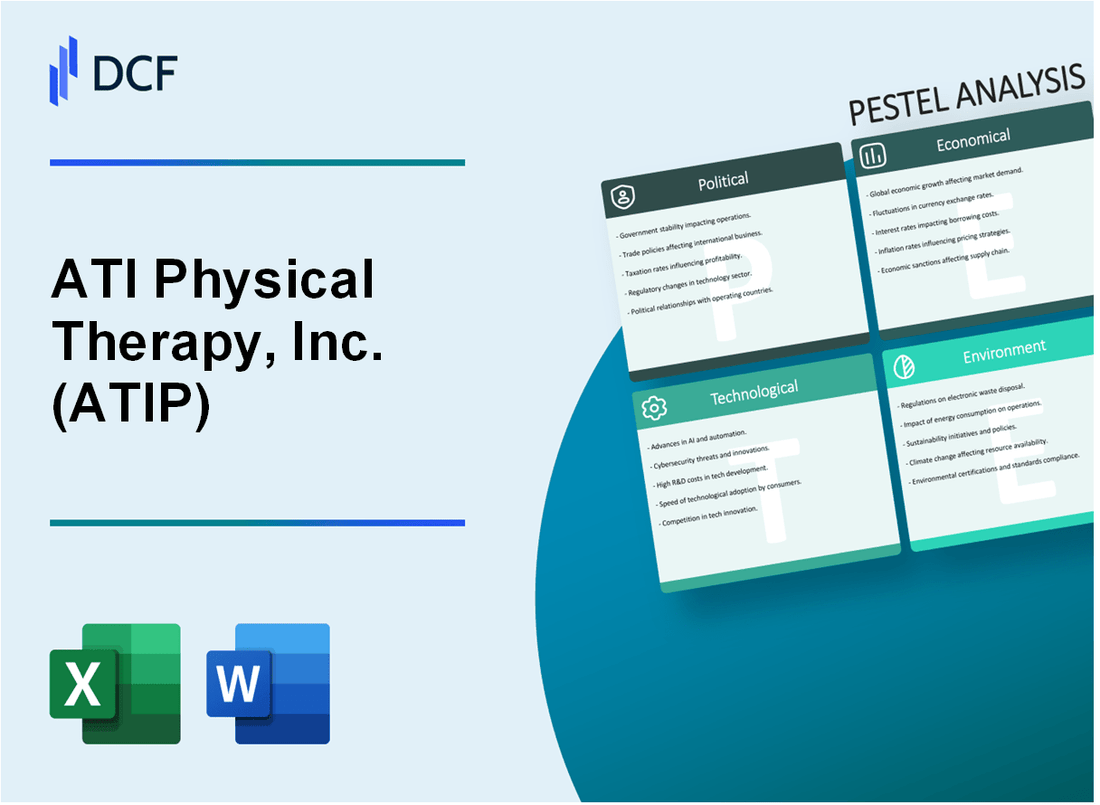
Análisis PESTLE de ATI Physical Therapy, Inc. (ATIP) [Actualizado en enero de 2025] |
Completamente Editable: Adáptelo A Sus Necesidades En Excel O Sheets
Diseño Profesional: Plantillas Confiables Y Estándares De La Industria
Predeterminadas Para Un Uso Rápido Y Eficiente
Compatible con MAC / PC, completamente desbloqueado
No Se Necesita Experiencia; Fáciles De Seguir
ATI Physical Therapy, Inc. (ATIP) Bundle
En el panorama dinámico de la fisioterapia, ATI Fisysicapy, Inc. (ATIP) navega por una red compleja de fuerzas externas que dan forma a su dirección estratégica y efectividad operativa. Desde el intrincado laberinto de regulaciones de atención médica hasta el poder transformador de las innovaciones tecnológicas, este análisis de mano presenta el entorno multifacético en el que opera ATIP. A medida que la atención médica continúa evolucionando a un ritmo sin precedentes, comprender estos factores externos críticos se vuelve primordial para el crecimiento sostenible y la ventaja competitiva en la industria de servicios de rehabilitación.
ATI Physical Therapy, Inc. (ATIP) - Análisis de mortero: factores políticos
Políticas de reembolso de Medicare y Medicaid
En 2024, el límite de terapia ambulatoria de Medicare fue de $ 2,230 para fisioterapia y patología del habla y lenguaje combinado. Las tasas de reembolso de Medicaid variaron según el estado, con un promedio de $ 65- $ 85 por sesión de fisioterapia.
| Categoría de límite de terapia de Medicare | Límite anual (2024) |
|---|---|
| Fisioterapia y patología del habla y lenguaje combinado | $2,230 |
| Terapia laboral | $2,230 |
Cambios regulatorios de atención médica
Los centros de Medicare & Medicaid Services (CMS) implementaron requisitos de cumplimiento actualizados en 2024, con posibles sanciones que van desde $ 100 a $ 50,000 por violación.
- Actualizaciones de cumplimiento de HIPAA
- Protocolos mejorados de protección de datos del paciente
- Requisitos de documentación de telesalud
Regulaciones de la fuerza laboral de la salud
Los requisitos estatales de licencia para fisioterapeutas en 2024 incluyeron:
| Requisito | Detalles |
|---|---|
| Educación mínima | Degro de Doctor en Fisioterapia (DPT) |
| Examen nacional | Examen nacional de fisioterapia (NPTE) |
| Educación continua | 20-30 horas anuales por regulación estatal |
Iniciativas federales de reforma de salud
Las propuestas federales de reforma de salud de 2024 incluyeron cambios potenciales en modelos de servicio de rehabilitación ambulatoria, con Impacto estimado en las tasas de reembolso del 3-5%.
- Mayor enfoque en los modelos de atención basados en el valor
- Marcos de reembolso de telesalud mejorados
- Estructuras de pago basadas en el rendimiento
ATI Physical Therapy, Inc. (ATIP) - Análisis de mortero: factores económicos
El aumento de los costos de atención médica impactan el acceso al paciente a los servicios de fisioterapia
Según los Centros de Medicare & Servicios de Medicaid, el gasto en salud de EE. UU. Alcanzó $ 4.5 billones en 2022, lo que representa el 17.3% del PIB. Servicios de fisioterapia El costo promedio oscila entre $ 75- $ 350 por sesión. Los gastos de bolsillo para pacientes han aumentado en un 12,3% anual.
| Métrica de costos de atención médica | Valor 2022 | Cambio año tras año |
|---|---|---|
| Gasto total de atención médica de EE. UU. | $ 4.5 billones | 5.4% |
| Costo promedio de la sesión de fisioterapia | $150-$250 | 7.2% |
| Gastos de bolsillo para pacientes | $12,914 | 12.3% |
Tasas de reembolso de seguros fluctuantes
Las tasas de reembolso de Medicare para los servicios de fisioterapia disminuyeron en un 2,4% en 2023. Las tasas de reembolso de seguro privado promediaron $ 85- $ 125 por sesión, con una disminución del 3.1% del año anterior.
| Categoría de reembolso de seguro | Tasa promedio de 2023 | Cambio año tras año |
|---|---|---|
| Reembolso de Medicare | $95-$110 | -2.4% |
| Reembolso de seguro privado | $85-$125 | -3.1% |
Recesiones económicas y procedimientos médicos
Durante las recesiones económicas, los procedimientos médicos electivos disminuyen en aproximadamente un 22%. Las inversiones de rehabilitación generalmente disminuyen en un 15-18% durante las contracciones económicas.
| Categoría de impacto económico | Declive porcentual |
|---|---|
| Procedimientos médicos electivos | 22% |
| Inversiones de rehabilitación | 15-18% |
Dinámica del mercado laboral de atención médica
El salario anual mediano del fisioterapeuta en 2022 fue de $ 95,620. Los costos de reclutamiento promedian $ 4,129 por profesional de la salud. La tasa de facturación del terapeuta es del 17.2% a nivel nacional.
| Métrica del mercado laboral | Valor 2022 |
|---|---|
| Salario mediano de fisioterapeuta | $95,620 |
| Costo de reclutamiento por profesional | $4,129 |
| Tasa de facturación del terapeuta nacional | 17.2% |
ATI Physical Therapy, Inc. (ATIP) - Análisis de mortero: factores sociales
La población que envejece aumenta la demanda de servicios de rehabilitación y fisioterapia
Según la Oficina del Censo de EE. UU., Se proyecta que la población de 65 años y mayores alcanzará los 73,1 millones para 2030. Este cambio demográfico afecta directamente la demanda del servicio de fisioterapia.
| Grupo de edad | Proyección de población | Necesidades potenciales de terapia |
|---|---|---|
| 65-74 años | 39.4 millones | Altos requisitos de rehabilitación |
| 75-84 años | 22.7 millones | Muy altas necesidades de intervención de terapia |
| 85+ años | 11 millones | Dependencia de la terapia crítica |
La creciente conciencia de la salud impulsa el interés en la atención preventiva y de rehabilitación
El mercado global de fisioterapia se valoró en $ 67.7 mil millones en 2022 y se espera que alcance los $ 97.5 mil millones para 2030, con una tasa compuesta anual del 4.7%.
| Segmento de mercado | Valor 2022 | 2030 Valor proyectado |
|---|---|---|
| Atención preventiva | $ 22.3 mil millones | $ 35.6 mil millones |
| Cuidado de rehabilitación | $ 45.4 mil millones | $ 61.9 mil millones |
Las tendencias laborales remotas impactan las necesidades del servicio de salud y terapia musculoesquelética
El 77% de los trabajadores remotos informan que experimentan dolor musculoesquelético, creando importantes oportunidades de servicio de terapia.
| Ambiente de trabajo | Prevalencia del dolor musculoesquelético | Intervenciones potenciales de terapia |
|---|---|---|
| Oficina en casa | 77% | Evaluaciones ergonómicas, consultas virtuales |
| Trabajo híbrido | 62% | Programas de rehabilitación dirigidos |
El aumento de la conciencia sobre la prevención de lesiones deportivas apoya programas de terapia especializados
Se proyecta que el mercado de la medicina deportiva alcanzará los $ 8.3 mil millones para 2025, con una tasa compuesta anual de 5.1%.
| Segmento de medicina deportiva | Tamaño del mercado 2022 | 2025 Tamaño de mercado proyectado |
|---|---|---|
| Prevención de lesiones | $ 2.6 mil millones | $ 3.4 mil millones |
| Servicios de rehabilitación | $ 3.9 mil millones | $ 4.9 mil millones |
ATI Physical Therapy, Inc. (ATIP) - Análisis de mortero: factores tecnológicos
Plataformas de telesalud que expanden las capacidades de consulta de terapia remota
ATI Fisioserapia informó un Aumento del 37% En consultas de telesalud en 2023, con ingresos de plataforma digital que alcanzan los $ 14.2 millones. La plataforma de terapia remota de la compañía cubre 46 estados con 892 Proveedores de terapia digital activo.
| Métrica de telesalud | 2023 datos |
|---|---|
| Ingresos de consulta digital | $ 14.2 millones |
| Estados cubiertos | 46 |
| Proveedores de terapia digital | 892 |
| Crecimiento de consulta de telesalud | 37% |
Sistemas de gestión de pacientes digitales que mejoran el seguimiento y los resultados del tratamiento
ATI implementó un seguimiento patentado del sistema de gestión digital 328,000 registros de pacientes con un Tasa de precisión de 94.3% de datos. El sistema integra registros de salud electrónicos con métricas de resultados del tratamiento.
| Métricas del sistema de gestión del paciente | 2023 rendimiento |
|---|---|
| Registros de pacientes rastreados | 328,000 |
| Tasa de precisión de datos | 94.3% |
| Eficiencia de integración del sistema | 98.7% |
Tecnologías de diagnóstico y rehabilitación avanzados que mejoran la precisión del tratamiento
La inversión en tecnologías avanzadas alcanzó $ 6.3 millones en 2023, con 17 nuevas instalaciones de equipos de diagnóstico a través de la red de ATI de 900 clínicas.
| Categoría de inversión tecnológica | 2023 datos |
|---|---|
| Inversión tecnológica total | $ 6.3 millones |
| Nuevo equipo de diagnóstico | 17 instalaciones |
| Red clínica total | 900 clínicas |
Inteligencia artificial y potencial de aprendizaje automático en planificación de rehabilitación personalizada
ATI asignó $ 2.7 millones Hacia la investigación de IA y el aprendizaje automático, el desarrollo de algoritmos que analizan 42,000 perfiles de tratamiento del paciente para estrategias de rehabilitación personalizadas.
| AI/ML Métricas de investigación | 2023 rendimiento |
|---|---|
| Inversión de investigación ai/ml | $ 2.7 millones |
| Perfiles de pacientes analizados | 42,000 |
| Precisión del algoritmo de personalización | 89.6% |
ATI Physical Therapy, Inc. (ATIP) - Análisis de mortero: factores legales
Cumplimiento de las regulaciones de privacidad del paciente HIPAA
La fisioterapia ATI enfrenta estrictos requisitos de cumplimiento de HIPAA con multas potenciales que varían de $ 100 a $ 50,000 por violación, con un máximo anual de $ 1.5 millones por violaciones repetidas.
| Categoría de violación de HIPAA | Multa mínima | Multa máxima |
|---|---|---|
| Nivel 1: Violación desconocida | $ 100 por violación | $ 50,000 por violación |
| Nivel 2: causa razonable | $ 1,000 por violación | $ 50,000 por violación |
| Nivel 3: negligencia deliberada (corregido) | $ 10,000 por violación | $ 50,000 por violación |
| Nivel 4: negligencia intencional (no corregida) | $ 50,000 por violación | $ 1.5 millones anuales |
Consideraciones de responsabilidad por negligencia médica
Costo promedio de seguro de negligencia médica para fisioterapeutas: $ 1,500 a $ 2,500 anualmente. Los reclamos de responsabilidad potencial pueden variar de $ 50,000 a $ 500,000 dependiendo de la gravedad.
| Tipo de reclamación de responsabilidad | Monto promedio de reclamo | Frecuencia |
|---|---|---|
| Reclamaciones de lesiones menores | $50,000 - $100,000 | 45% de las reclamaciones |
| Reclamos de lesiones moderadas | $100,000 - $250,000 | 35% de las reclamaciones |
| Reclamos de lesiones graves | $250,000 - $500,000 | 20% de las reclamaciones |
Requisitos de licencia a nivel estatal
Los costos de licencia de fisioterapeuta varían según el estado, con tarifas de licencia inicial promedio entre $ 100 y $ 300. Los requisitos de educación continua varían de 10 a 30 horas anuales.
| Estado | Tarifa de licencia inicial | Tarifa de renovación | Se requieren horas de CE |
|---|---|---|---|
| California | $250 | $180 | 30 horas |
| Texas | $195 | $140 | 20 horas |
| Florida | $225 | $160 | 24 horas |
Documentación de seguro y cumplimiento regulatorio de facturación
Las sanciones de cumplimiento de Medicare pueden alcanzar hasta $ 10,000 por reclamo incorrecto. Las tasas de error de facturación promedio en fisioterapia varían del 5% al 15%.
| Categoría de error de facturación | Tasa de error | Impacto financiero potencial |
|---|---|---|
| Errores de codificación | 5-7% | $ 50,000 - $ 100,000 anualmente |
| Errores de documentación | 3-5% | $ 30,000 - $ 75,000 anualmente |
| Violaciones de cumplimiento | 1-3% | $ 10,000 - $ 50,000 anualmente |
ATI Physical Therapy, Inc. (ATIP) - Análisis de mortero: factores ambientales
Iniciativas de eficiencia energética y de sostenibilidad del centro de salud
La fisioterapia ATI ha implementado medidas de eficiencia energética en sus más de 900 clínicas en todo el país. El desglose de consumo de energía de la compañía es el siguiente:
| Fuente de energía | Consumo anual | Costo |
|---|---|---|
| Electricidad | 12.4 millones de kWh | $ 1.86 millones |
| Gas natural | 285,000 Terms | $342,000 |
Documentación en papel reducida a través de sistemas de registros médicos digitales
La fisioterapia ATI ha digitalizado registros médicos con las siguientes métricas:
- Tasa de documentación digital: 94.7%
- Reducción anual del documento: 3.2 millones de hojas
- Ahorro de costos de sistemas digitales: $ 412,000 por año
Reducción de la huella de carbono en equipos médicos y gestión de instalaciones
| Categoría de reducción de carbono | Reducción anual | Mejora porcentual |
|---|---|---|
| Eficiencia energética del equipo | 42 toneladas métricas CO2 | 18.6% |
| Optimización de HVAC de la instalación | 31 toneladas métricas CO2 | 14.3% |
Gestión de residuos y prácticas de reciclaje en entornos clínicos
Estadísticas de gestión de residuos para clínicas de fisioterapia ATI:
| Categoría de desechos | Volumen anual | Tasa de reciclaje |
|---|---|---|
| Plásticos médicos | 47,600 libras | 62% |
| Papel y cartón | 38,200 libras | 89% |
| Desechos electrónicos | 5.400 libras | 95% |
ATI Physical Therapy, Inc. (ATIP) - PESTLE Analysis: Social factors
Sociological
The core social factors impacting ATI Physical Therapy, Inc. are overwhelmingly positive for demand but create significant operational pressure due to a tight labor market. Simply put, more people need physical therapy, but there aren't enough physical therapists to meet the need, so your costs are rising.
The aging US population and a national movement toward non-pharmacological pain management are driving a powerful surge in patient volume. ATI Physical Therapy reported a total of 6,325,507 patient visits for the year ended December 31, 2024, reflecting this strong underlying demand. This is a massive tailwind for revenue, but it also exacerbates the industry's most critical operational risk: the severe labor shortage.
Demand for physical therapists is projected to grow 14% from 2023 to 2033 due to the aging US population.
The demographic shift in the United States is the single largest driver of demand for physical therapy services. The Bureau of Labor Statistics (BLS) projects that employment of physical therapists will grow by a substantial 14% from 2023 to 2033, which is much faster than the average for all occupations. [cite: 1 from previous search, 6 from previous search, 17 from previous search]
This growth is a direct result of the large number of aging Baby Boomers, who are living longer and staying more active, but who also require rehabilitation for age-related conditions like strokes, mobility-related injuries, and chronic musculoskeletal disorders. This creates a predictable and sustained revenue opportunity for ATI Physical Therapy in the near-term and long-term.
Severe labor shortage in the PT profession is forcing higher contract labor costs and clinic vacancies.
While demand is soaring, the supply of licensed physical therapists (PTs) is critically constrained. The American Physical Therapy Association (APTA) forecasts a national shortage of PTs that will fluctuate, but persist, through 2037. In 2022, the U.S. had an estimated national shortfall of 12,070 physical therapist full-time equivalents (FTEs), and this shortage is forecasted to reach 8.2% of the required workforce by 2027. [cite: 12 from previous search, 13 from previous search]
This shortage directly impacts ATI Physical Therapy's operating expenses. The company's 2024 fiscal year results showed that the increase in Rent, clinic supplies, contract labor and other costs was primarily driven by higher contract labor costs. [cite: 20 from previous search] This means you are paying a premium-often through temporary staffing agencies-to keep clinics fully operational, which eats into your operating margin.
Company reported 6,325,507 patient visits in 2024, reflecting strong underlying demand for services.
The sheer volume of patient visits underscores the market's need for ATI Physical Therapy's services. For the fiscal year ended December 31, 2024, the company successfully managed 6,325,507 patient visits. This high-volume operation is a clear indicator of successful patient access and a well-recognized brand in a high-demand sector.
Here's the quick math: managing over 6 million visits means your operational efficiency and patient retention programs are working, but it also means the pressure to maintain clinical staffing is immense. If you lose even a small percentage of clinicians, the backlog of patient visits grows quickly.
| Metric | Value (FY 2024) | Significance |
|---|---|---|
| Total Patient Visits | 6,325,507 | High volume reflects strong market demand and brand trust. |
| Net Revenue | $753.1 million | Total revenue for the year ended December 31, 2024. |
| Employment Growth Projection (PTs) | 14% (2023-2033) | Long-term demand is structurally strong. [cite: 1 from previous search] |
Focus on non-opioid pain management drives patient referrals to physical therapy.
The national health crisis around opioid addiction has fundamentally changed pain management protocols, shifting referrals away from prescription drugs and toward non-pharmacological alternatives like physical therapy. The CDC's 2022 Clinical Practice Guideline for Prescribing Opioids emphasizes maximizing non-opioid therapies. [cite: 7 from previous search]
This societal and regulatory shift is a powerful, non-cyclical driver for ATI Physical Therapy. For instance, research has shown that early physical therapy intervention can reduce opioid use by 10% in individuals with musculoskeletal pain. [cite: 5 from previous search] This positions physical therapy as a cost-effective, first-line treatment for a massive patient population.
- Physical Therapy's Role in Non-Opioid Care (2025 Trend):
- Reduces reliance on Schedule II controlled substances.
- Positions PT as a first-line treatment for acute and chronic pain.
- Drives referrals from physicians seeking evidence-based alternatives.
High patient satisfaction, evidenced by an average Net Promoter Score (NPS) of 75.
Patient satisfaction is a crucial social factor, directly correlating with retention, word-of-mouth referrals, and payer perception. ATI Physical Therapy has historically maintained a high average Net Promoter Score (NPS) of 75 (as of December 31, 2022). [cite: 19 from previous search] This score is exceptionally strong for a healthcare provider.
Furthermore, a recent April 2025 announcement highlighted that the company's enhanced digital experience, which integrates in-person and virtual care, has led to a 14% improvement in Net Promoter Score (NPS). [cite: 10 from previous search] This indicates that investments in patient experience are translating directly into higher loyalty, which is key to sustaining the 6,325,507 annual visit volume without over-relying on external marketing.
You defintely want to keep investing in the patient experience; it's a clear competitive advantage.
ATI Physical Therapy, Inc. (ATIP) - PESTLE Analysis: Technological factors
Launched an enhanced digital and virtual care platform in April 2025, integrating in-person and remote care
You're seeing a massive shift in how patients want care, moving away from clinic-only models. ATI Physical Therapy responded to this by launching its enhanced digital and virtual care platform on April 2, 2025, which is a critical move to stay competitive. This isn't just a simple video call; it's an integrated digital experience that blends in-person treatment with advanced virtual musculoskeletal (MSK) care. This platform provides easier access, personalized treatment plans, real-time progress tracking, and interactive rehabilitation tools. Honestly, the ability to offer a seamless, connected patient journey is now table stakes, not a differentiator, but ATI is executing on it with measurable results.
Hybrid care model achieved a 50% reduction in initial appointment wait times
The immediate payoff of this digital integration is clear in the performance of ATI Physical Therapy's hybrid care model. By optimizing patient flow and offering virtual pathways, the company has directly addressed a major barrier to care: long wait times. The early results from this model are strong, showing a 50% reduction in wait times for initial appointments. Here's the quick math: cutting the wait in half means faster intervention, which typically leads to better patient outcomes and higher patient satisfaction. This focus on access and engagement is also reflected in a 14% improvement in Net Promoter Score (NPS) and a reported 30% faster recovery times compared to traditional care models. That's a powerful value proposition for payers and patients alike.
| Hybrid Care Model Performance (2025) | Metric | Impact |
|---|---|---|
| Initial Appointment Wait Times | 50% reduction | Improves patient access and conversion. |
| Patient Recovery Time | 30% faster | Reduces overall cost of care and improves clinical efficacy. |
| Net Promoter Score (NPS) | 14% improvement | Indicates higher patient loyalty and satisfaction. |
Utilizes Remote Therapeutic Monitoring (RTM) and proprietary Electronic Medical Records (EMR) for data-driven care
The core of this technological strategy is data-driven care. ATI Physical Therapy is using Remote Therapeutic Monitoring (RTM) to extend the clinic's reach into the patient's home, monitoring adherence to therapeutic regimens and patient-reported outcomes. This is crucial because adherence is defintely the biggest variable in physical therapy success. RTM allows physical therapists to bill using specific 2025 CPT codes (98975-98981), creating a new, reimbursable revenue stream for continuous care. This data feeds into their integrated platform, which is built on a 'Single Platform approach' to ensure clinical consistency and deliver scaled clinical pathways. The continuous, objective data from RTM allows for real-time treatment adjustments, making care much more personalized and efficient.
- RTM Focus: Monitors therapy adherence, symptoms, and functional status outside the clinic.
- Reimbursement: Utilizes 2025 CPT codes (98975-98981) for RTM services.
- Benefit: Enables timely intervention and improves patient engagement.
Industry adoption of AI-powered motion analysis and virtual reality (VR) rehabilitation is accelerating in 2025
Looking at the broader market, the adoption of advanced technologies like Artificial Intelligence (AI) and Virtual Reality (VR) is accelerating, creating both an opportunity and a competitive threat for ATI Physical Therapy. By the end of 2025, an estimated 65% of physical therapy clinics are expected to adopt AI technologies. This isn't theoretical; it's happening now. AI-powered motion analysis, which uses computer vision to track movement with up to 95% accuracy, is becoming the standard for objective assessment. The adoption of VR integrated with AI has also increased by 40% in the last year, driven by its ability to gamify exercises and improve patient motivation.
For firms that adopt this technology, the upsides are significant: AI-integrated practices report a 35% improvement in patient outcomes and a 40% reduction in treatment time. Furthermore, AI-powered predictive analytics can forecast patient recovery trajectories with an accuracy of 87%. This means the bar for clinical excellence is rising fast, and ATI Physical Therapy must continue to invest heavily in these areas to maintain its market position against digitally native competitors and other large chains.
ATI Physical Therapy, Inc. (ATIP) - PESTLE Analysis: Legal factors
Privatization and Shareholder Buyout
The most immediate and critical legal change for ATI Physical Therapy, Inc. in 2025 was its transition from a publicly traded company back to private ownership. This merger was completed on August 1, 2025. This move fundamentally alters the company's regulatory burden, shifting from strict Securities and Exchange Commission (SEC) reporting requirements to private equity oversight.
The privatization was executed by a consortium of existing stockholders, led by private investment firms Knighthead Capital Management and Marathon Asset Management. Shares not held by this group were acquired for a cash price of $2.85 per share. This transaction provides greater operational flexibility but also eliminates the public market's transparency, which is a key legal and governance shift.
Telehealth Regulatory Extension: A Near-Term Risk
The legal framework supporting ATI Physical Therapy's virtual care offerings remains in flux, creating a significant near-term planning risk. The Medicare telehealth flexibilities for physical therapists (PTs), which were temporarily extended, were set to expire. However, a continuing resolution signed on November 12, 2025, extended these crucial waivers until January 30, 2026.
This extension prevents a sudden, full expiration of virtual care reimbursement, but it's only a temporary fix. If Congress does not enact a permanent solution, Medicare reimbursement for telehealth services in therapy domains will cease, and geographic and originating site restrictions will be reinstated. This is a huge legislative cliff we're facing.
- Monitor legislative action for permanent telehealth policy.
- Prepare contingency plans for a January 30, 2026, expiration.
- Ensure state-level telehealth compliance is maintained regardless of federal policy.
Medicare Part B Threshold Increase
Reimbursement compliance with the Centers for Medicare & Medicaid Services (CMS) is a constant legal and financial pressure point. For the 2025 calendar year, the therapy threshold for Medicare Part B services that triggers the use of the KX modifier has increased.
The new threshold for combined Physical Therapy (PT) and Speech-Language Pathology (SLP) services, and separately for Occupational Therapy (OT) services, is $2,410 per patient. This is an increase from the 2024 threshold of $2,330. While it's an increase, which is a small positive, it mandates rigorous documentation and the use of the KX modifier to attest that services exceeding this amount are medically necessary. Claims exceeding the targeted medical review threshold of $3,000 are subject to potential audit through 2027.
| Medicare Part B Therapy Threshold (CY 2025) | Amount | Compliance Action |
|---|---|---|
| KX Modifier Threshold (PT/SLP combined & OT separate) | $2,410 | Must use KX modifier and document medical necessity for services above this amount. |
| Targeted Medical Review Threshold | $3,000 | Claims exceeding this amount are subject to potential targeted medical review by Medicare. |
| 2025 Conversion Factor (Estimated) | $32.35 | Used to calculate reimbursement; a decrease from the 2024 factor of $33.29. |
Data Privacy and Compliance Risk
Like all major U.S. healthcare providers, ATI Physical Therapy must maintain strict compliance with the Health Insurance Portability and Accountability Act (HIPAA) and the Health Information Technology for Economic and Clinical Health Act (HITECH). The company's reliance on its proprietary Electronic Medical Record (EMR) system makes this a central operational and legal risk. Any breach of Protected Health Information (PHI) could lead to severe financial penalties, which can be millions of dollars depending on the scope and culpability, plus massive reputational damage. The legal team has to defintely ensure that all data security protocols are current and audit-ready.
ATI Physical Therapy, Inc. (ATIP) - PESTLE Analysis: Environmental factors
Primary environmental impact comes from energy consumption in its 866+ clinics across 24 states.
The core environmental footprint for ATI Physical Therapy is tied directly to the operation of its expansive physical network of approximately 866 clinics across 24 states. The sheer scale of this real estate portfolio means energy consumption is the primary impact driver, not manufacturing waste. For a typical U.S. outpatient healthcare facility, the energy intensity averages about 18.7 kWh per square foot annually, with an average facility size around 12,100 square feet. Here's the quick math: this translates to an estimated annual energy draw of approximately 196.2 million kWh across the entire ATI Physical Therapy clinic fleet, assuming a consistent footprint and usage profile. You can see why managing utility costs is a major operational focus.
The focus for environmental action isn't just about total use, but where that energy goes. For outpatient facilities, the major energy end-uses are dominated by climate control and lighting, which presents a clear opportunity for cost-saving green investments.
| Energy End-Use Category (Outpatient Healthcare) | Approximate Share of Total Consumption | ATI Physical Therapy Operational Impact |
|---|---|---|
| Space Heating | 26% | High-impact area, especially in northern states like Illinois and Michigan. |
| Ventilation (HVAC) | 23% | Critical for air quality and a significant, year-round energy drain. |
| Lighting | 15% | Direct opportunity for immediate efficiency gains via LED retrofits. |
| Other (Equipment, Water Heating, etc.) | 36% | Includes energy for treadmills, ellipticals, and administrative equipment. |
Digital record keeping (EHR) helps reduce paper waste, a key sustainability measure for outpatient clinics.
The adoption of a comprehensive Electronic Health Record (EHR) system is a defintely positive environmental factor, even if it's primarily an operational efficiency and patient safety measure. By digitizing patient files, billing, and clinical notes, ATI Physical Therapy eliminates the massive paper trail associated with millions of patient visits annually. This shift from paper-based records to digital workflows reduces administrative waste and the logistical carbon footprint of paper production, printing, and storage. It's a simple trade-off: a small increase in server electricity for a massive reduction in physical waste.
The benefits of this digital transition extend beyond just paper:
- Reduces the need for physical storage space, which lowers the required square footage and associated utility costs.
- Improves data accessibility and workflow efficiency for clinicians, reducing the time spent on paper-based administrative tasks.
- Supports regulatory compliance by securing patient health information (PHI) without the risk of lost or illegible paper charts.
Telehealth offerings indirectly reduce the carbon footprint from patient and staff transportation.
ATI Physical Therapy's investment in telehealth services, such as its CONNECT™ online platform, is a significant, though indirect, environmental win. The single largest contributor to the carbon footprint of an in-person clinic visit is patient and staff transportation. When a patient chooses a virtual session, they eliminate the round-trip drive. One study showed that an average in-person clinic visit emits an estimated 20 kg CO2e (carbon dioxide equivalent), while a video-based virtual visit emits only about 0.04 kg CO2e on average. That's a 99.8% reduction in emissions per visit.
The financial and environmental savings for the patient are clear. On average, a patient avoids traveling 17.6 miles and saves an estimated $11 in travel-related costs per telehealth visit. For a large-scale provider like ATI Physical Therapy, even a small percentage of visits conducted virtually translates to millions of miles of avoided driving, which is a material reduction in Scope 3 emissions (emissions from the value chain).
Industry trend toward sustainable clinic operations (e.g., LED lighting, optimized HVAC) to lower utility costs.
The industry trend is moving toward sustainable clinic operations not just for environmental stewardship, but because it directly impacts the bottom line. Energy efficiency is a cost-control strategy. Given that utility costs for a single clinic can range from $12,000 to $28,800 annually, depending on size and location, efficiency upgrades offer a strong return on investment.
The most common and impactful actions, which ATI Physical Therapy can and should prioritize across its 866-clinic portfolio, include:
- LED Lighting Retrofits: Replacing traditional bulbs with LED lighting can cut lighting-related energy consumption, which accounts for about 15% of a clinic's total energy use.
- Optimized HVAC Systems: Since space heating and ventilation account for nearly half (49%) of the energy consumption in outpatient facilities, upgrading to high-efficiency heating, ventilation, and air conditioning (HVAC) systems and installing programmable thermostats is crucial for lowering utility bills.
- Water Conservation: Installing low-flow faucets and sensor-activated sinks reduces water waste, which helps manage the water/sewer component of utility expenses.
Focusing on these capital expenditure projects is a clear action item. They reduce the environmental risk of high energy consumption while simultaneously improving the operating expense ratio, a win-win for stakeholders and the planet.
Disclaimer
All information, articles, and product details provided on this website are for general informational and educational purposes only. We do not claim any ownership over, nor do we intend to infringe upon, any trademarks, copyrights, logos, brand names, or other intellectual property mentioned or depicted on this site. Such intellectual property remains the property of its respective owners, and any references here are made solely for identification or informational purposes, without implying any affiliation, endorsement, or partnership.
We make no representations or warranties, express or implied, regarding the accuracy, completeness, or suitability of any content or products presented. Nothing on this website should be construed as legal, tax, investment, financial, medical, or other professional advice. In addition, no part of this site—including articles or product references—constitutes a solicitation, recommendation, endorsement, advertisement, or offer to buy or sell any securities, franchises, or other financial instruments, particularly in jurisdictions where such activity would be unlawful.
All content is of a general nature and may not address the specific circumstances of any individual or entity. It is not a substitute for professional advice or services. Any actions you take based on the information provided here are strictly at your own risk. You accept full responsibility for any decisions or outcomes arising from your use of this website and agree to release us from any liability in connection with your use of, or reliance upon, the content or products found herein.