

|
Atlanticus Holdings Corporation (ATLC): Análisis FODA [Actualizado en Ene-2025] |
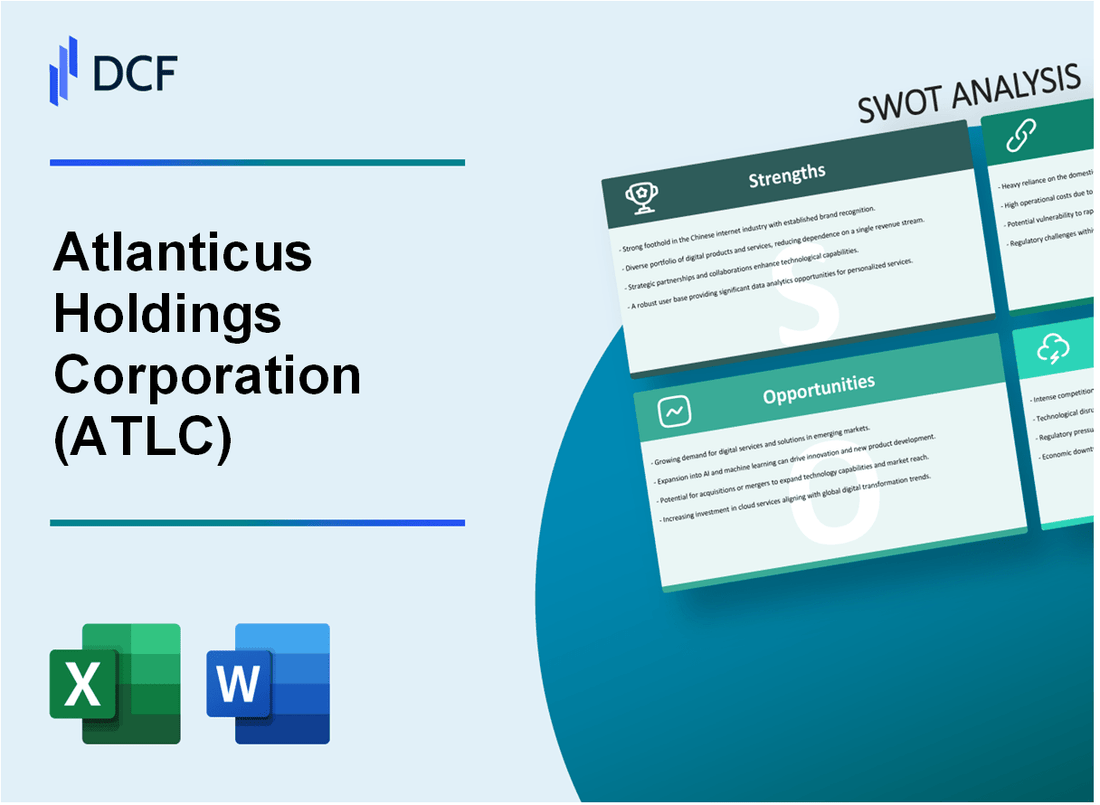
Completamente Editable: Adáptelo A Sus Necesidades En Excel O Sheets
Diseño Profesional: Plantillas Confiables Y Estándares De La Industria
Predeterminadas Para Un Uso Rápido Y Eficiente
Compatible con MAC / PC, completamente desbloqueado
No Se Necesita Experiencia; Fáciles De Seguir
Atlanticus Holdings Corporation (ATLC) Bundle
En el panorama dinámico de los servicios financieros, Atlanticus Holdings Corporation (ATLC) se encuentra en una coyuntura crítica, navegando por los complejos desafíos y oportunidades del mercado con precisión estratégica. Este análisis FODA integral revela la robusta infraestructura digital de la compañía, las innovadoras soluciones de fintech y el potencial de crecimiento en los mercados emergentes de crédito al consumo, al tiempo que destaca los riesgos críticos y las presiones competitivas que podrían dar forma a su trayectoria futura. Los inversores y los observadores de la industria obtendrán información profunda sobre cómo ATLC se está posicionando para aprovechar sus fortalezas y mitigar las posibles vulnerabilidades en un ecosistema de tecnología financiera cada vez más competitiva.
Atlanticus Holdings Corporation (ATLC) - Análisis FODA: Fortalezas
Plataforma de servicios financieros diversificados
Atlanticus Holdings Corporation opera en múltiples segmentos de servicios financieros con un enfoque en las soluciones de crédito y pago del consumidor. A partir del tercer trimestre de 2023, la compañía informó:
| Segmento financiero | Contribución de ingresos |
|---|---|
| Crédito de consumo | $ 156.3 millones |
| Soluciones de pago | $ 87.5 millones |
| Servicios habilitados para la tecnología | $ 42.1 millones |
Infraestructura de tecnología digital fuerte
La plataforma de tecnología de la compañía admite capacidades de préstamo de consumo robustas con las siguientes métricas clave:
- Procesamiento de origen de préstamo digital: 98.7% automatizado
- Decisión de crédito en tiempo real: menos de 30 segundos
- Modelos de crédito de aprendizaje automático que cubren el 85% de la cartera de préstamos
Crecimiento constante de ingresos y rentabilidad
Destacado de rendimiento financiero de 2022-2023:
| Métrica financiera | 2022 | 2023 | Índice de crecimiento |
|---|---|---|---|
| Ingresos totales | $ 285.6 millones | $ 324.7 millones | 13.7% |
| Lngresos netos | $ 47.3 millones | $ 59.2 millones | 25.2% |
Modelo de negocio flexible
Indicadores de adaptabilidad clave:
- Diversificación de cartera de productos en 3 líneas comerciales principales
- Presencia en 47 estados de EE. UU.
- Capacidad para ajustar los modelos de suscripción de crédito en tiempo real
Equipo de gestión experimentado
Credenciales del equipo de liderazgo:
| Puesto ejecutivo | Años en servicios financieros |
|---|---|
| CEO | 24 años |
| director de Finanzas | 18 años |
| CTO | 15 años |
Atlanticus Holdings Corporation (ATLC) - Análisis FODA: debilidades
Capitalización de mercado relativamente pequeña
A partir de enero de 2024, Atlanticus Holdings Corporation (ATLC) tiene una capitalización de mercado de aproximadamente $ 314 millones, significativamente menor en comparación con los competidores de servicios financieros más grandes.
| Competidor | Capitalización de mercado |
|---|---|
| ATLC | $ 314 millones |
| Promedio de competidores más grandes | $ 4.2 mil millones |
Riesgo de concentración en préstamos al consumidor
ATLC demuestra una concentración significativa en los mercados de préstamos de consumo, con 87.6% de los ingresos derivados de productos de crédito al consumidor.
- Portafolio de crédito al consumo: $ 1.2 mil millones
- Cuentas por cobrar con tarjeta de crédito: $ 782 millones
- Segmento de préstamos personales: $ 418 millones
Vulnerabilidad a las recesiones económicas
La Compañía exhibe una sensibilidad potencial a las fluctuaciones económicas, con disposiciones de pérdida de crédito que aumentan en 22.3% en el último año fiscal.
| Año fiscal | Disposiciones de pérdida de crédito |
|---|---|
| 2022 | $ 42.6 millones |
| 2023 | $ 52.1 millones |
Diversificación geográfica limitada
ATLC opera principalmente en 7 estados, con presencia de mercado concentrada en el sureste de los Estados Unidos.
- Estados operativos primarios: Georgia, Florida, Carolina del Norte, Carolina del Sur
- Mercados secundarios: Texas, Virginia, Alabama
Dependencia de la plataforma tecnológica
El desempeño comercial de la compañía está críticamente vinculado a la infraestructura tecnológica, con 68% de los procesos operativos administrados digitalmente.
| Inversión tecnológica | Cantidad |
|---|---|
| Presupuesto anual de TI | $ 24.3 millones |
| Desarrollo de plataforma digital | $ 8.7 millones |
Atlanticus Holdings Corporation (ATLC) - Análisis FODA: oportunidades
Expandir los préstamos digitales y las soluciones de fintech en los mercados emergentes de crédito al consumo
El mercado global de préstamos digitales se valoró en $ 4.8 billones en 2022 y se proyecta que alcanzará los $ 20.3 billones para 2030, con una tasa compuesta anual del 19.5%.
| Segmento de mercado | Crecimiento proyectado (2023-2030) |
|---|---|
| Préstamo de consumo digital | 22.3% CAGR |
| Préstamos personales en línea | 18.7% CAGR |
Potencial para adquisiciones estratégicas para mejorar las capacidades tecnológicas
Las inversiones de adquisición de tecnología en el sector FinTech alcanzaron los $ 49.3 mil millones en 2022.
- Valor de adquisición promedio de fintech: $ 127 millones
- Áreas de enfoque de tecnología potencial:
- Puntuación crediticia impulsada por la IA
- Evaluación de riesgos de aprendizaje automático
- Sistemas de verificación de blockchain
Creciente demanda de servicios alternativos de crédito y tecnología financiera
Se espera que el mercado de préstamos alternativos alcance los $ 567 mil millones para 2027, con una tasa de crecimiento anual del 15,6%.
| Segmento de préstamos alternativos | Tamaño del mercado (2023) |
|---|---|
| Préstamos entre pares | $ 67.8 mil millones |
| Préstamos en el mercado en línea | $ 48.3 mil millones |
Aumento de la adopción de IA y aprendizaje automático en la evaluación de crédito
La IA en el mercado de servicios financieros proyectó alcanzar los $ 130.1 mil millones para 2028, con un 25,4% de CAGR.
- Mejoras de precisión de evaluación de crédito de IA:
- Reducción del riesgo de incumplimiento: 35-40%
- Aumento de la velocidad de procesamiento: 60-70%
- Reducción de costos: 20-25%
Posible expansión en segmentos de crédito al consumidor desatendidos
El mercado de crédito al consumo desatendido estimado en $ 1.3 billones en volumen de préstamos anuales potenciales.
| Segmento desatendido | Tamaño potencial del mercado |
|---|---|
| Consumidores de archivos de crédito delgados | $ 487 mil millones |
| Trabajadores económicos de conciertos | $ 312 mil millones |
| Mercado de crédito de inmigrantes | $ 214 mil millones |
Atlanticus Holdings Corporation (ATLC) - Análisis FODA: amenazas
Aumento del escrutinio regulatorio en los préstamos y servicios financieros de los consumidores
El sector de préstamos de consumo enfrenta desafíos regulatorios significativos, con la Oficina de Protección Financiera del Consumidor (CFPB) que imponía $ 3.7 mil millones en multas en 2023. Los costos de cumplimiento para las instituciones financieras han aumentado en un 60% en los últimos cinco años.
| Métrico regulatorio | Valor 2023 |
|---|---|
| Acciones de cumplimiento de CFPB | $ 3.7 mil millones |
| Aumento de costos de cumplimiento | 60% |
| Expansión del personal de cumplimiento promedio | 42% |
Competencia intensa de instituciones financieras más grandes y compañías emergentes de fintech
El panorama competitivo muestra una presión de mercado significativa con las principales empresas de FinTech que experimentan un crecimiento sustancial:
- PayPal reportó $ 27.5 mil millones de ingresos en 2023
- Square (bloque) generó $ 17.4 mil millones en ingresos anuales
- Affirm Holdings vio un crecimiento de ingresos de 47% año tras año
La recesión económica potencial que afecta el rendimiento del crédito al consumidor
| Indicador de mercado de crédito | 2023 estadísticas |
|---|---|
| Tasa de incumplimiento de crédito al consumidor | 3.8% |
| Tasas de carga proyectadas | 4.2% |
| Tasas de delincuencia | 2.9% |
Riesgos de ciberseguridad y desafíos de protección de datos
Las amenazas de ciberseguridad continúan aumentando:
- Costo promedio de violación de datos: $ 4.45 millones
- Sector de servicios financieros Experiencias del 35% de todos los incidentes de ciberseguridad
- Daños estimados del delito cibernético: $ 8 billones en 2023
Cambios tecnológicos rápidos que requieren inversión continua en infraestructura digital
| Área de inversión tecnológica | Gasto anual |
|---|---|
| Transformación digital | $ 2.3 billones |
| AI y aprendizaje automático | $ 500 mil millones |
| Tecnologías de ciberseguridad | $ 188 mil millones |
Las tasas de adopción de tecnología en los servicios financieros muestran importantes presiones de transformación digital:
- Adopción de la computación en la nube: 94%
- Integración de IA: 68%
- Exploración de blockchain: 45%
Atlanticus Holdings Corporation (ATLC) - SWOT Analysis: Opportunities
Expand market share in the underserved, non-prime consumer credit segment.
You know the non-prime consumer credit market is huge, and Atlanticus Holdings Corporation is right in the sweet spot. The opportunity here isn't just about serving more customers; it's about capitalizing on a segment that traditional banks often overlook, but which is still credit-worthy using advanced analytics (proprietary technology and analytics). The company's focus on this niche is driving significant top-line growth.
For the third quarter of 2025, Total Operating Revenue and Other Income jumped to $495.3 million, a 41.1% increase over the same period in 2024. This growth rate is defintely a clear indicator that their model for the financially underserved is scaling effectively. This segment has less competition, allowing for better pricing and higher yields, provided the underwriting risk is managed accurately with their technology platform.
Leverage the Mercury acquisition to scale general-purpose credit card offerings.
The acquisition of Mercury Financial LLC is a game-changer, not just an add-on. It immediately expanded Atlanticus's reach into the near-prime consumer segment, which is a slightly less risky pool than their core non-prime market. This move instantly positioned the combined entity as a top 25 credit card program in the U.S.
Here's the quick math on the Mercury deal, which closed for approximately $166.5 million in cash:
- Added 1.3 million new credit card accounts.
- Contributed $3.2 billion in credit card receivables.
- Increased total managed receivables to $6.6 billion, a 148.7% increase from the previous year.
This integration allows Atlanticus to apply its technology and portfolio optimization strategies to a much larger and more diverse credit card base, driving cost synergies and increasing originations for their bank partners.
Cross-sell new financial products to the expanded base of over 5.7 million customers.
With the Mercury acquisition, Atlanticus now serves a massive base of over 5.7 million consumers as of Q3 2025. This is the real, immediate opportunity: turning a transactional relationship into a multi-product one. You have a captive audience that has already been underwritten and is engaging with a credit product.
The company's product suite is broad-it includes general-purpose credit cards, retail credit, patient financing, and dealer solutions products. The ability to cross-sell these different products to the newly acquired 1.3 million Mercury customers, and the existing base, is a low-cost, high-return growth lever. They can offer installment loans or private label credit to a customer who started with a general-purpose card, for example. This is a huge, immediate growth path.
To be fair, successful cross-selling depends on seamless integration of the Mercury platform, but the potential is clear.
| Metric | Q3 2025 Value | Significance |
|---|---|---|
| Total Accounts Served | Over 5.7 million | Massive cross-selling base. |
| Managed Receivables (Post-Acquisition) | $6.6 billion | Represents the total size of the loan portfolios. |
| Q3 2025 Total Operating Revenue | $495.3 million | Demonstrates the scale of the current revenue engine. |
Further strategic acquisitions, using the 2025 debt offering proceeds to fund portfolio purchases.
Management is clearly in an acquisitive phase, and they've already secured the capital to keep the momentum going. In August 2025, Atlanticus successfully priced an offering of $400 million in 9.750% Senior Notes due 2030.
The stated purpose for a portion of these proceeds is explicitly to fund future acquisitions of portfolios and associated businesses. This isn't just theory; they already executed on this strategy in Q3 2025 by acquiring an additional $165 million of retail credit receivables. This shows a clear, actionable path for inorganic growth, which is often faster than organic origination.
This war chest allows them to be opportunistic, buying up distressed or non-core portfolios from other financial institutions, a strategy they've executed successfully for years. They've purchased over $6 billion in credit card receivables portfolios throughout their history. The new debt offering gives them the liquidity to act quickly when a good portfolio deal comes up, further consolidating their position in the non-prime space.
Atlanticus Holdings Corporation (ATLC) - SWOT Analysis: Threats
Rising interest rates increase the cost of capital and pressure net margins.
The persistent high-interest-rate environment is a direct and significant threat to Atlanticus Holdings Corporation's profitability, primarily by driving up the cost of funding its loan portfolio. The company's interest expense has soared in 2025, increasing to $53.7 million in the second quarter, a sharp jump from $37.9 million in the same period a year prior. This is a material increase that directly compresses the net interest margin (NIM), which is the profit spread between what the company earns on loans and what it pays for funding.
To fund its growth, Atlanticus Holdings Corporation has been forced to accept a much higher cost of capital. For instance, the company priced a $400 million Senior Notes offering in August 2025 with an interest rate of 9.750%. To be fair, that rate is a substantial premium over the 6.125% rate on its existing notes due in 2026, showing the real-time jump in borrowing costs. Management defintely anticipates this trend to continue, expecting quarterly interest expense to rise further as they secure additional debt financing at these higher effective rates.
Increased loan delinquencies and charge-offs in the non-prime sector.
While Atlanticus Holdings Corporation has reported some favorable internal performance-noting lower delinquencies and improved net returns in its fair value assessment for Q2 2025-the broader non-prime market trend is a clear and persistent threat. Operating in the near-prime space means the portfolio is inherently sensitive to economic stress, and the overall US consumer is stretched.
Here's the quick math on the general market risk Atlanticus Holdings Corporation faces:
- Credit card charge-offs, a key metric for their business, fell slightly to 4.04% in Q2 2025, but that rate remains very elevated compared to the last decade.
- Early-indicator credit card delinquency rates stabilized at a very high 2.93% in Q2 2025, a 10-year historical high.
- The surge in other consumer debt defaults, like student loan delinquencies jumping from under 1% to 13% by Q2 2025, signals a broader deterioration in consumer credit health.
A higher volume of credit card debt, up around 50% in recent years, means consumers are carrying much higher balances, increasing the risk pool for a non-prime lender. If the economy slows or unemployment ticks up, Atlanticus Holdings Corporation's specific credit performance could quickly revert to the elevated market average.
Heightened regulatory scrutiny in the consumer finance industry.
The consumer finance industry, especially the non-prime segment, is under constant and increasing regulatory pressure, a risk Atlanticus Holdings Corporation explicitly acknowledges in its filings. 2025 is being called the 'Year of Regulatory Shift,' with regulators focusing heavily on consumer protection, fairness, and fraud prevention.
Specific regulatory actions pose a threat to the company's operating model and costs:
| Regulatory Body | 2025 Action/Focus | Potential Impact on Atlanticus Holdings Corporation |
|---|---|---|
| Consumer Financial Protection Bureau (CFPB) | Proposed rule to amend Regulation V (Fair Credit Reporting Act) regarding definitions of consumer report and consumer reporting agency. | Increased compliance costs and potential restrictions on the use of alternative data in underwriting, which is crucial for the near-prime sector. |
| Federal Deposit Insurance Corporation (FDIC) | Proposed rule on custodial deposit accounts ('FBO' accounts) impacting bank-fintech arrangements. | Direct operational and compliance risk to the company's core business model, which relies on partnerships with bank partners to originate loans. |
| Federal/State Regulators (General) | Focus on consumer protection, fraud, and fair treatment of customers. | Risk of litigation, regulatory fines, and required changes to servicing practices, all of which drive up operating expenses. |
Any adverse outcome from litigation or a new regulatory mandate could force a costly overhaul of its technology platform or lending practices.
Competition from other fintechs and traditional banks entering the near-prime space.
The near-prime and installment loan space is becoming fiercely competitive, a threat driven by both aggressive fintech innovation and the entry of larger, well-capitalized traditional players. The digital lending market is racing at full speed.
The competitive threats are twofold:
- Fintech Disruption: Companies like Upstart and Zest AI are leveraging Artificial Intelligence (AI) and alternative data to underwrite loans, which could expand credit access for over 50 million 'credit-invisible' consumers. AI-driven underwriting can slash loan processing time by 70% to 80%, a speed advantage that puts pressure on Atlanticus Holdings Corporation's own technology platform.
- Market Consolidation: The alternative financing sector saw $12.3 billion in merger and acquisition activity in 2024, a 45% year-over-year increase. Industry forecasts suggest that fifty large competitors could control ninety percent of the installment loan market by 2027. This consolidation means Atlanticus Holdings Corporation will be competing against fewer, but much larger, entities with deeper pockets and greater scale.
Major banks are now recognizing the lucrative potential of this sector, further intensifying the fight for market share. The market is very competitive.
Disclaimer
All information, articles, and product details provided on this website are for general informational and educational purposes only. We do not claim any ownership over, nor do we intend to infringe upon, any trademarks, copyrights, logos, brand names, or other intellectual property mentioned or depicted on this site. Such intellectual property remains the property of its respective owners, and any references here are made solely for identification or informational purposes, without implying any affiliation, endorsement, or partnership.
We make no representations or warranties, express or implied, regarding the accuracy, completeness, or suitability of any content or products presented. Nothing on this website should be construed as legal, tax, investment, financial, medical, or other professional advice. In addition, no part of this site—including articles or product references—constitutes a solicitation, recommendation, endorsement, advertisement, or offer to buy or sell any securities, franchises, or other financial instruments, particularly in jurisdictions where such activity would be unlawful.
All content is of a general nature and may not address the specific circumstances of any individual or entity. It is not a substitute for professional advice or services. Any actions you take based on the information provided here are strictly at your own risk. You accept full responsibility for any decisions or outcomes arising from your use of this website and agree to release us from any liability in connection with your use of, or reliance upon, the content or products found herein.