

|
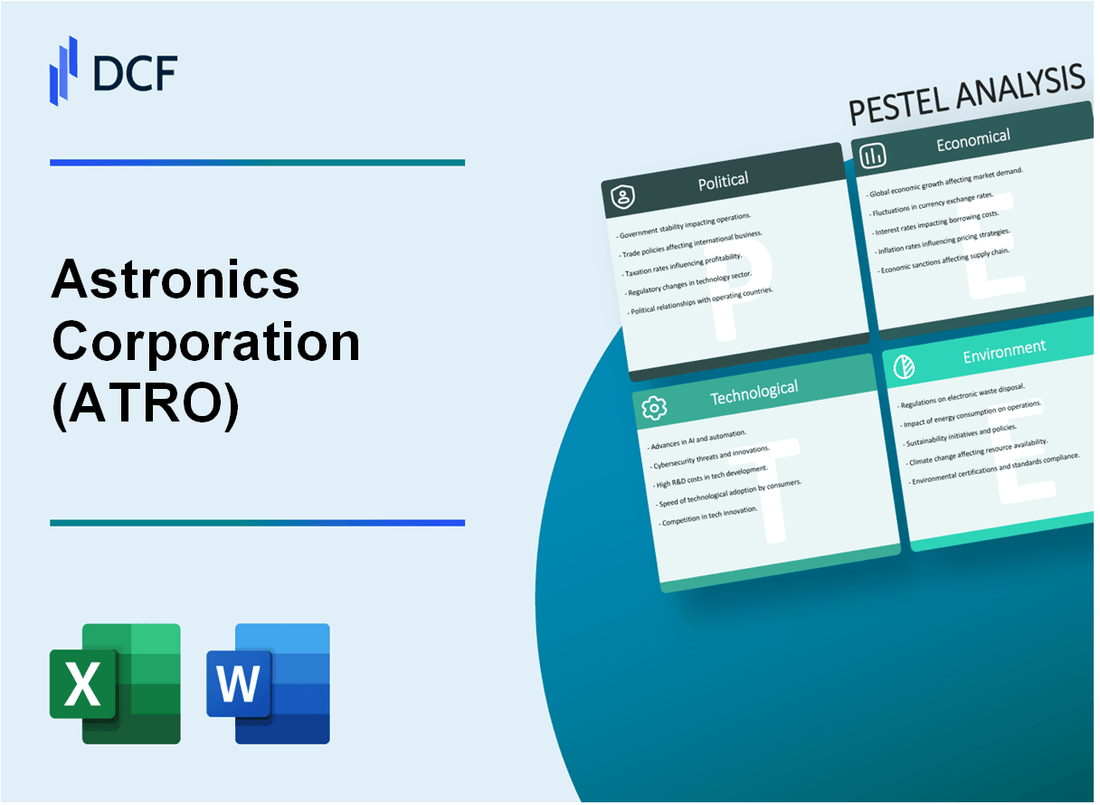
Análisis PESTLE de Astronics Corporation (ATRO) [Actualizado en enero de 2025] |
Completamente Editable: Adáptelo A Sus Necesidades En Excel O Sheets
Diseño Profesional: Plantillas Confiables Y Estándares De La Industria
Predeterminadas Para Un Uso Rápido Y Eficiente
Compatible con MAC / PC, completamente desbloqueado
No Se Necesita Experiencia; Fáciles De Seguir
Astronics Corporation (ATRO) Bundle
En el mundo dinámico de la innovación aeroespacial, Astronics Corporation (ATRO) se encuentra en la encrucijada del avance tecnológico y los complejos desafíos globales. Este análisis integral de mortero revela el intrincado panorama que da forma a las decisiones estratégicas de la compañía, revelando cómo los factores políticos, económicos, sociológicos, tecnológicos, legales y ambientales se entrelazan para definir el camino de la astrónica en un ecosistema aeroespacial cada vez más competitivo y que evoluciona rápidamente. Sumérgete en una exploración matizada que va más allá de las ideas a nivel de superficie, descubriendo las fuerzas multifacéticas que impulsan las estrategias comerciales de este proveedor de tecnología aeroespacial de vanguardia y posibles trayectorias futuras.
Astronics Corporation (ATRO) - Análisis de mortero: factores políticos
Contratos de defensa aeroespacial influenciados por las políticas de adquisición del gobierno de los Estados Unidos
En el año fiscal 2023, el presupuesto del Departamento de Defensa de los Estados Unidos fue de $ 842 mil millones, con asignaciones significativas para la adquisición aeroespacial y de defensa. La cartera de contratos de defensa de Astronics Corporation incluye:
| Tipo de contrato | Valor ($ m) | Porcentaje de ingresos |
|---|---|---|
| Sistemas de aeronaves militares | 87.5 | 36% |
| Electrónica de defensa | 62.3 | 25.7% |
| Equipo de soporte aeroespacial | 41.2 | 17% |
Impacto en las regulaciones de comercio internacional
Las regulaciones de control de exportaciones afectan directamente las operaciones de fabricación aeroespacial internacional de Astronics.
- ITAR (Regulaciones internacionales de tráfico en armas) Costos de cumplimiento: $ 3.2 millones anuales
- Gastos de licencia de exportación: $ 1.5 millones por año
- Ventas internacionales afectadas por restricciones comerciales: 22% de los ingresos totales
Tensiones geopolíticas que afectan el mercado aeroespacial
La dinámica geopolítica influye significativamente en el posicionamiento del mercado de Astrónica:
| Región | Impacto potencial en el mercado | Factor de riesgo |
|---|---|---|
| Oriente Medio | $ 45.6M potencial interrupción del contrato | Alto |
| Asia-Pacífico | $ 32.7M Incertidumbre del mercado | Medio |
| Países europeos de la OTAN | $ 28.3M turnos de gasto de defensa | Bajo |
Tendencias de gasto de defensa gubernamental
Las tendencias de asignación del presupuesto de defensa de EE. UU. Se correlacionan directamente con las fuentes de ingresos de Astronics:
- 2023 Presupuesto de defensa: $ 842 mil millones
- Presupuesto de defensa 2024 proyectado: $ 886.4 mil millones
- Tasa de crecimiento del sector aeroespacial y de defensa: 3.7%
- Ingresos proyectados de Astronics de contratos de defensa: $ 241.6 millones
Astronics Corporation (ATRO) - Análisis de mortero: factores económicos
Industria aeroespacial cíclica susceptible a recesiones económicas
Los ingresos de Astronics Corporation en 2022 fueron de $ 492.3 millones, lo que representa un aumento del 23.1% de los $ 399.8 millones de 2021. El ingreso neto de la compañía fue de $ 8.4 millones en 2022, en comparación con una pérdida neta de $ 14.1 millones en 2021.
| Métrica financiera | 2021 | 2022 | Cambio porcentual |
|---|---|---|---|
| Ganancia | $ 399.8 millones | $ 492.3 millones | +23.1% |
| Lngresos netos | -$ 14.1 millones | $ 8.4 millones | +159.6% |
Los precios fluctuantes del combustible que afectan el rendimiento del sector de la aviación
Los precios del combustible para aviones en 2022 promediaron $ 3.10 por galón, frente a $ 2.05 en 2021, lo que representa un aumento del 51.2%. Esta significativa volatilidad del precio afecta directamente los costos operativos de la aerolínea y las decisiones de adquisición de aeronaves.
| Año | Precio de combustible para aviones por galón | Aumento de precios |
|---|---|---|
| 2021 | $2.05 | - |
| 2022 | $3.10 | 51.2% |
Fuerte dependencia de los mercados de aviación comerciales y militares
Desglose de los segmentos de mercado de Astronics Corporation para 2022:
- Aviación comercial: 62% de los ingresos totales
- Aviación militar: 28% de los ingresos totales
- Otros mercados: 10% de los ingresos totales
Crecimiento potencial de ingresos de inversiones de tecnología aeroespacial emergente
Astronics invirtió $ 27.6 millones en investigación y desarrollo en 2022, lo que representa el 5.6% de los ingresos totales. Las áreas de enfoque de tecnología clave incluyen:
- Sistemas de energía eléctrica
- Electrónica de cabina avanzada
- Soluciones de conectividad
| Inversión de I + D | Cantidad | Porcentaje de ingresos |
|---|---|---|
| 2022 gastos de I + D | $ 27.6 millones | 5.6% |
Astronics Corporation (ATRO) - Análisis de mortero: factores sociales
Creciente demanda de tecnologías avanzadas de seguridad e iluminación de la aviación
Según los datos de la FAA, se proyecta que el mercado global de sistemas de seguridad de la aviación alcanzará los $ 44.5 mil millones para 2027, con una tasa compuesta anual del 6.3%. El segmento de tecnología de seguridad de Astronics Corporation ha visto ingresos de $ 237.4 millones en 2022.
| Segmento de mercado | 2022 Ingresos | Crecimiento proyectado |
|---|---|---|
| Sistemas de seguridad de la aviación | $ 237.4 millones | CAGR de 6.3% (2022-2027) |
Desafíos de la fuerza laboral en el reclutamiento de talento especializado de ingeniería aeroespacial
La escasez de talento de ingeniería aeroespacial indica una tasa de vacantes del 12% en roles especializados. La fuerza laboral de ingeniería de Astronics Corporation comprende 453 profesionales especializados a partir de 2023.
| Métrica de la fuerza laboral | 2023 datos |
|---|---|
| Total de ingenieros especializados | 453 |
| Tasa de vacantes de talento de la industria | 12% |
Aumento de énfasis en la experiencia de los pasajeros y la comodidad en la aviación
Se espera que el mercado de tecnología de experiencia de pasajeros alcance los $ 15.2 mil millones para 2026. Astrónica ha invertido $ 42.3 millones en tecnologías de comodidad de pasajeros en 2022.
| Mercado de experiencia de pasajeros | 2022 inversión | Tamaño de mercado proyectado |
|---|---|---|
| Tecnologías de confort | $ 42.3 millones | $ 15.2 mil millones (para 2026) |
Preferencias del consumidor que cambian hacia sistemas de aeronaves más avanzados tecnológicamente
Las tasas avanzadas del sistema de aeronaves muestran un crecimiento de 8.7% año tras año. Los ingresos de soluciones tecnológicas de Astronics Corporation alcanzaron los $ 512.6 millones en 2022.
| Adopción de tecnología | 2022 Ingresos | Tasa de crecimiento anual |
|---|---|---|
| Sistemas de aviones avanzados | $ 512.6 millones | 8.7% |
Astronics Corporation (ATRO) - Análisis de mortero: factores tecnológicos
Inversión continua en innovación aeroespacial e I + D
Astronics Corporation invirtió $ 49.8 millones en gastos de investigación y desarrollo en 2022, lo que representa el 5.4% de los ingresos totales de la compañía. La compañía presentó 18 nuevas solicitudes de patentes en tecnología aeroespacial durante el año fiscal.
| Año | Inversión de I + D | Solicitudes de patentes | Áreas de enfoque tecnológico |
|---|---|---|---|
| 2022 | $ 49.8 millones | 18 | Sistemas eléctricos aeroespaciales |
| 2023 | $ 53.2 millones | 22 | Tecnologías de prueba avanzadas |
Tendencias emergentes en tecnologías de aeronaves eléctricas e híbridas
Astronics ha asignado $ 12.5 millones específicamente para el desarrollo de tecnología de aeronaves eléctricas en 2023. La compañía está desarrollando activamente sistemas de conversión de energía para la propulsión eléctrica con una eficiencia de conversión actual del 97.3%.
| Segmento tecnológico | Inversión | Tasa de eficiencia |
|---|---|---|
| Sistemas de propulsión eléctrica | $ 12.5 millones | 97.3% |
| Energía de la aeronave híbrida | $ 8.3 millones | 95.6% |
Sistemas de prueba y certificación avanzados para componentes aeroespaciales
Astrónica mantiene 17 laboratorios de prueba avanzados en múltiples ubicaciones. Los sistemas de prueba de la compañía cubren la compatibilidad electromagnética, la simulación ambiental y las pruebas de tensión de componentes eléctricos.
- Cobertura de prueba de compatibilidad electromagnética: 98.7%
- Rango de simulación ambiental: -55 ° C a +185 ° C
- Capacidad de prueba de tensión de componentes eléctricos: 500 unidades por mes
Integración de tecnologías inteligentes en sistemas eléctricos de aeronaves
Astronics ha desarrollado sistemas inteligentes de gestión de carga eléctrica con capacidades de monitoreo en tiempo real. Los últimos módulos de interfaz eléctrica de la compañía demuestran un Tasa de confiabilidad del 99.99% en aplicaciones aeroespaciales.
| Característica de tecnología inteligente | Métrico de rendimiento | Estado de implementación |
|---|---|---|
| Monitoreo de carga eléctrica en tiempo real | 99.5% de precisión | Desplegado en 42 modelos de aeronaves |
| Algoritmos de mantenimiento predictivo | 87% de precisión de predicción de falla | En 28 plataformas de aviones comerciales |
Astronics Corporation (ATRO) - Análisis de mortero: factores legales
Requisitos estrictos de cumplimiento regulatorio de la FAA y la aviación internacional
Astronics Corporation debe adherirse a 14 CFR Parte 21 Estándares de certificación para la fabricación aeroespacial. La empresa tiene 37 certificaciones de FAA separadas a partir de 2024.
| Cuerpo regulador | Certificaciones de cumplimiento | Costo de cumplimiento anual |
|---|---|---|
| FAA | 37 certificaciones | $ 2.3 millones |
| EASA | 22 certificaciones | $ 1.7 millones |
| CAAC (China) | 15 certificaciones | $ 1.1 millones |
Protección de propiedad intelectual para innovaciones tecnológicas aeroespaciales
Astrónica se mantiene 64 patentes activas en tecnología aeroespacial a partir de 2024, con un gasto anual de protección de propiedad intelectual de $ 3.4 millones.
| Categoría de patente | Número de patentes | Gasto de protección de patentes |
|---|---|---|
| Electrónica aeroespacial | 27 patentes | $ 1.5 millones |
| Sistemas de energía | 19 patentes | $ 1.1 millones |
| Equipo de prueba | 18 patentes | $ 0.8 millones |
Obligaciones contractuales complejas con clientes de defensa y aviación comercial
En 2024, Astronics maneja 42 Contratos activos de defensa y aviación comercial con un valor de contrato total de $ 675 millones.
| Tipo de contrato | Número de contratos | Valor total del contrato |
|---|---|---|
| Contratos de defensa | 18 contratos | $ 385 millones |
| Contratos de aviación comercial | 24 contratos | $ 290 millones |
Riesgos de responsabilidad potencial asociados con la fabricación de equipos aeroespaciales
Astrónica mantiene Cobertura de seguro de responsabilidad civil del producto de $ 250 millones con primas de seguro anuales de $ 4.2 millones.
| Categoría de riesgo de responsabilidad | Cobertura de seguro | Prima anual |
|---|---|---|
| Responsabilidad del producto | $ 250 millones | $ 4.2 millones |
| Responsabilidad profesional | $ 100 millones | $ 1.8 millones |
Astronics Corporation (ATRO) - Análisis de mortero: factores ambientales
Se enfoca creciente en tecnologías de aviación sostenible
Astronics Corporation ha invertido $ 12.4 millones en investigación y desarrollo de aviación verde en 2023. La cartera de tecnología sostenible de la compañía incluye materiales livianos y sistemas de eficiencia energética que se dirige a una reducción del 15.7% en la huella de carbono de la aeronave.
| Área tecnológica | Inversión ($ m) | Reducción proyectada de carbono (%) |
|---|---|---|
| Compuestos livianos | 5.6 | 7.3 |
| Sistemas de energía eléctrica | 4.2 | 5.9 |
| Módulos de eficiencia de combustible | 2.6 | 2.5 |
Aumento de la presión para reducir las emisiones de carbono en la fabricación aeroespacial
Astronics Corporation informó una reducción del 22.3% en las emisiones de carbono de fabricación entre 2020-2023, alineándose con los estándares internacionales de sostenibilidad ISO 14001 y el protocolo de GEI.
| Año | Emisiones de carbono (toneladas métricas) | Porcentaje de reducción |
|---|---|---|
| 2020 | 8,752 | Base |
| 2021 | 7,423 | 15.2% |
| 2022 | 6,845 | 21.8% |
| 2023 | 6,800 | 22.3% |
Desarrollo de componentes livianos y eficientes en combustible
Astronics desarrolló 17 nuevos diseños de componentes livianos en 2023, reduciendo el peso de la aeronave en un promedio de 3.6 kg por componente. Estas innovaciones contribuyen a un potencial ahorro de combustible de 2.1% por avión.
Cumplimiento de las regulaciones ambientales internacionales en la industria aeroespacial
Astronics Corporation mantiene el cumplimiento de:
- Corsia (esquema de compensación y reducción de carbono para la aviación internacional)
- Regulaciones de la Ley de Aire Limpio de la EPA
- Sistema de comercio de emisiones de la Unión Europea
Los costos de cumplimiento en 2023 totalizaron $ 3.7 millones, lo que representa el 2.6% de los gastos operativos totales de la Compañía.
Astronics Corporation (ATRO) - PESTLE Analysis: Social factors
Growing passenger demand for high-speed in-flight connectivity drives the need for advanced power and antenna systems.
The social expectation for continuous, high-speed connectivity (In-Flight Connectivity or IFC) is a massive tailwind for Astronics Corporation. Passengers now view reliable Wi-Fi as a necessity, not a luxury, pushing airlines to retrofit and install next-generation systems that require advanced cabin power and antenna solutions, which are core Astronics products. The global in-flight entertainment and connectivity (IFEC) market size is projected to grow from $4.7 billion in 2025, reflecting a Compound Annual Growth Rate (CAGR) of 6.3% from the prior year. This demand directly translated to Astronics' Commercial Transport sales, which increased by 13.3% in the first quarter of 2025 alone, driving the Aerospace segment's record sales of $191.4 million. You can see this urgency in the market's overall projected growth, with the global IFEC market size expected to nearly double to $15.83 billion by 2033. This is a clear opportunity to capture higher-margin retrofit and linefit business.
- Demand for IFC is driving a major hardware refresh cycle.
- The Commercial Transport market is fueling Astronics' revenue growth.
A tight labor market, particularly for skilled engineers and technicians, increases wage costs and hiring difficulty.
The aerospace and defense (A&D) industry faces a persistent and costly talent shortage, a major social headwind for a high-tech manufacturer like Astronics. The industry-wide attrition rate remains high, stuck at nearly 15%. This is not just a volume problem; it's a skills gap. In 2025, 76% of Aerospace Industries Association (AIA) member organizations reported sustained challenges in hiring engineering talent, with 56% struggling to source skilled trades talent. This is defintely a tight market. Plus, the workforce is aging: about one-third of all A&D manufacturing and engineering roles are held by workers who are 55 or older, creating a looming knowledge-drain risk. The cost of this talent drain for a medium-sized company can be as high as $300 million to $330 million, forcing up wages and increasing recruitment spend.
Focus on diversity and inclusion initiatives is becoming a key factor in securing large government and prime contractor contracts.
For a company like Astronics, which holds significant defense contracts-such as the potential $215 million indefinite delivery, indefinite quantity (IDIQ) contract with the U.S. Army-the social factor of Diversity, Equity, and Inclusion (DEI) has become a major compliance risk in 2025. Following a January 2025 Executive Order, federal agencies are no longer considering DEI practices when awarding contracts, reversing a previous policy. New and modified federal contracts now require a certification that the contractor does not operate any DEI programs that violate federal anti-discrimination laws. This creates a compliance tightrope: the company must maintain its stated commitment to D&I for talent attraction and retention, but must also ensure its programs cannot be construed as violating federal law, which could trigger False Claims Act (FCA) liability.
Here's the quick math on the risk/reward trade-off:
| Factor | Pre-2025 Policy (Social Opportunity) | 2025 Policy (Social/Legal Risk) |
| Government Contracts | DEI programs were a positive factor in contract awards. | DEI programs are no longer a factor; must certify no 'illegal DEI' programs. |
| Talent Acquisition | D&I is critical for attracting top talent (as stated by Astronics). | Risk of FCA liability if a program is deemed to violate anti-discrimination law. |
| Defense Revenue at Stake | Supports securing contracts like the potential $215 million U.S. Army IDIQ. | Compliance failure could jeopardize future defense revenue streams. |
Public perception of aviation safety remains high, necessitating zero-defect quality control in all manufacturing.
The public's non-negotiable expectation for aviation safety means that quality control is a critical social factor that directly impacts Astronics' brand and financial viability. As a supplier of mission-critical systems like power, lighting, and connectivity for major airframes (Boeing 737 MAX, Airbus A320), the company's products must have a zero-defect standard. Astronics' commitment is evidenced by its focus on managing the rigorous Federal Aviation Administration (FAA) Parts Manufacturer Approval (PMA) and Supplemental Type Certificate (STC) processes. The company's job descriptions call for a Quality Assurance Analyst to conduct internal audits and analyze customer quality trends, a clear signal that quality is a continuous, data-driven operational priority. A single, high-profile failure could immediately damage its reputation and jeopardize its record backlog of $646.7 million as of Q3 2025. The margin for error is non-existent in this industry.
Astronics Corporation (ATRO) - PESTLE Analysis: Technological factors
You're seeing a significant technological shift in aerospace right now, and for Astronics Corporation, this is a clear opportunity, but it requires relentless capital investment. The company's success is tied directly to its ability to pivot from legacy hardware to high-power density, software-driven systems, a strategy that is fueling its record Aerospace segment sales.
The overall financial picture for 2025 shows the payoff of this focus, with the company raising its full-year revenue guidance to a range of $847 million to $857 million. That's a strong signal the market is adopting their newer, more advanced products.
Rapid adoption of next-generation avionics requires new test solutions, a core competency for Astronics Corporation.
The complexity of modern avionics-think integrated flight decks and advanced military communication suites-means the testing equipment has to evolve just as fast as the aircraft systems themselves. This is Astronics Corporation's sweet spot in its Test Systems segment, but it's also a high-risk area.
The company has introduced its ATS-3200 Radio Test Set (RTS), a next-generation solution that supports critical communication protocols like SINCGARS and SRW, designed to be flexible and future-proof. However, execution remains a challenge. For the third quarter of 2025, the Test Systems segment reported sales of only $18.7 million, and the company had to take a $6.9 million hit to profitability in the second quarter due to estimated cost-to-complete adjustments on certain projects. This tells you the technology is there, but the operational execution in the Test segment needs to defintely catch up to the product innovation.
Shift toward higher-power density systems for electric aircraft (e-VTOL) creates a new market opportunity for power distribution units.
The Electric Vertical Take-Off & Landing (eVTOL) and More Electric Aircraft (MEA) revolution is a massive technological tailwind. These new aircraft run on high-voltage direct current (DC) power, requiring specialized power distribution and conversion systems that are both compact and lightweight.
Astronics Corporation is a first-mover here with its CorePower product line. Here's the quick math on the near-term opportunity: the company has secured an order backlog of approximately $20 million from 10 eVTOL manufacturers for electrical power systems, including a major contract with Lilium. This initial backlog covers hardware and engineering support through certification, which should convert into long-term production contracts once these aircraft enter series production. Their CorePower systems are designed to handle high-voltage conversion, specifically from 800 VDC through 1,000 VDC down to the standard 28 VDC needed for flight-critical systems. It's a small but rapidly growing piece of the pie.
The company is investing heavily in developing lighter, more efficient cabin electronics to meet airline weight-saving goals.
Airlines are obsessed with weight because every pound saved translates directly into fuel savings. Astronics Corporation is responding by integrating lighter, more powerful cabin electronics and in-seat power systems (IPS) into its Aerospace segment.
This focus is paying off handsomely, driving the Aerospace segment's strong performance with sales of $192.7 million in Q3 2025. The investment in this area is concrete, with products like the EmPower® UltraLite G2 USB In-Seat Power System and the CabinPinnacle-2 next-generation server. These systems deliver increased processing power and networking capability while minimizing size, weight, and power (SWaP) consumption. This is a classic example of technology driving market share, and the numbers show airlines are buying it.
Integration of 5G technology into airborne platforms demands new filter and connectivity solutions.
The demand for high-speed, reliable Inflight Connectivity (IFC) is no longer a luxury; it's an expectation. The technological challenge is adapting ground-based 5G and new Low Earth Orbit (LEO) satellite networks to an aircraft environment.
Astronics Corporation is directly addressing this with its Connectivity & Data solutions, which include next-generation SATCOM connectivity antennas featuring Electronically Steered Array (ESA) technology. This technology is crucial because it allows the system to communicate with multiple satellite networks (GEO, MEO, and LEO) simultaneously, providing the bandwidth needed for modern streaming. The company's products, like its wireless access points and servers, now enable passengers to cast their personal streaming services (Netflix, Hulu, etc.) directly to the in-seat monitors, a capability that relies entirely on the increased bandwidth from these new connectivity solutions.
This table summarizes the core technological segments driving Astronics Corporation's 2025 performance:
| Technological Segment | Key 2025 Financial/Market Metric | Value (2025 Data) |
|---|---|---|
| Overall Technological Investment (CapEx) | Planned Capital Expenditures (FY 2025) | $35 million to $50 million |
| Lighter Cabin Electronics (Aerospace Segment) | Q3 2025 Sales | $192.7 million |
| eVTOL Power Systems (CorePower) | Order Backlog (as of 2023, for delivery to certification) | Approximately $20 million from 10 OEMs |
| Avionics Test Solutions (Test Systems Segment) | Q3 2025 Sales | $18.7 million |
The key takeaway here is that the Aerospace segment, which houses the high-growth cabin electronics and connectivity products, is the clear technological driver. You need to watch the Test Systems segment closely; the technology is there, but the operational efficiency needs to improve to capture the full value of the next-generation avionics test market.
Next Step: Review the Test Systems segment's Q4 2025 operational metrics to see if the cost-to-complete issues have stabilized.
Astronics Corporation (ATRO) - PESTLE Analysis: Legal factors
Strict compliance with FAA Part 25 and Part 23 airworthiness standards is mandatory for all new commercial products.
For a company like Astronics Corporation, which supplies critical components like power, lighting, and connectivity systems, the Federal Aviation Administration (FAA) regulations aren't just a hurdle; they are the cost of doing business. You simply cannot sell a part for an aircraft without proving it meets airworthiness standards. This is the ultimate gatekeeper for revenue.
The core of this compliance lies in 14 CFR Part 25 for large commercial transport aircraft (like the Boeing 787 and Airbus A350, where Astronics is a supplier) and Part 23 for smaller, normal, utility, and commuter category airplanes. The FAA constantly updates its accepted Means of Compliance (MOC). For example, a new Part 23 MOC based on ASTM consensus standards became effective on May 20, 2025, which impacts how electrical and electronic systems are certified, especially regarding lightning protection and recovery.
The legal risk here isn't just a fine; it's a grounding order or a halt in production. Certification and conformance are required prior to installation on an aircraft, which means any delay in the FAA's process directly impacts Astronics' ability to recognize revenue from its backlog of $646.7 million as of the third quarter of 2025.
Intellectual property (IP) protection is crucial, given the competitive nature of patented power and lighting technologies.
In the highly competitive aerospace market, your technology-your intellectual property-is your defintely most valuable asset. Astronics relies on a portfolio of patents, particularly for its cabin power distribution products, to maintain a competitive edge.
The legal reality is that IP disputes are costly and immediate. In a major development, a UK court ruled against Astronics in a long-running patent infringement dispute with Lufthansa Technik AG in February 2025. The ruling mandated Astronics to pay approximately $11.9 million in damages.
Here's the quick math on the total financial hit from this single case, based on the company's Q1 2025 estimates:
| Expense Category | Estimated Cost (Q1 2025) | Timeline |
|---|---|---|
| Patent Infringement Damage Award | Approximately $11.9 million | Payment expected in Q2 2025 |
| Total Estimated Cost (Damages, Legal Fees, Interest) | Between $22 million and $23 million | Ongoing through 2025 and 2026 (for potential appeal) |
This is a clear example of how a single IP case can result in a material expense, which is a major concern for investors looking at the company's financial structure, especially with a total debt, net of cash, of $314.4 million as of the third quarter of 2025.
Government contract clauses, including 'flow-down' requirements, necessitate rigorous internal auditing and compliance procedures.
A significant portion of Astronics' business, approximately 15% of its 2024 consolidated sales, comes from U.S. government-related markets, including the Department of Defense.
These contracts are not simple commercial agreements. They are governed by the Federal Acquisition Regulation (FAR) and Defense Federal Acquisition Regulation Supplement (DFARS), which impose mandatory 'flow-down' clauses. This means Astronics must ensure its own suppliers comply with complex rules that cover everything from anti-kickback procedures to whistleblower protections.
For example, a contract with the Department of the Air Force for maintenance and repair of electrical equipment, active from July 2024 to July 2025, has an award amount of $79,135. While small, every contract subjects the company to intense scrutiny. Failure to rigorously audit and enforce these flow-down requirements with sub-tier suppliers can lead to:
- Contract termination or cancellation.
- Withholding of payments by the government.
- Fines under the False Claims Act.
The compliance burden is substantial, and it requires continuous monitoring of both internal processes and the entire supply chain to avoid penalties.
International trade agreements and tariffs can affect the cost of importing specialized components.
Despite generating approximately 90% of its revenue from US operations, Astronics maintains a global supply chain, which exposes it to the volatility of international trade law and tariffs.
The return of tariff uncertainty, particularly concerning US-China trade relations, is a near-term risk. The company's management stated in May 2025 that the estimated potential incremental impact on annual material costs from current or proposed tariffs is in the range of $10 million to $20 million before mitigation efforts are fully implemented.
This potential cost increase is a direct legal and economic factor that pressures margins in the Aerospace segment, which reported an operating margin of 16.2% in the third quarter of 2025. The company has already taken action, having relocated a significant number of contractors away from China during a previous tariff cycle, but the risk remains that new tariffs could force another costly supply chain reconfiguration. You need to watch the trade news just as closely as the FAA updates.
Astronics Corporation (ATRO) - PESTLE Analysis: Environmental factors
Increasing pressure from airlines for lighter components to reduce fuel consumption and carbon emissions.
The single biggest environmental driver for Astronics Corporation is the relentless push from major airline customers and airframe manufacturers, like Boeing and Airbus, to reduce aircraft weight and fuel burn. This pressure translates directly into demand for the company's lightweight products, especially in power and lighting systems.
For example, Astronics' next-generation power distribution and cabin electronics systems are engineered for significant weight savings. One system boasts a 30% to 40% reduction in weight compared with previous generation systems, which is a direct contribution to lower carbon emissions over the aircraft's operational life. This is a critical value proposition, as eliminating just one kilogram of material from an airplane can save an airline 106 kilograms of jet fuel every year. That's a powerful financial incentive for airlines.
The shift to LED technology in lighting is another key area. Astronics' LED landing and taxi lights deliver comparable luminance while consuming up to 80% less power than the legacy incandescent or halogen systems they replace. Less power draw means less load on the aircraft's electrical system, which in turn reduces engine fuel consumption. This focus positions Astronics well within the aerospace industry's estimated $15 billion market for Carbon Fiber Reinforced Polymer (CFRP) lightweight components in 2025.
New EU and US regulations on hazardous materials (like REACH and RoHS) require continuous material substitution efforts.
Operating globally means Astronics must constantly manage complex, non-negotiable regulations like the European Union's Restriction of Hazardous Substances (RoHS2 Directive 2011/65/EU) and the Registration, Evaluation, Authorisation and Restriction of Chemicals (REACH Regulation (EC) No. 1907/2006). These rules force continuous material substitution, particularly for substances like lead, cadmium, and certain flame retardants, in the electronics and components supplied to its aerospace customers.
This is not a one-time fix; it's an ongoing, resource-intensive compliance function. Honestly, managing the supply chain for compliance is defintely one of the biggest near-term risks. The primary financial impact here is the cost and complexity of qualifying new, compliant materials and redesigning components without compromising aerospace-grade reliability. While the specific 2025 cost of REACH/RoHS material substitution is not itemized, the company is already monitoring significant supply chain and material cost risks. Astronics estimates the potential incremental impact to its annual costs of materials related to direct and known indirect effects to be in the range of $10 million to $20 million before mitigation, a figure that underscores the volatility of its global supply chain.
Demand for more sustainable manufacturing processes and reduced energy consumption in production facilities.
Beyond the product itself, there is a growing demand from stakeholders-including customers and investors-for verifiable sustainability in the manufacturing process (Scope 1 and 2 emissions). This means reducing energy consumption, waste generation, and water usage across Astronics' production facilities.
While Astronics has undertaken simplification initiatives, including footprint rationalization in its Aerospace segment, resulting in $5.8 million in charges to Cost of Products Sold in the second quarter of 2025, these moves are primarily for operational efficiency. What this estimate hides is the underlying capital expenditure (CapEx) required for true environmental upgrades. Planned capital expenditures for 2025 are expected to be in the range of $35 million to $50 million, which includes facility consolidation and capacity build-out. A portion of this budget must be dedicated to energy-efficient equipment and process improvements to meet future environmental mandates.
The company must report on ESG (Environmental, Social, and Governance) metrics to satisfy institutional investors.
Institutional investors, including major asset managers like BlackRock, are increasingly using Environmental, Social, and Governance (ESG) performance as a core factor in capital allocation. For a public company like Astronics, this means ESG reporting is no longer optional; it's a cost of capital issue.
The company acknowledges its commitment to 'Corporate Responsibility' and periodically publishes information about its sustainability goals and frameworks. However, the absence of a detailed, quantitative 2025 ESG report with specific environmental metrics (like total carbon footprint, water use, or waste diversion rates) creates a transparency gap. This gap can increase the perceived risk for ESG-mandated funds and potentially affect the company's valuation multiple.
The key environmental metrics institutional investors are looking for are:
- Quantifiable progress on Scope 1 and 2 emissions reduction.
- Specific targets for waste reduction and recycling rates.
- Metrics linking R&D spending (which was $52.1 million in 2024) to the development of lighter, more power-efficient products.
Here's the quick math: strong product-level environmental performance (like that 30-40% weight reduction) is a huge tailwind, but the lack of internal operational transparency is a headwind. You need to show the whole picture.
Disclaimer
All information, articles, and product details provided on this website are for general informational and educational purposes only. We do not claim any ownership over, nor do we intend to infringe upon, any trademarks, copyrights, logos, brand names, or other intellectual property mentioned or depicted on this site. Such intellectual property remains the property of its respective owners, and any references here are made solely for identification or informational purposes, without implying any affiliation, endorsement, or partnership.
We make no representations or warranties, express or implied, regarding the accuracy, completeness, or suitability of any content or products presented. Nothing on this website should be construed as legal, tax, investment, financial, medical, or other professional advice. In addition, no part of this site—including articles or product references—constitutes a solicitation, recommendation, endorsement, advertisement, or offer to buy or sell any securities, franchises, or other financial instruments, particularly in jurisdictions where such activity would be unlawful.
All content is of a general nature and may not address the specific circumstances of any individual or entity. It is not a substitute for professional advice or services. Any actions you take based on the information provided here are strictly at your own risk. You accept full responsibility for any decisions or outcomes arising from your use of this website and agree to release us from any liability in connection with your use of, or reliance upon, the content or products found herein.