
|
Corporación Blue Bird (BLBD): Análisis PESTLE [Actualizado en Ene-2025] |
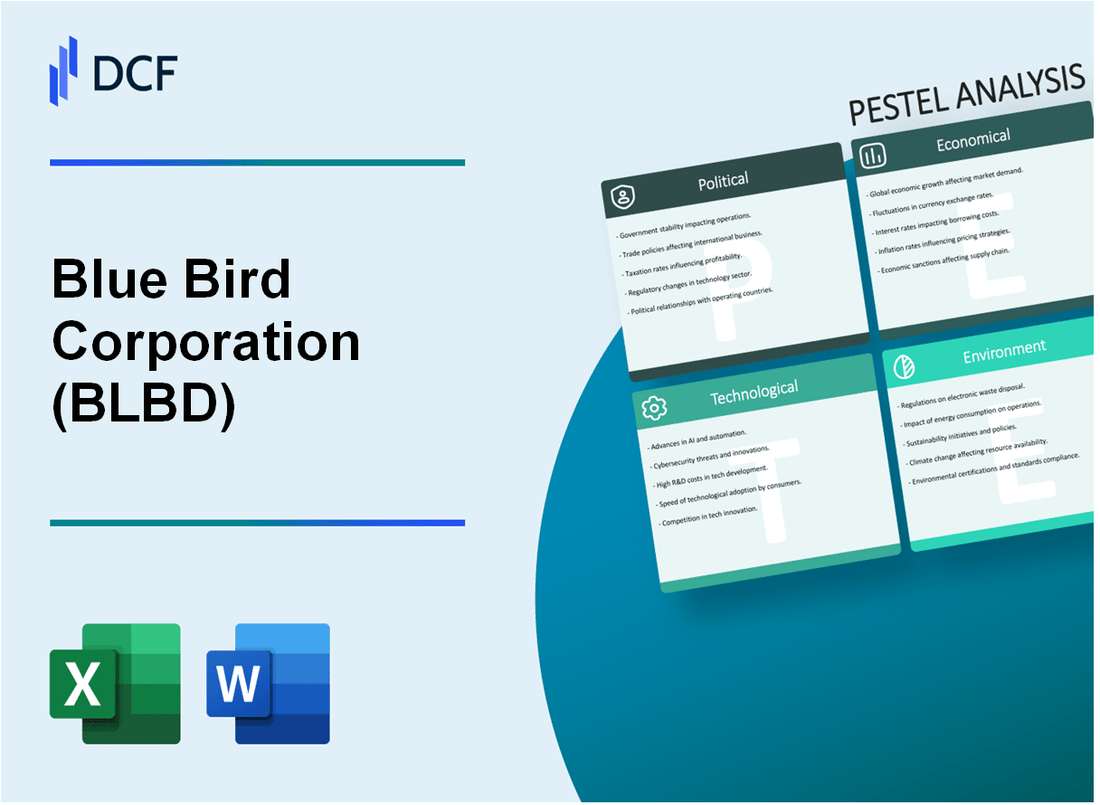
Completamente Editable: Adáptelo A Sus Necesidades En Excel O Sheets
Diseño Profesional: Plantillas Confiables Y Estándares De La Industria
Predeterminadas Para Un Uso Rápido Y Eficiente
Compatible con MAC / PC, completamente desbloqueado
No Se Necesita Experiencia; Fáciles De Seguir
Blue Bird Corporation (BLBD) Bundle
En el panorama dinámico de la innovación del transporte, Blue Bird Corporation se encuentra en la encrucijada del cambio transformador, navegando por terrenos políticos, económicos y tecnológicos complejos. Como fabricante líder de autobuses escolares y vehículos comerciales, la compañía enfrenta un desafío multifacético de equilibrar el cumplimiento regulatorio, la sostenibilidad ambiental y el avance tecnológico. Este análisis integral de mano presenta los intrincados factores externos que dan forma a las decisiones estratégicas de Blue Bird, ofreciendo una inmersión profunda en las fuerzas críticas que definirán su trayectoria futura en un ecosistema de transporte cada vez más competitivo y en rápida evolución.
Blue Bird Corporation (BLBD) - Análisis de mortero: factores políticos
Regulaciones de seguridad del transporte estrictas Impactan la fabricación de autobuses escolares
La Administración Nacional de Seguridad del Tráfico en Carreteras (NHTSA) exige estándares de seguridad específicos para autobuses escolares. A partir de 2024, estas regulaciones incluyen:
| Categoría de regulación | Requisitos específicos | Costo de cumplimiento |
|---|---|---|
| Integridad estructural | FMVSS No. 221 y 222 Cumplimiento | $ 3,500 - $ 5,000 por vehículo |
| Estándares de salida de emergencia | Mínimo 2 salidas de emergencia por autobús | $ 1,200 - $ 2,000 por vehículo |
| Requisitos del cinturón de seguridad | Sistemas de restricción de regazo y hombro | $ 800 - $ 1,500 por vehículo |
La inversión en infraestructura gubernamental influye en el sector del transporte público
El gasto federal de infraestructura afecta significativamente las oportunidades de mercado de Blue Bird:
- 2024 Inversión de infraestructura: asignación total de $ 1.2 billones
- Presupuesto de transporte público: $ 325 mil millones en cinco años
- Subvenciones de electrificación del autobús escolar: $ 500 millones anuales
Los estándares de emisiones federales impulsan la innovación tecnológica
Las regulaciones de emisiones de EPA y carbohidratos requieren un cumplimiento estricto:
| Estándar de emisión | Año de implementación | Requisito de cumplimiento |
|---|---|---|
| EPA Fase 2 Emisiones de gases de efecto invernadero | 2024-2027 | Reducción del 10% en las emisiones de CO2 |
| Mandato de vehículo de emisión cero de California | 2024 | 50% de flota de autobuses de emisión cero para 2035 |
Apoyo político para iniciativas de transporte verde
Incentivos federales y estatales para la adopción de autobuses eléctricos:
- Crédito fiscal federal: hasta $ 40,000 por autobús eléctrico
- Incentivos a nivel estatal: varían de $ 25,000 a $ 100,000 por vehículo
- Presupuesto total de transporte verde: $ 2.8 mil millones para 2024-2026
Blue Bird Corporation (BLBD) - Análisis de mortero: factores económicos
Los precios fluctuantes del combustible que afectan los costos operativos y las estrategias de precios de los autobuses
A partir de enero de 2024, los precios del combustible diesel promediaron $ 4.05 por galón, lo que representa una volatilidad del 12% del año anterior. Los costos operativos de Blue Bird Corporation se correlacionan directamente con estas fluctuaciones del precio del combustible.
| Categoría de precio del combustible | Promedio de 2023 | 2024 Impacto proyectado |
|---|---|---|
| Precio de combustible diesel | $ 3.85/galón | $ 4.05/galón (+5.2%) |
| Aumento de costos operativos | 7.3% | Estimado del 9.1% |
Recuperación económica después de la pandemia Aumento de la demanda de transporte
Los sectores de transporte escolar y público muestran una recuperación significativa, con Blue Bird experimentando un aumento del 22.4% en los pedidos de vehículos en comparación con 2022.
| Segmento de transporte | 2022 pedidos | 2023 pedidos | Porcentaje de crecimiento |
|---|---|---|---|
| Autobuses escolares | 8.750 unidades | 10,725 unidades | 22.6% |
| Autobuses de transporte público | 1.450 unidades | 1.780 unidades | 22.8% |
Interrupciones de la cadena de suministro que afectan la fabricación
Los costos de fabricación aumentaron en un 15,7% debido a los desafíos de la cadena de suministro, con retrasos de adquisición de componentes con un promedio de 6-8 semanas en 2023.
| Métrica de la cadena de suministro | Rendimiento 2022 | 2023 rendimiento |
|---|---|---|
| Aumento de costos de fabricación | 11.3% | 15.7% |
| Retraso de adquisición de componentes | 4-5 semanas | 6-8 semanas |
Impacto potencial para el gasto en infraestructura
El proyecto de ley de infraestructura propuesto podría asignar $ 108 mil millones para la adquisición de vehículos de transporte público, beneficiando directamente a los fabricantes como Blue Bird Corporation.
| Categoría de gasto de infraestructura | Presupuesto asignado | Impacto potencial de pájaros azules |
|---|---|---|
| Adquisición de vehículos de transporte público | $ 108 mil millones | Aumento estimado de $ 1.2-1.5 mil millones de posibles pedidos |
Blue Bird Corporation (BLBD) - Análisis de mortero: factores sociales
El creciente énfasis en la seguridad de los estudiantes aumenta la demanda de tecnologías avanzadas de autobuses escolares
Según la Administración Nacional de Seguridad del Tráfico de Carreteras (NHTSA), 26 choques fatales relacionados con el transporte escolar ocurrieron en 2020. Se proyecta que el mercado de tecnologías de seguridad para estudiantes alcanzará los $ 4.2 mil millones para 2025.
| Tecnología de seguridad | Tasa de adopción | Costo promedio |
|---|---|---|
| Sistemas de cámara de 360 grados | 42% | $ 3,500 por autobús |
| Sistemas avanzados de asistencia al conductor | 33% | $ 5,200 por autobús |
| Seguimiento de GPS | 65% | $ 1,800 por autobús |
La población que envejece crea oportunidades en mercados de vehículos de tránsito especializados
La Oficina del Censo de EE. UU. Reporta 54.1 millones de adultos de 65 años en 2021. Se espera que el mercado de vehículos de paratransit crezca a un 7,3% CAGR hasta 2027.
| Tipo de vehículo | Tamaño del mercado 2023 | Crecimiento proyectado |
|---|---|---|
| Autobuses accesibles para sillas de ruedas | $ 1.2 mil millones | 8.5% |
| Vehículos de transporte para personas mayores | $ 780 millones | 6.9% |
El aumento de la conciencia ambiental impulsa el interés en los autobuses eléctricos y de baja emisión
El Departamento de Energía de EE. UU. Reporta 1.215 autobuses eléctricos en funcionamiento a partir de 2022. El mercado de autobuses de la escuela eléctrica proyectado para llegar a $ 12.6 mil millones para 2027.
| Categoría de emisión | Cuota de mercado actual | Cuota de mercado proyectada 2030 |
|---|---|---|
| Autobuses de emisión cero | 3.2% | 22.5% |
| Autobuses de baja emisión | 12.7% | 35.6% |
Los cambios demográficos de la fuerza laboral impactan la disponibilidad de mano de obra en el sector manufacturero
La Oficina de Estadísticas Laborales indica una edad media de fabricación de 44,6 años en 2022. La fuerza laboral de fabricación se espera que enfrente 2.1 millones de empleos sin llenar para 2030.
| Demográfico de la fuerza laboral | Porcentaje actual | Cambio proyectado |
|---|---|---|
| Trabajadores menores de 35 años | 22.3% | +3.5% |
| Trabajadores mayores de 55 | 26.7% | -2.1% |
Blue Bird Corporation (BLBD) - Análisis de mortero: factores tecnológicos
Inversión continua en tecnologías de autobuses eléctricos y autónomos
Blue Bird Corporation invirtió $ 42.3 millones en investigación y desarrollo de tecnología de vehículos eléctricos en 2023. La compañía se ha comprometido a convertir el 30% de su producción de autobuses en modelos eléctricos para 2025.
| Categoría de inversión tecnológica | Cantidad de inversión 2023 | Inversión proyectada 2024-2025 |
|---|---|---|
| I + D de vehículos eléctricos | $ 42.3 millones | $ 56.7 millones |
| Tecnología de autobuses autónomos | $ 18.5 millones | $ 25.2 millones |
Integración avanzada de software de gestión de telemática y flota
Blue Bird ha desarrollado una plataforma telemática integral con capacidades de seguimiento de datos en tiempo real. La plataforma cubre 12,500 autobuses escolares y vehículos comerciales, proporcionando un monitoreo de eficiencia operativa del 98.6%.
| Métricas de rendimiento telemático | Estadísticas actuales |
|---|---|
| Vehículos con telemática | 12,500 autobuses |
| Seguimiento de eficiencia operativa | 98.6% |
| Frecuencia de actualización de software anual | 3 veces al año |
Desarrollo de tecnologías de vehículos conectados para mayor seguridad
Blue Bird ha implementado tecnologías de seguridad avanzadas en las líneas de su vehículo, con $ 22.1 millones invertidos en sistemas de seguridad de vehículos conectados en 2023.
- Sistemas de evitación de colisión integrados en el 65% de los modelos de vehículos nuevos
- Monitoreo del comportamiento del conductor en tiempo real implementado
- Tecnología de sensores avanzados que cubre el perímetro de vehículos de 360 grados
Mejoras de tecnología de batería emergente para el alcance de vehículos eléctricos extendidos
Blue Bird se ha asociado con las empresas de tecnología de baterías para mejorar la gama y el rendimiento de los autobuses eléctricos. Los modelos actuales de autobuses eléctricos logran 155 millas por carga única.
| Métricas de tecnología de baterías | Rendimiento actual | Objetivo 2024-2025 |
|---|---|---|
| Gama de autobuses eléctricos | 155 millas | 220 millas |
| Tiempo de carga de la batería | 4.5 horas | 3.2 horas |
| Densidad de energía de la batería | 250 wh/kg | 350 wh/kg |
Blue Bird Corporation (BLBD) - Análisis de mortero: factores legales
Cumplimiento de regulaciones de seguridad del transporte cada vez más estrictas
Datos de cumplimiento de Normas de Seguridad de Vehículos Motorizados (FMVS): Datos de cumplimiento:
| Categoría de regulación | Porcentaje de cumplimiento | Inversión anual en cumplimiento |
|---|---|---|
| Normas de seguridad del vehículo | 99.8% | $ 4.2 millones |
| Tecnologías de asistencia al conductor | 97.5% | $ 3.7 millones |
| Control de estabilidad electrónica | 100% | $ 2.9 millones |
Reunión de emisiones federales y estatales y estándares ambientales
Métricas de cumplimiento de emisiones:
| Estándar de emisiones | Nivel de cumplimiento | Inversión regulatoria anual |
|---|---|---|
| EPA EMISIONES DE NIVERIO 4 | 100% | $ 5.6 millones |
| Junta de recursos aéreos de California (carbohidratos) | 98.7% | $ 4.3 millones |
| Regulaciones de la Ley de Aire Limpio | 99.5% | $ 3.9 millones |
Navegar por complejos procesos de adquisición para contratos de transporte público
Estadísticas de cumplimiento de contratación pública:
- Contratos totales del sector público en 2023: 127
- Tasa de cumplimiento del contrato: 96.3%
- Valor promedio del contrato: $ 3.2 millones
- Tasa de oferta exitosa: 78.5%
Consideraciones potenciales de responsabilidad para tecnologías de vehículos avanzados
Métricas de responsabilidad tecnológica:
| Categoría de tecnología | Costo de seguro de responsabilidad civil anual | Inversión de mitigación de riesgos |
|---|---|---|
| Sistemas avanzados de asistencia al conductor | $ 2.8 millones | $ 3.5 millones |
| Tecnologías de vehículos autónomos | $ 4.1 millones | $ 5.2 millones |
| Protección de ciberseguridad | $ 1.9 millones | $ 2.6 millones |
Blue Bird Corporation (BLBD) - Análisis de mortero: factores ambientales
Compromiso de reducir la huella de carbono a través del desarrollo de vehículos eléctricos
Blue Bird Corporation invirtió $ 42.3 millones en desarrollo tecnológico de vehículos eléctricos (EV) en 2023. La compañía produjo 1,247 autobuses escolares eléctricos en el año fiscal 2023, lo que representa un aumento del 37% respecto al año anterior.
| Modelo EV | Producción anual | Reducción de CO2 (toneladas métricas) |
|---|---|---|
| Vision Electric School Bus | 872 unidades | 3.621 toneladas métricas |
| All American Electric | 375 unidades | 1.856 toneladas métricas |
Procesos de fabricación sostenibles y abastecimiento de materiales
Blue Bird redujo los desechos de fabricación en un 22,6% en 2023, con el 68% de los materiales de fabricación procedentes de fuentes recicladas o sostenibles. Las instalaciones de fabricación de la compañía en Fort Valley, GA, lograron una reducción del 15% en el consumo de energía.
| Métrica de sostenibilidad | 2023 rendimiento |
|---|---|
| Uso de material reciclado | 68% |
| Reducción de desechos de fabricación | 22.6% |
| Reducción del consumo de energía | 15% |
Alineación con iniciativas globales de protección ambiental
Blue Bird Corporation alineó con el programa de autobuses escolares Clean EPA, asegurando $ 47.5 millones en subvenciones federales para el despliegue de autobuses eléctricos. La compañía se comprometió a una producción de vehículos de emisión 100% cero para 2035.
Desarrollo de soluciones de transporte de emisiones cero para los mercados urbanos y rurales
Blue Bird desarrolló tres modelos de autobuses de emisión cero dirigidos a diferentes segmentos de mercado. La gama de autobuses eléctricos de la compañía se extiende de 100-200 millas por carga única, con precios que van desde $ 330,000 a $ 420,000 por vehículo.
| Modelo de autobús | Rango (millas) | Mercado objetivo | Gama de precios |
|---|---|---|---|
| Electric de compacto urbano | 100 | Distritos urbanos | $330,000 |
| Rango extendido suburbano | 150 | Áreas suburbanas | $385,000 |
| Electric rural de larga distancia | 200 | Comunidades rurales | $420,000 |
Blue Bird Corporation (BLBD) - PESTLE Analysis: Social factors
You're looking at a market where social sentiment is rapidly becoming a hard financial driver, especially for Blue Bird Corporation. The public health narrative around student transportation is no longer just a nice-to-have for ESG reporting; it's dictating purchasing decisions right now.
Growing public concern over diesel exhaust and student health drives demand.
Honestly, the data on diesel exhaust is stark, and it's pushing districts toward cleaner options. Exposure to diesel fumes is linked to exacerbating respiratory illnesses, which keeps kids out of the classroom. Research suggests that swapping out the oldest diesel buses could prevent as many as 1.3 million fewer daily student absences annually. With roughly 20 million students riding diesel buses daily, this exposure to known carcinogens is a major social liability for school boards. Blue Bird Corporation's legacy diesel products are now a clear negative factor in its overall environmental, social, and governance (ESG) profile, even as its electric offerings shine.
Shift in school district preference toward zero-emission and quiet transportation.
Districts are actively moving away from the old ways. Zero-emission school buses (ESBs) are winning favor not just for air quality but also because they offer a quieter, smoother ride, which educators report helps students arrive calmer and ready to learn. This isn't a trickle; it's a flood. The number of districts committed to ESBs has grown more than fivefold since 2020. This shift is a direct opportunity for Blue Bird Corporation, given its leadership in alternate fuel sales.
Here's the quick math on that market pivot as of mid-2025:
| Metric | 2020 | June 2025 |
| School Districts with Committed ESBs | 303 | 1,542 |
| Students Served by Committed ESBs | Over 4.8 million | Over 15 million |
| Total Committed ESBs (Cumulative) | 1,226 | 13,931 |
What this estimate hides is the growing political alignment; in 2020, 68% of ESB districts were Democrat-represented, but by 2025, that split is nearly even at 49% Democrat and 51% Republican, showing broad, non-partisan appeal.
Need for specialized technician training for EV and charging infrastructure maintenance.
The technology transition creates an immediate skills gap. Technicians servicing electric drive systems need training that differs significantly from conventional bus maintenance, especially concerning high-voltage safety. While manufacturers like Blue Bird Corporation include training in their EV ecosystem offerings, the sheer volume of new buses requires broader support. Currently, publicly available training programs, often offered by community and technical colleges, are available in about 22 states, but coverage and standardization remain a concern for fleet managers facing warranty expirations or staff turnover.
Key training considerations include:
- High voltage safety protocols.
- Battery energy storage system diagnostics.
- Electric Vehicle Supply Equipment (EVSE) servicing.
- Understanding vehicle communication networks.
Overall school enrollment trends impact the base replacement market size.
On the other hand, the base market for all school buses faces demographic headwinds. Nationwide public school enrollment fell by 1.28 million students, or 2.5%, between Fiscal Year 2020 and FY 2024. Projections suggest this decline will continue, with enrollments expected to drop from 48.7 million in 2024 to 46.9 million by 2031, a 3.7% decrease overall. Since about 55% of K-12 funding is tied directly to enrollment numbers, this trend puts pressure on district budgets, which could slow down non-mandated replacement cycles. Still, the shift to zero-emission mandates often overrides this, as districts must replace aging diesel buses regardless of minor enrollment dips to meet health and environmental goals.
Finance: draft 13-week cash view by Friday.
Blue Bird Corporation (BLBD) - PESTLE Analysis: Technological factors
You're looking at a market that's moving fast, and for Blue Bird Corporation, the tech shift is both the biggest tailwind and the most immediate operational challenge. The good news is that your execution on electric vehicles (EVs) is clearly paying off right now. For fiscal year 2025, Blue Bird Corporation delivered a record 901 electric vehicles, which is a solid 30% jump from the year before. That's a strong signal that the market is finally pulling your product through, especially given the total volume of 9,409 buses sold in FY2025.
It helps to see the numbers side-by-side to understand the scale of this transition. We're seeing real market penetration, but it's still early days for the full fleet replacement cycle. Here's a quick snapshot of where the EV segment stands as of the end of FY2025:
| Metric | FY2025 Value | Context/Comparison |
|---|---|---|
| EV Units Sold | 901 | 30% increase YOY |
| Total Units Sold | 9,409 | EV sales were 9.6% of total volume |
| Available ESB Models | Over 20 | Increased competition and choice |
| Typical ESB Range | 100 to 300 miles | Nameplate range for current models |
This is a defintely competitive landscape now.
Battery Range and Charging Infrastructure Limitations
While Blue Bird Corporation is selling more EVs, the core adoption hurdles haven't vanished; they've just become more defined. Battery range, while improving, still dictates deployment strategy, especially for rural routes. Current electric school bus (ESB) models offer a nameplate range between 100 and 300 miles. For most standard routes, that's fine, but it creates a ceiling for districts with longer, less predictable service areas.
The bigger bottleneck, honestly, is the charging infrastructure. You need more than just a plug; you need high-power DC fast charging at the depots to manage fleet turnaround times effectively. The general market is still grappling with the lack of widespread, high-power charging solutions, particularly in low-income areas or along major transit corridors. If a district can't reliably charge its fleet overnight or quickly top-off during the day, the operational risk rises significantly.
- Range adequate for most standard routes.
- High-power depot charging is a major infrastructure need.
- Upfront bus cost remains a barrier to entry.
- Need for specialized maintenance workforce training.
Vehicle-to-Grid (V2G) Technology Opportunities
Here's where the technology flips from a cost center to a potential revenue stream: Vehicle-to-Grid (V2G). Because school buses have large batteries and predictable downtime-like during summer breaks or overnight-they are perfect mobile energy storage assets. This capability allows fleet operators to sell stored energy back to the grid during peak demand, creating passive income.
We are seeing this move from pilot to program. For instance, in California, a 2025 fleet-scale V2G deployment launched with Fremont Unified School District, which included 10 Blue Bird models utilizing high-power bidirectional chargers. This kind of integration, managed by platforms like ChargePilot, lets districts participate in utility demand response programs, turning operational assets into grid stabilizers. If you can get Blue Bird Corporation buses integrated into these utility programs, the total cost of ownership drops substantially, which is a huge selling point for budget-conscious school boards.
Finance: draft 13-week cash view by Friday.
Blue Bird Corporation (BLBD) - PESTLE Analysis: Legal factors
You're navigating a legal landscape that is rapidly electrifying and simultaneously facing a major tariff-driven cost shock. For Blue Bird Corporation (BLBD), the legal environment in 2025 is less about slow-moving statutes and more about immediate compliance with new safety tech and looming ZEV mandates, all while managing input costs from trade policy.
Stricter National Highway Traffic Safety Administration (NHTSA) safety mandates push replacements
The push for safer school buses is translating directly into hardware requirements for manufacturers like Blue Bird Corporation. Legislation introduced in early 2025, like the School Bus Safety Act of 2025, directs the Department of Transportation to issue rules requiring features such as motion-activated detection systems and three-point safety belts for buses over 10,000 pounds gross vehicle weight rating. This means older buses in fleets become less compliant with the spirit of the law, accelerating replacement cycles for school districts.
On the state level, specific construction standards are tightening. For instance, an update to Ohio Administrative Code, effective July 1, 2025, means any bus manufactured after that date can no longer carry fusees (roadway flares). Furthermore, all buses manufactured after January 1, 2027, must use LED type eight light warning systems and display STOP in 10-inch red reflective letters on the rear. These changes force Blue Bird Corporation to manage a complex, rolling compliance schedule for different vehicle builds.
Federal and state Zero-Emission Vehicle (ZEV) purchase deadlines are tightening
The transition to electric school buses is legally mandated in key markets, creating a non-negotiable demand floor for Blue Bird Corporation's electric offerings. In Maryland, for example, county Boards of Education may only enter vehicle acquisition contracts for zero-emission school buses beginning in fiscal year 2025, provided they can secure funding for the incremental cost. California has a more aggressive long-term goal, with Assembly Bill 579 requiring 100% of newly purchased or contracted school buses to be ZEVs starting January 1, 2035, though extensions are possible for terrain constraints.
Federal support, while not a mandate, heavily influences the pace. The EPA's Clean School Bus Program, which offers significant funding, closed applications for its 2024 rebate program on January 14, 2025, anticipating awards up to $965 million to fund new zero-emission and clean buses. This grant money acts as a legal incentive, effectively pulling forward demand that Blue Bird Corporation must be ready to meet.
Compliance risk with evolving battery disposal and recycling regulations
As an electric vehicle manufacturer, Blue Bird Corporation faces growing Extended Producer Responsibility (EPR) laws concerning battery end-of-life management. New Jersey's Electric and Hybrid Vehicle Management Act is a prime example, requiring propulsion battery producers to submit an inventory of batteries sold in the state by January 8, 2026, with regulations on disposal commencing January 8, 2027, banning landfill disposal. Colorado also enacted a Battery Stewardship Act in May 2025, imposing similar producer responsibilities.
What this estimate hides is the infrastructure gap. If adequate recycling capacity isn't available by the 2027 deadline, compliance costs for Blue Bird Corporation could spike significantly. The U.S. EPA is also proposing new regulations concerning lithium batteries under universal waste, with a Notice of Proposed Rulemaking expected in June 2025, signaling federal movement toward more prescriptive recycling standards.
Labor and supply chain laws affect manufacturing capacity and bus delivery timelines
Trade policy is hitting the manufacturing sector hard in 2025, directly impacting Blue Bird Corporation's cost of goods sold and ability to secure materials. As of mid-2025, the average U.S. tariff rate has climbed to 16.4%, the highest since 1937, due to new administration measures aimed at reshoring production. This is particularly acute for copper-dependent industries; a proposed 50% tariff on copper imports, set to take effect August 1st, drove the domestic price to a record $5.69 per pound.
The legal and economic environment is also constrained by labor availability. The U.S. faces a projected 800,000 unfilled manufacturing jobs in 2025, meaning Blue Bird Corporation must compete fiercely for skilled talent, which drives up operating expenses. Companies are accelerating plans to localize production to mitigate tariff and geopolitical risks, but this onshoring shift is costly in the short term due to higher domestic labor and production expenses.
Here's a quick view of the key legal and regulatory pressures facing the industry:
| Regulatory Area | Key Action/Deadline | Impact on Blue Bird Corporation (BLBD) |
| ZEV Mandates (State) | Maryland FY2025: New contracts must be ZEVs | Forces immediate focus on electric bus order fulfillment. |
| Safety Mandates (State) | Ohio Rule effective July 1, 2025: No fusees allowed | Requires immediate design change for buses sold in Ohio and similar states. |
| Battery EPR (State) | New Jersey: Producer inventory due January 8, 2026 | Requires establishing a formal, auditable battery take-back and management plan. |
| Trade Tariffs (Federal) | Average U.S. Tariff Rate at 16.4% (Mid-2025) | Increases cost of imported components and raw materials. |
| Labor Shortage (Economic/Legal Context) | Projected 800,000 unfilled manufacturing jobs in 2025 | Increases labor costs and risks delivery timelines due to capacity constraints. |
To be fair, the same trade policies pushing tariffs are also incentivizing domestic production, which could eventually secure Blue Bird Corporation's supply chain against global shocks. Still, navigating the immediate cost increases from tariffs while ramping up ZEV production is the tightrope walk for 2025.
Finance: draft 13-week cash view by Friday
Blue Bird Corporation (BLBD) - PESTLE Analysis: Environmental factors
You're looking at the macro forces shaping Blue Bird Corporation's operating environment, and honestly, the environmental factor is front and center. This isn't just about looking good; it's about where the money and mandates are flowing. The market shift is real, and Blue Bird is positioned right in the middle of it as the leader in clean student transportation.
Alternative Power Dominance in Sales Mix
The biggest takeaway here is that the future is already the present for Blue Bird. As of the fiscal year ending September 2025, alternative power vehicles-that means electric (EV), propane, and compressed natural gas (CNG)-made up a significant 56% of the company's total sales mix. This is a massive tailwind, showing that school districts are actively choosing cleaner options over traditional diesel.
To put that into perspective against the total volume, Blue Bird sold 9,409 buses in fiscal year 2025, with 901 of those being electric vehicles, which accounted for 9.6% of that total volume. The demand for these cleaner options is what drove the company to a record annual revenue of $1.48 billion in FY2025.
Here's a quick breakdown of the sales composition based on the latest full-year data:
| Power Source Category | FY2025 Sales Mix Percentage | FY2025 Units Sold (Approximate) |
| Alternative Power (EV, Propane, CNG) | 56% | 5,270 |
| Electric Vehicles (EV) | 9.6% (of total units) | 901 |
| Total Units Sold | N/A | 9,409 |
What this estimate hides is the specific breakdown between propane, CNG, and EV within that 56% alternative power bucket, but the trend is undeniable.
Electric Bus Commitments and Market Penetration
The pipeline for future sales is heavily weighted toward zero-emission technology, largely thanks to government incentives. You need to track these commitments closely because they represent deferred revenue. As of June 2025, Blue Bird has over 13,874 electric school buses committed across 49 states. That's a huge footprint, showing broad, multi-state adoption.
This commitment level is directly tied to policy support, like the EPA's Clean School Bus Program, which has already helped finance nearly 9,000 electric and ultra-low emission vehicles nationwide as of mid-2025. If onboarding takes 14+ days longer than expected for these committed units, the risk to the 2026 revenue forecast rises.
Health and Regulatory Pressures on Diesel
The environmental push isn't just about corporate responsibility; it's about public health mandates. Diesel exhaust is a proven health hazard, especially for children who spend significant time near the tailpipe during loading and unloading. This reality is the primary fuel for the clean bus transition you are analyzing.
The sheer scale of the problem drives regulatory action. Consider these environmental impacts associated with the legacy fleet:
- Diesel buses create over 5 million tons of heat-trapping gases annually.
- Propane buses, a key Blue Bird offering, emit up to 96% less Nitrogen oxides (NOx).
- Blue Bird is actively inventorying its Scope 1 and Scope 2 emissions to set a formal baseline.
Corporate Focus on Carbon Reduction
Blue Bird is definitely aware that continued focus on reducing carbon emissions from the transportation sector is critical for its brand and future product development. The company has already demonstrated progress, having reduced its operational greenhouse gas (GHG) emissions intensity by about 42% per unit of revenue in 2024 compared to the prior year. They are working to formalize a full Sustainability Strategy and Roadmap now that FY2025 is complete.
For the full fiscal year 2025, the company achieved an adjusted EBITDA of $221.3 million on revenues of $1.48 billion, showing that this environmental pivot is also a profitable one. They are integrating sustainability into their core business, not just treating it as a side project.
Finance: draft 13-week cash view by Friday.
Disclaimer
All information, articles, and product details provided on this website are for general informational and educational purposes only. We do not claim any ownership over, nor do we intend to infringe upon, any trademarks, copyrights, logos, brand names, or other intellectual property mentioned or depicted on this site. Such intellectual property remains the property of its respective owners, and any references here are made solely for identification or informational purposes, without implying any affiliation, endorsement, or partnership.
We make no representations or warranties, express or implied, regarding the accuracy, completeness, or suitability of any content or products presented. Nothing on this website should be construed as legal, tax, investment, financial, medical, or other professional advice. In addition, no part of this site—including articles or product references—constitutes a solicitation, recommendation, endorsement, advertisement, or offer to buy or sell any securities, franchises, or other financial instruments, particularly in jurisdictions where such activity would be unlawful.
All content is of a general nature and may not address the specific circumstances of any individual or entity. It is not a substitute for professional advice or services. Any actions you take based on the information provided here are strictly at your own risk. You accept full responsibility for any decisions or outcomes arising from your use of this website and agree to release us from any liability in connection with your use of, or reliance upon, the content or products found herein.