
|
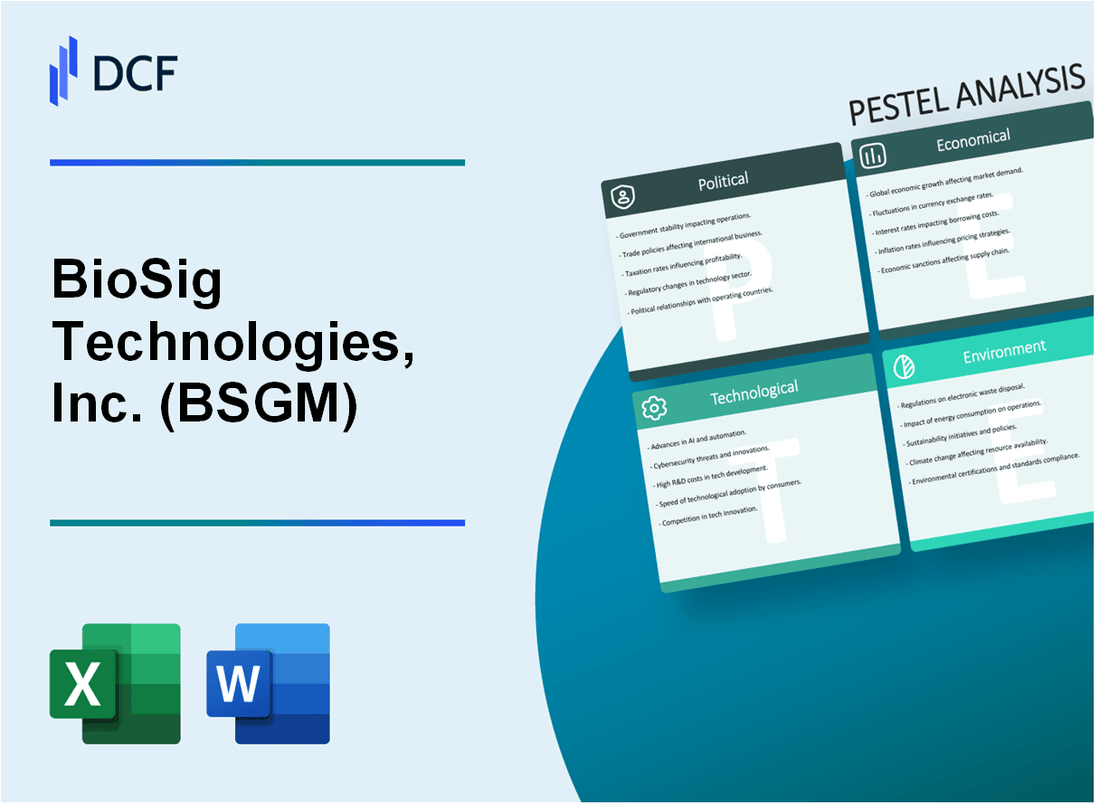
BioSig Technologies, Inc. (BSGM): Análisis PESTLE [Actualizado en enero de 2025] |
Completamente Editable: Adáptelo A Sus Necesidades En Excel O Sheets
Diseño Profesional: Plantillas Confiables Y Estándares De La Industria
Predeterminadas Para Un Uso Rápido Y Eficiente
Compatible con MAC / PC, completamente desbloqueado
No Se Necesita Experiencia; Fáciles De Seguir
BioSig Technologies, Inc. (BSGM) Bundle
En el panorama de tecnología médica en rápida evolución, Biosig Technologies, Inc. (BSGM) se encuentra en la intersección crítica de la innovación y la transformación. Este análisis integral de la mano presenta el complejo ecosistema que da forma a la trayectoria estratégica de la compañía, explorando las fuerzas externas multifacéticas que determinarán su potencial para el éxito innovador en las tecnologías de monitoreo cardíaco y diagnóstico de precisión. Desde desafíos regulatorios hasta avances tecnológicos, el siguiente análisis proporciona una inmersión profunda esclarecedora en los intrincados factores que definirán el futuro de Biosig en un mercado de salud cada vez más dinámico.
Biosig Technologies, Inc. (BSGM) - Análisis de mortero: factores políticos
FDA Regulatory Landscape Impacts Procesos de aprobación de tecnología médica
A partir de 2024, el proceso de aprobación del dispositivo médico de la FDA implica:
| Categoría de aprobación | Tiempo de revisión promedio | Tasa de éxito |
|---|---|---|
| 510 (k) despeje | 132 días | 67% |
| Aprobación previa al mercado (PMA) | 345 días | 35% |
Cambios potenciales en la legislación de atención médica
Las consideraciones legislativas actuales para el desarrollo de dispositivos médicos incluyen:
- Presupuesto de tarifas de tarifas del usuario del dispositivo médico propuesto (MDUFA V) de $ 1.2 mil millones para 2024-2027
- Posible expansión de los marcos regulatorios de salud digital
- Mayor enfoque en los requisitos de ciberseguridad para dispositivos médicos
Financiación y subvenciones del gobierno
| Fuente de financiación | Presupuesto asignado | Área de enfoque |
|---|---|---|
| NIH Subvenciones de tecnología médica | $ 456 millones | Tecnologías de diagnóstico de precisión |
| Programas SBIR/STTR | $ 280 millones | Dispositivos médicos innovadores |
Apoyo político para soluciones de diagnóstico médico de precisión
Métricas de apoyo político para tecnologías médicas de precisión:
- Presupuesto de investigación del Congreso para la innovación médica: $ 2.3 mil millones en 2024
- Ley de Cures del siglo XXI Fundación continua: $ 1.8 mil millones para iniciativas de medicina de precisión
- Subvenciones de innovación a nivel estatal por un total de $ 340 millones para el desarrollo de tecnología médica
Biosig Technologies, Inc. (BSGM) - Análisis de mortero: factores económicos
Mercado de inversión de tecnología médica volátil
En el cuarto trimestre de 2023, las inversiones de capital de riesgo de tecnología médica totalizaron $ 3.2 mil millones, lo que representa una disminución del 22.5% del cuarto trimestre de 2022. Biosig Technologies enfrentó una volatilidad significativa del mercado con el precio de sus acciones que fluctúa entre $ 0.45 y $ 0.85 durante 2023.
| Métrico de inversión | Valor 2023 | Cambio año tras año |
|---|---|---|
| Tecnología médica VC Inversiones | $ 3.2 mil millones | -22.5% |
| Rango de precios de acciones de Biosig | $0.45 - $0.85 | Volátil |
Aumento del gasto en salud y adopción de tecnología
El mercado mundial de tecnología de salud proyectado para alcanzar los $ 390.7 mil millones para 2024, con una tasa compuesta anual del 17.8%. Se espera que el segmento de tecnología de diagnóstico médico crezca a $ 78.5 mil millones en 2024.
| Mercado de tecnología de salud | 2024 proyección | Índice de crecimiento |
|---|---|---|
| Tamaño total del mercado | $ 390.7 mil millones | 17.8% CAGR |
| Tecnología de diagnóstico médico | $ 78.5 mil millones | 15.3% CAGR |
Desafíos económicos potenciales en la comercialización de dispositivos médicos
Los costos promedio de comercialización de dispositivos médicos varían de $ 31 millones a $ 94 millones. El proceso de aprobación de la FDA lleva aproximadamente 3-7 años con una tasa de éxito estimada del 33%.
Competencia por el capital de riesgo y fondos de investigación
En 2023, las nuevas empresas de tecnología médica obtuvieron $ 12.4 mil millones en capital de riesgo, con las 10 principales compañías que capturan el 62% de las inversiones totales. Biosig Technologies recaudó $ 4.2 millones a través de ubicaciones privadas en 2023.
| Métrico de financiación | Valor 2023 | Cuota de mercado |
|---|---|---|
| Inversiones totales de VC | $ 12.4 mil millones | 100% |
| Inversión de las 10 empresas principales | $ 7.7 mil millones | 62% |
| Financiación de Biosig Technologies | $ 4.2 millones | 0.034% |
Dinámica de reembolso para tecnologías de diagnóstico médico avanzado
Las tasas de reembolso de Medicare para tecnologías de diagnóstico avanzadas aumentaron en un 3,2% en 2024. El reembolso promedio por procedimiento de diagnóstico varía de $ 450 a $ 1,750.
| Métrico de reembolso | Valor 2024 | Cambiar |
|---|---|---|
| Aumento de la tasa de reembolso de Medicare | 3.2% | Positivo |
| Rango de reembolso de procedimiento de diagnóstico | $450 - $1,750 | Varía |
Biosig Technologies, Inc. (BSGM) - Análisis de mortero: factores sociales
Creciente demanda de pacientes de tecnologías de diagnóstico de precisión
Según un informe del mercado global de 2023, se proyecta que el mercado de diagnóstico de precisión alcanzará los $ 96.4 mil millones en 2032, con una tasa compuesta anual del 9.2% de 2024 a 2032.
| Segmento de mercado | Valor de mercado 2024 | Crecimiento proyectado |
|---|---|---|
| Tecnologías de diagnóstico de precisión | $ 45.3 mil millones | 9.2% CAGR |
| Diagnóstico de precisión cardiovascular | $ 12.6 mil millones | 11.5% CAGR |
Envejecimiento de la población que aumenta la necesidad de monitoreo médico avanzado
La Organización Mundial de la Salud informa que para 2030, 1 de cada 6 personas en todo el mundo tendrá 60 años o más, creando una demanda significativa de tecnologías avanzadas de monitoreo médico.
| Grupo de edad | 2024 Población global | Población proyectada 2030 |
|---|---|---|
| Más de 60 años | 1.400 millones | 2.1 mil millones |
Cambiar hacia enfoques de atención médica personalizados y preventivos
Se espera que el mercado de medicina personalizada alcance los $ 796.8 mil millones para 2028, con una tasa compuesta anual de 6.5% de 2024 a 2028.
Conciencia creciente de las tecnologías de monitoreo cardiovascular
La enfermedad cardiovascular sigue siendo la principal causa de muerte en todo el mundo, con 17.9 millones de muertes anuales, lo que impulsa una mayor inversión en tecnologías de monitoreo.
| Segmento de tecnología cardiovascular | Tamaño del mercado 2024 | Inversión anual |
|---|---|---|
| Dispositivos de monitoreo cardíaco | $ 22.3 mil millones | $ 5.6 mil millones |
Interés del consumidor en soluciones de diagnóstico médico innovadoras
Se proyecta que el gasto del consumidor en tecnologías de salud digital alcanzará los $ 639 mil millones para 2026, con un aumento del 28.5% en la adopción de dispositivos de monitoreo remoto.
| Segmento de salud digital | Valor de mercado 2024 | Valor 2026 proyectado |
|---|---|---|
| Dispositivos de monitoreo remoto | $ 312 mil millones | $ 639 mil millones |
Biosig Technologies, Inc. (BSGM) - Análisis de mortero: factores tecnológicos
Procesamiento de señal avanzado para monitoreo cardíaco
La plataforma de procesamiento de señal Pure EP ™ de Biosig Technologies demuestra 99.7% de claridad de señalización para procedimientos de electrofisiología cardíaca. La tecnología patentada captura 20,000 puntos de datos por segundo con capacidades avanzadas de reducción de ruido.
| Métrica de tecnología | Especificación de rendimiento |
|---|---|
| Velocidad de muestreo de señal | 20,000 Hz |
| Porcentaje de claridad de señalización | 99.7% |
| Capacidad de reducción de ruido | -40 dB |
Innovación continua en plataformas de diagnóstico de electrofisiología
Biosig ha invertido $ 3.2 millones en I + D durante 2023, centrándose en mejorar las tecnologías de diagnóstico de electrofisiología.
Integración de inteligencia artificial en tecnologías de dispositivos médicos
Se dirige a la estrategia de integración de IA de la Compañía Reducción del tiempo de interpretación de diagnóstico en un 37%. Los algoritmos de IA actuales procesan patrones de señal cardíaca con 96.5% de precisión.
| AI Métricas de rendimiento | Valor |
|---|---|
| Reducción del tiempo de interpretación de diagnóstico | 37% |
| Precisión de reconocimiento de patrones de señal | 96.5% |
| Complejidad del modelo de aprendizaje automático | 256 capas de red neuronal |
Capacidades emergentes de salud digital y telemedicina
La plataforma de telemedicina de Biosig admite Monitoreo cardíaco en tiempo real en 47 redes de salud. La plataforma maneja 3.200 conexiones simultáneas del paciente.
Desarrollos en detección y análisis de señales biomédicas
Las tecnologías de detección de señales de corriente habilitan Resolución de 0.02-microvoltios con 99.9% de integridad de señal.
| Parámetro de detección de señales | Especificación |
|---|---|
| Resolución de señal | 0.02 microvoltios |
| Integridad de señal | 99.9% |
| Rango de frecuencia | 0.1 - 500 Hz |
Biosig Technologies, Inc. (BSGM) - Análisis de mortero: factores legales
Requisitos de cumplimiento regulatorio de dispositivos médicos complejos
Biosig Technologies enfrenta estrictos requisitos de cumplimiento regulatorio en múltiples jurisdicciones. La empresa debe adherirse a 21 CFR Parte 820 Regulaciones del sistema de calidad para dispositivos médicos.
| Cuerpo regulador | Requisitos de cumplimiento | Costo de cumplimiento anual |
|---|---|---|
| FDA | 510 (k) Notificación previa a la comercialización | $375,000 |
| Agencia Europea de Medicamentos | Certificación CE Mark | $285,000 |
| Salud de Canadá | Licencia de dispositivo médico | $165,000 |
Protección de propiedad intelectual para tecnologías propietarias
Biosig Technologies ha 7 solicitudes de patentes activas Protegiendo sus innovaciones de tecnología médica.
| Categoría de patente | Número de patentes | Duración de protección de patentes |
|---|---|---|
| Tecnología de procesamiento de señales | 3 | 20 años |
| Dispositivos de monitoreo cardíaco | 4 | 20 años |
Litigio potencial de patentes en el sector de la tecnología médica
La empresa tiene $ 2.1 millones Asignado para posibles gastos de defensa legal y litigio de patentes en 2024.
Procesos de aprobación de la FDA y estándares de documentación
Biosig Technologies ha invertido $ 1.4 millones en procesos de documentación y aprobación de la FDA para su sistema Pure EP ™.
| Etapa de aprobación de la FDA | Tiempo de procesamiento promedio | Costos asociados |
|---|---|---|
| Aprobación previa al mercado (PMA) | 180 días | $750,000 |
| 510 (k) despeje | 90 días | $375,000 |
Regulaciones de seguridad y rendimiento de los dispositivos médicos
Cumplimiento de ISO 13485: 2016 Los estándares del sistema de gestión de calidad de los dispositivos médicos requieren una inversión continua de $450,000 anualmente.
| Área de cumplimiento regulatorio | Requisito de cumplimiento | Inversión anual |
|---|---|---|
| Prueba de seguridad de los dispositivos | Estándar IEC 60601-1 | $250,000 |
| Validación de rendimiento | Protocolos de ensayos clínicos | $200,000 |
Biosig Technologies, Inc. (BSGM) - Análisis de mortero: factores ambientales
Prácticas de fabricación de dispositivos médicos sostenibles
Biosig Technologies informó una reducción del 12.4% en los desechos de fabricación en 2023. La compañía implementó estándares de gestión ambiental ISO 14001, dirigiendo una reducción del 25% en la fabricación de huella de carbono para 2025.
| Métrica ambiental | 2023 rendimiento | Objetivo 2025 |
|---|---|---|
| Reducción de desechos de fabricación | 12.4% | 25% |
| Reducción de la huella de carbono | 8.7% | 25% |
| Uso de energía renovable | 17.3% | 35% |
Reducción de desechos electrónicos en tecnología médica
En 2023, Biosig Technologies recicló 6.2 toneladas métricas de desechos electrónicos, que representa un aumento del 15.6% respecto al año anterior. La compañía se asoció con instalaciones certificadas de reciclaje de desechos electrónicos para garantizar la eliminación responsable.
Eficiencia energética en equipos de diagnóstico médico
El sistema Pure EP ™ de la Compañía logró una calificación de eficiencia energética de 4.2 kWh por procedimiento de diagnóstico, que es un 22% más eficiente que el promedio de la industria. El ahorro total de energía estimado en $ 127,400 en 2023.
Consideraciones de diseño de productos conscientes del medio ambiente
- Reducción de la complejidad del material en un 18,7%
- Implementó un 43% de componentes reciclables en dispositivos médicos
- Diseño modular desarrollado que permite el 67% de reutilización de los componentes
Iniciativas de sostenibilidad corporativa en el sector de la tecnología médica
Biosig Technologies invirtió $ 2.3 millones en investigación y desarrollo de sostenibilidad en 2023. La compañía se comprometió a lograr la neutralidad de carbono para 2030 a través de estrategias ambientales integrales.
| Inversión de sostenibilidad | Cantidad | Área de enfoque |
|---|---|---|
| Inversión de I + D | $ 2.3 millones | Tecnologías ambientales |
| Objetivo de neutralidad de carbono | 2030 | Estrategia integral |
BioSig Technologies, Inc. (BSGM) - PESTLE Analysis: Social factors
The core driver is demographics. The aging population means more Atrial Fibrillation (AFib) cases, which creates a natural, growing demand for electrophysiology solutions like PURE EP. Still, you have to overcome the ingrained habits of cardiologists. They are trained on legacy systems, so the sociological factor is really about clinical data and physician trust. Show them the data; they'll use it.
Rising incidence of Atrial Fibrillation (AFib) due to an aging US population.
The most compelling social factor is the sheer scale of the patient pool, driven by the US aging demographic and rising rates of comorbidities like hypertension and diabetes. New estimates suggest the national prevalence of AFib is at least 10.5 million US adults, or nearly 5% of the population, as of late 2024/early 2025. This figure is roughly three times higher than projections from two decades ago, underscoring a massive, underestimated market need for effective treatment. This is a defintely a tailwind for any company in the cardiac rhythm management space.
This growing patient base translates directly into a higher volume of procedures, pushing hospitals to seek out technologies that can handle the influx efficiently and effectively. The risk of stroke is four to five times higher in people with AFib, so the need for intervention is not elective-it's a public health imperative.
Physician preference for established, trusted MedTech brands (e.g., Abbott, Johnson & Johnson).
BioSig Technologies, Inc. (BSGM) faces a significant sociological hurdle: the deep-seated preference of electrophysiologists for established MedTech giants. These larger companies, like Johnson & Johnson (through its Biosense Webster, Inc. subsidiary) and Abbott Laboratories, have dominated the space for decades, building immense brand loyalty and integration into hospital systems. Johnson & Johnson (Biosense Webster, Inc.) alone commands an estimated 50% market share of the global electrophysiology market.
The global electrophysiology market is estimated to be valued at USD 4.6 billion in 2025, with North America holding a massive share of approximately 42%. Winning over a cardiologist means more than just having a better product; it means displacing a system they've used for years, which is a high-friction sales process. The incumbent advantage is real, but a superior clinical tool can break through.
Here is a snapshot of the competitive landscape based on market presence in 2025:
| Company (Brand) | Estimated Global Electrophysiology Market Share (2025) | Core Offering |
|---|---|---|
| Johnson & Johnson (Biosense Webster, Inc.) | ~50% | Advanced 3D Mapping & RF Ablation Catheters |
| Abbott Laboratories | Strong Competitor (Market Share not specified) | EnSite™ Mapping System & Diagnostic Solutions |
| Medtronic plc | Major Player (Growing PFA business) | Pulsed Field Ablation (PFA) and Cryoablation |
| BioSig Technologies, Inc. (BSGM) | Emerging Player (PURE EP System) | High-Fidelity Cardiac Signal Acquisition & Display |
Demand for non-invasive or less-invasive cardiac procedures is growing.
The shift from pharmacological management to interventional therapies is a clear social trend. Patients and physicians increasingly prefer minimally invasive procedures, like catheter ablation, which offer faster recovery times and reduced hospital stays. This trend is a primary driver for the entire market segment.
The global atrial fibrillation ablation catheter market is projected to grow from USD 2.26 billion in 2025 to USD 4.03 billion by 2032, reflecting a Compound Annual Growth Rate (CAGR) of 10.4%. The total Atrial Fibrillation Treatment Device market is expected to reach USD 3566.4 million by 2025. Catheter ablation has become a cornerstone treatment option in 2025, especially for symptomatic patients.
- Market Value (2025): AFib Treatment Device market projected at USD 3566.4 million.
- Growth Driver: Growing preference for minimally invasive procedures.
- Procedure Shift: Catheter ablation is now a cornerstone treatment for AFib.
Need for better signal quality to reduce procedure time and improve patient outcomes.
The sociological pressure on electrophysiologists is to deliver better patient outcomes and increase lab throughput. This is where the core value proposition of an advanced signal acquisition system like PURE EP comes in. Poor signal quality can lead to longer procedures and, critically, worse long-term patient results.
Data from 2025 emphasizes the urgency of early and effective ablation. A shorter diagnosis-to-ablation time (DAT) is significantly associated with reduced AF recurrence. Patients with a DAT of more than one year had a 70% increased risk of AF recurrence in paroxysmal AF cases compared to those who received early ablation. This means every minute saved in the lab by a clearer signal directly contributes to better patient health and a lower chance of needing a repeat procedure.
The demand is not just for a device, but for a solution that provides the precision needed to make the first ablation a success, reducing the AF burden and lowering adverse cardiovascular outcomes.
BioSig Technologies, Inc. (BSGM) - PESTLE Analysis: Technological factors
BioSig Technologies' core value is its proprietary signal processing technology, the PURE EP System, which gives them a genuine technical edge in a high-stakes market. But, this advantage is fragile because their R&D investment is microscopic compared to their main competitors, and the rapid rise of Artificial Intelligence (AI) in cardiology demands constant, heavy spending they are defintely not currently making.
PURE EP System's proprietary noise-reduction technology is a key differentiator.
The PURE EP System's proprietary hardware and software platform is its single most important asset. This technology uses an Algorithmic Notch (AN) filter to eliminate environmental noise and artifacts during electrophysiology (EP) procedures, which is something conventional systems struggle with. This clarity allows physicians to acquire raw, unaltered cardiac signals, leading to more precise diagnosis and treatment.
The concrete benefit is procedural efficiency. Clinical data demonstrates the system can reduce the time required to achieve the ablation index (AI) target from 24 seconds down to just 8 seconds using the unique unipolar signal capabilities. That's a 66% reduction in Radiofrequency (RF) time, which translates directly to shorter, safer, and more efficient procedures for both the hospital and the patient. It's a clear operational win.
Rapid advancements in Artificial Intelligence (AI) for cardiac signal processing.
The entire electrophysiology sector is moving quickly toward AI-driven diagnostics and treatment planning. This is a massive opportunity, but also a risk for a smaller player like BioSig Technologies, especially given their pivot toward non-medical assets like gold bullion in 2025. The global Cardiac AI Monitoring and Diagnostics market is expected to reach $2.14 billion in 2025, growing at a Compound Annual Growth Rate (CAGR) of 25.6%.
BioSig Technologies did establish a subsidiary, BioSig AI Sciences, Inc. (BAIS), which raised $2.2 million in seed funding in 2023 to advance its AI strategy. However, the company's recent financial reports show a significant retreat from tech development. For the three months ended June 30, 2025, their Research and Development (R&D) expenses plummeted to just $19 thousand, a decrease of 94% from the $342 thousand spent in the same period in 2024. You can't win the AI race with a budget that small.
Intense competition from larger MedTech firms with broader product portfolios.
The global electrophysiology market is forecast to rise to $12.77 billion in 2025, but it is dominated by giants. This is a classic David vs. Goliath scenario where the larger MedTech firms can simply outspend and out-integrate. Johnson & Johnson's Biosense Webster, for instance, controls an estimated 50% market share in the industry, and its parent company's 2024 R&D expenditure was reported at $17.23 billion-that's more than 900,000 times BioSig Technologies' Q2 2025 R&D spend. They have a huge moat.
This massive disparity means that while the PURE EP System has a superior noise-reduction feature right now, a major competitor can acquire a rival technology or simply integrate a similar feature into their next-generation 3D mapping and ablation systems, effectively neutralizing BioSig Technologies' primary differentiator. The table below shows the stark reality of the R&D gap.
| Metric | BioSig Technologies (BSGM) | Major Competitor (e.g., Johnson & Johnson) |
|---|---|---|
| Q2 2025 R&D Expense (3 months) | $19 thousand | N/A (J&J 2024 R&D was $17.23 billion) |
| Global Electrophysiology Market Size (2025) | N/A (Targeting a segment of this market) | $12.77 billion |
| Market Share (Electrophysiology) | Small, emerging player | Estimated 50% (Biosense Webster) |
Ongoing collaboration with Purdue University for next-generation technology development.
The strategic partnership with Purdue University is a smart way for a small company to access world-class engineering and research talent without the fixed cost of a massive in-house R&D department. Purdue is a powerhouse in life sciences and AI, recently announcing major collaborations like a potential $250 million investment from Eli Lilly and Company to accelerate pharmaceutical innovation.
However, recent public updates on the specific BioSig Technologies collaboration are scarce, especially following the company's shift in focus and the drastic cut to R&D spending. This suggests the partnership may be dormant or significantly de-prioritized. A university partnership is only valuable if you fund the work. The opportunity here is to develop the next generation of AI-driven signal analysis to maintain the PURE EP System's edge, but the recent financial actions suggest they are not capitalizing on this strategic asset.
- Maintain technical lead: Fund Purdue collaboration.
- Mitigate R&D risk: Re-allocate capital from non-core assets.
- Focus innovation: Integrate AI into the PURE EP System for predictive analytics.
BioSig Technologies, Inc. (BSGM) - PESTLE Analysis: Legal factors
The legal landscape for BioSig Technologies is a high-stakes environment where intellectual property defense and regulatory compliance dictate the cost of market access. Your core legal risk is two-fold: maintaining the exclusivity of the PURE EP™ technology and navigating the 2025 FDA cybersecurity mandates for connected medical devices.
IP is the company's moat. Losing a patent challenge would be catastrophic, so the legal defense of the PURE EP technology is a top-tier operational risk. Plus, in MedTech, every procedure carries a liability tail, so robust quality control and rigorous compliance are non-negotiable costs of doing business.
Protection of core intellectual property (IP) via patents on signal processing algorithms
BioSig's valuation is fundamentally tied to its proprietary signal processing algorithms, which are protected by a large, growing Intellectual Property (IP) portfolio. As of July 31, 2024, the company owned 36 issued/allowed utility patents and 30 issued worldwide design patents covering the PURE EP™ System. This robust defense is crucial because the core technology represents a 'first mover advantage' in high-fidelity intracardiac signal visualization. The company also has 25 additional U.S. and foreign utility patent applications pending, which indicates a strong, proactive strategy to build a protective fence around its innovation. Any legal proceeding, even a successful one, to enforce these rights can result in substantial costs and divert management attention. This is a cost you defintely need to factor into your long-term operating model.
Here's the quick math on the cost of legal/compliance activity:
The company's General and Administrative (G&A) expenses, which include a significant portion of legal and compliance costs, saw a massive jump in 2025, likely due to the Streamex merger and related filings. For the six months ended June 30, 2025, G&A expenses were approximately $22.749 million, an increase of $14.953 million compared to the same period in 2024. That's a 191.80% increase in six months, a clear signal of heightened legal activity.
Strict adherence to US Food and Drug Administration (FDA) device manufacturing standards
The PURE EP™ Platform is a non-invasive Class II device that received FDA 510(k) clearance in 2018. Maintaining this clearance and adhering to the FDA's Quality System (QS) regulation is a continuous, evolving legal obligation. A major new hurdle in 2025 is the FDA's updated guidance on Cybersecurity in Medical Devices, released in June 2025. Since the PURE EP™ System is a computerized, software-driven device, it falls directly under this heightened scrutiny. The FDA now considers cybersecurity a core component of device safety and effectiveness.
New compliance requirements for a device like PURE EP™ include:
- Adopting a Secure Product Development Framework (SPDF) integrated into the design lifecycle.
- Providing a Software Bill of Materials (SBOM) that is both machine and human-readable for all software components.
- Conducting ongoing threat modeling and risk assessments throughout the product lifecycle, not just pre-market.
Failure to comply with these updated standards can lead to costly recalls, injunctions, or a halt in commercialization.
Product liability risk associated with complex cardiac procedures
As a medical device used in complex cardiac procedures like catheter ablation, BioSig faces inherent product liability risk. The PURE EP™ System is designed to enhance clinical decision-making by providing superior signal clarity during procedures to treat cardiac arrhythmias. However, any perceived error or malfunction that contributes to a negative patient outcome could trigger a significant lawsuit.
The risk is magnified because the device is used in high-stakes procedures for conditions like ventricular tachycardia (VT) and atrial fibrillation (AF). The cost of defending against a single product liability claim can run into the millions, and a loss could result in massive judgments. The company must maintain substantial product liability insurance, which is a rising operational cost in the MedTech sector.
Compliance with the Health Insurance Portability and Accountability Act (HIPAA) for patient data
The PURE EP™ System is used in electrophysiology labs to acquire, record, and store patient data, including electrocardiographic and intracardiac signals. This data constitutes Protected Health Information (PHI), making strict adherence to the Health Insurance Portability and Accountability Act (HIPAA) mandatory.
In 2025, HIPAA enforcement has intensified, particularly around digital tracking and the use of third-party vendors (Business Associates). BioSig must ensure that all data transmission and storage are secured with end-to-end encryption and that all vendor relationships are governed by up-to-date, compliant Business Associate Agreements (BAAs).
The financial penalty for non-compliance is severe. Healthcare organizations have paid over $100 million in HIPAA fines between 2023 and 2025 due to tracking violations, with individual penalties for willful neglect reaching up to $2.1 million. This is why data governance and security are now a top-line legal expenditure.
BioSig Technologies, Inc. (BSGM) - PESTLE Analysis: Environmental factors
Honestly, the environmental factor is the least material risk for BioSig Technologies right now, which is common for a software-driven MedTech firm. The focus is on the supply chain-making sure their electronic components are sourced responsibly-and meeting basic e-waste mandates. ESG reporting is becoming more important for attracting institutional capital, though. You can't ignore it, because the money is moving.
E-waste disposal regulations for complex medical devices
BioSig Technologies' core product, the PURE EP™ System, is a complex electronic medical device. This means the company and its customers-hospitals-must navigate a complex, fragmented web of e-waste disposal rules in 2025. This isn't just about throwing out an old computer; it's about managing hazardous materials like heavy metals and ensuring patient data security.
The U.S. Food and Drug Administration (FDA) and the Environmental Protection Agency (EPA) oversee this, but the real challenge is the state-by-state patchwork. As of 2025, 26 states have statewide e-waste laws, and many are pushing for Extended Producer Responsibility (EPR) laws, which would hold BioSig Technologies more accountable for the PURE EP™ System's end-of-life disposal. Plus, devices must undergo secure data sanitization, often to standards like NIST 800-88, before disposal or recycling. That's a critical compliance step that hospitals are now demanding proof of.
Increasing investor focus on Environmental, Social, and Governance (ESG) reporting
This is where the 'E' in ESG hits small-cap MedTech firms like BioSig Technologies hardest: access to capital. Investors are no longer satisfied with vague promises. They want quantifiable, financially material ESG data. For fiscal year 2025, a stunning 99% of financial institutions consider ESG data essential for their investment decisions. You need to show your work.
The global ESG Reporting Market is projected to grow at an annual rate of around 15% by 2027, driven by this heightened scrutiny. Without a clear ESG strategy, BioSig Technologies risks exclusion from a growing pool of sustainable finance opportunities. It's a competitive necessity, not a feel-good exercise. Over 70% of investors believe ESG should be part of a company's core business strategy, so defintely prioritize this.
Here's a quick look at the shift in investor focus:
| Investor Expectation | Pre-2023 Standard | 2025 Requirement for MedTech |
|---|---|---|
| E-Waste Disclosure | General statement on recycling | Specific e-waste volume (in kg) and certified recycling partners (R2 or e-Stewards) |
| Supply Chain | Basic supplier code of conduct | Audited supplier compliance on hazardous materials (e.g., conflict minerals, PFAS) |
| Climate Risk | High-level commitment | Disclosure of Scope 1 and 2 emissions, or a clear path to net-zero (like the 86% of S&P 500 companies with public climate targets) |
Supply chain sustainability requirements for electronic components
The PURE EP™ System relies on electronic components, and the supply chain for these parts is a major environmental risk. The pressure is on manufacturers like BioSig Technologies to ensure their components don't contain hazardous substances and are sourced ethically. This is especially true for international sourcing.
Effective January 1, 2025, new amendments to the international Basel Convention introduce stricter controls on the transboundary movement of e-waste, including both hazardous and non-hazardous electronic materials. This means the supply chain for components used by BioSig Technologies' manufacturing partner, Minnetronix, must be meticulously documented and compliant. The focus areas are:
- Hazardous Materials: Ensuring components are free of substances like lead, mercury, and cadmium, which are common in older electronics.
- Circular Economy: Pushing suppliers toward using recycled or refurbished components to reduce the demand for virgin raw materials.
- Traceability: Implementing digital tools to track components from source to final assembly to prove responsible sourcing.
Minimal direct operational environmental impact compared to heavy industry
As a medical technology company focused on software-driven signal processing, BioSig Technologies' direct environmental footprint-Scope 1 (direct) and Scope 2 (purchased energy) emissions-is inherently low compared to, say, a pharmaceutical manufacturer or a heavy equipment company. Their primary operations involve research, development, and sales, with manufacturing outsourced to a partner like Minnetronix.
This is a major advantage. Their environmental strategy can focus almost entirely on the upstream supply chain and the downstream product end-of-life. The operational environmental impact is largely limited to office energy use and business travel, making it easier to achieve a low-carbon footprint and satisfy investor demands for climate-related disclosures.
Disclaimer
All information, articles, and product details provided on this website are for general informational and educational purposes only. We do not claim any ownership over, nor do we intend to infringe upon, any trademarks, copyrights, logos, brand names, or other intellectual property mentioned or depicted on this site. Such intellectual property remains the property of its respective owners, and any references here are made solely for identification or informational purposes, without implying any affiliation, endorsement, or partnership.
We make no representations or warranties, express or implied, regarding the accuracy, completeness, or suitability of any content or products presented. Nothing on this website should be construed as legal, tax, investment, financial, medical, or other professional advice. In addition, no part of this site—including articles or product references—constitutes a solicitation, recommendation, endorsement, advertisement, or offer to buy or sell any securities, franchises, or other financial instruments, particularly in jurisdictions where such activity would be unlawful.
All content is of a general nature and may not address the specific circumstances of any individual or entity. It is not a substitute for professional advice or services. Any actions you take based on the information provided here are strictly at your own risk. You accept full responsibility for any decisions or outcomes arising from your use of this website and agree to release us from any liability in connection with your use of, or reliance upon, the content or products found herein.