

|
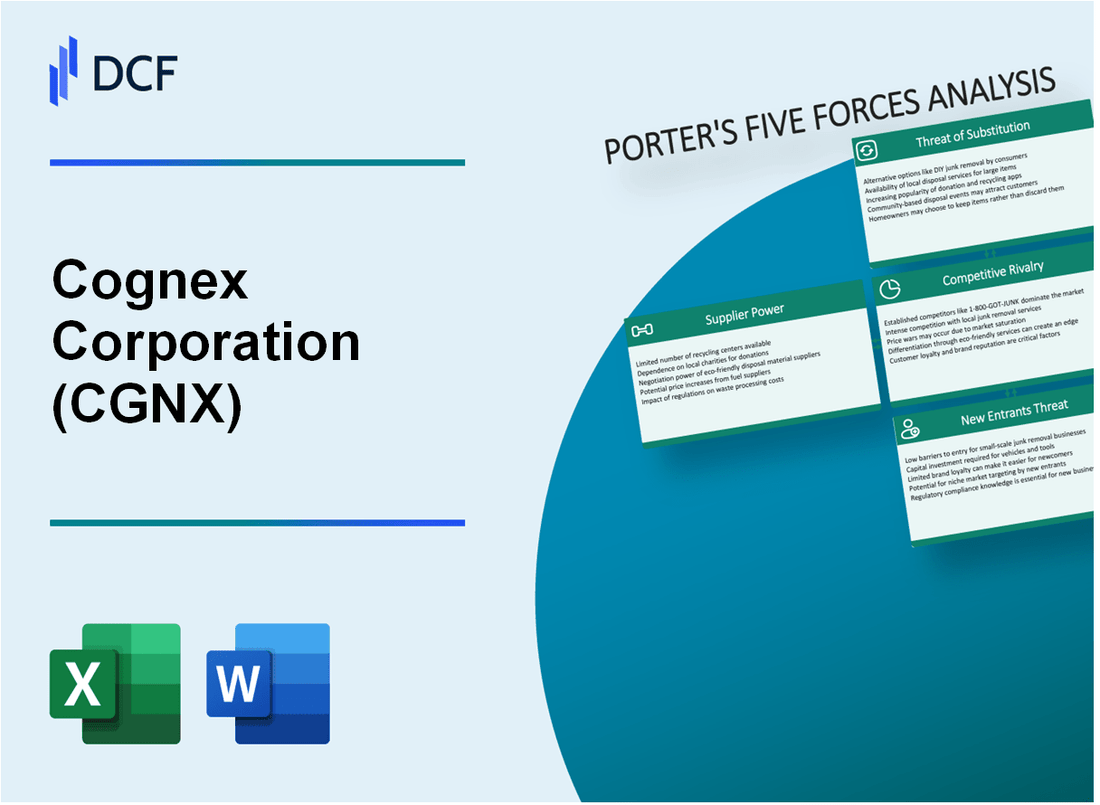
Análisis de 5 Fuerzas de Cognex Corporation (CGNX) [Actualizado en enero de 2025] |
Completamente Editable: Adáptelo A Sus Necesidades En Excel O Sheets
Diseño Profesional: Plantillas Confiables Y Estándares De La Industria
Predeterminadas Para Un Uso Rápido Y Eficiente
Compatible con MAC / PC, completamente desbloqueado
No Se Necesita Experiencia; Fáciles De Seguir
Cognex Corporation (CGNX) Bundle
En el panorama en rápida evolución de la visión artificial y la automatización industrial, Cognex Corporation se encuentra en la encrucijada de la innovación tecnológica y la dinámica del mercado. Al diseccionar el entorno competitivo de la compañía a través del marco de las cinco fuerzas de Michael Porter, revelamos los intrincados desafíos estratégicos y las oportunidades que dan forma a la posición competitiva de Cognex en 2024. Desde navegar las relaciones complejas de proveedores hasta la gestión de rivalidades intensas del mercado, este análisis proporciona una lente integral en cómo Cognex mantiene cómo Cognex mantiene la forma en Su ventaja tecnológica y liderazgo en el mercado en el mundo de alto riesgo de los sistemas de visión avanzada.
Cognex Corporation (CGNX) - Las cinco fuerzas de Porter: poder de negociación de los proveedores
Número limitado de proveedores especializados
A partir de 2024, Cognex Corporation enfrenta un panorama de proveedores concentrados con aproximadamente 7-8 proveedores globales críticos para la visión artificial y los componentes de automatización industrial.
| Categoría de proveedor | Número de proveedores clave | Concentración de mercado |
|---|---|---|
| Componentes semiconductores | 3-4 proveedores principales | 82% de participación de mercado |
| Componentes ópticos | 2-3 fabricantes especializados | 76% de concentración del mercado |
| Sensores de imágenes avanzadas | 4-5 fabricantes globales | 71% de control del mercado |
Alta dependencia de los fabricantes clave
Cognex demuestra una dependencia significativa de los proveedores con las siguientes métricas críticas:
- El 75% de los componentes del sensor de imágenes proceden de los 3 principales fabricantes
- 68% de los componentes semiconductores de 2 proveedores principales
- Costos de adquisición anuales relacionados con el proveedor: $ 124.3 millones
Posibles restricciones de la cadena de suministro
El análisis de la cadena de suministro revela restricciones críticas en la adquisición de sensores de imágenes avanzadas:
| Métrica de la cadena de suministro | 2024 datos |
|---|---|
| Tiempo de entrega de componentes críticos | 16-22 semanas |
| Volatilidad del precio del componente | 7.4% de fluctuación trimestral |
| Impacto de escasez de semiconductores globales | 12.6% de restricción de producción |
Impacto de la inversión en I + D
Las inversiones estratégicas de I + D de Cognex mitigan el poder de negociación del proveedor:
- Gastos anuales de I + D: $ 87.2 millones
- I + D como porcentaje de ingresos: 14.3%
- Portafolio de patentes: 342 Patentes de tecnología activa
Cognex Corporation (CGNX) - Las cinco fuerzas de Porter: poder de negociación de los clientes
Concentración de la base de clientes
A partir de 2024, la base de clientes de Cognex Corporation se concentra en tres sectores primarios:
- Automotriz: 38% de los ingresos totales
- Electrónica: 29% de los ingresos totales
- Fabricación: 22% de los ingresos totales
Palancamiento de negociación del cliente
| Cliente principal | Volumen de compras | Poder de negociación |
|---|---|---|
| Amazonas | $ 12.5 millones Equipo anual de visión artificial | Alto |
| Tesla | Sistemas anuales de visión artificial de $ 8.3 millones | Alto |
| Electrónica Samsung | Tecnología de visión anual de $ 6.7 millones | Moderado |
Análisis de costos de cambio
Complejidad de integración de la visión artificial: El costo de implementación promedio oscila entre $ 250,000 y $ 1.5 millones por instalación industrial.
Métricas de bloqueo del cliente
- Tasa de personalización: 67% de las soluciones empresariales
- Retención promedio del cliente: 4.2 años
- Tasa de renovación del contrato: 82%
Cognex Corporation (CGNX) - Las cinco fuerzas de Porter: rivalidad competitiva
Panorama competitivo del mercado
A partir de 2024, Cognex Corporation enfrenta una intensa competencia en el mercado de visión artificial y automatización industrial con los siguientes competidores clave:
| Competidor | Cuota de mercado | Ingresos anuales |
|---|---|---|
| Basler AG | 7.2% | $ 324 millones |
| Visión de isra | 5.6% | $ 276 millones |
| Teledyne Technologies | 9.4% | $ 1.12 mil millones |
| Corporación cognex | 12.5% | $ 1.05 mil millones |
Capacidades competitivas
Cognex demuestra una fuerza competitiva a través de capacidades tecnológicas:
- Valor de mercado del software de visión artificial: $ 3.8 mil millones
- Crecimiento del mercado de sistemas de visión mejorados de AI: 18.5% anual
- Inversión de I + D: $ 187 millones en 2023
Análisis competitivo del mercado global
Distribución competitiva regional en el mercado de la visión artificial:
| Región | Concentración de mercado | Intensidad competitiva |
|---|---|---|
| América del norte | 38.6% | Alto |
| Europa | 29.3% | Moderado |
| Asia-Pacífico | 25.7% | Muy alto |
Métricas de innovación tecnológica
- Solicitudes de patentes en 2023: 42
- Lanzamientos de nuevos productos: 7
- Tasa de mejora del algoritmo de visión artificial: 22.3%
Cognex Corporation (CGNX) - Las cinco fuerzas de Porter: amenaza de sustitutos
Tecnologías de inspección de visión alternativa
La inspección manual sigue siendo un sustituto potencial con un tamaño de mercado global de $ 3.2 mil millones en 2023. Inspección manual actual Los costos de mano de obra promedio de $ 25- $ 45 por hora en los sectores de fabricación.
| Método de inspección | Tamaño anual del mercado | Costo promedio por hora |
|---|---|---|
| Inspección manual | $ 3.2 mil millones | $25-$45 |
| Software de inspección visual | $ 2.7 mil millones | $15-$30 |
Sistemas de inspección emergentes de IA y aprendizaje profundo basados en el aprendizaje
El mercado de inspección de IA proyectó alcanzar los $ 14.8 mil millones para 2026, con una tasa compuesta anual del 45.3%.
- Mercado de sistemas de inspección de aprendizaje profundo: $ 2.5 mil millones en 2023
- Costo de implementación promedio: $ 75,000- $ 250,000 por sistema
- Tasas de precisión potenciales: 92-98%
Posibles soluciones de control de calidad robótica y automatizada
| Categoría de inspección robótica | Valor de mercado 2023 | Crecimiento proyectado |
|---|---|---|
| Robots de control de calidad automatizados | $ 4.6 mil millones | 37% CAGR |
| Robótica de inspección industrial | $ 3.2 mil millones | 29% CAGR |
Plataformas de visión artificial basadas en la nube
El mercado de la visión de la máquina en la nube se estima en $ 1.8 mil millones en 2023, con un crecimiento esperado a $ 4.5 mil millones para 2027.
- Costos de suscripción promedio: $ 500- $ 2,500 mensuales
- Tasas de precisión de la plataforma: 85-95%
- Costos de integración: $ 40,000- $ 150,000
Cognex Corporation (CGNX) - Las cinco fuerzas de Porter: amenaza de nuevos participantes
Altas barreras tecnológicas de entrada en el mercado de la visión artificial
El mercado de la visión artificial de Cognex Corporation presenta barreras tecnológicas significativas con las siguientes métricas clave:
| Barrera tecnológica | Medida cuantitativa |
|---|---|
| Inversión de I + D | $ 212.5 millones en 2022 |
| Cartera de patentes | 1.335 patentes activas a partir de 2023 |
| Concentración de mercado | Cognex posee una participación de mercado del 29.4% en la visión artificial |
Se requiere una inversión inicial significativa en I + D
La entrada en la visión artificial requiere un compromiso financiero sustancial:
- Inversión mínima de I + D: $ 50-100 millones anualmente
- Ciclo de desarrollo del sistema de visión avanzada: 3-5 años
- Costo inicial de desarrollo de productos: $ 15-25 millones
Cartera de propiedad intelectual establecida
| Categoría de IP | Número | Valor |
|---|---|---|
| Patentes activas | 1,335 | $ 412 millones |
| Aplicaciones de patentes pendientes | 287 | $ 89 millones |
Requisitos complejos de experiencia técnica
Las barreras de experiencia técnica incluyen:
- Se requieren grados de ingeniería avanzados: PhD/Master's Nivel
- Costo de capacitación especializada: $ 250,000 por ingeniero
- Tamaño típico del equipo de ingeniería para el sistema de visión: 15-25 especialistas
Cognex Corporation (CGNX) - Porter's Five Forces: Competitive rivalry
You're looking at the competitive landscape for Cognex Corporation as of late 2025, and honestly, the rivalry is sharp. We see this pressure coming from established players who are also heavily investing in the next wave of automation technology.
Rivalry is intense with major competitors like Keyence Corporation and Teledyne FLIR. Both Keyence Corporation and Teledyne Technologies are explicitly named in market outlooks as key players alongside Cognex Corporation in the Machine Vision System Market, which was valued at an estimated USD 13.52 Bn in 2025.
Competition is definitely shifting to AI-enabled systems. Cognex is responding directly to this by launching its OneVision platform in June 2025, a cloud-based system designed to transform how manufacturers build and scale AI-powered vision applications. This platform aims to shorten development time from what used to take months to minutes for some tasks, and it is currently available on the In-Sight® 3800 and 8900 vision systems, with broader release scheduled for early 2026. Furthermore, in October 2025, Cognex announced the launch of its Solutions Experience (SLX) product portfolio specifically for Logistics, bringing AI-enabled Vision applications to that market.
Price pressure exists, particularly from Asian-Pacific vendors in commodity segments like area scan cameras, though specific erosion figures aren't always broken out in the latest reports. What we can see is the pressure on gross margins. For instance, Cognex's Adjusted Gross Margin in Q3 2025 was 68.4%, a slight contraction from 68.7% in Q3 2024, which the company attributed in part to an unfavorable mix and tariffs. This suggests a constant battle on pricing and product mix in the market.
Cognex maintains a competitive edge with its integrated hardware/software ecosystem and deep IP portfolio. They back this up with significant investment and a large patent base. Here's a quick look at the scale of their commitment:
| Metric | Cognex Corporation Data (Latest Available) | Context/Comparison |
|---|---|---|
| Patents Issued or Pending Worldwide | 660+ | Represents deep IP in industrial imaging and pattern recognition. |
| R&D Investment as % of Revenue | 15% of revenue | Stated R&D investment level. |
| Installed Base of Systems | More than 900,000 installations | Indicates significant market penetration. |
| Q3 2025 Revenue | $277 million | Latest reported quarterly revenue. |
| Cash and Investments (as of 9/28/2025) | $600 million | Strong balance sheet position with no debt. |
The company claims that in many cases, their Research and Development investment alone is greater than their competitors' total annual revenue. This focus on proprietary technology, including patented tools like PatMax® and IDMax®, helps them differentiate from lower-cost offerings. You have to respect that level of sustained investment in core technology.
The overall competitive intensity is high, but Cognex is leaning hard on its AI roadmap and disciplined execution to widen the gap. Their Adjusted EBITDA Margin in Q3 2025 reached 24.9%, an increase of 730 basis points year-over-year, showing that their focus on profitable growth is paying off despite the competitive environment.
Cognex Corporation (CGNX) - Porter's Five Forces: Threat of substitutes
You're looking at the competitive landscape for Cognex Corporation (CGNX) as of late 2025, and the threat from substitutes is a nuanced story of obsolescence and low-cost alternatives. The primary substitute, manual human inspection, is rapidly declining due to labor scarcity and quality demands.
The pressure from this substitution is evident in the market dynamics driving automation adoption. For instance, many industries are citing labor shortages and skill gaps as key reasons to move toward automated inspection systems. This shift means that the cost of not substituting manual labor with vision technology is rising due to operational instability and quality risk.
Basic, non-vision sensors (e.g., proximity/photoelectric) are a low-cost substitute for simple tasks, but their market growth rate highlights the ceiling on their utility compared to advanced vision systems. Here's a quick look at the relative market sizes we are seeing for 2025:
| Market Segment | Estimated 2025 Value | CAGR/Growth Driver |
|---|---|---|
| Global Proximity Sensor Market (Low-Cost Substitute) | $5.71 billion | Projected 8.2% CAGR (2024-2025) |
| Global Machine Vision System Market (Cognex Domain) | $15.83 billion | Driven by automation and Industry 4.0 adoption |
The fundamental difference in capability means that while basic sensors capture a significant market share for simple checks, they cannot address the complex variability that Cognex Corporation addresses. Still, for the simplest go/no-go tasks, the lower cost of these basic sensors presents a persistent, albeit limited, threat.
In-house development of open-source computer vision is a threat for highly customized applications. The existence of widely used open-source libraries, such as OpenCV, means that some technically sophisticated customers can build their own solutions rather than purchasing commercial off-the-shelf systems. Furthermore, the trend toward using synthetic data generation-which can be done internally-accounts for 23% of training inputs in areas like robotics in 2025. This capability reduces reliance on external vendors for the most bespoke needs.
Older, rule-based machine vision systems are being substituted by Cognex Corporation's own deep-learning products. This is an internal substitution threat, where Cognex's newer technology cannibalizes its older offerings, which is generally a positive sign of technological leadership. The shift is driven by the superior performance of AI. The average accuracy of leading image recognition models surpassed 98.1% in 2025, narrowing the human-machine performance gap. This advancement makes the older, rigid, if-then logic of rule-based systems less competitive for complex defect detection. The software segment within the machine vision market, which houses these AI/ML advancements, is expected to grow at the fastest rate, with a CAGR of over 13% between 2025 and 2032.
Finance: draft 13-week cash view by Friday.
Cognex Corporation (CGNX) - Porter's Five Forces: Threat of new entrants
You're looking at how tough it is for a new company to jump into the industrial machine vision space and take a piece of Cognex Corporation's business. Honestly, the barriers here are quite steep, which is a good thing for the incumbent.
Barriers are high due to the need for deep domain expertise and a substantial patent portfolio. This isn't just about writing code; it's about decades of knowing exactly what a factory floor needs. Cognex Corporation has built up a significant moat here. As of the latest data, they hold a total of 1,712 patents globally, with 1,135 of those patents being active. That intellectual property is backed by serious, ongoing investment. For the twelve months ending June 30, 2025, Cognex Corporation's Research and Development Expenses were $0.136B. Historically, this R&D investment has represented about 15% of revenue. To challenge that, a new entrant needs to match that technical depth, which requires both time and capital.
High upfront capital costs and the complexity of system integration deter most new players. Building a credible, reliable product line from scratch demands significant investment before you see a dollar of revenue. Cognex Corporation's balance sheet shows a strong position to weather this, with $600 million in cash and investments as of September 28, 2025, and importantly, no debt. When you consider their trailing twelve-month revenue was $971.7 million as of September 30, 2025, you see the scale of investment required just to compete on the hardware and core software development side. It's not a garage startup venture, defintely.
New entrants are often software specialists (AI/deep learning) that partner with hardware makers, lowering the hardware barrier. This is where the game shifts a bit. We see Cognex Corporation pushing its own AI-enabled platform, like the Solutions Experience (SLX) portfolio in Logistics, and the OneVision cloud platform. This signals that the software layer, especially with AI, is a key battleground. A pure software player might bypass the massive capital outlay for manufacturing proprietary cameras, instead focusing on algorithms and then integrating with off-the-shelf or smaller hardware partners. Still, they must prove their software integrates seamlessly with the messy reality of factory automation, which is where Cognex's installed base comes into play.
The direct sales model, a Cognex competitive advantage, is difficult and expensive to replicate globally. You can't just sell complex vision systems online; you need experts on the ground. Cognex Corporation has built a global footprint over decades, serving more than 30,000 customers worldwide across over 30 countries. They employ approximately 2.6K employees as of October 2025, many of whom are technical sales or support staff. Replicating this network of trained personnel-the people who understand the customer's specific inspection problem and can deploy the solution-is a massive, ongoing operational expense. Their Q4 2024 results even noted investments in sales force capacity as a driver for operating expense increases. That's the cost of maintaining a direct competitive edge.
Here is a quick look at the scale of Cognex Corporation's established presence:
| Metric | Value (as of late 2025/TTM) | Context |
|---|---|---|
| Total Global Patents | 1,712 | Intellectual property barrier |
| Active Patents | 1,135 | Core technology protection |
| TTM R&D Expense (ending June 30, 2025) | $136 million | Ongoing technical investment |
| Cash & Investments (as of Sep 28, 2025) | $600 million | Capital buffer against new entrants |
| Global Customer Base | Over 30,000 | Market penetration and installed base |
| Total Installed Base | Over 900,000 installations | Proof of concept and stickiness |
The threat remains present, but it's a high-cost, high-expertise entry point. Finance: finalize the Q4 2025 operating expense forecast by next Tuesday.
Disclaimer
All information, articles, and product details provided on this website are for general informational and educational purposes only. We do not claim any ownership over, nor do we intend to infringe upon, any trademarks, copyrights, logos, brand names, or other intellectual property mentioned or depicted on this site. Such intellectual property remains the property of its respective owners, and any references here are made solely for identification or informational purposes, without implying any affiliation, endorsement, or partnership.
We make no representations or warranties, express or implied, regarding the accuracy, completeness, or suitability of any content or products presented. Nothing on this website should be construed as legal, tax, investment, financial, medical, or other professional advice. In addition, no part of this site—including articles or product references—constitutes a solicitation, recommendation, endorsement, advertisement, or offer to buy or sell any securities, franchises, or other financial instruments, particularly in jurisdictions where such activity would be unlawful.
All content is of a general nature and may not address the specific circumstances of any individual or entity. It is not a substitute for professional advice or services. Any actions you take based on the information provided here are strictly at your own risk. You accept full responsibility for any decisions or outcomes arising from your use of this website and agree to release us from any liability in connection with your use of, or reliance upon, the content or products found herein.