

|
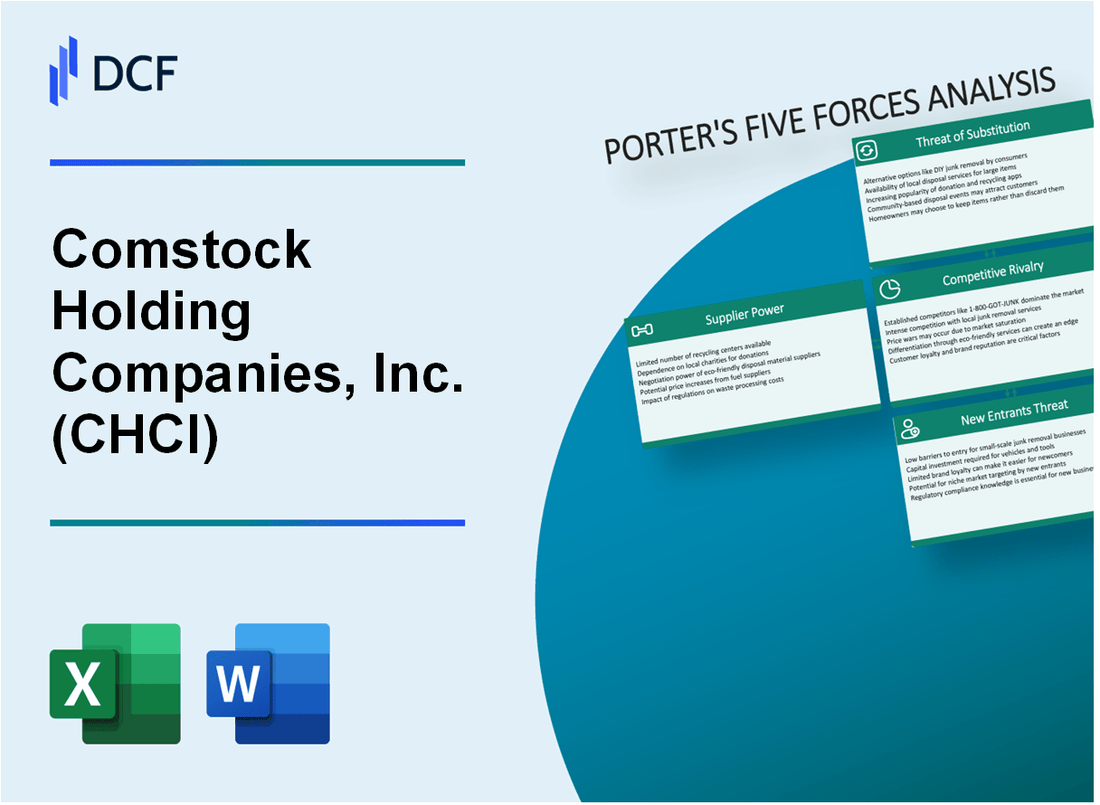
Comstock Holding Companies, Inc. (CHCI): 5 FORCES Analysis [Apr-2026 Updated] |
Completamente Editable: Adáptelo A Sus Necesidades En Excel O Sheets
Diseño Profesional: Plantillas Confiables Y Estándares De La Industria
Predeterminadas Para Un Uso Rápido Y Eficiente
Compatible con MAC / PC, completamente desbloqueado
No Se Necesita Experiencia; Fáciles De Seguir
Comstock Holding Companies, Inc. (CHCI) Bundle
You're looking for the sharpest read on Comstock Holding Companies, Inc.'s market moat right now, so I cut straight to the chase using Porter's Five Forces as of late 2025. Honestly, the picture is one of impressive financial discipline-think zero debt as of Q2 2025 and 27 straight quarters of revenue growth-which helps them manage supplier costs even with high D.C. labor prices. Still, while high occupancy (96% residential) limits tenant leverage, the real estate game here is tough, with rivalry high and substitutes like remote work always lurking. See below how their 91 assets and 15 in the pipeline stack up against the barriers to entry they've built.
Comstock Holding Companies, Inc. (CHCI) - Porter's Five Forces: Bargaining power of suppliers
When looking at Comstock Holding Companies, Inc. (CHCI), the power held by its suppliers is a key factor in understanding operational leverage and margin stability. This force is shaped by the availability and specialization of inputs, whether they are physical materials, skilled labor, or professional services required for their transit-oriented development and asset management model.
One persistent pressure point for Comstock Holding Companies, Inc. (CHCI) is the high cost of specialized construction labor and materials in the D.C. metro area. This regional dynamic directly impacts the cost basis for any ground-up development or significant capital improvements Comstock Holding Companies, Inc. (CHCI) undertakes. While the search results don't provide a specific D.C. construction inflation index for late 2025, the general market condition is a known headwind for developers in this high-demand region.
However, Comstock Holding Companies, Inc. (CHCI) has actively worked to reduce reliance on external, third-party vendors for certain operational needs. This is evident in the strategic vertical integration of its services arm. Specifically, during the third quarter of 2025, Comstock Holding Companies, Inc. (CHCI) invested heavily in its ParkX subsidiary by hiring 139 new employees to support new service offerings, such as porter and janitorial services. This internal staffing increase is designed to mitigate the power of external service providers for these functions, allowing Comstock Holding Companies, Inc. (CHCI) to capture more of the service revenue itself, as seen by the 59% year-over-year increase in ParkX subsidiary revenue in Q3 2025.
The bargaining power of specialized consultants, particularly those needed for large-scale, transit-oriented development entitlements in the D.C. region, remains a factor due to the limited pool of experts with the requisite local knowledge and regulatory success. Still, Comstock Holding Companies, Inc. (CHCI)'s asset-light strategy significantly reduces the power of a different, critical supplier group: capital providers and lenders. You see this clearly on the balance sheet.
The asset-light model translates directly into financial strength, which is the ultimate counter to supplier power in the capital markets. As of the second quarter of 2025, Comstock Holding Companies, Inc. (CHCI) reported having zero debt. This pristine balance sheet, which also generated over $2 million of operating cash in Q2 2025 alone, means Comstock Holding Companies, Inc. (CHCI) does not face the same covenant pressures or interest rate volatility that debt-laden peers do when negotiating with financial suppliers.
Here is a quick look at the internal mitigation versus external capital reliance:
| Supplier/Input Category | Impact/Mitigation Factor | Relevant 2025 Data Point |
|---|---|---|
| Specialized Construction Labor/Materials | High regional cost pressure | Not specified in public filings |
| Third-Party Service Vendors (Parking/Janitorial) | Mitigated by vertical integration (ParkX) | Added 139 staff in Q3 2025 |
| Capital Providers/Lenders | Reliance minimized by asset-light model | Zero debt as of Q2 2025 |
| Entitlement Consultants | Limited number of specialists | Not specified in public filings |
The internal expansion of ParkX is a direct action to control service costs, which is a tangible response to supplier power. The zero debt position is an even stronger structural defense against the power of financial suppliers.
- ParkX headcount growth in Q3 2025: 139 employees.
- ParkX third-party revenue growth (Q2 2025 YoY): 124%.
- Q3 2025 Net Income: $0.541 million.
- Q2 2025 Operating Cash Generated: Over $2 million.
This focus on fee-based revenue streams, which grew 30% year-to-date in Q3 2025, helps insulate Comstock Holding Companies, Inc. (CHCI) from the volatility of construction supplier pricing by providing a more stable, recurring revenue base. Finance: draft 13-week cash view by Friday.
Comstock Holding Companies, Inc. (CHCI) - Porter's Five Forces: Bargaining power of customers
You're analyzing the customer side of Comstock Holding Companies, Inc. (CHCI)'s business, and honestly, the data suggests customers have a mixed bag of power, heavily mitigated by long-term contractual lock-ins.
Institutional asset management clients, which include owners and governmental bodies, are definitely sophisticated players. They understand real estate finance and asset performance deeply, which inherently grants them higher potential switching power in an open market. However, for a significant portion of Comstock Holding Companies, Inc. (CHCI)'s fee base, this power is currently constrained by existing agreements.
The strength of the underlying managed assets limits the power of the tenants who are, in a sense, customers of the managed properties. For the residential side, the portfolio occupancy was reported high at 96% as of Q1 2025. That near-full house means individual residential tenants have very little leverage to negotiate terms on existing leases.
Similarly, on the commercial side, the leasing percentage was strong at 93% (Q1 2025). This high occupancy rate across office and retail spaces indicates that current commercial tenants have low power to demand concessions from Comstock Holding Companies, Inc. (CHCI) for their existing premises.
The most significant factor dampening customer power, particularly for the asset management segment, is the contractual structure. Comstock Holding Companies, Inc. (CHCI)'s asset management services platform is anchored by a long-term, full-service asset management agreement (the 2022 AMA) with Comstock Partners, LC, which extends through 2035. This agreement covers the Anchor Portfolio assets, locking in a substantial, predictable stream of fee-based revenue.
Here's a quick look at the operational metrics that reflect this low immediate customer leverage:
| Metric | Value | Reporting Period |
|---|---|---|
| Residential Portfolio Occupancy | 96% | Q1 2025 |
| Stabilized Commercial Portfolio Leased Percentage | 93% | Q1 2025 |
| Asset Management Agreement Term (Anchor Portfolio) | Through 2035 | As of 2024/2025 Filings |
| Total Managed Assets (AUM) | 91 assets | Q3 2025 |
The recurring revenue streams derived from these agreements are clearly a priority, as evidenced by the 30% year-over-year increase in recurring, fee-based revenue from property management subsidiaries reported in Q3 2025. This focus on sticky revenue directly counters customer power.
The power dynamic can be broken down by customer type:
- Institutional Owners (Asset Management Clients): High sophistication, but locked in by agreements extending to 2035.
- Commercial Tenants: Low power due to 93% stabilized portfolio lease rate (Q1 2025).
- Residential Tenants: Very low power given 96% occupancy (Q1 2025).
- ParkX Third-Party Clients: Growing, with 17 new third-party ParkX contracts added Year-to-Date as of Q3 2025, suggesting competitive service but also successful client acquisition.
What this estimate hides is the negotiation leverage held by prospective major clients for the new Trophy-class office towers at Reston Station, which secured significant leases post-Q3 2025. Finance: draft 13-week cash view by Friday.
Comstock Holding Companies, Inc. (CHCI) - Porter's Five Forces: Competitive rivalry
You're looking at the competitive landscape for Comstock Holding Companies, Inc. (CHCI) in the D.C. metro area, and honestly, the rivalry is intense. The real estate development and asset management market across the Washington, D.C. region is defintely highly fragmented and competitive. You've got everyone from national giants to nimble local players vying for the same prime transit-adjacent land and management contracts. It's a tough crowd to stand out in.
Where Comstock Holding Companies, Inc. carves its niche is through a clear focus. They aren't just building; they are concentrating on large-scale, transit-oriented, mixed-use developments. Think about Reston Station-that's the flagship example of this strategy in action. This focus on creating integrated live-work-play environments near Metro stations helps them secure long-term, fee-based revenue streams, which is a key differentiator from more traditional, single-asset developers.
The proof of this strategy's effectiveness, despite the rivalry, shows up in the numbers. Comstock Holding Companies, Inc. has achieved 27 consecutive quarters of year-to-date revenue growth as of late 2025. That's a streak that beats many peers in this cyclical industry. For instance, in the first nine months of 2025, the company reported a 13% increase in year-to-date revenue, reaching $38.93 million. This consistent top-line performance contrasts with the market noise. The company's year-to-date revenue growth of 13% in 2025 has significantly outperformed the S&P 500's 13% gain over the same period, with the stock itself surging 66% YTD.
Key competitors include large, diversified real estate firms and regional developers. While The RMR Group is often mentioned in broader contexts, a direct comparison with a publicly traded peer like Claros Mortgage Trust (CMTG) highlights the performance gap in profitability metrics based on recent filings. Here's a quick look at how Comstock Holding Companies, Inc. stacked up against one of its real estate industry counterparts through the third quarter of 2025:
| Metric (As of Q3 2025) | Comstock Holding Companies, Inc. (CHCI) | Claros Mortgage Trust (CMTG) |
|---|---|---|
| Q3 2025 Revenue | $13.32 million | Data Not Available |
| YTD 2025 Revenue | $38.93 million | Data Not Available |
| Q3 2025 Net Income | $0.541 million | Data Not Available |
| Net Margin (Latest Reported) | 28.35% | -184.07% |
| Return on Equity (Latest Reported) | 30.98% | Lower than CHCI |
| Analyst Consensus Rating Score (Max 4.00) | 3.00 (1 Buy) | 1.50 (1 Buy, 3 Sell) |
The competitive rivalry is managed by Comstock Holding Companies, Inc.'s operational structure, which emphasizes recurring revenue. This structure helps insulate them somewhat from the volatility that hits pure development plays. You can see this strength in their fee-based segments:
- Recurring, fee-based revenue from property management subsidiaries was up 30% vs. prior year.
- Third-party revenue from the ParkX subsidiary saw a 96% increase in Q3 2025.
- ParkX subsidiary revenue increased 59% vs. prior year.
- The residential managed portfolio was reported at 96% leased.
Still, the pressure from rivals is constant, especially as they invest heavily in growth initiatives, like the ParkX expansion which added 139 new employees in Q3 2025 to staff new contracts. That kind of operational scaling is a direct response to the need to compete on service quality and contract acquisition.
Comstock Holding Companies, Inc. (CHCI) - Porter's Five Forces: Threat of substitutes
You're looking at the landscape for Comstock Holding Companies, Inc. (CHCI) and need to see what outside options could pull business away from their core offerings. The threat of substitutes is real, but the nature of Comstock Holding Companies, Inc. (CHCI)'s transit-adjacent, mixed-use focus gives them a distinct moat.
Substitution for commercial space exists via traditional suburban office parks or the continued trend of remote/hybrid work. The shift is measurable: as of Q3 2025, 24% of new U.S. job postings were hybrid and 12% were fully remote, though fully on-site remained the majority at 64%. This flexibility offers a cost-saving substitute; for instance, companies can save up to $11,000 per employee per year by adopting a hybrid model. The broader office market shows this pressure, with the US nationwide vacancy rate at 16.4% as of Q3 2025, and some regional suburban markets, like Chicago's, hitting a record-high 32% vacancy at the start of 2025. Still, Comstock Holding Companies, Inc. (CHCI)'s stabilized commercial managed portfolio is holding strong at a 93% leased percentage as of Q3 2025.
Residential substitutes include non-transit-oriented housing or single-family homes outside the urban core. The demand dynamics here favor rentals over ownership for many, but the type of rental matters. Single-family rental (SFR) prices have shown greater price appreciation than multifamily rentals (MFR) since the pandemic, with SFR rents up 41% compared to 26% for MFRs since pre-pandemic levels. This suggests a premium on the single-family lifestyle substitute, though high mortgage rates are keeping many in the rental pool, with a record 30% of single-family home purchases in the first half of 2025 made by investors. Comstock Holding Companies, Inc. (CHCI)'s residential portfolio is even tighter, reporting a 96% leased percentage in Q3 2025.
Other third-party firms or in-house teams can substitute for Comstock Holding Companies, Inc. (CHCI)'s fee-based asset management and property services. This segment is part of the larger Third Party Asset Management Market, which was valued at $101.7 Billion in 2024 and projected to grow to $105.3 Billion in 2025. Comstock Holding Companies, Inc. (CHCI)'s Asset Management segment accounted for 49.2% of its total Q3 2025 revenue of $13.3 million. The growth in the broader asset management industry, projected to reach $1,122.04 billion by 2032, shows a large, growing pool of potential competitors.
The unique value proposition of transit-adjacent, mixed-use communities makes direct substitution defintely difficult. Comstock Holding Companies, Inc. (CHCI) manages a portfolio of 91 assets that includes commercial, residential, and hospitality facilities, often near Metro rail stations. This focus on integrated, transit-oriented development creates a specific product that is not easily replicated by generic suburban office parks or standalone residential complexes. The delivery of key assets like The Row at Reston Station and the JW Marriott Reston Station in 2025 highlights this differentiated offering, which attracts tenants seeking the convenience of live-work-play environments.
| Metric Category | Comstock Holding Companies, Inc. (CHCI) Data (Latest Available 2025) | Substitute Market Data (Latest Available 2025) |
| Commercial Occupancy/Vacancy | Stabilized Commercial Portfolio Leased: 93% | US Nationwide Office Vacancy Rate: 16.4% (Q3 2025) |
| Residential Occupancy | Residential Portfolio Leased: 96% (Q3 2025) | SFR Rent Premium over Multifamily: 20% (Late 2024/Early 2025) |
| Fee-Based Services Market Size | Asset Management Revenue Share (Q3 2025): 49.2% of total revenue | Third Party Asset Management Market Value: $105.3 Billion (Forecast 2025) |
| Workplace Trend Impact | Commercial Leases Executed YTD (Q3 2025): 193,000 sqft | Hybrid Job Postings (Q3 2025): 24% of new postings |
The threat is best understood by looking at the market segments:
- Remote/Hybrid Work: Offers savings up to $11,000 per employee annually.
- Suburban Office Parks: Chicago suburban vacancy hit 32% at year-end 2024.
- Non-Transit Residential: SFR rents grew 4.4% YoY in 2024, outpacing apartments at 2.4%.
- Third-Party Services: The overall third-party asset management market is projected to grow at a 3.6% CAGR through 2035.
Comstock Holding Companies, Inc. (CHCI) reported Q3 2025 revenue of $13.3 million, on a managed portfolio of 91 assets.
Comstock Holding Companies, Inc. (CHCI) - Porter's Five Forces: Threat of new entrants
You're assessing the barriers to entry in the specialized D.C. metro real estate development and management space, and honestly, the hurdles for a new firm are substantial. Comstock Holding Companies, Inc. benefits from structural advantages that make immediate, meaningful competition difficult to mount.
High Capital Requirement for Large-Scale D.C. Metro Development Acts as a Significant Barrier
The sheer scale of capital required to compete in the transit-oriented development (TOD) space around the D.C. Metro system is a massive deterrent. This isn't just about buying land; it's about financing massive, multi-phase, mixed-use projects that often involve public-private partnerships. To give you a sense of the ecosystem's capital demands, the Washington Metropolitan Area Transit Authority (Metro) has a constrained FY2026-FY2031 Capital Improvement Program (CIP) totaling $10.9 billion. Furthermore, Metro's FY2025 capital budget was approved for $2.3 billion. A new entrant would need access to comparable, or even greater, private capital to match Comstock Holding Companies, Inc.'s existing scale and pipeline, which is a tough ask without an established track record in this specific, high-cost market.
Regulatory Complexity and Long Entitlement Processes in Northern Virginia Require Deep, Specialized Local Knowledge
Breaking ground in Northern Virginia, where Comstock Holding Companies, Inc. focuses a significant portion of its development, involves navigating intricate zoning, environmental reviews, and public-private coordination. This regulatory gauntlet demands specialized local expertise that takes years, if not decades, to cultivate. New entrants face significant time delays and unforeseen costs simply trying to secure the necessary entitlements (official permissions) for large-scale projects, whereas Comstock Holding Companies, Inc. has established relationships and a proven process for moving projects through the pipeline.
- The region is preparing for $7 billion in regional transit investments, indicating complex stakeholder coordination.
- Comstock Holding Companies, Inc. has a history of major public-private partnership developments.
Comstock Holding Companies, Inc.'s Established Portfolio and Pipeline Create Scale Barriers
Comstock Holding Companies, Inc.'s existing operational footprint and near-term growth capacity create an immediate scale barrier. They are not just planning; they are operating and delivering. As of late 2025, Comstock Holding Companies, Inc. operates 91 assets. Their development pipeline, which includes assets under construction and in development, totals 15 new assets. This pipeline is projected to deliver nearly 10 million square feet of mixed-use and transit-oriented properties at full build-out. A new firm would be entering a market where Comstock Holding Companies, Inc. already commands significant square footage and operational scale.
Here's a quick look at the current operational and near-term asset base:
| Metric | Number/Amount | Context/Date Reference |
| Operating Assets | 91 | As of November 2025 |
| Assets Under Construction/Development (Pipeline) | 15 (4 under construction + 11 under development) | As of November 2025 |
| Total Projected Pipeline Build-out | Nearly 10 million square feet | Total projected build-out |
| Stabilized Commercial Assets (Q1 2025) | 14 (2.3 million sqft) | Q1 2025 Portfolio Detail |
| Stabilized Residential Assets (Q1 2025) | 6 (1.8 million sqft) | Q1 2025 Portfolio Detail |
The Long-Term Asset Management Contracts Secure Future Revenue
The business model itself acts as a moat. Comstock Holding Companies, Inc. generates substantial, predictable revenue from long-term asset management contracts. This stability makes it hard for new firms to gain market share quickly because they lack the established, recurring fee base. For instance, Comstock Holding Companies, Inc. has achieved 27 consecutive quarters of revenue growth. In Q3 2025, Asset Management alone accounted for 49.2% of total revenue, with Property Management at 21.7% and ParkX Management at 29.1%. The recurring, fee-based revenue from property management subsidiaries was up 30% year-to-date in Q3 2025. This consistent cash flow from existing contracts provides Comstock Holding Companies, Inc. with the financial resilience to weather market shifts and fund ongoing operations while a new entrant is still trying to secure its first major, long-term management agreement.
Disclaimer
All information, articles, and product details provided on this website are for general informational and educational purposes only. We do not claim any ownership over, nor do we intend to infringe upon, any trademarks, copyrights, logos, brand names, or other intellectual property mentioned or depicted on this site. Such intellectual property remains the property of its respective owners, and any references here are made solely for identification or informational purposes, without implying any affiliation, endorsement, or partnership.
We make no representations or warranties, express or implied, regarding the accuracy, completeness, or suitability of any content or products presented. Nothing on this website should be construed as legal, tax, investment, financial, medical, or other professional advice. In addition, no part of this site—including articles or product references—constitutes a solicitation, recommendation, endorsement, advertisement, or offer to buy or sell any securities, franchises, or other financial instruments, particularly in jurisdictions where such activity would be unlawful.
All content is of a general nature and may not address the specific circumstances of any individual or entity. It is not a substitute for professional advice or services. Any actions you take based on the information provided here are strictly at your own risk. You accept full responsibility for any decisions or outcomes arising from your use of this website and agree to release us from any liability in connection with your use of, or reliance upon, the content or products found herein.