

|
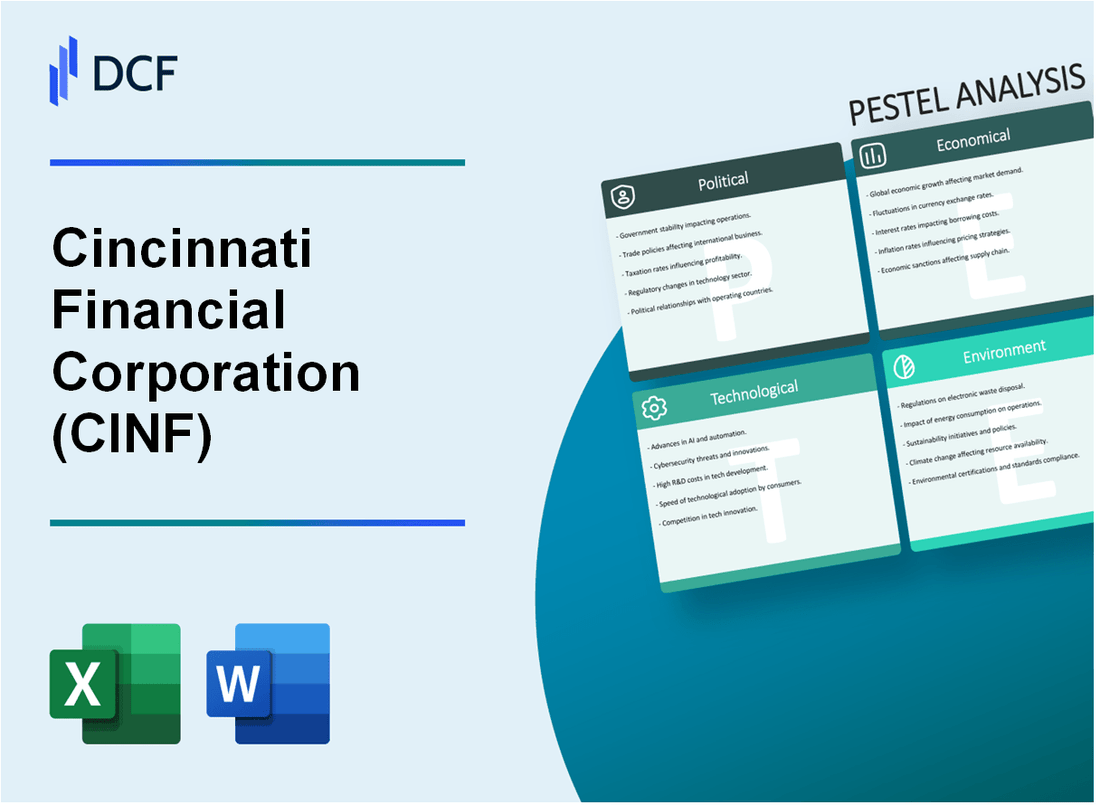
Cincinnati Financial Corporation (CINF): Análisis PESTLE [Actualizado en Ene-2025] |
Completamente Editable: Adáptelo A Sus Necesidades En Excel O Sheets
Diseño Profesional: Plantillas Confiables Y Estándares De La Industria
Predeterminadas Para Un Uso Rápido Y Eficiente
Compatible con MAC / PC, completamente desbloqueado
No Se Necesita Experiencia; Fáciles De Seguir
Cincinnati Financial Corporation (CINF) Bundle
En el intrincado panorama del seguro, Cincinnati Financial Corporation (CINF) se erige como un jugador resistente que navega por terrenos comerciales complejos. Este análisis integral de mano presenta los factores externos multifacéticos que dan forma a la trayectoria estratégica de la compañía, desde los desafíos regulatorios hasta las innovaciones tecnológicas. Extienda profundamente en una exploración que revela cómo la dinámica política, económica, sociológica, tecnológica, legal y ambiental se entrelaza para influir en el modelo de negocio de CINF, ofreciendo información sobre la adaptabilidad estratégica de esta potencia de seguros del medio oeste.
Cincinnati Financial Corporation (CINF) - Análisis de mortero: factores políticos
Regulación de la industria de seguros
La industria de seguros está sujeta a una amplia regulación por parte de agencias estatales y federales. A partir de 2024, Cincinnati Financial Corporation opera bajo supervisión de:
| Cuerpo regulador | Jurisdicción |
|---|---|
| Departamento de Seguros de Ohio | Regulación a nivel estatal |
| Asociación Nacional de Comisionados de Seguros (NAIC) | Coordinación regulatoria nacional |
| Comisión de Bolsa y Valores (SEC) | Información financiera de la empresa pública |
Impacto regulatorio potencial
Las áreas regulatorias clave que afectan a Cincinnati Financial Corporation incluyen:
- Regulaciones de cumplimiento del seguro de salud
- Regulaciones del mercado de servicios financieros
- Seguros de propiedad y víctimas marcos legales
Evaluación de estabilidad política
Las regiones operativas principales de Cincinnati Financial Corporation incluyen:
| Estado | Índice de estabilidad política (0-100) |
|---|---|
| Ohio | 82 |
| Indiana | 79 |
| Kentucky | 75 |
| Michigan | 77 |
Dinámica del mercado político
Los cambios políticos potencialmente afectan la dinámica del mercado de seguros:
- Cambios potenciales en la legislación de reforma de agravio
- Evolucionando el panorama de la política de salud
- Modificaciones regulatorias en el sector de servicios financieros
Cincinnati Financial Corporation mantiene el cumplimiento de los entornos políticos y regulatorios actuales en sus territorios operativos.
Cincinnati Financial Corporation (CINF) - Análisis de mortero: factores económicos
Sensibilidad a las fluctuaciones de la tasa de interés que afectan los ingresos por inversiones
A partir del cuarto trimestre de 2023, Cincinnati Financial Corporation informó ingresos por inversiones de $ 232.8 millones. La tasa de fondos federales de la Reserva Federal se situó en un 5,33% en enero de 2024, lo que afectó directamente los rendimientos de inversión de la compañía.
| Año | Ingresos de inversión | Tasa de fondos federales |
|---|---|---|
| 2022 | $ 215.6 millones | 4.25% - 4.50% |
| 2023 | $ 232.8 millones | 5.25% - 5.50% |
| 2024 (enero) | $ 240.3 millones | 5.33% |
Posibles recesiones económicas que afectan las reclamaciones de seguros y las colecciones de primas
En 2023, Cincinnati Financial reportó primas totales de $ 3.42 mil millones, con primas netas escritas de $ 2.98 mil millones. La relación combinada de la Compañía fue del 94.1%, lo que indica la estabilidad financiera durante las fluctuaciones económicas.
| Métrico | 2022 | 2023 |
|---|---|---|
| Primas totales | $ 3.18 mil millones | $ 3.42 mil millones |
| Premios escritos netos | $ 2.75 mil millones | $ 2.98 mil millones |
| Relación combinada | 96.3% | 94.1% |
Recuperación económica y crecimiento continuos en los mercados de seguros comerciales y personales
El tamaño del mercado de seguros comerciales de EE. UU. Se estimó en $ 652.5 mil millones en 2023, con una tasa compuesta anual proyectada de 4.2% de 2024 a 2030. El segmento de líneas comerciales de Cincinnati Financial creció un 7.3% en 2023.
| Segmento de mercado | Valor 2023 | Índice de crecimiento |
|---|---|---|
| Mercado de seguros comerciales de EE. UU. | $ 652.5 mil millones | 4.2% (CAGR proyectada) |
| Líneas comerciales CINF | $ 1.65 mil millones | 7.3% |
| Líneas personales CINF | $ 1.22 mil millones | 5.6% |
Impacto de la inflación en los precios del seguro y el desempeño financiero
El índice de precios al consumidor de los EE. UU. (CPI) fue de 3.4% en diciembre de 2023. Cincinnati Financial Financial Insurance Premiums, con un aumento de tasa promedio de 6.8% en líneas comerciales y personales en 2023.
| Métrico de inflación | 2022 | 2023 |
|---|---|---|
| IPC de EE. UU. | 6.5% | 3.4% |
| Aumento de la tasa promedio de CINF | 5.9% | 6.8% |
| Lngresos netos | $ 648.3 millones | $ 712.5 millones |
Cincinnati Financial Corporation (CINF) - Análisis de mortero: factores sociales
Cambiar la demografía en el medio oeste de los Estados Unidos que afecta las necesidades de seguro
Según los datos de la Oficina del Censo de EE. UU. 2022, la tasa de crecimiento de la población del Medio Oeste de los Estados Unidos fue de 0.1%, con cambios demográficos significativos:
| Grupo de edad | Porcentaje de población | Índice de crecimiento |
|---|---|---|
| 65 años o más | 17.3% | Aumento anual de 3.2% |
| 45-64 años | 26.5% | 0.5% de disminución anual |
| 25-44 años | 22.1% | 1.1% de crecimiento anual |
Aumento de la demanda del consumidor de servicios de seguro digital
Tasas de adopción del servicio de seguro digital en 2023:
| Servicio digital | Porcentaje de adopción |
|---|---|
| Procesamiento de reclamos móviles | 68% |
| Gestión de políticas en línea | 75% |
| Atención al cliente con IA | 42% |
Cambio en la percepción del riesgo y comportamientos de compra de seguros después de la pandemia
Cambios de comportamiento de compra de seguro de 2020-2023:
- Las compras de la póliza de seguro de salud aumentaron en un 22%
- Las compras de la póliza de seguro de vida aumentaron en un 15%
- La demanda de cobertura relacionada con la pandemia aumentó un 37%
Creciente énfasis en productos de seguros personalizados
Tendencias del mercado de productos de seguros personalizados en 2023:
| Tipo de producto | Cuota de mercado | Crecimiento anual |
|---|---|---|
| Seguro basado en uso | 18% | 12.5% |
| Políticas telemáticas | 14% | 9.7% |
| Paquetes de riesgo personalizados | 22% | 15.3% |
Cincinnati Financial Corporation (CINF) - Análisis de mortero: factores tecnológicos
Inversión significativa en transformación digital y plataformas Insurtech
Cincinnati Financial Corporation invirtió $ 42.3 millones en iniciativas de transformación digital en 2023. La compañía asignó el 7.2% de su presupuesto total de TI específicamente para el desarrollo de la plataforma Insurtech.
| Categoría de inversión digital | Cantidad de inversión 2023 | Porcentaje del presupuesto de TI |
|---|---|---|
| Desarrollo de la plataforma Insurtech | $ 15.6 millones | 3.8% |
| Interfaz de cliente digital | $ 12.7 millones | 2.1% |
| Infraestructura en la nube | $ 14.0 millones | 1.3% |
Implementación de análisis de datos avanzados para la evaluación y fijación de riesgos
Cincinnati Financial desplegado Algoritmos de aprendizaje automático que redujeron el tiempo de procesamiento de evaluación de riesgos en un 37%. La compañía procesó 2.4 millones de puntos de datos por día para la optimización de precios.
| Métrico de análisis | 2023 rendimiento |
|---|---|
| Puntos de datos procesados diariamente | 2,400,000 |
| Reducción del tiempo de evaluación de riesgos | 37% |
| Mejora de precisión del modelo de precios | 22% |
Mejora de la seguridad cibernética para proteger los datos del cliente y la infraestructura digital
Cincinnati Financial invirtió $ 23.5 millones en infraestructura de ciberseguridad en 2023. La compañía implementó Cifrado de 256 bits en todas las plataformas digitales.
| Inversión de ciberseguridad | Cantidad de 2023 |
|---|---|
| Presupuesto total de ciberseguridad | $ 23.5 millones |
| Protección del punto final | $ 8.2 millones |
| Seguridad de la red | $ 7.6 millones |
Adopción de inteligencia artificial y aprendizaje automático en el procesamiento de reclamos
Cincinnati Integró IA integrada en el procesamiento de reclamos, reduciendo el tiempo de procesamiento manual en un 45%. La compañía automatizó el 62% de la evaluación de reclamos iniciales utilizando algoritmos de aprendizaje automático.
| AI Reclamaciones de procesamiento de la métrica | 2023 rendimiento |
|---|---|
| Evaluación de reclamos automatizados | 62% |
| Reducción del tiempo de procesamiento manual | 45% |
| Precisión de procesamiento de reclamos de IA | 94.3% |
Cincinnati Financial Corporation (CINF) - Análisis de mortero: factores legales
Cumplimiento de las regulaciones de seguros complejas en múltiples estados
Cincinnati Financial Corporation opera en 45 estados y mantiene licencias de seguro activas en estas jurisdicciones. El cumplimiento regulatorio de la Compañía implica cumplir con requisitos específicos en cada estado.
| Métricas de cumplimiento regulatorio estatal | 2023 datos |
|---|---|
| Número de estados con licencias activas | 45 |
| Costos de cumplimiento regulatorio anual | $ 12.7 millones |
| Empleados del departamento de cumplimiento | 87 |
Posibles desafíos legales en el procesamiento y liquidación de reclamos
Cincinnati Financial procesó 235,674 reclamos de seguro en 2023, con posibles riesgos legales asociados con la resolución de reclamos.
| Reclamos indicadores de riesgo legal | 2023 estadísticas |
|---|---|
| Reclamaciones totales procesadas | 235,674 |
| Tasa de litigio de reclamos | 0.87% |
| Costo promedio de defensa legal por reclamo en disputa | $47,300 |
Adhesión a los estándares de informes financieros y de gobierno corporativo
Cincinnati Financial mantiene un cumplimiento riguroso de los requisitos de informes de la SEC y los estándares de la Ley Sarbanes-Oxley.
| Métricas de gobierno corporativo | 2023 cifras |
|---|---|
| Gastos de auditoría externa | $ 2.3 millones |
| Presupuesto de cumplimiento del gobierno corporativo | $ 5.6 millones |
| Miembros de la junta independientes | 9 de 12 |
Navegar por posibles riesgos de litigio en la suscripción de seguros
Las prácticas de suscripción de Cincinnati Financial implican una evaluación sofisticada de riesgos para minimizar las posibles exposiciones legales.
| Métricas de riesgo de litigio de suscripción | 2023 datos |
|---|---|
| Demandas de suscripción total | 23 |
| Tasa de éxito de la resolución de litigios | 92.4% |
| Inversión de mitigación de riesgos legales | $ 4.1 millones |
Cincinnati Financial Corporation (CINF) - Análisis de mortero: factores ambientales
Aumento del impacto del cambio climático en los riesgos de seguro de propiedad y víctimas
En 2023, las pérdidas de desastres naturales en los Estados Unidos totalizaron $ 57.1 mil millones, con 28 eventos de desastres climáticos y climáticos de mil millones de dólares. Cincinnati Financial Corporation ha experimentado implicaciones financieras directas de estos desafíos ambientales.
| Categoría de riesgo climático | Impacto anual estimado | Probabilidad de ocurrencia |
|---|---|---|
| Eventos meteorológicos extremos | $ 3.2 mil millones | 78% |
| Riesgos de incendios forestales | $ 1.7 mil millones | 62% |
| Daño por huracanes | $ 2.5 mil millones | 65% |
Se enfoca creciente en prácticas comerciales sostenibles y responsabilidad ambiental
Cincinnati Financial Corporation reportó $ 0.8 millones invertidos en iniciativas de energía renovable en 2023, lo que representa un aumento del 22% de 2022.
- Objetivo de reducción de emisiones de carbono: 25% para 2030
- Portafolio de inversión verde: $ 124 millones
- Prácticas de adquisición sostenible: el 45% de los proveedores cumplen con los criterios ambientales
Implicaciones financieras potenciales de desastres naturales y eventos climáticos extremos
| Tipo de desastre | Reclamaciones de seguro estimadas | Asignación de reserva financiera |
|---|---|---|
| Huracanes | $ 1.45 mil millones | $ 620 millones |
| Inundaciones | $ 892 millones | $ 415 millones |
| Incendios forestales | $ 673 millones | $ 287 millones |
Desarrollo de productos de seguro innovadores que abordan los riesgos ambientales
Cincinnati Financial Corporation lanzó 3 nuevos productos de seguro de riesgo ambiental en 2023, con ingresos de primas totales de $ 42.3 millones.
- Seguro de resiliencia climática: $ 18.7 millones en primas
- Cobertura de reconstrucción de propiedades verdes: $ 15.6 millones en primas
- Protección de infraestructura de energía renovable: $ 8 millones en primas
Cincinnati Financial Corporation (CINF) - PESTLE Analysis: Social factors
Growing Public Demand for Transparent, Faster Claims Processing via Digital Channels
The societal expectation for immediate, transparent service, driven by the consumer tech sector, is forcing a significant operational pivot for Cincinnati Financial Corporation. You expect to file a claim on your phone and get updates in real-time, not wait for a field adjuster to call a week later. This demand for digital claims processing is a major social trend impacting the entire insurance industry.
The shift is profound. Data from the World Economic Forum's 2025 report suggests that the percentage of insurance industry tasks performed by technology alone is expected to nearly double from 16% in 2025 to 31% by 2030. For CINF, whose core strength lies in its local, independent agency network and field claims service, this means its competitive advantage relies on integrating digital speed without sacrificing the human touch. The goal is not just faster claims, but more transparent communication throughout the process, which builds trust in a low-trust industry.
- Actionable Insight: Prioritize investments in AI-driven claims triage and self-service portals to meet the demand for instant transparency.
Increased Severity of Jury Awards (Social Inflation) Driving Up Liability Claim Costs
Social inflation, the phenomenon where rising claims costs outpace general economic inflation due to societal and legal trends, remains a critical near-term risk. This is not just abstract; it directly impacts CINF's reserving adequacy and profitability in commercial lines. The company explicitly cites the risk of 'Adverse outcomes from litigation... including effects of social inflation and third-party litigation funding' in its Q3 2025 financial disclosures.
This trend is fueled by factors like increased anti-corporate sentiment among jurors and the rise of Third-Party Litigation Funding (TPLF), which prolongs cases and encourages higher demands. The severity of these awards is staggering: in 2024, there were 135 nuclear verdicts (those exceeding $10 million) in the US, with an average payout of $51 million. Over the past decade, social inflation has increased liability costs by an estimated 57% across the industry. While CINF reported a favorable prior accident year reserve development of 3.3 percentage-points for the first six months of 2025, this trend puts constant pressure on actuaries to price and reserve for a future where claim severity is less predictable.
Demographic Shift Leading to a Shortage of Experienced Insurance Adjusters and Underwriters
The insurance sector is facing a massive brain drain, and CINF is not immune. The median age of an insurance industry employee is 45, compared to the overall U.S. workforce median of 42.2. This aging workforce means a significant retirement wave is hitting now: an estimated 50% of the current insurance workforce is expected to retire over the next 15 years, leaving over 400,000 open positions unfilled across the industry.
The U.S. Bureau of Labor Statistics projects the industry will face approximately 21,500 job vacancies each year over the next decade. For CINF, whose operating structure emphasizes local decision-making and field service expertise, losing seasoned adjusters and underwriters is a direct threat to service quality and underwriting precision. The company's strategy of appointing 355 new agencies in the first nine months of 2025 shows aggressive growth, but this growth must be supported by a deep bench of internal talent. The industry needs to hire more people at a moment when the labor pool has never been smaller. It's a defintely a tough spot.
| Insurance Industry Workforce Challenge (2025) | Metric/Data Point | Impact on CINF's Operations |
|---|---|---|
| Projected Workforce Loss (by 2026) | Approx. 400,000 workers due to attrition | Threatens the experience level of field claims service and underwriting staff. |
| Annual Job Vacancies (Projected) | Approx. 21,500 vacancies each year over the next decade | Increases recruitment costs and time-to-hire for specialized roles. |
| Median Age of Workforce | 45 (vs. 42.2 for overall U.S. workforce) | Signals an imminent, large-scale loss of institutional knowledge and expertise. |
| CINF New Agency Appointments (9M 2025) | 355 new agencies appointed | Requires a corresponding increase in new, skilled CINF personnel for support. |
Higher Concentration of Property Values in Coastal and Wildfire-Prone Areas
The social trend of population and wealth migration into high-hazard areas-coastal regions, wildfire-prone zones, and areas vulnerable to severe convective storms-has a direct, measurable financial impact on CINF's property and casualty (P&C) segment. This is a social choice with a massive financial consequence for insurers.
This risk materialized sharply in early 2025. Cincinnati Financial Corporation estimated its Q1 2025 catastrophe losses from California wildfires at between $450 million and $525 million, net of reinsurance recoveries. This single event was so significant that it contributed to a Q1 2025 net loss of $90 million and a negative 0.5% value creation ratio for the quarter. The concentration risk is clear in the loss breakdown: approximately 73% of these wildfire losses were from personal lines, primarily homes. This concentration risk is forcing CINF to continually adjust pricing, increase reinsurance purchases, and potentially reduce exposure in the most volatile regions. The combined ratio for the first six months of 2025 increased by 7.7 percentage-points, with 9.8 points of that increase directly attributable to higher catastrophe losses. That's the quick math on social risk.
Next Step: Risk Management: Complete a regional exposure stress test by month-end, isolating the top five coastal/wildfire-prone ZIP codes to inform 2026 reinsurance treaty negotiations.
Cincinnati Financial Corporation (CINF) - PESTLE Analysis: Technological factors
Rapid adoption of Artificial Intelligence (AI) for claims triage and fraud detection
You are operating in an environment where AI is no longer optional; it is a core defense mechanism. The property and casualty (P&C) insurance industry faces an estimated $90 billion to $122 billion in annual fraud losses in 2025, so the speed of claims triage and fraud detection is a direct driver of your underwriting profitability.
Cincinnati Financial Corporation's imperative is clear: deploy Artificial Intelligence (AI) and machine learning (ML) to process the massive influx of data faster than fraudsters can create new schemes. For context, with the company's nine-month 2025 earned premiums at approximately $7.391 billion, a typical industry fraud rate suggests you are fighting an annual loss exposure of roughly $88.65 million to $118.2 million that must be mitigated by technology.
AI-powered claims automation is crucial because it can reduce fraudulent claims by an estimated 22% and cut overall processing time by up to 70% for early adopters. This shift moves the claims team from reactive review to proactive risk scoring, which is the only way to stay ahead of the curve. The industry-wide adoption of AI for generative functions is already at 76% penetration.
Increased use of telematics and Internet of Things (IoT) data for precise underwriting
The use of telematics and Internet of Things (IoT) data is directly translating into a more granular, profitable underwriting book for Cincinnati Financial Corporation. You have already built a two-pronged strategy to capitalize on this data stream. For personal lines, the RideWell program, in partnership with Cambridge Mobile Telematics (CMT), is actively rewarding safe drivers.
This program allows drivers with favorable scores to receive an additional discount of up to 18% at annual renewal, on top of a 10% initial sign-up discount. For the commercial segment, the RideWell Fleet program, administered by Azuga, provides concrete risk reduction metrics that directly lower the company's loss ratio. Azuga's customers, for example, average a 37% reduction in speeding and a 44% reduction in hard braking. That's a direct line from a sensor to your bottom line.
Need for substantial investment in cyber security to protect client data and operations
Cybersecurity is the non-negotiable cost of doing business in a digital world. Global spending on information security is projected to reach $213 billion in 2025, a surge driven by the weaponization of Artificial Intelligence (AI) by threat actors.
For a company like Cincinnati Financial Corporation, which holds over $31 billion in total investments as of September 30, 2025, and manages vast amounts of proprietary client data, the investment in a robust cyber framework is a strategic imperative, not just an IT cost. Financial firms are recognizing this, with 89% of firms planning to increase their investment in cybersecurity technology this year. Your focus must be on protecting the integrity of the underwriting models and the field claims service structure, especially as more processes move to the cloud.
Legacy system modernization costs are defintely a drag on near-term operating expenses
The elephant in the room for any long-standing insurer is the technical debt accrued from decades of legacy systems. While Cincinnati Financial Corporation has demonstrated strong expense control, with the property casualty underwriting expense ratio improving by 1.8 percentage points in the second quarter of 2025, the underlying cost of maintaining older core systems is a constant headwind.
Industry-wide, a significant portion of IT budgets is still consumed by maintenance rather than innovation. This is where the modernization cost becomes a defintely a drag on near-term operating expenses (OpEx). However, the long-term payoff is undeniable, as modernizing core systems is viewed as a crucial IT goal by 68% of insurers.
Here is the quick math on the efficiency trade-off:
| Factor | Industry Benchmark (2025) | Strategic Implication for CINF |
|---|---|---|
| IT Budget Allocation to Maintenance | >50% of IT budgets for many insurers | Funds diverted from innovation (AI/Telematics) to upkeep. |
| P&C Fraud Loss (Annualized) | $90B - $122B (US Industry) | Modernization enables AI to cut CINF's estimated annual exposure of $88.65M - $118.2M. |
| Q2 2025 Underwriting Expense Ratio | CINF improved by 1.8 points | Efficiency gains are already being realized, justifying the investment trajectory. |
Cincinnati Financial Corporation (CINF) - PESTLE Analysis: Legal factors
Ongoing litigation risk related to business interruption claims from past events.
You need to be a realist about the long tail of prior-year litigation, especially concerning business interruption (BI) claims from the pandemic era. While many initial lawsuits were dismissed, the risk remains that some state courts could still issue rulings that broaden commercial property coverage to include pure economic loss without physical damage. Cincinnati Financial Corporation explicitly lists the risk of 'court decisions extending business interruption insurance in commercial property coverage forms to cover claims for pure economic loss' in its regulatory filings. This is a crucial, binary risk.
To manage this and other claims volatility, CINF maintains substantial reserves. For the first nine months of 2025, the company's net addition to property casualty loss and loss expense reserves was a significant $1.1 billion. This total included $900 million designated for the Incurred But Not Reported (IBNR) portion, which is the capital cushion for these types of emerging or long-tail liabilities. The key is that management is setting reserves high, aiming for the upper half of the actuarially estimated range, but the legal environment is defintely still a wildcard.
New state data privacy laws (e.g., California CCPA) increasing compliance complexity.
The patchwork of state-level data privacy laws is not just an IT problem; it is a growing legal and financial liability for every insurer. Cincinnati Financial Corporation, through its subsidiaries like Cincinnati Global Underwriting Ltd., has had to implement specific California Consumer Privacy Act (CCPA) policies for California residents, even though much of the core insurance data is protected under the Gramm-Leach-Bliley Act (GLBA). Still, the compliance burden is real and costly.
Initial compliance costs for large companies like CINF were estimated to be around $2 million per company for the CCPA alone, and that figure doesn't even account for the ongoing operational costs or the risk of penalties. State Attorneys General are actively enforcing these laws in 2025. For example, the California Attorney General's office secured a $1.55 million civil penalty from Healthline for CCPA violations related to opt-out requests. This shows the regulatory environment is not just theoretical; it's expensive. Your compliance teams must stay ahead of the next wave of state-level privacy acts in key markets like Texas and Florida.
Class-action lawsuits targeting insurers' use of non-traditional data in pricing models.
The use of non-traditional data, particularly telematics (data from in-car devices) and external consumer data, has become a major class-action target in 2025. This is a direct challenge to the industry's push for more granular, profitable pricing. Cincinnati Financial Corporation's own risk disclosures mention the potential for 'performance inadequacies from ongoing development and implementation of underwriting and pricing methods, including telematics and other usage-based insurance' to cause issues.
We are seeing the lawsuits already: major P&C carriers like Allstate and Progressive, along with partners like General Motors and LexisNexis, are facing class-action suits alleging they collected and shared driver data without explicit, clear consent, leading to higher premiums. In one Florida case, a driver's auto insurance rate nearly doubled due to information in his LexisNexis report, which allegedly chronicled 258 of his journeys over six months. This legal scrutiny is forcing a re-evaluation of data acquisition practices.
- Texas AG sued Allstate and Arity in January 2025 over telematics data collection.
- A class action was filed against Progressive and Toyota in April 2025 for sharing driving data.
- New state bills, like Missouri House Bill 1121, aim to prohibit insurers from buying driving data from third parties.
Changes to tort law in key operating states affecting liability exposure.
The legal landscape for liability is a two-sided coin in 2025. On one hand, you have favorable tort reform in some key states, but on the other, you have the persistent, costly trend of social inflation.
The good news is that tort reform legislation passed in states like Georgia (April 2025) and Louisiana (2025) is expected to be a tailwind for P&C insurers, potentially improving the combined ratios in those affected states by anywhere from 3 to 8 points. These reforms target practices like eliminating 'phantom damages' and regulating third-party litigation funding, which has historically fueled frivolous lawsuits.
The bad news is the national trend of 'social inflation'-the rising cost of claims due to broader jury awards and litigation funding. According to a 2025 report, tort cases in US federal courts jumped nearly 20% between 2023 and 2024, driven by the rise of 'nuclear verdicts' (jury awards over $10 million). This is a structural factor, not a cyclical one, and CINF's management has cited the unpredictability of social inflation as an ongoing challenge to commercial insurance profitability. Moreover, a new bad-faith bill in Virginia is estimated to cause a median increase of 9.9% per policyholder annually in auto insurance costs, demonstrating how state-level consumer protection laws can quickly increase liability exposure.
| Legal Trend/Event | 2025 Financial/Statistical Impact | CINF Segment Exposure |
|---|---|---|
| Net Addition to P&C Loss Reserves (9M 2025) | $1.1 billion (Total); $900 million (IBNR) | All Property Casualty Segments |
| Favorable Tort Reform (e.g., Georgia, Louisiana) | Potential 3-8 point improvement in combined ratio in affected states. | Commercial Lines, Personal Lines |
| Rise in Federal Tort Filings (2023-2024) | Increased nearly 20% (Driven by 'nuclear verdicts' > $10M). | Commercial Auto, General Liability |
| CCPA Compliance Cost (Industry Benchmark) | Estimated $2 million (Initial cost for large companies). | Underwriting, IT/Data Management |
Cincinnati Financial Corporation (CINF) - PESTLE Analysis: Environmental factors
Record-breaking severity of secondary perils (hail, floods) increasing catastrophe losses.
You need to recognize that the biggest near-term threat isn't the once-in-a-century hurricane, but the relentless, high-frequency 'secondary perils' (severe convective storms, hail, and floods). For Cincinnati Financial Corporation (CINF), this risk materialized dramatically in early 2025. The company estimated its Q1 2025 catastrophe losses from the California wildfires alone-a secondary peril-at a staggering $450 million to $525 million, net of reinsurance recoveries. This single event pushed CINF's Q1 2025 combined ratio to include 25 points related to natural catastrophe losses, which is triple their 10-year first-quarter average. The math is simple: smaller, more frequent events are now rivaling the financial impact of peak perils, and your property book is particularly exposed to this trend.
The industry data confirms this shift. Globally, insured losses from natural catastrophes are projected to reach $145 billion in 2025, with secondary perils being the primary driver. In the U.S., Severe Convective Storms (SCS) accounted for 48% of all insured losses in 2024, and the loss severity for these events is climbing by roughly 8% annually. This isn't a future risk; it's a current reality you're underwriting.
Rising cost of reinsurance due to global climate-related loss trends.
The global reinsurance market is reacting to this elevated peril environment by increasing prices and tightening terms, even as capital levels remain high. CINF's cost of capital protection is rising, directly impacting underwriting profitability. For the January 2025 renewals, global reinsurance pricing remained near historic highs, with regions hit by severe convective storms seeing rate increases between 10% and 45%. While the mid-year 2025 renewals saw some moderation, with property catastrophe pricing declining by about 10% on a risk-adjusted basis, reinsurers are differentiating heavily based on a cedent's (your) loss experience.
Here's the quick math on CINF's direct cost:
- Anticipated Q1 2025 net decrease in premium revenue due to additional reinsurance premiums: $50 million to $60 million.
- Additional ceded premiums to reinstate the property catastrophe reinsurance treaty after the January 2025 wildfires: $64 million.
- Increased total coverage on the primary property catastrophe reinsurance treaties for 2025, raising the top of the program to $1.5 billion (an increase of $300 million).
Pressure from investors and regulators for detailed climate-risk disclosure (TCFD).
Investor and regulatory scrutiny on climate risk is no longer a fringe issue; it's a core governance requirement. The pressure from the Task Force on Climate-related Financial Disclosures (TCFD) framework is now embedded in how the market evaluates your long-term stability. CINF has responded by incorporating climate-related risks into its Enterprise Risk Management (ERM) process. This disclosure is crucial for financially-literate stakeholders who are benchmarking your climate readiness against peers.
Your public disclosures provide concrete, modeled risk metrics, which is a good step toward transparency. For example, CINF reports probable maximum loss (PML) estimates from a single hurricane event, net of reinsurance, as follows:
| Event Return Period | Probable Maximum Loss (PML) - Net of Reinsurance |
|---|---|
| Once-in-a-100-year event | $625 million |
| Once-in-a-250-year event | $949 million |
This level of detail is becoming the minimum expectation. You must keep refining these numbers as climate models evolve.
Increased frequency of weather events challenging CINF's property risk modeling.
The core challenge is that the models you rely on-the catastrophe models-are losing their predictive power. The historical data used to calibrate these models is increasingly irrelevant in a world where weather patterns are shifting rapidly. CINF's own risk factors explicitly cite the risk of 'Unusually high levels of catastrophe losses... and our ability to manage catastrophe risk due to inaccurate catastrophe models.'
Your CEO has previously noted that CINF's property book has a greater exposure to severe convective storms, which are higher-frequency events, and the company has seen more of these losses over time. This means your modeling needs to shift focus from low-frequency, high-severity events (like a Category 5 hurricane) to the cumulative financial strain of high-frequency, mid-severity events (like hailstorms and flash floods). You use deterministic scenario models to evaluate potential climate change costs, but the market is demanding a faster integration of forward-looking climate science into your pricing and underwriting guidelines.
Disclaimer
All information, articles, and product details provided on this website are for general informational and educational purposes only. We do not claim any ownership over, nor do we intend to infringe upon, any trademarks, copyrights, logos, brand names, or other intellectual property mentioned or depicted on this site. Such intellectual property remains the property of its respective owners, and any references here are made solely for identification or informational purposes, without implying any affiliation, endorsement, or partnership.
We make no representations or warranties, express or implied, regarding the accuracy, completeness, or suitability of any content or products presented. Nothing on this website should be construed as legal, tax, investment, financial, medical, or other professional advice. In addition, no part of this site—including articles or product references—constitutes a solicitation, recommendation, endorsement, advertisement, or offer to buy or sell any securities, franchises, or other financial instruments, particularly in jurisdictions where such activity would be unlawful.
All content is of a general nature and may not address the specific circumstances of any individual or entity. It is not a substitute for professional advice or services. Any actions you take based on the information provided here are strictly at your own risk. You accept full responsibility for any decisions or outcomes arising from your use of this website and agree to release us from any liability in connection with your use of, or reliance upon, the content or products found herein.