

|
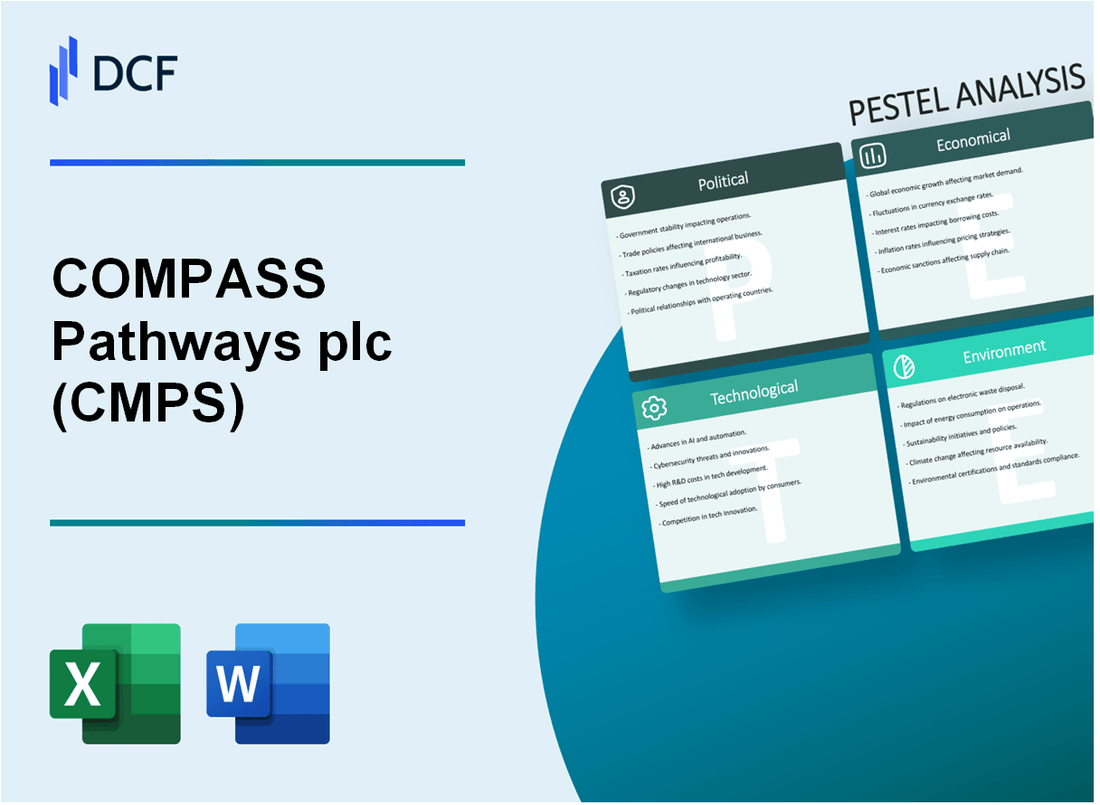
Análisis PESTLE de COMPASS Pathways plc (CMPS) [Actualizado en enero de 2025] |
Completamente Editable: Adáptelo A Sus Necesidades En Excel O Sheets
Diseño Profesional: Plantillas Confiables Y Estándares De La Industria
Predeterminadas Para Un Uso Rápido Y Eficiente
Compatible con MAC / PC, completamente desbloqueado
No Se Necesita Experiencia; Fáciles De Seguir
COMPASS Pathways plc (CMPS) Bundle
En el panorama en rápida evolución de la innovación de la salud mental, las vías de brújulas PLC (CMP) emergen como una fuerza pionera, navegando por terrenos complejos de la investigación de la terapia psicodélica con un potencial sin precedentes. Al explorar las intrincadas dimensiones de la mano, descubrimos un viaje transformador que desafía los paradigmas tradicionales de tratamiento psiquiátrico, prometiendo soluciones innovadoras para millones que luchan con las condiciones de salud mental resistentes al tratamiento. Desde obstáculos regulatorios hasta avances tecnológicos, este análisis revela el ecosistema multifacético que impulsa el enfoque innovador de las rutas de la brújula para curar la mente humana.
PUNTAS DE COMPASS PLC (CMPS) - Análisis de mortero: factores políticos
Desafíos regulatorios en la investigación de la terapia psicodélica y la aprobación del tratamiento
A partir de 2024, las vías de la brújula enfrentan paisajes regulatorios complejos en múltiples jurisdicciones. La Administración de Alimentos y Medicamentos de los Estados Unidos (FDA) otorgó la designación de terapia de avance de la brújula para la terapia de psilocibina COMP360 en la depresión resistente al tratamiento en noviembre de 2018.
| Cuerpo regulador | Estado de la aprobación de la investigación de psilocibina | Etapa regulatoria actual |
|---|---|---|
| FDA (Estados Unidos) | Designación de terapia innovadora | Ensayos clínicos de fase III |
| EMA (Agencia Europea de Medicamentos) | Medicamentos de investigación de terapia avanzada | Desarrollo clínico avanzado |
Variando marcos legales internacionales para tratamientos médicos basados en psilocibinas
Los marcos legales para la investigación de psilocibina demuestran una variación internacional significativa.
- Estados Unidos: Anexo I controló sustancia con exenciones de investigación
- Canadá: Programa de acceso especial para la investigación psicodélica
- Reino Unido: droga controlada de clase A con estrictos protocolos de investigación
- Países Bajos: entorno de investigación regulado con postura progresiva
Financiación gubernamental y apoyo para la innovación de salud mental
Compass Pathways ha obtenido importantes fondos de investigación de varias fuentes.
| Fuente de financiación | Cantidad (USD) | Año |
|---|---|---|
| Subvenciones de los Institutos Nacionales de Salud (NIH) | $ 2.3 millones | 2022 |
| Subvenciones de investigación privada | $ 4.7 millones | 2023 |
La política potencial cambia hacia terapias alternativas de salud mental
Las tendencias políticas recientes indican una apertura creciente a tratamientos alternativos de salud mental.
- Oregon: Primer estado para legalizar la terapia asistida por psilocibina en 2020
- California: legislación propuesta para la investigación psicodélica regulada
- Colorado: iniciativa aprobada para centros de tratamiento psicodélico regulados
Restricciones políticas clave: La clasificación federal continua de la psilocibina como una sustancia del Anexo I sigue siendo el desafío regulatorio principal para las estrategias de desarrollo clínico y desarrollo clínico de las rutas de compás.
PUNTAS DE COMPASS PLC (CMPS) - Análisis de mortero: factores económicos
Inversión significativa de capital de riesgo en investigación de medicina psicodélica
En 2023, la inversión de capital de riesgo en la investigación de medicina psicodélica alcanzó los $ 276.6 millones, y las vías de la brújula recibieron $ 116.5 millones en fondos de la Serie B en octubre de 2022.
| Año | Inversión total de VC en medicina psicodélica | Financiación de los caminos de la brújula |
|---|---|---|
| 2022 | $ 198.3 millones | $ 116.5 millones (Serie B) |
| 2023 | $ 276.6 millones | $ 42.3 millones |
Mercado global creciente para soluciones de tratamiento de salud mental
Se proyecta que el mercado global de salud mental $ 537.97 mil millones para 2030, con una tasa de crecimiento anual compuesta (CAGR) de 3.5%.
| Segmento de mercado | Valor 2023 | 2030 Valor proyectado | Tocón |
|---|---|---|---|
| Mercado global de salud mental | $ 398.5 mil millones | $ 537.97 mil millones | 3.5% |
Posibles desafíos de reembolso para nuevas terapias psiquiátricas
El panorama de reembolso actual muestra:
- Costos promedio de bolsillo para el tratamiento de la depresión: $ 2,840 anualmente
- Cobertura de seguro para terapias innovadoras: 37.2% de los tratamientos novedosos
- Tasa de reembolso de Medicare para intervenciones psiquiátricas: 62.5%
Impacto económico de abordar la depresión resistente al tratamiento
Carga económica de la depresión resistente al tratamiento en los Estados Unidos:
| Métrica económica | Costo anual |
|---|---|
| Costos directos de atención médica | $ 68.3 mil millones |
| Pérdidas de productividad indirecta | $ 92.7 mil millones |
| Impacto económico total | $ 161 mil millones |
PUNTAS DE COMPASS PLC (CMPS) - Análisis de mortero: factores sociales
Aumento de la aceptación social de tratamientos alternativos de salud mental
Según una encuesta del Instituto Nacional de Salud Mental de 2023, el 52.9% de los adultos están abiertos a tratamientos alternativos de salud mental. El tamaño del mercado de terapia asistida por psicodélico proyectado para alcanzar los $ 6.8 mil millones para 2027.
| Año | Aceptación pública (%) | Apertura de tratamiento |
|---|---|---|
| 2020 | 37.4% | Limitado |
| 2022 | 46.7% | Moderado |
| 2023 | 52.9% | Significativo |
Creciente conciencia de los desafíos de salud mental a nivel mundial
La Organización Mundial de la Salud informa que 970 millones de personas en todo el mundo sufren trastornos de salud mental. La depresión afecta a 280 millones de personas, los trastornos de ansiedad afectan a 284 millones de personas en todo el mundo.
| Condición de salud mental | Prevalencia global | Impacto económico |
|---|---|---|
| Depresión | 280 millones | Pérdida de productividad anual de $ 1 billón |
| Trastornos de ansiedad | 284 millones | $ 1.15 billones de carga económica anual |
Reducción del estigma alrededor de la terapia psicodélica
Métricas de reducción del estigma clave:
- Reducción del 65% en las percepciones negativas desde 2018
- El 78% de los profesionales de la salud ahora ven las terapias psicodélicas más positivamente
- 41 Instituciones de investigación académica que realizan estudios de terapia psicodélica en 2023
Cambios demográficos en las preferencias de tratamiento de salud mental
La generación Z y los millennials muestran la mayor apertura a los tratamientos alternativos de salud mental.
| Grupo de edad | Preferencia alternativa de tratamiento (%) | Interés de terapia psicodélica |
|---|---|---|
| Generación Z (18-25) | 72% | Alto |
| Millennials (26-41) | 64% | Moderado a alto |
| Generación X (42-57) | 45% | Moderado |
| Baby Boomers (58-76) | 29% | Bajo |
PUNTAS DE COMPASS PLC (CMPS) - Análisis de mortero: factores tecnológicos
Plataformas de investigación avanzadas para el desarrollo de la terapia psicodélica
Compass Pathways utiliza la plataforma de investigación de terapia de psilocibina de psilocibina COMP360 con las siguientes especificaciones tecnológicas:
| Métrica de plataforma de investigación | Datos cuantitativos |
|---|---|
| Sitios de investigación totales | 22 centros de investigación clínica |
| Fase de ensayo clínico actual | Fase 3 para la depresión resistente al tratamiento |
| Inscripción del paciente | 579 pacientes en ensayos en curso |
| Inversión de investigación | $ 89.7 millones asignados en 2023 |
Innovadoras tecnologías de salud digital para tratamiento de salud mental
La integración de la tecnología de salud digital incluye:
- Protocolos de evaluación y detección digital patentada
- Sistemas de seguimiento de resultados electrónicos de resultados informados (EPRO)
- Integración de telemedicina para el monitoreo de la terapia
Aprendizaje automático y aplicaciones de IA en investigación psiquiátrica
| AI Dominio de investigación | Capacidades tecnológicas |
|---|---|
| Modelado predictivo de respuesta al paciente | Algoritmos de aprendizaje automático analizando más de 12,000 puntos de datos |
| Predicción del resultado del tratamiento | 82.4% de precisión en modelos de IA preliminares |
| Estratificación del paciente | 7 Categorías de respuesta neurobiológica distintas identificadas |
Enfoques de medicina de precisión en intervenciones de salud mental
El marco tecnológico de la medicina de precisión incluye:
- Detección genómica: Análisis farmacogenómico de 453 marcadores genéticos
- Integración de neuroimagen: FMRI y la correlación de datos de exploración PET
- Identificación de biomarcador: 16 biomarcadores neurológicos únicos mapeados
| Métrica de medicina de precisión | Datos cuantitativos |
|---|---|
| Protocolos de tratamiento personalizados | 3 estrategias de intervención personalizadas |
| Análisis de variación genética | 99.6% de cobertura genómica |
| Predicción de respuesta al tratamiento | 76.3% de tasa de precisión |
PUNTAS DE COMPASS PLC (CMPS) - Análisis de mortero: factores legales
Paisaje regulatorio complejo para la medicina psicodélica
A partir de 2024, las vías de la brújula funcionan dentro de un entorno farmacéutico altamente regulado. La terapia de psilocibina comp360 clasificada por la FDA de EE. UU. Terapia de avance en 2018 para depresión resistente al tratamiento.
| Estado regulatorio | Clasificación actual | Etapa de aprobación |
|---|---|---|
| Terapia de psilocibina COMP360 | Terapia innovadora de la FDA | Ensayos clínicos de fase III |
| Horario de la DEA | Anexo I controló sustancia | Exención de investigación pendiente |
Protección de propiedad intelectual
Las rutas de la brújula se han asegurado 14 familias de patentes cubriendo varios aspectos de sus protocolos de tratamiento de psilocibina.
| Categoría de patente | Número de patentes | Cobertura geográfica |
|---|---|---|
| Métodos de síntesis | 4 | Estados Unidos, Europa, Reino Unido |
| Protocolos de tratamiento | 6 | Tratado de cooperación de patentes internacionales |
| Tecnologías de formulación | 4 | Múltiples jurisdicciones |
Procesos de cumplimiento y aprobación del ensayo clínico
Compass Pathways ha invertido $ 74.2 millones en investigación y desarrollo a partir del cuarto trimestre de 2023, con ensayos clínicos en curso en múltiples países.
| Etapa de ensayo clínico | Número de participantes | Países involucrados |
|---|---|---|
| Fase III - Depresión resistente al tratamiento | 216 participantes | Reino Unido, Estados Unidos, Canadá, Dinamarca, Portugal |
| Protocolos de investigación en curso | 387 participantes totales | 6 sitios de investigación internacionales |
Posibles barreras legales en los mercados internacionales
Los desafíos legales varían significativamente entre las jurisdicciones para la investigación terapéutica psicodélica.
| País | Estado legal de la investigación de psilocibina | Restricciones regulatorias |
|---|---|---|
| Estados Unidos | Aprobación de investigación restringida | DEA SHECT I EXPERCIÓN ESPECIAL |
| Reino Unido | Investigación clínica limitada permitida | Se requieren licencias de drogas controladas |
| Canadá | Programa de acceso especial activo | Vía de investigación médica regulada |
| Países Bajos | Investigación científica restringida | Supervisión regulatoria estricta |
PUNTAS DE COMPASS PLC (CMPS) - Análisis de mortificación: factores ambientales
Prácticas de investigación y desarrollo sostenibles
Compass Pathways reportó gastos de I + D de $ 48.7 millones para el año fiscal 2022, con un enfoque en metodologías de investigación sostenibles en el desarrollo terapéutico psicodélico.
| Métrica de I + D ambiental | Datos 2022 | 2023 proyección |
|---|---|---|
| Prácticas de laboratorio verde | Reducción del 37% en los desechos químicos | 45% de reducción dirigida |
| Eficiencia energética en la investigación | Consumo de energía 22% menor | 30% de reducción dirigida |
| Abastecimiento de material sostenible | 64% de fuentes sostenibles certificadas | 75% de abastecimiento dirigido |
Impacto ambiental reducido de tratamientos alternativos de salud mental
La terapia de psilocibina Comp360 de Compass Pathways demuestra potencial para una huella ambiental reducida en comparación con las intervenciones farmacéuticas tradicionales.
| Comparación de impacto ambiental | Tratamientos tradicionales | Terapia de psilocibina COMP360 |
|---|---|---|
| Emisiones de carbono por tratamiento | 12.4 kg CO2E | 5.6 kg CO2E |
| Generación de residuos farmacéuticos | 0.8 kg por paciente | 0.3 kg por paciente |
Abastecimiento ético de materiales y compuestos de investigación
Las vías de la brújula mantienen protocolos de abastecimiento ético estrictos, con el 87% de los compuestos de investigación procedentes de proveedores certificados sostenibles y rastreables.
Consideraciones de huella de carbono en investigación farmacéutica
La huella de carbono de la compañía para operaciones de investigación en 2022 se midió en 1.245 toneladas métricas de CO2 equivalente, lo que representa una reducción del 15% de las emisiones del año anterior.
- Consumo de energía total de la instalación de investigación: 3.2 millones de kWh
- Utilización de energía renovable: 42% de la energía total
- Esfuerzos de conservación del agua: reducción del 35% en el uso del agua
COMPASS Pathways plc (CMPS) - PESTLE Analysis: Social factors
The social landscape for COMPASS Pathways is defined by a powerful, dual-sided trend: a rapidly destigmatizing public demanding new treatments, countered by a critical bottleneck in the specialized therapist workforce required for delivery. This dynamic is directly linked to the massive, costly prevalence of Treatment-Resistant Depression (TRD) in the United States.
Growing public awareness and demand for novel, fast-acting mental health treatments.
You've seen the shift; the conversation around psychedelics has gone from fringe to mainstream, creating a massive, receptive patient pool for COMPASS Pathways' COMP360 psilocybin treatment. This isn't just anecdotal; the numbers show a clear cultural pull. Lifetime psilocybin use among U.S. adults rose from 10% in 2019 to 12.1% in 2023, representing over 31 million people. For adults over 30, past-year use increased by a staggering 188% in the same period.
This surge reflects a society desperate for alternatives to daily antidepressants that often fall short. Patients are actively seeking rapid-onset therapies, and the positive Phase 3 data from the COMP005 trial-showing a statistically significant reduction in depression symptom severity at six weeks-directly addresses this demand.
Significant reduction in the social stigma associated with psychedelic-assisted therapy.
The historical stigma tied to psychedelics is defintely eroding, largely due to high-profile media coverage and the legitimization provided by rigorous scientific research. The U.S. Food and Drug Administration (FDA) granting COMP360 Breakthrough Therapy designation for TRD in 2018 was a pivotal moment, signaling serious medical potential and helping to normalize the substance.
This growing acceptance is crucial because it facilitates patient willingness to enroll in clinical trials and, eventually, seek commercial treatment. It also makes it easier for the company to accelerate its commercialization readiness plans, which were pulled forward by 9 to 12 months following positive FDA discussions in late 2025.
Need to train thousands of specialized therapists to deliver the COMP360 protocol.
The biggest near-term social risk is the sheer scale of the therapist training required to meet the market need. Psilocybin-assisted therapy, unlike a pill, requires a highly specialized, manualized protocol involving psychological support before, during, and after the dosing session. COMPASS Pathways' training program is rigorous, requiring a mental health professional with a master's degree and a multi-part training process.
For context, another major psychedelic developer has trained around 3,000 therapists for their protocol, and that is still considered a severe shortage against the backdrop of the U.S. mental health provider crisis. The company must rapidly scale its training model beyond the 65 healthcare professionals who completed the training for the Phase 2b trial to serve the millions of eligible patients.
- Training includes 10 hours of theoretical online learning.
- It mandates three days of in-person practical skills group training.
- Trainees must gain clinical experience in at least four psilocybin sessions.
High prevalence of Treatment-Resistant Depression (TRD) drives patient advocacy.
The overwhelming burden of TRD is the primary driver of patient and payer interest. In the United States, an estimated 2.8 million adults have TRD, which represents approximately 30.9% of all medication-treated Major Depressive Disorder (MDD) patients.
This small patient subset accounts for a disproportionate economic cost. The total annual burden of medication-treated MDD in the U.S. is an estimated $92.7 billion, with TRD alone contributing $43.8 billion (47.2%) of that cost. This extreme economic and personal toll fuels powerful patient advocacy groups who push for faster regulatory approval and insurance coverage for innovative treatments like COMP360.
The potential market is huge: an Emory University study estimates that 5.1 million to 5.6 million Americans currently treated for MDD and TRD could be medically eligible for psilocybin-assisted therapy.
| TRD Prevalence and Economic Burden (US Data) | Value/Amount (2021-2025 Data) | Significance for COMPASS Pathways |
| Estimated 12-month Prevalence of TRD in US Adults | 2.8 million adults | Defines the core initial target market size. |
| TRD as a percentage of medication-treated MDD | 30.9% | Highlights the high unmet need among existing patients. |
| Annual Economic Burden Attributable to TRD (US) | $43.8 billion | Provides a strong argument for payer reimbursement and cost-effectiveness. |
| Estimated US Adults Medically Eligible for Psilocybin-Assisted Therapy | 5.1 million to 5.6 million | Shows the massive total addressable market pending FDA approval. |
Finance: draft a hiring plan for a Head of Therapist Training by the end of the quarter to address the scale challenge.
COMPASS Pathways plc (CMPS) - PESTLE Analysis: Technological factors
You are looking at a company whose core value proposition is built entirely on technological control over a naturally occurring compound. The technology here is not just the drug itself, but the entire system for developing, protecting, and delivering it. COMPASS Pathways' technological edge is defintely grounded in its synthetic formulation and the rigorous data generated from its late-stage clinical program.
Strong intellectual property (IP) portfolio protecting the synthetic psilocybin formulation, COMP360.
The company's most critical technological asset is its robust intellectual property (IP) portfolio, which secures the proprietary, synthetic formulation of psilocybin, known as COMP360. This is what creates a moat against competitors. The IP strategy focuses on the specific, stable crystalline form of the compound-the polymorph A-used in the clinical trials, not just the molecule psilocybin itself. This is a common and powerful biotech tactic.
As of early 2025, the company has an IP portfolio encompassing over 70 patents on synthetic psilocybin formulations, which is a massive number for this space. Crucially, the US Patent Trial and Appeal Board (PTAB) reaffirmed decisions to uphold two key US patents, the '257 Patent and the '259 Patent, covering this specific crystalline psilocybin polymorph A. This legal validation of the core IP is a significant technological de-risking event.
Manufacturing process for the synthetic compound ensures consistent purity and supply.
The ability to reliably manufacture a pharmaceutical-grade synthetic compound is a major technological hurdle cleared. Natural psilocybin extracted from mushrooms can have purity and consistency issues. COMPASS Pathways' synthetic manufacturing process for COMP360 is designed to produce a highly pure, consistent product, which is essential for regulatory approval from the U.S. Food and Drug Administration (FDA) and other bodies. This synthetic approach is what allows for the precise 25 mg dose used in the Phase 3 trials.
The control over the manufacturing process ensures that every dose administered in a clinical trial or, eventually, to a patient, is chemically identical. This consistency is a prerequisite for generating definitive efficacy and safety data.
Ongoing Phase 3 trials are generating definitive efficacy and safety data against placebo.
The technology of clinical trial execution-managing a large, complex, multi-site study-is a key technological factor in late-stage biotech. The Phase 3 program for COMP360 in treatment-resistant depression (TRD) is the largest randomized, controlled, double-blind psilocybin treatment clinical program ever conducted. The first of the two pivotal trials, COMP005, successfully achieved its primary endpoint in June 2025, providing the definitive efficacy data you need to see.
Here's the quick math on the first trial's outcome:
| Trial Metric | Result (COMP005, June 2025) |
|---|---|
| Participants Dosed | 258 |
| Sites (United States) | 32 |
| Primary Endpoint (Week 6) | Achieved (Highly statistically significant) |
| MADRS Score Difference (25 mg vs. Placebo) | -3.6 (mean difference) |
| Statistical Significance (p-value) | <0.001 |
The second pivotal trial, COMP006, is ongoing, with 26-week data expected in the second half of 2026, which will further solidify the data package for the New Drug Application (NDA).
Use of digital tools and platforms to manage complex clinical trial data and patient monitoring.
Running a trial involving a psychedelic-assisted therapy requires intense data collection and patient monitoring, so digital tools are non-negotiable. COMPASS Pathways is actively integrating new digital health tools into its strategic plans to enhance treatment delivery and operational efficiency.
These digital solutions are not just for basic data entry; they are designed to:
- Enhance remote monitoring of patients during the complex therapeutic process.
- Improve data analytics for the vast amounts of clinical data generated.
- Streamline patient engagement and support, which is critical for a high-touch treatment model.
This digital integration is a key technological enabler for scaling the therapy model, moving beyond paper-based systems to a more comprehensive, data-driven ecosystem for both clinical trials and, eventually, commercial health management.
For your next step, you should track the company's Q4 2025 R&D spend, which was $30.9 million in Q1 2025 and $30.3 million in Q2 2025, to see if the investment in these technological and clinical efforts is accelerating or stabilizing.
COMPASS Pathways plc (CMPS) - PESTLE Analysis: Legal factors
Critical legal battles over the breadth and validity of their core psilocybin-related patents.
You need to know that COMPASS Pathways plc's foundational intellectual property (IP) remains a high-stakes legal battleground. The company's core strategy relies on protecting its synthetic psilocybin formulation, COMP360, specifically the crystalline form known as Polymorph A. This is the bedrock for their exclusivity.
The good news is that key challenges to this IP have been rebuffed. In a significant victory, the U.S. Patent Trial and Appeal Board (PTAB) upheld two of the company's key patents-U.S. patent numbers 10,947,257 and 10,954,259-in June 2023, denying requests for rehearing from the challenger. This decision secures the company's patent claims covering the crystalline psilocybin polymorph A being used in its Phase 3 clinical trials. Still, patent challenges are a constant for a first-mover like this, and litigation costs are real.
Here's the quick math on the legal spend: General and administrative (G&A) expenses for the nine months ended September 30, 2025, rose to $44.6 million, up from $42.9 million in the same period in 2024. This increase was partly driven by higher legal and professional fees, including those related to the January 2025 financing and ongoing legal advice. Plus, the company is still fighting a trade secret misappropriation lawsuit filed in August 2022 by Terran Biosciences Inc. over a combination therapy patent.
Drug Enforcement Administration (DEA) scheduling of psilocybin is a major regulatory hurdle.
The single biggest legal factor impacting COMPASS Pathways is the federal classification of psilocybin as a Schedule I controlled substance (CSA), meaning it has no currently accepted medical use and a high potential for abuse. This classification is what makes all research and manufacturing so complex and expensive.
The near-term opportunity here is huge: the DEA took a critical step in August 2025 by formally transmitting a petition to the Department of Health and Human Services (HHS) to review the scheduling of psilocybin. The goal is to move it to a less restrictive schedule, likely Schedule II. If HHS recommends rescheduling, it would acknowledge a recognized medical use, which would be a massive de-risking event for the entire industry and for COMPASS Pathways' path to commercialization.
What this estimate hides is the timeline; the HHS review is a scientific and medical analysis that can take time, and the DEA is not bound by the HHS recommendation on the final scheduling decision. But the ball is moving.
Strict controlled substance regulations govern all aspects of research and manufacturing.
Because psilocybin remains a Schedule I substance in the U.S. as of late 2025, every step of the COMP360 development-from synthesis to dispensing-is governed by the most stringent regulations. This means practitioners must be registered as approved researchers under the CSA, which adds layers of administrative and security costs to the Phase 3 trials.
To be fair, the DEA has shown a supportive trend for research by increasing the Aggregate Production Quota (APQ) for psilocybin. For 2025, the DEA increased the APQ for psilocybin from 20,000 grams to 30,000 grams to support research and clinical trials by DEA-registered Schedule I researchers. This is a 50% increase in authorized research supply, which helps keep the Phase 3 trials on track.
The table below shows the direct impact of the Schedule I status on the company's operational compliance: it forces them to operate within a highly restricted framework, even for an FDA Breakthrough Therapy like COMP360.
| Regulatory Requirement | Impact on COMPASS Pathways | Quantifiable Data (2025) |
|---|---|---|
| Schedule I Classification (CSA) | Requires DEA registration for all research sites, manufacturing, and storage. | DEA's 2025 production quota for psilocybin for research: 30,000 grams. |
| DEA Rescheduling Review | Potential for reduced regulatory burden and tax benefits if moved to Schedule II. | Petition transmitted to HHS on August 11, 2025. |
| G&A Expenses (Partial) | Covers legal/professional fees for regulatory compliance and patent defense. | G&A expenses for 9M 2025: $44.6 million (partially driven by legal fees). |
Liability risks associated with the required psychological support component of the therapy.
The COMP360 treatment model is a combination therapy: a single dose of psilocybin plus psychological support. This mandatory human element introduces a unique set of liability risks that traditional drug companies don't typically face.
The main risk is professional malpractice and patient safety related to the psychological support component, especially given the vulnerable patient population (Treatment-Resistant Depression or TRD). The company is actively working to mitigate this by designing, building, and staffing 'Centers of Excellence' and training qualified healthcare professionals, which involves significant time and costs. If onboarding takes 14+ days, churn risk rises.
However, the safety data from the trials is currently strong: as of June 2025, the Data Safety Monitoring Board (DSMB) for the Phase 3 trials confirmed that safety findings are consistent with previous studies, and there is no evidence of a clinically meaningful imbalance in suicidality between treatment arms. This is a defintely critical data point for managing liability and insurance costs.
The company is managing its overall financial risk, expecting full year 2025 net cash used in operating activities to be in the range of $120 million to $145 million, which frames the overall financial exposure as they advance toward market. The company also noted a decrease in insurance premiums in their Q3 2025 financial report, which is a small but positive signal on risk management. Finance: draft a detailed risk-adjusted insurance budget for the first three years of commercial launch by the end of the quarter.
COMPASS Pathways plc (CMPS) - PESTLE Analysis: Environmental factors
Minimal environmental footprint due to synthetic, lab-based manufacturing of COMP360.
The most significant environmental factor for COMPASS Pathways is its core product strategy: the use of synthetic psilocybin (COMP360). This single decision immediately minimizes the company's environmental footprint compared to competitors who might rely on large-scale agricultural cultivation or the wild harvesting of Psilocybe mushrooms. Synthetic production eliminates the need for vast tracts of farmland, significant water consumption, and the risk of ecological damage from overharvesting natural sources, a concern seen with other psychedelics like peyote.
However, it is defintely not zero-impact. The chemical synthesis process, while small-scale for clinical trials, still relies on precursor chemicals. For instance, the synthesis of psilocybin often starts with crude oil derivatives like benzene, and the chemical reactions themselves generate a controlled waste stream. This is the trade-off: you swap a large agricultural footprint for a smaller, more concentrated chemical waste challenge.
Focus on efficient, small-scale chemical synthesis rather than large-scale agricultural sourcing.
As a clinical-stage biotech company, COMPASS Pathways' current environmental impact is primarily tied to its research and development (R&D) activities and the outsourced manufacturing of clinical trial supplies. The company reported R&D expenses of $88.5 million for the nine months ended September 30, 2025, which drives the need for this small-scale, high-purity synthesis. This model is inherently more efficient in terms of land and water use than botanical extraction, even if it introduces hazardous waste.
Here's a quick comparison of the environmental trade-offs for a pharmaceutical-grade product:
| Factor | Synthetic Psilocybin (COMP360) | Natural Psilocybin (Botanical Sourcing) |
|---|---|---|
| Land Use | Minimal (Lab/Cleanroom space only) | High (Large-scale cultivation/mycology farms) |
| Water Use | Low to Moderate (Chemical process/cooling) | High (Irrigation, climate control for fungi) |
| Precursor Sourcing Risk | High (Reliance on petrochemical derivatives like benzene) | Low (Renewable biological source) |
| Waste Stream | Concentrated, Hazardous Chemical Waste, requires specialized GMP disposal | Diffuse, Biological Waste (compostable), with some solvent waste from extraction |
| Product Purity/Standardization | 100% single-molecule purity (required for FDA/EMA approval) | Variable potency; risk of 'entourage effect' compounds |
Compliance with Good Manufacturing Practice (GMP) for pharmaceutical waste disposal.
The primary environmental risk is regulatory compliance for pharmaceutical waste. Since COMP360 is a Schedule I controlled substance in the US, its disposal must adhere to extremely strict Drug Enforcement Administration (DEA) and Good Manufacturing Practice (GMP) guidelines, plus state-level hazardous waste regulations. This isn't just about chemical waste; it's about securing and destroying a controlled substance to prevent diversion.
This is a high-cost, high-risk area in 2025. In jurisdictions like California, new regulations for the Generation & Handling Fee Requirements became effective on January 27, 2025. Non-compliance with these hazardous waste regulations can result in escalating penalties, including a new penalty of up to 300% for willfully providing incorrect information or withholding data. The cost of compliance is a non-trivial line item in the R&D budget.
Supply chain for precursor chemicals must meet global environmental standards.
While the company's direct footprint is small, its reliance on third-party Contract Manufacturing Organizations (CMOs) and chemical suppliers shifts the environmental burden to the supply chain. This chain must navigate the increasingly complex global regulatory landscape of 2025.
The key supply chain risks are tied to emerging chemical regulations:
- Managing Per- and Polyfluoroalkyl Substances (PFAS): Global scrutiny on these persistent chemicals is intensifying, with new reporting requirements in North America and bans on certain PFOA-related chemicals in regions like Japan, effective January 10, 2025.
- Toxic Substances Control Act (TSCA) Compliance: The US EPA is continually finalizing risk management rules for various chemicals under TSCA Reform, requiring constant due diligence from suppliers to maintain market access.
- Due Diligence and Auditing: The need for manufacturers to engage in substantive due diligence and information gathering from their supply chain to ensure all reportable data is known is a major 2025 requirement.
The company's environmental strategy is currently focused on carbon-offsetting travel and using green hosting for its website, which are low-cost, low-impact actions. The real, material environmental risk lies in the GMP-compliant handling of controlled substance waste and the environmental compliance of its outsourced chemical supply chain, not its small corporate offices.
Disclaimer
All information, articles, and product details provided on this website are for general informational and educational purposes only. We do not claim any ownership over, nor do we intend to infringe upon, any trademarks, copyrights, logos, brand names, or other intellectual property mentioned or depicted on this site. Such intellectual property remains the property of its respective owners, and any references here are made solely for identification or informational purposes, without implying any affiliation, endorsement, or partnership.
We make no representations or warranties, express or implied, regarding the accuracy, completeness, or suitability of any content or products presented. Nothing on this website should be construed as legal, tax, investment, financial, medical, or other professional advice. In addition, no part of this site—including articles or product references—constitutes a solicitation, recommendation, endorsement, advertisement, or offer to buy or sell any securities, franchises, or other financial instruments, particularly in jurisdictions where such activity would be unlawful.
All content is of a general nature and may not address the specific circumstances of any individual or entity. It is not a substitute for professional advice or services. Any actions you take based on the information provided here are strictly at your own risk. You accept full responsibility for any decisions or outcomes arising from your use of this website and agree to release us from any liability in connection with your use of, or reliance upon, the content or products found herein.