

|
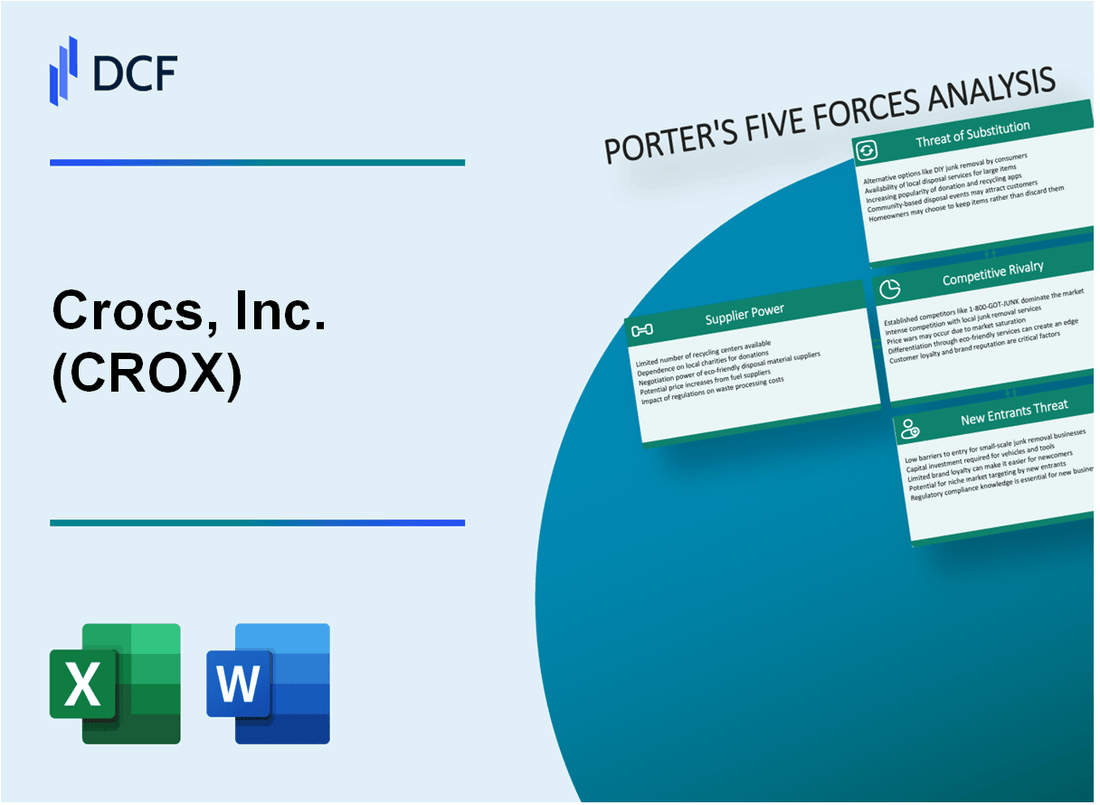
Crocs, Inc. (CROX): 5 FORCES Analysis [Apr-2026 Updated] |
Completamente Editable: Adáptelo A Sus Necesidades En Excel O Sheets
Diseño Profesional: Plantillas Confiables Y Estándares De La Industria
Predeterminadas Para Un Uso Rápido Y Eficiente
Compatible con MAC / PC, completamente desbloqueado
No Se Necesita Experiencia; Fáciles De Seguir
Crocs, Inc. (CROX) Bundle
You're looking at a company projected to hit $4.3 billion to $4.5 billion in 2025 revenue, which means you need a crystal-clear view of its competitive moat, right? As someone who's spent two decades in the trenches, including a decade leading analysis at a major asset manager, I can tell you that even a cultural juggernaut faces real pressure. This quick, precise Porter's Five Forces analysis cuts through the noise, showing you exactly where the power lies-from the proprietary Croslite™ material acting as a supplier shield to the defintely real risk posed by athletic footwear substitutes. Dive in below to see the hard numbers on rivalry intensity and customer leverage that will shape the next chapter for Crocs, Inc.
Crocs, Inc. (CROX) - Porter's Five Forces: Bargaining power of suppliers
You're looking at how much leverage Crocs, Inc.'s suppliers have, which directly impacts the company's cost structure and profitability. Honestly, the power dynamic here is a mix of Crocs, Inc.'s proprietary advantages and external trade pressures.
Production Outsourcing and Capital Risk
Crocs, Inc. relies heavily on a third-party manufacturing base to produce its footwear. This structure means the company keeps its capital investment risk low; it doesn't own the massive factory footprint that some competitors might. While the exact percentage of entirely outsourced production isn't a commonly published figure, the strategy is clearly one of asset-light operations, using multiple contract manufacturers globally.
The proprietary nature of the core component gives Crocs, Inc. some insulation, but the reliance on external partners for assembly remains a key factor in supplier power.
Proprietary Material and Switching Costs
The bargaining power of suppliers for the basic raw materials, like the elastomer resins used to make Croslite™, is somewhat mitigated because Crocs, Inc. uses a proprietary formulation. However, the push toward sustainability is creating a new type of supplier constraint. Crocs, Inc. is working toward a goal of achieving 50% bio-circular content within its Croslite™ compounds by 2030. As of August 2024, the company had already achieved 25% bio-circular content.
This focus on bio-circular inputs, sourced from repurposed waste like spent cooking oil, limits the pool of suppliers who can meet the necessary scale and ISCC PLUS certification standards. You see, this innovation, while good for ESG, tightens the circle of qualified material providers, potentially increasing their leverage over time.
- Croslite™ material accounts for more than 80% of Crocs, Inc.'s total materials used.
- The current bio-circular content in Croslite™ is at least 25% (as of August 2024).
- The long-term goal for bio-circular content is 50% by 2030.
- The company maintains the same style, comfort, and price point while rolling out better materials.
Global Manufacturing Diversification
To counter the risk of concentration with any single manufacturer, Crocs, Inc. maintains a flexible, globally-diversified manufacturing base. This diversification is critical for managing geopolitical and operational risks. For instance, in 2023, approximately 56% of Crocs Brand production was in Vietnam.
By May 2025, the company's planned sourcing mix reflected this strategy to spread risk across several nations, which helps prevent any one supplier or country from holding too much sway over production capacity.
| Sourcing Location (Planned May 2025) | Percentage of Sourcing Mix |
|---|---|
| Vietnam | 47% |
| Indonesia | 17% |
| China | 13% |
| India | 13% |
| Mexico | 5% |
| Cambodia | 5% |
Tariff Headwinds and Cost Pressure
External trade policy is definitely increasing supplier cost pressure on Crocs, Inc. The company explicitly warned that evolving global trade policy, specifically new tariffs, would create a significant financial headwind in fiscal year 2025. This pressure is felt because the cost of goods sold rises, and Crocs, Inc. is trying to avoid passing the full amount to the consumer.
Here's the quick math on the tariff impact, based on the current sourcing mix as of mid-2025:
- Annualized tariff headwind projected for 2025: $90 million.
- Projected tariff impact in the second half of 2025: $40 million.
- Tariffs are expected to impact the adjusted operating margin by approximately 170 basis points in the second half of 2025.
If the most severe tariff scenarios were to materialize, the potential annualized cost could be as high as $130 million, though management indicated they would cancel orders rather than absorb that full amount. This uncertainty forces Crocs, Inc. to be extremely cautious with its supplier contracts and inventory planning.
Crocs, Inc. (CROX) - Porter's Five Forces: Bargaining power of customers
You're looking at how much sway the end buyer has over Crocs, Inc. (CROX) pricing and terms. It's a mixed bag, honestly, with some strong brand equity pushing back against general consumer caution.
Customer power is definitely mitigated by strong brand loyalty and a stated 26.8% repeat customer rate. This suggests a core group of buyers who aren't easily swayed by a competitor's price tag. Also, the cultural relevance is high; Crocs, Inc. (CROX) is the #1 footwear brand on TikTok Shop in the U.S., which helps keep price sensitivity low for trend-driven purchases. For example, during a Super Brand Day event last October, Crocs raked in $1 million in sales and saw a 28,300% increase in live shopping sales versus pre-event levels.
Direct-to-Consumer (DTC) channels are helping Crocs, Inc. (CROX) keep a tighter grip on pricing. For the Crocs Brand specifically, DTC channels grew 2.0% in Q3 2025, reaching $472 million in revenue for the quarter. When you sell directly, you control the shelf price, which is a big plus when the broader market is soft.
Still, the wholesale channel is where customer power really shows up, especially for the HEYDUDE brand, which is facing significant pressure. The company is actively cleaning up inventory, which means deep discounts or returns to retailers, effectively lowering realized pricing. The outline suggests a projected decline of 7% to 9% for the wholesale channel in 2025, but the Q3 2025 actuals show the severity of the situation for the HEYDUDE brand.
Here's a quick look at the channel split for Q3 2025, which shows the DTC strength offsetting some wholesale weakness:
| Brand | Channel | Q3 2025 Revenue (Millions USD) | Year-over-Year Change |
|---|---|---|---|
| Crocs Brand | DTC | $472 | +2.0% |
| Crocs Brand | Wholesale | $364 | -7.9% |
| HEYDUDE Brand | DTC | $91 | -0.5% |
| HEYDUDE Brand | Wholesale | $69 | -38.6% |
Consumers are definitely showing caution, which forces strategic price management across the board. Consolidated revenues for Crocs, Inc. (CROX) fell 6.2% in Q3 2025 to $996 million. This caution is most evident in the HEYDUDE brand's performance, where overall revenue plunged 21.6% to $160 million in Q3 2025. You see this pressure reflected in the need for strategic action.
The overall impact of customer dynamics in Q3 2025 can be summarized by these key financial shifts:
- Consolidated revenue decrease: 6.2%.
- Income from operations decrease: 23.0%.
- HEYDUDE brand revenue decrease: 21.6%.
- Crocs Brand revenue decrease: 2.5%.
- Debt paid down: $63 million.
Finance: draft 13-week cash view by Friday.
Crocs, Inc. (CROX) - Porter's Five Forces: Competitive rivalry
You're looking at the competitive rivalry force for Crocs, Inc. (CROX), and honestly, it's a heavyweight fight every single day. The casual footwear market is packed, and Crocs, Inc. is competing against giants whose revenues dwarf its own. To put the scale in perspective, Nike posted revenues of $51.4 billion in 2024, and Adidas brought in $25 billion that same year. Compare that to Crocs, Inc.'s consolidated revenue of $996 million in the third quarter of 2025 alone, which was a 6.2% drop year-over-year. This sheer scale difference means rivals can outspend Crocs, Inc. significantly on marketing and R&D, making the rivalry intense.
Still, Crocs, Inc. manages to maintain a strong profitability edge, which is key to surviving this pressure. For the third quarter of 2025, the company posted an adjusted operating margin of 20.8%. That's impressive when you see that Nike's operating margin was reported at 11% in a recent comparison. Now, the company is guiding for a lower adjusted operating margin of approximately 15.5% for the fourth quarter of 2025, partly due to tariff headwinds. The focus on cost savings, including an identified incremental $100 million in gross cost savings beyond the $50 million for 2025, is a direct action to defend this margin against competitive pricing pressures.
Direct competition from other comfort-focused brands is definitely significant, especially in the clog and casual space. Birkenstock, for instance, is actively stealing share, with Crocs, Inc. expecting a 12% decline in North America clog sales in 2025, while Birkenstock's closed-toe shoe penetration has doubled from FY22 to FY25, reaching 40%. Skechers USA, Inc. also competes directly by focusing on comfort and everyday style across a wide range of casual and athletic footwear. The pressure is visible across the portfolio; the HEYDUDE brand is feeling it acutely.
The high rivalry pressure is clearly reflected in the HEYDUDE brand's recent performance. In the third quarter of 2025, HEYDUDE Brand revenues plummeted 21.6% to $160 million. This drop was driven by wholesale channel collapse, which saw revenues decrease 38.6%, and required significant cleanup actions like returns and markdown allowances. This indicates that in its specific segment, Crocs, Inc. is facing severe competitive pushback or inventory issues that rivals are exploiting.
To counter this, Crocs' strategy leans heavily on innovation and brand heat. They are using collaborations and new product introductions to keep the core brand relevant against rivals with massive scale. Here's a quick look at the competitive positioning versus key rivals based on recent market data:
| Metric | Crocs, Inc. (2025 Est. / Q3 2025 Actual) | Nike (2024 Actual) | Adidas (2024 Actual) |
|---|---|---|---|
| Revenue Scale (Annual) | N/A (Q3 2025 Rev: $996M) | $51.4 Billion | $25 Billion |
| Global Footwear Market Share | 1.0% (2024) | 14.1% (Global Sportswear Share, 2024) | 8.9% (Global Sportswear Share, 2024) |
| Adjusted Operating Margin | 20.8% (Q3 2025 Actual) | 11% (Reported) | N/A |
The reliance on brand-building tactics is essential because the company's overall market share is small compared to the leaders. The Crocs brand itself accounted for 80% of revenue in 2024, while HEYDUDE made up the remaining 20%. The path forward requires continuous differentiation, especially as consumer tastes shift. The Sydney Sweeney partnership is set to end after 2025, which adds another layer of uncertainty regarding the marketing spend needed to maintain momentum.
The competitive pressures manifest in several ways you need to watch:
- North America Crocs Brand revenue decreased 8.8% in Q3 2025.
- HEYDUDE wholesale revenue fell 38.6% in Q3 2025.
- Google Search Trends interest for Crocs is down 23% compared to Birkenstock's 2% decline.
- The company is actively using cash flow to fight back via capital allocation.
Finance: draft 13-week cash view by Friday.
Crocs, Inc. (CROX) - Porter's Five Forces: Threat of substitutes
The threat of substitutes is moderate-to-high, especially when you consider the sheer scale of the competition; the global footwear market is projected to reach approximately $495.46 billion in 2025, up from an estimated $427 billion in 2025 according to some reports, making the $384.21 billion figure you started with a reasonable baseline for the competitive environment you are operating in.
Athletic footwear presents a strong substitute trend, actively pulling consumer 'open to buy' dollars away from the casual space you occupy. For instance, the global athletic footwear market was valued at $131.1 billion in 2024, and while non-athletic footwear still held over 65% of the global market share in 2024, the athletic segment is the fastest growing, with projections showing it could claim 56% of the market by 2037. You see this dynamic playing out in your own portfolio, too; for Q1 2025, the HEYDUDE brand saw a 10% revenue dip, which is a clear indicator of where consumer dollars are moving when they prioritize performance or athleisure styling.
Honestly, numerous alternatives exist that offer comparable comfort, which keeps the pressure on. You have everything from basic sandals and flip-flops to the latest fashion sneakers competing for the same consumer dollar. To be fair, the average consumer switching cost between casual footwear brands is estimated to be between $20-$50, which is low enough to encourage trial of a competitor's product. Furthermore, the emerging sustainable and eco-friendly footwear alternatives market is projected to reach $8.25 billion by 2025, representing another distinct substitute category.
What keeps your core product sticky, though, is the functional switching cost created by your unique Croslite™ comfort and the instantly recognizable clog design. Developing a material with similar properties requires significant R&D investment from a substitute competitor, which is a barrier. You continue to invest here; by 2024, 25% of your Croslite material incorporated bio-circular content, with a stated 2030 objective of reaching 50% bio-circular material, which is a key differentiator that competitors cannot easily replicate without their own material science breakthroughs.
Still, rapidly changing fashion trends pose a defintely real risk that can shift consumer preference away from the core clog silhouette. You are already seeing this pressure manifest in your secondary brand; for the full year 2025, the HEYDUDE Brand is anticipated to experience a revenue decline of approximately 7% to 9% compared to fiscal year 2024. This shows you that even with the core brand's strength, a shift in casual fashion sentiment can immediately impact revenue streams.
Here's a quick look at how the major segments stack up in terms of market size and growth drivers, which helps map the substitute landscape:
| Segment | 2024 Market Size (Approximate) | Key Driver |
| Global Footwear (Total) | USD 423.35 billion (Source 6) / USD 457.09 billion (Source 4) | Rising disposable income, e-commerce penetration |
| Non-Athletic Footwear | Over 65% of global market share (Source 3) | Demand for casual and formal wear |
| Athletic Footwear | USD 138.53 billion (Source 14) | Health and fitness awareness, athleisure trend |
| Sustainable Footwear (Substitute) | Projected to reach USD 8.25 billion by 2025 | Environmental awareness |
You need to keep an eye on how quickly fashion cycles turn, as that dictates how much 'open to buy' budget consumers allocate to non-performance, non-essential comfort wear like the classic clog versus a trend-driven sneaker.
- Consumer switching cost between casual brands: $20-$50.
- Projected Crocs Brand revenue growth for 2025: Mid-single-digit increase, around 4.5%.
- Projected HEYDUDE Brand revenue change for 2025: Down 7% to 9%.
- Target Adjusted Operating Margin for 2025: 24.0%.
Crocs, Inc. (CROX) - Porter's Five Forces: Threat of new entrants
The threat of new entrants for Crocs, Inc. remains moderate to low, primarily because of the sheer scale and brand equity the company has built. You are competing against a business that posted total revenues of $4,102.1 million for the year ended December 31, 2024. For fiscal year 2025, the Crocs Brand is projected to see revenue growth of approximately 4.5%.
New players must spend heavily just to get noticed. Matching Crocs, Inc.'s global recognition requires significant capital outlay for brand building. In 2024, the company's Selling, General, and Administrative expenses (SG&A) totaled $1.38 billion. This level of marketing spend sets a high bar for any startup trying to achieve similar awareness.
The perceived proprietary nature of the core material acts as an intellectual property barrier, even with legal complexities. While Crocs, Inc. conceded that the Croslite material is not patented, the company has historically advertised it as patented, proprietary, and exclusive, suggesting a material difference in the eyes of the consumer. This perception, whether legally sound or not, creates a hurdle for new entrants claiming similar material advantages.
To be fair, the barriers for basic footwear design and manufacturing are quite low, which is where the threat is highest. For a very lean start, some industry estimates suggest a product launch is feasible with under $10,000 in startup capital when paired with crowdfunding. However, establishing a manufacturing footprint capable of volume requires more. For a small-scale shoe manufacturing unit, initial capital needs can range from ₹10 lakh to ₹20 lakh+. For machinery alone in manufacturing, estimates can reach $100,000 - $300,000.
Crocs, Inc.'s established economies of scale in production and distribution are incredibly difficult for smaller players to replicate. The company achieved a gross margin of 58.8% in 2024 and is targeting an adjusted operating margin of approximately 24.0% for 2025. This efficiency is powered by their massive distribution network, which put their product 'everywhere'.
Here's a quick look at the cost spectrum for starting a footwear venture, which helps frame the capital barrier:
| Business Model | Estimated Startup Investment Range (USD/INR Equivalent) | Key Financial Metric |
|---|---|---|
| Home-Based/Reselling | As low as ₹7,000 (approx. $84) | Low initial stock cost |
| Online Store (DTC) | $50,000 - $200,000 | Website/e-commerce cost: $1,000 - $5,000 |
| Small-Scale Manufacturing | $120,000 - $240,000 (approx. ₹10 - ₹20 lakh+) | Machinery & Equipment: $100,000 - $300,000 |
The scale of Crocs, Inc.'s operations, evidenced by its $4.1021 billion 2024 revenue, allows it to negotiate better terms and spread fixed costs, which new entrants cannot immediately match. The international footprint, with 44.1% of 2024 Crocs Brand revenue coming from international sales, also represents a massive distribution hurdle.
The primary risks for new entrants attempting to challenge Crocs, Inc. are:
- Brand equity value is established.
- Marketing spend is substantial.
- Achieving similar gross margins is hard.
- Global distribution is extensive.
- Perceived material advantage is strong.
Finance: draft 13-week cash view by Friday.
Disclaimer
All information, articles, and product details provided on this website are for general informational and educational purposes only. We do not claim any ownership over, nor do we intend to infringe upon, any trademarks, copyrights, logos, brand names, or other intellectual property mentioned or depicted on this site. Such intellectual property remains the property of its respective owners, and any references here are made solely for identification or informational purposes, without implying any affiliation, endorsement, or partnership.
We make no representations or warranties, express or implied, regarding the accuracy, completeness, or suitability of any content or products presented. Nothing on this website should be construed as legal, tax, investment, financial, medical, or other professional advice. In addition, no part of this site—including articles or product references—constitutes a solicitation, recommendation, endorsement, advertisement, or offer to buy or sell any securities, franchises, or other financial instruments, particularly in jurisdictions where such activity would be unlawful.
All content is of a general nature and may not address the specific circumstances of any individual or entity. It is not a substitute for professional advice or services. Any actions you take based on the information provided here are strictly at your own risk. You accept full responsibility for any decisions or outcomes arising from your use of this website and agree to release us from any liability in connection with your use of, or reliance upon, the content or products found herein.