

|
Análisis FODA de Ginkgo Bioworks Holdings, Inc. (DNA) [Actualizado en enero de 2025] |
Completamente Editable: Adáptelo A Sus Necesidades En Excel O Sheets
Diseño Profesional: Plantillas Confiables Y Estándares De La Industria
Predeterminadas Para Un Uso Rápido Y Eficiente
Compatible con MAC / PC, completamente desbloqueado
No Se Necesita Experiencia; Fáciles De Seguir
Ginkgo Bioworks Holdings, Inc. (DNA) Bundle
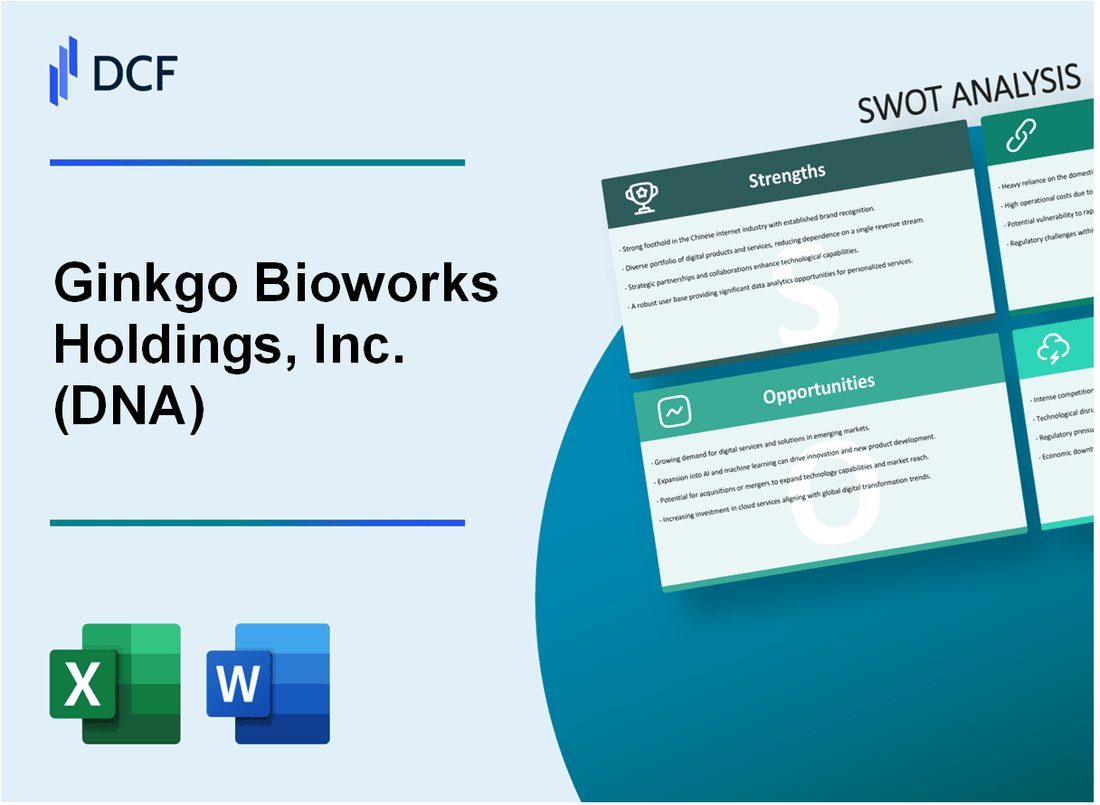
En el mundo de vanguardia de la biología sintética, Ginkgo Bioworks Holdings, Inc. (ADN) está a la vanguardia de la ingeniería genética transformadora, navegando por un complejo panorama de innovación, desafíos y potencial. Este análisis FODA integral revela el posicionamiento estratégico de la compañía en 2024, explorando cómo su pionera tecnología de programación celular y diversas asociaciones de la industria están reformando la frontera biotecnología, al tiempo que enfrenta simultáneamente los desafíos financieros, reguladores y de mercado críticos que podrían definir su trayectoria en el bio- emergente- economía basada.
Ginkgo Bioworks Holdings, Inc. (ADN) - Análisis FODA: Fortalezas
Plataforma pionera en biología sintética
Ginkgo Bioworks funciona con una plataforma de tecnología de programación de celdas de vanguardia. A partir del cuarto trimestre de 2023, la plataforma de la compañía demostró capacidades en todo:
| Métrica de plataforma | Indicador de rendimiento |
|---|---|
| Capacidad total de bioingeniería | Más de 220,000 pies cuadrados de espacio de laboratorio |
| Ciclos anuales de diseño de construcción-construcción | Aproximadamente 4,500 proyectos únicos de ingeniería de organismo |
Cartera de propiedades intelectuales
Paisaje de patentes:
- Solicitudes de patentes totales: 438
- Patentes concedidas: 276
- Familias de patentes: 89
Diversas fuentes de ingresos
| Segmento de la industria | Contribución de ingresos (2023) |
|---|---|
| Farmacéuticos | $ 79.4 millones |
| Agricultura | $ 42.6 millones |
| Materiales/industriales | $ 33.2 millones |
Asociaciones estratégicas
Red de colaboración:
- 16 Instituciones de investigación farmacéutica importantes
- 22 compañías de biotecnología agrícola
- 9 empresas de ingeniería de materiales especializados
Experiencia en gestión
| Métrico de liderazgo | Estadística |
|---|---|
| Experiencia de liderazgo promedio en biología sintética | 18.7 años |
| Titulares de doctorado en equipo ejecutivo | 73% |
Ginkgo Bioworks Holdings, Inc. (ADN) - Análisis FODA: debilidades
Pérdidas financieras históricas consistentes y flujo de efectivo negativo
Ginkgo Bioworks informó una pérdida neta de $ 306.1 millones para el año fiscal 2022, con un déficit acumulado de $ 1.2 mil millones al 31 de diciembre de 2022. El desempeño financiero de la compañía demuestra desafíos continuos de flujo de efectivo.
| Métrica financiera | Valor 2022 | Valor 2021 |
|---|---|---|
| Pérdida neta | $ 306.1 millones | $ 248.1 millones |
| Flujo de caja operativo | -$ 234.7 millones | -$ 190.5 millones |
Altos gastos de investigación y desarrollo
Los gastos de I + D para Ginkgo Bioworks fueron significativos, por un total de $ 267.8 millones en 2022, lo que representa el 53% de los ingresos totales.
- Gastos de I + D como porcentaje de ingresos: 53%
- Gasto total de I + D en 2022: $ 267.8 millones
- Inversión de I + D por empleado: aproximadamente $ 1.2 millones
Complejidad de las tecnologías de ingeniería biológica
La escalabilidad comercial sigue siendo un desafío crítico para plataformas de biología sintética de Ginkgo Bioworks. La tecnología de la compañía requiere una validación extensa y procesos de ingeniería complejos.
Dependencia de los mercados emergentes
Ginkgo Bioworks opera en mercados especulativos con marcos regulatorios inciertos, particularmente en biología sintética y desarrollo de organismo diseñado.
| Segmento de mercado | Complejidad regulatoria | Madurez del mercado |
|---|---|---|
| Biología sintética | Alto | Emergente |
| Organismos diseñados | Muy alto | Etapa temprana |
Cartera de productos comerciales limitados
En comparación con las empresas de biotecnología establecidas, Ginkgo Bioworks tiene una gama de productos comerciales relativamente estrechos, centrada principalmente en tecnologías de plataforma en lugar de ventas directas de productos.
- Número de productos comerciales: limitado
- Concentración de ingresos: principalmente servicios basados en plataformas
- Penetración del mercado: predominantemente en sectores de biotecnología especializados
Ginkgo Bioworks Holdings, Inc. (ADN) - Análisis FODA: oportunidades
Creciente demanda global de soluciones de fabricación sostenibles y biológicas
Se proyecta que el mercado de fabricación global de BIO BIO alcance los $ 686.79 mil millones para 2030, con una tasa compuesta anual del 13.7%. Ginkgo Bioworks está posicionado para capturar una participación de mercado significativa en este sector en expansión.
| Segmento de mercado | 2024 Valor proyectado | Índice de crecimiento |
|---|---|---|
| Biotecnología industrial | $ 254.3 mil millones | 15.2% |
| Fabricación sostenible | $ 187.6 mil millones | 14.8% |
Expandir aplicaciones en medicina personalizada y terapéutica genética
Se espera que el mercado de medicina personalizada alcance los $ 796.8 mil millones para 2028, con la biología sintética que juega un papel crucial.
- El mercado de terapia genética proyectada alcanzará $ 13.8 mil millones para 2025
- El mercado de edición de genes CRISPR se estima en $ 4.3 mil millones en 2024
- Se espera que la medicina de precisión crezca al 11,5% CAGR
Potencial para innovaciones innovadoras en tecnologías de mitigación del cambio climático
Climate Tech Investments alcanzaron los $ 196 mil millones en 2022, con soluciones de biología sintética ganando una tracción significativa.
| Segmento de tecnología climática | Proyección de inversión 2024 | Potencial de crecimiento |
|---|---|---|
| Captura de carbono biológico | $ 3.2 mil millones | 22.5% |
| Biomanufacturación sostenible | $ 2.7 mil millones | 18.9% |
Aumento de la inversión en biología sintética del capital de riesgo y fondos del gobierno
La financiación de la biología sintética alcanzó los $ 12.1 mil millones en 2023, con un fuerte interés de los inversores continuos.
- Inversión de capital de riesgo: $ 8.3 mil millones
- Financiación del gobierno: $ 3.8 mil millones
- Tamaño promedio de la oferta: $ 42.6 millones
Mercados emergentes en biomanufacturación y producción de proteínas alternativas
Se proyecta que el mercado de proteínas alternativas alcanzará los $ 290.4 mil millones para 2030, presentando oportunidades significativas para Ginkgo Bioworks.
| Categoría de proteína | Tamaño del mercado 2024 | Crecimiento proyectado |
|---|---|---|
| Proteínas cultivadas | $ 1.2 mil millones | 41.3% |
| Proteínas de fermentación de precisión | $ 890 millones | 35.7% |
Ginkgo Bioworks Holdings, Inc. (ADN) - Análisis FODA: amenazas
Marcos regulatorios estrictos que rigen la ingeniería genética y la biotecnología
El sector de la biotecnología enfrenta desafíos regulatorios complejos en múltiples jurisdicciones. A partir de 2024, la FDA ha implementado 17 vías regulatorias distintas Para las tecnologías de ingeniería genética, con un costo promedio de cumplimiento de $ 3.2 millones por ciclo de desarrollo de productos.
| Agencia reguladora | Costo de cumplimiento anual | Tiempo de revisión promedio |
|---|---|---|
| FDA | $ 3.2 millones | 12-18 meses |
| EPA | $ 2.7 millones | 9-14 meses |
| USDA | $ 2.1 millones | 8-12 meses |
Intensa competencia de biotecnología establecida y compañías farmacéuticas
El análisis competitivo del panorama revela una presión significativa del mercado:
- Mercado de biología sintética proyectada para llegar a $ 41.4 mil millones para 2025
- Los 5 principales competidores controlan el 62% de la participación de mercado
- Gastos de I + D por los principales competidores:
| Compañía | Gastos anuales de I + D | Capitalización de mercado |
|---|---|---|
| Ilumina | $ 792 millones | $ 32.1 mil millones |
| Twist BioScience | $ 214 millones | $ 1.8 mil millones |
| Genómica sintética | $ 168 millones | $ 1.2 mil millones |
Posible escepticismo público sobre tecnologías de modificación genética
Las encuestas de percepción pública indican desafíos significativos:
- El 37% de los estadounidenses expresa su preocupación por la seguridad de la ingeniería genética
- Las tasas de escepticismo del consumidor aumentaron un 12% desde 2020
- Índice de sentimiento negativo de medios: 0.64 (escala 0-1)
Volatilidad en los mercados de inversión en biotecnología y las posibles limitaciones de financiación
El panorama de la inversión demuestra una volatilidad significativa:
| Métrico de inversión | Valor 2023 | Cambio |
|---|---|---|
| Financiación de capital de riesgo | $ 6.3 mil millones | -22% |
| Valoración del mercado público | $ 14.2 mil millones | -37% |
| Financiación de la salida a bolsa | $ 1.7 mil millones | -45% |
Cambios tecnológicos rápidos que requieren inversiones de capital significativas continuas
La evolución tecnológica exige inversiones sustanciales:
- Costo promedio de actualización de tecnología anual: $ 68 millones
- Se requiere inversión de capital estimada: $ 245 millones en 3 años
- Riesgo de obsolescencia tecnológica: 42% en 5 años
Ginkgo Bioworks Holdings, Inc. (DNA) - SWOT Analysis: Opportunities
You're looking at Ginkgo Bioworks Holdings, Inc. (DNA) right now and seeing a company at a genuine inflection point, moving past heavy cost-cutting and toward scaling its technology platform. The biggest opportunity is clearly capitalizing on the massive industry shift toward AI-driven drug discovery and biomanufacturing. This isn't just hype; it's the new operating model for synthetic biology, and Ginkgo's platform is built to feed and benefit from it.
Expand the Cell Engineering segment, projected to hit $117 million to $137 million in 2025 revenue.
The Cell Engineering segment is your near-term revenue anchor, and management has reaffirmed its guidance for the full 2025 fiscal year. We are looking at a projected revenue range of $117 million to $137 million for this segment alone. To be fair, Q3 2025 revenue was down year-over-year, but that was largely due to a $45 million noncash revenue item from a prior year contract termination, so you have to look past that noise. The real story here is the underlying demand from biopharma and government customers, which is keeping this core business on track to meet its annual target.
Here's the quick math on the full-year expectation:
- Full Year 2025 Total Revenue Guidance: $167 million to $187 million.
- Cell Engineering Contribution: $117M - $137M.
- Biosecurity Contribution: At least $40 million.
What this estimate hides is the potential for upside if the tools business accelerates faster than expected, but for now, this range is the solid base you should use for your near-term modeling.
Monetize the new tools business (Datapoints, Automation) by selling autonomous lab infrastructure to customers.
The strategic pivot is away from being purely a service provider to becoming a dominant tools provider. Ginkgo Bioworks is actively pushing its Automation and Datapoints offerings, which are the physical and digital infrastructure that powers AI in biology. The goal is a massive shift in the revenue mix, targeting 80% tools and 20% services by 2030. This means moving from high-touch service contracts to selling scalable, repeatable products.
We are already seeing concrete evidence of this monetization strategy taking hold:
- The Pacific Northwest National Laboratory (PNNL) selected Ginkgo Automation to deliver a state-of-the-art automated anaerobic phenotyping platform.
- New offerings like in vitro ADME profiling and cell-free protein synthesis systems are being launched, sometimes priced low enough for direct purchase, like a reagent kit for as little as $2,000.
If onboarding takes 14+ days, churn risk rises, but selling infrastructure like this creates stickier, more predictable revenue streams, which is what investors want to see.
Deepen long-term, high-value partnerships, like the recent extension with Bayer for ag biologicals.
Long-term, deep partnerships are crucial for de-risking R&D spend, and the recent extension with Bayer is a prime example. Ginkgo Bioworks and Bayer renewed their multi-year strategic alliance, which originally started in 2017, to focus on next-generation biological solutions for agriculture. This collaboration centers on developing innovative microbial nitrogen fixation technologies designed to complement traditional synthetic fertilizers.
This relationship is important because it leverages Ginkgo's dedicated Agriculture Biologicals Research & Development site in West Sacramento, focusing on key areas:
| Focus Area | Goal |
| Microbial Nitrogen Fixation | Develop alternatives to synthetic fertilizers. |
| Biological Crop Protection | Identify next-generation tools for growers. |
| Carbon Sequestration | Advance sustainable farming practices. |
Bayer retains the right to commercialize the resulting products, which is a classic, lower-risk model for Ginkgo in this space, providing steady development revenue while Bayer handles the market rollout. Finance: draft 13-week cash view by Friday.
Ginkgo Bioworks Holdings, Inc. (DNA) - SWOT Analysis: Threats
You're looking at the headwinds facing Ginkgo Bioworks as we move deeper into 2025, and honestly, the path to profitability is steep. The biggest threat is the sheer difficulty in hitting that Adjusted EBITDA breakeven by the end of 2026 while simultaneously navigating a competitive landscape that demands constant, expensive innovation.
Risk of Not Achieving the Stated Goal of Adjusted EBITDA Breakeven by the End of 2026
The commitment to reach Adjusted EBITDA breakeven by the end of 2026 is a major operational pressure point, especially when you look at the recent performance. For the third quarter of 2025, the Adjusted EBITDA loss was negative $56 million, which was actually worse than the negative $20 million loss in the third quarter of 2024, largely due to the absence of a large non-cash revenue release from a terminated contract the prior year. Here's the quick math: to hit that 2026 target, analysts suggest the company will likely need to at least double its revenue. While you've made great strides cutting costs-achieving $250 million in annualized run-rate savings by Q2 2025-the underlying revenue growth needs to accelerate significantly from the Q3 2025 total revenue of just $38.83 million. What this estimate hides is the continued cash burn; the company ended Q3 2025 with $462 million in cash, which is a solid cushion but not infinite given the losses.
The financial distress signals are still visible, too.
- Altman Z-Score of -6.5 signals severe financial distress.
- GAAP net loss for Q3 2025 widened to $81 million.
- The stock price reaction to Q3 results shows investor confidence is definitely shaken.
Intense Competition from Established Contract Research Organizations (CROs) and New Biotech Startups
You are operating in a massive, yet crowded, service space. The global Contract Research Organization (CRO) market was valued up to $82 billion in 2024 and is projected to hit $139.42 billion by 2029. This means established giants are competing for the same biopharma dollars, and they often have deeper pockets and longer track records in traditional clinical research. For Ginkgo Bioworks, the threat is most acute in the Cell Engineering segment, which is your primary revenue driver. In Q3 2025, Cell Engineering revenue plunged to $29 million, a 61% decrease year-over-year when adjusting for the prior year's non-cash revenue event. This drop shows that even with new offerings like 'lab data as a service,' securing and maintaining high-value, recurring service contracts against hungry competitors is a constant battle.
Macroeconomic Uncertainty Could Slow Customer R&D Spending, Impacting New Program Starts
The broader economic climate directly impacts how much money your customers-biopharma, industrial biotech, and others-are willing to spend on outsourced R&D. We saw in late 2024 that the CRO sector slowdown was driven by 'lack of funding and investment, rising interest rates and global recession concerns'. If that sentiment returns or deepens in 2026, customers will pull back on exploratory science, which is the lifeblood of new programs at Ginkgo Bioworks. Furthermore, your Biosecurity segment revenue is highly sensitive to external funding cycles. For Q3 2025, Biosecurity revenue was only $9 million, down from $14 million the year prior. This revenue stream is 'almost entirely dependent on government funding,' meaning any shift in federal priorities or budget tightening poses a substantial downside risk to that guidance.
Regulatory Changes in Synthetic Biology or Biosecurity Could Increase Compliance Costs
While government focus on biotechnology is high-with reports like the NSCEB emphasizing its national importance-the flip side of that attention is increased regulatory scrutiny. As you engineer novel biological systems, any new mandates regarding biosafety, biosecurity protocols, or data handling for engineered organisms could force immediate, unbudgeted capital expenditures or operational changes. These compliance costs are often fixed in the short term and don't generate immediate revenue, directly eating into your already tight margins as you push for that 2026 breakeven point. It's a classic risk in a frontier technology: innovation outpaces regulation, and then regulation catches up, often with a hefty price tag.
Finance: draft 13-week cash view by Friday
Disclaimer
All information, articles, and product details provided on this website are for general informational and educational purposes only. We do not claim any ownership over, nor do we intend to infringe upon, any trademarks, copyrights, logos, brand names, or other intellectual property mentioned or depicted on this site. Such intellectual property remains the property of its respective owners, and any references here are made solely for identification or informational purposes, without implying any affiliation, endorsement, or partnership.
We make no representations or warranties, express or implied, regarding the accuracy, completeness, or suitability of any content or products presented. Nothing on this website should be construed as legal, tax, investment, financial, medical, or other professional advice. In addition, no part of this site—including articles or product references—constitutes a solicitation, recommendation, endorsement, advertisement, or offer to buy or sell any securities, franchises, or other financial instruments, particularly in jurisdictions where such activity would be unlawful.
All content is of a general nature and may not address the specific circumstances of any individual or entity. It is not a substitute for professional advice or services. Any actions you take based on the information provided here are strictly at your own risk. You accept full responsibility for any decisions or outcomes arising from your use of this website and agree to release us from any liability in connection with your use of, or reliance upon, the content or products found herein.