

|
Dynatrace, Inc. (DT): Análisis FODA [Actualizado en enero de 2025] |
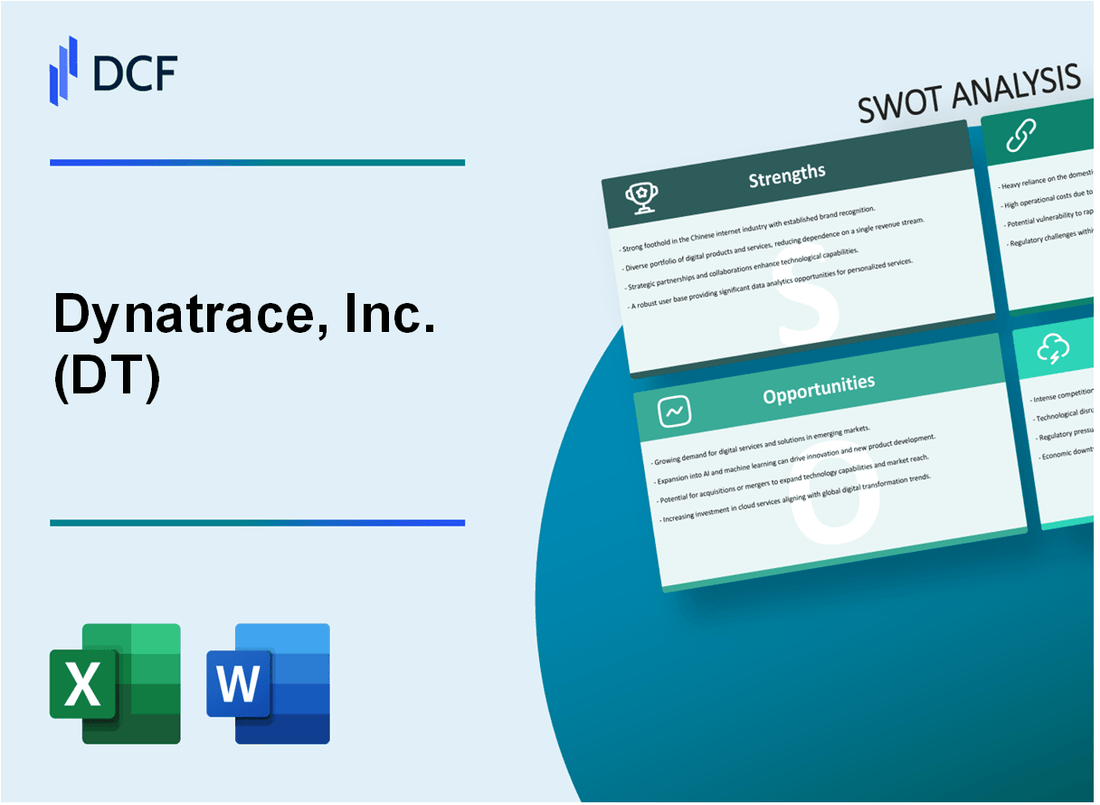
Completamente Editable: Adáptelo A Sus Necesidades En Excel O Sheets
Diseño Profesional: Plantillas Confiables Y Estándares De La Industria
Predeterminadas Para Un Uso Rápido Y Eficiente
Compatible con MAC / PC, completamente desbloqueado
No Se Necesita Experiencia; Fáciles De Seguir
Dynatrace, Inc. (DT) Bundle
En el panorama de rápido evolución de la observabilidad en la nube y la gestión del rendimiento digital, Dynatrace, Inc. (DT) se encuentra a la vanguardia de la innovación tecnológica, aprovechando las soluciones con AI de vanguardia para transformar cómo las empresas monitorean y optimizan sus ecosistemas digitales. Este análisis FODA integral revela el posicionamiento estratégico de una compañía que ha demostrado constantemente una notable resiliencia y destreza tecnológica, que ofrece ideas sin precedentes sobre su potencial de crecimiento, desafíos y ventajas competitivas en el mundo dinámico de la monitorización de la nube e infraestructura híbrida.
Dynatrace, Inc. (DT) - Análisis FODA: fortalezas
Líder en observabilidad con IA y soluciones de monitoreo de pila completa
Dynatrace posee un Cuota de mercado del 72% en plataformas de observabilidad con IA a partir del cuarto trimestre de 2023. La compañía sirve Más de 7.300 clientes empresariales A nivel mundial, incluyendo 89 de las compañías Fortune 100.
| Posición de mercado | Métricas de rendimiento |
|---|---|
| Participación de mercado de observabilidad de IA | 72% |
| Clientes empresariales | 7,300+ |
| Penetración de Fortune 100 | 89 empresas |
Fuerte enfoque en tecnologías de transformación nativa y nativa de la nube
Dynatrace admite entornos de nubes híbridas y múltiples nubes con capacidades integrales de monitoreo en todo:
- AWS
- Microsoft Azure
- Plataforma en la nube de Google
- Kubernetes
- OpenShift
Crecimiento constante de ingresos y desempeño financiero
| Métrica financiera | 2023 rendimiento |
|---|---|
| Ingresos anuales | $ 1.28 mil millones |
| Tasa de crecimiento de ingresos | 16.4% |
| Lngresos netos | $ 214.5 millones |
Integración de plataforma robusta
La plataforma de Dynatrace se integra tecnologías avanzadas incluido:
- Motor Davis AI
- Análisis automatizado de causa raíz
- Monitoreo del rendimiento en tiempo real
- Análisis predictivo
Inversiones de investigación y desarrollo
| Categoría de inversión de I + D | 2023 gastos |
|---|---|
| Gastos totales de I + D | $ 302.6 millones |
| Porcentaje de ingresos | 23.6% |
| IA y investigación de aprendizaje automático | $ 127.1 millones |
Dynatrace, Inc. (DT) - Análisis FODA: debilidades
Precios más altos en comparación con los competidores
La estructura de precios de Dynatrace muestra un posicionamiento premium en el mercado de observabilidad. Según los datos de precios de 2023:
| Nivel de precios | Costo mensual | Posición comparativa del mercado |
|---|---|---|
| Plan empresarial | $ 225 por anfitrión | 15-20% más alto que los competidores |
| Plan profesional | $ 150 por host | 10-15% por encima del promedio del mercado |
Dependencia de los clientes empresariales
Las métricas de concentración del cliente revelan una dependencia empresarial significativa:
- El 78% de los ingresos derivados de las compañías Fortune 500
- Los 10 mejores clientes representan el 35% de los ingresos recurrentes anuales
- Valor promedio de contrato empresarial: $ 487,000
Suite de productos complejos
La evaluación de la complejidad del producto destaca los desafíos potenciales:
| Métrica de complejidad del producto | Medida cuantitativa |
|---|---|
| Número de módulos de productos | 17 módulos de monitoreo distintos |
| Tiempo de implementación | Promedio de 6-8 semanas para la implementación completa |
| Requisitos de capacitación | 40-60 horas de capacitación técnica inicial |
Diversificación geográfica limitada
Distribución de ingresos geográficos:
- América del Norte: 68% de los ingresos totales
- Europa: 24% de los ingresos totales
- Asia-Pacífico: 8% de los ingresos totales
Monitoreo de nubes Desafíos de paisajes
Métricas de adaptación del mercado:
- Inversión en tecnología nativa de nube: $ 87.5 millones en 2023
- Gasto de I + D: 22% de los ingresos anuales
- Nuevo ciclo de lanzamiento de la función de monitoreo de la nube: 3-4 meses
Dynatrace, Inc. (DT) - Análisis FODA: oportunidades
Mercado de expansión de monitoreo de infraestructura en nubes e híbridas
Se proyecta que el mercado global de monitoreo de la nube alcanza $ 6.26 mil millones para 2026, con una tasa de crecimiento anual compuesta (CAGR) de 15.7%. El monitoreo de infraestructura de nubes híbridas representa un Segmento de mercado potencial de $ 3.8 mil millones.
| Segmento de mercado | Valor proyectado para 2026 | Tocón |
|---|---|---|
| Monitoreo de la nube | $ 6.26 mil millones | 15.7% |
| Monitoreo de nubes híbridas | $ 3.8 mil millones | 14.2% |
Creciente demanda de soluciones de observabilidad impulsadas por la IA
AI en el mercado de operaciones de TI se espera que llegue $ 41.5 mil millones para 2026. La plataforma con IA de Dynatrace aborda las necesidades clave del mercado con Informes de rendimiento automatizados.
- AI Observabilidad del mercado del mercado: 32.5% CAGR
- Tasa de adopción de AI empresarial: 56% en 2023
- Tamaño del mercado de análisis de análisis predictivo: $ 28.1 mil millones para 2026
Aumento de la adopción de iniciativas de transformación digital a nivel mundial
El gasto global de transformación digital prevista para llegar $ 3.4 billones para 2026. Empresas asignando 10-15% de los presupuestos de TI a las iniciativas de transformación digital.
| Región | Inversión de transformación digital | Crecimiento esperado |
|---|---|---|
| América del norte | $ 1.2 billones | 18.2% |
| Europa | $ 892 mil millones | 15.7% |
| Asia-Pacífico | $ 1.1 billones | 22.3% |
Potencial para asociaciones y adquisiciones estratégicas
Mercado de asociación tecnológica valorado en $ 435 mil millones. Oportunidades de integración potenciales con los principales proveedores de la nube y proveedores de software empresarial.
- Valor promedio de asociación tecnológica: $ 78 millones
- Potencial de adquisición estratégica en el sector de observabilidad: $ 2.3 mil millones
- Crecimiento del mercado de integración empresarial: 17.5% anual
Mercados emergentes en ciberseguridad y gestión del desempeño
Mercado global de ciberseguridad proyectado para llegar $ 366.10 mil millones para 2028. El mercado de software de gestión del rendimiento se espera que llegue $ 12.5 mil millones para 2025.
| Segmento de mercado | Tamaño de mercado proyectado | Tocón |
|---|---|---|
| Ciberseguridad | $ 366.10 mil millones | 13.4% |
| Gestión de desempeño | $ 12.5 mil millones | 11.8% |
Dynatrace, Inc. (DT) - Análisis FODA: amenazas
Intensa competencia de gigantes tecnológicos establecidos
Dynatrace enfrenta una presión competitiva significativa de las principales empresas de tecnología:
| Competidor | Capitalización de mercado | Ingresos anuales en observabilidad/monitoreo |
|---|---|---|
| Sistemas de Cisco | $ 231.9 mil millones | $ 12.7 mil millones |
| IBM | $ 127.3 mil millones | $ 6.5 mil millones |
| Dinatracia | $ 12.4 mil millones | $ 1.2 mil millones |
Cambio de infraestructura de tecnología y nube que cambia rápidamente
La evolución de la infraestructura tecnológica presenta desafíos significativos:
- Mercado de computación en la nube proyectado para alcanzar los $ 1.5 billones para 2030
- La adopción de Kubernetes aumentó en un 67% en entornos empresariales
- Arquitectura de microservicios que crece a una tasa de compuesto anual del 22.5%
Posibles recesiones económicas que afectan el gasto de TI empresarial
Indicadores económicos que afectan la inversión:
| Métrica económica | Valor 2023 | Impacto potencial en el gasto de TI |
|---|---|---|
| Crecimiento global del PIB | 2.9% | Reducción potencial del 5-8% en los presupuestos de TI |
| Inversión del sector tecnológico | $ 580 mil millones | Potencial 12% Contracción |
Aumento de la complejidad de los entornos híbridos de múltiples nubes
Desafíos de complejidad de múltiples nubes:
- El 85% de las empresas usan estrategias de múltiples nubes
- La organización promedio utiliza 2.6 proveedores de nubes públicas
- Se espera que Hybrid Cloud Market alcance los $ 145 mil millones para 2026
Regulaciones potenciales de riesgos de ciberseguridad y privacidad de datos
Landscape regulatorio y de seguridad:
| Regulación | Potencial bien | Impacto global |
|---|---|---|
| GDPR | Hasta € 20 millones | Afecta a 27 países de la UE |
| CCPA | Hasta $ 7,500 por violación | Cubre las empresas de California |
Dynatrace, Inc. (DT) - SWOT Analysis: Opportunities
Total Addressable Market (TAM) for observability and security is a massive $65 billion
You need to know where the real money is, and for Dynatrace, Inc., the market is enormous and getting bigger. The Total Addressable Market (TAM) for combined observability and security is estimated at a staggering $65 billion. This isn't just a big number; it shows the sheer scale of the opportunity for a unified platform like Dynatrace's.
Here's the quick math: The observability component alone accounts for about $51 billion of that TAM, and the security portion is around $14 billion. Dynatrace's Annual Recurring Revenue (ARR) for the full fiscal year 2025 was $1.734 billion, which means the company has captured only a small fraction of the total market. This leaves a massive runway for growth, especially as enterprises continue to shift their spending from legacy point solutions to integrated platforms.
| Market Segment | Estimated TAM (2025) | Dynatrace FY2025 ARR | Opportunity Gap |
|---|---|---|---|
| Observability | $51 billion | (Included in total ARR) | Massive |
| Security | $14 billion | (Included in total ARR) | Significant |
| Total Observability & Security | $65 billion | $1.734 billion | $63.266 billion |
Enterprise shift to tool consolidation favors a unified platform approach
The days of having a dozen different monitoring tools-one for logs, one for traces, another for security-are ending. Honestly, that fragmented approach creates more problems than it solves, leading to what we call 'observability debt.' The market is defintely moving toward consolidation, and this is a direct tailwind for Dynatrace, Inc.'s unified platform strategy.
Organizations are actively addressing this tool sprawl. Data shows the average number of observability tools per enterprise has already dropped from 6 to 4.4, a 27% decline over two years. Plus, a majority of organizations-specifically 52%-plan to consolidate their observability tools onto unified platforms in the next 12 to 24 months. Dynatrace's single-platform architecture, which integrates metrics, logs, traces, and security data with its Davis® AI, is perfectly positioned to win these consolidation deals.
Explosive growth in Generative AI and Agentic AI workloads requires new observability
Generative AI (GenAI) and Agentic AI are no longer pilot programs; they are becoming core to business operations. This new wave of AI creates a fresh, complex observability challenge because you need to monitor the AI models themselves, not just the infrastructure they run on. Every modern application will use LLMs for things like decision-making, so the need for specialized observability is a necessity.
The market is responding with increased budget allocation. A Dynatrace-commissioned report from October 2025 showed that 100% of business leaders surveyed are using AI today, and a significant 70% are increasing their observability budgets specifically to scale these AI projects. Dynatrace is ahead of the curve, integrating with tools like Amazon Bedrock AgentCore to deliver end-to-end observability for Agentic AI on Amazon Web Services (AWS) as of November 2025. This focus on AI-powered observability is now the #1 criterion for selecting a solution.
Expanding security portfolio, like Cloud Security Posture Management (CSPM), opens new revenue streams
The security market is a clear, immediate revenue opportunity. Dynatrace has substantially expanded its security portfolio, notably with the launch of its Cloud Security Posture Management (CSPM) solution in February 2025. This is a critical move because CSPM addresses a major pain point: cloud misconfigurations were used as the initial access vector in 30% of all cloud environment attacks in the first half of 2024.
The Cloud Security Posture Management market is projected to be valued at $5.25 billion in 2025, and it's forecast to grow at a strong 15.2% Compound Annual Growth Rate (CAGR) through 2030. By integrating CSPM with its existing Application Security and Threat Observability, Dynatrace can offer a truly unified security and observability platform, which is what large enterprises are demanding to reduce operational complexity and ensure continuous compliance.
Strategic collaborations with hyperscalers like Amazon Web Services (AWS) and Google Cloud
You can't win the cloud war without strong partners. Dynatrace has solidified its position as the preferred observability layer across the major cloud providers. This is a crucial opportunity to drive co-selling and platform adoption.
- Amazon Web Services (AWS): In April 2025, Dynatrace announced a new multi-year Strategic Collaboration Agreement (SCA) with AWS. This deep alliance focuses on joint go-to-market strategies and co-innovation, specifically to provide deeper insights into AWS environments and their expanding Generative AI applications. Dynatrace was also recognized as the AWS EMEA Technology Partner of the Year at re:Invent 2024.
- Google Cloud: Dynatrace announced an early access program in April 2025 for joint Google Cloud customers to deploy its Grail data lakehouse architecture on Google Cloud. This integration helps customers unify and analyze their data within their existing Google Cloud ecosystems, enhancing performance and security.
These strategic partnerships mean Dynatrace is not just a vendor; it's an integrated component of the hyperscalers' own offerings, which significantly lowers customer friction and accelerates large-scale enterprise adoption. They are now actively recommended by the hyperscalers' field teams.
Dynatrace, Inc. (DT) - SWOT Analysis: Threats
Intense competition from large, well-funded rivals like Datadog and cloud giants.
You're operating in a market where the competition isn't just nimble, pure-play rivals; it's also the behemoths who own the underlying infrastructure. Dynatrace faces a continuous, high-stakes battle against Datadog, which holds a 6.6% mindshare in Application Performance Monitoring (APM) and Observability as of November 2025, slightly behind Dynatrace's 8.1% mindshare. Datadog's strength is its broad integration and competitive pricing for a unified platform, making it a default choice for many cloud-native teams.
The bigger threat comes from the 'Big Three' cloud providers-Amazon Web Services, Microsoft Azure, and Google Cloud. They control a combined 63% of the global cloud infrastructure market, which was a $99 billion market as of Q2 2025. Their built-in observability tools (like Amazon CloudWatch, Azure Monitor, and Google Cloud Operations Suite) are often free or deeply integrated, creating a strong gravitational pull that makes it harder for an independent vendor like Dynatrace to get a foot in the door. You have to be demonstrably better, not just different.
| Competitive Threat Group | Key Rivals | 2025 Market Footprint |
|---|---|---|
| Pure-Play Observability | Datadog, New Relic, Splunk | Datadog holds 6.6% APM mindshare (Nov 2025). |
| Cloud Infrastructure Giants | Amazon Web Services, Microsoft Azure, Google Cloud | Control 63% of the Q2 2025 global cloud infrastructure market. |
| Open-Source Alternatives | Grafana, Prometheus, OpenTelemetry | Growing adoption of OpenTelemetry as the de facto standard for instrumentation. |
Macroeconomic uncertainty leads to cautious IT spending and longer sales cycles.
Despite the overall worldwide IT spending forecast to grow 7.9% to $5.43 trillion in 2025, a significant 'uncertainty pause' on net-new spending is a major headwind. This caution is driven by global economic and geopolitical risks. For Dynatrace, this translates directly into slower deal velocity and increased scrutiny on large contracts, especially for new customers. The data shows that while 61% of enterprises started 2025 in a better position than the prior year, only 24% expect to end the year ahead of their initial 2025 plans. This gap signals that budget holders are pulling back on discretionary or non-critical projects, even if the underlying demand for observability remains strong.
The result is a lengthening of sales cycles, which pressures your quarterly Annual Recurring Revenue (ARR) growth targets. It's a classic case of enterprises prioritizing cost optimization over new platform adoption, even if your solution offers better long-term efficiency. You must prove immediate, massive ROI.
Rapid technological change forces continuous, expensive R&D to maintain platform edge.
The observability market is evolving at a breakneck pace, driven by the triple wave of generative AI, rapid cloud adoption, and edge computing. To maintain its leadership position in AI-powered observability, Dynatrace must continuously pour capital into research and development. Your R&D investment for fiscal year 2025 was high, representing 22.64% of total revenue. This is a necessary expense to keep the platform ahead of rivals and integrate new technologies like eBPF and advanced AI model monitoring.
The risk is that a competitor, especially one of the cloud giants with near-limitless resources, could leapfrog Dynatrace with a breakthrough feature, instantly devaluing years of R&D investment. The observability platform market is projected to reach $2.9 billion in 2025 and grow at a 15.9% CAGR to $6.1 billion by 2030, so standing still is not an option. This high-cost R&D treadmill is a structural threat to long-term margin expansion.
Pricing pressure from competitors offering cheaper, usage-based models.
Pricing is a major battleground in the observability space, with competitive intensity rising and vendors increasingly positioning pricing around the total telemetry costs. While Dynatrace's new Dynatrace Platform Subscription (DPS) model is consumption-based, it still competes with rivals who may offer lower cost-per-gigabyte or more aggressive free tiers. The industry is seeing a 'Shift to Flexible Pricing Models' as a key trend in 2025.
Enterprises are actively working to cut observability costs, with industry benchmarks suggesting that organizations are reducing this spending from 10-20% of infrastructure costs down to 5-10% through data optimization and tool consolidation. This trend forces Dynatrace to constantly justify its premium pricing by demonstrating superior AI-driven automation and root-cause analysis that saves more in operational costs than it charges in subscription fees. If you can't show that value, you lose the deal.
Risk of customer churn if the adoption of the new Dynatrace Platform Subscription (DPS) model is slow or confusing.
The shift to the DPS model is a major strategic move, and while it's showing strong results, it introduces transition risk. As of the end of fiscal year 2025, over 40% of the customer base and more than 60% of Annual Recurring Revenue (ARR) were leveraging the DPS model. By Q1 2026, DPS accounted for over 65% of ARR.
The good news is that DPS customers consume resources at nearly twice the rate of those on the legacy SKU-based model, which is a great sign for expansion. However, the threat lies in the remaining customer base and in new prospects who may find the new consumption-based pricing model confusing or unpredictable. Usage-based models can lead to 'bill shock' if not managed well, which is a primary driver of churn. While your Net Retention Rate (NRR) of 111% (Q1 2026) and gross retention in the mid-90s percentage range are strong, any confusion around the DPS model could slow down adoption and cause a defintely avoidable churn spike among your legacy customers.
Disclaimer
All information, articles, and product details provided on this website are for general informational and educational purposes only. We do not claim any ownership over, nor do we intend to infringe upon, any trademarks, copyrights, logos, brand names, or other intellectual property mentioned or depicted on this site. Such intellectual property remains the property of its respective owners, and any references here are made solely for identification or informational purposes, without implying any affiliation, endorsement, or partnership.
We make no representations or warranties, express or implied, regarding the accuracy, completeness, or suitability of any content or products presented. Nothing on this website should be construed as legal, tax, investment, financial, medical, or other professional advice. In addition, no part of this site—including articles or product references—constitutes a solicitation, recommendation, endorsement, advertisement, or offer to buy or sell any securities, franchises, or other financial instruments, particularly in jurisdictions where such activity would be unlawful.
All content is of a general nature and may not address the specific circumstances of any individual or entity. It is not a substitute for professional advice or services. Any actions you take based on the information provided here are strictly at your own risk. You accept full responsibility for any decisions or outcomes arising from your use of this website and agree to release us from any liability in connection with your use of, or reliance upon, the content or products found herein.