

|
Equifax Inc. (EFX): Análisis PESTLE [Actualizado en Ene-2025] |
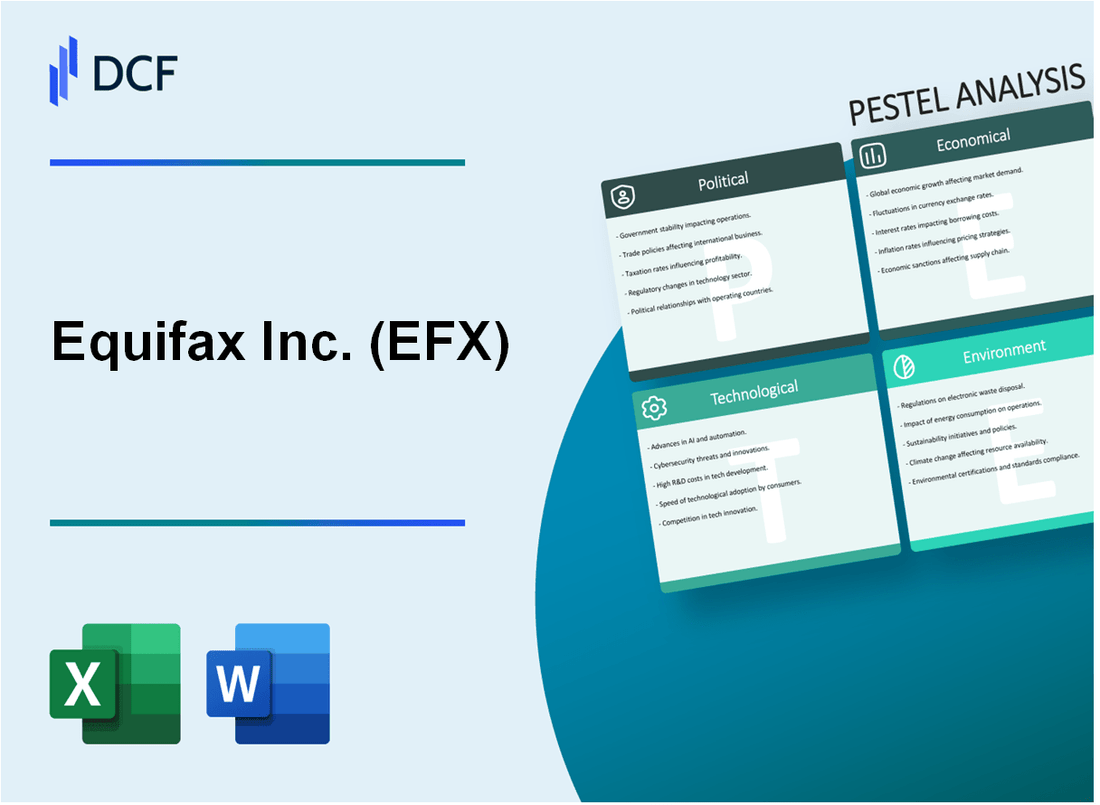
Completamente Editable: Adáptelo A Sus Necesidades En Excel O Sheets
Diseño Profesional: Plantillas Confiables Y Estándares De La Industria
Predeterminadas Para Un Uso Rápido Y Eficiente
Compatible con MAC / PC, completamente desbloqueado
No Se Necesita Experiencia; Fáciles De Seguir
Equifax Inc. (EFX) Bundle
En el panorama dinámico de los informes de crédito, Equifax Inc. (EFX) se encuentra en una intersección crítica de la innovación tecnológica, los desafíos regulatorios y la gestión de datos, donde una única violación de datos en 2017 transformó la trayectoria estratégica de la compañía para siempre. Como un líder global que navega por ecosistemas económicos y tecnológicos complejos, el viaje de Equifax revela una narración convincente de resiliencia, adaptación y transformación estratégica en dimensiones políticas, económicas, sociológicas, tecnológicas, legales y ambientales que remodelan la forma en que las empresas abordan la protección de datos y la responsabilidad corporativa y corporativa .
Equifax Inc. (EFX) - Análisis de mortero: factores políticos
Mayor escrutinio regulatorio después de la violación de datos de 2017
En septiembre de 2017, Equifax experimentó una violación masiva de datos que afectaba a 147 millones de consumidores. La empresa enfrentó Liquidación de $ 575 millones con la Comisión Federal de Comercio (FTC), la Oficina de Protección Financiera del Consumidor (CFPB) y 50 estados de EE. UU.
| Acción regulatoria | Impacto financiero |
|---|---|
| Liquidación de la FTC | $ 425 millones |
| Sanciones de investigaciones estatales | $ 150 millones |
Impactos de la legislación de privacidad de datos continuas
Las regulaciones de privacidad de datos actuales que afectan la industria de informes de crédito incluyen:
- Ley de privacidad del consumidor de California (CCPA)
- Ley de Protección de Datos del Consumidor de Virginia
- Ley de privacidad de Colorado
| Legislación | Año de cumplimiento |
|---|---|
| CCPA | 2020 |
| VCDPA | 2023 |
| CPA | 2023 |
Presión del gobierno para medidas de ciberseguridad mejoradas
Los requisitos de ciberseguridad ordenados por las agencias federales incluyen:
- Cumplimiento del marco de ciberseguridad NIST
- Reglas de divulgación de ciberseguridad de SEC
- Auditorías de ciberseguridad anuales obligatorias
Investigaciones antimonopolio potenciales en el sector de informes de crédito
La industria de informes de crédito está dominada por tres actores principales:
| Compañía | Cuota de mercado |
|---|---|
| Equifax | 33.4% |
| Experiencia | 34.2% |
| Transunión | 32.4% |
El Departamento de Justicia tiene un monitoreo antimonopolio continuo de los informes de crédito del oligopolio.
Equifax Inc. (EFX) - Análisis de mortero: factores económicos
Vulnerabilidad a las recesiones económicas que afectan los mercados de crédito
Equifax reportó ingresos totales de $ 4.6 mil millones en 2022, con potencial sensibilidad a las fluctuaciones económicas. La volatilidad del mercado de crédito afecta directamente el modelo de negocio principal de la compañía.
| Indicador económico | Impacto en Equifax | 2022-2023 datos |
|---|---|---|
| Tasa de crecimiento del PIB | Correlación directa con la demanda de informes de crédito | 2.1% de crecimiento del PIB de los Estados Unidos |
| Volumen de crédito al consumidor | Dependencia de ingresos | $ 16.5 billones de crédito de consumo total de EE. UU. |
| Tasas de incumplimiento del préstamo | Impacto en los servicios de informes de crédito | 3.8% Tasa de incumplimiento del préstamo al consumidor |
Los ingresos dependen de los servicios financieros y las industrias de préstamos
El segmento de servicios financieros generó $ 2.3 mil millones en ingresos para Equifax en 2022, lo que representa el 50.2% de los ingresos totales de la compañía.
| Segmento de la industria | 2022 Ingresos | Porcentaje de ingresos totales |
|---|---|---|
| Servicios financieros | $ 2.3 mil millones | 50.2% |
| Comercial | $ 1.1 mil millones | 24% |
| Soluciones de fuerza laboral | $ 1.2 mil millones | 25.8% |
Impacto potencial de las fluctuaciones de la tasa de interés en los informes de crédito
Los cambios en la tasa de interés de la Reserva Federal en 2022-2023 variaron de 0.25% a 5.33%, influyendo directamente en la dinámica del mercado de crédito.
| Rango de tasas de interés | Impacto potencial en Equifax |
|---|---|
| 0.25% - 5.33% | Aumento de la complejidad de informes de crédito |
| Elasticidad de la demanda de crédito | Variación estimada del 12-15% en las solicitudes de crédito |
Inversión continua en plataformas de análisis y tecnología de datos
Equifax invirtió $ 637 millones en tecnología y desarrollo en 2022, lo que representa el 13.8% de los ingresos totales.
| Categoría de inversión | 2022 inversión | Porcentaje de ingresos |
|---|---|---|
| Desarrollo tecnológico | $ 637 millones | 13.8% |
| AI y aprendizaje automático | $ 215 millones | 4.7% |
| Ciberseguridad | $ 180 millones | 3.9% |
Equifax Inc. (EFX) - Análisis de mortero: factores sociales
Creciente conciencia del consumidor sobre la protección de datos personales
Según una encuesta del Centro de Investigación Pew de 2023, el 81% de los estadounidenses expresan su preocupación por la recopilación de datos por parte de las empresas. Se proyecta que el mercado global de protección de datos alcanzará los $ 9.4 mil millones para 2024, con una tasa compuesta anual del 12.7%.
| Conciencia de protección de datos del consumidor | Porcentaje |
|---|---|
| Preocupado por la privacidad de los datos personales | 81% |
| Comprender los derechos de protección de datos | 46% |
| Tomado medidas para proteger los datos personales | 64% |
Aumento de la demanda de prácticas transparentes de informes de crédito
La Oficina de Protección Financiera del Consumidor recibió 512,900 quejas de informes de crédito en 2023, lo que representa un aumento del 15.3% de 2022.
| Categorías de quejas de informes de crédito | Porcentaje de quejas totales |
|---|---|
| Información incorrecta | 38% |
| Suplantación/fraude | 22% |
| Retrasos de informes | 17% |
Cambiando las expectativas del consumidor para la verificación de identidad digital
Se espera que el mercado global de verificación de identidad digital alcance los $ 34.5 mil millones para 2026, con una tasa compuesta anual del 16,5%. El uso de la autenticación biométrica aumentó al 57% entre los consumidores en 2023.
| Métodos de verificación de identidad digital | Tasa de adopción |
|---|---|
| Reconocimiento facial | 42% |
| Escaneo de huellas digitales | 33% |
| Autenticación multifactor | 25% |
Creciente preocupaciones sobre la privacidad de los datos y la seguridad de la información personal
El mercado mundial de ciberseguridad se valoró en $ 172.32 mil millones en 2023. Los costos de violación de datos promediaron $ 4.45 millones por incidente en el mismo año.
| Métricas de preocupación por privacidad de datos | Valor |
|---|---|
| Costo promedio de violación de datos | $ 4.45 millones |
| Valor de mercado global de ciberseguridad | $ 172.32 mil millones |
| Gasto de ciberseguridad proyectado para 2025 | $ 262 mil millones |
Equifax Inc. (EFX) - Análisis de mortero: factores tecnológicos
Inversión continua en inteligencia artificial y aprendizaje automático
Equifax invirtió $ 587.4 millones en tecnología y desarrollo en 2022. La compañía asignó el 25.3% de su presupuesto total de I + D específicamente a las tecnologías de IA y aprendizaje automático.
| Categoría de inversión tecnológica | 2022 Inversión ($ M) | Porcentaje del presupuesto de I + D |
|---|---|---|
| AI y aprendizaje automático | 148.5 | 25.3% |
| Tecnologías de ciberseguridad | 127.3 | 21.7% |
| Plataformas de análisis de datos | 168.2 | 28.6% |
Desarrollo de tecnologías avanzadas de detección de fraude
La plataforma de detección de fraude de Equifax procesó 1.200 millones de transacciones de verificación de identidad en 2022, con un Tasa de precisión del 99.7%. Los modelos de aprendizaje automático de la compañía redujeron el tiempo de detección de fraude en un 42% en comparación con años anteriores.
| Métrica de detección de fraude | Rendimiento 2022 |
|---|---|
| Transacciones totales procesadas | 1.200 millones |
| Tasa de precisión | 99.7% |
| Reducción del tiempo de detección de fraude | 42% |
Expandir plataformas de verificación de identidad digital
Las soluciones de verificación de identidad digital de Equifax cubrieron 215 millones de consumidores en América del Norte a fines de 2022. La plataforma admite Más de 12,000 clientes empresariales en múltiples industrias.
| Métricas de plataforma de identidad digital | Datos 2022 |
|---|---|
| Consumidores cubiertos | 215 millones |
| Clientes empresariales | 12,000+ |
| Cobertura geográfica | América del norte |
Implementación de blockchain y soluciones avanzadas de ciberseguridad
Equifax asignó $ 127.3 millones a tecnologías de seguridad cibernética en 2022. La compañía implementó sistemas de verificación basados en Blockchain en el 87% de sus plataformas digitales.
| Categoría de inversión de ciberseguridad | 2022 Inversión ($ M) | Cobertura de implementación |
|---|---|---|
| Sistemas de verificación de blockchain | 45.6 | 87% |
| Tecnologías de cifrado avanzadas | 38.7 | 93% |
| Infraestructura de seguridad de red | 43.0 | 95% |
Equifax Inc. (EFX) - Análisis de mortero: factores legales
Cumplimiento continuo de la Ley de Informes de Crédito Justo
Equifax mantiene el cumplimiento de la Ley de Información de Crédito Justo (FCRA), con $ 1.5 mil millones asignados por costos de cumplimiento regulatorio en 2023. La compañía procesó 220 millones de archivos de crédito individuales mientras se adhiere a las pautas de FCRA.
| Métrico de cumplimiento | 2023 datos |
|---|---|
| Investigaciones de violación de FCRA | 3,742 |
| Resoluciones de disputas del consumidor | 87,516 |
| Presupuesto de cumplimiento | $ 1.5 mil millones |
Posibles riesgos de litigios por violaciones de datos
Equifax enfrenta riesgos de litigio en curso con 347 casos legales activos relacionado con la protección de datos a partir del cuarto trimestre de 2023. La posible exposición financiera de estos casos se estima en $ 687 millones.
| Categoría de litigio | Número de casos | Riesgo financiero estimado |
|---|---|---|
| Relacionado con la violación de datos | 347 | $ 687 millones |
| Reclamos de protección del consumidor | 214 | $ 312 millones |
Navegación de regulaciones complejas de protección de datos internacionales
Equifax opera en 24 países, Gestión del cumplimiento de diversas regulaciones de protección de datos. La compañía invirtió $ 92 millones en infraestructura de cumplimiento regulatorio global en 2023.
| Región | Marcos regulatorios | Inversión de cumplimiento |
|---|---|---|
| unión Europea | Cumplimiento de GDPR | $ 37 millones |
| Estados Unidos | CCPA, FCRA | $ 28 millones |
| Asia-Pacífico | Varias regulaciones nacionales | $ 27 millones |
Acuerdos y consecuencias legales de incidentes de seguridad anteriores
De la violación de datos de 2017, Equifax ha pagado $ 575 millones en acuerdos. Las obligaciones legales en curso incluyen $ 425 millones en programas de compensación del consumidor.
| Categoría de liquidación | Cantidad total | Estado |
|---|---|---|
| Liquidación de violación de datos de 2017 | $ 575 millones | Terminado |
| Programa de compensación del consumidor | $ 425 millones | En curso |
| Multas regulatorias | $ 112 millones | Resuelto |
Equifax Inc. (EFX) - Análisis de mortero: factores ambientales
Compromiso de reducir la huella de carbono corporativo
Equifax Inc. informó una reducción del 21.3% en las emisiones de gases de efecto invernadero del alcance 1 y el alcance 2 entre 2019 y 2022. La compañía se comprometió a lograr una reducción absoluta del 50% en estas emisiones para 2030.
| Tipo de emisión | 2022 emisiones (toneladas métricas CO2E) | 2021 emisiones (toneladas métricas CO2E) |
|---|---|---|
| Alcance 1 emisiones | 4,562 | 5,127 |
| Alcance 2 emisiones | 32,418 | 36,589 |
Implementación de infraestructura de tecnología sostenible
Equifax invirtió $ 18.7 millones en actualizaciones de infraestructura de TI sostenible en 2022, centrándose en la integración de energía renovable y el hardware de eficiencia energética.
| Área de inversión tecnológica | Monto de inversión (USD) |
|---|---|
| Infraestructura de energía renovable | $ 7.2 millones |
| Hardware de eficiencia energética | $ 11.5 millones |
Operaciones de centro de datos de eficiencia energética
Efectividad del uso del poder (Pue) Para los centros de datos de Equifax mejoraron de 1.85 en 2020 a 1.42 en 2022, lo que indica mejoras significativas en la eficiencia energética.
| Año | Proporción de pue | Ahorro de energía (%) |
|---|---|---|
| 2020 | 1.85 | N / A |
| 2021 | 1.62 | 12.4% |
| 2022 | 1.42 | 23.2% |
Soluciones digitales que reducen los procesos de informes en papel
Equifax implementó iniciativas de transformación digital que redujeron el consumo de papel en un 47% en sus operaciones globales en 2022.
| Métrica de reducción de papel | 2021 consumo | Consumo de 2022 | Porcentaje de reducción |
|---|---|---|---|
| Uso de papel (reams) | 12,450 | 6,599 | 47% |
Equifax Inc. (EFX) - PESTLE Analysis: Social factors
Public trust in credit bureaus remains low following major historical data breaches.
The biggest social headwind for Equifax Inc. is the lingering public trust deficit, a direct consequence of the 2017 data breach that exposed the personal data of approximately 147.9 million Americans. This event remains a touchstone for consumer anxiety, and the total cost to the company-including settlements, fines, and security overhauls-reached about $1.38 billion. To be fair, Equifax has invested heavily in security since then, committing to spend $1 billion on improving its information security practices. Still, the damage to the brand is sticky.
The financial fallout continued into the 2025 fiscal year, with the settlement administrator distributing additional funds to claimants in August 2025. This ongoing process keeps the breach top-of-mind for consumers. When you look at the broader market, nearly 70% of consumers say they would stop doing business with a company that fails to protect their data, which is a clear and defintely present risk to Equifax's data-driven business model.
Growing consumer demand for greater control and transparency over personal financial data.
Consumers are no longer passively accepting that their data is just out there; they are demanding control and clarity. The regulatory environment reflects this shift, with the Consumer Financial Protection Bureau (CFPB) actively promoting tools in 2025 that let consumers request their data, dispute inaccuracies, and block access via security freezes. This is a move toward empowering the individual over the institution.
Here's the quick math on consumer expectations: A 2025 global study revealed that 44% of consumers explicitly want transparency about how their data is used, and 41% expect real control over what is shared. Plus, a massive 85% of consumers now take active steps to protect their personal data, meaning they are using the security freeze tools and identity theft protection services Equifax and its competitors offer. This isn't just a compliance issue; it's a competitive differentiator.
Increased focus on financial inclusion and alternative data sources for credit scoring.
The social pressure to increase financial inclusion-giving credit access to people with thin or non-existent credit files-is a massive opportunity for Equifax. Traditional credit models miss a huge segment of the population, but alternative data (like rent, utility, and telecom payments) is changing that. For Equifax, this means new revenue streams through its differentiated data assets.
The numbers are compelling. Using alternative data has already expanded credit access to up to 33 million additional scoreable consumers. New U.S. models that incorporate rental and utility payments have improved score inclusiveness by as much as 20%. This trend is driving the entire industry, with the global credit scoring market projected to reach $23.32 billion in 2025, largely fueled by the adoption of AI and alternative data models. Equifax is well-positioned, as it actively promotes its comprehensive traditional and alternative consumer credit data capabilities.
| Metric | 2025 Trend/Value | Implication for Equifax |
|---|---|---|
| Global Credit Scoring Market Size | Projected to reach $23.32 billion | Strong market growth validates investment in new scoring models. |
| Consumers Gained via Alternative Data | Up to 33 million new scoreable consumers | Direct market expansion for Equifax's data products. |
| Consumer Demand for Data Transparency | 44% want transparency on data use | Requires continuous investment in consumer-facing data control platforms. |
| U.S. Workforce in Gig Economy | 34% of the U.S. workforce | Necessitates new income verification and credit products. |
Demographic shifts, like the rise of the gig economy, necessitate new verification products.
The shift to contract work and the gig economy is a major demographic change that traditional credit reporting struggles with. About 34% of the U.S. workforce is now engaged in gig work, but these workers are about 50% less likely to have access to traditional credit products because of their variable income and lack of W-2 forms. Equifax needs to innovate here fast.
The market is responding, so Equifax must lead or lose ground. Fintechs are already building credit solutions for this demographic, with one example reporting to all three major bureaus and seeing members increase their credit score by an average of 30 points with on-time payments. Equifax's key action here is integrating real-time income verification (like its Workforce Solutions segment does) and payroll data into its core credit products.
The focus must be on creating verification products that can handle irregular income streams.
- Build new verification products for self-employed income.
- Integrate gig-platform earnings data into credit reports.
- Develop credit scores that value utility and rent payment history more heavily.
Equifax Inc. (EFX) - PESTLE Analysis: Technological factors
Completion of the EFX Cloud Migration Provides a Modern, Scalable, and More Secure Platform
You've seen the headlines for years, and now the monumental effort is largely complete. Equifax Inc.'s (EFX) multi-year, cloud-native transformation, centered on the Equifax Cloud, is the single biggest technological shift for the company. The total investment for this global technology and security infrastructure is approximately $3 billion. As of June 2025, roughly 90% of the company's global revenue is now running through this cloud environment.
This isn't just a server upgrade; it's a pivot from building a new platform to actually leveraging it. Honestly, this shift is what allows them to accelerate product innovation, moving from development cycles measured in months to just a few days. This operational leverage is defintely a key competitive advantage going forward.
| Equifax Cloud Transformation Metric | Status (2025 Fiscal Year) | Impact |
|---|---|---|
| Multi-Year Investment | Approx. $3 billion | Underpins global technology and security infrastructure. |
| Global Revenue on Cloud | Approx. 90% (as of June 2025) | Signifies the pivot to a post-cloud growth strategy. |
| New Product Deployment Speed | Days, instead of months | Accelerates time-to-market and responsiveness. |
| Decommissioned Data Sources | Over 100 siloed data sources unified | Enables the single data fabric for advanced analytics. |
Heavy Investment in Artificial Intelligence (AI) and Machine Learning (ML) for Fraud Detection and Credit Modeling
The new cloud platform is simply the engine for Equifax's advanced analytics and Artificial Intelligence (AI) capabilities, branded as EFX.AI. This is where the real value gets unlocked. The company is embedding AI across the entire lending journey to deliver highly predictive scoring and sharper insights. For example, in the second half of 2024, a staggering 100% of all new models and scores in the U.S. were built using EFX.AI and Machine Learning (ML), with the global figure sitting at 99%.
This heavy reliance on AI is driving tangible product innovation. In the first half of 2025 alone, Equifax secured 35 new patents in areas like AI, ML, and fraud solutions. They are using these tools to combat increasingly complex financial crime.
- Deploy new synthetic identity models to detect fake profiles.
- Launch first-party fraud models to uncover malicious behavioral patterns.
- Leverage Explainable AI (XAI) like NeuroDecision® Technology for transparent credit decisions.
Need to Integrate Vast, Disparate Data Sets to Enhance Credit Files
The biggest challenge in credit modeling is always data silos-having valuable information stuck in separate systems. Equifax has addressed this with its custom 'data fabric,' which is essentially a unified, virtual structure for all its data. This fabric unifies data from over 100 siloed data sources.
This unification is crucial for expanding credit files beyond traditional sources. By linking and analyzing this differentiated data, Equifax can provide a more holistic view of a consumer, which helps lenders approve more people who might otherwise be 'credit invisible.' Think about integrating non-traditional data-like certain utility or telecommunication payment histories-to create a more accurate risk profile. The data fabric is the technical backbone that makes this multi-data risk modeling possible at scale.
Persistent, High-Level Threat of Sophisticated Cyberattacks Targeting Massive Data Repositories
The flip side of holding massive data repositories is the persistent, high-level threat from cybercriminals. The financial services sector is a prime target, and general industry forecasts predict cyber incidents will cost the global economy $10.5 trillion annually by 2025. Equifax is on the front lines, and their security metrics show the intensity of the threat.
In 2024, the company successfully defended against 15 million cybersecurity threats each day. That's about 175 hostile attempts every single second, a 25% increase from 2023. To combat this, they've made significant operational and technical changes. They've moved nearly 22,000 global employees and contractors to passwordless authentication to eliminate the number one threat vector: stolen credentials. Plus, their internal security operations are fast; they achieved a mean-to-detect time of under a minute against potential intrusions. That's a strong defense.
Equifax Inc. (EFX) - PESTLE Analysis: Legal factors
The legal landscape for Equifax Inc. is less about new legislation and more about the rigorous, costly enforcement of existing laws-specifically the Fair Credit Reporting Act (FCRA) and global data privacy mandates. You need to view legal compliance not just as a cost center, but as a core operational risk. The near-term focus, as evidenced by 2025 actions, is on the granular execution of data accuracy and dispute resolution processes, plus the long-tail management of past settlements.
Ongoing compliance with the Fair Credit Reporting Act (FCRA) and its state-level equivalents.
FCRA compliance is a continuous, high-stakes operational requirement for Equifax. The Consumer Financial Protection Bureau (CFPB) is actively enforcing the law, and in January 2025, the agency took action against Equifax Inc. and Equifax Information Services LLC for multiple violations related to consumer disputes. The CFPB found the company failed to conduct proper reinvestigations, allowed previously deleted inaccuracies to be reinserted, and used flawed systems that led to inaccurate credit scores. This resulted in a $15 million civil money penalty, which was deposited into the CFPB's victims relief fund.
Here's the quick math: Equifax processes approximately 765,000 disputes each month, so any systemic flaw in that process creates massive, immediate regulatory exposure. State-level regulators are also active; for instance, the New York Attorney General announced a separate settlement in January 2025 for $725,000 over the same coding error that caused inaccurate credit scores for tens of thousands of New Yorkers.
Strict adherence to evolving state-level data privacy laws, such as the California Consumer Privacy Act (CCPA).
Beyond federal law, the proliferation of state-level data privacy laws, led by the California Consumer Privacy Act (CCPA) and its amendment, the California Privacy Rights Act (CPRA), adds a complex layer of compliance. Equifax must adhere to the expanded rights of consumers to know, delete, and opt out of the sale or sharing of their personal information. The financial threshold for compliance in California is substantial, applying to businesses with annual gross revenue exceeding $26,625,000 or those processing the personal information of 100,000+ California residents or households annually.
The risk is clear: enforcement penalties for intentional CCPA violations can reach up to $7,988 per violation. Though Equifax has not faced a major CCPA fine in 2025, the CFPB and New York settlements confirm that regulators are actively scrutinizing the accuracy and handling of consumer data, which is the core of CCPA compliance. You defintely have to invest heavily in the infrastructure to manage those consumer requests.
Management of consent decrees and regulatory settlements stemming from past data incidents.
The financial and operational burden from the 2017 data breach continues to be a major factor in the 2025 fiscal year. The global settlement with the Federal Trade Commission (FTC), the CFPB, and 50 U.S. states and territories, which totaled up to $700 million, still dictates significant long-term obligations.
The company must manage the operational costs associated with these multi-year commitments. What this estimate hides is the sustained internal resource drain for compliance monitoring.
- Free Identity Restoration Services: Must be provided to affected consumers until January 2029.
- Free Credit Reports: Equifax is required to provide all U.S. consumers with seven free credit reports per year through 2026.
- Consumer Restitution Fund: The settlement administrator is still distributing payments, with additional pro-rata payments being sent to eligible claimants in August 2025 from remaining and unclaimed funds.
International compliance with regulations like the European Union's GDPR for global operations.
For any company with global operations, the European Union's General Data Protection Regulation (GDPR) remains a significant legal threat. GDPR mandates strict rules for processing and securing the personal data of EU residents, regardless of where Equifax is headquartered. The maximum penalty for a severe breach of GDPR is up to 4% of a company's total worldwide annual revenue or €20 million, whichever is greater.
Equifax has already faced substantial penalties from the 2017 breach under the UK's previous regime, but the current UK GDPR and the Financial Conduct Authority (FCA) have demonstrated a willingness to impose massive fines. In 2023, the FCA fined Equifax Ltd £11,164,400 for failing to manage and monitor the security of UK consumer data that was outsourced to its US parent company. This shows that the risk from global operations is persistent, and the cumulative total of GDPR fines globally reached approximately €5.88 billion by January 2025.
| Regulatory Action (2025) | Regulator/Jurisdiction | Penalty/Settlement Amount | Primary Violation |
|---|---|---|---|
| Consent Order (Jan 17, 2025) | CFPB (Federal) | $15 million civil penalty | FCRA violations: Improper dispute investigations, inaccurate credit scores due to flawed software. |
| Settlement (Jan 14, 2025) | New York Attorney General (State) | $725,000 settlement | Inaccurate credit scores due to coding error, harming New York consumers. |
| 2017 Breach Settlement (Ongoing) | FTC, CFPB, States | Up to $700 million total | Ongoing obligation for free identity restoration until January 2029 and free credit reports through 2026. |
| FCA Fine (2023, indicative risk) | FCA (UK) | £11,164,400 fine | Failure to manage security of outsourced UK consumer data (GDPR-level risk). |
Equifax Inc. (EFX) - PESTLE Analysis: Environmental factors
Need to reduce the significant energy consumption of large-scale data centers (EFX Cloud)
The core environmental challenge for Equifax Inc. is managing the massive energy demand of its data processing infrastructure. While the company doesn't manufacture physical goods, its business is powered by data centers, which are notorious energy hogs. The good news is that the company's $3 billion Equifax Cloud transformation is the primary lever for addressing this. This shift is not just about modernizing technology; it's a critical environmental strategy, leveraging the enhanced energy efficiency of hyperscale cloud providers like Google, who are committed to running on carbon-free energy. Since 2022, this cloud migration has helped Equifax avoid approximately 13,000 metric tons of GHG emissions annually compared to running the same workload on-site. That's a huge saving in operational emissions.
Growing investor and stakeholder pressure to report on and improve ESG (Environmental, Social, and Governance) metrics
Investor scrutiny on ESG performance is not a trend; it's a permanent fixture, and Equifax is feeling the heat just like every other major corporation. Stakeholder input directly informs their environmental priorities. To meet this demand for transparency and action, Equifax has committed to reaching net-zero greenhouse gas (GHG) emissions by 2040 along a science-based pathway. Their near-term GHG reduction targets have been validated by the Science Based Targets initiative (SBTi), which gives them real credibility. They also use the Task Force on Climate-related Financial Disclosures (TCFD) framework to analyze and report on climate-related governance and risks, which is what serious investors want to see.
Corporate sustainability initiatives focused on reducing carbon footprint and e-waste
Equifax is making tangible progress on its carbon footprint, driven by the cloud migration and strategic real estate moves. They set an SBTi-approved target to reduce absolute Scope 1 and 2 GHG emissions by 54.6% by 2032 from a 2019 base year. Here's the quick math: as of early 2025, they had already decreased these combined emissions by 52.3%, putting them well ahead of schedule on their near-term goal. The physical decommissioning of legacy infrastructure is key; they have shut down a total of 36 data centers since 2019, including 10 in 2024. Plus, they are tackling Scope 3 (value chain emissions) by committing that 73% of their suppliers by spend will have science-based targets by 2027.
This is where the rubber meets the road on sustainability:
- Decommissioned 36 data centers since 2019.
- Targeting 54.6% reduction in Scope 1 and 2 emissions by 2032.
- New offices, like the one in Nottingham, UK, use 30% less energy.
- Aiming for 100% diversion from landfill at new office locations.
Risk of physical climate events (floods, extreme heat) impacting data center uptime and business continuity
Even with the move to the cloud, Equifax remains exposed to physical climate risks, as their cloud providers' data centers are themselves critical infrastructure. A July 2025 report by the Cross Dependency Initiative (XDI) highlights that data centers globally are facing sharply rising risks from climate-driven extreme weather like flooding, tropical cyclones, and extreme heat. This isn't a future problem; the XDI report estimates that 6.25% of data centers worldwide are already at High Risk in 2025. Equifax has recognized this by conducting an inaugural climate scenario analysis to understand the potential impact of these physical risks on their operations and business continuity. The risk is systemic, affecting power grids and communication links that all data centers rely on.
| Environmental Metric/Target | 2025 Fiscal Year Status/Commitment | Base Year/Target Date |
|---|---|---|
| Net-Zero GHG Emissions Commitment | On track, enabled by Equifax Cloud | 2040 |
| Absolute Scope 1 & 2 GHG Reduction Progress | Reduced by 52.3% | Target: 54.6% by 2032 (from 2019 base) |
| Data Centers Decommissioned (Total) | 36 total decommissioned | Since 2019 |
| Annual GHG Emissions Avoided (Cloud) | Approximately 13,000 metric tons | Annually (since 2022) |
| Scope 3 Supplier Engagement Target | 73% of suppliers by spend to have science-based targets | By 2027 |
Your next step: Finance should model the impact of a 5% reduction in mortgage originations on the USIS segment's revenue for the next two quarters, factoring in the defintely higher margin from the new cloud platform.
Disclaimer
All information, articles, and product details provided on this website are for general informational and educational purposes only. We do not claim any ownership over, nor do we intend to infringe upon, any trademarks, copyrights, logos, brand names, or other intellectual property mentioned or depicted on this site. Such intellectual property remains the property of its respective owners, and any references here are made solely for identification or informational purposes, without implying any affiliation, endorsement, or partnership.
We make no representations or warranties, express or implied, regarding the accuracy, completeness, or suitability of any content or products presented. Nothing on this website should be construed as legal, tax, investment, financial, medical, or other professional advice. In addition, no part of this site—including articles or product references—constitutes a solicitation, recommendation, endorsement, advertisement, or offer to buy or sell any securities, franchises, or other financial instruments, particularly in jurisdictions where such activity would be unlawful.
All content is of a general nature and may not address the specific circumstances of any individual or entity. It is not a substitute for professional advice or services. Any actions you take based on the information provided here are strictly at your own risk. You accept full responsibility for any decisions or outcomes arising from your use of this website and agree to release us from any liability in connection with your use of, or reliance upon, the content or products found herein.