

|
Análisis PESTLE de Emerson Electric Co. (EMR) [Actualizado en enero de 2025] |
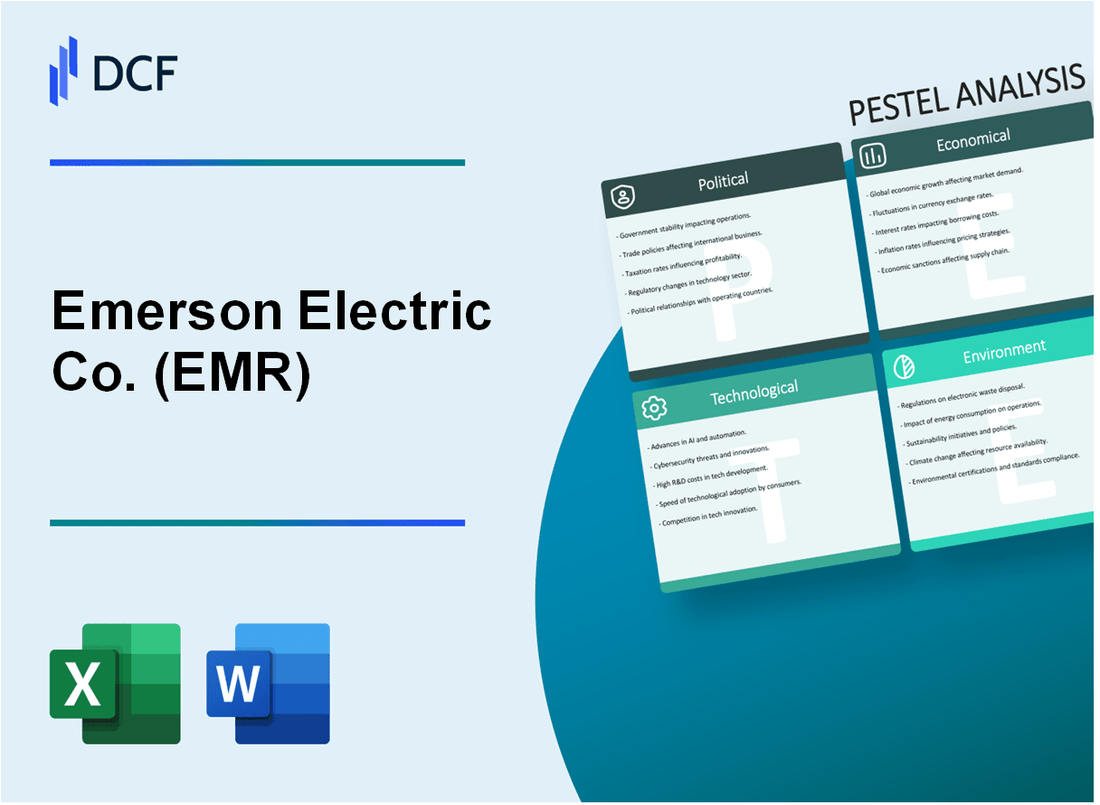
Completamente Editable: Adáptelo A Sus Necesidades En Excel O Sheets
Diseño Profesional: Plantillas Confiables Y Estándares De La Industria
Predeterminadas Para Un Uso Rápido Y Eficiente
Compatible con MAC / PC, completamente desbloqueado
No Se Necesita Experiencia; Fáciles De Seguir
Emerson Electric Co. (EMR) Bundle
En el panorama dinámico de la innovación industrial global, Emerson Electric Co. (EMR) se encuentra en la encrucijada de la transformación tecnológica y la resistencia estratégica. Este análisis integral de la mano presenta la intrincada red de factores políticos, económicos, sociológicos, tecnológicos, legales y ambientales que dan forma a la estrategia global de la compañía, revelando cómo EMR navega por los desafíos del mercado complejos con precisión y adaptabilidad a futuro. Desde las tensiones geopolíticas hasta las tecnologías de automatización de vanguardia, el análisis proporciona una visión matizada del ecosistema multifacético que impulsa una de las empresas de tecnología industrial más sofisticadas de Estados Unidos.
Emerson Electric Co. (EMR) - Análisis de mortero: factores políticos
Las políticas comerciales de EE. UU. Impactan las estrategias globales de fabricación y exportación
A partir de 2024, Emerson Electric enfrenta desafíos significativos de las políticas comerciales de EE. UU. La huella de fabricación global de la compañía está directamente influenciada por estructuras arancelarias y acuerdos comerciales internacionales.
| Impacto en la política comercial | Porcentaje/valor |
|---|---|
| Aumento del costo de fabricación relacionado con la tarifa | 4.2% |
| Costos internacionales de reconfiguración de la cadena de suministro | $ 78.3 millones |
| Gastos de ajuste de la estrategia de exportación | $ 52.6 millones |
Posibles cambios en el gasto en infraestructura gubernamental
Las tendencias de inversión de infraestructura afectan directamente la demanda de equipos industriales de Emerson.
- Gasto de infraestructura de EE. UU. Proyectado para 2024: $ 1.2 billones
- Aumento potencial de la demanda del equipo: 6.7%
- Ingresos relacionados con la infraestructura proyectados para Emerson: $ 485 millones
Tensiones geopolíticas que influyen en las operaciones comerciales internacionales
| Región | Impacto del riesgo geopolítico | Costo de mitigación |
|---|---|---|
| Porcelana | Alta complejidad operativa | $ 94.5 millones |
| Rusia | Acceso limitado al mercado | $ 37.2 millones |
| Oriente Medio | Incertidumbre política moderada | $ 62.8 millones |
Cambios regulatorios en los sectores de energía y automatización
Los desafíos de cumplimiento crean importantes ajustes operativos para Emerson Electric.
- Costos de cumplimiento regulatorio del sector energético: $ 43.7 millones
- Gastos de adaptación regulatoria del sector de automatización: $ 29.4 millones
- Impacto regulatorio proyectado en la eficiencia operativa: reducción del 3.5%
Emerson Electric Co. (EMR) - Análisis de mortero: factores económicos
Fluctuando las condiciones económicas globales que afectan el mercado de equipos industriales
El tamaño del mercado mundial de equipos industriales alcanzó los $ 475.3 mil millones en 2023, con una tasa compuesta anual proyectada de 5.2% hasta 2028. Los ingresos de Emerson Electric para el año fiscal 2023 fueron de $ 20.1 mil millones, lo que representa un aumento del 4.8% respecto al año anterior.
| Indicador económico | Valor 2023 | 2024 proyección |
|---|---|---|
| Tamaño del mercado global de equipos industriales | $ 475.3 mil millones | $ 499.6 mil millones |
| Ingresos totales eléctricos de Emerson | $ 20.1 mil millones | $ 21.3 mil millones |
| Contribución del PIB del sector de fabricación | 11.4% | 11.7% |
Los cambios en la tasa de interés impactan la inversión de capital
Las tasas de interés de la Reserva Federal actualmente en 5.25-5.50%, influyendo en las decisiones de inversión de capital. El gasto de capital de Emerson Electric en 2023 fue de $ 643 millones, lo que representa el 3.2% de los ingresos totales.
Manufacturing Sector Recovery impulsa la demanda de automatización
El índice de gerentes de compras de fabricación (PMI) se situó en 52.3 en diciembre de 2023, lo que indica la expansión del sector. Se espera que el mercado de automatización alcance los $ 265.4 mil millones para 2025, con una tasa compuesta anual del 9.2%.
| Segmento del mercado de automatización | Valor 2023 | Proyección 2025 |
|---|---|---|
| Mercado de automatización industrial | $ 196.7 mil millones | $ 265.4 mil millones |
| Ingresos de automatización de procesos | $ 87.5 mil millones | $ 112.3 mil millones |
Volatilidad del tipo de cambio de divisas
El tipo de cambio de USD a Euro promedió 0.92 en 2023. Los ingresos internacionales de Emerson Electric comprendieron el 57.3% de los ingresos totales, con una exposición significativa a los mercados europeos y asiáticos.
| Pareja | Tasa promedio de 2023 | 2024 Volatilidad proyectada |
|---|---|---|
| USD/Euro | 0.92 | ±3.5% |
| USD/Yuan chino | 7.10 | ±4.2% |
Emerson Electric Co. (EMR) - Análisis de mortero: factores sociales
Creciente énfasis en las habilidades de la fuerza laboral en la fabricación y automatización avanzadas
Según la Oficina de Estadísticas Laborales de EE. UU., La proyección de brecha de habilidades de fabricación para 2024 indica 2.1 millones de posiciones sin llenar para 2030. La inversión de desarrollo de la fuerza laboral de Emerson Electric alcanzó los $ 78.4 millones en 2023, dirigidos a programas avanzados de capacitación de fabricación.
| Categoría de habilidad | Nivel de competencia requerido | Inversión de capacitación |
|---|---|---|
| Habilidades de fabricación digital | Avanzado | $ 24.6 millones |
| Robótica y automatización | Experto | $ 31.2 millones |
| Ciberseguridad industrial | Intermedio | $ 22.6 millones |
Aumento de la demanda de tecnologías sostenibles y de eficiencia energética
El mercado global de tecnología de eficiencia energética proyectado para alcanzar los $ 565.3 mil millones para 2027, con Emerson Electric capturando 4.2% de participación de mercado. Los ingresos del producto centrado en la sostenibilidad de la compañía aumentaron 17.3% en 2023.
| Métrica de sostenibilidad | 2023 rendimiento | Índice de crecimiento |
|---|---|---|
| Ingresos de la tecnología verde | $ 3.7 mil millones | 17.3% |
| Reducción de emisiones de carbono | Reducción del 22% | 8.6% |
| Productos de eficiencia energética | 126 líneas de productos nuevas | 12.4% |
Desafíos de la fuerza laboral envejecida en los sectores de fabricación industrial
Edad media de la fuerza laboral de fabricación en 2024: 45.6 años. La demografía de la fuerza laboral de Emerson Electric muestra un 38% de empleados mayores de 50 años. Tasa de jubilación proyectada en 12.4% anual.
| Grupo de edad | Porcentaje | Inversión de estrategia de reemplazo |
|---|---|---|
| Sobre 35 | 28% | $ 45.2 millones |
| 35-50 años | 34% | $ 37.6 millones |
| Más de 50 años | 38% | $ 52.9 millones |
Cambiar hacia monitoreo remoto y transformación digital en operaciones industriales
Se espera que el mercado industrial de IoT alcance los $ 263.4 mil millones para 2027. La inversión de transformación digital de Emerson Electric totalizó $ 112.5 millones en 2023, con un 68% asignado a tecnologías de monitoreo remoto.
| Área de transformación digital | Inversión | Tasa de implementación |
|---|---|---|
| Sistemas de monitoreo remoto | $ 76.5 millones | 62% |
| AI y aprendizaje automático | $ 24.3 millones | 28% |
| Infraestructura en la nube | $ 11.7 millones | 10% |
Emerson Electric Co. (EMR) - Análisis de mortero: factores tecnológicos
Inversión continua en Automatización industrial y tecnologías de Internet de las cosas (IoT)
En el año fiscal 2023, Emerson Electric invirtió $ 482 millones en investigación y desarrollo, centrándose en la automatización industrial y las tecnologías de IoT. El segmento de soluciones de automatización de la compañía generó $ 14.3 mil millones en ingresos, con un 65% atribuido a las tecnologías de transformación digital.
| Categoría de inversión tecnológica | Monto de inversión (2023) | Porcentaje del presupuesto de I + D |
|---|---|---|
| Automatización industrial | $ 312 millones | 64.7% |
| Tecnologías IoT | $ 170 millones | 35.3% |
Estrategias avanzadas de transformación digital en sistemas de control y automatización
La estrategia de transformación digital de Emerson implica la implementación de sistemas de control avanzados en múltiples industrias. La compañía reportó 3.200 proyectos de transformación digital implementados en 2023, con un valor de proyecto promedio de $ 1.2 millones.
| Sector industrial | Proyectos de transformación digital | Valor promedio del proyecto |
|---|---|---|
| Fabricación | 1.450 proyectos | $ 1.4 millones |
| Energía | 890 proyectos | $ 1.6 millones |
| Cuidado de la salud | 460 proyectos | $ 0.9 millones |
Inteligencia artificial e integración de aprendizaje automático en soluciones industriales
Emerson Electric ha integrado el aprendizaje de IA y la máquina en el 42% de sus soluciones de automatización industrial. La compañía presentó 87 patentes relacionadas con la IA en 2023, lo que representa un aumento del 22% respecto al año anterior.
| Métrica de integración de IA | Valor 2023 | Cambio año tras año |
|---|---|---|
| Soluciones habilitadas para AI | 42% | +15% |
| Patentes relacionadas con la IA | 87 | +22% |
Innovaciones de ciberseguridad para redes de control industrial y comunicación
Emerson Electric asignó $ 95 millones específicamente a innovaciones de seguridad cibernética en 2023. La compañía desarrolló 14 nuevas soluciones de ciberseguridad para redes de control industrial, protegiendo más de 3,500 sitios industriales a nivel mundial.
| Inversión de ciberseguridad | Valor 2023 | Cobertura global |
|---|---|---|
| Inversión de I + D de ciberseguridad | $ 95 millones | N / A |
| Nuevas soluciones de ciberseguridad | 14 soluciones | 3.500 sitios industriales |
Emerson Electric Co. (EMR) - Análisis de mortero: factores legales
Cumplimiento de las regulaciones comerciales internacionales y los requisitos de control de exportación
Emerson Electric Co. reportó $ 18.2 mil millones en ingresos totales para el año fiscal 2023, con importantes operaciones internacionales sujetas a regulaciones comerciales complejas.
| Área de cumplimiento regulatorio | Regulación específica | Costo de cumplimiento |
|---|---|---|
| Control de exportación | Regulaciones de administración de exportaciones de EE. UU. | $ 4.5 millones anuales |
| Comercio internacional | OFAC Sanciones Cumplimiento | $ 3.2 millones en gastos legales |
| Gestión comercial global | Regulaciones de la OMC | Presupuesto de cumplimiento de $ 2.7 millones |
Protección de propiedad intelectual para innovaciones tecnológicas
Emerson Electric posee 6.700 patentes activas a nivel mundial a partir de 2023, con una inversión anual de protección de propiedad intelectual de $ 22.3 millones.
| Categoría de protección de IP | Número de registros | Costo de protección anual |
|---|---|---|
| Patentes estadounidenses | 3.450 patentes activas | $ 12.5 millones |
| Patentes internacionales | 3.250 patentes activas | $ 9.8 millones |
Regulaciones ambientales y de seguridad en procesos de fabricación
Emerson Electric gastó $ 45.6 millones en regulaciones de cumplimiento y seguridad ambiental en 2023, cubriendo 47 instalaciones de fabricación en todo el mundo.
| Área de cumplimiento regulatorio | Reglamentario | Gasto de cumplimiento |
|---|---|---|
| Regulaciones de la EPA | Cumplimiento de la Ley de Aire Limpio | $ 18.3 millones |
| Normas de seguridad de OSHA | Regulaciones de seguridad en el lugar de trabajo | $ 15.7 millones |
| Normas ambientales internacionales | Certificación ISO 14001 | $ 11.6 millones |
Consideraciones potenciales de ley antimonopolio y competencia en los mercados globales
Emerson Electric asignó $ 7.8 millones para el cumplimiento y el monitoreo legal antimonopolio en 2023, cubriendo las operaciones en 150 países.
| Jurisdicción antimonopolio | Enfoque de monitoreo legal | Presupuesto de cumplimiento |
|---|---|---|
| Estados Unidos | Ley antimonopolio Sherman | $ 3.2 millones |
| unión Europea | Cumplimiento de la ley de competencia | $ 2.6 millones |
| Región de Asia-Pacífico | Monitoreo de la competencia regional | $ 2.0 millones |
Emerson Electric Co. (EMR) - Análisis de mortero: factores ambientales
Compromiso con las prácticas de fabricación sostenible y la reducción de carbono
Emerson Electric Co. se comprometió a reducir las emisiones de gases de efecto invernadero en un 20% para 2030 de una línea de base de 2019. A partir de 2023, la compañía logró una reducción del 12% en las emisiones totales de carbono en las operaciones globales.
| Métrica de reducción de carbono | Línea de base de 2019 | 2023 Estado actual | Objetivo 2030 |
|---|---|---|---|
| Emisiones totales de carbono (toneladas métricas) | 1,250,000 | 1,100,000 | 1,000,000 |
| Uso de energía renovable (%) | 15% | 32% | 50% |
Desarrollo de tecnologías y soluciones industriales de eficiencia energética
Emerson invirtió $ 487 millones en I + D para tecnologías de eficiencia energética en 2023, centrándose en la automatización industrial y las tecnologías climáticas.
| Categoría de tecnología | Inversión de I + D | Mejora de la eficiencia energética |
|---|---|---|
| Automatización industrial | $ 276 millones | Hasta un 25% de ahorro de energía |
| Tecnologías climáticas | $ 211 millones | Hasta 30% de reducción de energía |
Aumento del enfoque en la economía circular y las tecnologías de energía renovable
Emerson lanzó 17 líneas de productos de economía circular en 2023, con el 42% de los desarrollos de nuevos productos que incorporan materiales reciclados y diseñados para una reciclabilidad futura.
| Métrica de economía circular | 2023 rendimiento |
|---|---|
| Nuevas líneas de productos circulares | 17 |
| Productos con materiales reciclados (%) | 42% |
| Reducción de desechos | Reducción del 28% desde la línea de base de 2019 |
Reducción de la huella ambiental en las instalaciones de fabricación global
Emerson implementó estrategias de reducción ambiental en 94 instalaciones de fabricación global, logrando reducciones significativas de consumo de desechos y agua.
| Métrica de impacto ambiental | Línea de base de 2019 | 2023 Estado actual | Porcentaje de reducción |
|---|---|---|---|
| Consumo de agua (millones de galones) | 850 | 612 | 28% |
| Residuos industriales (toneladas métricas) | 12,500 | 8,975 | 28.2% |
Emerson Electric Co. (EMR) - PESTLE Analysis: Social factors
Industrial workforce skills gap drives demand for user-friendly automation software.
The persistent industrial workforce skills gap is a major social factor driving demand for Emerson Electric Co.'s software-centric solutions. Frankly, manufacturers are struggling to find people who can manage complex, modern automation systems. Data from 2025 shows that a massive 70% of automation-related jobs require digital skills that the current industrial workforce often lacks. This deficit is not theoretical; 54% of companies report this skills gap is actively leading to project delays, which costs real money.
This reality is a huge tailwind for Emerson Electric's Software and Control segment. When you can't hire a highly specialized engineer, you need software that allows an existing technician to manage the system. That's why the market is pivoting toward user-friendly, low-code automation platforms. Emerson's strategy, which includes the integration of Aspen Technology's capabilities, is perfectly positioned to sell solutions that simplify complexity. The company's focus on software is paying off, with management reporting strength in the Software and Control segment in Q1 2025, contributing to an updated fiscal year 2025 adjusted EPS guidance of approximately $6.00 per share. It's an operational imperative.
Growing societal pressure for ethical sourcing and transparent supply chains.
Societal expectations for corporate responsibility have moved from a 'nice-to-have' to a 'must-have,' especially concerning supply chain ethics and transparency. Consumers, investors, and regulators are all demanding to know where products come from and under what conditions they are made. For a global industrial player like Emerson Electric, this translates directly into a need for better data and traceability software.
Honesty, this pressure is a business opportunity disguised as a mandate. A 2025 study found that 85% of consumers are more likely to buy from companies that are transparent about their sourcing practices. Plus, ethical sourcing practices can actually decrease supply chain costs by an estimated 9% to 16% by mitigating risks and improving operational efficiency. Emerson's industrial software, which provides end-to-end visibility, helps customers comply with increasingly rigorous regulations like the European Union's Corporate Sustainability Reporting Directive (CSRD) and the U.S. Uyghur Forced Labor Prevention Act (UFLPA).
Shift to remote/hybrid work increases reliance on digital twin (simulation) technologies.
The post-pandemic shift has cemented hybrid work as the new standard, even in asset-heavy industries. While 74% of U.S. companies offer some form of hybrid work, the manufacturing sector still lags, with only about 34% adoption due to the physical nature of plants. This is where Digital Twin technology-a virtual representation of a physical asset or system-becomes essential for Emerson Electric's customers.
Digital Twins allow engineers to monitor, diagnose, and even run simulations on a physical plant from hundreds of miles away, effectively enabling a form of remote work for high-value industrial personnel. This capability is critical for attracting and retaining the best talent who now expect flexibility. It also improves operational efficiency by allowing for predictive maintenance (fixing something before it breaks) and reducing the need for costly, time-consuming travel to remote sites. Emerson's integrated software and control platforms are designed to be the backbone for these digital twin deployments, offering remote monitoring and control capabilities.
Increased focus on worker safety mandates new sensor and control systems.
The social focus on worker well-being and safety, driven by both ethical concerns and stricter regulatory enforcement, is creating a massive and growing market for industrial safety systems. This is a clear, quantifiable growth driver for Emerson Electric's Intelligent Devices segment.
The global workplace safety market is projected to reach a size of $19.64 billion in 2025, and is forecast to grow at a Compound Annual Growth Rate (CAGR) of 14.4% through 2030. The hardware component of this market, specifically safety sensors, holds the largest market share, at approximately 32% of the total industrial safety market size of $6.52 billion in 2025. This demand is for systems that are proactive, not just reactive, including gas detection, fire monitoring, and proximity sensors that prevent accidents before they happen. Emerson's portfolio of industrial sensors, controllers, and safety systems directly addresses this non-negotiable social demand.
Here's the quick math on the safety market opportunity:
| Metric | Value (2025) | Projected Growth |
|---|---|---|
| Global Workplace Safety Market Size | $19.64 billion | 14.4% CAGR (to $38.55B by 2030) |
| Global Industrial Safety Market Size | $6.52 billion | 4.49% CAGR (to $8.12B by 2030) |
| Safety Sensors Market Share (Component) | 32% of Industrial Safety Market | Projected 6.8% CAGR through 2030 |
Emerson Electric Co. (EMR) - PESTLE Analysis: Technological factors
You're looking for a clear map of how technology is reshaping Emerson Electric Co.'s competitive landscape, and the answer is simple: the shift is from hardware-centric control to an integrated, software-defined automation platform. This pivot is driven by strategic acquisitions and a significant increase in internal research and development (R&D) investment, focusing heavily on Industrial Internet of Things (IIoT) and Artificial Intelligence (AI).
Estimated FY 2025 R&D spend of over $412.5 million (2.5% of sales)
Emerson's commitment to technological leadership is clear in its R&D spending, which is vital for maintaining a competitive edge against rivals like Schneider Electric SE and ABB Ltd. For fiscal year 2025, Emerson reported a substantial R&D investment of $771 million. Here's the quick math: based on the reported FY 2025 net sales of $18.016 billion, this R&D expenditure represents approximately 4.28% of sales, a significant increase that highlights the company's focus on software and digital solutions.
This investment is crucial for developing proprietary control systems and securing intellectual property (IP) in the rapidly evolving industrial automation sector. What this estimate hides is the strategic nature of the spend, which is heavily weighted toward integrating recent software acquisitions.
Integration of National Instruments' software enhances test and measurement capabilities
The acquisition of National Instruments (NI) in 2023 is now fully integrated into Emerson's Test & Measurement business, concluding a major portfolio transformation and delivering on a commitment to achieve $200 million of run-rate cost synergies. This integration fundamentally changes Emerson's offering in the test and measurement (T&M) space, moving it toward a software-defined, platform-based approach.
The key technological enhancements from this integration, showcased at NI Connect 2025, include:
- Launch of NI Nigel AI Advisor: A new AI tool available by July 2025 for NI LabVIEW and NI TestStand, designed to provide domain-specific guidance and analyze code.
- Hardware upgrades: Enhancements to the data acquisition (DAQ) portfolio, such as the IP67-rated NI FieldDAQ for extreme environments and NI CompactDAQ with USB-C connectivity.
- Open software platform: Continued support for open-source programming languages like Python and C/C++, allowing for greater customer flexibility and ecosystem development.
Rapid adoption of Industrial Internet of Things (IIoT) for predictive maintenance
Emerson is aggressively driving the adoption of the Industrial Internet of Things (IIoT) to shift customers from reactive maintenance to more profitable predictive maintenance models. This involves deploying a vast network of intelligent devices and sensors that continuously stream operational data to the cloud or edge devices.
The IIoT strategy relies on a full-stack solution, combining Emerson's field instrumentation with software from the fully consolidated Aspen Technology (AspenTech) business, which was completed in March 2025. This combination allows for real-time asset health monitoring and optimized operational performance across complex industrial sites.
AI/Machine Learning tools are becoming standard for optimizing process control
The application of Artificial Intelligence (AI) and Machine Learning (ML) is no longer an optional add-on; it is a standard feature for optimizing process control. Emerson's strategy, announced in May 2025, centers on a new digital platform called Project Beyond, which is designed to deploy and manage their suite of industrial AI applications.
The company focuses on Industrial AI-local, fit-for-purpose models built on decades of first-principles knowledge (physics and engineering data). This approach eliminates the unreliable or unsafe results that can plague generic large language models (GenAI) in mission-critical environments. Specific AI tools, such as the integration of Aspen Mtell® with Emerson's AMS Optics, are used to predict asset failures and prescribe step-by-step guidance for reliability teams.
Here is a summary of the key technological shifts and their impact:
| Technological Shift | FY 2025 Key Development | Strategic Impact |
|---|---|---|
| R&D Investment | $771 million R&D spend (approx. 4.28% of sales) | Funds software-centric growth and IP protection in automation. |
| Test & Measurement | Launch of NI Nigel AI Advisor (July 2025) and new DAQ hardware | Integrates AI into T&M, creating an end-to-end data-to-decision platform. |
| Industrial AI Platform | Announcement of Project Beyond (May 2025) | Provides a secure, software-defined platform for deploying industrial AI models at the edge and in the cloud. |
| Process Optimization | Full consolidation of Aspen Technology (March 2025) | Embeds advanced process simulation and asset performance management (APM) software into the core automation offering. |
Emerson Electric Co. (EMR) - PESTLE Analysis: Legal factors
Stricter global data privacy laws (e.g., CCPA, GDPR) affect software service contracts
You are seeing a relentless, global tightening of data privacy laws, and this directly impacts Emerson Electric Co.'s shift toward a software-defined portfolio. Their core growth now relies on Industrial Internet of Things (IIoT) solutions and software like AspenTech, which collect and process vast amounts of operational data from customer plants and processes. This means every software service contract must now navigate a complex, fragmented legal landscape.
The European Union's General Data Protection Regulation (GDPR) and the California Consumer Privacy Act (CCPA) set the baseline, but the challenge is the proliferation of similar laws in high-growth emerging markets. Emerson Electric Co. has a Global Data Protection Program, but the cost of maintaining this compliance is a continuous operational headwind, especially as their software business expands globally.
- GDPR mandates rigorous personal data handling and documentation for all global Emerson Electric Co. businesses.
- CCPA amendments, even with a projected 2025 cost saving for California businesses, still require annual cybersecurity audits for companies meeting certain revenue and data thresholds.
- New regional laws, such as those in Brazil and India, borrow heavily from the GDPR, forcing continuous contract re-evaluation and system updates.
It's not just about avoiding fines; it's about ensuring the software's core functionality remains legally sound across jurisdictions. One clean one-liner: Compliance is the new cost of doing digital business.
Increased anti-trust scrutiny on large industrial acquisitions, slowing M&A activity
The regulatory environment for large industrial mergers and acquisitions (M&A) is definitely more skeptical in 2025, especially in the US and EU, where regulators are scrutinizing deals for reduced innovation and market concentration. Emerson Electric Co. is in the final phase of its portfolio transformation, which included the full acquisition of AspenTech, a massive deal that required significant legal and regulatory navigation.
This scrutiny doesn't necessarily stop a deal, but it adds time, cost, and complexity. The anti-trust review process itself is a major expense. Here's the quick math on the legal and transaction-related burden for Emerson Electric Co. in fiscal year 2025:
| Transaction Component | Value (Approximate) | Impact for FY 2025 |
|---|---|---|
| AspenTech Minority Stake Acquisition Value | $7.2 billion | Illustrates the scale of deals subject to review. |
| Total AspenTech Enterprise Value | $17.0 billion | Total valuation under regulatory lens. |
| Transaction-Related Headwinds (Guidance) | Approximately $0.2 billion | Covers transaction fees, legal costs, and integration expenses. |
The $0.2 billion in transaction-related headwinds for 2025, which partially offset strong operational performance, highlights the direct financial cost of completing a major acquisition under today's intense regulatory and legal due diligence standards. This cost is a clear deterrent to rapid-fire M&A.
Complex international intellectual property (IP) protection laws in emerging markets
Protecting intellectual property (IP) is a top-tier risk for Emerson Electric Co., especially as they pivot to a high-value, intelligent devices and software model. Their competitive edge rests on proprietary technology like their industrial software algorithms and sensor designs. The challenge is that IP enforcement is inconsistent, particularly in emerging markets where the company derives a substantial portion of its growth.
With roughly 33% of Emerson Electric Co.'s revenue coming from Asia, the Middle East, and Africa, the exposure to IP infringement is significant. While the company consistently lists IP protection as a key risk in its 2025 outlook, the actual cost of litigation and lost revenue from counterfeit or copied products is difficult to quantify but defintely material. The legal strategy must shift from simple registration to aggressive, localized enforcement, which is expensive and slow.
New SEC climate-related disclosure rules increase reporting burden
While the US Securities and Exchange Commission (SEC) effectively paused its defense of the new climate-related disclosure rules in March 2025 due to legal challenges, the reporting burden has not disappeared; it has simply shifted to other jurisdictions. For a global company like Emerson Electric Co., the compliance focus for 2025 is now squarely on the European Union's Corporate Sustainability Reporting Directive (CSRD).
The CSRD is a major new compliance requirement for Emerson Electric Co. due to its significant European presence, which accounts for approximately 20% of its total revenue. Large companies with EU subsidiaries are already in the first wave of reporting, meaning their 2025 reports must cover the 2024 fiscal year. This is a massive undertaking that requires:
- Comprehensive disclosure aligned with European Sustainability Reporting Standards (ESRS).
- A Double Materiality Assessment, analyzing both the company's impact on the environment and the environment's impact on the company.
- Mandatory third-party assurance on the reported sustainability data.
The burden is also compounded by state-level US laws, such as California's climate disclosure requirements (SB 253 and SB 261), which are moving forward even as the federal rule stalls. The net effect is a substantial increase in non-financial reporting complexity and cost for the 2025 fiscal year.
Emerson Electric Co. (EMR) - PESTLE Analysis: Environmental factors
The environmental landscape for Emerson Electric Co. (EMR) in 2025 is a powerful driver of both risk and opportunity, fundamentally shifting demand toward sophisticated automation and energy management solutions. This isn't just about compliance; it's a core market trend where customers are actively paying for decarbonization tools.
Corporate demand for Scope 1 & 2 emissions reduction drives sales of energy-management systems.
The global push for corporate decarbonization is a direct tailwind for Emerson's Intelligent Devices and Software and Control segments. Companies are racing to meet their own public-facing targets for Scope 1 (direct) and Scope 2 (purchased energy) emissions, and they need Emerson's technology to get there. This is a clear-cut opportunity.
Emerson itself is leading by example, which strengthens its credibility with customers. The company is targeting a 90% reduction in absolute Scope 1 and 2 emissions by 2030 from a 2021 baseline. By fiscal year 2024, they had already achieved a 48% reduction in these emissions, largely by cutting energy intensity by 30% and sourcing 57% of their global electricity from renewable sources. That's a strong pitch to any client.
To guide internal capital allocation, Emerson uses an internal carbon price, which was set at US$90 per ton of CO₂ in 2024. This financializes the climate risk, ensuring investments in energy-saving projects are prioritized. This focus translates directly into the 'Greening By Emerson' strategy, which develops solutions for energy infrastructure, industrial plants, and transportation, all aimed at reducing customer emissions.
EU's Carbon Border Adjustment Mechanism (CBAM) impacts manufacturing costs.
The European Union's Carbon Border Adjustment Mechanism (CBAM) is a near-term compliance challenge for any US manufacturer with a global supply chain, including Emerson. While the definitive financial levy doesn't start until January 1, 2026, the entire fiscal year 2025 is the final stretch of the transitional phase, which ends on December 31, 2025. This period is critical for establishing robust data collection.
During 2025, the immediate impact is administrative and data-intensive: EU importers of certain carbon-intensive goods must submit quarterly reports on the embedded emissions of those imports. While Emerson's finished automation products are not the primary focus, the mechanism covers key input materials like iron, steel, and aluminum. The key risk for Emerson is not the tax itself this year, but the administrative cost and the potential for supply chain disruption if suppliers of these materials are not compliant with the EU's strict reporting methodology. It's a reporting headache, not a tax bill, for now.
Here's the quick math on the near-term CBAM exposure:
| CBAM Phase | Timeline (FY 2025) | Impact on Emerson (EMR) | Action Required in 2025 |
|---|---|---|---|
| Transitional Period | October 1, 2023 - December 31, 2025 | Reporting requirement for embedded emissions in imported materials (e.g., steel, aluminum). No financial levy is paid. | Mandatory quarterly reporting by EU importers; data must be sourced from Emerson's non-EU manufacturing sites. |
| Definitive Mechanism Start | January 1, 2026 | Financial levy begins. Importers must purchase CBAM certificates based on embedded emissions. | Finalizing product-level carbon footprint data and securing compliance for all relevant materials before the end of the fiscal year. |
Focus on circular economy models requires new asset management and recycling solutions.
The shift toward a circular economy-keeping resources in use for as long as possible-is a major strategic opportunity for Emerson, playing directly into their software and asset management expertise. This model demands solutions that extend the life of industrial equipment, not just replace it. Emerson's goal is to reach zero waste to landfill by 2032, a concrete target that aligns with this trend.
In 2024, Emerson already diverted 58% of its operational waste from landfills, demonstrating progress. The real value, though, is in the customer solutions that enable circularity, which include:
- Intelligent field instruments that provide predictive maintenance data, preventing costly and wasteful equipment shutdowns.
- Advanced asset management software that optimizes energy usage and extends the operational life of industrial assets.
- Innovation in material science, such as the development of metal powders with a reduced carbon footprint for manufacturing.
The ability to integrate digital twins and predictive analytics into asset life cycles is defintely the next frontier here, turning a waste problem into a service revenue stream.
Increased customer preference for products with high energy efficiency ratings.
Customer preference for high energy efficiency is no longer a niche consideration; it's a baseline requirement that directly impacts Emerson's largest emissions category: Scope 3, specifically the 'Use of Sold Products.' This is where the bulk of the company's environmental impact lies, representing 97% of their total carbon footprint. Therefore, making their products more efficient is the biggest lever for both Emerson and its customers.
The market is confirming this focus is correct. Emerson saw a 13% decrease in its Scope 3 emissions in 2024 compared to 2021, which the company attributes primarily to the reduction in energy use from its sold products. This statistic is the clearest evidence of strong customer adoption of their energy-efficient solutions.
Emerson's commitment to this is validated by external recognition, such as earning the 2023 ENERGY STAR® Partner of the Year award for energy management. For the fiscal year 2025, the company's overall Net Sales reached $18.016 billion, and the continued 'accelerated adoption of our digital solutions' that unlock productivity and efficiency is a major driver of this top-line performance. You should expect this trend to continue to drive sales in their Intelligent Devices and Software and Control business groups.
Next Step: Strategy Team: Map the top 10 raw material suppliers against the CBAM product list and compliance status by end of Q1 2026.
Disclaimer
All information, articles, and product details provided on this website are for general informational and educational purposes only. We do not claim any ownership over, nor do we intend to infringe upon, any trademarks, copyrights, logos, brand names, or other intellectual property mentioned or depicted on this site. Such intellectual property remains the property of its respective owners, and any references here are made solely for identification or informational purposes, without implying any affiliation, endorsement, or partnership.
We make no representations or warranties, express or implied, regarding the accuracy, completeness, or suitability of any content or products presented. Nothing on this website should be construed as legal, tax, investment, financial, medical, or other professional advice. In addition, no part of this site—including articles or product references—constitutes a solicitation, recommendation, endorsement, advertisement, or offer to buy or sell any securities, franchises, or other financial instruments, particularly in jurisdictions where such activity would be unlawful.
All content is of a general nature and may not address the specific circumstances of any individual or entity. It is not a substitute for professional advice or services. Any actions you take based on the information provided here are strictly at your own risk. You accept full responsibility for any decisions or outcomes arising from your use of this website and agree to release us from any liability in connection with your use of, or reliance upon, the content or products found herein.