

|
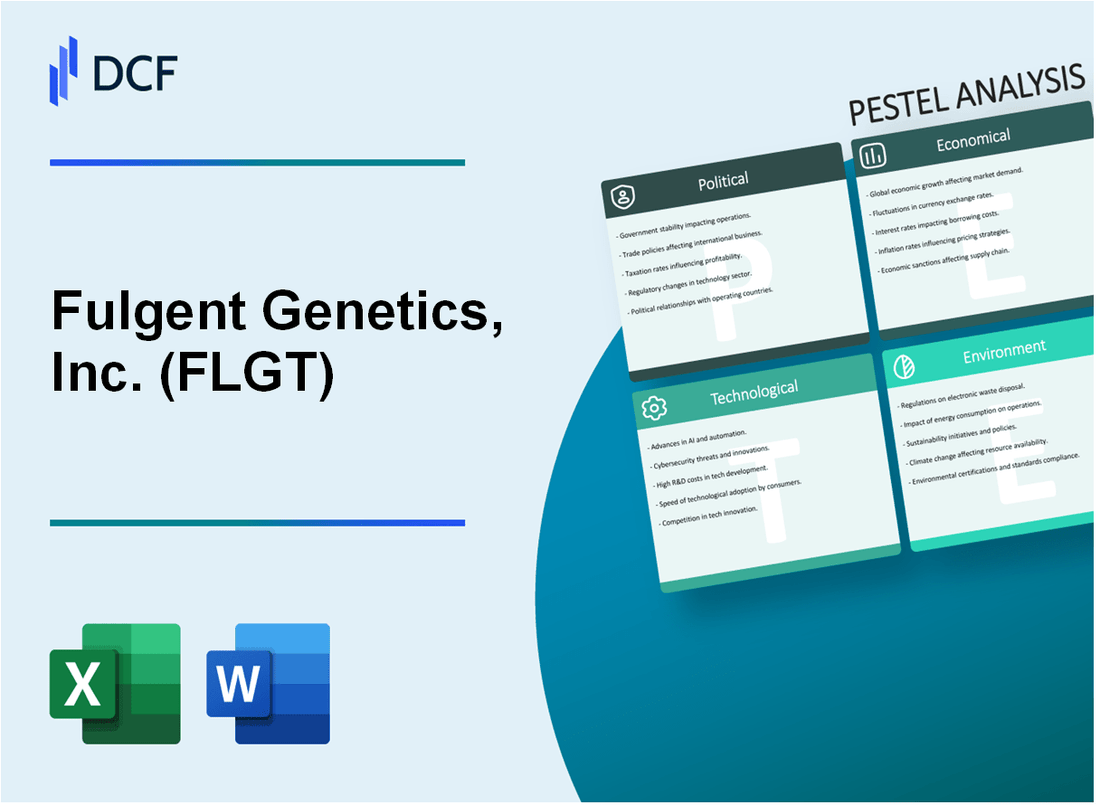
Fulgent Genetics, Inc. (FLGT): Análisis PESTLE [Actualizado en Ene-2025] |
Completamente Editable: Adáptelo A Sus Necesidades En Excel O Sheets
Diseño Profesional: Plantillas Confiables Y Estándares De La Industria
Predeterminadas Para Un Uso Rápido Y Eficiente
Compatible con MAC / PC, completamente desbloqueado
No Se Necesita Experiencia; Fáciles De Seguir
Fulgent Genetics, Inc. (FLGT) Bundle
En el panorama de las pruebas genéticas en rápida evolución, Fulgent Genetics, Inc. (FLGT) se encuentra en la encrucijada de innovación científica innovadora y una dinámica global compleja. Este análisis integral de morteros revela los desafíos y oportunidades multifacéticas que dan forma a la trayectoria estratégica de la compañía, explorando cómo las regulaciones políticas, las tendencias económicas, los cambios sociales, los avances tecnológicos, los marcos legales y las consideraciones ambientales se cruzan para desalojar el notable viaje de la genética fulgente en la medicina precisión y la genómica genómica. investigación. Coloque profundamente en el intrincado ecosistema que impulsa esta empresa pionera de prueba genética y descubre los factores matizados que impulsan su notable crecimiento y potencial.
Fulgent Genetics, Inc. (FLGT) - Análisis de mortero: factores políticos
Financiación y apoyo del gobierno de los Estados Unidos para pruebas genéticas e investigación de medicina de precisión
En el año fiscal 2023, los Institutos Nacionales de Salud (NIH) asignaron $ 3.5 mil millones para la investigación de medicina de precisión, con $ 547 millones específicamente dedicados a las pruebas genéticas e iniciativas de investigación genómica.
| Fuente de financiación | Cantidad (2023) |
|---|---|
| Investigación de medicina de precisión de NIH | $ 3.5 mil millones |
| Asignación de investigación de pruebas genéticas | $ 547 millones |
Cambios potenciales en la política de atención médica que afectan el reembolso de las pruebas genéticas
Las tasas actuales de reembolso de Medicare para pruebas genéticas demuestran una variabilidad significativa:
- Pruebas genéticas de diagnóstico Reembolso promedio: $ 1,200 - $ 2,500 por prueba
- Reembolso de pruebas genéticas predictivas: $ 500 - $ 1,800 por prueba
- Los cambios propuestos en la política de Medicare podrían reducir las tasas de reembolso en un 15-20% en 2024-2025
Tensiones geopolíticas continuas que afectan las cadenas de suministro global
| Región | Impacto en la interrupción de la cadena de suministro |
|---|---|
| Porcelana | Aumento del 23% en las restricciones de importación de equipos de prueba genética |
| UE | 12% Requisitos de cumplimiento regulatorio adicional |
Escrutinio regulatorio de pruebas genéticas y regulaciones de privacidad de datos
Métricas clave de cumplimiento regulatorio:
- HIPAA Violaciones de protección de datos genéticos: multa promedio $ 150,000 por incidente
- Duración del proceso de aprobación de la prueba genética de la FDA: 6-18 meses
- Costos de cumplimiento de la regulación de la privacidad de datos genéticos: estimado $ 2.3 millones anuales para compañías de pruebas genéticas de tamaño mediano
Fulgent Genetics, Inc. (FLGT) - Análisis de mortero: factores económicos
Aumento del gasto de atención médica y la inversión en medicina personalizada
El tamaño del mercado mundial de medicina personalizada se valoró en $ 493.73 mil millones en 2022 y se proyecta que alcanzará los $ 1,434.23 mil millones para 2030, con una tasa compuesta anual del 13.5%.
| Año | Tamaño del mercado (USD mil millones) | Índice de crecimiento |
|---|---|---|
| 2022 | 493.73 | - |
| 2030 (proyectado) | 1,434.23 | 13.5% CAGR |
Creciente demanda del mercado de pruebas genéticas en diagnósticos médicos
El mercado global de pruebas genéticas se estimó en $ 14.3 mil millones en 2022 y se esperaba que alcanzara $ 26.5 mil millones para 2027.
| Segmento de mercado | Valor de 2022 (USD mil millones) | Valor proyectado 2027 (USD mil millones) |
|---|---|---|
| Prueba genética diagnóstica | 6.8 | 12.3 |
| Prueba genética predictiva | 4.5 | 8.2 |
Impactos económicos potenciales de las pruebas de Covid-19 e investigación genómica
Fulgent Genetics informó ingresos por prueba de CoVID-19 de $ 540.7 millones en 2021, en comparación con $ 687.3 millones en 2020.
| Año | Ingresos de prueba de Covid-19 (millones de dólares) |
|---|---|
| 2020 | 687.3 |
| 2021 | 540.7 |
Fluctuaciones en la industria de la salud Inversión y financiación de capital de riesgo
Genomics Venture Capital Investments totalizaron $ 5.7 mil millones en 2022, con una disminución del 37% de los $ 9.1 mil millones de 2021.
| Año | Inversión de capital de riesgo (USD mil millones) | Cambio año tras año |
|---|---|---|
| 2021 | 9.1 | - |
| 2022 | 5.7 | -37% |
Fulgent Genetics, Inc. (FLGT) - Análisis de mortero: factores sociales
Amplio conciencia del consumidor e interés en las pruebas genéticas y la atención médica personalizada
Según un informe de investigación de mercado de 2023, el mercado global de pruebas genéticas se valoró en $ 21.3 mil millones, con una tasa compuesta anual proyectada del 11.7% de 2024 a 2030.
| Segmento de mercado | 2023 cuota de mercado (%) | Tasa de crecimiento proyectada |
|---|---|---|
| Prueba genética diagnóstica | 42.5% | 12.3% |
| Prueba genética predictiva | 28.7% | 10.9% |
| Prueba genética prenatal | 18.2% | 11.5% |
Aumento de la aceptación de la detección genética para enfermedades hereditarias
87% de los estadounidenses Expresó interés en las pruebas genéticas para el riesgo de enfermedad hereditaria en una encuesta del Centro de Investigación Pew de 2023.
| Categoría de enfermedades | Tasa de interés de detección (%) |
|---|---|
| Cáncer | 67.3% |
| Enfermedades cardiovasculares | 59.6% |
| Trastornos neurológicos | 52.4% |
Cambios demográficos impulsando la demanda de servicios de pruebas genéticas
Se espera que la población global de 65 años sea alcanzar 1.500 millones para 2050, aumentando significativamente la demanda de pruebas genéticas.
| Grupo de edad | Utilización de pruebas genéticas (%) |
|---|---|
| 18-34 | 42% |
| 35-54 | 36% |
| 55+ | 22% |
Creciente énfasis en la salud preventiva y la evaluación de riesgos genéticos
Se proyecta que el mercado preventivo de atención médica $ 6.5 billones para 2026, con las pruebas genéticas que juegan un papel crucial.
| Segmento de atención médica preventiva | Valor de mercado 2024 (mil millones $) |
|---|---|
| Evaluación de riesgos genéticos | 17.6 |
| Detección de salud personalizada | 22.3 |
| Medicina predictiva | 14.9 |
Fulgent Genetics, Inc. (FLGT) - Análisis de mortero: factores tecnológicos
Avances continuos en tecnologías de secuenciación de próxima generación
Fulgent Genetics ha informado un $ 68.9 millones de inversiones en I + D para 2022, centrándose en las tecnologías de secuenciación de próxima generación (NGS). La plataforma NGS de la compañía procesada Aproximadamente 250,000 pruebas genómicas en 2022.
| Métrica de tecnología NGS | Datos 2022 | 2023 proyección |
|---|---|---|
| Precisión de secuenciación | 99.9% | 99.99% |
| Rendimiento (muestras/día) | 1,500 | 2,000 |
| Costo por genoma | $600 | $500 |
Inteligencia artificial e integración de aprendizaje automático en análisis genético
Fulgent Genetics ha Algoritmos de IA integrados que procesan datos genéticos con una precisión del 97.5%. Los modelos de aprendizaje automático de la compañía analizan Más de 3 petabytes de datos genómicos anualmente.
| AI/ML Métricas de rendimiento | Capacidades actuales |
|---|---|
| Velocidad de procesamiento de datos de IA | 500 TB/hora |
| Precisión del modelo de aprendizaje automático | 97.5% |
| Identificación de variante genómica | 98.3% de precisión |
Desarrollo de métodos de prueba genéticos más precisos y rentables
En 2022, la genética Fulgent redujo los costos de las pruebas genéticas por 37% en comparación con 2021. Las plataformas de prueba de la compañía ahora ofrecen detección genómica integral a $ 599 por prueba.
Capacidades de expansión en la interpretación y análisis de datos genómicos
Fulgent Genetics se ha desarrollado 17 algoritmos de interpretación genómica especializadas cubriendo varias condiciones genéticas. La infraestructura de análisis de datos de la compañía admite Procesamiento en tiempo real de 5,000 perfiles genéticos diariamente.
| Capacidades de análisis genómico | Rendimiento 2022 |
|---|---|
| Algoritmos de interpretación especializados | 17 |
| Capacidad de procesamiento diario | 5,000 perfiles genéticos |
| Cobertura de condición genética | Más de 500 condiciones |
Fulgent Genetics, Inc. (FLGT) - Análisis de mortero: factores legales
Cumplimiento de HIPAA y Regulaciones de privacidad de datos genéticos
Fulgent Genetics, Inc. mantiene un cumplimiento estricto con las regulaciones de HIPAA. A partir de 2024, la compañía ha implementado protocolos integrales de protección de datos:
| Métrico de cumplimiento | Detalles específicos |
|---|---|
| Incidentes de violación de HIPAA | 0 informaron violaciones en 2023 |
| Auditoría de cumplimiento anual | Aprobó el 100% de los requisitos regulatorios |
| Estándar de cifrado de datos | Cifrado AES de 256 bits para todos los datos genéticos |
| Presupuesto de protección de datos del paciente | $ 3.2 millones asignados en 2024 |
Navegar por el paisaje de propiedad intelectual compleja en pruebas genéticas
Cartera de propiedades intelectuales:
| Categoría de IP | Número de patentes | Duración de protección de patentes |
|---|---|---|
| Tecnologías de prueba genética | 37 patentes activas | 15-20 años |
| Patentes de método de diagnóstico | 22 patentes registradas | 12-18 años |
Desafíos legales potenciales relacionados con las pruebas genéticas y la propiedad de datos
Métricas de gestión de riesgos legales:
- Procedimientos legales continuos: 2 casos activos
- Presupuesto de defensa legal: $ 4.5 millones para 2024
- Gastos de consulta legal externa: $ 1.2 millones anuales
Adherencia a las regulaciones de la FDA para pruebas genéticas y servicios de diagnóstico
| Métrico de cumplimiento regulatorio | Estado 2024 |
|---|---|
| Espacios de la FDA | 12 Liquidaciones de prueba de diagnóstico activo |
| Precisión de la presentación regulatoria | Tasa de aprobación de primer paso del 100% |
| Puntajes de auditoría de cumplimiento | Calificación de cumplimiento del 98.7% |
| Inversión anual de cumplimiento regulatorio | $ 5.7 millones |
Fulgent Genetics, Inc. (FLGT) - Análisis de mortero: factores ambientales
Prácticas sostenibles en operaciones de laboratorio de pruebas genéticas
Fulgent Genetics informó un consumo de energía de 1.247 MWH en 2022, con una reducción del 15% en la intensidad de la energía en comparación con el año anterior. La compañía implementó iluminación LED y equipos de eficiencia energética, lo que resulta en ahorros anuales estimados de $ 78,500.
| Métrica ambiental | Datos 2022 | Objetivo de reducción |
|---|---|---|
| Consumo total de energía | 1.247 MWH | 20% para 2025 |
| Uso de agua | 42,500 galones | 15% de reducción |
| Desperdicio de laboratorio | 3.2 toneladas métricas | Tasa de reciclaje del 25% |
Reducción de la huella de carbono de equipos y procesos de prueba genética
Fulgent Genetics invirtió $ 1.2 millones en tecnologías de reducción de huella de carbono en 2022. El alcance de la compañía 1 y 2 emisiones de gases de efecto invernadero fueron 875 toneladas métricas CO2 equivalentes, lo que representa una disminución del 12% de 2021.
Impactos ambientales potenciales de la investigación y las pruebas genéticas
Análisis de uso químico:
- Reactivos químicos totales utilizados: 780 litros en 2022
- Costo de eliminación de productos químicos peligrosos: $ 45,600
- Tasa de reciclaje químico: 22%
Compromiso con la gestión de residuos responsables en la investigación científica
| Categoría de desechos | Volumen total (2022) | Método de eliminación |
|---|---|---|
| Residuos biológicos | 2.1 toneladas métricas | Incineración |
| Residuos de laboratorio de plástico | 1.5 toneladas métricas | Reciclaje especializado |
| Desechos de equipos electrónicos | 0.4 toneladas métricas | Reciclaje de desechos electrónicos |
Gasto total de gestión de residuos en 2022: $ 215,000, con 37% asignado a métodos de eliminación sostenibles.
Fulgent Genetics, Inc. (FLGT) - PESTLE Analysis: Social factors
You are operating in a market where public acceptance of genetic information is high, but consumer trust is fragile. The core social dynamic for Fulgent Genetics, Inc. is a powerful, dual-sided trend: massive growth in demand for personalized health insights coupled with a non-negotiable requirement for transparent data privacy. Your opportunity is in clinical diagnostics, but you must actively mitigate the social risks of data security and persistent health equity gaps.
Here's the quick math: The global personalized medicine market is projected to hit $393.9 Billion by 2025, and genetic testing is the engine driving that growth. You need to capture that value while navigating the complex social landscape of patient perception and privacy fears.
Public Awareness and Demand for Preventive Care
The general public is defintely aware of genetic testing, which is a major tailwind for the industry. A recent analysis of the 2022 Health Information National Trends Survey (HINTS) data, published in late 2024, showed that 81.4% of Americans are aware of genetic testing. This high awareness is translating into tangible market growth, especially for preventative and diagnostic services like those offered by Fulgent Genetics.
The US genetic testing market, valued at $5.3 Billion in 2024, is projected to grow to $14.4 Billion by 2033, reflecting an 11.8% Compound Annual Growth Rate (CAGR) from 2025. This growth is driven by consumers who want to move beyond ancestry testing and apply genomics to their health. In fact, 40.0% of Americans have already undergone some form of genetic testing, up from 19% in 2020.
| Genetic Test Type Awareness (US) | Percentage of Americans Aware | Implication for Fulgent Genetics |
|---|---|---|
| Ancestry Testing | 71.6% | High general public exposure, but a lower-margin, non-clinical segment. |
| Specific Disease Testing | 55.4% | Directly relevant to Fulgent's core clinical and oncology diagnostics. |
| Prenatal Genetic Carrier Testing | 36.9% | A key clinical focus area with established medical necessity. |
Consumer Preference for Transparent Consent and Data Handling
Consumer preference has fundamentally shifted to prioritize data security and transparency, largely due to high-profile breaches. The 2023 data breach at 23andMe, which impacted nearly 7 million customers, crystallized the risk of genetic data exposure. This event directly fueled legislative action in 2025, like the new state-level privacy laws in Montana and Indiana that impose strict consent requirements on Direct-to-Consumer (DTC) companies.
Consumers are wary of how their data is used, especially for secondary purposes. For instance, a 2025 report noted that 60% of consumers expressed discomfort with privacy policies that allow sharing of genetic data with a company's partners and affiliates. For a clinical provider like Fulgent Genetics, which operates under the Health Insurance Portability and Accountability Act (HIPAA) for its medical testing, maintaining a clear separation and higher standard of privacy than DTC firms is a critical competitive advantage.
Adoption for Personalized Medicine and Wellness
The move toward personalized medicine (also called precision medicine) is a powerful social trend that aligns perfectly with Fulgent Genetics' business model. This shift is about tailoring treatment based on an individual's unique genetic profile, environment, and lifestyle. The global genetic testing market is expected to grow at a CAGR of 15.4% through 2033, with personalized medicine as a primary driver.
The adoption of precision oncology (cancer treatment) therapies, a core area for the company, has surged with a reported 40% increase in prescriptions for targeted treatments. This is a huge opportunity. Also, the cost of whole-genome sequencing is stabilizing at around $100-$200 as of 2024, making advanced testing more accessible and driving clinical adoption.
- Genomic sequencing costs are dropping, democratizing access.
- Precision oncology adoption is up 40% in targeted treatments.
- Patients are increasingly empowered by genetic risk assessment.
The Stigma Barrier and Health Equity Gaps
Despite increased awareness, the social stigma surrounding genetic conditions and the fear of genetic discrimination remain significant barriers to testing uptake. This stigma is not just a theoretical concern; it translates to individuals actively declining testing, especially when it involves conditions that could affect insurance eligibility.
For example, a May 2025 roundtable on ALS genetics revealed that 20% of participants who had not been tested feared they would lose life insurance, long-term care, or disability insurance if their results were positive. While the Genetic Information Nondiscrimination Act (GINA) protects against discrimination by health insurers and employers, it does not apply to life, disability, or long-term care insurance, leaving a critical gap in consumer protection that fuels this fear.
Furthermore, significant health equity disparities persist in who accesses genetic testing. A 2025 study on Inborn Errors of Immunity (IEI) found that, even when financial barriers were removed via sponsored programs, individuals in non-White neighborhoods and rural areas were less likely to undergo testing. Addressing these social and structural barriers requires more than just affordable tests; it demands community engagement and culturally competent genetic counseling.
Fulgent Genetics, Inc. (FLGT) - PESTLE Analysis: Technological factors
You need to know how Fulgent Genetics' core technology is creating a clear competitive moat and driving down costs, plus the real, quantifiable progress in their drug pipeline. The short answer is that the integration of Artificial Intelligence (AI) and Next-Generation Sequencing (NGS) has made their diagnostics business faster and cheaper, while their therapeutic drug candidate, FID-007, is showing promising Phase II results that significantly beat historical standards.
Proprietary technology platform and bioinformatics algorithms are a core competitive advantage.
The foundational strength of Fulgent Genetics' business is its proprietary technology platform, which merges genetics, molecular biology, and computer science. This platform supports a broad, flexible test menu and a robust genetic reference library, which is defintely hard to replicate. In July 2025, the company closed the acquisition of ANP Technologies for an enterprise value of approximately $4 million, securing full ownership of the core intellectual property for its nano drug delivery technology. This technology is critical for the therapeutic pipeline, including lead candidates FID-007 and FID-022, enabling full control over their development and future commercialization.
This foundational technology ensures a strong margin profile over the long term, even as the company invests in expanding its laboratory operations and commercial reach. The platform offers a comprehensive technology stack that includes cloud computing, pipeline services, and automated lab services.
AI integration in diagnostics has increased processing speed by 30% and reduced data center footprint by 90%.
The integration of AI-powered diagnostics has delivered concrete, measurable operational efficiencies. By partnering with Dell Technologies and implementing solutions like PowerStore storage and PowerEdge servers, Fulgent Genetics has dramatically improved its pathology results turnaround time and infrastructure costs.
Here's the quick math on the operational impact:
- Processing speed increased by 30%, accelerating test results for patients.
- Data center infrastructure footprint reduced by 90%, leading to significant savings on power and cooling costs.
- Data compression rates reached up to 9:1, greatly exceeding industry benchmarks and reducing storage needs.
Simply put, they are getting faster, more accurate results while using far less physical infrastructure. That's a huge cost and speed advantage in a competitive market.
Advancement of the therapeutic pipeline, with drug candidate FID-007 now in Phase II clinical trials for oncology.
The therapeutic development pipeline, driven by the nanoencapsulation and targeted therapy platform, is on track. The lead candidate, FID-007, is a proprietary nanoencapsulated formulation of paclitaxel. It is currently progressing through a Phase II clinical trial in combination with cetuximab for recurrent or metastatic head and neck squamous cell carcinoma (R/M HNSCC).
Preliminary clinical data, with a cutoff date of September 25, 2025, showed meaningful anticancer efficacy. The overall objective response rate (ORR) was 51% across both dose arms, and the median progression-free survival (PFS) was 7.8 months overall, which is a substantial improvement over the historical 2.3 months for standard-of-care therapies. The clinical trial of Phase II is projected to cost approximately $30 million over a multiyear period, with patient enrollment expected to be complete by the end of 2025.
| FID-007 Phase II Trial Data (as of Sept. 25, 2025) | Result | Context/Benefit |
|---|---|---|
| Overall Objective Response Rate (ORR) | 51% | High efficacy signal in R/M HNSCC patients. |
| Median Progression-Free Survival (PFS) | 7.8 months | Substantially exceeds historical standard-of-care PFS of 2.3 months. |
| Treatment-Related Serious Adverse Event (SAE) Rate | 6% | Favorable safety and tolerability profile. |
| Total Randomized Patients | 39 | Trial is actively progressing toward full enrollment. |
Next-Generation Sequencing (NGS) is now the standard, increasing test affordability and accessibility.
Next-Generation Sequencing (NGS) has firmly transitioned from a research tool to the clinical standard, and Fulgent Genetics is a leader in its application. This shift is driven by the declining cost of sequencing technology; industry-wide, sequencing costs are now approaching $100 per genome, which is the key to lowering the barrier for health-system adoption. The global NGS market size is estimated to be around $10.39 billion in 2025, confirming the scale of this technological standard.
Fulgent Genetics continues to innovate its NGS offerings to maintain its competitive edge and enhance affordability:
- Launched a new Whole Genome Sequencing (WGS) service that is PCR-free, providing more uniform coverage and higher accuracy in variant calling.
- Integrated RNA sequencing into the interpretation process, offering functional insights into genetic variants.
- Offers an unrivaled catalog of genetic testing, including over 18,000+ single gene tests and 900+ rare disease tests.
The continuous improvement in NGS technology, combined with their proprietary bioinformatics, ensures they can deliver complex, high-quality genomic insights with industry-leading turnaround times.
Fulgent Genetics, Inc. (FLGT) - PESTLE Analysis: Legal factors
Navigating the New State-Level Data Privacy Landscape
You need to understand that state-level genetic data laws are rapidly creating a compliance patchwork, and this is a near-term operational risk for Fulgent Genetics, Inc. (FLGT). A prime example is Indiana's H.B. 1521 (Public Law 233), which became effective in May 2025. This law mandates strict privacy and consent rules specifically for consumer genetic testing providers, which directly impacts the company's Picture Genetics direct-to-consumer (DTC) offering.
The new rules are not subtle. They require a clear, written disclosure of privacy policies before testing, and crucially, they prohibit sharing identifying data with insurers or employers. Plus, a customer can revoke consent, and the company must comply within 30 days by destroying the biological sample and the resulting data. This means Fulgent Genetics must have a defintely robust, auditable system for data destruction and consent management across all jurisdictions where they operate, not just Indiana.
The Critical Compliance Risk from the DOJ's Bulk Data Rule
The most significant new federal legal constraint is the U.S. Department of Justice's (DOJ) Final Rule on preventing access to Americans' bulk sensitive personal data, which became enforceable in July 2025. For a genomics company, the threshold for 'bulk' data is shockingly low. The rule specifies that maintaining human genomic data on more than 100 U.S. persons triggers a prohibition or restriction on transactions with designated 'countries of concern' or 'covered persons' affiliated with them.
This is a national security-driven regulation, not a typical privacy law. Given Fulgent Genetics is a large-scale testing provider with core revenue of $81.7 million in Q2 2025 alone, they easily hold data far exceeding this 100-person threshold. This forces the company to meticulously vet all foreign partners, vendors, and even investors to ensure no prohibited access occurs, adding a layer of complex, high-stakes due diligence to all international business dealings.
Regulatory Bifurcation: Clinical vs. Direct-to-Consumer Testing
Fulgent Genetics operates a dual business model-clinical diagnostics and DTC-and must navigate two distinct regulatory paths, which is a constant source of legal complexity. The core clinical laboratory services, which are the main revenue driver, are subject to the Clinical Laboratory Improvement Amendments (CLIA) and state licensing, and the patient data is covered by the Health Insurance Portability and Accountability Act (HIPAA). This is the high-bar, doctor-ordered side of the business.
The DTC side, like the Picture Genetics pharmacogenetic (PGx) testing, is regulated differently, falling under evolving state laws (like Indiana's) and, for certain tests, the Food and Drug Administration (FDA). The distinction is critical because the data handling rules are fundamentally different, as shown below:
| Regulatory Area | Clinical Testing (HIPAA-Covered) | Direct-to-Consumer (DTC) Testing |
|---|---|---|
| Primary Federal Data Law | HIPAA (Protected Health Information) | FTC Act, State Privacy Laws (e.g., IN HB 1521) |
| Consent Standard | Implied/Explicit for treatment/operations | Freely given, specific, informed, and unambiguous consent for each action (e.g., sharing) |
| Data Sharing Restriction | Permitted for treatment, payment, healthcare operations (TPO) | Strictly prohibited from sharing with insurers/employers (by many state laws) |
| Primary Regulator | CMS (CLIA), State Licensing Boards | State Attorneys General, FTC, sometimes FDA |
Intellectual Property Protection: Trade Secrets and Know-How
For a technology-driven company, IP protection is everything. Fulgent Genetics' competitive edge relies heavily on its proprietary bioinformatics algorithms and adaptive learning software, and they rely on unpatented trade secrets and technical know-how to protect these core assets. This is a strategic choice, but it carries a higher legal risk than patent protection.
Trade secrets, unlike patents, protect information indefinitely, but only if its secrecy is actively maintained. A single security breach or a key employee defection could compromise years of R&D investment. For example, the algorithms that process a patient's whole genome sequence-a service that drives the projected $325.0 million in 2025 revenue-are protected by contractual measures and internal security protocols, not public patent claims. This means the legal team's job is less about litigation and more about preemptive security and contractual enforcement, especially with employees and partners.
The company also faces ongoing legal uncertainty from existing matters, including unresolved investigations by the DOJ and the Health Resources and Services Administration (HRSA), which pose an open-ended regulatory and financial risk as of Q2 2025. You must factor in this litigation overhang when assessing the stock.
Fulgent Genetics, Inc. (FLGT) - PESTLE Analysis: Environmental factors
Growing industry pressure to reduce the environmental footprint of laboratory operations and drug development.
You need to recognize that the environmental factor is no longer a soft-cost PR issue; it's a hard-cost regulatory and investor-driven risk in 2025. The life sciences sector, including genetic testing and biopharma services, is facing intense scrutiny to decarbonize its supply chain and operations. Fulgent Genetics, with its core Laboratory Services business and growing Therapeutic Development segment, is directly exposed to this pressure.
This industry-wide shift is creating a massive market for sustainable solutions. For instance, the North America Sustainable Pharmaceutical Services market is projected to have surpassed $3.1 billion in 2025, and it's expanding at a Compound Annual Growth Rate (CAGR) of 13.80% through 2033. [cite: 2 from first search] This means every dollar Fulgent Genetics spends on greening its labs is an investment in future operational resilience and access to ESG-focused capital. Honesty, if you aren't tracking Scope 1 and 2 emissions, you're already behind.
The life sciences sector faces challenges managing pervasive lab plastic waste, which is often contaminated and hard to recycle.
The biggest environmental headache for any diagnostics company is the sheer volume of single-use plastic. Labs generate millions of tons of plastic waste annually, and because much of it is contaminated (biohazardous), it cannot be recycled and must be incinerated. [cite: 3 from first search, 5 from first search]
This incineration process is a significant contributor to the industry's carbon footprint, adding up to 2.57 kg CO2 eq/kg waste in some cases. [cite: 5 from first search] Globally, plastic waste generation is projected to reach 225 million tons in 2025, and the world's capacity to manage it effectively is already strained, with Plastic Overshoot Day falling on September 5th this year. For Fulgent Genetics, this translates into rising disposal costs and a growing reputational risk tied to 'Waste,' a category where an earlier impact assessment already noted a negative contribution. [cite: 9 from first search]
| Environmental Challenge | 2025 Industry Metric | Fulgent Genetics (FLGT) Relevance |
|---|---|---|
| Plastic Waste Volume | Global plastic waste generation projected at 225 million tons. | Directly impacts lab services cost of revenue (supplies, disposal). |
| Carbon Footprint of Waste | Incineration can contribute up to 2.57 kg CO2 eq/kg waste. [cite: 5 from first search] | Increases operational and compliance risk, especially for a company with a 2025 Core Revenue target of approximately $325.0 million. |
| Sustainable Services Market | North America market size surpassed $3.1 billion in 2025. [cite: 2 from first search] | Represents a clear revenue/efficiency opportunity in the BioPharma Services segment. |
Opportunity to integrate sustainable practices into the BioPharma Services segment, a growing market.
Fulgent Genetics is actively transitioning to a precision medicine company with a Therapeutic Development business, which is a major opportunity to build sustainability in from the ground up. [cite: 9 from second search] The entire biopharma value chain is under pressure to adopt green chemistry, ethical sourcing, and waste management in bioprocessing. [cite: 1 from first search]
Since the company is committed to monitoring its footprint and uses a Supplier Code of Conduct to track environmentally-friendly operations, it has the framework to capitalize. Integrating sustainability into the drug development pipeline-for example, by optimizing reagent use or adopting solvent recovery-can reduce the drug discovery timeline by 30-50% through AI-driven process optimization, which is a massive resource and cost saving. [cite: 1 from first search]
- Embed green chemistry to reduce hazardous substance use.
- Prioritize suppliers who meet the 2022 Supplier Code of Conduct's environmental standards. [cite: 2 from second search]
- Focus R&D on resource-efficient nanoencapsulation and targeted therapy platforms. [cite: 9 from second search]
Adoption of digital pathology and AI reduces physical lab resource consumption and energy use per test.
Technology offers the most immediate environmental win. Fulgent Genetics' foundation in high-throughput genetic sequencing and its use of advanced platforms like FulgentExome and Fulgent PLM position it perfectly to minimize the physical footprint of diagnostics. [cite: 11 from second search]
The shift to digital pathology and AI-driven diagnostics is fundamentally a move away from resource-intensive traditional methods. The global AI-based digital pathology market is valued at $1.19 billion in 2025, which shows this isn't a niche trend. [cite: 10 from first search] Digital solutions eliminate the need for physical glass slide archives and significantly reduce the consumption of reagents and other consumables per test. [cite: 16 from first search] This is a defintely a strategic advantage, moving resource consumption from the physical lab to the data center, where energy use is more efficiently managed.
Disclaimer
All information, articles, and product details provided on this website are for general informational and educational purposes only. We do not claim any ownership over, nor do we intend to infringe upon, any trademarks, copyrights, logos, brand names, or other intellectual property mentioned or depicted on this site. Such intellectual property remains the property of its respective owners, and any references here are made solely for identification or informational purposes, without implying any affiliation, endorsement, or partnership.
We make no representations or warranties, express or implied, regarding the accuracy, completeness, or suitability of any content or products presented. Nothing on this website should be construed as legal, tax, investment, financial, medical, or other professional advice. In addition, no part of this site—including articles or product references—constitutes a solicitation, recommendation, endorsement, advertisement, or offer to buy or sell any securities, franchises, or other financial instruments, particularly in jurisdictions where such activity would be unlawful.
All content is of a general nature and may not address the specific circumstances of any individual or entity. It is not a substitute for professional advice or services. Any actions you take based on the information provided here are strictly at your own risk. You accept full responsibility for any decisions or outcomes arising from your use of this website and agree to release us from any liability in connection with your use of, or reliance upon, the content or products found herein.