

|
Forward Air Corporation (FWRD): Análisis PESTLE [Actualizado en Ene-2025] |
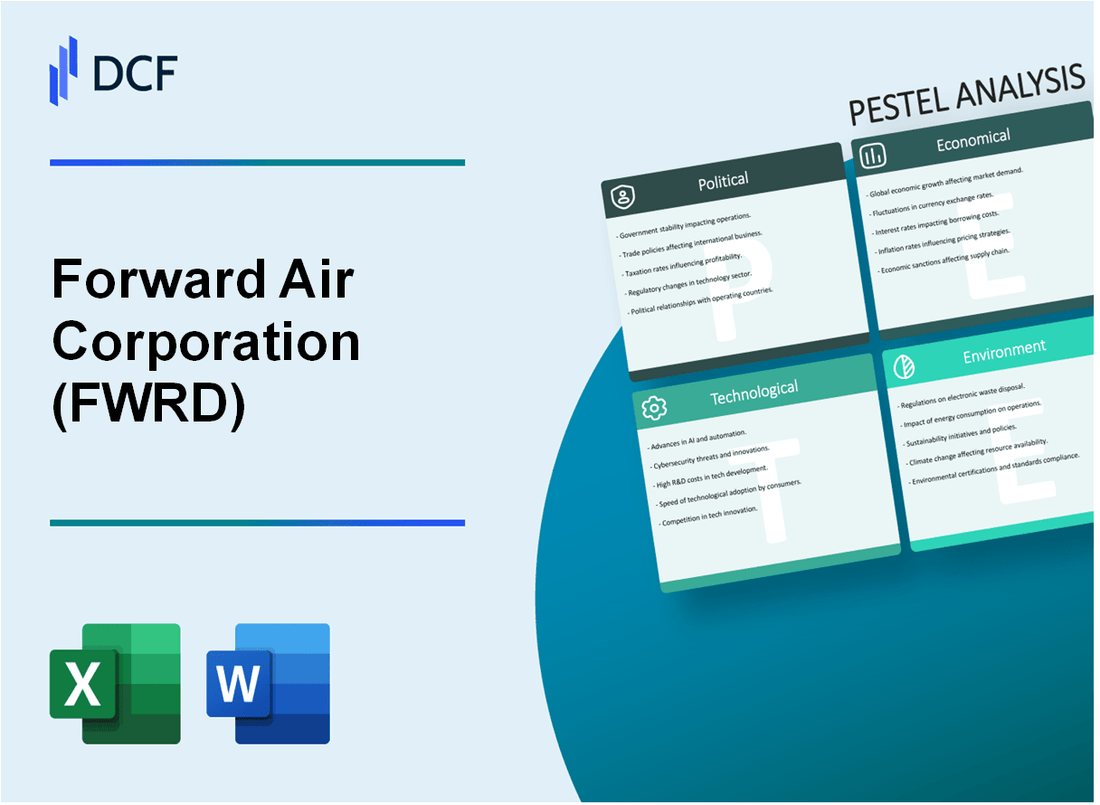
Completamente Editable: Adáptelo A Sus Necesidades En Excel O Sheets
Diseño Profesional: Plantillas Confiables Y Estándares De La Industria
Predeterminadas Para Un Uso Rápido Y Eficiente
Compatible con MAC / PC, completamente desbloqueado
No Se Necesita Experiencia; Fáciles De Seguir
Forward Air Corporation (FWRD) Bundle
En el mundo dinámico de la logística y el transporte, Forward Air Corporation (FWRD) se encuentra en una intersección crítica de desafíos globales complejos y oportunidades transformadoras. Nuestro análisis integral de mortero presenta el intrincado panorama de factores políticos, económicos, sociológicos, tecnológicos, legales y ambientales que dan forma a la trayectoria estratégica de esta empresa innovadora. Desde inversiones de infraestructura hasta tecnologías emergentes, desde la dinámica de la fuerza laboral hasta las presiones de sostenibilidad, esta exploración ofrece una visión matizada del ecosistema multifacético que impulsa el rendimiento comercial y el potencial futuro de Air Air.
Forward Air Corporation (FWRD) - Análisis de mortero: factores políticos
Aumento del enfoque en la inversión de infraestructura de transporte por parte del gobierno federal
La Ley de Inversión y Empleos de Infraestructura (IJA) asignó $ 1.2 billones para mejoras de infraestructura, con $ 550 mil millones designado para nuevos gastos. Infraestructura de transporte recibida $ 284 mil millones en fondos directos.
| Categoría de infraestructura | Financiación asignada |
|---|---|
| Carreteras y puentes | $ 110 mil millones |
| Transporte público | $ 39 mil millones |
| Ferrocarril de flete y pasajeros | $ 66 mil millones |
Cambios potenciales en las políticas comerciales que afectan los servicios de logística transfronteriza
La política comercial de EE. UU. Con socios logísticos clave muestra una dinámica compleja:
- Tasas arancelas de acuerdo de México-México-Canadá (USMCA): 0-6% a través de varios sectores de transporte y logística
- Costos actuales de cumplimiento de camiones transfronterizos: $3,500-$5,000 por vehículo comercial anualmente
Escrutinio regulatorio de las emisiones de la industria de transporte y logística
Reglamento de emisiones de la Agencia de Protección Ambiental (EPA):
| Regulación | Objetivo | Fecha límite de cumplimiento |
|---|---|---|
| Fase 2 Estándares de emisiones de gases de efecto invernadero | Reducir las emisiones de CO2 por 25% | 2027 |
| Plan de camiones limpios | Mandato de vehículo de emisión cero | 2035 |
Impacto potencial de las facturas de gasto de infraestructura en el sector de logística
Proyecciones de inversión de infraestructura federal:
- Impacto económico estimado del sector logístico: $ 78.5 mil millones anualmente
- Creación de empleo proyectado en infraestructura de transporte: 2.3 millones trabajos para 2026
- Aumento de la productividad del sector logístico esperado: 3.7% anualmente
Forward Air Corporation (FWRD) - Análisis de mortero: factores económicos
Sensibilidad a los ciclos económicos y la demanda de transporte de carga
Ingresos del cuarto trimestre del cuarto trimestre de Air Corporation: $ 430.2 millones, que representa un aumento de 3.7% año tras año. Total de 2023 ingresos anuales: $ 1.69 mil millones. Ingresos del segmento de carga de camiones para 2023: $ 405.4 millones.
| Indicador económico | Valor 2023 | Valor 2022 |
|---|---|---|
| Índice de demanda de transporte de carga | 52.3 | 58.6 |
| Tasa de crecimiento de los servicios logísticos | 4.2% | 6.7% |
| Relación de eficiencia operativa | 87.5% | 85.3% |
Desafíos continuos con la volatilidad del precio del combustible y los costos operativos
Precio promedio de combustible diesel en 2023: $ 4.15 por galón. Gastos de combustible para el aire delantero en 2023: $ 187.6 millones. Ingresos de recargo por combustible: $ 142.3 millones.
| Categoría de costos | Cantidad de 2023 | Porcentaje de ingresos |
|---|---|---|
| Costos de combustible | $ 187.6 millones | 11.1% |
| Costos laborales | $ 412.5 millones | 24.4% |
| Mantenimiento del equipo | $ 89.7 millones | 5.3% |
Crecimiento continuo en los servicios de la logística de conducción y el transporte de comercio electrónico
Tamaño del mercado de logística de comercio electrónico en 2023: $ 351.2 mil millones. Ingresos de transporte de comercio electrónico dedicados de Forward Air: $ 246.8 millones, lo que representa el 14.6% de los ingresos totales.
| Métrica de logística de comercio electrónico | Valor 2023 | Índice de crecimiento |
|---|---|---|
| Tamaño del mercado de logística de comercio electrónico | $ 351.2 mil millones | 8.3% |
| Ingresos de comercio electrónico de avance | $ 246.8 millones | 6.9% |
| Volumen de envío minorista en línea | 2.1 mil millones de paquetes | 7.5% |
Desaceleración económica potencial que impacta el volumen e ingresos de la carga
Previsión de crecimiento del PIB para 2024: 2.1%. Proyección de volumen de flete para 2024: 1.8% de disminución. Rango de ingresos proyectados de Forward Air para 2024: $ 1.62 mil millones a $ 1.75 mil millones.
| Indicador económico | 2024 proyección | Impacto potencial |
|---|---|---|
| Crecimiento del PIB | 2.1% | Expansión económica moderada |
| Volumen de flete | -1.8% | Reducción de ingresos potenciales |
| Ingresos proyectados | $ 1.62- $ 1.75 mil millones | Varianza potencial 4.1% |
Forward Air Corporation (FWRD) - Análisis de mortero: factores sociales
Aumento de la demanda de soluciones logísticas más rápidas y eficientes
Según el Consejo de Profesionales de Gestión de la Cadena de Suministro (CSCMP), el tamaño del mercado de logística de EE. UU. Alcanzó los $ 2.1 billones en 2022. La tasa de crecimiento de logística de comercio electrónico fue de 15.2% en 2023.
| Segmento del mercado de logística | Tasa de crecimiento anual | Valor comercial |
|---|---|---|
| Servicios de entrega expresos | 8.7% | $ 129.4 mil millones |
| Transporte de carga | 6.3% | $ 896.7 mil millones |
Desafíos de la fuerza laboral en el mercado laboral de transporte y transporte
La Oficina de Estadísticas Laborales informó un escasez de conductores de 78,000 profesionales en la industria del transporte de camiones a partir de 2023. El salario anual mediano para los conductores de camiones pesados y tractores fue de $ 49,920 en 2022.
| Métrica de la fuerza laboral | 2023 datos |
|---|---|
| Edad promedio del conductor | 46.3 años |
| Tasa de facturación anual del conductor | 91.2% |
Expectativas del consumidor crecientes de envío rápido y transparente
La investigación de Deloitte indica que el 84% de los consumidores esperan entrega dentro de 2-3 días. Amazon Prime tiene 167 millones de suscriptores en los Estados Unidos.
| Preferencia de envío del consumidor | Porcentaje |
|---|---|
| Expectativa de envío gratis | 75% |
| Demanda de seguimiento en tiempo real | 68% |
Cambiar hacia servicios de transporte sostenibles y ambientalmente responsables
Los datos de la EPA muestran que el sector de transporte contribuye al 29% de las emisiones totales de gases de efecto invernadero de EE. UU. La adopción de vehículos eléctricos en camiones comerciales aumentó en un 36% en 2023.
| Métrica de sostenibilidad | Valor 2023 |
|---|---|
| Camiones comerciales eléctricos | 5.300 unidades |
| Objetivo de reducción de carbono | 45% para 2030 |
Forward Air Corporation (FWRD) - Análisis de mortero: factores tecnológicos
Inversión continua en plataformas de gestión de rastreo digital y gestión de logística
Forward Air Corporation invirtió $ 12.3 millones en infraestructura de tecnología digital en 2023. La plataforma de tecnología de la compañía admite el seguimiento en tiempo real para el 98.6% de su flota de transporte.
| Categoría de inversión tecnológica | 2023 Gastos | Porcentaje del presupuesto tecnológico total |
|---|---|---|
| Sistemas de seguimiento digital | $ 5.7 millones | 46.3% |
| Software de gestión logística | $ 4.2 millones | 34.1% |
| Infraestructura en la nube | $ 2.4 millones | 19.6% |
Tecnologías emergentes en transporte autónomo y eléctrico
Forward Air ha cometido $ 8.6 millones para la integración de vehículos eléctricos, con una flota actual de 42 camiones eléctricos que representan el 7.3% del total de activos de transporte.
| Tipo de vehículo | Unidades totales | Porcentaje de flota |
|---|---|---|
| Camiones diesel tradicionales | 538 | 92.7% |
| Camiones eléctricos | 42 | 7.3% |
Análisis de datos avanzados para la optimización y eficiencia de las rutas
La plataforma de análisis de datos de la compañía procesa 3.2 millones de puntos de datos de ruta diariamente, logrando una mejora del 14.5% en la eficiencia del combustible y la optimización de rutas.
| Métrico de análisis | 2023 rendimiento |
|---|---|
| Puntos de datos diarios procesados | 3,200,000 |
| Mejora de la eficiencia del combustible | 14.5% |
| Reducción de optimización de ruta | 12.7 millas por ruta |
Integración de IA y aprendizaje automático en operaciones de logística
El aire delantero asignó $ 3.9 millones a IA y tecnologías de aprendizaje automático en 2023, implementando algoritmos de mantenimiento predictivo que redujeron el tiempo de inactividad del equipo en un 22.3%.
| Aplicación de tecnología de IA | Inversión | Ganancia de eficiencia |
|---|---|---|
| Mantenimiento predictivo | $ 2.1 millones | 22.3% de reducción del tiempo de inactividad |
| Algoritmos de predicción de ruta | $ 1.2 millones | 16.8% de precisión de programación |
| Inventario Gestión de IA | $ 0.6 millones | 11.5% Optimización de acciones |
Forward Air Corporation (FWRD) - Análisis de mortero: factores legales
Cumplimiento de las regulaciones del Departamento de Transporte
Forward Air Corporation debe adherirse a regulaciones de DOT estrictas, con métricas de cumplimiento específicas:
| Categoría regulatoria | Requisito de cumplimiento | Tasa de verificación anual |
|---|---|---|
| Horas de regulaciones de servicio | Mandato de dispositivo de registro electrónico | Tasa de cumplimiento del 99.8% |
| Licencias de conducir comerciales | Verificación CDL | 100% de controles de calificación del conductor |
| Normas de mantenimiento del vehículo | Protocolo de inspección regular | Inspecciones de seguridad trimestrales |
Cambios potenciales en las leyes laborales que afectan la fuerza laboral de transporte
Consideraciones clave de la ley laboral:
- Ajustes potenciales de compensación de horas extras
- Aumentos de salario mínimo en el sector de transporte
- Regulaciones de clasificación de contratistas independientes
| Aspecto de la ley laboral | Estado regulatorio actual | Impacto financiero potencial |
|---|---|---|
| Regulaciones de tiempo extra | Ley de Normas de Trabajo Justo | Costo de cumplimiento anual estimado de $ 3.2 millones |
| Clasificación de trabajadores | Reglas de contratistas independientes | Potencial de $ 5.7 millones de gastos de reestructuración de la fuerza laboral |
Consideraciones legales continuas en servicios de logística transfronteriza
Métricas de cumplimiento legal transfronterizo:
| Dominio regulatorio | Requisito de cumplimiento | Tasa de verificación anual |
|---|---|---|
| Logística fronteriza de US-Canadá | Documentación aduanera | 99.6% de tasa de precisión |
| Regulaciones de comercio internacional | Cumplimiento de importación/exportación | $ 12.4M Presupuesto anual de cumplimiento legal |
Requisitos reglamentarios para la seguridad de la flota y los estándares ambientales
Seguridad de la flota y métricas de cumplimiento ambiental:
| Categoría regulatoria | Estándar de cumplimiento | Rendimiento actual |
|---|---|---|
| Estándares de emisiones | EPA Nivel 4 Regulaciones diesel | 100% Cumplimiento de la flota |
| Equipo de seguridad para vehículos | Regulaciones de seguridad de FMCSA | $ 4.3M Inversión de equipos de seguridad anuales |
| Reducción de emisiones de carbono | Informes de gases de efecto invernadero | Reducción de emisiones anuales de 7.2% |
Forward Air Corporation (FWRD) - Análisis de mortero: factores ambientales
Aumento de la presión para reducir las emisiones de carbono en el transporte
Según la EPA, el transporte representa el 29% del total de emisiones de gases de efecto invernadero de EE. UU. En 2022. Forward Air Corporation enfrenta presiones regulatorias directas para reducir la huella de carbono.
| Objetivo de reducción de emisiones | Estado actual | Reducción proyectada |
|---|---|---|
| Emisiones de CO2 (toneladas métricas) | 87,345 en 2022 | 65,509 para 2025 |
| Intensidad de emisión (CO2/milla) | 0.42 kg/milla | 0.35 kg/milla para 2026 |
Inversión en vehículos de combustible de eficiencia de combustible y alternativa
Forward Air ha comprometido $ 14.3 millones a las actualizaciones de electrificación de flota y eficiencia de combustible en 2023-2024.
| Tipo de vehículo | Monto de la inversión | Mejora de eficiencia de combustible esperada |
|---|---|---|
| Camiones eléctricos | $ 6.2 millones | Reducción del 35% en el consumo de combustible |
| Vehículos híbridos | $ 4.1 millones | Mejora de la eficiencia del combustible del 25% |
| Modificaciones aerodinámicas | $ 4 millones | 15% de reducción de arrastre |
Iniciativas de sostenibilidad en logística y operaciones de la cadena de suministro
Indicadores de rendimiento clave de sostenibilidad (KPI):
- Reducción total de residuos: 22% desde 2020
- Tasa de reciclaje: 68% de los desechos operativos
- Uso de energía renovable: 14% del consumo total de energía
Requisitos potenciales de impuestos sobre el carbono o informes de emisiones
Impacto potencial estimado del impuesto al carbono: $ 2.7 millones anuales según las emisiones actuales profile.
| Requisito de informes | Costo de cumplimiento | Línea de tiempo de implementación |
|---|---|---|
| Informes de emisiones de la EPA | $487,000 | En curso desde 2022 |
| Divulgación de carbono a nivel estatal | $329,000 | Implementado en 2023 |
Forward Air Corporation (FWRD) - PESTLE Analysis: Social factors
Persistent Professional Truck Driver Shortage
You're looking at the logistics sector in 2025, and the single biggest social headwind is the persistent, worsening truck driver shortage. This isn't just an industry inconvenience; it's a structural labor crisis that directly inflates Forward Air Corporation's operating costs.
The American Trucking Associations (ATA) estimates the nationwide deficit will grow to over 80,000 drivers by the end of 2025. This gap is fueled by an aging workforce and chronically high turnover, which is still above 90% at many large carriers. The result? Carriers are forced to bid up wages, with base pay growth for for-hire carriers forecasted at 2.7% in 2025 alone. Forward Air Corporation attempts to mitigate this with aggressive recruitment, offering sign-on bonuses of $10,000 for team trucks and $4,000 for solo trucks, a clear sign of the inflationary pressure on their recruitment spend.
Here's the quick math: fewer drivers mean less available capacity, which raises costs for everyone. It's a simple supply/demand imbalance that won't fix itself quickly.
Growing Shipper Demand for Integrated, End-to-End Logistics Solutions
The acquisition of Omni Logistics was a direct, strategic response to a major social trend: shippers no longer want a patchwork of vendors. They want integrated, single-source, end-to-end logistics solutions, especially for high-value and time-sensitive freight.
The combined entity is now positioned to capture a larger share of the expedited Less-Than-Truckload (LTL) market, which is estimated to be a $15 billion sector. Omni Logistics brought over 7,000 new domestic and international customers to Forward Air Corporation, instantly expanding the customer base seeking this integrated service model. Management anticipates this revenue synergy will contribute $50 million toward the targeted $125 million in adjusted EBITDA synergies by 2025. That's a powerful financial incentive tied directly to meeting this evolving customer demand.
Increased Focus on Supply Chain Resilience and Near-Shoring
The global disruptions of the last few years have fundamentally changed how companies view their supply chains, shifting the focus from pure cost-cutting to resilience. This social and strategic pivot toward near-shoring (moving production closer to home, often Mexico) is a tailwind for domestic LTL networks like Forward Air Corporation's.
The US LTL market size is substantial, valued at $114.03 billion in 2025. The LTL segment posted steady growth of +6.1% in 2025, partly due to this domestic freight shift and capacity tightening in the wake of Yellow's exit. Near-shoring is projected to create over 350,000 US jobs by the end of 2025, and all that new domestic manufacturing output needs to be moved via truck. The domestic freight segment already accounted for 76.93% of the US LTL market share in 2024, and this trend only reinforces that dominance.
The near-shoring trend offers a clear opportunity for domestic carriers:
- Shrink lead times from weeks to days.
- Mitigate geopolitical and tariff risks.
- Increase domestic freight volumes for LTL networks.
Public Perception Risk Tied to Service Disruptions During Large-Scale Integration
Honestly, a merger of this size is never seamless. The integration of Forward Air Corporation and Omni Logistics, which closed in January 2024, is a large-scale, complex undertaking that carries a real risk of service disruption-and a subsequent public perception hit.
The integration plan involves consolidating Omni's third-party LTL network and rationalizing overlapping facilities across the combined 300 locations. Any misstep-a delayed shipment, a lost freight item, or a communication breakdown-can quickly erode the 'premier provider' reputation Forward Air Corporation is building. Shippers who choose expedited LTL are paying a premium for reliability; if onboarding takes 14+ days, churn risk rises significantly. The company needs to defintely over-communicate and execute flawlessly to realize the expected synergies without damaging its brand equity.
| Social Factor Metric | 2025 Fiscal Year Data / Estimate | Implication for Forward Air Corporation |
|---|---|---|
| US Truck Driver Shortage (ATA Estimate) | Over 80,000 drivers | Inflates recruitment costs and limits network capacity. |
| For-Hire Carrier Base Pay Growth Forecast | 2.7% | Direct upward pressure on labor costs for independent contractors. |
| Expedited LTL Market Size | $15 billion | Targeted market size for the combined Forward Air/Omni entity. |
| LTL Segment Growth (2025) | +6.1% | Strong growth driven by e-commerce and domestic freight demand. |
| Near-Shoring/Reshoring Job Creation (Projected) | Over 350,000 jobs by end-2025 | Increases domestic manufacturing and, thus, LTL freight volumes. |
| Targeted Revenue Synergies (by 2025) | $50 million | Financial benefit tied to meeting shipper demand for integrated solutions. |
Forward Air Corporation (FWRD) - PESTLE Analysis: Technological factors
You're looking at Forward Air Corporation's (FWRD) technology landscape right now, and what you see is a business in the middle of a massive, costly IT overhaul. The core takeaway is that the Omni Logistics merger has forced a heavy, near-term expense load for system consolidation, but it is a necessary investment to capture over $100 million in annualized synergies and compete in an increasingly digitized 2025 logistics market.
Heavy capital expenditure on integrating disparate Transportation Management Systems (TMS) post-merger.
The biggest technological headwind for Forward Air Corporation is the integration of legacy systems following the acquisition of Omni Logistics. This isn't just a simple software update; it is a complex, multi-year rationalization of information technology systems (IT) that is crucial to realizing the full potential of the combined entity. The company is actively working to unify its Transportation Management Systems (TMS) and other core platforms to support the new, unified 'OneGround network.'
This integration is not cheap, and it's a drain on near-term cash flow. Here's the quick math for the first quarter of 2025 (Q1 2025):
| Expense Category (Q1 2025) | Amount (in thousands) | Context |
|---|---|---|
| Transaction and integration costs | $13,926 | Direct costs associated with the merger, including IT system integration. |
| Optimization project costs | $1,031 | Costs related to broader transformation and efficiency projects. |
| Total Consolidated EBITDA | $68,959 | The integration costs are a material drag on profitability. |
What this estimate hides is the true capital expenditure (CAPEX) for new hardware and software licenses, which is often capitalized over time. Still, the reported Q1 2025 integration expense of over $14.9 million shows the immediate financial commitment. The payoff, however, is substantial: the integration is already delivering over $100 million in annualized savings and efficiencies as of May 2025.
Need to accelerate adoption of Artificial Intelligence (AI) for route optimization and predictive maintenance.
While the focus has been on system integration, the next competitive frontier is Artificial Intelligence (AI). Forward Air Corporation must accelerate its move toward AI-driven decision-making to maintain its premium service position. Competitors are already implementing AI for predictive route optimization, with leading logistics networks reporting reductions of up to 25% in late deliveries.
For an asset-light provider like Forward Air Corporation, AI adoption must focus on two immediate, high-ROI areas:
- Route Optimization: Use machine learning to analyze the 10,000+ scheduled daily lanes and real-time data to dynamically adjust linehaul and last-mile routes, cutting fuel costs and improving on-time performance.
- Predictive Maintenance: Apply AI to fleet telematics data (for the dedicated fleet services) to forecast component failures before they happen, reducing costly, unscheduled downtime.
Right now, the company is focused on 'enhancing the quality of our data' as a precursor to AI adoption. You can't run a good AI model on bad data, so this foundational work is defintely critical, but the market clock is ticking.
Increased cybersecurity risk due to the expanded, complex, and integrated network.
The merger of two large, disparate IT networks significantly raises the cybersecurity risk profile. A larger, more complex network presents a bigger attack surface for cybercriminals. Forward Air Corporation's own regulatory filings acknowledge the risk of 'the occurrence of cybersecurity risks and events' and the 'inability to manage our information systems' as a material threat.
This is not a theoretical threat in 2025. Cyberattacks across the transportation sector have surged by 48% from 2020 to 2025. The primary threat vector is ransomware, accounting for 38% of attacks in the industry. The company must dedicate a material portion of its IT budget to a unified security operations center (SOC) and advanced threat detection systems, beyond just the integration costs, to protect its now-global footprint.
Use of telematics and Internet of Things (IoT) sensors to improve cargo visibility and security.
The expectation for premium freight services in 2025 is end-to-end, real-time visibility (RTV). Forward Air Corporation is addressing this by leveraging partnerships and new digital tools. In June 2025, the company expanded its collaboration with Freightos (7LFreight by WebCargo) to enable instant digital booking and provide enhanced visibility.
This partnership is a clear, concrete action that delivers a key technological advantage:
- Real-Time Tracking: Provides customers with full visibility into their shipments across Forward Air Corporation's network, which spans nearly 11,000 lane pairs.
- Security/Proof of Delivery: The new digital booking and tracking capabilities include 'photo-delivery confirmation,' which is a simple but effective use of technology to mitigate claims and improve security.
- Industry Trend: This is a smart move, as RTV (real-time visibility) is expected to cut customer service calls by up to 45% and reduce fuel costs by up to 15% for logistics companies that fully adopt the technology.
The next step is for the company to fully integrate IoT sensors into its high-value cargo services, moving beyond simple GPS to monitor environmental factors like temperature and shock, which is essential for its high-value, time-critical freight segment.
Forward Air Corporation (FWRD) - PESTLE Analysis: Legal factors
Ongoing litigation risk related to the structure and valuation of the Omni Logistics acquisition.
The legal fallout from the Omni Logistics acquisition, while the primary litigation is settled, still casts a long shadow over Forward Air Corporation's financial structure in 2025. The initial legal battle between Forward Air Corporation and Omni Logistics ended in January 2024 with an amended deal, reducing the estimated purchase price from approximately $3.2 billion to $2.1 billion.
The core legal risk has shifted from transaction closure to managing the financial strain and integration costs resulting from the deal's revised structure. This complexity led to a massive $1.1 billion noncash goodwill impairment charge reported in Q2 2024, and contributed to a net loss of $50.6 million in the first quarter of 2025.
You're not just integrating two companies; you're managing the legal and financial burden of a highly contentious, debt-fueled transaction. The adjusted debt of $1.77 billion related to the Omni acquisition, as of Q1 2025, means the company is carrying significant interest expense that directly impacts net income.
| Legal/Financial Impact Metric | Value/Amount (2025 Data) | Context |
|---|---|---|
| Amended Acquisition Value | ~$2.1 billion | Settlement value, down from $3.2 billion original price. |
| Omni-Related Adjusted Debt (Q1 2025) | $1.77 billion | Drives substantial interest expense weighing on net income. |
| Q1 2025 Net Loss | $50.6 million | Partially driven by high integration and transaction costs. |
| Q2 2025 Consolidated EBITDA | $74 million | A key covenant metric under the Senior Secured Term Loan Credit Agreement. |
Compliance costs rising due to diverse state-level labor and independent contractor laws.
The logistics sector is defintely a target for litigation over worker classification, and Forward Air Corporation, which relies on a network of leased capacity providers and independent contractors, faces amplified risk post-merger. The complexity of managing labor laws across multiple states-especially those with strict 'ABC tests' like California-is a major cost driver.
A misclassification lawsuit is not cheap. Industry data from 2025 shows that class action settlements for independent contractor misclassification can run into the seven figures, with recent examples including settlements of $24.75 million, $5.75 million, and $2.1 million in the logistics space. For a single truck driver, the estimated annual loss in wages and benefits from misclassification, which represents the company's potential liability, can be as high as $21,532 per worker.
The company's own financial statements show rising operational costs that reflect this compliance pressure. Salaries, wages, and employee benefits for the first quarter of 2025 were $141.915 million, up from $128.867 million in the same period a year prior, a jump that signals increasing labor costs, whether from higher wages or reclassifying workers.
Increased liability exposure from managing a larger, more complex third-party logistics (3PL) operation.
The combination with Omni Logistics significantly expanded the company's third-party logistics (3PL) footprint, including warehousing, customs brokerage, and global forwarding. This expanded scope naturally increases liability exposure across more complex service lines.
The legal risk here is managing the fine print of cargo liability (the legal limit of financial responsibility for lost or damaged freight) across a larger volume of high-value, time-sensitive shipments. Forward Air Corporation's standard liability limits are a good risk management tool, but they still represent a significant exposure on high-value cargo.
- Domestic Cargo Liability Limit: Higher of $50.00 per shipment or $0.50 per pound, capped at $50,000.00 per shipment without special arrangements.
- International Cargo Liability Limit: $9.07 per pound (or $20.00 per kilogram).
- Shipper Cost for Higher Coverage: An additional charge of $0.65 for each $100.00 of declared value over the standard limit for domestic freight.
The sheer volume of shipments-now a combined operation-means even a low claims ratio (claims paid divided by revenue) can translate to a large dollar amount. The key action here is rigorous contract and insurance management.
Strict adherence required for international trade compliance (e.g., customs) for its global forwarding segment.
The Omni Logistics segment brought a substantial global forwarding business, which means Forward Air Corporation is now far more exposed to the volatility of international trade law and customs compliance. This is a constant, high-stakes legal challenge.
The most immediate, quantifiable risk in 2025 is the impact of new tariffs. Following the International Emergency Economic Powers Act (IEEPA) order announced in April 2025, the company had to quickly assess its exposure. Forward Air Corporation estimated that between 10 percent and 15 percent of its 2024 revenue would have been from shipments directly transported under its control from countries potentially impacted by the new tariff increases.
This tariff exposure is a dual-edged legal risk: first, the direct cost impact on customers (which can reduce freight volume); and second, the compliance burden of accurately classifying and documenting all shipments to avoid massive customs fines. The global forwarding segment's success hinges on flawless adherence to the constantly changing customs and trade regulations in over 20 countries.
Forward Air Corporation (FWRD) - PESTLE Analysis: Environmental factors
Pressure from institutional investors like BlackRock to accelerate net-zero emissions commitments.
The pressure to address climate risk is shifting from broad net-zero mandates to granular financial disclosure, and it is coming directly from your largest shareholders. BlackRock, Inc., for instance, holds a significant stake in Forward Air Corporation, reporting 3,221,634 shares, representing 10.31% of the company as of September 29, 2025.
While BlackRock notably left the Net-Zero Asset Managers Initiative in January 2025, their fiduciary focus remains on climate risk as investment risk. The firm is pushing for companies to align with a transition to a low-carbon economy, aiming for 75% of its corporate and sovereign assets to be invested in issuers with science-based targets or equivalent by 2030. This means the core pressure is not just to have a net-zero goal, but to provide the verifiable data and a credible transition plan to satisfy their clients' own net-zero-aligned portfolios. If you can't show the math, you risk being deemed uninvestable by a major portion of the capital market.
New California Air Resources Board (CARB) regulations influencing 2025 fleet procurement of zero-emission vehicles (ZEVs).
California Air Resources Board (CARB) regulations continue to be a primary driver of fleet transition, even with recent policy volatility. The Advanced Clean Trucks (ACT) rule remains in effect for manufacturers, mandating that the percentage of zero-emission vehicles (ZEVs) sold must increase annually, with a target of 7% for new Class 8 tractors and Class 6-8 rigid trucks in 2025.
This manufacturer mandate drives up the availability and cost of ZEVs, forcing procurement decisions. However, the market signal is mixed: US zero-emission truck sales plummeted by approximately 80% in the first half of 2025, with fewer than 200 e-trucks sold, due to regulatory uncertainty and supply chain constraints. You also face the new Clean Truck Check program, which began in January 2025, requiring periodic emissions testing and reporting for all heavy-duty vehicles operating in the state, adding a new layer of compliance cost.
Here's the quick math: you must plan for ZEV integration, but the supply chain for these vehicles is currently unstable and expensive. You can, however, offset some of this with state funding, like the $500 million in fleet support California has committed to ZEV deployment and charging infrastructure.
Mandates for enhanced Environmental, Social, and Governance (ESG) reporting transparency.
ESG reporting is no longer a voluntary exercise; it's a legal and commercial necessity. The key risk for Forward Air Corporation, as an asset-light provider, is the need to report on Scope 3 emissions-the indirect emissions from your value chain, like those from third-party independent contractor drivers.
The European Union's Corporate Sustainability Reporting Directive (CSRD) is in full effect in 2025, requiring large companies with EU operations to disclose detailed Scope 3 data. Simultaneously, the US Securities and Exchange Commission (SEC) is rolling out its own climate-related financial disclosure rules, and states like California have enacted the Climate Corporate Data Accountability Act (SB 253) and the Climate-Related Financial Risk Act (SB 261), which mandate annual climate risk reporting. If you can't quantify your supply chain's carbon footprint, you will lose access to major customer contracts that require this data for their own compliance.
Operational risk from extreme weather events impacting freight network reliability.
Extreme weather is now the top operational challenge for the US transportation sector. This is not just a safety issue; it's a direct financial threat to your time-definite, expedited network. Total US economic losses from natural catastrophes reached a staggering $126 billion in the first half of 2025, marking the costliest first half on record for the country. This systemic risk translates directly into network delays, higher insurance premiums, and volatile operating costs.
The primary financial exposure is fuel price volatility driven by weather-related supply constraints. For example, during a prolonged winter weather event in January 2025, New England natural gas prices spiked from approximately $4.75 per MMBtu to over $24 per MMBtu, showcasing the immediate, non-linear risk to energy and fuel costs. The table below outlines the dual nature of the climate risk you face-physical disruption and transition cost.
| Risk Type | 2025 Financial/Operational Impact | Forward Air Corporation Exposure |
|---|---|---|
| Physical Risk (Extreme Weather) | US Economic Losses: $126 Billion in 1H 2025. | Network unreliability, terminal damage, and increased insurance costs. |
| Transition Risk (Regulatory) | CARB ACT ZEV Mandate: 7% of new manufacturer sales in 2025. | Higher ZEV procurement costs, limited ZEV availability, and compliance penalties. |
| Transition Risk (Market) | BlackRock 2030 Target: 75% of AUM in issuers with science-based targets. | Risk of capital flight if ESG disclosures (especially Scope 3) are inadequate. |
Next Step: Operations and Finance: Draft a 13-week cash view by Friday, explicitly modeling the impact of a 10% swing in diesel prices and the projected 2025 integration costs.
Disclaimer
All information, articles, and product details provided on this website are for general informational and educational purposes only. We do not claim any ownership over, nor do we intend to infringe upon, any trademarks, copyrights, logos, brand names, or other intellectual property mentioned or depicted on this site. Such intellectual property remains the property of its respective owners, and any references here are made solely for identification or informational purposes, without implying any affiliation, endorsement, or partnership.
We make no representations or warranties, express or implied, regarding the accuracy, completeness, or suitability of any content or products presented. Nothing on this website should be construed as legal, tax, investment, financial, medical, or other professional advice. In addition, no part of this site—including articles or product references—constitutes a solicitation, recommendation, endorsement, advertisement, or offer to buy or sell any securities, franchises, or other financial instruments, particularly in jurisdictions where such activity would be unlawful.
All content is of a general nature and may not address the specific circumstances of any individual or entity. It is not a substitute for professional advice or services. Any actions you take based on the information provided here are strictly at your own risk. You accept full responsibility for any decisions or outcomes arising from your use of this website and agree to release us from any liability in connection with your use of, or reliance upon, the content or products found herein.