
|
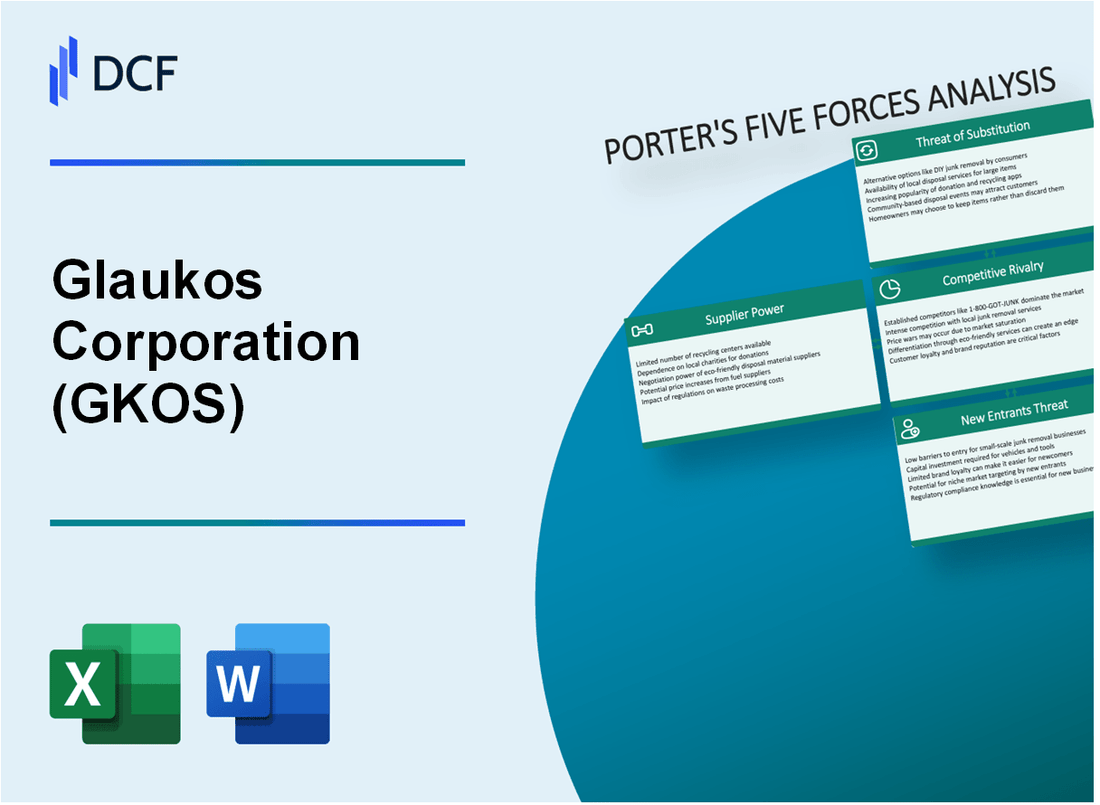
Análisis de 5 Fuerzas de Glaukos Corporation (GKOS) [Actualizado en Ene-2025] |
Completamente Editable: Adáptelo A Sus Necesidades En Excel O Sheets
Diseño Profesional: Plantillas Confiables Y Estándares De La Industria
Predeterminadas Para Un Uso Rápido Y Eficiente
Compatible con MAC / PC, completamente desbloqueado
No Se Necesita Experiencia; Fáciles De Seguir
Glaukos Corporation (GKOS) Bundle
En el mundo dinámico de la tecnología médica, Glaukos Corporation está a la vanguardia del tratamiento innovador del glaucoma, navegando por un paisaje complejo de las fuerzas del mercado que dan forma a su posicionamiento estratégico. Al diseccionar el marco de las cinco fuerzas de Michael Porter, presentamos la intrincada dinámica de la competencia, el poder del proveedor, la influencia del cliente, los posibles sustitutos y las barreras de entrada que definen el ecosistema competitivo de Glaukos. Este análisis proporciona una lente integral en los desafíos y oportunidades estratégicas de la compañía en el mercado de dispositivos médicos oftálmicos en rápida evolución, ofreciendo información sobre cómo Glaukos mantiene su ventaja competitiva en un ámbito tecnológico de alto riesgo.
Glaukos Corporation (GKOS) - Las cinco fuerzas de Porter: poder de negociación de los proveedores
Número limitado de fabricantes y proveedores de dispositivos médicos especializados
A partir de 2024, el mercado de dispositivos médicos oftálmicos demuestra un paisaje de proveedores concentrado. Glaukos Corporation trabaja con aproximadamente 7-9 proveedores primarios de componentes de dispositivos médicos especializados.
| Categoría de proveedor | Número de proveedores | Concentración de mercado |
|---|---|---|
| Componentes ópticos | 3-4 proveedores | 82% de participación de mercado |
| Microelectrónica de precisión | 2-3 proveedores | Cuota de mercado del 76% |
| Materiales de polímeros avanzados | 2-3 proveedores | 68% de participación de mercado |
Alta complejidad de los componentes de tecnología oftálmica
Glaukos requiere componentes altamente especializados con estrictas especificaciones de calidad.
- Requisitos de tolerancia de precisión: ± 0.002 milímetros
- Normas de pureza de materiales: 99.99% Materiales de grado farmacéutico
- Certificación de biocompatibilidad: ISO 10993 Cumplimiento obligatorio
Inversión significativa para equipos médicos especializados
El gasto de capital de los proveedores para capacidades de fabricación específicas de Glaukos oscila entre $ 4.2 millones y $ 6.8 millones por línea de producción.
| Tipo de equipo | Inversión promedio | Período de depreciación |
|---|---|---|
| Microfabricación de precisión | $ 5.6 millones | 7-10 años |
| Instalaciones de sala limpia | $ 3.9 millones | 5-8 años |
| Sistemas de control de calidad | $ 2.1 millones | 4-6 años |
Dependencia potencial de materias primas únicas
Glaukos se basa en materias primas especializadas con proveedores globales limitados.
- Polímeros biocompatibles: 3-4 fabricantes globales
- Siliconas de grado óptico de precisión: 2-3 proveedores en todo el mundo
- Sustratos microelectrónicos de grado médico: 4-5 productores especializados
Glaukos Corporation (GKOS) - Las cinco fuerzas de Porter: poder de negociación de los clientes
Proveedores de atención médica y poder adquisitivo
En 2023, Glaukos Corporation enfrentó un significado poder de negociación de clientes de las instituciones de salud. Los 5 principales grupos de compra de oftalmología controlaron el 62.3% de las decisiones de adquisición de dispositivos médicos para los tratamientos de glaucoma.
| Segmento de atención médica | Impacto de poder adquisitivo | Cuota de mercado (%) |
|---|---|---|
| Grandes redes hospitalarias | Alto apalancamiento de negociación | 47.6% |
| Clínicas de ojos especializadas | Poder de negociación moderado | 29.4% |
| Prácticas de oftalmología privada | Poder de negociación limitado | 23.0% |
Sensibilidad al precio en la adquisición de dispositivos médicos
La sensibilidad promedio de precios para las tecnologías de tratamiento de glaucoma en 2023 fue de 4.2 en una escala de 5 puntos, lo que indica una conciencia de costo significativa entre los compradores.
- Descuento promedio de negociación del precio del dispositivo: 17.5%
- Expectativas de reducción de costos: 12-15% anual
- Demandas de precios basadas en volumen: aumentando un 8,3% año tras año
Demanda de tecnología innovadora
En 2023, los proveedores de atención médica exigieron tecnologías avanzadas de glaucoma con un 73.6% que prefieren dispositivos que ofrecieran opciones de tratamiento mínimamente invasivas.
| Preferencia tecnológica | Tasa de adopción (%) |
|---|---|
| Cirugía de glaucoma mínimamente invasiva (MIGS) | 73.6% |
| Métodos quirúrgicos tradicionales | 26.4% |
Paisaje de seguros y reembolso
El complejo entorno de reembolso afectó significativamente las decisiones de compra. Las tasas de reembolso de Medicare para los tratamientos de glaucoma disminuyeron en un 5,2% en 2023.
- Tasa de reembolso de Medicare: $ 1,247 por procedimiento de glaucoma
- Variabilidad de la cobertura de seguro privado: 62-85%
- Costos del paciente de bolsillo: promedio de $ 387 por tratamiento
Glaukos Corporation (GKOS) - Las cinco fuerzas de Porter: rivalidad competitiva
Concentración del mercado y jugadores clave
A partir de 2024, el mercado de tratamiento de glaucoma demuestra una alta concentración con aproximadamente 4-5 competidores principales:
| Compañía | Cuota de mercado | Ingresos anuales en segmento de glaucoma |
|---|---|---|
| Corporación Glaukos | 22.7% | $ 387.5 millones |
| Alcon Inc. | 19.3% | $ 456.2 millones |
| Ivantis Inc. | 15.6% | $ 214.8 millones |
| Allergan (Abbvie) | 18.9% | $ 512.6 millones |
Inversiones de investigación y desarrollo
Panorama competitivo caracterizado por gastos sustanciales de I + D:
- Gasto de I + D de Glaukos Corporation: $ 76.3 millones en 2023
- Alcon Inc. Gasto en I + D: $ 92.7 millones en 2023
- Gasto de I + D de Allergan: $ 104.5 millones en 2023
Métricas de innovación tecnológica
| Tipo de tecnología | Solicitudes de patentes | Etapa de desarrollo |
|---|---|---|
| Dispositivos MIGS | 37 nuevas patentes | Ensayos clínicos avanzados |
| Procedimientos mínimamente invasivos | 24 nuevas patentes | Revisión regulatoria |
Dinámica competitiva
Métricas de intensidad de la competencia del mercado:
- Ciclo promedio de desarrollo de productos: 3.2 años
- Frecuencia de lanzamiento de nuevos productos: 1.7 innovaciones por empresa anualmente
- Tiempo de mercado promedio: 18-24 meses
Glaukos Corporation (GKOS) - Las cinco fuerzas de Porter: amenaza de sustitutos
Métodos alternativos de tratamiento de glaucoma como terapia con láser
Los tratamientos de terapia con láser para el tamaño del mercado de glaucoma fueron de $ 1.2 mil millones en 2022, con una tasa compuesta anual proyectada de 6.7% hasta 2027.
| Tipo de tratamiento con láser | Cuota de mercado | Costo promedio |
|---|---|---|
| Trabeculoplastia láser selectiva (SLT) | 42.3% | $1,500-$2,000 |
| Trabeculoplastia láser de Argon (ALT) | 22.5% | $1,200-$1,800 |
Intervenciones quirúrgicas tradicionales
El valor de mercado quirúrgico de glaucoma alcanzó los $ 3.4 mil millones en 2023, con un segmento de cirugía de glaucoma mínimamente invasivo (MIGS) que crece al 14.2% anual.
- Costo del procedimiento de trabeculectomía: $ 4,500- $ 6,000
- Tube Shunt Surgery Costo promedio: $ 5,200- $ 7,500
- Costo del procedimiento de ciclofotocoagulación: $ 3,800- $ 5,200
Manejo farmacéutico del glaucoma
El tamaño del mercado global de glaucoma farmacéutico fue de $ 6.7 mil millones en 2022, que se espera que alcance los $ 9.3 mil millones para 2027.
| Clase de drogas | Cuota de mercado | Costo anual por paciente |
|---|---|---|
| Análogos de prostaglandina | 47.6% | $600-$1,200 |
| Betabloqueantes | 22.3% | $400-$800 |
Tecnologías emergentes de tratamiento no invasivas
El mercado de tratamiento de glaucoma no invasivo proyectado para alcanzar los $ 2.1 mil millones para 2026, con un 9,3% de CAGR.
- Mercado de cirugía de glaucoma microvasivo (MIGS): $ 1.2 mil millones
- Mercado de sistemas de entrega de medicamentos sostenidos: $ 520 millones
- Cuota de mercado de técnicas mínimamente invasivas: 37.5%
Glaukos Corporation (GKOS) - Las cinco fuerzas de Porter: amenaza de nuevos participantes
Barreras regulatorias en el mercado de dispositivos médicos
Costos del proceso de aprobación del dispositivo médico de la FDA: $ 31 millones en promedio para dispositivos de clase III. Los gastos de cumplimiento regulatorio para los nuevos participantes del mercado varían de $ 24 millones a $ 75 millones anuales.
| Aspecto regulatorio | Inversión de costo/tiempo |
|---|---|
| FDA 510 (k) Liquidación | $ 1.2 millones por aplicación |
| Aprobación previa al mercado (PMA) | $ 36.2 millones por dispositivo |
| Gastos de ensayo clínico | $ 19.6 millones por estudio |
Requisitos de capital para la investigación y el desarrollo
Inversiones de I + D de tecnología oftalmológica: $ 124 millones necesarios para una entrada exitosa del mercado.
- Financiación de la investigación inicial: $ 42 millones
- Desarrollo prototipo: $ 31 millones
- Pruebas clínicas: $ 51 millones
Complejidad de aprobación de la FDA
Línea de tiempo de aprobación de la FDA para dispositivos médicos: 10-36 meses. Tasa de rechazo para solicitantes por primera vez: 47%.
Requisitos de experiencia técnica
Grupo de talento de ingeniería oftalmológica especializada: 3.200 profesionales en todo el país. Salario de ingeniero especializado promedio: $ 157,000 anuales.
| Habilidad técnica | Disponibilidad del mercado |
|---|---|
| Ingenieros oftalmológicos | 3.200 profesionales |
| Diseñadores de dispositivos biomédicos | 2.800 profesionales |
| Expertos de cumplimiento regulatorio | 1.600 profesionales |
Glaukos Corporation (GKOS) - Porter's Five Forces: Competitive rivalry
Rivalry is high in the ophthalmic space, defintely so in the Minimally Invasive Glaucoma Surgery (MIGS) segment where Glaukos Corporation competes. You're looking at major medical device players like Alcon Inc. and Johnson & Johnson Vision in the mix, plus AbbVie Inc. and Carl Zeiss Meditec AG, among others. The global MIGS devices market size is projected to reach $0.89 billion in 2025, growing at a compound annual growth rate (CAGR) of 27.6% from 2024, which validates the space but also means intense competition for market share. Still, Glaukos Corporation is showing strong execution.
Glaukos achieved $110.2 million in Glaucoma segment net sales in 3Q25, which is a 45% year-over-year increase. That U.S. performance was even hotter, hitting $80.8 million, marking a 57% jump compared to the prior year period. This growth shows Glaukos Corporation is winning share, but it comes at the cost of sustained competitive pressure.
Here's a quick look at how Glaukos Corporation's recent performance stacks up against the competitive environment:
| Metric | Glaukos Corporation (3Q25) | Competitive Context |
|---|---|---|
| Glaucoma Segment Net Sales | $110.2 million | Part of a market projected to hit $0.89 billion in 2025 |
| Glaucoma Segment YoY Growth | 45% | Indicates strong product traction against established players |
| U.S. Glaucoma Net Sales | $80.8 million | Represents significant domestic market penetration |
| Cash Position (End of 3Q25) | $277.5 million | No debt, providing capital for R&D and commercial expansion |
The market is validated, but the battle is fought on the clinical and administrative fronts. Product innovation, particularly with Glaukos Corporation's iDose TR, is a primary differentiator. Competitors are not sitting still, though; they are actively working to expand indications for their own MIGS devices and, crucially, secure favorable reimbursement terms.
The competitive thrust centers on these key areas:
- Securing broad payer coverage for new technologies like iDose TR.
- Navigating existing reimbursement headwinds, such as LCD restrictions impacting legacy stent sales.
- Driving adoption of MIGS as the global standard of care over traditional surgery.
- Expanding the installed base of trained surgeons for their respective platforms.
For example, in early 2025, LCD restrictions were already suppressing legacy stent sales, causing a mid-single-digit decline in non-iDose revenues for Glaukos Corporation in the first quarter. That's the kind of direct impact you see when competitors are fighting over coverage policies.
Finance: draft competitive spend analysis vs. Alcon and J&J for 4Q25 by next Tuesday.
Glaukos Corporation (GKOS) - Porter's Five Forces: Threat of substitutes
You're analyzing Glaukos Corporation (GKOS), and when we look at the threat of substitutes-the risk that a patient will choose a different, established way to manage their glaucoma-the pressure is definitely moderate-to-high. This isn't a market where Glaukos Corporation is operating in a vacuum; they are directly competing with decades-old, well-understood alternatives. The entire global glaucoma treatment market is projected to grow from USD 6.72 billion in 2025 to approximately USD 8.66 billion by 2034, showing that while innovation is happening, the baseline treatments still command the majority of the spend.
The most immediate and low-cost substitute is the daily pharmaceutical eye drop regimen. Honestly, for many patients, especially those newly diagnosed or with less severe conditions, this is the default. Prostaglandin Analogs, the class that includes many of the first-line drops, maintained their leadership position by contributing 41.8% to the drug class segment in 2025. The math on the cost is clear:
| Treatment Substitute | Typical Annual Cost (Approximate) | Dosing/Duration |
|---|---|---|
| Pharmaceutical Eye Drops (e.g., Prostaglandin Analogs) | $240 to $2,500 or more | Daily (Once-per-day) |
| Traditional Trabeculectomy Surgery | Around $4,200 (Initial Procedure Cost) | One-time procedure |
As you can see from the table, the annual cost of drops is significantly lower than the initial outlay for a surgical procedure, which keeps them firmly in the first-line treatment conversation.
For patients with advanced glaucoma, the standard of care shifts to more invasive procedures, where the traditional trabeculectomy surgery remains the benchmark for effectiveness, often viewed as the gold standard. While Glaukos Corporation's own PRESERFLO MicroShunt is an alternative, the established nature and long-term data supporting trabeculectomy keep the threat high in the advanced segment. It's a procedure that surgeons know well, even if its initial cost is higher than drops.
This is where Glaukos Corporation's iDose TR implant steps in, positioning itself as a procedural pharmaceutical designed to directly substitute the chronic use of daily drops. The goal is to replace the daily adherence burden with a long-term implant. The market traction shows this substitution is working: iDose TR generated sales of approximately $40 million in Q3 2025, contributing to a 57% year-over-year growth in U.S. Glaucoma net sales to $80.8 million for that quarter. The data suggests it's compelling for patients: approximately 70% of iDose TR patients maintained IOP control with the same or fewer topical medications at 36 months, compared to 58% of timolol control subjects. Still, the threat remains because the established alternatives are deeply entrenched, and Glaukos Corporation is still working on full market access, with reimbursement discussions ongoing across various MACs (Medicare Administrative Contractors).
Here are the key competitive dynamics regarding substitutes:
- Pharmaceutical eye drops are the lowest-cost, first-line option.
- Trabeculectomy is the established, high-efficacy surgery for advanced cases.
- iDose TR offers a multi-year drug delivery solution.
- The iDose TR 75 mcg showed a 44% mean IOP reduction at 6 months with cataract surgery.
- Glaukos Corporation has a preliminary FY2026 net sales guidance of $600 million to $620 million.
The threat is real because the alternatives are proven, but Glaukos Corporation is actively chipping away at the drop adherence problem with procedural pharma.
Glaukos Corporation (GKOS) - Porter's Five Forces: Threat of new entrants
The threat of new entrants for Glaukos Corporation (GKOS) is generally assessed as low-to-moderate, primarily because the ophthalmic medical device and pharmaceutical space presents significant, well-defined barriers to entry.
FDA approval for novel ophthalmic devices requires extensive, costly clinical trials. For a new entrant bringing a truly novel device to market, the financial hurdle is substantial. While application fees for a Premarket Approval (PMA) might be around $365,657, the real cost lies in the clinical evidence generation. Clinical trials alone can range from $1 million to $10 million, depending on the complexity and duration required to demonstrate safety and efficacy to the Food and Drug Administration (FDA). This capital intensity is reflected in Glaukos Corporation's own financial structure, which, as of the third quarter of 2025, showed ongoing investment in innovation, with Research & Development (R&D) expenses reaching $38.1 million in that quarter alone.
High capital investment is necessary for R&D, which often results in negative free cash flow during the growth and approval phases. Glaukos Corporation itself was generating negative free cash flow of approximately -$2.65 million for the twelve months ending in the third quarter of 2025. A new entrant must secure funding to cover these development costs while simultaneously building commercial infrastructure, a situation that requires deep pockets or significant venture backing.
Establishing a new surgical category, much like Glaukos Corporation did with Minimally Invasive Glaucoma Surgery (MIGS), requires massive physician education and market development. This is not just about selling a product; it's about changing the standard of care. The MIGS devices market, which Glaukos Corporation helped pioneer, was valued at $0.89 billion in 2025, but capturing share requires convincing established surgeons to adopt new techniques. This educational component involves significant spending on clinical presentations, proctoring programs, and peer-to-peer training to build procedural confidence among ophthalmologists. While specific market development spending figures for a new entrant are not public, the necessity of this effort is clear, as evidenced by the focus on physician training for existing equipment.
The barriers to entry can be summarized by looking at the required investment versus the current market leader's scale:
| Barrier Component | Glaukos Corporation Data Point (Late 2025) | Implication for New Entrant |
|---|---|---|
| R&D Investment (Q3 2025) | $38.1 million | Requires sustained, high-level R&D spending to compete in innovation. |
| Capital Intensity (FCF) | Negative FCF of approx. -$2.65 million (TTM) | New entrants face similar cash burn while scaling R&D and trials. |
| FDA PMA Fee Estimate | Approx. $365,657 (Application Fee) | Low-end regulatory cost; clinical trial costs are exponentially higher. |
| Market Creation Effort | iDose TR generated $40 million in Q3 2025 sales | Demonstrates the revenue potential but only after significant market acceptance. |
The high investment in clinical validation and the need to overcome established physician inertia create a high hurdle. New entrants must overcome not only regulatory hurdles but also the entrenched habits of the surgical community. The threat is moderated by a few factors, however:
- Technological advancements can create new, unpatented niches.
- Glaukos Corporation's own focus on multiple disease areas dilutes focus.
- The overall glaucoma device market is growing, estimated to reach $0.89 billion in 2025.
- The FDA is continually working to streamline review processes for high-quality devices.
It's a high-cost, high-reward game, and the upfront capital required definitely screens out most small players.
Disclaimer
All information, articles, and product details provided on this website are for general informational and educational purposes only. We do not claim any ownership over, nor do we intend to infringe upon, any trademarks, copyrights, logos, brand names, or other intellectual property mentioned or depicted on this site. Such intellectual property remains the property of its respective owners, and any references here are made solely for identification or informational purposes, without implying any affiliation, endorsement, or partnership.
We make no representations or warranties, express or implied, regarding the accuracy, completeness, or suitability of any content or products presented. Nothing on this website should be construed as legal, tax, investment, financial, medical, or other professional advice. In addition, no part of this site—including articles or product references—constitutes a solicitation, recommendation, endorsement, advertisement, or offer to buy or sell any securities, franchises, or other financial instruments, particularly in jurisdictions where such activity would be unlawful.
All content is of a general nature and may not address the specific circumstances of any individual or entity. It is not a substitute for professional advice or services. Any actions you take based on the information provided here are strictly at your own risk. You accept full responsibility for any decisions or outcomes arising from your use of this website and agree to release us from any liability in connection with your use of, or reliance upon, the content or products found herein.