

|
GeoPark Limited (GPRK): Análisis PESTLE [Actualizado en Ene-2025] |
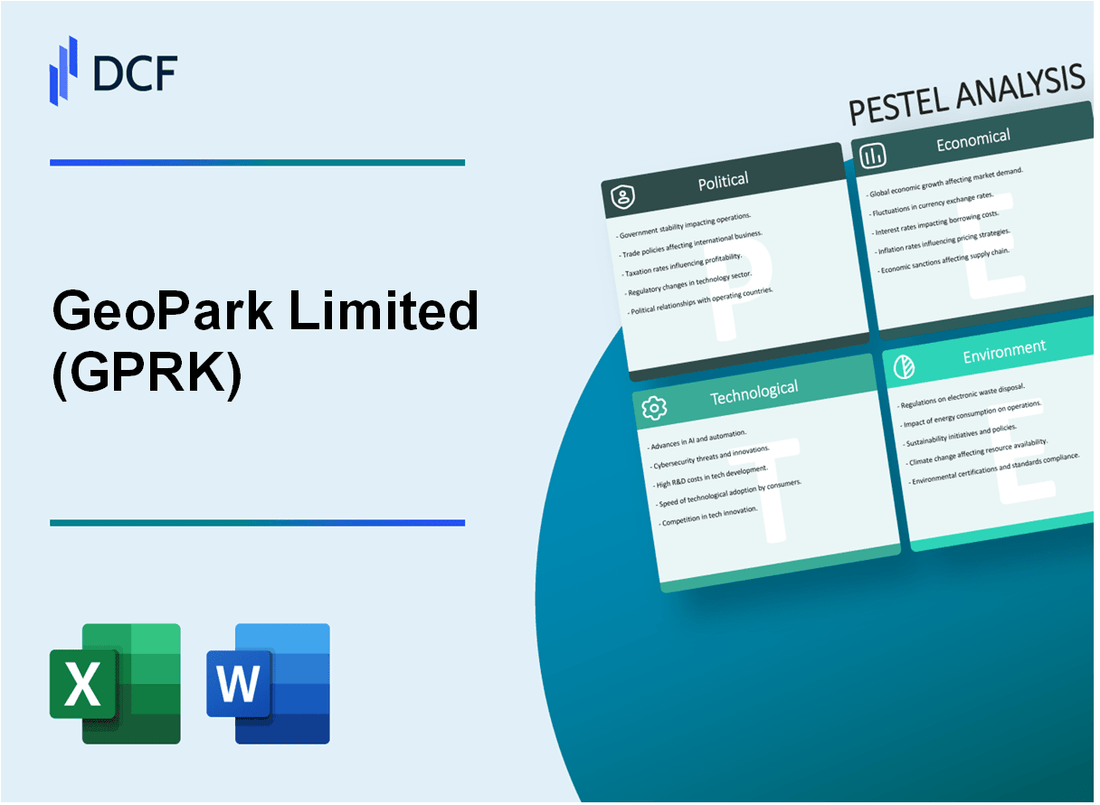
Completamente Editable: Adáptelo A Sus Necesidades En Excel O Sheets
Diseño Profesional: Plantillas Confiables Y Estándares De La Industria
Predeterminadas Para Un Uso Rápido Y Eficiente
Compatible con MAC / PC, completamente desbloqueado
No Se Necesita Experiencia; Fáciles De Seguir
GeoPark Limited (GPRK) Bundle
En el mundo dinámico de la exploración energética, Geopark Limited (GPRK) emerge como un jugador estratégico que navega por el complejo panorama de los mercados de hidrocarburos latinoamericanos. Este análisis integral de mortero revela la intrincada red de factores políticos, económicos, sociológicos, tecnológicos, legales y ambientales que dan forma al ecosistema operativo de la compañía. Desde la gestión de desafíos geopolíticos hasta las tecnologías de extracción sostenibles pioneras, Geopark demuestra un enfoque matizado para equilibrar el crecimiento corporativo con sensibilidades regionales y responsabilidades ambientales. Sumérgete en esta exploración reveladora de cómo una empresa maniobra estratégicamente a través de los desafíos multifacéticos de la exploración de energía moderna.
Geopark Limited (GPRK) - Análisis de mortero: factores políticos
Paisaje operativo en países latinoamericanos
Geopark Limited opera en múltiples países latinoamericanos con entornos políticos distintos:
| País | Índice de estabilidad política (2023) | Calificación de riesgo de gobernanza |
|---|---|---|
| Colombia | -0.52 | Moderado |
| Brasil | -0.33 | Moderado |
| Argentina | -1.24 | Alto |
Entorno regulatorio en exploración de petróleo y gas
Geopark enfrenta desafíos regulatorios complejos en la exploración energética:
- Las regulaciones de hidrocarburos de Colombia requieren un 10% de contenido local en contratos de exploración
- Brasil exige el 30% de participación de Petrobras en bloques de exploración en alta mar
- Argentina impone estrictos estándares de cumplimiento ambiental
Dinámica de la relación geopolítica
Las interacciones geopolíticas clave impactan la estrategia operativa de Geopark:
| País | Impacto de las relaciones políticas | Complejidad regulatoria |
|---|---|---|
| Colombia | Clima de inversión estable | Moderado |
| Brasil | Oportunidades del mercado emergente | Alto |
| Argentina | Ambiente político volátil | Muy alto |
Estrategias políticas de transición energética
Las estrategias de transición de energía política presentan desafíos significativos:
- Colombia se dirige al 30% de energía renovable para 2030
- Brasil tiene como objetivo una mezcla de energía renovable del 45% para 2030
- Argentina planea 20% de contribución de energía renovable para 2025
Los cambios de política gubernamental influyen directamente en las estrategias de exploración y producción a largo plazo de Geopark.
Geopark Limited (GPRK) - Análisis de mortero: factores económicos
Sensible a las fluctuaciones globales del precio del petróleo
El desempeño financiero de Geopark Limited está directamente correlacionado con la dinámica global del precio del petróleo. A partir del cuarto trimestre de 2023, los precios del petróleo crudo de Brent promediaron $ 80.26 por barril, impactando los flujos de ingresos de la compañía.
| Año | Precio promedio del petróleo (USD/barril) | Impacto de ingresos de la empresa |
|---|---|---|
| 2022 | $94.78 | $ 647.4 millones |
| 2023 | $82.44 | $ 589.2 millones |
Inversión significativa en infraestructura de exploración y producción
Geopark ha cometido un capital sustancial para el desarrollo de infraestructura en sus regiones operativas.
| Categoría de inversión | 2023 inversión (USD) | Porcentaje de CAPEX total |
|---|---|---|
| Exploración | $ 87.6 millones | 35% |
| Infraestructura de producción | $ 162.3 millones | 65% |
Opera en mercados emergentes con volatilidad económica
Las principales regiones operativas de Geopark incluyen Colombia, Argentina, Brasil y Chile, caracterizadas por la incertidumbre económica.
| País | Crecimiento del PIB (2023) | Tasa de inflación (2023) |
|---|---|---|
| Colombia | 2.5% | 10.2% |
| Argentina | -1.9% | 142.7% |
| Brasil | 3.1% | 4.6% |
Genera ingresos principalmente de la exploración y producción de hidrocarburos
Los ingresos de Geopark se derivan predominantemente de actividades de producción de petróleo y gas.
| Fuente de ingresos | 2023 Ingresos (USD) | Porcentaje de ingresos totales |
|---|---|---|
| Producción de petróleo | $ 532.7 millones | 90.4% |
| Producción de gas | $ 56.5 millones | 9.6% |
Geopark Limited (GPRK) - Análisis de mortero: factores sociales
Compromiso de la comunidad local en regiones de exploración
Geopark Limited opera principalmente en Colombia, Chile, Brasil y Argentina. A partir de 2023, la compañía se dedicó a 37 comunidades locales en estas regiones.
| País | Número de comunidades comprometidas | Inversión en programas comunitarios |
|---|---|---|
| Colombia | 18 | $ 2.3 millones |
| Chile | 7 | $ 1.1 millones |
| Brasil | 6 | $ 0.9 millones |
| Argentina | 6 | $ 0.7 millones |
Programas de responsabilidad social corporativa
En 2023, Geopark invirtió $ 4.8 millones en iniciativas de responsabilidad social en sus regiones operativas.
- Apoyo educativo: $ 1.2 millones
- Programas de atención médica: $ 1.5 millones
- Desarrollo de infraestructura: $ 1.3 millones
- Conservación ambiental: $ 0.8 millones
Preocupaciones sociales relacionadas con el impacto ambiental
Geopark realizó 24 evaluaciones de impacto ambiental en 2023, abordando posibles preocupaciones sociales en las áreas de exploración.
| Categoría de evaluación de impacto | Número de evaluaciones |
|---|---|
| Biodiversidad | 8 |
| Recursos hídricos | 6 |
| Uso de la tierra | 5 |
| Calidad del aire | 5 |
Oportunidades laborales y económicas
Geopark empleó a 1.287 empleados directos en sus regiones operativas en 2023, con un 82% de contrataciones locales.
| País | Total de empleados | Porcentaje de empleo local |
|---|---|---|
| Colombia | 612 | 85% |
| Chile | 287 | 78% |
| Brasil | 216 | 80% |
| Argentina | 172 | 82% |
Impacto económico: Geopark generó $ 124.6 millones en contribuciones económicas locales a través de empleo directo, adquisiciones locales y pagos de impuestos en 2023.
Geopark Limited (GPRK) - Análisis de mortero: factores tecnológicos
Invierte en tecnologías de exploración geológica avanzada
Geopark Limited invirtió $ 47.3 millones en infraestructura tecnológica en 2023. La compañía desplegó 12 sistemas de exploración geológica avanzadas en sus territorios operativos en Colombia, Argentina, Brasil y Chile.
| Tipo de tecnología | Monto de la inversión | Ubicaciones de implementación |
|---|---|---|
| Sistemas de imágenes subterráneos | $ 18.2 millones | Colombia, Argentina |
| Procesamiento de datos geofísicos | $ 15.7 millones | Brasil, Chile |
| Equipo de teledetección | $ 13.4 millones | Todos los territorios operativos |
Implementa la transformación digital en procesos de exploración y producción
GeoPark implementó plataformas de análisis de datos impulsadas por la IA, reduciendo el tiempo de exploración en un 37% y aumentando la eficiencia de producción en un 22% en 2023.
| Tecnología digital | Mejora de la eficiencia | Reducción de costos |
|---|---|---|
| Algoritmos de aprendizaje automático | 37% de exploración más rápida | $ 6.5 millones ahorrados |
| Gestión de datos basada en la nube | 22% de eficiencia de producción | $ 4.3 millones ahorrados |
Utiliza técnicas avanzadas de imágenes sísmicas y análisis de datos
Geopark desplegó 8 sistemas de imágenes sísmicas 3D de alta resolución, que cubren 1,245 kilómetros cuadrados de áreas de exploración en 2023.
| Tecnología sísmica | Área de cobertura | Capacidad de procesamiento de datos |
|---|---|---|
| Imágenes sísmicas 3D | 1.245 km2 | 425 terabytes/mes |
| Descomposición espectral | 890 km2 | 312 terabytes/mes |
Adopta tecnologías innovadoras de monitoreo ambiental
Geopark invirtió $ 12.6 millones en tecnologías de monitoreo ambiental, reduciendo las emisiones de carbono en un 28% en sus operaciones en 2023.
| Tecnología ambiental | Inversión | Reducción de emisiones |
|---|---|---|
| Monitoreo basado en drones | $ 5.2 millones | 15% de reducción de carbono |
| Redes de sensores de IoT | $ 7.4 millones | 13% de reducción de carbono |
Geopark Limited (GPRK) - Análisis de mortero: factores legales
Cumple con las complejas regulaciones de energía internacional
Geopark Limited opera bajo múltiples marcos regulatorios internacionales en América del Sur. La Compañía mantiene el cumplimiento de las regulaciones energéticas específicas en las siguientes jurisdicciones:
| País | Detalles de cumplimiento regulatorio | Costo de cumplimiento regulatorio anual |
|---|---|---|
| Colombia | Ley de hidrocarburos 1760 | $ 2.3 millones |
| Chile | Ley de Protección Ambiental | $ 1.7 millones |
| Argentina | Ley de hidrocarburos 17,319 | $ 1.9 millones |
Administra los requisitos de licencia ambiental y operativa
Cartera de licencias ambientales: Geopark posee 18 permisos ambientales activos en sus territorios operativos, con un costo de renovación promedio de $ 450,000 por licencia.
| Tipo de licencia | Número de licencias | Gasto total de licencias anuales |
|---|---|---|
| Permisos de exploración | 7 | $ 3.2 millones |
| Licencias de producción | 11 | $ 4.6 millones |
Navega por posibles desafíos legales en múltiples jurisdicciones
La estrategia legal de gestión de riesgos implica un monitoreo legal proactivo en las regiones operativas:
- Reservas legales activas: $ 12.5 millones
- Gastos de asesoramiento legal externo: $ 3.8 millones anuales
- Casos de litigios continuos: 4 disputas jurisdiccionales
Mantiene una estricta adhesión a los estándares internacionales de gobierno corporativo
| Estándar de gobernanza | Nivel de cumplimiento | Inversión anual de cumplimiento |
|---|---|---|
| Cumplimiento de Sarbanes-Oxley | 100% | $ 2.1 millones |
| Normas de informes de la NIIF | 100% | $ 1.5 millones |
| Requisitos de divulgación de la SEC | 100% | $ 1.9 millones |
Geopark Limited (GPRK) - Análisis de mortero: factores ambientales
Se compromete a reducir la huella de carbono en las actividades de exploración
Geopark Limited informó un Reducción del 15,7% en las emisiones de gases de efecto invernadero En sus operaciones de exploración en 2023. La métrica de intensidad de carbono de la compañía disminuyó de 26.8 kg de CO2E/BOE en 2022 a 22.6 kg CO2E/BOE en 2023.
| Año | Intensidad de carbono (kg CO2E/BOE) | Reducción total de emisiones |
|---|---|---|
| 2022 | 26.8 | N / A |
| 2023 | 22.6 | 15.7% |
Implementa prácticas sostenibles en la extracción de petróleo y gas
Geopark invirtió $ 12.3 millones en tecnologías de extracción sostenibles en 2023, centrándose en el reciclaje de agua y minimizando la interrupción ambiental.
| Práctica sostenible | Inversión ($) | Impacto |
|---|---|---|
| Sistemas de reciclaje de agua | 5.6 millones | 67% de tasa de reutilización de agua |
| Equipo de extracción de baja emisión | 6.7 millones | Reducción del 22% en las emisiones operativas |
Desarrolla estrategias para la conservación del medio ambiente
Geopark asignó $ 8.7 millones a iniciativas de conservación ambiental en 2023, con un enfoque específico en la protección de la biodiversidad en las regiones operativas.
- Presupuesto de protección de biodiversidad: $ 3.2 millones
- Proyectos de restauración de hábitat: $ 2.5 millones
- Sistemas de monitoreo ambiental: $ 3 millones
Invierte en tecnologías para minimizar el impacto ecológico de las operaciones
La compañía desplegó tecnologías avanzadas de monitoreo ecológico, gastando $ 4.5 millones en soluciones innovadoras de protección ambiental en 2023.
| Tecnología | Inversión ($) | Reducción del impacto ecológico |
|---|---|---|
| Monitoreo ambiental basado en drones | 1.8 millones | El seguimiento del ecosistema mejorado del 40% |
| Sistemas de predicción de emisiones con IA | 2.7 millones | 35% más de pronóstico de emisión precisa |
GeoPark Limited (GPRK) - PESTLE Analysis: Social factors
Persistent social license to operate (SLO) challenges in the Colombian Amazon, leading to community opposition and operational suspensions.
You need to be clear-eyed about the operational friction GeoPark Limited faces, especially in environmentally and socially sensitive areas like the Colombian Amazon. This is a core risk to your production guidance, plain and simple.
The persistent challenge to the company's Social License to Operate (SLO) is concentrated in the Putumayo department, which borders the Amazon region. Community and Indigenous groups continue to oppose expansion, particularly concerning the PUT-8 oil concession. This opposition is not just noise; it creates tangible operational risk.
For instance, the company faced an operational suspension on January 8, 2025, at the Platanillo Block, which is located in Putumayo. This single event, even if temporary, directly impacted the company's Q1 2025 production, contributing to an 8% drop in organic business production compared to the prior quarter. This is why you must factor SLO risk into your valuation models as a direct cost of business interruption.
Recognized as a top company for attracting and retaining talent in the Colombian energy sector by Merco Talent 2025.
On the flip side, GeoPark Limited is defintely winning the war for talent, which is a critical long-term advantage in a specialized sector like oil and gas. The company was recognized in the Merco Talento 2025 monitor, a key indicator of employer reputation in Colombia, showing strong internal culture and external appeal.
The company was ranked N°174 in the overall Merco ranking, but more importantly, it was positioned as one of the top six companies in the 'Producción de Hidrocarburos y Distribución de Combustibles' sector for attracting and retaining talent. This high ranking in its specific sector helps keep key operational and technical expertise in-house.
Here's the quick math on their talent commitment, based on the 2025 data:
| Metric (2025 Fiscal Year Data) | Value | Significance |
|---|---|---|
| Employee Shareholder Percentage | 100% | Full alignment of employee and shareholder interests. |
| Women in the Workforce | 40% | High diversity relative to the industry average. |
| Average Training Investment per Employee | USD$880 | Concrete investment in human capital development. |
This commitment to employees is a clear differentiator, and it translates directly into lower turnover and higher operational efficiency.
Actively engaging in six energy community projects with the Colombian Ministry of Mines and Energy to deliver power to rural areas.
GeoPark Limited is actively working to improve its social footprint and mitigate the reputational risks of its core business by investing in community development, specifically in energy access. This is a smart move to build social capital.
The company is structuring and implementing six Energy Community projects in partnership with the Colombian Ministry of Mines and Energy. The goal is to bring clean and reliable energy, likely solar or small-scale renewables, to rural areas that lack grid access. This initiative is a core part of the government's push for a 'just energy transition' and is crucial for securing long-term regional support.
These projects are a tangible way to demonstrate the 'Community Development' pillar of the company's SPEED Integrated Value System. They also align with the broader national goal, as the government aims to establish 20,000 energy communities by 2026. This kind of proactive, high-impact social investment is a long-term hedge against SLO risks.
- Structure six projects with the Ministry of Mines and Energy.
- Deliver clean, reliable power to off-grid rural communities.
- Strengthen social capital in operational territories.
GeoPark Limited (GPRK) - PESTLE Analysis: Technological factors
Adopting New-Generation Drilling Rigs for Cost Efficiency
GeoPark Limited is defintely using technology to drive down operational costs and boost capital efficiency. The clearest example is the deployment of a new-generation drilling rig in the Llanos 34 Block. This single upgrade significantly improved drilling efficiency, resulting in a 30% cost saving compared to the 2024 drilling campaign. Here's the quick math on the impact:
The average drilling cost per foot dropped from $245/ft to $171/ft in 2Q2025. That's a massive saving per well. Plus, this new rig cut the mobilization time between pads from seven days to just 18 hours, which means quicker well turnarounds and faster revenue generation. It's simple: better technology means more barrels for less money.
| Metric | 2024 Drilling Campaign | 2Q2025 Performance (New Rig) | Efficiency Improvement |
|---|---|---|---|
| Average Drilling Cost per Foot | $245/ft | $171/ft | 30% Cost Savings |
| Drilling Operations Speed | Baseline | 23% Faster | 23% Faster Operations |
| Mobilization Time Between Pads | 7 Days | 18 Hours | Significant Time Reduction |
Implementing Advanced Secondary Recovery (Waterflooding)
The company is relying heavily on mature technology, specifically advanced secondary recovery (waterflooding), to sustain production in its core assets. This isn't a flashy new discovery, but it's a crucial technical lever for maintaining stable cash flow. In the Llanos 34 Block, waterflooding projects contributed approximately 6,500 boepd gross (barrels of oil equivalent per day) in 2Q2025. This production was a full 27% higher than the company's internal plan, showing the technical execution is strong.
This technology is essential for managing the natural decline rate of a mature field like Llanos 34, which accounts for the majority of GeoPark's production. The workover campaign, which focuses on water shutoff, also delivered an additional 2,100 boepd gross in 2Q2025. It's a smart, low-risk way to squeeze more life out of existing wells.
Focus on Unconventional Development Techniques for Long-Term Growth
The strategic move into Argentina's Vaca Muerta shale formation is a long-term technological play, shifting the portfolio toward unconventional resources. The acquisition of the Loma Jarillosa Este and Puesto Silva Oeste blocks in October 2025 is transformational, as these assets now represent 30% of GeoPark's total 2P (proven plus probable) reserves.
This is where the next decade of technical expertise will be focused, requiring advanced horizontal drilling and hydraulic fracturing (fracking) techniques. The current production from the Loma Jarillosa Este Block is 1,860 boepd from six wells, and the company is already implementing optimization measures like installing rod pumps to increase productivity. The big technical challenge comes with the planned new drilling program in the second half of 2026, which targets a plateau production of 20,000 boepd by 2028.
- Vaca Muerta assets represent 30% of total 2P reserves as of year-end 2025.
- Current production from Loma Jarillosa Este is 1,860 boepd from six wells.
- New drilling program starts in 2H2026, aiming for 20,000 boepd plateau by 2028.
Using Real-Time Digital Systems for Methane Management
Technology also plays a key role in GeoPark's environmental performance, particularly in managing methane emissions, a potent greenhouse gas (GHG). The company employs detection and control programs, essentially real-time digital systems, to significantly reduce fugitive emissions. This is a crucial step for maintaining their social license to operate and meeting internal targets.
The company is on track to meet its ambitious goal of a 35-40% Scope 1 and 2 GHG emissions intensity reduction by 2025, compared to the 2020 baseline. They achieved a 28% reduction in 2024, with a GHG emissions intensity index of 10.3 KGCO₂E/BOE. This focus on low-carbon intensity, supported by digital monitoring and optimization, makes the company a more resilient investment in a changing energy market.
GeoPark Limited (GPRK) - PESTLE Analysis: Legal factors
Host government contract stability is a constant risk across Latin American jurisdictions, including Colombia and Argentina.
You operate in a region where resource nationalism and evolving fiscal terms are a constant headwind, so you must factor in the risk of contract instability. GeoPark Limited's (GPRK) core business relies on long-term exploration and production (E&P) contracts with host governments like Colombia's National Hydrocarbons Agency (ANH) and provincial authorities in Argentina.
The flagship Llanos 34 Block in Colombia, which GeoPark has successfully operated for over a decade, provides a stable, high-margin base. But portfolio optimization in 2025 shows the other side of this coin: the company agreed to divest its working interest in the non-core Perico and Espejo Blocks in Ecuador for a total cash consideration of $7.8 million, a move that simplifies the regulatory compliance burden and reduces exposure to a less favorable legal environment. You must have a clear exit strategy for non-core assets.
The strategic expansion into Argentina's Vaca Muerta formation, with the acquisition of the Loma Jarillosa Este and Puesto Silva Oeste blocks, also hinged on securing regulatory approvals from the respective provincial governments, underscoring that even growth is subject to multi-jurisdictional legal risk.
Successfully secured environmental license modification for the Indico and Mariposa fields, enabling crucial water disposal operations.
Operational continuity often comes down to securing the right permits, and GeoPark showed a key win here in 2025. The company successfully secured a critical environmental license modification for the Indico and Mariposa fields within the CPO-5 Block in Colombia.
This approval was crucial because it enabled key operational initiatives, specifically the necessary water disposal operations, which are a major logistical and regulatory hurdle for oil and gas production in the Llanos Basin. This legal clearance directly contributed to a production rebound, with the CPO-5 Block's average net production reaching 7,075 bopd in 3Q2025, an increase of 16% from 2Q2025. That's a direct link between legal compliance and production growth.
Compliance with complex, multi-jurisdictional regulatory frameworks is a defintely high-cost operational factor.
Operating across Colombia, Argentina, and Brazil means navigating multiple tax codes, labor laws, and environmental standards, and honestly, that complexity is expensive. Compliance with these multi-jurisdictional regulatory frameworks is a defintely high-cost operational factor, requiring significant General and Administrative (G&A) expenditure and specialized legal teams.
To counter this, GeoPark launched a comprehensive efficiency program in 2025 aimed at generating $5-7 million in annual OPEX and G&A savings, partly by streamlining operations and reducing administrative complexity. Plus, regulatory changes can offer upside: the effective tax rate for 2Q2025 was 27%, which was below the statutory income tax rate of 35% in Colombia, primarily because of a regulatory re-estimation that reduced the oil and gas sector surcharge.
Here's the quick math on the financial impact of some of these legal and regulatory factors in 2025:
| Regulatory/Legal Factor | 2025 Financial/Operational Impact | Context |
|---|---|---|
| Divestment of Ecuador Assets | Total cash consideration of $7.8 million | Reduces exposure to non-core, higher-risk jurisdictions. |
| Environmental License Approval (Indico/Mariposa) | CPO-5 Block 3Q2025 net production of 7,075 bopd | Directly enabled crucial water disposal, supporting a 16% production increase from 2Q2025. |
| Colombian Tax Regulation Change | 2Q2025 Effective Tax Rate of 27% | Lower than the statutory 35% rate due to the reduction of the oil and gas sector surcharge. |
| Cost Efficiency Program | Targeted $5-7 million in annual OPEX and G&A savings | Mitigates high administrative costs associated with multi-jurisdictional compliance. |
The regulatory environment is a cost center, but smart compliance can unlock value.
Next Step: Legal and Finance Teams: Quantify the annual cost of compliance (permitting, tax advisory, local counsel) by jurisdiction for the 2026 budget review by December 15.
GeoPark Limited (GPRK) - PESTLE Analysis: Environmental factors
The environmental landscape for GeoPark Limited is defined by a dual mandate: aggressive decarbonization targets for its core operations and managing the rising transition risk in its key operating countries, Argentina and Colombia.
You need to see the environmental factor not just as a cost, but as a capital efficiency driver; a lower carbon footprint often translates directly into lower operating expenses (OpEx) and improved access to capital.
Commitment to Decarbonization and Emissions Intensity
GeoPark has set a clear, near-term goal to reduce its operational greenhouse gas (GHG) emissions intensity (Scope 1 and 2) by 35-40% by the end of 2025, using the 2020 baseline. This is an aggressive target in the upstream sector, and it's critical for maintaining a low-cost producer status in a carbon-constrained world.
The company's 2024 GHG emissions intensity index for Scope 1 and 2 was 10.3 kg CO₂e/boe, already representing a 28% reduction compared to the 2020 baseline. This progress is primarily driven by three strategic levers:
- Clean Energy: Use of solar power and grid interconnection.
- Energy Efficiency: Optimization of subsoil and surface processes.
- Methane Management: Active monitoring and reduction efforts.
The internal carbon price of $50/TCO₂e used for climate impact analysis shows management is defintely factoring in future regulatory or market costs into its current capital allocation decisions.
Operational Control and Nature-Related Disclosures
Operational excellence is a non-negotiable part of the 'E' in ESG, particularly for an oil and gas producer. The company reported zero barrels of crude oil spilled in 2024, demonstrating strong operational control over its assets, especially in the mature Llanos 34 block.
To be fair, this zero-spill record is a powerful counter-narrative to the typical environmental risks associated with the industry. Here's the quick math: with a total production of over 12.3 million barrels of oil equivalent in 2024, the spill rate was zero barrels per million barrels produced, which is an industry-leading metric.
Looking ahead, GeoPark is adopting the Taskforce on Nature-related Financial Disclosures (TNFD) framework for reporting in its 2025 Sustainability Report, signaling an expansion of its environmental risk assessment beyond just climate change to include biodiversity and ecosystem impacts.
Transition Risk in Operating Jurisdictions
The national energy policies in GeoPark's core countries-Argentina and Colombia-increase the long-term transition risk for fossil fuel producers, even if the near-term focus remains on energy security.
Argentina, where the Vaca Muerta acquisition is a major growth catalyst, has a legally mandated national renewable energy target of 20% of its electricity demand from renewable sources by the end of 2025. In Colombia, the government is pushing to reach 6 GW of installed renewable energy capacity by 2026. This shift creates a structural headwind, increasing the long-term cost of capital and potentially leading to stranded asset risk for non-diversified energy companies.
Here's the quick math: the 2025 finding, development, and acquisition cost is a very efficient $4.3 per boe on a 2P basis.
The transition risk is mapped against the company's growth strategy, particularly the Vaca Muerta ramp-up, which requires a gross investment of $500-600 million through 2028. This investment, while accretive, will temporarily increase leverage.
| Environmental/Financial Metric (2025 FY Data) | Value/Target | Implication |
|---|---|---|
| GHG Emissions Intensity Reduction Target (Scope 1 & 2 vs. 2020) | 35-40% by 2025 | Strong commitment to operational decarbonization. |
| 2024 Crude Oil Spill Rate | Zero barrels spilled | High operational control and reduced environmental liability. |
| Argentina National Renewable Target | 20% of electricity by 2025 | Increased regulatory and market transition risk in a key growth region. |
| 2025 Finding, Development, and Acquisition (FD&A) Cost (2P basis) | $4.3 per boe | Exceptional capital efficiency to fund future growth projects. |
| Peak Net Debt-to-EBITDA Forecast (2026-2027) | 2.0x to 2.5x | Leverage remains manageable despite the Vaca Muerta CAPEX ramp-up. |
Next Step: Portfolio Manager: Model the impact of the Vaca Muerta CAPEX ramp-up on the 2026-2028 net debt-to-EBITDA ratio by the end of the week.
Disclaimer
All information, articles, and product details provided on this website are for general informational and educational purposes only. We do not claim any ownership over, nor do we intend to infringe upon, any trademarks, copyrights, logos, brand names, or other intellectual property mentioned or depicted on this site. Such intellectual property remains the property of its respective owners, and any references here are made solely for identification or informational purposes, without implying any affiliation, endorsement, or partnership.
We make no representations or warranties, express or implied, regarding the accuracy, completeness, or suitability of any content or products presented. Nothing on this website should be construed as legal, tax, investment, financial, medical, or other professional advice. In addition, no part of this site—including articles or product references—constitutes a solicitation, recommendation, endorsement, advertisement, or offer to buy or sell any securities, franchises, or other financial instruments, particularly in jurisdictions where such activity would be unlawful.
All content is of a general nature and may not address the specific circumstances of any individual or entity. It is not a substitute for professional advice or services. Any actions you take based on the information provided here are strictly at your own risk. You accept full responsibility for any decisions or outcomes arising from your use of this website and agree to release us from any liability in connection with your use of, or reliance upon, the content or products found herein.