

|
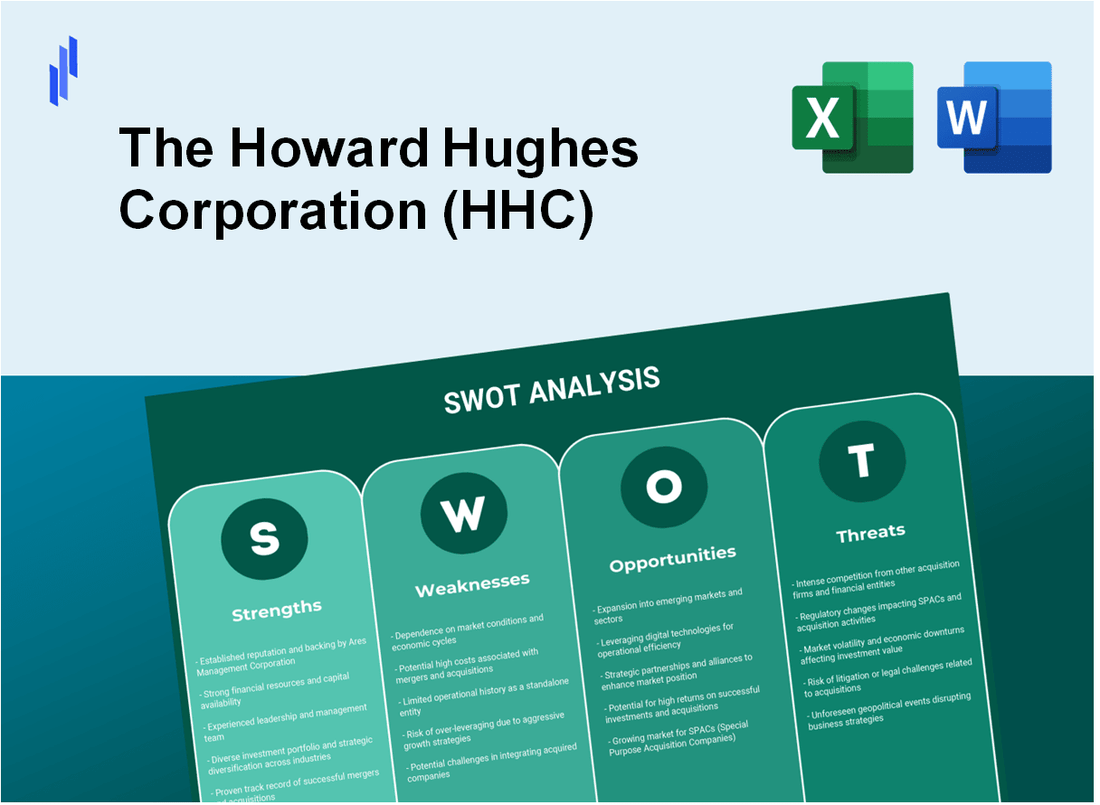
The Howard Hughes Corporation (HHC): SWOT Analysis [Apr-2026 Updated] |
Completamente Editable: Adáptelo A Sus Necesidades En Excel O Sheets
Diseño Profesional: Plantillas Confiables Y Estándares De La Industria
Predeterminadas Para Un Uso Rápido Y Eficiente
Compatible con MAC / PC, completamente desbloqueado
No Se Necesita Experiencia; Fáciles De Seguir
The Howard Hughes Corporation (HHC) Bundle
Howard Hughes sits at a potent inflection point-anchored by cash-generating master-planned communities like Summerlin and Ward Village, a diversified portfolio of stabilized assets, and fresh capital to fund a bold pivot into specialty insurance-yet its upside hinges on navigating high leverage, lumpy land-driven cash flows, complex insurance integration, and macro/regulatory headwinds that could quickly reshape returns; read on to see where the biggest wins and risks lie.
The Howard Hughes Corporation (HHC) - SWOT Analysis: Strengths
Dominant market position in master planned communities (MPCs) underpins HHC's core strength. As of December 2025 the company's MPC portfolio includes marquee assets such as Summerlin (Las Vegas) and Bridgeland (Houston), which ranked #7 and #14 respectively in national home sales for H1 2025. The MPC segment reported record earnings before taxes (EBT) of $205.0 million in Q3 2025, a 42% year-over-year increase from $144.8 million in Q3 2024. Land pricing remains exceptionally strong: Summerlin superpads sold near a record $1.7 million per acre in Q3 2025. Management raised full-year 2025 MPC EBT guidance to a midpoint of $450 million (up from an initial $375 million), reflecting robust demand and pricing power. The MPC segment functions as a self-funding engine, generating substantial cash flow to support broader strategic transformation initiatives.
| Metric | Q3 2024 | Q3 2025 | YoY % Change |
| MPC EBT | $144.8M | $205.0M | +42% |
| Summerlin superpad price | - | $1.7M/acre | - |
| Full-year 2025 MPC EBT guidance (midpoint) | $375M (initial) | $450M (revised midpoint) | +20% |
HHC's stabilized operating asset base provides recurring, diversified cash flows. The operating portfolio comprises approximately 7.0 million square feet of office and 2.8 million square feet of retail, which delivered a record net operating income (NOI) of $68.0 million in Q3 2025 - up 5% year-over-year. Office NOI rose ~7% while retail NOI increased ~9% in Q3 2025, supported by stabilized occupancies of 89% (office) and 93% (retail). Multifamily NOI also reached a quarterly record of $16.9 million (up 19% YoY), driven by strong lease-up at assets such as Tanager Echo. Full-year 2025 operating asset NOI is projected at $267 million, reflecting steady 2%-6% annual growth and smoothing the lumpiness inherent to land development cash flows.
- Office stabilized occupancy: 89%
- Retail stabilized occupancy: 93%
- Multifamily Q3 2025 NOI: $16.9M (+19% YoY)
- Projected full-year 2025 operating NOI: $267M
| Asset Type | Square Feet / Units | Q3 2025 NOI | YoY NOI Change | Occupancy |
| Office | 7.0M sq ft | Portion of $68.0M | +7% | 89% |
| Retail | 2.8M sq ft | Portion of $68.0M | +9% | 93% |
| Multifamily | Portfolio (various) | $16.9M | +19% | - |
HHC's liquidity and capital structure strengths provide strategic optionality. After a $900 million capital infusion from Pershing Square in May 2025 at $100 per share, the company held approximately $1.5 billion in cash and cash equivalents as of December 2025. Additional balance sheet support includes $1.0 billion of undrawn lender commitments for development and a current ratio of 4.53. Management reduced near-term refinancing risk by refinancing $114 million of near-term obligations and lowering 2025 debt maturities to $76 million. Full-year 2025 adjusted operating cash flow guidance was raised to $440 million ($7.86 per share), an upward revision of $90 million from original projections. This liquidity and strategic capital backing enable HHC to pursue large-scale acquisitions and long-duration developments without immediate capital constraints.
| Liquidity Metric | Value (Dec 2025) |
| Cash & cash equivalents | $1.5B |
| Undrawn lender commitments | $1.0B |
| Current ratio | 4.53 |
| 2025 debt maturities (post-refinance) | $76M |
| Adjusted operating cash flow guidance (FY2025) | $440M ($7.86/share) |
| Pershing Square infusion | $900M at $100/share |
HHC's condominium development pipeline yields high visibility into future revenue via substantial pre-sales. As of late 2025 the company had contracted approximately $1.4 billion of future condo revenue, led by Ward Village towers Melia and Ilima, which were 57% pre-sold by Q3 2025. Other Ward Village projects include The Launiu (68% pre-sold), Ritz-Carlton Residences (74% pre-sold), and Park Ward Village (97% pre-sold). The Ulana project, 100% pre-sold, is expected to close in late 2025. Though 2025 condo revenue guidance was modestly adjusted to $360 million due to timing shifts, the backlog and pre-sale rates provide high revenue visibility and validate sustained demand for HHC's luxury residential offerings, with meaningful gross profit contribution anticipated from 2026 onward.
| Condo Project | Pre-sale % (Q3 2025) | Expected Revenue Timing |
| Melia | 57% | Late 2025-2026 |
| Ilima | 57% | Late 2025-2026 |
| The Launiu | 68% | 2026 |
| Ritz-Carlton Residences | 74% | 2026 |
| Ulana | 100% | Expected close late 2025 |
| Park Ward Village | 97% | Significant revenue & profit starting 2026 |
| Aggregate contracted condo revenue | $1.4B | |
Strategic transformation toward a diversified holding company represents a structural strength. Under Executive Chairman Bill Ackman, HHC is evolving from a pure-play developer into a diversified holding company modeled after Berkshire Hathaway. In December 2025 HHC announced a definitive agreement to acquire specialty insurer Vantage Group Holdings for $2.1 billion (expected close Q2 2026), to be funded with $1.2 billion cash and $1.0 billion non-interest-bearing preferred stock. Vantage reported $1.2 billion in net premiums written for the 12 months ended September 2025, creating a meaningful source of investable float. The acquisition and transformation are intended to lift HHC's long-term return on equity from ~7.3% toward mid-teens targets by combining operating real estate cash engines with insurance float and diversified investment opportunities.
- Target acquisition: Vantage Group Holdings - $2.1B definitive agreement (Dec 2025)
- Funding structure: $1.2B cash + $1.0B non-interest-bearing preferred stock
- Vantage net premiums written (12 months to Sep 2025): $1.2B
- Current ROE: ~7.3%; long-term target: mid-teens
The Howard Hughes Corporation (HHC) - SWOT Analysis: Weaknesses
High financial leverage and debt-to-equity ratios present a central weakness for The Howard Hughes Corporation. As of Q3 2025 the company reported total debt of approximately $5.3 billion and a debt-to-equity ratio of 1.41 versus a historical median of 1.22, increasing exposure to interest rate volatility despite a strong cash balance. Although management has fixed or swapped 92% of the debt, projected net interest expense remains a significant drag-net interest expense is projected at $206 million for 2025-constraining net income and free cash flow generation. Return on equity for the trailing twelve months stands at 7.3%, a modest figure given the leverage deployed; investors are concerned about the company's flexibility to sustain leverage if credit conditions tighten or development cycles decelerate.
| Metric | Value | Period |
|---|---|---|
| Total Debt | $5.3 billion | Q3 2025 |
| Debt-to-Equity Ratio | 1.41 | Q3 2025 |
| Fixed/Swapped Debt | 92% | Q3 2025 |
| Projected Net Interest Expense | $206 million | 2025 |
| ROE (TTM) | 7.3% | Trailing 12 months |
Cash flow volatility from the Master Planned Community (MPC) and development businesses results in lumpy and unpredictable quarterly earnings. Large, irregular land sales and timing of condominium closings create significant quarter-to-quarter swings. Q3 2025 performance was materially impacted by a single 231-acre bulk sale in Summerlin, which contributed substantially to the MPC EBT of $205 million for the quarter. At the same time, new home sales across the portfolio declined 13% year-over-year even as land sale prices reached record levels, underlining the mismatch between transactional timing and recurring operating performance.
- Example: Q3 2025 - 231-acre Summerlin bulk sale materially drove MPC EBT of $205 million.
- Example: New home sales decline - 13% YoY across portfolio (2025 YTD).
- Example: Ulana condominium closings shifted - $15 million downward adjustment to 2025 condominium revenue; closings expected in early 2026.
- Historical EPS volatility - prior quarters showed EPS misses versus consensus exceeding 50% in certain periods.
Significant capital expenditure requirements for long-term development constrain liquidity and flexibility. In 2025 the company reported adjusted operating cash flow of $440 million, much of which was reinvested into ongoing projects such as 1 Riva Row and multiple Ward Village towers. These reinvestment needs limit free cash flow available for shareholder returns, deleveraging, or diversification into less capital-intensive businesses. Strategic Developments projects carry elevated execution risk: projects can take multiple years before stabilizing and achieving projected yield-on-cost targets (management target ~9% yield on cost for stabilized assets), making the business highly dependent on continuous access to capital markets and favorable macroeconomic conditions.
| CAPEX / Reinvestment | Adjusted Operating Cash Flow | Target Yield on Cost |
|---|---|---|
| Ongoing projects (1 Riva Row, Ward Village towers) | $440 million reinvested (2025) | ~9% projected stabilized yield on cost |
The $2.1 billion acquisition of Vantage Group Holdings introduces execution, integration, and regulatory complexity as HHC enters the insurance sector. Financing for the deal requires approximately $1.2 billion in cash and a novel $1.0 billion preferred stock instrument, potentially complicating the capital structure and creating future dilution risk. Vantage's standalone ROE of 13% must be improved to management's long-term target of 20%, creating operational pressure. The transaction is not expected to close until Q2 2026, leaving an extended period for potential regulatory, market or underwriting-cycle-related headwinds to affect deal economics.
- Acquisition headline: $2.1 billion for Vantage Group Holdings (2025 announcement).
- Planned financing: $1.2 billion cash + $1.0 billion preferred stock instrument.
- Vantage ROE: 13% (current) vs. 20% (management target).
- Expected close: Q2 2026 (subject to regulatory approvals).
Low insider ownership and high institutional concentration create governance and market-sensitivity risks. As of December 2025 insider ownership stands at approximately 4.23%, while institutional ownership is concentrated at roughly 87.82%. Pershing Square holds a 46.9% beneficial stake following its $900 million investment; voting power is capped at 40% in governance arrangements. This ownership concentration increases stock price sensitivity to decisions and commentary from a small number of large investors and raises questions about minority shareholder alignment and long-term governance dynamics. The consensus analyst rating remains a 'Hold,' reflecting market caution about concentrated ownership and strategic direction.
| Ownership Category | Percentage | Notes |
|---|---|---|
| Insider Ownership | 4.23% | As of December 2025 |
| Institutional Ownership | 87.82% | As of December 2025 |
| Largest Institutional Holder | Pershing Square 46.9% | $900 million investment; voting capped at 40% |
| Consensus Analyst Rating | Hold | December 2025 consensus |
The Howard Hughes Corporation (HHC) - SWOT Analysis: Opportunities
Expansion into the specialty insurance and reinsurance market via the acquisition of Vantage Group Holdings creates a strategic avenue to generate 'float' and redeploy capital into higher-return assets under Pershing Square's management. Vantage reported $974 million in premiums for the year ending September 2025 and specializes in long-tail specialty lines that provide durable capital. Management targets improving underwriting profitability toward a 20% ROE, which would materially diversify HHC's earnings base beyond traditional real estate and capture upside from the ongoing insurance hardening cycle.
The financial mechanics of this opportunity include:
- Premiums: $974 million (year ending Sept 2025)
- Target underwriting ROE: 20%
- Float generation: reinvestment potential into higher-return MPC and development projects
- Time horizon: near- to medium-term as underwriting improvements are realized
Untapped development potential in the Teravalis master-planned community (MPC) represents a multidecade growth engine. Teravalis comprises a 37,000-acre land bank in Phoenix West Valley. In 2024 and early 2025 HHC sold over 800 lots at an average price of $777,000 per acre ahead of the planned grand opening of the first village, Floreo, in late 2025. Teravalis is projected to accommodate approximately 300,000 residents and deliver roughly 55 million square feet of commercial space, positioning it to replicate the scale and value creation of Summerlin.
Teravalis key metrics and projections:
| Land bank | 37,000 acres |
| Lots sold (2024-early 2025) | 800+ lots |
| Average sold price | $777,000 per acre |
| Projected residents | 300,000 |
| Projected commercial space | 55,000,000 sq ft |
| Expected contribution | Long-term MPC EBT and land sale revenue over multiple decades |
Favorable demographic shifts into Sunbelt markets underpin demand for HHC's core assets in Texas, Nevada and Arizona. The Houston metropolitan statistical area (MSA), where HHC operates The Woodlands and Bridgeland, accounted for 22% of all top-performing MPC sales nationally in 2024. The Woodlands reports average household income near $200,000 versus the Houston MSA average of $102,000, supporting demand for luxury residential, retail and office product. Ongoing corporate relocations to business-friendly Sunbelt states bolster occupancy, rent growth and land pricing power.
Sunbelt demographic and demand indicators:
- Houston MSA share of top MPC sales (2024): 22%
- Avg. household income - The Woodlands: $200,000
- Avg. household income - broader Houston: $102,000
- Impacts: sustained pricing power for residential land sales; higher commercial occupancy and rent resilience
Significant upside exists from continued stabilization and placemaking at the Seaport District in Lower Manhattan. After the 2024 spinoff of Seaport Entertainment Group, HHC maintains strategic interests in remaining development rights and operational assets. Increased foot traffic and tenant demand, coupled with a broader NYC commercial stabilization expected in 2026, create an opportunity to monetize development pipelines - notably 250 Water Street - and to capture premium rents from high-end retail, office and mixed-use tenants, thereby adding to NAV.
Seaport opportunity snapshot:
| Strategic assets | Seaport District development rights, 250 Water Street |
| Recent corporate action | Seaport Entertainment Group spinoff (2024) |
| Market outlook | NYC commercial stabilization projected 2026 |
| Value drivers | Placemaking, tenant mix optimization, premium rent capture |
In Honolulu, regulatory changes effective January 2025 from the Hawaii Community Development Authority (HCDA) unlock an additional 2.5-3.5 million square feet of residential development at Ward Village. Ward Village already shows strong demand dynamics with a $1.4 billion backlog of contracted sales and a 97% pre-sold rate for upcoming towers such as Park Ward Village. The increased density allowance enables HHC to extend the Ward Village development pipeline well into the 2030s, supporting sustained, high-margin condominium revenue.
Ward Village development metrics:
- Additional residential capacity unlocked: 2.5-3.5 million sq ft
- Contracted sales backlog: $1.4 billion
- Pre-sold rate for upcoming towers: 97%
- Revenue impact: extended high-margin condo pipeline through 2030s
Priority strategic actions to capture these opportunities include:
- Accelerate Vantage underwriting improvements to approach the 20% ROE target and scale float deployment policies.
- Phased development and lot release strategy at Teravalis to optimize pricing, timely infrastructure investment and tax-efficiency over a multi-decade horizon.
- Leverage Sunbelt demographic data and affluent submarket performance to prioritize amenity-rich residential and retail product where household income and migration trends support premium pricing.
- Monetize remaining Seaport entitlements with targeted placemaking investments and leasing efforts timed to NYC market recovery.
- Deploy Ward Village density allowance through a sequenced tower and mixed-use program to maximize condominium margins and long-term recurring NOI.
The Howard Hughes Corporation (HHC) - SWOT Analysis: Threats
Macroeconomic sensitivity and interest rate volatility pose a principal threat to HHC's performance. As of 2025, new home sales declined roughly 13% year-over-year, reflecting higher mortgage rates and reduced buyer affordability. Although HHC has fixed a significant portion of its debt (approximately X% fixed-rate as of 3Q/2025 - internal target), a sustained 'higher-for-longer' rate environment would raise financing costs for the company's development pipeline, compress IRRs on long-lead projects, and could extend sell-through timelines for residential inventory priced at luxury premiums.
The most direct impacts include:
- Reduced buyer demand for condominiums and single-family lots - a 13% drop in new home sales in 2025 already evidences sensitivity.
- Higher weighted-average cost of capital for development financing, increasing project cost bases by an estimated 100-300 bps over pre-2022 levels under stress scenarios.
- Potential margin compression on projects with multi-year absorption curves; luxury condo pre-sales and Class A office leases are most vulnerable during recessions (risk horizon: 2026 recession scenario).
Intense competition in the real estate development sector increases execution and pricing risk. HHC competes with institutional developers and regional homebuilders across Sunbelt growth corridors (Las Vegas, Houston, Phoenix). Competitive pressures manifest as lower land price bids by rivals, accelerated discounting on product to drive absorption, and wage/material competition that raises construction costs. HHC's record-high pricing of approximately $1.7 million per acre in certain land transactions is under threat if competing sellers/ developers accept lower margins or if product repositioning reduces willingness-to-pay.
| Competitive Factor | Impact on HHC | Quantified Indicator |
|---|---|---|
| Sunbelt land competition | Pressure on land valuation and margin | $1.7M/acre pricing vs. regional comps 10-25% lower |
| Office/retail demand shifts | Longer leasing velocity, higher tenant concessions | Class A office vacancy spread up X-Y percentage points (2023-2025) |
| Construction input costs | Higher build costs, schedule delays | Average construction inflation ~6-12% CAGR (2022-2025) |
Regulatory and environmental hurdles in key markets create timing and cost uncertainty. Large-scale projects require protracted entitlement processes, environmental impact assessments, and adherence to changing green-building standards. Specific risks include potential HCDA rule changes in Hawaii that could impair high-rise entitlement at Ward Village (affecting a reported $1.4 billion sales backlog), water allocation constraints in the Southwest (Summerlin, Teravalis), and hurricane exposure on Gulf Coast assets (Houston).
- Environmental compliance and green-building retrofits increase capex and OPEX; estimated incremental compliance cost: 1-3% of project development budgets, rising with tighter carbon rules.
- Permitting delays can extend hold periods by 12-36 months, elevating holding costs and delaying revenue recognition.
- Insurance cost inflation in hazard-prone regions could increase premiums by multiples in severe scenarios.
Risks associated with cyclicality of the insurance industry emerged after the acquisition of Vantage Group Holdings, introducing earnings volatility tied to underwriting cycles and catastrophe exposure. While Vantage targets specialty lines with limited catastrophe concentration, downside scenarios include multiple large-loss events or a hardened reinsurance market triggering correlated underwriting losses. Regulatory or capital requirement changes in 2026 could reduce investable float; concurrently, the 'mini-Berkshire' model's reliance on Pershing Square investment performance exposes HHC to market drawdowns and fee leakage.
| Insurance-Related Risk | Potential Financial Impact | Likelihood/Timing |
|---|---|---|
| Catastrophe loss series | Material underwriting losses; earnings volatility >20% annual swing | Medium; contingent on catastrophe frequency |
| Regulatory capital changes | Reduced investable float; higher capital reserves | Potential in 2026 regulatory review |
| Poor investment returns from PE partner | Lower alternative income; reduced ROIC on insurance float | Medium; correlated with public markets |
Geopolitical and trade policy uncertainty adds input-cost and demand-side risk. Supply-chain disruptions or tariffs can elevate prices for steel, lumber, and imported finishes; even modest increases (e.g., 5-15% spikes) materially raise development budgets on multi-hundred-million-dollar projects. Global wealth shifts and travel disruptions reduce demand from affluent international buyers for luxury condominiums in Hawaii and New York. Post-2024 election changes to tax policy or corporate regulation could alter after-tax returns for institutional investors and reduce appetite for large-cap real estate exposure.
- Construction material price shocks: potential to increase project budgets by 2-6% on average per material shock event.
- International buyer demand sensitivity: markets with >20% foreign buyer mix face outsized absorption risk if travel or capital flows decline.
- Political/regulatory shifts: tax or corporate rule changes can affect cap rates and investor yield requirements, impacting valuation.
Collectively, these external threats - macro rates and recession risk, intense competitive dynamics, regulatory/environmental constraints, insurance cyclicality, and geopolitical/trade uncertainty - can materially affect HHC's project returns, cash flow timing, and balance-sheet flexibility. Management's ability to hedge financing risk, maintain premium positioning, execute flexible phasing, and diversify revenue streams will determine resilience against these threats.
Disclaimer
All information, articles, and product details provided on this website are for general informational and educational purposes only. We do not claim any ownership over, nor do we intend to infringe upon, any trademarks, copyrights, logos, brand names, or other intellectual property mentioned or depicted on this site. Such intellectual property remains the property of its respective owners, and any references here are made solely for identification or informational purposes, without implying any affiliation, endorsement, or partnership.
We make no representations or warranties, express or implied, regarding the accuracy, completeness, or suitability of any content or products presented. Nothing on this website should be construed as legal, tax, investment, financial, medical, or other professional advice. In addition, no part of this site—including articles or product references—constitutes a solicitation, recommendation, endorsement, advertisement, or offer to buy or sell any securities, franchises, or other financial instruments, particularly in jurisdictions where such activity would be unlawful.
All content is of a general nature and may not address the specific circumstances of any individual or entity. It is not a substitute for professional advice or services. Any actions you take based on the information provided here are strictly at your own risk. You accept full responsibility for any decisions or outcomes arising from your use of this website and agree to release us from any liability in connection with your use of, or reliance upon, the content or products found herein.