

|
Himax Technologies, Inc. (HIMX): Análisis PESTLE [Actualizado en Ene-2025] |
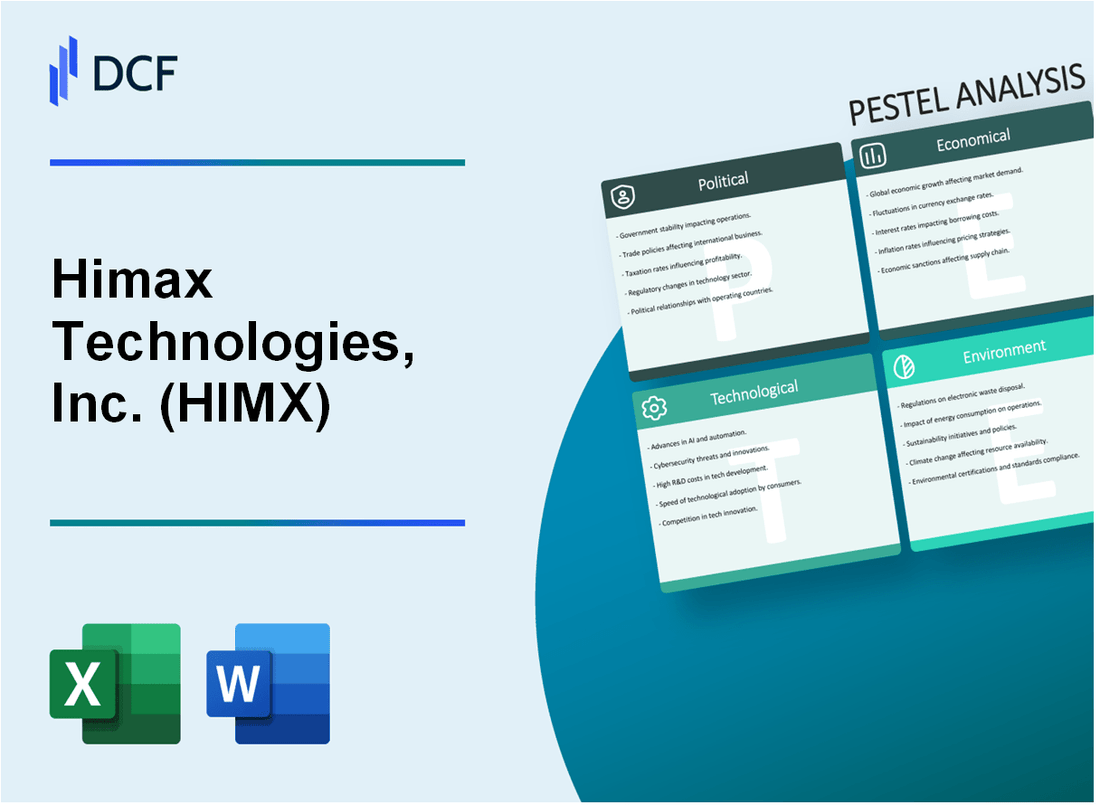
Completamente Editable: Adáptelo A Sus Necesidades En Excel O Sheets
Diseño Profesional: Plantillas Confiables Y Estándares De La Industria
Predeterminadas Para Un Uso Rápido Y Eficiente
Compatible con MAC / PC, completamente desbloqueado
No Se Necesita Experiencia; Fáciles De Seguir
Himax Technologies, Inc. (HIMX) Bundle
En el mundo dinámico de las tecnologías de semiconductores, Himax Technologies, Inc. (HIMX) se encuentra en la encrucijada de la innovación y los desafíos globales, navegando por un complejo panorama de tensiones geopolíticas, interrupciones tecnológicas y oportunidades de mercado emergentes. Este análisis integral de la maja revela los intrincados factores externos que dan forma a la trayectoria estratégica de la compañía, ofreciendo una inmersión profunda en el entorno multifacético que influye mundial.
Himax Technologies, Inc. (Himx) - Análisis de mortero: factores políticos
La posición geopolítica estratégica de Taiwán y las regulaciones de la industria de semiconductores
La industria de semiconductores de Taiwán está sujeta a marcos regulatorios estrictos gobernados por el Consejo de Seguridad Nacional y el Ministerio de Asuntos Económicos. A partir de 2024, el gobierno taiwanés hace cumplir Regulaciones de control de exportación que afectan directamente las capacidades operativas de Himax Technologies.
| Cuerpo regulador | Medidas regulatorias clave | Impacto en Himax |
|---|---|---|
| Consejo de Seguridad Nacional | Restricciones avanzadas de exportación de tecnología de semiconductores | Límites de transferencia de tecnología a ciertos países |
| Ministerio de Asuntos Económicos | Mecanismos de detección de inversiones | Aprobación obligatoria para asociaciones de tecnología internacional |
Tensiones comerciales de US-China y desafíos operativos
Las tensiones comerciales en curso crean complejidades operativas significativas para las empresas tecnológicas taiwanesas como Himax Technologies.
- Restricciones de exportación de EE. UU. En tecnologías avanzadas de semiconductores a China: implementado en octubre de 2022
- Las empresas taiwanesas deben obtener licencias especiales para las exportaciones de tecnología
- Posibles sanciones financieras por incumplimiento: hasta $ 300,000 por violación
Subsidios gubernamentales e incentivos fiscales
El gobierno taiwanés brinda un apoyo sustancial para la investigación y el desarrollo de semiconductores.
| Tipo de subsidio | Cantidad (USD) | Criterios de elegibilidad |
|---|---|---|
| Crédito fiscal de I + D | Asignación anual de $ 50 millones | Empresas que invierten> 3% de los ingresos en la investigación de semiconductores |
| Subvención de desarrollo tecnológico | Hasta $ 25 millones por proyecto | Innovación avanzada de tecnología de semiconductores |
Dinámica política a través del Estrecho
Las relaciones políticas entre Taiwán y China influyen significativamente en la transferencia de tecnología y las asociaciones internacionales.
- Restricciones al intercambio de tecnología con fabricantes de semiconductores chinos
- Detección mejorada de colaboraciones de tecnología transfronteriza
- Posibles riesgos geopolíticos que afectan la inversión internacional
Himax Technologies, Inc. (Himx) - Análisis de mortero: factores económicos
La demanda global de semiconductores impulsa el crecimiento de los ingresos para las tecnologías HIMAX
HIMAX Technologies reportó ingresos totales de $ 787.8 millones para el año fiscal 2022, con los ingresos del segmento de semiconductores que representan $ 521.1 millones. El tamaño global del mercado de semiconductores se valoró en $ 573.44 mil millones en 2022, con una tasa compuesta anual proyectada de 12.2% de 2023 a 2030.
| Año | Ingresos totales ($ M) | Ingresos de semiconductores ($ M) | Tasa de crecimiento del mercado |
|---|---|---|---|
| 2022 | 787.8 | 521.1 | 12.2% |
Los tipos de cambio de divisas fluctuantes afectan el desempeño financiero internacional
HIMAX TECNOLOGÍAS experimentó el cambio de cambio de divisas de $ 14.3 millones En ganancias/pérdidas de divisas durante 2022. El tipo de cambio USD/TWD fluctuó entre 29.50 y 32.80 durante todo el año.
| Pareja | Tasa más baja | Tasa más alta | Impacto de divisas ($ M) |
|---|---|---|---|
| USD/TWD | 29.50 | 32.80 | 14.3 |
Las interrupciones continuas de la cadena de suministro impactan los costos de fabricación y las estrategias de precios
Los costos de fabricación aumentaron por 8.7% en 2022 debido a desafíos de la cadena de suministro. El margen bruto de Himax fue del 24.3% en 2022, en comparación con el 26.5% en 2021.
| Año | Aumento de costos de fabricación | Margen bruto |
|---|---|---|
| 2022 | 8.7% | 24.3% |
Los mercados emergentes en Asia presentan oportunidades de expansión significativas para las tecnologías de exhibición
Mercado de tecnología de exhibición asiática proyectado para llegar $ 223.6 mil millones Para 2025. Himax Technologies amplió su presencia en el mercado en China, con los ingresos de los mercados chinos que aumentaron en un 17,2% en 2022.
| Región | Tamaño del mercado 2025 (proyectado) | Crecimiento de ingresos |
|---|---|---|
| Mercado asiático | $ 223.6 mil millones | 17.2% |
Himax Technologies, Inc. (Himx) - Análisis de mortero: factores sociales
Creciente demanda de consumidores de tecnologías de visualización avanzada en teléfonos inteligentes y sectores automotrices
El tamaño del mercado global de exhibición de teléfonos inteligentes se valoró en $ 98.5 mil millones en 2022, con una tasa compuesta anual proyectada de 6.2% de 2023 a 2032. Se espera que el mercado de visualización automotriz alcance los $ 22.5 mil millones para 2027.
| Segmento de mercado | Tamaño del mercado 2022 | Tasa de crecimiento proyectada |
|---|---|---|
| Pantallas de teléfonos inteligentes | $ 98.5 mil millones | CAGR de 6.2% (2023-2032) |
| Pantallas automotrices | $ 12.3 mil millones | CAGR de 8.5% (2023-2027) |
Aumento del enfoque en la transformación digital en múltiples industrias
El tamaño del mercado global de transformación digital fue de $ 737.8 mil millones en 2022, que se espera que alcance los $ 2,361.8 mil millones para 2030, con una tasa compuesta anual del 16.5%.
| Año | Tamaño del mercado de transformación digital |
|---|---|
| 2022 | $ 737.8 mil millones |
| 2030 (proyectado) | $ 2,361.8 mil millones |
Escasez de habilidades de la fuerza laboral en ingeniería de semiconductores avanzados
La industria de los semiconductores que enfrenta 300,000 escasez de fuerza laboral en los Estados Unidos para 2025. Global Semiconductor Workforce Gap estimada en 1,4 millones de profesionales para 2030.
| Región | Escasez de la fuerza laboral | Año proyectado |
|---|---|---|
| Estados Unidos | 300,000 | 2025 |
| Global | 1.4 millones | 2030 |
Alciamiento de las expectativas del consumidor para tecnologías de exhibición de alta resolución y eficiencia energética
El mercado de pantalla 4K proyectado para alcanzar los $ 310.5 mil millones para 2027. Se espera que el mercado de tecnología de pantalla de eficiencia energética crezca al 12.3% CAGR de 2022 a 2030.
| Tecnología de visualización | Tamaño del mercado (2022) | Tamaño de mercado proyectado | Tocón |
|---|---|---|---|
| Pantallas 4K | $ 158.2 mil millones | $ 310.5 mil millones (2027) | 14.5% |
| Pantallas de eficiencia energética | $ 86.7 mil millones | $ 224.3 mil millones (2030) | 12.3% |
Himax Technologies, Inc. (Himx) - Análisis de mortero: factores tecnológicos
Inversión continua en innovaciones de controladores de IC minId y pantalla
Himax Technologies invirtió $ 48.3 millones en gastos de I + D en 2022, lo que representa el 12.4% de los ingresos totales. La compañía ha desarrollado más de 30 soluciones diferentes de IC de controlador minilado con lanzamientos de píxeles que van desde 0.4 mm a 1.2 mm.
| Área tecnológica | Monto de la inversión | Conteo de patentes |
|---|---|---|
| IC del conductor minido | $ 18.7 millones | 47 patentes activas |
| Mostrar tecnologías de controlador | $ 22.5 millones | 63 patentes activas |
Inteligencia artificial e integración de aprendizaje automático en el diseño de semiconductores
HIMAX ha dedicado el 23% de su fuerza laboral de I + D a la IA y el diseño de semiconductores de aprendizaje automático, con el desarrollo actual de productos relacionados con la IA que alcanza $ 15.2 millones en inversión para 2022-2023.
| Segmento de tecnología de IA | Personal de I + D | Inversión anual |
|---|---|---|
| Diseño de semiconductores de IA | 87 ingenieros | $ 15.2 millones |
| Desarrollo de IC de aprendizaje automático | 62 ingenieros | $ 11.6 millones |
Aplicaciones de expansión en la realidad aumentada y las tecnologías de visualización automotriz
HIMAX ha desarrollado 12 soluciones especializadas de controlador AR y 8 tecnologías de visualización automotriz, con una penetración proyectada del mercado del 16,5% en segmentos automotrices para 2025.
| Segmento tecnológico | Soluciones de productos | Cuota de mercado proyectada |
|---|---|---|
| Muestra de realidad aumentada | 12 soluciones de controlador | 8.3% |
| Tecnologías de visualización automotriz | 8 soluciones especializadas | 16.5% |
Procesos de fabricación avanzados para mantener una ventaja tecnológica competitiva
HIMAX utiliza procesos de fabricación de semiconductores de 7 nm y 5 nm, con una capacidad de fabricación actual de 350,000 obleas por año y una inversión tecnológica de $ 62.4 millones en desarrollo avanzado de procesos.
| Proceso de fabricación | Nodo tecnológico | Capacidad anual | Inversión |
|---|---|---|---|
| Fabricación avanzada de semiconductores | 7 nm/5 nm | 350,000 obleas | $ 62.4 millones |
Himax Technologies, Inc. (Himx) - Análisis de mortero: factores legales
Protección de propiedad intelectual en tecnología de semiconductores
A partir de 2024, Himax Technologies tiene 87 patentes activas En tecnologías de pantalla y semiconductores. Desglose de la cartera de patentes:
| Categoría de patente | Número de patentes | Cobertura geográfica |
|---|---|---|
| Mostrar tecnologías IC del controlador | 52 | Taiwán, Estados Unidos, China, Japón |
| Tecnologías del sensor de imágenes CMOS | 35 | Taiwán, Estados Unidos, Europa |
Cumplimiento de la regulación del comercio internacional
Métricas de cumplimiento para 2024:
- Certificaciones de control de exportación: 4 estándares internacionales
- Presupuesto de cumplimiento regulatorio: $ 3.2 millones
- Países con cumplimiento comercial activo: 12 jurisdicciones
Paisaje de patentes en tecnología de exhibición
Litigios de patentes y estadísticas de licencia:
| Métrico de patente | 2024 datos |
|---|---|
| Disputas de patente activas | 2 |
| Acuerdos de licencia | 7 |
| Ingresos anuales de licencia | $ 5.6 millones |
Marco regulatorio ambiental y de sostenibilidad
Métricas de cumplimiento de sostenibilidad:
- Certificaciones ambientales: ISO 14001: 2015
- Gasto de cumplimiento regulatorio: $ 2.7 millones
- Objetivos de reducción de emisiones de carbono: 15% para 2025
Himax Technologies, Inc. (Himx) - Análisis de mortero: factores ambientales
Compromiso de reducir la huella de carbono en la fabricación de semiconductores
Himax Technologies informó un Reducción del 12.5% en las emisiones directas de gases de efecto invernadero de sus instalaciones de fabricación en 2023. La métrica de intensidad de carbono de la compañía es de 0.85 toneladas métricas de CO2 equivalente por millón de dólares de ingresos.
| Métrica ambiental | 2023 datos | Comparación 2022 |
|---|---|---|
| Emisiones totales de carbono | 42,650 toneladas métricas CO2E | 48,750 toneladas métricas CO2E |
| Consumo de energía | 215,000 MWh | 232,000 MWH |
| Uso de energía renovable | 18.7% | 14.3% |
Implementación de prácticas de producción sostenibles y tecnologías de eficiencia energética
Himax invirtió $ 4.2 millones en equipos de fabricación de semiconductores de eficiencia energética en 2023. La compañía logró un promedio de 22% de mejora de la eficiencia energética en sus líneas de producción.
| Inversiones de eficiencia energética | Cantidad | Impacto |
|---|---|---|
| Actualizaciones de equipos | $4,200,000 | 22% de mejora de la eficiencia energética |
| Sistemas de fabricación inteligentes | $1,850,000 | Reducción del 15% en el desperdicio de energía |
Reciclaje y estrategias de gestión de residuos electrónicos responsables
Tecnologías HIMAX recicladas 87.6% de sus desechos electrónicos En 2023, procesando aproximadamente 156 toneladas métricas de componentes y materiales electrónicos.
| Métrica de gestión de residuos | 2023 rendimiento |
|---|---|
| Residuos electrónicos totales procesados | 156 toneladas métricas |
| Tasa de reciclaje | 87.6% |
| Desechos desviados de los vertederos | 136.7 toneladas métricas |
Desarrollo de materiales semiconductores ecológicos y procesos de producción
Himax asignado $ 3.7 millones para la investigación y el desarrollo de materiales semiconductores sostenibles. La compañía desarrolló tres nuevas tecnologías de proceso de semiconductores bajos en carbono en 2023.
| Área de enfoque de I + D | Inversión | Resultados |
|---|---|---|
| Investigación de materiales sostenibles | $3,700,000 | 3 nuevas tecnologías de baja carbono |
| Procesos de fabricación verde | $2,500,000 | 2 métodos de producción ecológicos |
Himax Technologies, Inc. (HIMX) - PESTLE Analysis: Social factors
You're trying to map where consumer behavior is driving the semiconductor market, and honestly, the display world is bifurcating: it's either massive, high-res screens or tiny, ultra-bright ones for your face. For Himax Technologies, Inc., this social shift is a direct tailwind, but it also creates a tricky inventory management situation in the short term. The core takeaway is that the public's relentless demand for better visual fidelity in cars, on their faces, and in their living rooms is fueling Himax's high-margin, non-driver IC business, even as the traditional mobile market moderates.
Increasing consumer demand for high-resolution AMOLED and Micro-LED displays in smartphones and TVs.
The average consumer's expectation for picture quality has moved past 4K and into the realm of perfect blacks and higher brightness. This is a huge social trend that directly benefits Himax's driver IC business, particularly for Active-Matrix Organic Light-Emitting Diode (AMOLED) and Mini/Micro-LED technologies. The global OLED market is valued at a substantial $31.60 billion in 2025, and the broader AMOLED display market is anticipated to reach $68.55 billion by 2031, growing at a Compound Annual Growth Rate (CAGR) of 25.20% from 2024 to 2031.
Here's the quick math on the premium TV segment: Mini-LED TV shipments are expected to increase at a 15% CAGR from 2024 through 2029, which is nearly double the projected 8% CAGR for OLED TVs. This indicates a strong consumer preference for the high-brightness, high-contrast performance that Himax's display driver ICs enable in both technologies. The Micro-LED display market, while still nascent, is forecast to grow at a staggering 57.4% CAGR through 2032, with the market size anticipated to surpass $3.82 billion in 2025. That's where the future high-value driver ICs will be sold.
Rapid adoption of Augmented Reality (AR) and Virtual Reality (VR) devices drives LCOS microdisplay demand.
The social drive toward immersive computing, or the 'metaverse' if you want to use the buzzword, is directly impacting the demand for microdisplays, which are Himax's specialty. The overall Microdisplay market size is projected to reach $3.07 billion in 2025. Within this, the AR/VR headset segment is expanding rapidly at a 20.3% CAGR. You need to look closely at the split here: Augmented Reality (AR) displays are projected to surge 42% year-over-year in 2025, while Virtual Reality (VR) displays are only expected to grow a modest 2.5%. This disproportionate growth is key.
Himax is a recognized market leader in Liquid Crystal on Silicon (LCoS) microdisplays, which are defintely critical for the high-brightness, compact form factors required by AR glasses. The AR market's focus on AI-enabled applications, rather than just media consumption, is what's driving this growth. Himax's proprietary Color Sequential Front-lit LCoS Microdisplay, which boasts an industry-leading 400K nits of brightness, is perfectly positioned for this high-growth AR segment.
Growing demand for advanced driver-assistance systems (ADAS) in vehicles requires specialized display solutions.
The social factor here is simple: consumers are demanding safer, more digitized, and more autonomous vehicles. This translates into more and larger displays inside the car. The Advanced Driver-Assistance Systems (ADAS) market is growing from $43.03 billion in 2024 to $50.13 billion in 2025, representing a strong CAGR of 16.5%.
For Himax, this demand is a primary revenue driver. The automotive display segment is so strong that it is expected to overtake laptops in 2025 to become the #3 largest display application category by revenue, rising at an 8.5% CAGR. Himax is the global leader in this space, holding a commanding market share:
- Automotive Display Driver IC (DDIC) Market Share: 40%
- Automotive Touch and Display Driver Integration (TDDI) Market Share: Over 50%
This market leadership is supported by the social trend toward features like large-sized, high-resolution, and curved displays, which require Himax's advanced TDDI and local dimming Tcon (Timing Controller) solutions.
Shift to remote work and education sustains moderate demand for laptop/tablet driver ICs.
While the initial pandemic-era boom is over, the permanent shift to hybrid and remote work models is sustaining a floor for laptop and tablet demand. Approximately 28.7% of employees currently work either fully remote or in hybrid arrangements. This structural change means a consistent need for personal computing devices, which are increasingly adopting premium displays.
The trend is toward higher-end displays for these devices, with OLED panels for mobiles and tablets leading the OLED market application segment with a 53.6% share in 2024. Himax is well-positioned with its comprehensive ICs for both LCD and OLED notebooks, including TDDI. However, the near-term market is showing typical cyclicality; Himax expects its Q3 2025 smartphone and tablet IC revenues to decline quarter-over-quarter as customers work through inventory from earlier, larger purchases. This is a moderation, not a collapse.
| Himax's Key Social Factor Exposure (2025 Data) | Market Size / Revenue (2025) | Growth Rate / CAGR | Himax Market Position |
|---|---|---|---|
| High-Resolution Displays (AMOLED/Micro-LED) | OLED Market: $31.60 billion | AMOLED CAGR: 25.20% (2024-2031) | Supplies DDICs for high-end OLED/Mini-LED TVs and phones. |
| AR/VR Headsets (LCoS Microdisplay) | Microdisplay Market: $3.07 billion | AR Display Growth: 42% YoY (2025) | Market leader in LCoS microdisplays for AR glasses. |
| ADAS in Vehicles (Specialized Displays) | ADAS Market: $50.13 billion | ADAS CAGR: 16.5% (2024-2025) | #1 global market share in Automotive DDIC (40%) and TDDI (>50%). |
| Remote Work/Education (Laptop/Tablet ICs) | N/A (Sustained Demand) | Hybrid Job Postings: 24% (Q2 2025) | Supplies ICs for both LCD and OLED notebooks/tablets. |
Himax Technologies, Inc. (HIMX) - PESTLE Analysis: Technological factors
Industry shift from traditional LCD to advanced AMOLED and Micro-LED driver ICs requires high R&D investment.
The display industry's rapid move away from traditional liquid-crystal displays (LCDs) to organic light-emitting diodes (AMOLED) and next-generation Micro-LEDs is forcing Himax Technologies, Inc. to front-load significant research and development (R&D) capital. This isn't a slow transition; it's a fundamental technology shift, particularly in the high-growth automotive sector where Himax is the global market share leader. The company is actively advancing development in the automotive OLED sector, with numerous projects underway in partnership with leading panel makers, positioning OLED ICs as a key growth driver in the coming years.
To keep pace, Himax must invest heavily in new materials and design architectures. For the third quarter of 2025 alone, the company reported R&D expenses of $46.952 million, a clear indicator of the scale of this investment. This money goes directly into developing complex solutions like Touch and Display Driver Integration (TDDI) and local dimming timing controllers (Tcon) for both LCD and OLED, which are critical for next-generation smart cabins that demand higher resolution and better power efficiency.
Himax holds a leading position in LCOS technology, critical for next-generation AR/HUD (Head-Up Display) applications.
Himax maintains a strong technological lead in Liquid Crystal on Silicon (LCoS) microdisplays, a core component for augmented reality (AR) glasses and automotive Head-Up Displays (HUD). This LCoS technology is a strategic asset, providing a unique competitive edge in the emerging metaverse and smart-wearable markets. The company's proprietary Dual-Edge Front-lit LCoS microdisplay, unveiled in May 2025, is a breakthrough in miniaturization and performance.
The technical specifications of this new LCoS microdisplay are impressive and address major barriers to AR adoption:
- Brightness: Up to 350,000 nits
- Volume: Just 0.09 cubic centimeters
- Weight: Less than 0.2 grams
- Power Consumption: No more than 250 milliwatts
This innovation directly targets the global AR/VR market, which is projected to reach $95.3 billion by 2027. A co-design initiative with Vuzix for a fully integrated AR display module is scheduled for commercial release at the end of 2025, solidifying Himax's position as a key supplier for next-gen AR hardware. That's a massive opportunity.
Competition intensifies in the 3D sensing market, pressuring Himax's non-driver product margins.
While Himax's non-driver products-which include 3D sensing solutions, Wafer-Level Optics (WLO), and the WiseEye™ Ultralow Power AI Sensing platform-are a key focus for long-term growth, the market for these is highly competitive. The company has historically faced profit pressure from 'intensified competition' and 'adverse product mix change,' a risk that remains a factor in the volatile 3D sensing and AIoT (Artificial Intelligence of Things) space.
The non-driver segment is crucial for diversifying revenue away from the cyclical display market and for improving the overall corporate profit margin. However, the company's gross margin saw a sequential decline from 31.2% in Q2 2025 to 30.2% in Q3 2025, even with a favorable product mix cited in Q2. This trend suggests that pricing pressures in one or more product lines, including the non-driver segment, are a constant factor. Himax must defintely continue to differentiate with its unique offerings, like the WiseEye AI platform, which provides ultralow power contextual awareness for AIoT applications.
Dependence on mature nodes (e.g., 40nm, 28nm) for DDIs limits process technology cost reduction.
The bulk of display driver ICs (DDIs), especially for large-panel applications, are manufactured on older, more mature semiconductor process nodes, such as 40nm and 28nm. While these nodes offer a cost-effective solution for large-area chips, they inherently limit the potential for significant cost reduction and power efficiency improvements compared to leading-edge technologies. The industry is rapidly moving to advanced nodes like 7nm, 5nm, and 3nm to achieve the massive parallel processing and high memory bandwidth required for high-end AI chips.
Himax's DDIs, by necessity, remain tied to these mature nodes, which affects the company's ability to lower the cost-per-die (chip) as quickly as those leveraging the latest process technology. This creates a dual-track technology strategy:
| Product Line | Typical Process Node | Primary Technological Constraint |
| Traditional DDIC (Large Panel) | Mature Nodes (e.g., 40nm, 28nm) | Limits cost reduction and power efficiency gains. |
| TDDI, OLED ICs, WiseEye AI | More Advanced/Specialized Nodes | Requires high R&D investment (Q3 2025 R&D: $46.952M) to compete with leaders. |
The trade-off is clear: maintaining cost-competitiveness in the core DDI business requires using older nodes, but future growth and technology leadership demand massive investment in the more advanced process technology needed for OLED and AI sensing.
Himax Technologies, Inc. (HIMX) - PESTLE Analysis: Legal factors
You need to understand that the legal landscape for a fabless semiconductor company like Himax Technologies is not just about patents; it's a high-stakes mix of global trade controls, intellectual property enforcement, and evolving data privacy laws. These factors directly map to your product development and market access, so we need to be defintely precise.
Strict Intellectual Property (IP) protection laws in key markets are vital to protect Himax's extensive patent portfolio.
Himax's competitive edge rests on its deep technology, especially in display drivers, timing controllers, and 3D sensing. This makes the strength of global Intellectual Property (IP) laws a core financial factor. As of September 30, 2025, Himax held a substantial portfolio of 2,586 patents granted and 371 patents pending worldwide. Here's the quick math: a single successful IP infringement case against a competitor can protect billions in future revenue, but a loss can cost millions in legal fees and market share.
The good news is that IP policy in the US, one of Himax's key markets, is leaning toward stronger protections for patent owners in high-tech sectors in 2025. Also, global IP offices are collaborating more, which should lead to stronger penalties for infringement and more standardized frameworks. This trend is crucial, given that a significant portion of the company's revenue comes from products like its automotive In-Cell Touch and Display Driver Integration (TDDI) and WiseEye™ AI sensing solutions.
| IP Portfolio Metric (as of Q3 2025) | Amount | Significance to Himax |
|---|---|---|
| Total Patents Granted Worldwide | 2,586 | Defends core technologies (DDIC, TDDI, WiseEye AI, WLO) against competitors. |
| Patents Pending Approval | 371 | Pipeline protection for next-generation products, especially in AR/VR and AI. |
| US IP Policy Trend (2025) | Stronger Patent Owner Protections | Increases the value and enforceability of US-held patents. |
Compliance with US export administration regulations (EAR) regarding technology transfer is mandatory.
The geopolitical climate means the US Export Administration Regulations (EAR), administered by the Bureau of Industry and Security (BIS), have become a major operational risk. Himax is subject to these complex regulations, which have intensified, particularly concerning technology transfer to China.
The focus is on advanced computing semiconductors and AI-related chips. New rules implemented in January 2025 tightened controls, including broader licensing requirements for foundries and packaging companies. Furthermore, BIS released heightened global due diligence requirements in May 2025 for companies trading in semiconductors used in Artificial Intelligence (AI). This is a constant headache because a failure to comply, or if a customer is added to the BIS Entity List, could force Himax to suspend sales, which would materially and adversely impact their results. This is more than a paper exercise; it's a supply chain audit.
Data privacy regulations (e.g., GDPR, CCPA) affect the deployment of 3D sensing solutions in consumer devices.
The growth of Himax's 3D sensing and WiseEye™ Ultralow Power AI Sensing technology, which includes biometric authentication, runs straight into global data privacy laws like Europe's General Data Protection Regulation (GDPR) and the California Consumer Privacy Act (CCPA). These solutions process sensitive personal data, so compliance is non-negotiable for market adoption.
Himax has tackled this head-on with a privacy-first architecture. For example, their WiseEye Palm Vein Authentication Module is explicitly GDPR-compliant. The key is that it uses on-device AI to perform real-time palm vein recognition entirely on the endpoint device, eliminating the need to store biometric data in the cloud or on a centralized server. That's a smart technical solution to a tough legal problem. Plus, the module is certified to PSA (Platform Security Architecture) Level 2, which attests to its adherence to rigorous industry security standards.
Anti-trust scrutiny in the global semiconductor market could impact future merger and acquisition activity.
The global semiconductor market is seeing rising anti-trust scrutiny, which impacts Himax's ability to grow through strategic mergers or acquisitions (M&A). Regulators in the US, EU, and China are increasingly scrutinizing deals, even those below traditional reporting thresholds, especially in the strategically critical AI and chip sectors.
Honestly, the mortality rate for tech M&A is rising. Over a fifth of all mergers that were either prohibited or abandoned in 2024 were in the tech sector, a jump from 16% in 2023. High-profile cases like the Synopsys/Ansys deal in 2025, which required substantial divestitures to gain approval, show that regulators are willing to intervene aggressively to maintain competition. For a company like Himax, which operates in specialized, high-growth segments like 3D sensing and automotive display drivers, any future move to acquire a smaller, innovative competitor would face an intense and lengthy review process. This means organic growth may be the only reliable path for near-term expansion.
- Antitrust intervention in tech M&A is focused on preventing early consolidation in AI.
- China is using its antitrust tools to focus on M&A in strategic sectors like semiconductors.
- High scrutiny means M&A is a slow, high-risk strategy for sector expansion.
Finance: Track the cost of compliance for the new BIS due diligence requirements by the end of Q1 2026.
Himax Technologies, Inc. (HIMX) - PESTLE Analysis: Environmental factors
You can't talk about a fabless semiconductor company like Himax Technologies without talking about the environmental footprint of its foundry partners. Since Himax doesn't own the factories (fabs), their biggest environmental risks are indirect, specifically around water, energy, and customer demands for a clean supply chain. This is a massive cost-of-doing-business issue, not a compliance footnote.
Adherence to global e-waste directives like RoHS and WEEE
As a global supplier of display driver ICs and other components, Himax must adhere to the world's most stringent product-level environmental regulations. This isn't optional; it's a gate to the European market. The company's policy commits to 'green products' and compliance with all applicable laws, which includes the European Union's Restriction of Hazardous Substances (RoHS) and Waste Electrical and Electronic Equipment (WEEE) directives.
Compliance is managed through R&D devoted to 'green products' and energy-saving design, ensuring the components themselves are free of restricted materials like lead and mercury. Plus, the company holds key environmental certifications, which is your proof of process. It's a non-negotiable standard.
- Hold ISO14001 certification (Environmental Management System).
- Hold ISO14064 certification (Greenhouse Gas Quantification and Reporting).
- Design commitment to energy-saving and waste-reducing components.
Pressure from major customers (Apple, Samsung) to meet stringent supply chain carbon neutrality goals
This is where the rubber meets the road in 2025. Your top-tier customers are not just asking for compliance; they are demanding a verifiable path to carbon neutrality, pushing the entire supply chain to shoulder the Scope 3 emissions burden (value chain emissions). This is a defintely a challenge.
Apple, a major client for many in the display ecosystem, has set a firm goal for 100% carbon neutrality across its entire supply chain and product life cycle by 2030. To achieve this, Apple is working with suppliers to implement abatement equipment for industrial processes, such as flat-panel display manufacturing. Similarly, Samsung's 'Galaxy for the Planet' initiative has a set of targets to be reached by the end of 2025 to reduce its environmental footprint. This means Himax must ensure its foundry partners are on track with their renewable energy and emission reduction commitments, or risk being deprioritized for future design-wins.
Water and energy consumption by foundry partners (TSMC, UMC) pose an indirect environmental risk
Himax, being a fabless company, relies heavily on Taiwanese foundries like Taiwan Semiconductor Manufacturing Company (TSMC) and United Microelectronics Corporation (UMC). The sheer scale of semiconductor manufacturing's water and energy needs in a region prone to drought creates a massive, indirect risk for Himax's supply stability. This is a systemic risk you must track.
Here's the quick math on the indirect risk and opportunity from their main foundry partners, based on recent 2023/2024 performance and 2025 targets:
| Foundry Partner | Key Environmental Metric | 2023/2024 Performance | 2025 Target / Context |
|---|---|---|---|
| TSMC | Water Consumption Risk | Anticipates supplying only two-thirds of daily water needed for Taiwan facilities. | Using 2025 as the baseline year for SBTi absolute reduction targets. [cite: 6 (from initial search)] |
| UMC | Renewable Energy Usage | 11% renewable energy usage rate in 2023, expected to surpass 16% in 2024. [cite: 2 (from initial search)] | Targeting 25% renewable energy usage rate. [cite: 2 (from initial search)] |
| UMC | GHG Emissions Reduction (Scope 1 & 2) | 26% reduction in 2023 (based on 2020 levels), ahead of 2030 target. [cite: 2 (from initial search)] | Accelerating path toward net zero emissions by 2050. [cite: 2 (from initial search)] |
| UMC | Water Recycling/Reclaimed Use | Overall reclaimed water usage rate reached 23.7% in 2023, saving 5.47 million tons of water. [cite: 2 (from initial search)] | Continual focus on enhancing water recycling rates and efficiency. [cite: 2 (from initial search)] |
Increasing focus on green manufacturing processes for semiconductor fabrication
The entire semiconductor industry is shifting to green manufacturing, driven by the need to secure resources and meet customer mandates. For Himax, this translates to a need for continued investment in R&D for low-power chip designs like its WiseEye™ ultralow power AI sensing technology, which reduces the end-product's energy consumption, thereby lowering its Scope 3 emissions profile.
The company's strategic collaboration with Tata Electronics and Powerchip Semiconductor Manufacturing Corporation (PSMC) in India, announced in March 2025, is a key move here. Tata Electronics is a 'greenfield venture' committed to a trusted and sustainable electronics value chain [cite: 7 (from initial search)]. This new, geographically diverse supply chain is being built with modern environmental standards in mind, which mitigates the concentration risk associated with the environmental challenges in Taiwan's science parks.
Disclaimer
All information, articles, and product details provided on this website are for general informational and educational purposes only. We do not claim any ownership over, nor do we intend to infringe upon, any trademarks, copyrights, logos, brand names, or other intellectual property mentioned or depicted on this site. Such intellectual property remains the property of its respective owners, and any references here are made solely for identification or informational purposes, without implying any affiliation, endorsement, or partnership.
We make no representations or warranties, express or implied, regarding the accuracy, completeness, or suitability of any content or products presented. Nothing on this website should be construed as legal, tax, investment, financial, medical, or other professional advice. In addition, no part of this site—including articles or product references—constitutes a solicitation, recommendation, endorsement, advertisement, or offer to buy or sell any securities, franchises, or other financial instruments, particularly in jurisdictions where such activity would be unlawful.
All content is of a general nature and may not address the specific circumstances of any individual or entity. It is not a substitute for professional advice or services. Any actions you take based on the information provided here are strictly at your own risk. You accept full responsibility for any decisions or outcomes arising from your use of this website and agree to release us from any liability in connection with your use of, or reliance upon, the content or products found herein.