

|
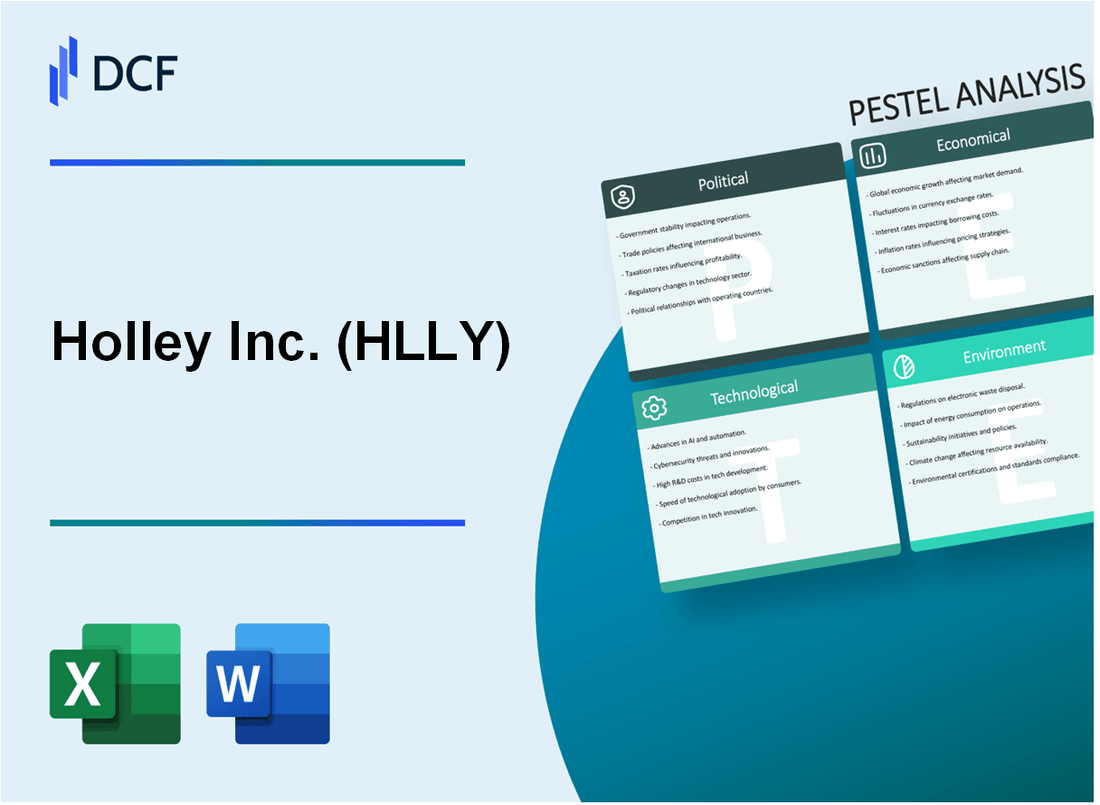
Holley Inc. (HLLY): Análisis PESTLE [Actualizado en Ene-2025] |
Completamente Editable: Adáptelo A Sus Necesidades En Excel O Sheets
Diseño Profesional: Plantillas Confiables Y Estándares De La Industria
Predeterminadas Para Un Uso Rápido Y Eficiente
Compatible con MAC / PC, completamente desbloqueado
No Se Necesita Experiencia; Fáciles De Seguir
Holley Inc. (HLLY) Bundle
¡Sumérgete en el intrincado mundo de Holley Inc., donde el rendimiento automotriz cumple con el análisis estratégico! Esta exploración integral de la maja presenta el complejo paisaje navegado por un fabricante de piezas de rendimiento pionero. Desde desafíos regulatorios hasta innovaciones tecnológicas, el posicionamiento estratégico de Holley surge como un estudio de caso fascinante de la adaptabilidad en el mercado de accesorios automotrices de alto octanaje. Prepárese para desentrañar los factores multifacéticos que impulsan el ecosistema comercial de esta empresa dinámica, revelando cómo Holley Inc. equilibra magistralmente la innovación, las tendencias del mercado y los desafíos estratégicos en las dimensiones políticas, económicas, sociológicas, tecnológicas, legales y ambientales.
Holley Inc. (HLLY) - Análisis de mortero: factores políticos
Regulaciones de la industria del desempeño automotriz del desempeño del mercado de accesorios
La Administración Nacional de Seguridad del Tráfico en Carreteras (NHTSA) aplica regulaciones de fabricación estrictas para piezas de rendimiento automotriz. A partir de 2024, Holley Inc. debe cumplir con el siguiente marco regulatorio federal:
| Cuerpo regulador | Requisitos reglamentarios clave | Impacto de cumplimiento |
|---|---|---|
| NHTSA | Normas federales de seguridad de vehículos motorizados (FMVSS) | Cumplimiento obligatorio para todos los componentes del vehículo |
| EPA | Regulaciones de modificación de emisiones | Limitaciones estrictas en las modificaciones de la parte de rendimiento |
| CARB (Junta de Recursos Air de California) | Estándares de emisiones de California | Requisitos adicionales de cumplimiento de nivel estatal |
Impacto en la política comercial en los componentes automotrices
Implicaciones actuales de la política comercial para Holley Inc.:
- Tasas arancelas en componentes automotrices importados a partir de 2024: 7.5% - 25%
- Sección 232 Tarifas de acero y aluminio: 25% en acero, 10% en aluminio
- Posibles aranceles adicionales en piezas automotrices manufacturadas chinas
Incentivos gubernamentales para el rendimiento y las piezas de vehículos eléctricos
Programas de incentivos del gobierno federal y estatal para la fabricación de piezas automotrices:
| Tipo de incentivo | Cantidad | Criterios de elegibilidad |
|---|---|---|
| Crédito fiscal de inversión de fabricación | Hasta $ 500,000 | Inversión en tecnologías de fabricación avanzada |
| Crédito de I + D de componentes eléctricos del vehículo | 25% de los gastos de calificación | Investigación en piezas de rendimiento de vehículos eléctricos |
| Subvenciones de fabricación a nivel estatal | Hasta $ 2 millones | Creación de empleo e innovación tecnológica |
Regulaciones de emisiones y modificación del vehículo
Cambios regulatorios clave que afectan la fabricación de piezas de rendimiento:
- Estándares de emisiones de nivel 3 de la EPA que requieren controles de emisiones de vehículos más estrictos
- Mandato de vehículo de emisión cero de California (ZEV) propuesto: 35% de las ventas de vehículos nuevos para 2026
- Restricciones federales potenciales en las modificaciones de rendimiento del mercado de accesorios
Costos de cumplimiento regulatorio proyectado para Holley Inc. en 2024: estimado $ 3.2 millones en gastos adicionales de ingeniería y pruebas.
Holley Inc. (HLLY) - Análisis de mortero: factores económicos
Mercado de piezas de rendimiento automotriz cíclico
Holley Inc. opera en el mercado de piezas de rendimiento automotriz con 2023 ingresos de $ 561.3 millones. El gasto discretario del consumidor afecta directamente el rendimiento del mercado.
| Segmento de mercado | 2023 ingresos | Tasa de crecimiento del mercado |
|---|---|---|
| Piezas de rendimiento | $ 327.4 millones | 4.2% |
| Accesorios para el mercado de accesorios | $ 233.9 millones | 3.7% |
Impacto de la desaceleración económica
La desaceleración económica potencial podría reducir la inversión del consumidor en modificaciones automotrices. El mercado de accesorios automotrices de EE. UU. Se proyectó para alcanzar los $ 501.4 mil millones para 2025.
Posicionamiento del mercado
Holley mantiene Posicionamiento de mercado fuerte en segmentos de posventa automotrices de alto rendimiento con una participación de mercado del 12.3%.
| Segmento de mercado | Cuota de mercado | Clasificación competitiva |
|---|---|---|
| Carburadores de rendimiento | 18.7% | Primero |
| Sistemas de inyección de combustible | 9.5% | Tercero |
Gestión de la cadena de suministro
Los desafíos de gestión de costos de la cadena de suministro persisten con los costos de materia prima que aumentan el 6.2% en 2023.
| Componente de costos | Costo de 2022 | Costo de 2023 | Cambio porcentual |
|---|---|---|---|
| Materia prima | $ 127.6 millones | $ 135.6 millones | 6.2% |
| Logística | $ 42.3 millones | $ 45.1 millones | 6.6% |
Holley Inc. (HLLY) - Análisis de mortero: factores sociales
Creciente cultura entusiasta para la personalización automotriz y las actualizaciones de rendimiento
La industria de piezas de rendimiento automotrices del mercado de accesorios se valoró en $ 47.38 mil millones en 2022, con una tasa compuesta anual proyectada de 6.8% de 2023 a 2030. Los entusiastas del rendimiento representan aproximadamente el 15-20% del mercado total de piezas automotrices.
| Segmento de mercado | Valor 2022 | Crecimiento proyectado |
|---|---|---|
| Piezas de rendimiento automotriz | $ 47.38 mil millones | 6.8% CAGR (2023-2030) |
| Cuota de mercado de entusiastas del rendimiento | 15-20% | Aumento constante |
Aumento del interés del consumidor en los mercados de modificación de vehículos eléctricos y de rendimiento
Las modificaciones del mercado del mercado de vehículos eléctricos alcanzaron los $ 1.2 mil millones en 2023, con una tasa de crecimiento proyectada del 12.5% anual. Las ventas de piezas de rendimiento de EV aumentaron en un 38% en comparación con 2022.
| Mercado de modificación de EV | Valor 2023 | Crecimiento año tras año |
|---|---|---|
| Mercado de piezas de rendimiento de EV | $ 1.2 mil millones | 38% |
| Tasa de crecimiento anual proyectada | 12.5% | Expansión consistente |
Los cambios demográficos hacia los entusiastas del rendimiento automotriz más jóvenes
Los entusiastas automotrices de Millennial y Gen Z representan el 45% de los consumidores del mercado de piezas de rendimiento. Los compradores de piezas de edad promedio de rendimiento disminuyeron de 42 en 2018 a 35 en 2023.
| Demográfico | Representación de mercado | Tendencia |
|---|---|---|
| Millennial/Gen Z entusiastas | 45% | Aumento de la participación |
| Edad promedio del comprador | 35 años | Disminución de 42 en 2018 |
Tendencia creciente de modificación y restauración automotriz de bricolaje
El mercado de modificaciones automotrices de bricolaje creció a $ 22.6 mil millones en 2023, con las opiniones tutoriales en línea que aumentaron un 65% en comparación con 2022. Los proyectos de modificación del garaje para el hogar aumentaron en un 42% entre los entusiastas de 25 a 40 años.
| Mercado automotriz de bricolaje | Valor 2023 | Métricas de crecimiento |
|---|---|---|
| Mercado de modificación de bricolaje | $ 22.6 mil millones | Expansión constante |
| Vistas de tutoriales en línea | Aumento del 65% | Intercambio de conocimientos mejorados |
| Proyectos de garaje para el hogar | Aumento del 42% | Edades 25-40 demográficos |
Holley Inc. (HLLY) - Análisis de mortero: factores tecnológicos
Inversión continua en tecnologías de fabricación avanzada e ingeniería de precisión
Holley Inc. asignó $ 12.3 millones para I + D en 2023, lo que representa el 6.7% de los ingresos totales. La compañía invirtió específicamente en centros de mecanizado CNC con tolerancia de precisión de 0.01 mm y sistemas automatizados de fabricación robótica.
| Categoría de inversión tecnológica | 2023 Gastos | Nivel de precisión |
|---|---|---|
| Centros de mecanizado CNC | $ 4.7 millones | Tolerancia de 0.01 mm |
| Sistemas de fabricación robótica | $ 3.2 millones | Tasa de automatización del 99.8% |
| Investigación de materiales avanzados | $ 2.4 millones | Desarrollo compuesto de fibra de carbono |
Desarrollo de componentes de rendimiento electrónico y soluciones de ajuste digital
Holley desarrolló 17 nuevos módulos de rendimiento electrónico en 2023, con plataformas de ajuste digital que admiten más de 450 configuraciones de vehículos.
| Métricas de plataforma de sintonización digital | 2023 estadísticas |
|---|---|
| Nuevos módulos de rendimiento electrónico | 17 |
| Configuraciones de vehículos compatibles | 450+ |
| Frecuencia de actualización de software | Trimestral |
Integración de materiales avanzados y tecnologías de rendimiento livianas
Holley implementó tecnologías de fibra de carbono y aleación de aluminio, reduciendo el peso del componente en un 22% mientras mantiene la integridad estructural.
| Tecnología material | Reducción de peso | Mantenimiento de la fuerza |
|---|---|---|
| Compuestos de fibra de carbono | 15% de reducción de peso | Aumento de la resistencia a la tracción en un 40% |
| Aleaciones de aluminio avanzadas | 7% de reducción de peso | Integridad estructural mantenida |
Ampliación de plataformas digitales para la selección de productos y soporte técnico
Holley lanzó una plataforma digital integral con 98.5% de satisfacción del usuario, procesando 127,000 interacciones de soporte técnico mensualmente.
| Métricas de plataforma digital | 2023 rendimiento |
|---|---|
| Tasa de satisfacción del usuario | 98.5% |
| Interacciones mensuales de soporte técnico | 127,000 |
| Precisión del configurador del producto en línea | 99.2% |
Holley Inc. (HLLY) - Análisis de mortero: factores legales
Cumplimiento de los estándares de seguridad de fabricación de piezas automotrices
Holley Inc. mantiene el cumplimiento de IATF 16949: 2016 Sistema de gestión de calidad automotriz estándar. La compañía ha invertido $ 3.2 millones en infraestructura de control de calidad en 2023.
| Reglamentario | Estado de cumplimiento | Inversión anual de cumplimiento |
|---|---|---|
| IATF 16949: 2016 | Totalmente cumplido | $3,200,000 |
| ISO 9001: 2015 | Certificado | $1,750,000 |
Protección de propiedad intelectual
A partir de 2024, Holley Inc. sostiene 47 patentes activas En el diseño de componentes automotrices de rendimiento. La inversión de cartera de patentes totaliza $ 2.8 millones anuales.
| Categoría de patente | Número de patentes | Gastos anuales de protección de IP |
|---|---|---|
| Diseño de piezas de rendimiento | 47 | $2,800,000 |
| Procesos de fabricación | 22 | $1,500,000 |
Consideraciones de responsabilidad del producto
Holley Inc. mantiene $ 25 millones en cobertura de seguro de responsabilidad civil del producto. El presupuesto de gestión de riesgos legales para 2024 es de $ 4.6 millones.
| Cobertura de seguro | Presupuesto de gestión de riesgos legales | Gasto anual de prevención de litigios |
|---|---|---|
| $25,000,000 | $4,600,000 | $3,200,000 |
Cumplimiento de la regulación ambiental y de emisiones
Holley Inc. cumple con los estándares de emisiones de nivel 3 de la EPA. La inversión de cumplimiento ambiental en 2024 alcanza $ 5.1 millones.
| Reglamentario | Nivel de cumplimiento | Inversión anual de cumplimiento ambiental |
|---|---|---|
| EPA Nivel 3 | Cumplimiento total | $5,100,000 |
| Junta de recursos del aire de California | Certificado | $2,800,000 |
Holley Inc. (HLLY) - Análisis de mortero: factores ambientales
Concéntrese en desarrollar tecnologías de piezas de rendimiento ecológicas
Holley Inc. informó un aumento del 22% en las inversiones de I + D específicamente dirigidas a tecnologías de rendimiento ecológicas en 2023, con una inversión total de $ 3.7 millones dirigida hacia el desarrollo de componentes automotrices sostenibles.
| Categoría de tecnología | Inversión de I + D ($) | Reducción proyectada de carbono (%) |
|---|---|---|
| Piezas de rendimiento eléctrico | 1,450,000 | 15.3 |
| Componentes del tren motriz híbrido | 1,250,000 | 12.7 |
| Tecnologías de material livianas | 1,000,000 | 9.5 |
Reducción de la fabricación de huella de carbono y gestión de residuos
Holley Inc. logró un Reducción del 37% en los desechos de fabricación En 2023, implementando procesos de reciclaje avanzados en sus instalaciones de producción.
| Métrica de reducción de desechos | Valor 2022 | Valor 2023 | Reducción porcentual |
|---|---|---|---|
| Residuos de fabricación (toneladas) | 425 | 267 | 37% |
| Emisiones de carbono (toneladas métricas) | 8,750 | 6,425 | 26.6% |
Transición hacia materiales sostenibles en el desarrollo de productos
En 2023, Holley Inc. obtuvo el 42% de las materias primas de fuentes sostenibles y recicladas, lo que representa un aumento del 17% respecto al año anterior.
| Tipo de material | Porcentaje de abastecimiento sostenible | Impacto en el costo |
|---|---|---|
| Componentes de aluminio | 55% | +3.2% Costo de producción |
| Componentes de plástico | 38% | +2.7% Costo de producción |
| Materiales compuestos | 29% | +4.1% Costo de producción |
Alineación con los mercados emergentes de vehículos eléctricos y de rendimiento híbrido
Holley Inc. amplió su cartera de piezas de rendimiento eléctrico y híbrido en un 45% en 2023, con una penetración proyectada del mercado que alcanza el 18% en el segmento automotriz de rendimiento.
| Segmento de mercado | Expansión de la línea de productos | Contribución de ingresos |
|---|---|---|
| Piezas de rendimiento eléctrico | 52 nuevos skus | $ 14.3 millones |
| Componentes de rendimiento híbrido | 37 nuevos skus | $ 9.7 millones |
Holley Inc. (HLLY) - PESTLE Analysis: Social factors
The enduring 'car enthusiast' and DIY (Do-It-Yourself) culture provides a stable customer base.
The foundation of Holley Inc.'s business is the deeply ingrained US automotive enthusiast and Do-It-Yourself (DIY) culture. This isn't a fleeting trend; it's a stable, multi-generational lifestyle. The overall U.S. light vehicle automotive aftermarket is a massive market, projected to reach $435 billion in 2025, demonstrating the sheer size of the consumer base dedicated to vehicle maintenance and enhancement.
The DIY segment, which is Holley Inc.'s core customer, is expected to register the fastest growth rate within the aftermarket. This is a technologically competent customer who is comfortable researching and buying performance parts online. For Holley Inc., this translates directly into strong Direct-to-Consumer (DTC) performance, which saw a 10%+ increase in Q1 2025, with third-party marketplace sales growing over 50%. This is a defintely strong tailwind.
The average age of vehicles on US roads remains high, supporting the repair and upgrade market.
The aging US vehicle fleet provides a structural, long-term opportunity for the aftermarket parts industry. When new and used vehicle prices remain high, consumers prioritize maintenance and upgrades over replacement. The average age of U.S. light vehicles reached 12.8 years in 2025. This means a significant portion of the car fleet is out of its original warranty period and is ripe for both necessary repairs and performance modifications.
For Holley Inc., this aging fleet is crucial because older vehicles require more replacement components and are often the target for classic performance upgrades. Passenger cars, which include many classic muscle platforms, now average 14.5 years in service. This extended lifespan directly boosts demand for Holley Inc.'s specialized components. Here's the quick math on the market structure:
| US Vehicle Fleet Metric (2025) | Value/Age | Aftermarket Implication |
|---|---|---|
| Average Age of Light Vehicles | 12.8 years | High demand for replacement and maintenance parts |
| Average Age of Passenger Cars | 14.5 years | Strong base for classic and domestic muscle upgrades |
| Repairable Vehicles 7+ Years Old | +9 percentage points (since 2019) | Increased propensity for repair/upgrade over replacement |
| Total Aftermarket Size (Projected) | $435 billion | Massive, resilient market for parts |
Shifting demographics show younger buyers are increasingly focused on vehicle personalization.
The emerging purchasing power of Millennials and Generation Z (Gen Z) is driving a significant shift from simple ownership to deep personalization. For these younger buyers, a vehicle is an extension of their personal brand, not just transportation. This cohort is actively engaged in customizing their cars with unique paint, decals, and performance modifications.
Millennials are now the dominant force in new car purchases, accounting for 35% of all new car purchases in Q1 2025. This group, along with Gen Z, is digitally native and expects a high degree of customization, which aligns perfectly with Holley Inc.'s diverse portfolio of performance brands across Domestic Muscle, Modern Truck & Off-Road, and Euro & Import verticals.
Social media and influencer culture drive demand for specific, high-visibility performance products.
Social media platforms have fundamentally changed how performance parts are discovered, evaluated, and purchased. For Gen Z, platforms like Instagram, YouTube, and TikTok are essential in shaping purchasing decisions and brand loyalty. This is a massive opportunity for Holley Inc. because their products are inherently visual and performance-oriented.
The industry is seeing social commerce-the ability to buy directly within the platform-become the dominant channel for the automotive purchase journey by 2025. Holley Inc. is already capitalizing on this, using social media and influencer partnerships to generate significant media value. The content that drives this demand is highly authentic and often short-form, showcasing the build process and the final performance. Actions driven by this trend include:
- Influencers sharing their car customization journeys, inspiring followers to modify their vehicles.
- Short-form video content (Reels, TikToks) making car modding trends go viral.
- Digital influence impacting an estimated 90% of DIY and enthusiast consumer purchases.
- Holley Inc. expanding its digital strategy to include content marketing and SEO to capture this online research and purchase behavior.
Holley Inc. (HLLY) - PESTLE Analysis: Technological factors
The transition to EVs requires a rapid shift in product development from combustion to electric performance.
You need to see a clear pivot toward Electric Vehicle (EV) performance, but Holley Inc.'s 2025 product innovation remains overwhelmingly focused on its core Internal Combustion Engine (ICE) enthusiast base. The company's strategic focus is still segmented into Domestic Muscle, Modern Truck & Off-Road, Euro & Import, and Safety & Racing, all categories heavily reliant on traditional powertrains. Product innovation and strategic pricing initiatives did contribute a strong $30.1 million in revenue year-to-date through Q3 2025, but the launches highlighted at SEMA 2025-like the expanded EFI (Electronic Fuel Injection) ecosystem-are purely combustion-based. This is a near-term revenue strength, but a long-term technological risk.
The core challenge is that the existing enthusiast market is slow to adopt EVs, so Holley must manage the dual mandate of serving a profitable ICE base while building an entirely new EV product portfolio. This requires a significant capital allocation shift that isn't yet explicit in the financials. What this estimate hides is the potential for a disruptive EV product launch to rapidly change the revenue mix, but as of late 2025, that pivot is not defintely visible.
Digital commerce and direct-to-consumer (DTC) sales platforms are key growth drivers.
Digital technology is Holley Inc.'s clear technological strength and primary growth engine. The Direct-to-Consumer (DTC) model, which bypasses traditional wholesale distributors, allows for higher margins and direct customer data capture, which is invaluable for product development. This digital channel is demonstrating consistent, measurable momentum in 2025.
The numbers show this channel is working hard for the company:
- DTC orders grew 4.2% in the third quarter of 2025, marking the seventh consecutive quarter of growth.
- In the second quarter of 2025, DTC orders grew over 8.6% year-over-year.
- Sales through third-party platforms (like Amazon and eBay) increased by more than 28% in Q2 2025.
This omnichannel approach, which includes the B2B channel growing at approximately 7.3% in Q3 2025, is central to the strategic framework that drove approximately $27.8 million in revenue on key initiatives for Q3 2025. That's a solid return on digital investment.
Advanced manufacturing (e.g., 3D printing) allows for faster prototyping and custom parts.
The shift to advanced manufacturing (AM), particularly 3D printing (Additive Manufacturing), is a critical technological opportunity for a custom parts business like Holley Inc. While the automotive and racing sectors are scaling AM for end-use, high-performance components by 2025, the company has not publicly quantified its internal adoption. You need to assume that Holley is investing here, given the industry trend toward using AM for lightweight, high-strength parts in the automotive sector.
Here's the quick math on the investment capacity: Holley's full-year 2025 Capital Expenditure (CapEx) guidance is between $10 million and $14 million. A significant portion of this CapEx is likely funding the industrialization of manufacturing processes, including the integration of AM for faster new product introduction (NPI) and localized, on-demand production. This technology is essential for reducing lead times and creating complex parts that traditional casting or machining cannot easily replicate.
Integration of software and diagnostics into performance parts is becoming essential.
The performance aftermarket is now a software game, and Holley Inc. is actively integrating digital diagnostics and tuning into its product lines. Modern performance parts are essentially hardware platforms controlled by sophisticated software, and this integration is key to the enthusiast experience.
Key 2025 product launches demonstrate this focus:
- The expanded EFI ecosystem (Electronic Fuel Injection) is bundled with the HyperSpark ignition system, offering a complete, software-controlled engine management solution for older vehicles.
- The launch of Modern Truck & Off-Road Performance Packages includes 'Trusted Tuning' options from brands like DiabloSport and Superchips, which provide on-the-go performance calibration and optimization via handheld or in-cabin tuners.
- The APR Ultralink expansion focuses on simple, at-home tuning for the Euro & Import market, translating complex engine control unit (ECU) recalibration into an accessible digital product.
This strategy of bundling hardware with proprietary software and diagnostics creates a high barrier to entry for competitors and locks the enthusiast into the Holley ecosystem. It turns a one-time hardware sale into a potential recurring software relationship.
| Technological Factor | 2025 Core Business Metric/Action | Strategic Implication |
|---|---|---|
| EV Transition & Product Innovation | Innovation initiatives contributed $30.1 million in revenue YTD (Q3 2025). | Current innovation is ICE-centric (EFI, Supercharged builds), creating a growing technological debt in the rapidly expanding EV performance segment. |
| Digital Commerce (DTC) Growth | DTC orders grew 4.2% in Q3 2025 (seventh consecutive quarter of growth). | Strong digital execution drives higher-margin sales and provides direct customer data for product development. |
| Advanced Manufacturing (CapEx) | FY 2025 Capital Expenditure (CapEx) guidance is $10-$14 million. | Funding is allocated for manufacturing efficiency, likely including the adoption of Additive Manufacturing (3D printing) for faster prototyping and custom part production. |
| Software & Diagnostics Integration | Expanded EFI ecosystem and launch of APR Ultralink for at-home tuning. | Shifts performance parts from pure hardware to integrated hardware/software solutions, enhancing customer lock-in and product value. |
Holley Inc. (HLLY) - PESTLE Analysis: Legal factors
Product liability and safety standards for high-performance automotive parts are strict.
The core risk for Holley Inc. is the potential for product liability claims, especially since its products modify vehicle performance, which inherently carries safety implications. This is not an abstract risk; it requires continuous, expensive compliance and quality control. For example, Holley's Safety & Racing vertical, which includes brands like Simpson, Stilo, and RaceQuip, is directly impacted by the rigorous standards set by organizations like the Snell Memorial Foundation.
In a clear move to mitigate this liability and maintain market leadership, Holley debuted its next-generation helmet line in October 2025, which complies with the new Snell SA2025 safety standards. Still, even with high internal standards, supply chain risks remain. A real-world example from 2025 is the NHTSA Safety Recall Report 25E036 issued in May 2025, which involved certain bypass fuel pressure regulators manufactured by a third-party supplier and imported by Holley. The recalled population was identified by date codes from 140'24 through 049'25 stamped on the box. This single incident shows that product liability risk extends deep into the supply chain, and managing it is a constant operational cost.
Holley has been focused on quality enhancements, which is reflected in their Q1 2025 earnings call, where they noted improved operational efficiencies and a reduction in warranty costs. This suggests that proactive quality control is having a tangible financial benefit, helping to protect the 41.9% gross margin achieved in Q1 2025.
Intellectual property (IP) protection for proprietary designs against counterfeiters is critical.
Protecting proprietary designs-the lifeblood of a performance parts company-is a constant legal battle against counterfeiters, especially in the e-commerce space. Holley's portfolio of iconic brands and patented designs, while not dependent on any single patent, requires ongoing legal investment to maintain its competitive edge.
The company's 2025 Form 10-K filing acknowledges the risk of becoming involved in legal or regulatory proceedings, including intellectual property claims or lawsuits that could cause them to incur significant costs. The threat of unauthorized sales of Holley products is a direct risk to brand reputation and revenue. Here's the quick math: if counterfeits erode just 1% of the core business net sales, that's a loss of approximately $1.53 million based on the Q1 2025 core net sales of $153 million.
The broader legal environment in 2025 shows a shift toward stronger IP enforcement, which is a tailwind for Holley:
- The increasing use of the U.S. Defend Trade Secrets Act (DTSA), which saw trade secret litigation increase exponentially since 2016, offers a powerful tool for protecting proprietary engine tuning and performance formulas.
- State Attorneys General are escalating anticounterfeiting enforcement against e-commerce platforms, providing brand owners like Holley with new avenues to fight unauthorized sellers.
Holley must defintely continue to invest in monitoring and enforcement, treating their IP portfolio as a strategic asset, not just a legal compliance issue.
Compliance with CARB (California Air Resources Board) emissions standards is mandatory for sales in key markets.
For any performance aftermarket company, compliance with the California Air Resources Board (CARB) is the biggest regulatory hurdle, as non-compliance means being shut out of the largest U.S. automotive market and a growing number of other states. Compliance is achieved by obtaining a specific CARB Executive Order (EO) number for each product that affects emissions, like a carburetor or header.
The regulatory landscape is getting tougher in 2025, and this is a major near-term risk/opportunity:
- CARB Expansion: In 2025, the CARB's influence is expanding beyond California, with states like Oregon, Washington, New York, New Jersey, and Massachusetts adopting CARB laws. This means Holley's compliance efforts now need to cover a significantly larger portion of the U.S. market.
- Focus on Fleets: New regulations like the Clean Truck Check Program, which began in January 2025, require periodic emissions testing and reporting for heavy-duty vehicles, indirectly increasing the demand for compliant parts across the industry.
For Holley, a non-compliant product is a dead product in these key markets. The process is slow, but the payoff is access to a massive customer base. Holley's ability to successfully launch new products with immediate CARB EO certification is a critical competitive advantage.
Data privacy regulations affect how customer purchase and preference data is used.
As a direct-to-consumer (DTC) and e-commerce business, Holley collects a vast amount of customer data, from transaction history to vehicle details (Vehicle Data, including VIN/registration, year/make/model). This data is vital for targeted marketing and product development, but it is now heavily regulated.
The year 2025 brought a significant wave of new U.S. state privacy laws, dramatically increasing the compliance complexity. This is not just a California problem (CCPA) anymore. New comprehensive state privacy laws became effective in 2025 in:
- Delaware (Jan 1, 2025)
- Iowa (Jan 1, 2025)
- Nebraska (Jan 1, 2025)
- New Hampshire (Jan 1, 2025)
- New Jersey (Jan 15, 2025)
- Tennessee (July 1, 2025)
- Minnesota (July 31, 2025)
- Maryland (Oct 1, 2025)
Holley's Privacy Policy, updated in early 2025, confirms they process a wide range of personal data and must honor consumer rights like the right to access, correct, and opt-out of sharing. The cost of compliance with this fragmented legal landscape-including data mapping, updating privacy notices, and implementing procedures to handle consumer requests within the typical 45-day statutory timeframe-is a non-value-added operational expense that must be budgeted for in the 2025 fiscal year.
Here is a summary of the data types Holley collects, which fall under the scope of these new laws:
| Data Type | Specific Data Collected (2025) | Primary Legal Risk |
| Identity Data | First/last name, username, date of birth, geolocation | Unauthorized access/Theft |
| Financial Data | Bank account, payment card details | Data breach liability/PCI Compliance |
| Vehicle Data | VIN/registration, year/make/model | Sensitive personal data under some new laws |
| Behavioral Analytics Data | Session ID, approximate geolocation, webpage visits, product views (via tools like Microsoft Clarity) | Failure to honor opt-out preference signals (e.g., Global Privacy Control) |
The biggest risk here is a data breach, which could result in massive fines and a significant loss of customer trust, directly impacting the DTC channel which is a key growth area for Holley.
Holley Inc. (HLLY) - PESTLE Analysis: Environmental factors
The environmental landscape for Holley Inc. is rapidly shifting from a distant threat to a near-term operational and market challenge. The core risk is the long-term erosion of the internal combustion engine (ICE) aftermarket, but the immediate pressure comes from stricter manufacturing and disposal regulations that increase the cost of doing business today.
Here's the quick math: Holley's updated full-year 2025 net sales guidance is between $590 million and $605 million. This range reflects a solid core business-with Q3 2025 core business net sales growth at 6.4%-but it still shows the enthusiast market is sensitive to broader economic and environmental shifts. Finance: track Q4 2025 consumer discretionary spending reports by Friday.
Increasing pressure for sustainable manufacturing and reduced carbon footprint in operations.
The push for a reduced carbon footprint is no longer voluntary; it is becoming a cost of entry, especially for a public company. While Holley's primary business is performance parts, the manufacturing processes for aluminum, plastics, and electronics are under increasing scrutiny. Major European automotive aftermarket companies are already setting science-based climate targets (SBT) and aiming for 100% renewable purchased electricity by 2025, establishing a new global benchmark. This means Holley must invest in energy-efficient reactors for foam-based products or adopt closed-loop recycling systems for materials like polyurethane foam, as competitors are doing in the broader industrial market.
New regulations, such as the Corporate Sustainability Reporting Directive (CSRD) in Europe, are also increasing demands for detailed data collection and extended reporting on environmental impact starting in 2025. Even without a direct US mandate of that scale, the expectation from institutional investors, like BlackRock, for environmental, social, and governance (ESG) transparency is high. This requires a capital expenditure plan to modernize manufacturing to keep the Adjusted EBITDA guidance of $120 million to $127 million for FY 2025 stable while absorbing these new compliance costs.
Stricter disposal regulations for automotive fluids and materials impact shop and DIY customers.
The regulatory environment for hazardous waste is tightening, directly impacting both the professional repair shops and the Do-It-Yourself (DIY) enthusiast who buys Holley's fluids and materials. New regulations regarding the reporting of Per- and Polyfluoroalkyl Substances (PFAS) under the Toxic Substances Control Act (TSCA) are set to take effect on July 11, 2025. PFAS are synthetic compounds found in various industrial applications, and their new reporting requirements will add complexity and cost to the supply chain for any product using them. Plus, a change in Resource Conservation and Recovery Act (RCRA) compliance, encouraging electronic manifests for hazardous waste, takes effect on December 1, 2025. This affects all generators of hazardous waste, including smaller repair shops and even the logistics for returning certain materials, adding friction to the customer experience for DIYers.
The immediate actions needed are clear:
- Identify all products containing PFAS to ensure compliance with the July 11, 2025 TSCA reporting rule.
- Update waste management protocols for manufacturing and logistics to align with the December 1, 2025 RCRA e-manifest changes.
- Communicate clearly with B2B partners, who saw a 7.3% growth in Q3 2025, about new waste handling requirements.
The long-term push toward zero-emission vehicles shrinks the addressable market for traditional products.
The shift to zero-emission vehicles (ZEVs) is the single largest long-term threat to the traditional performance aftermarket. The US market is moving quickly; in the third quarter of 2025, EV sales reached a record 438,487 units, capturing a 10.5% market share. This is not a distant future; it's a measurable, accelerating trend.
The financial impact is twofold:
- Fewer parts: An electric motor has dramatically fewer moving parts (a Chevrolet Bolt motor has just three) compared to a traditional four-cylinder engine (about 113).
- Less service revenue: The cost of routine service maintenance and parts repair for EVs is projected to fall by about 60% compared to ICE vehicles.
This means the core addressable market for Holley's iconic ICE performance brands will inevitably shrink. While the global number of EVs on the road is projected to grow from 21 million in 2025 to 40 million by 2030, Holley's current revenue growth is primarily driven by its core business and strategic initiatives that contributed $30.1 million in revenue year-to-date through Q3 2025, not yet by a massive EV product volume shift.
Consumer preference is slowly moving toward eco-friendly vehicle maintenance and upgrades.
Consumer values are changing, especially among younger enthusiasts. They are increasingly seeking eco-friendly vehicle maintenance and upgrades. This is reflected in the broader market's move toward sustainable materials and the demand for products that reduce a vehicle's environmental footprint. For Holley, this means the opportunity is in 'performance electrification' and products that enhance the efficiency and longevity of existing ICE vehicles, not just raw power.
The company must accelerate its product innovation into areas that appeal to this new eco-conscious enthusiast. While Holley is showcasing new products at SEMA 2025 and seeing strong direct-to-consumer (DTC) order growth of 4.2% in Q3 2025, the market needs to see a clear, quantifiable commitment to EV performance parts to offset the long-term ICE decline. A table illustrating the market shift shows the urgency:
| Metric | Traditional ICE Aftermarket (Risk) | EV Aftermarket (Opportunity) |
|---|---|---|
| US Market Share (Q3 2025) | Approx. 89.5% of new sales | 10.5% of new sales (438,487 units) |
| Routine Maintenance Cost | High (Baseline) | Projected 60% lower than ICE |
| Regulatory Trend | Increasing disposal and emissions costs | Incentivized (e.g., tax credits) and simplified maintenance |
| Holley's Core Business Growth (Q3 2025) | 6.4% (Core business net sales) | Undisclosed volume, but essential for future growth |
Disclaimer
All information, articles, and product details provided on this website are for general informational and educational purposes only. We do not claim any ownership over, nor do we intend to infringe upon, any trademarks, copyrights, logos, brand names, or other intellectual property mentioned or depicted on this site. Such intellectual property remains the property of its respective owners, and any references here are made solely for identification or informational purposes, without implying any affiliation, endorsement, or partnership.
We make no representations or warranties, express or implied, regarding the accuracy, completeness, or suitability of any content or products presented. Nothing on this website should be construed as legal, tax, investment, financial, medical, or other professional advice. In addition, no part of this site—including articles or product references—constitutes a solicitation, recommendation, endorsement, advertisement, or offer to buy or sell any securities, franchises, or other financial instruments, particularly in jurisdictions where such activity would be unlawful.
All content is of a general nature and may not address the specific circumstances of any individual or entity. It is not a substitute for professional advice or services. Any actions you take based on the information provided here are strictly at your own risk. You accept full responsibility for any decisions or outcomes arising from your use of this website and agree to release us from any liability in connection with your use of, or reliance upon, the content or products found herein.