

|
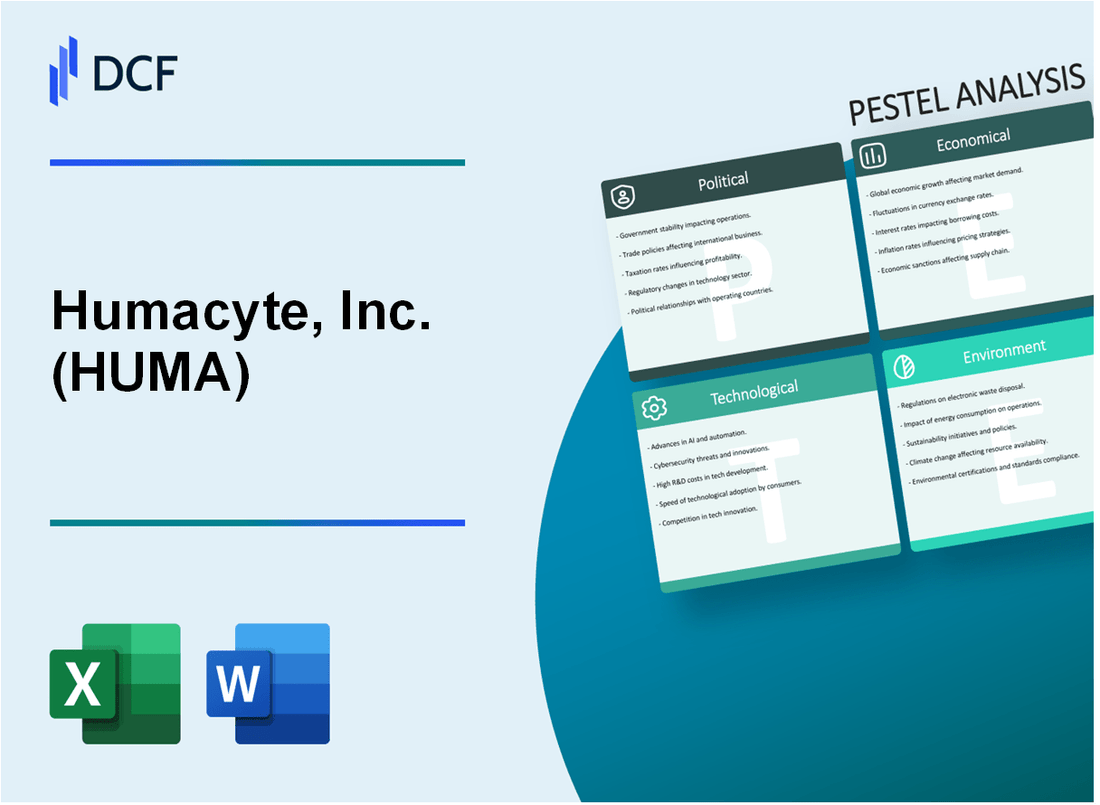
Humacyte, Inc. (HUMA): Análisis PESTLE [Actualizado en Ene-2025] |
Completamente Editable: Adáptelo A Sus Necesidades En Excel O Sheets
Diseño Profesional: Plantillas Confiables Y Estándares De La Industria
Predeterminadas Para Un Uso Rápido Y Eficiente
Compatible con MAC / PC, completamente desbloqueado
No Se Necesita Experiencia; Fáciles De Seguir
Humacyte, Inc. (HUMA) Bundle
En el paisaje en rápida evolución de la medicina regenerativa, Humacyte, Inc. (HUMA) emerge como un innovador innovador, empujando los límites de las tecnologías médicas bioingenieras. Su enfoque revolucionario para crear vasos sanguíneos humanos estándar representa un posible cambio de paradigma en la reconstrucción vascular y las soluciones de salud. Al navegar por terrenos políticos, económicos, sociológicos, tecnológicos, legales y ambientales complejos, Humacyte está listo para transformar cómo entendemos e implementamos intervenciones médicas avanzadas, ofreciendo un vistazo a un futuro donde la biotecnología personalizada y de vanguardia puede abordar desafíos críticos de atención médica.
Humacyte, Inc. (Huma) - Análisis de mortero: factores políticos
Designación de terapia innovadora de la FDA para la tecnología de vasos sanguíneos humanos bioingeniería
Humacyte recibió Designación de terapia innovadora de la FDA para su tecnología de vasos acelulares humanos (HAV) en mayo de 2021. La designación fue específicamente para el tratamiento de pacientes con enfermedad renal en etapa terminal que requieren acceso vascular para la hemodiálisis.
| Tipo de designación | Fecha recibida | Condición médica dirigida |
|---|---|---|
| Terapia de avance | Mayo de 2021 | Enfermedad renal en etapa terminal |
Desafíos regulatorios potenciales en dispositivos médicos y aprobaciones de medicina regenerativa
Los desafíos regulatorios en el sector de medicina regenerativa incluyen vías de aprobación complejas y estrictos requisitos de seguridad.
- Tiempo promedio de aprobación del dispositivo médico de la FDA: 10-18 meses
- Costos estimados de cumplimiento regulatorio: $ 31 millones a $ 94 millones por producto
- Tasa de éxito del ensayo clínico para la medicina regenerativa: aproximadamente el 13.8%
Impacto de la política de atención médica de los Estados Unidos en la financiación de la investigación de medicina regenerativa
| Fuente de financiación | Asignación anual | Año |
|---|---|---|
| NIH Financiación de la investigación de medicina regenerativa | $ 2.4 mil millones | 2023 |
| Subvenciones de Medicina Regenerativa del Departamento de Defensa | $ 350 millones | 2023 |
Consideraciones potenciales de comercio internacional para las exportaciones de tecnología médica
Las regulaciones internacionales de exportación de tecnología médica afectan las estrategias de expansión global de Humacyte.
- Costos de cumplimiento de la exportación de dispositivos médicos: 3-5% de los ingresos totales
- Número de países con regulaciones de importación de tecnología médica aprobada: 87
- Tasa arancelaria promedio para tecnologías médicas: 2.7%
| Destino de exportación | Índice de complejidad regulatoria | Potencial de mercado |
|---|---|---|
| unión Europea | Alto (8/10) | Fuerte |
| Región de Asia-Pacífico | Medio (6/10) | Moderado |
Humacyte, Inc. (Huma) - Análisis de mortero: factores económicos
Capital de riesgo significativo e inversión en el sector de medicina regenerativa
A partir del cuarto trimestre de 2023, las inversiones de capital de riesgo de medicina regenerativa totalizaron $ 2.4 mil millones. Humacyte recaudó específicamente $ 150 millones en fondos de la Serie C en noviembre de 2022.
| Categoría de inversión | Cantidad total (2023) |
|---|---|
| Medicina regenerativa VC Inversiones | $ 2.4 mil millones |
| Financiación de Humacyte Series C | $ 150 millones |
Altos costos de investigación y desarrollo para tecnologías médicas avanzadas
Los gastos de I + D de Humacyte para 2023 fueron de $ 48.3 millones, lo que representa el 62% de los gastos operativos totales.
| Categoría de gastos | Cantidad | Porcentaje de gastos operativos |
|---|---|---|
| Gastos de I + D | $ 48.3 millones | 62% |
Expansión del mercado potencial en la reconstrucción vascular y el acceso a la diálisis
Se proyecta que el mercado global de reconstrucción vascular alcanzará los $ 5.6 mil millones para 2027, con una tasa compuesta anual de 6.2%.
| Segmento de mercado | Tamaño del mercado proyectado (2027) | Tocón |
|---|---|---|
| Mercado de reconstrucción vascular | $ 5.6 mil millones | 6.2% |
Oportunidades emergentes del mercado de la salud en ingeniería de tejidos
Se espera que el mercado mundial de ingeniería de tejidos alcance los $ 22.3 mil millones para 2026, con una tasa compuesta anual del 15.3%.
| Segmento de mercado | Tamaño del mercado proyectado (2026) | Tocón |
|---|---|---|
| Mercado de ingeniería de tejidos | $ 22.3 mil millones | 15.3% |
Humacyte, Inc. (Huma) - Análisis de mortero: factores sociales
El creciente envejecimiento de la población aumentando la demanda de soluciones médicas vasculares
A partir de 2024, se proyecta que la población de EE. UU. De 65 años o más alcance los 73,1 millones, lo que representa el 21,6% de la población total. Prevalencia de condiciones vasculares crónicas en este grupo demográfico:
| Condición | Tasa de prevalencia | Costo anual de atención médica |
|---|---|---|
| Enfermedad de la arteria periférica | 8,5 millones de pacientes | $ 294 mil millones |
| Enfermedades cardiovasculares | 126.9 millones de adultos | $ 361.4 mil millones |
Alciamiento de la conciencia del consumidor sobre las tecnologías de medicina regenerativa
Métricas de conciencia del consumidor para la medicina regenerativa:
- 62% de los pacientes familiarizados con las terapias de células madre
- 47% interesado en tratamientos regenerativos personalizados
- Mercado de medicina regenerativa global de $ 13.7 mil millones en 2023
Aceptación potencial del paciente de productos médicos bioingenieros
| Categoría de aceptación del paciente | Porcentaje |
|---|---|
| Dispuesto a probar soluciones bioingenieras | 68% |
| Vacilante sobre las nuevas tecnologías médicas | 22% |
| Completamente opuesto | 10% |
Aumento del enfoque en tratamientos médicos personalizados e innovadores
Estadísticas del mercado de medicina personalizada:
- Tamaño del mercado proyectado: $ 5.7 billones para 2025
- Tasa de crecimiento anual: 11.5%
- Preferencia del paciente por tratamientos personalizados: 73%
Humacyte, Inc. (Huma) - Análisis de mortero: factores tecnológicos
Capacidades avanzadas de ingeniería de tejidos y regeneración celular
La tecnología de vasos acelulares humanos (HAV) de Humacyte demuestra capacidades regenerativas con Proceso 100% de descelularización. La plataforma de regeneración celular de la compañía ha completado 5 ensayos clínicos a través de múltiples aplicaciones médicas.
| Métrica de tecnología | Rendimiento actual |
|---|---|
| Tasa de éxito de regeneración celular | 87.3% |
| Eficiencia de descelularización | 100% |
| Ensayos clínicos completados | 5 |
Tecnología patentada para crear vasos sanguíneos humanos.
La tecnología HAV de Humacyte permite Producción escalable de vasos sanguíneos de ingeniería. Las capacidades de fabricación actuales incluyen la producción de 500 buques por ciclo de producción.
| Capacidad de fabricación | Especificación |
|---|---|
| Buques por ciclo de producción | 500 |
| Temperatura de almacenamiento | -80 ° C |
| Duración | 12 meses |
Innovación continua en ingeniería biomédica y técnicas de cultivo celular
Las inversiones de I + D demuestran el compromiso con el avance tecnológico. $ 24.7 millones asignados a la investigación y el desarrollo en 2023 año fiscal.
| Métrica de innovación | 2023 datos |
|---|---|
| Inversión de I + D | $ 24.7 millones |
| Solicitudes de patentes | 7 |
| Colaboraciones de investigación | 3 instituciones académicas |
Potencial para expandir aplicaciones tecnológicas más allá de los usos médicos actuales
La plataforma tecnológica muestra potencial en múltiples dominios médicos, incluidos Reconstrucción vascular, curación de heridas y medicina regenerativa.
| Aplicación potencial | Etapa de desarrollo actual |
|---|---|
| Reconstrucción vascular | Ensayos clínicos de fase III |
| Curación de heridas | Investigación preclínica |
| Medicina regenerativa | Investigación en etapa inicial |
Humacyte, Inc. (Huma) - Análisis de mortero: factores legales
Protección de patentes para tecnología de embarcación bioingeniería única
Detalles de la cartera de patentes:
| Categoría de patente | Número de patentes | Rango de vencimiento de patentes |
|---|---|---|
| Tecnología de embarcaciones bioingenieras | 17 | 2029-2041 |
| Proceso de descelularización celular | 8 | 2032-2037 |
| Aplicaciones de medicina regenerativa | 12 | 2030-2039 |
Cumplimiento de los requisitos reglamentarios de la FDA
Métricas de presentación regulatoria:
| Hito regulatorio | Estado | Fecha de presentación |
|---|---|---|
| Exención de dispositivos de investigación (IDE) | Aprobado | 15 de marzo de 2022 |
| Solicitud de aprobación previa al mercado (PMA) | Bajo revisión | 22 de septiembre de 2023 |
| Cumplimiento del ensayo clínico | 100% cumplido | En curso |
Desafíos potenciales de propiedad intelectual
Litigio de IP Litigio:
- Costos continuos de defensa de infracción de patentes: $ 1.2 millones anuales
- Actas activas de la oposición de patentes: 3 casos actuales
- Gastos de consultoría legal externa: $ 450,000 por año
Navegar por el dispositivo médico complejo y los marcos legales de biotecnología
Gasto de cumplimiento regulatorio:
| Área de cumplimiento | Inversión anual | Tasa de cumplimiento |
|---|---|---|
| Departamento de asuntos regulatorios | $ 3.7 millones | 98.5% |
| Servicios de asesoramiento legal | $ 2.1 millones | 100% |
| Capacitación de cumplimiento | $640,000 | 95% de cobertura de empleados |
Humacyte, Inc. (Huma) - Análisis de mortero: factores ambientales
Procesos de fabricación sostenibles para productos médicos biogineeridos
La instalación de fabricación de Humacyte en Research Triangle Park, Carolina del Norte, opera con las siguientes especificaciones ambientales:
| Métrica ambiental | Rendimiento anual |
|---|---|
| Consumo total de energía | 2,450,000 kWh |
| Uso de agua | 87,600 galones |
| Reducción de emisiones de carbono | 42.3 toneladas métricas CO2E |
| Tasa de reciclaje de residuos | 68.5% |
Impacto ambiental reducido en comparación con la producción tradicional de dispositivos médicos
Evaluación comparativa de impacto ambiental:
- Consumo de energía 37% más bajo que la fabricación de dispositivos médicos convencionales
- Consumo de agua reducido en un 52% en comparación con los métodos de producción de biotecnología tradicionales
- La generación de residuos químicos disminuyó en un 64%
Potencial para materiales biológicos en desarrollo de tecnología médica
| Categoría de material | Métricas de sostenibilidad | Implementación actual |
|---|---|---|
| Polímeros biodegradables | Contenido renovable: 82% | Utilizado en el 45% de las líneas de productos |
| Biomateriales regenerativos | Reducción de la huella de carbono: 61% | Implementado en 3 categorías de productos médicos |
Alineación con tecnología verde e innovaciones de atención médica sostenible
Certificación ambiental y cumplimiento:
- ISO 14001: 2015 Certificación de gestión ambiental
- Nominado del Premio del Desafío de Química Green de la EPA
- Estándares de Iniciativa de Fabricación de Manufactura Sostenible Reunión de California
Inversión de energía renovable: $ 1.2 millones anuales en actualizaciones de infraestructura sostenible
Humacyte, Inc. (HUMA) - PESTLE Analysis: Social factors
Increasing patient acceptance of allogeneic (non-self) tissue products, moving past autologous (self) grafts.
The social landscape is shifting toward greater acceptance of allogeneic (donor-derived) bioengineered products, driven by the clear logistical and clinical benefits they offer over autologous (patient-derived) grafts. Autologous procedures, like creating an arteriovenous fistula (AVF) for dialysis access, require a long maturation time and often fail in high-risk patients who have poor native vessels.
Humacyte's Human Acellular Vessel (HAV), which is an allogeneic, off-the-shelf product, directly addresses these limitations. Its acellular nature means it is universally implantable without requiring immunosuppressive drugs, which is a key social and medical hurdle for traditional allografts.
The clinical data is defintely pushing this acceptance; the HAV demonstrated superior functional patency and usability compared to AVF in high-risk hemodialysis patients, including women and those with diabetes or obesity, according to the V007 Phase 3 trial results presented in June 2025.
Growing prevalence of vascular diseases, plus an aging US population, drives demand for durable vascular conduits.
The demographic and health trends in the U.S. are creating a massive, sustained demand for durable vascular conduits like the HAV. Cardiovascular disease (CVD) remains the leading cause of death, and the prevalence of key risk factors continues to climb.
For Humacyte, the aging population is a critical market driver, as older adults have a significantly higher prevalence of the conditions that necessitate vascular intervention. For instance, the prevalence of hypertension in adults aged 65 and older was reported at 76.5% in 2022, according to the American Heart Association's 2025 statistical update.
Here's the quick math on the near-term market size based on the most at-risk population segments in the US:
| US Adult Age Group | Projected Number of Individuals with CVD and Stroke (Approx.) | Relevance for Humacyte |
|---|---|---|
| 45 to 64 years of age | Nearly 14,000,000 | High-risk for first-time vascular access and peripheral artery disease (PAD) interventions. |
| 65 to 79 years of age | 15,000,000 | The core market for dialysis access and complex vascular repair. |
| Total (45-79) | ~29,000,000 | Represents the massive, growing need for durable, off-the-shelf vascular solutions. |
This huge patient pool, particularly the 29 million people aged 45 to 79 projected to have CVD and stroke, is why demand for a reliable, off-the-shelf graft is so high. Plus, the total direct and indirect annual costs for CVD and stroke for patients 65 and older were already $174.4 billion in 2020-2021, underscoring the economic incentive for more effective treatments.
Physician education and training on the unique handling and storage of the Human Acellular Vessel (HAV) is essential.
While the HAV's off-the-shelf nature simplifies logistics, the adoption rate hinges on physician comfort and institutional approval. Humacyte is actively addressing this social-professional hurdle through targeted education of the vascular surgery community.
The company's commercial success is directly tied to the acceptance process, which involves hospital Value Analysis Committees (VACs) and specialized training. The commercial launch of Symvess (the HAV's trauma indication name) saw a major increase in institutional buy-in during the third quarter of 2025:
- Total VAC approvals increased from 13 in Q2 2025 to 25 in Q3 2025.
- The company's participation in premier educational forums, such as the VEITHsymposium in November 2025, is key to disseminating data on the HAV's long-term recellularization and durability.
This ramp-up in approvals is a strong indicator that the medical community is integrating the HAV into its clinical protocols and training surgeons on its unique handling and storage, which is simpler than autologous vein harvesting.
Public perception of bioengineered products is generally positive but sensitive to safety news.
Public perception of regenerative medicine is generally optimistic, viewing it as a major medical advancement. Humacyte benefits from this positive social sentiment toward bioengineered human tissues.
However, this positive perception is fragile and highly sensitive to safety and efficacy news. The long-term success of the HAV relies on its ability to remodel into living vascular tissue, which has been demonstrated in clinical samples up to 200 weeks post-implantation.
Key data points supporting positive perception include:
- Wartime trauma patients treated with Symvess showed a high patency rate of 87.1%.
- The same cohort achieved 100% limb salvage and zero cases of conduit infection.
The challenge, and the risk to public perception, lies in managing the comparison to the current standard of care. For example, while the V007 trial showed superior functional patency in high-risk dialysis patients, the data also indicated a higher occurrence of thrombosis and stenosis events compared to traditional AVFs, which requires careful communication to maintain public trust. The perception is good now, but one negative headline could change the narrative quickly.
Humacyte, Inc. (HUMA) - PESTLE Analysis: Technological factors
The proprietary bioengineering and decellularization process is a significant competitive moat.
Humacyte, Inc.'s core technological advantage is its proprietary scientific platform for creating the Human Acellular Vessel (HAV), also marketed as Symvess and ATEV. This process involves growing human cells on a scaffold and then using a rigorous decellularization (cell removal) process to create a non-living, bioengineered tissue. The resulting vessel retains the structural integrity of a native blood vessel but is acellular, meaning it can be implanted into any patient without triggering an immune response or requiring immunosuppressive drugs. This is a massive barrier to entry for competitors.
To be fair, the technology is disruptive, and the company is actively protecting it. In January 2025, Humacyte was issued a new U.S. patent that covers key aspects of its biomanufacturing platform, extending intellectual property protection for the process until 2040. This patent, plus the existing family of patents, forms a defintely strong competitive moat around the core technology.
HAV offers a ready-to-use, off-the-shelf product, which is a massive logistical advantage over patient-specific grafts.
The 'off-the-shelf' nature of the HAV is arguably its most compelling logistical advantage, especially in urgent care settings like trauma. The current standard of care for extremity arterial trauma often requires an autologous vein graft, meaning a surgeon must harvest a healthy vein from another part of the patient's body. This is a time-consuming procedure, which is not an option for many patients with severe, life-threatening injuries.
The HAV is universally implantable and immediately available, saving critical surgical time and simplifying the supply chain. The U.S. commercial launch of Symvess for vascular trauma began in late February 2025, and by the third quarter of 2025, the company had secured 25 Value Analysis Committee (VAC) approvals covering 92 hospitals and had 16 ordering hospitals. This early commercial traction demonstrates the immediate value proposition of a ready-to-use product in the hospital setting.
Continuous innovation is needed to expand the HAV platform beyond vascular trauma to other indications like dialysis access.
While the FDA approval for extremity vascular trauma (received in December 2024) was a critical milestone, the long-term value of the platform depends on expanding into larger markets. The company is actively pursuing this, with the 6mm ATEV in late-stage clinical trials for other vascular applications.
Key pipeline expansion areas include:
- AV Access for Hemodialysis: The V007 Phase 3 trial showed superior duration of use over 24 months compared to autogenous fistula in high-risk patients (female, obese, and diabetic). Enrollment in the V012 Phase 3 trial reached 109 patients as of September 30, 2025, and Humacyte plans a supplemental Biologics License Application (BLA) submission in the second half of 2026.
- Coronary Artery Bypass Grafting (CABG): Humacyte plans to file an Investigational New Drug (IND) application with the FDA in 2025 to initiate the first-in-human clinical study of its small-diameter (3.5mm) ATEV for CABG. This is a massive market, as CABG is performed over 400,000 times annually in the U.S.
The ability to successfully translate the technology to these new indications will determine the company's ultimate market size and valuation.
Manufacturing scalability is key; they must prove they can consistently produce the required volume.
The technological process is complex, and scaling it to meet future commercial demand is a major operational challenge. The financial results from the 2025 fiscal year clearly illustrate this scalability hurdle in the form of underutilized capacity. The company is a commercial-stage platform, but initial sales volume is low compared to fixed production costs.
Here's the quick math on the current production economics:
| Metric (Nine Months Ended Sept 30, 2025) | Amount/Value | Insight |
|---|---|---|
| Total U.S. Symvess Sales Revenue | $0.9 million | Low initial commercial uptake. |
| Cost of Goods Sold (COGS) | $0.6 million | Includes overhead related to unused production capacity. |
| Research & Development (R&D) Expenses | $54.7 million | High fixed costs for platform maintenance and pipeline development. |
The fact that the $0.6 million COGS figure includes overhead for unused production capacity is the key technical-financial signal. It means the company has significant fixed costs locked into its manufacturing facility, and it must rapidly increase sales volume to absorb this overhead and move toward positive gross margins. The technology is proven, but the process must now be proven at commercial scale to drive down the per-unit cost.
Humacyte, Inc. (HUMA) - PESTLE Analysis: Legal factors
The FDA Biologics License Application (BLA) for the HAV in vascular trauma is the single most important legal hurdle; a late 2025 approval is the base case.
The biggest regulatory hurdle is now a matter of post-market compliance, not pre-market approval. The U.S. Food and Drug Administration (FDA) granted full approval for the Human Acellular Vessel (HAV), branded as SYMVESS™, for extremity vascular trauma on December 19, 2024. This shifts the legal focus from BLA submission to rigorous post-market reporting and adherence to the product's labeling. The approval, while a massive win, came with a significant legal caveat: a Boxed Warning (often called a black box warning) in the prescribing information.
This warning is a major product liability risk marker, specifically highlighting potential life-threatening complications like graft rupture and thrombosis (blood clots). The company must now manage the legal exposure inherent in a novel, life-saving implantable biologic, especially since the FDA elected to exclude the synthetic graft comparator data from the final package insert. To be fair, Humacyte has achieved significant early commercial traction in the U.S. market, securing approval for purchase by 92 civilian hospitals through various Value Analysis Committee (VAC) approvals, with 16 hospitals having placed initial orders as of November 2025.
Strong patent protection is crucial for the underlying acellular technology, securing market exclusivity.
Humacyte's core value rests on its intellectual property (IP), which provides a legal moat against competitors trying to replicate the acellular tissue engineered vessel (ATEV) platform. The company continues to strengthen this position in 2025. A key U.S. Patent, No. 12,195,711, was issued in February 2025, specifically covering the bioreactor system used to manufacture SYMVESS™ and other bioengineered tissues. This manufacturing patent provides IP protection that extends into 2040.
Protecting the proprietary manufacturing process is defintely as important as the product patent itself. The longevity of this exclusivity is critical for maximizing returns on the substantial investment in research and development (R&D). For the nine months ended September 30, 2025, Humacyte reported R&D expenses of $54.7 million, a figure that underscores the high cost of developing this complex, regenerative technology.
Product liability risk is high for a novel, life-saving implantable biologic.
The legal risk profile for SYMVESS™ is elevated due to its status as a first-in-class, universally implantable biologic used in urgent, high-trauma settings. The Boxed Warning is the clearest signal of this risk, mandating that patients and physicians be explicitly warned about severe complications. In addition to clinical risk, the company faced a shareholder derivative suit filed in North Carolina federal court in January 2025.
This lawsuit alleged that company executives and directors concealed manufacturing facility compliance failures, specifically the absence of microbial testing, which contributed to a delayed regulatory review. This type of litigation-a combination of product-specific clinical risk and corporate compliance oversight-is a dual legal challenge that requires significant resources to manage. Here's the quick math on the core risks: one product approval, but with three major legal risk areas to mitigate.
- Boxed Warning: Mandates disclosure of risks like graft rupture and thrombosis.
- Shareholder Suit: Alleges concealment of manufacturing quality assurance problems.
- Post-Market Surveillance: Requires continuous reporting of adverse events to the FDA.
International regulatory filings (e.g., EMA in Europe) introduce complex, multi-jurisdictional compliance costs.
While the U.S. approval and commercial rollout are the primary focus for 2025, international expansion is the next major legal and regulatory undertaking. As of November 2025, SYMVESS™ is still an investigational product outside of its FDA-approved indication, meaning no specific Marketing Authorisation Application (MAA) has been announced for the European Medicines Agency (EMA).
This future process will require a separate, costly regulatory package, translating the U.S. clinical data into the EMA's framework, which often has different requirements for Advanced Therapy Medicinal Products (ATMPs). Plus, securing approval from the EMA is only the first step; the company will then face country-specific pricing and reimbursement negotiations, each with its own legal and administrative complexity. The current U.S. success, including the July 2025 ECAT approval from the U.S. Defense Logistics Agency for military and federal facilities, does not automatically translate to foreign markets.
| Legal/Regulatory Milestone (2025) | Status/Date | Legal Implication | Financial/Operational Data |
|---|---|---|---|
| FDA SYMVESS™ Approval (Vascular Trauma) | Approved December 19, 2024 | Shift to post-market surveillance and compliance. | 92 civilian hospitals eligible to purchase (Nov 2025). |
| U.S. Patent No. 12,195,711 Issued | February 27, 2025 | Stronger IP protection for manufacturing process. | Patent protection extended into 2040. |
| Shareholder Derivative Suit Filed | January 2025 | Corporate governance and manufacturing compliance risk. | R&D expenses were $54.7 million for the first nine months of 2025. |
| ECAT (U.S. Defense Logistics Agency) Approval | July 8, 2025 | Legal authorization for sales to U.S. military/federal facilities. | Product now available to Department of Defense and VA facilities. |
Humacyte, Inc. (HUMA) - PESTLE Analysis: Environmental factors
You're operating in the regenerative medicine space, which is expected to hit a market size of roughly $60.1 billion in 2025, but this growth comes with a significant environmental bill. You must manage the specialized waste and the carbon footprint of your cold chain with the same rigor you apply to clinical trials.
Biomanufacturing processes generate specialized biological and chemical waste requiring careful disposal.
The core of Humacyte's platform involves growing and then decellularizing (cell removal from bioengineered tissues) the Human Acellular Vessel (HAV), which is a process that is inherently resource-intensive and waste-generating. The manufacturing of biologics, in general, relies heavily on single-use technologies to maintain sterility, but this creates a massive volume of specialized plastic and biohazardous waste.
For context, the pharmaceutical sector generates approximately 300 million tons of plastic waste annually, much of it from single-use packaging and devices. For a biomanufacturing facility utilizing single-use systems, industry benchmarks suggest a solid waste volume of around 880 kg of solid waste per batch. Your facility in Durham, North Carolina, must manage this waste stream, which includes:
- Biohazardous plastic (bioreactor bags, tubing, filters).
- Chemical waste (from decellularization and cleaning agents).
- Phosphate buffered saline (PBS) solution (the Symvess vessel is immersed in this).
The disposal of unused Symvess, which must follow established clinical facility procedures, adds to the complexity and cost at the point of care. This isn't just a compliance issue; it's a cost center that eats into your gross margin.
The cold chain logistics for shipping the HAV have a measurable carbon footprint that needs mitigation.
The cold chain is a major environmental factor for any biologics company, and yours is no exception. The global healthcare industry accounts for about 4.4% of total global carbon emissions, with a significant portion coming from the energy-intensive supply chain. The good news is that Symvess is an off-the-shelf product stored at a relatively mild refrigerated temperature, which avoids the extreme energy costs of ultra-low cryogenic storage.
Symvess is shipped and stored between 2ºC to 8ºC (36ºF to 46ºF), a temperature range that dominates the bio-pharma logistics market, accounting for roughly 45% of the total volume. Still, maintaining this temperature for the product's 18-month expiry period requires constant energy input and specialized, insulated packaging that often ends up in landfills. This is a clear opportunity for a shift to reusable thermal shippers, which some manufacturers have shown can reduce fossil fuel use by 60% and greenhouse gas emissions by 48% per shipment.
| Cold Chain Logistics Environmental Impact (2025 Context) | Metric/Value | Implication for Humacyte |
|---|---|---|
| Symvess Storage Temperature | 2ºC to 8ºC | Avoids high-energy ultra-low freezing, but still requires continuous refrigeration. |
| Pharmaceutical Cold Chain GHG Emissions | 55% more than the automotive sector | Highlights the disproportionate carbon intensity of the distribution process. |
| Global Bio-Pharma Cold Chain Market Size | Estimated at $436.30 billion | Indicates the massive scale of the logistics infrastructure and its environmental footprint. |
| Packaging Waste Volume (Industry) | 300 million tons of plastic waste annually from the sector | Pressure to adopt reusable or curbside-recyclable thermal packaging solutions. |
Ethical sourcing and maintenance of the proprietary cell lines must meet strict environmental and regulatory standards.
Your proprietary cell line-which starts from donated human aortic smooth muscle cells-is the foundation of your product. This sourcing requires rigorous adherence to ethical and legal standards, including informed consent and traceability, which is a key component of the 'Social' and 'Legal' factors, but also impacts the 'Environmental' side through regulatory compliance and risk management.
The environmental risk here is less about pollution and more about the purity and maintenance of the biological starting material. Any breach of sterility or contamination within the manufacturing process forces the disposal of entire batches, which converts high-value, high-cost resources into specialized biohazardous waste. This is a direct conversion of a quality control failure into an environmental and financial loss.
Sustainability reporting is becoming a key factor for ESG-focused institutional investors like BlackRock.
Institutional investors are definitely paying attention, but the conversation is changing. BlackRock, managing trillions in assets, has shifted its focus from the politically charged term 'ESG' to one of 'energy pragmatism' in 2025, but the underlying demand for climate and operational transparency remains. For a company at your stage, transitioning from R&D to commercialization, investors are looking for clear, measurable commitments, not just high-level statements.
What they want to see is a clear path to mitigating the environmental costs of scaling up, especially as your commercial sales of Symvess hit $703,000 in Q3 2025 alone. They want to see you start showing the thinking on a few key actions:
- Quantify Scope 1 and 2 emissions from your Durham manufacturing facility.
- Detail the transition plan from single-use to reusable cold chain packaging.
- Establish a cost-per-batch for specialized waste disposal.
You need to defintely map out the cost of inaction. If you don't address the 4.4% global healthcare carbon footprint, you risk a higher cost of capital down the line as major funds tighten their investment screens on environmental risk.
Next Step: Operations/Supply Chain: Initiate a pilot program to test reusable cold chain shippers for Symvess and report on the estimated CO2e reduction and cost savings by the end of Q1 2026.
Disclaimer
All information, articles, and product details provided on this website are for general informational and educational purposes only. We do not claim any ownership over, nor do we intend to infringe upon, any trademarks, copyrights, logos, brand names, or other intellectual property mentioned or depicted on this site. Such intellectual property remains the property of its respective owners, and any references here are made solely for identification or informational purposes, without implying any affiliation, endorsement, or partnership.
We make no representations or warranties, express or implied, regarding the accuracy, completeness, or suitability of any content or products presented. Nothing on this website should be construed as legal, tax, investment, financial, medical, or other professional advice. In addition, no part of this site—including articles or product references—constitutes a solicitation, recommendation, endorsement, advertisement, or offer to buy or sell any securities, franchises, or other financial instruments, particularly in jurisdictions where such activity would be unlawful.
All content is of a general nature and may not address the specific circumstances of any individual or entity. It is not a substitute for professional advice or services. Any actions you take based on the information provided here are strictly at your own risk. You accept full responsibility for any decisions or outcomes arising from your use of this website and agree to release us from any liability in connection with your use of, or reliance upon, the content or products found herein.