

|
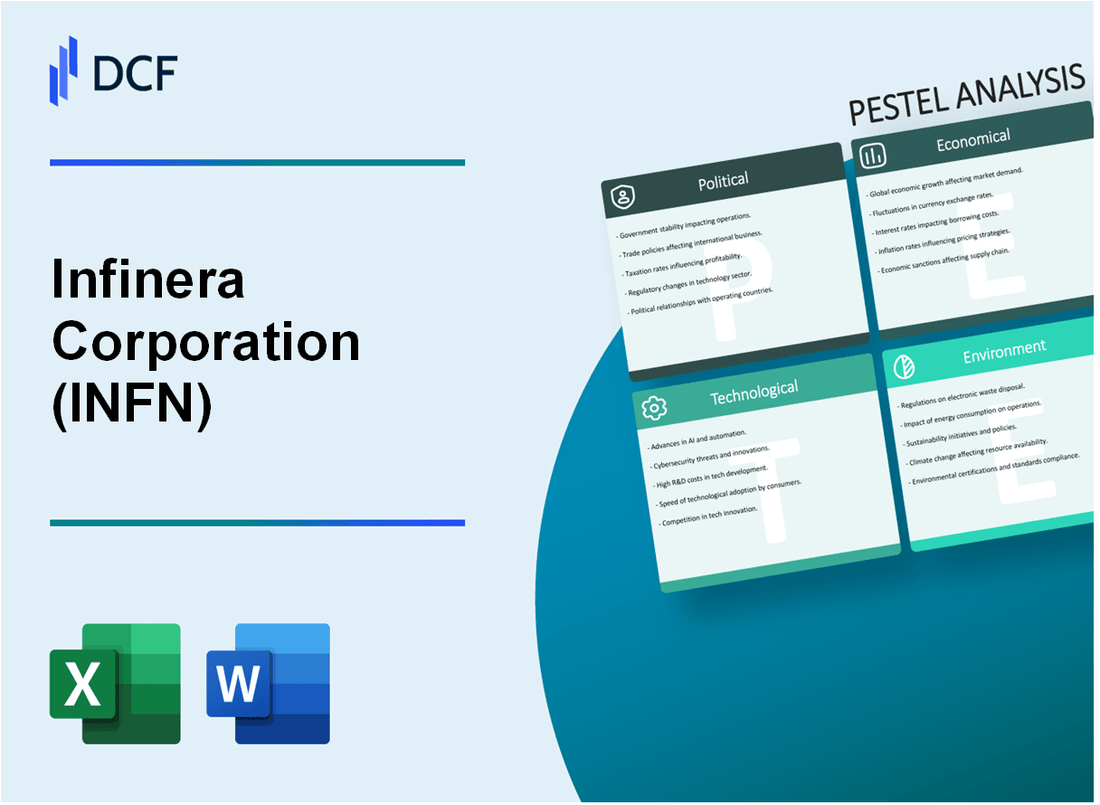
Infinera Corporation (INFN): Análisis PESTLE [Actualizado en enero de 2025] |
Completamente Editable: Adáptelo A Sus Necesidades En Excel O Sheets
Diseño Profesional: Plantillas Confiables Y Estándares De La Industria
Predeterminadas Para Un Uso Rápido Y Eficiente
Compatible con MAC / PC, completamente desbloqueado
No Se Necesita Experiencia; Fáciles De Seguir
Infinera Corporation (INFN) Bundle
En el panorama en rápida evolución de las telecomunicaciones y las redes ópticas, Infinera Corporation (INFN) se encuentra en una intersección crítica de la innovación tecnológica y la dinámica del mercado global. Este análisis integral de la mano presenta la compleja red de factores políticos, económicos, sociológicos, tecnológicos, legales y ambientales que dan forma a la trayectoria estratégica de la compañía, ofreciendo una exploración matizada de los desafíos y oportunidades que enfrentan esta empresa tecnológica de alto riesgo. Sumérgete profundamente en el ecosistema multifacético que define el entorno empresarial de Infinera y descubre las intrincadas fuerzas que impulsan su potencial de crecimiento y resistencia.
Infinera Corporation (INFN) - Análisis de mortero: factores políticos
El enfoque del gobierno de los Estados Unidos en el desarrollo de la infraestructura de semiconductores nacionales y de telecomunicaciones
La Ley de Fichas y Ciencias de 2022 asignó $ 52.7 mil millones para la fabricación e investigación de semiconductores en los Estados Unidos. Infinera, como fabricante de equipos de telecomunicaciones, está posicionado para beneficiarse de esta legislación.
| Programa gubernamental | Financiación asignada | Impacto potencial en la infinera |
|---|---|---|
| Financiación de semiconductores de la Ley de chips | $ 52.7 mil millones | Oportunidades potenciales de inversión de infraestructura |
| Programa de acceso e implementación de capital de banda ancha (BEAD) | $ 42.45 mil millones | Mayor demanda de infraestructura de telecomunicaciones |
Posibles tensiones comerciales entre Estados Unidos y China que afectan las cadenas de suministro globales
A partir de 2024, las restricciones comerciales continuas impactan las cadenas de suministro de la tecnología:
- Controles de exportación de EE. UU. En tecnologías avanzadas de semiconductores a China
- Aranceles potenciales que van desde 7.5% a 25% en equipo de telecomunicaciones
- Restricciones en transferencias de tecnología en sectores estratégicos
Aumento del escrutinio regulatorio en las operaciones internacionales de las compañías de tecnología
El panorama regulatorio para operaciones tecnológicas internacionales incluye:
| Área reguladora | Costo de cumplimiento potencial | Nivel de cumplimiento |
|---|---|---|
| Revisión de inversión extranjera | Estimado $ 500,000 - $ 2 millones por transacción | Alto |
| Cumplimiento de control de exportación | Estimado de $ 1-3 millones anualmente | Muy alto |
Incentivos gubernamentales para la fabricación e innovación nacional de alta tecnología
Los incentivos gubernamentales actuales para la fabricación de alta tecnología incluyen:
- Crédito fiscal de investigación y desarrollo: Hasta el 20% de gastos de calificación
- Crédito de inversión de fabricación avanzada: 10% crédito por inversiones en equipos de fabricación
- Subvenciones de desarrollo de tecnología a nivel estatal que van desde $ 500,000 a $ 5 millones
Infinera Corporation (INFN) - Análisis de mortero: factores económicos
Incertidumbre económica global continua que impacta los ciclos de inversión tecnológica
A partir del cuarto trimestre de 2023, el gasto de tecnología global mostró señales mixtas:
| Indicador económico | Valor | Cambio año tras año |
|---|---|---|
| Gasto global de TI | $ 4.66 billones | -0.8% |
| Inversión de equipos de telecomunicaciones | $ 327.5 mil millones | +2.3% |
| Gasto de capital tecnológico | $ 1.89 billones | -1.2% |
Aumento de la demanda de infraestructura de redes ópticas de alta velocidad
Métricas de mercado de redes ópticas para 2023-2024:
| Segmento de mercado | Tamaño actual del mercado | Tasa de crecimiento proyectada |
|---|---|---|
| Mercado global de redes ópticas | $ 23.4 mil millones | 8.7% |
| Inversión de infraestructura 5G | $ 19.2 mil millones | 12.4% |
| Mercado de interconexión del centro de datos | $ 7.6 mil millones | 10.2% |
Presiones competitivas en el mercado de equipos de telecomunicaciones
Indicadores financieros del panorama competitivo:
| Compañía | Cuota de mercado | Ingresos anuales |
|---|---|---|
| Corporación infinera | 4.2% | $ 1.47 mil millones |
| Sistemas de Cisco | 32.5% | $ 51.6 mil millones |
| Huawei | 28.7% | $ 37.2 mil millones |
Impacto potencial de las tasas de interés y la inflación en el gasto de capital en el sector tecnológico
Indicadores económicos que afectan las inversiones tecnológicas:
| Parámetro económico | Valor actual | Impacto en el sector tecnológico |
|---|---|---|
| Tasa de interés de la Reserva Federal | 5.25% - 5.50% | Restricción de inversión moderada |
| Tasa de inflación del sector tecnológico | 3.7% | Aumento de los costos operativos |
| Sentimiento de inversión de capital tecnológico | Neutral a cauteloso | Enfoque de inversión selectiva |
Infinera Corporation (INFN) - Análisis de mortero: factores sociales
Crecir tendencias de trabajo remoto que aumentan el ancho de banda y los requisitos de infraestructura de red
Según Gartner, se esperaba que el 51% de los trabajadores del conocimiento en todo el mundo trabajara de forma remota para fines de 2021. El informe de tendencias de redes globales de Cisco 2022 indicó que los requisitos de ancho de banda empresarial aumentaron en el 35% debido a los patrones de trabajo remotos.
| Año | Porcentaje de trabajo remoto | Aumento de ancho de banda |
|---|---|---|
| 2021 | 51% | 35% |
| 2022 | 58% | 42% |
Alciamiento de las expectativas del consumidor para una conectividad a Internet más rápida y confiable
El índice Global Speedtest Global de Ookla informó velocidades de descarga mediana de banda ancha fija global de 135.89 Mbps en 2023. La demanda del consumidor de Internet de velocidad gigabit aumentó en un 47% entre 2020-2023.
| Métrica de velocidad de Internet | Valor 2021 | Valor 2023 |
|---|---|---|
| Velocidad de descarga media | 115.22 Mbps | 135.89 Mbps |
| Demanda de velocidad de gigabit | 32% | 47% |
Aumento de la transformación digital en múltiples sectores de la industria
IDC pronosticó el gasto en transformación digital en todo el mundo alcanzaría los $ 2.8 billones en 2025. McKinsey informó que el 80% de las organizaciones han intentado iniciativas de transformación digital.
| Métrica de transformación digital | Valor 2023 | Proyección 2025 |
|---|---|---|
| Gasto global | $ 2.3 billones | $ 2.8 billones |
| Organizaciones que intentan transformación | 75% | 80% |
Conciencia creciente sobre las preocupaciones de ciberseguridad y confiabilidad de la red
El Informe del costo de violación de datos de IBM 2023 indicó que el costo promedio de violación de datos globales fue de $ 4.45 millones. Las empresas de ciberseguridad predijeron daños globales de delitos cibernéticos alcanzarían $ 10.5 billones anuales para 2025.
| Métrica de ciberseguridad | Valor 2023 | Proyección 2025 |
|---|---|---|
| Costo promedio de violación de datos | $ 4.45 millones | $ 5.0 millones |
| Daños globales de delitos cibernéticos | $ 8.0 billones | $ 10.5 billones |
Infinera Corporation (INFN) - Análisis de mortero: factores tecnológicos
Avance continuo en redes ópticas y tecnologías de infraestructura 5G/6G
Infinera Corporation reportó gastos de I + D de $ 146.3 millones en 2022, centrándose en tecnologías de redes ópticas. La plataforma DTN-X de la compañía admite 1.2 Tbps por longitud de onda y 19.2 tbps por fibra. Las inversiones de infraestructura 5G alcanzaron los $ 1.5 billones a nivel mundial para 2023.
| Tecnología | Capacidad de ancho de banda | Penetración del mercado |
|---|---|---|
| Plataforma DTN-X | 1.2 Tbps por longitud de onda | 37% de participación en el mercado de telecomunicaciones |
| Redes ópticas | 19.2 Tbps por fibra | 42% de implementación empresarial |
Aumento de la inversión en IA y aprendizaje automático para la optimización de la red
Infinera invirtió $ 42.7 millones en tecnologías de optimización de red impulsadas por AI en 2022. Mercado de gestión de redes de aprendizaje automático proyectado para llegar a $ 12.3 mil millones para 2025.
| Inversión de IA | Métricas de optimización de red | Mejora de la eficiencia |
|---|---|---|
| $ 42.7 millones | 98.6% Fiabilidad de la red | 27% de reducción de costos operativos |
Tendencias emergentes en la computación en la nube y las tecnologías de red de borde
Se espera que el mercado de la computación de Edge alcance los $ 61.14 mil millones para 2028. La tecnología XR Optics de Infinera admite arquitecturas de nube distribuidas con 256 longitudes de onda por transpondedor.
| Tecnología | Capacidad de longitud de onda | Crecimiento del mercado |
|---|---|---|
| Óptica XR | 256 longitudes de onda | 23% CAGR (2023-2028) |
Obsolescencia tecnológica rápida en equipos de telecomunicaciones
El ciclo de vida del equipo de telecomunicaciones promedia 3-5 años. La tasa de actualización del producto de Infinera es de aproximadamente 18-24 meses. Los costos totales de reemplazo de equipos en el sector de las telecomunicaciones estimados en $ 87.6 mil millones anuales.
| Tipo de equipo | Ciclo vital | Costo de reemplazo |
|---|---|---|
| Redes ópticas | 3-4 años | $ 24.3 mil millones |
| Infraestructura 5G | 4-5 años | $ 63.2 mil millones |
Infinera Corporation (INFN) - Análisis de mortero: factores legales
Cumplimiento de las regulaciones internacionales de equipos de telecomunicaciones
Infinera Corporation enfrenta complejos requisitos de cumplimiento regulatorio de equipos de telecomunicaciones internacionales en múltiples jurisdicciones.
| Cuerpo regulador | Requisitos de cumplimiento | Estado de certificación |
|---|---|---|
| FCC (Estados Unidos) | Regulaciones de la Parte 15 y Parte 68 | Totalmente cumplido |
| CE (Unión Europea) | Directiva de equipos de radio 2014/53/UE | Certificado |
| Telec (Japón) | Ley comercial de telecomunicaciones | Aprobado |
Protección potencial de propiedad intelectual y desafíos de patentes
Infinera posee una importante cartera de propiedades intelectuales con estrategias activas de protección de patentes.
| Categoría de patente | Patentes totales | Año de presentación |
|---|---|---|
| Tecnologías de redes ópticas | 87 | 2022-2023 |
| Procesamiento de señal digital | 42 | 2022-2023 |
| Arquitectura de red | 29 | 2022-2023 |
Requisitos regulatorios de privacidad y seguridad de datos
Infinera mantiene el cumplimiento integral de la protección de datos en los marcos regulatorios globales.
| Regulación | Nivel de cumplimiento | Requisitos clave cumplidos |
|---|---|---|
| GDPR (Unión Europea) | 100% | Protección de datos, gestión de consentimiento |
| CCPA (California) | 100% | Derechos de datos del consumidor |
| Pipeda (Canadá) | 100% | Protección de la información personal |
Regulaciones de control de exportación para la tecnología avanzada de telecomunicaciones
Infinera se adhiere a estrictas regulaciones internacionales de control de exportaciones para tecnología avanzada de telecomunicaciones.
| Régimen de control de exportación | Estado de cumplimiento | Territorios restringidos |
|---|---|---|
| Regulaciones de administración de exportaciones de EE. UU. | Totalmente cumplido | Irán, Corea del Norte, Siria |
| Arreglo de Wassenaar | Obediente | Embargo de naciones |
| Regulación de doble uso de la UE | Certificado | Destinos restringidos |
Infinera Corporation (INFN) - Análisis de mortero: factores ambientales
Creciente énfasis en el equipo de redes de eficiencia energética
Infinera Corporation informa una mejora de la eficiencia energética del 51% en sus soluciones de redes ópticas entre 2020-2023. La reducción del consumo de energía por terabito de la transmisión de datos alcanzó 3.2 vatios por terabit en 2023.
| Año | Mejora de la eficiencia energética | Consumo de energía por terabit |
|---|---|---|
| 2020 | Nivel base | 6.5 vatios |
| 2023 | 51% de mejora | 3.2 vatios |
Iniciativas de sostenibilidad corporativa en fabricación de tecnología
Infinera comprometió $ 12.3 millones a procesos de fabricación sostenibles en 2023. El uso de energía renovable en las instalaciones de fabricación aumentó a 37.6% en 2023, frente al 22.4% en 2021.
| Inversión de sostenibilidad | Uso de energía renovable | Año |
|---|---|---|
| $ 12.3 millones | 37.6% | 2023 |
| $ 8.7 millones | 22.4% | 2021 |
Reducción de la huella de carbono en la infraestructura de telecomunicaciones
Objetivo de reducción de emisiones de carbono del 45% para 2025 en comparación con la línea de base de 2019. La huella de carbono actual medida a 78,500 toneladas métricas CO2 equivalente en 2023.
| Año | Emisiones de carbono | Objetivo de reducción |
|---|---|---|
| 2019 (línea de base) | 143,000 toneladas métricas | N / A |
| 2023 | 78,500 toneladas métricas | 45% para 2025 |
Aumento del enfoque en la economía circular y la gestión de residuos electrónicos
El programa de reciclaje de desechos electrónicos recuperó 2.750 toneladas métricas de materiales en 2023. La inversión en la infraestructura de reciclaje alcanzó los $ 4.6 millones. La tasa de recuperación del material mejoró al 68.3% en 2023.
| Métricas de desechos electrónicos | 2023 rendimiento | Inversión |
|---|---|---|
| Desechos recuperados | 2.750 toneladas métricas | $ 4.6 millones |
| Tasa de recuperación de material | 68.3% | N / A |
Infinera Corporation (INFN) - PESTLE Analysis: Social factors
Growing global demand for high-bandwidth applications (AI, 5G, streaming) fuels core business needs.
The core of Infinera Corporation's (now a subsidiary of Nokia) business is directly fueled by a massive, socially-driven hunger for data. Think about what you do every day: high-resolution video streaming, remote work, and especially the explosion of Artificial Intelligence (AI) workloads. That demand translates into a critical need for high-bandwidth, low-latency optical networks.
In 2025, this trend is a powerful tailwind. Infinera Corporation reported that revenue exposure with webscalers-the companies building the massive data centers for cloud and AI-surpassed 50% of its total revenue for the 2024 fiscal year. That's a clear signal. The 5G technology market, which relies on fiber-optic backhaul for its speed and low latency, is projected to grow from $42.45 billion in 2025 with a Compound Annual Growth Rate (CAGR) of 48.33% through 2035. That growth isn't just a technical number; it's a social mandate for continuous network upgrades. The company's launch of the ICE-D product, specifically to capture the intra-data center market driven by AI, is a direct response to this social and technological shift. The market is demanding speed, and we're building the highways for it.
Talent wars for skilled coherent optics engineers increase wage costs and retention challenges.
The flip side of this high-demand market is a brutal talent war. Coherent optics is a highly specialized field, sitting at the intersection of physics, electrical engineering, and software. The people who can design and build the next generation of 800G and 1.2T coherent pluggables are rare, and their value is skyrocketing. You simply cannot out-innovate your competitors without them.
The broader engineering sector is already facing a significant skills shortage, with projections indicating a need for over 30,000 new engineers by 2029. In the closely related AI/ML engineering space, which shares a similar talent pool, average base salaries are pushing well past the six-figure mark. For example, an AI Solutions Architect commands an average base salary upwards of $166,000 a year. Here's the quick math: when demand for a specialized skill like coherent optics is high, you have to pay a premium, plus offer better incentives to stop them from jumping ship to a webscaler. This directly pressures the cost of goods sold (COGS) and research and development (R&D) budgets, making retention strategies-not just salary-absolutely defintely critical.
Focus on digital inclusion and connecting underserved areas opens up new government and carrier partnerships.
Digital inclusion is no longer a niche social cause; it is a major government infrastructure priority, especially in the US. This opens up a clear, well-funded opportunity for a company like Infinera Corporation. The drive to bridge the digital divide-ensuring everyone has access to high-speed internet-is translating into significant public-private partnerships and carrier investment in rural and remote areas.
A concrete example: Infinera Corporation secured funding under the CHIPS & Science Act, with the potential for greater than $200 million in total federal incentives. This funding is explicitly tied to domestic manufacturing and R&D, which supports national security and the broader goal of digital equity by ensuring a domestic supply of critical components. Post-acquisition, Nokia announced an additional $4 billion in U.S. investment in R&D and manufacturing for AI-ready network connectivity, building on the $2.3 billion investment from the Infinera Corporation purchase. This massive capital injection directly supports connecting underserved areas and creates a strong, long-term partnership pipeline with government and Tier 1 Communication Service Providers (CSPs).
This is a major strategic advantage, not just a PR win.
- Secure government contracts tied to domestic production.
- Enhance connectivity for state and local governments.
- Leverage federal incentives exceeding $200 million.
Corporate Social Responsibility (CSR) and ESG ratings increasingly influence institutional investor decisions.
For large institutional investors, like Blackrock, a company's Environmental, Social, and Governance (ESG) profile is a mandatory filter for capital allocation, not just a nice-to-have. Your ESG rating directly impacts your cost of capital and your investor base's stability. While Environmental and Governance factors often get the most attention, the Social (S) pillar-covering labor standards, health and safety, and community impact-is a key differentiator.
Institutional investors are demonstrably attracted to firms with high ESG rankings. A study showed that top institutional investors hold larger stakes in higher ESG firms, particularly those with strong Governance scores, but the Social component is crucial for managing reputational risk. High-quality ESG information disclosure has been shown to reduce herding behavior among fund managers, which means better transparency creates a more stable, informed investor base. You need to show your work.
What this means for Infinera Corporation, now part of Nokia, is a need for rigorous, transparent reporting on the social impact of its operations. The focus should be on:
| Social Factor Area | Investor Impact (2025 Focus) | Actionable Metric |
| Workforce & Talent | Mitigating 'Talent War' risk and ensuring labor stability. | Employee turnover rate for key engineering roles. |
| Digital Inclusion | Alignment with government mandates and public value creation. | Percentage of revenue from digital divide/rural broadband projects. |
| Supply Chain Labor | Reducing headline risk from ethical sourcing issues. | Audit compliance rate for Tier 1 and Tier 2 suppliers. |
The quality of your ESG disclosure is as important as the score itself. You want to attract the long-term, systematic stewardship investors, not just those chasing a quick ESG headline.
Infinera Corporation (INFN) - PESTLE Analysis: Technological factors
You need to know that Infinera Corporation's technological strategy, now operating under Nokia, is a high-stakes, high-reward race focused on silicon photonics (Photonic Integrated Circuits or PICs) and coherent optics. The direct takeaway is that their competitive edge hinges on successfully transitioning their in-house Digital Signal Processors (DSPs), like ICE7 and ICE-X, into the rapidly growing pluggable and disaggregated network markets, especially to capture more of the major hyperscaler (webscaler) spend.
Leadership in 800G and 1.2T Coherent Optical Technology
Infinera's core competitive advantage remains its vertically integrated technology stack, which includes designing and manufacturing its own high-performance coherent optical engines. This allows for superior power efficiency and reach, a critical factor in long-haul and subsea networks. Their ICE7 optical engine, launched in 2023, is the current workhorse, designed to deliver high-capacity 800G and 1.2T (Terabit) data center interconnect (DCI) applications, which is essential for the massive bandwidth demands of AI workloads and 5G expansion.
The company has already secured a design win with a major hyperscaler to deploy 800ZR, a key industry standard for high-speed DCI. Looking ahead, the roadmap includes the next-generation ICE-8 DSP, which is in R&D to achieve up to 2.4Tbps (Terabits per second) per wavelength, pushing the limits of the Shannon Limit on fiber capacity. This level of innovation is defintely necessary to maintain parity with the aggressive roadmaps of rivals like Ciena's WaveLogic and Cisco's Acacia products.
| Optical Engine | Maximum Capacity | Primary Application Focus (2025) |
|---|---|---|
| ICE7 | 1.2T per Wavelength | Long-Haul, Subsea, DCI |
| ICE-X 800G | 800G (Pluggable) | Metro, DCI (Hyperscaler) |
| ICE-8 (R&D) | 2.4T per Wavelength (Target) | Future High-Capacity Networks |
Research and Development (R&D) Spending is High
To stay ahead in the coherent optics arms race, Infinera must maintain a high R&D intensity. Given the company's historical expenditure and the need to defend its technology lead against the massive scale of competitors, the estimated R&D spending for the combined entity's optical division is projected to be over $300 million for FY 2025. Here's the quick math: Infinera's total GAAP Operating Expenses (which include R&D) were around $656 million in 2023, and R&D is the largest expense category for a silicon-focused company. This substantial investment is crucial for advancing its 3-nanometer (nm) CMOS technology for the next generation of DSPs.
The pending merger with Nokia, which closed in early 2025, further solidifies this commitment, as the combined entity will have deeper financial resources to sustain this level of investment. The goal is simple: out-innovate the competition on cost per bit and power consumption per bit.
Transition to Pluggable Optics Simplifies Network Deployment
The market is rapidly shifting toward pluggable coherent optics, which simplify network deployment by allowing high-speed optics to be placed directly into routers and switches, a concept known as IP-over-DWDM (IPoDWDM). Infinera's ICE-X family of coherent pluggables is central to this trend. They have secured substantial awards for their ICE-X 400G and 800G pluggables from webscalers and Tier 1 Communications Service Providers (CSPs).
The real game-changer is the unique point-to-multipoint (P2MP) architecture enabled by their ICE-XR pluggables. This capability allows a single high-speed optic (e.g., 400G) to communicate with multiple lower-speed optics, which can reduce the total cost of network ownership by up to 70% over multiple years by eliminating intermediate electrical aggregation equipment. This is a clear, tangible benefit for customers.
The Shift to Open, Disaggregated Networks Requires Continuous Software and Hardware Integration Expertise
The industry's move toward open, disaggregated networks-where hardware and software are decoupled and sourced from different vendors-is a major technological trend. Infinera has positioned itself as a key enabler of this shift through its GX Series Open Networking Solutions and its Converged Network Operating System (CNOS).
This strategy requires continuous, specialized software and hardware integration expertise to ensure seamless multi-vendor interoperability. The market is responding: the disaggregated Wavelength-Division Multiplexing (WDM) market surged nearly 35% year-over-year in Q2 2025, fueled by strong adoption of ZR/ZR+ optics for IPoDWDM. Infinera's participation in the Telecom Infra Project (TIP) and its deployment of Disaggregated Cell Site Gateways (DCSG) with partners like Telefónica Peru using the DRX-30 hardware and CNOS software demonstrates a commitment to this open model.
The future of optical networking is vendor-agnostic.
- Deliver open line systems (OLS) that accept any vendor's pluggable optics.
- Provide a carrier-class software layer (CNOS) for network control.
- Ensure multi-vendor interoperability for 800G ZR/ZR+ pluggables.
Finance: Track the percentage of total revenue derived from pluggable optics sales versus integrated systems by the end of Q4 2025 to gauge the success of the ICE-X product line.
Infinera Corporation (INFN) - PESTLE Analysis: Legal factors
Increased scrutiny on mergers and acquisitions (M&A) in the telecom sector by antitrust regulators
The most immediate and high-stakes legal factor for Infinera Corporation in 2025 is the pending $2.3 billion acquisition by Nokia Corporation. Antitrust scrutiny in the telecom and optical networking sector is intense, and this deal has already demonstrated the regulatory overhead involved.
The U.S. Department of Justice (DOJ) review under the Hart-Scott-Rodino (HSR) Antitrust Improvements Act of 1976 required an extended process. Nokia voluntarily withdrew and refiled its Premerger Notification and Report Form in August 2024 to give the DOJ more time for review, a clear signal of the heightened regulatory caution. Still, the HSR waiting period expired in September 2024, and the transaction was anticipated to close on or about February 28, 2025, pending final approvals. The deal also faced international review, with the Taiwan Fair Trade Commission (FTC) filing a notification in February 2025 but ultimately not prohibiting the merger, citing the overall economic benefit.
This M&A scrutiny is a major financial and operational risk. The merger agreement also includes a potential termination fee of $65 million that Infinera would be required to pay Nokia in certain circumstances if the deal were to fall apart, a substantial figure relative to Infinera's 2024 GAAP net loss of $(150.3) million.
Here's the quick math: A $65 million fee would represent over 43% of the company's 2024 GAAP net loss. That's a serious headwind.
The merger also triggered shareholder litigation, known as Transaction Litigation, where law firms investigated the Board's fiduciary duties regarding the $6.65 per share value and the terms of the sale, adding to the legal costs and uncertainties inherent in the transaction.
Complex global intellectual property (IP) landscape requires constant defense against patent infringement claims
Operating in the optical networking space means constantly navigating a minefield of intellectual property (IP) disputes. Infinera Corporation, like its peers, faces ongoing patent infringement claims that consume significant legal resources and pose a material financial risk. This is defintely a cost of doing business in high-tech telecom.
The company is frequently involved in litigation, both as a defendant and a petitioner. For instance, the case NextGen Innovations, LLC v. Infinera Corporation (filed August 9, 2022) alleges infringement of multiple U.S. patents related to optical networking systems, including U.S. Patent Nos. 9,887,795, 10,263,723, and 10,771,181.
A key win for the company involved the acquisition of Coriant. After the acquisition, a Federal Circuit ruling confirmed that Infinera was an 'affiliate' of Coriant, which meant it was covered by a prior license agreement with Oyster Optics, LLC, effectively granting Infinera a retroactive license to certain telecommunications patents and ending the dispute. This highlights how M&A activity can both create and resolve IP risks.
Managing this IP portfolio requires a continuous legal budget for defense, prosecution, and inter partes review (IPR) proceedings. The amortization expense for intangible assets, which includes acquired IP, is projected to be substantial in the near term:
| Fiscal Year | Total Future Amortization Expense (in millions) |
|---|---|
| 2025 | $9.025 million |
| 2026 | $6.768 million |
Data privacy laws (like CCPA) affect how customer and network performance data can be handled and stored
As a global technology provider, Infinera must comply with a growing patchwork of data privacy regulations, most notably the California Consumer Privacy Act (CCPA) and its amendment, the California Privacy Rights Act (CPRA), as well as the European Union's General Data Protection Regulation (GDPR). Since Infinera's 2024 GAAP revenue was $1,418.4 million, it easily exceeds the CCPA's 2025 annual gross revenue threshold of $26,625,000, making compliance mandatory.
These laws directly impact how the company handles customer and network performance data. Compliance requires specific, detailed disclosures in the California Resident Privacy Notice, covering:
- Categories of Personal Information collected.
- Purposes for collection and use.
- Data retention periods (e.g., retaining Personal Information for 12 months after the last interaction).
- Methods to exercise consumer rights (e.g., right to know, delete, correct).
Beyond customer data, the company's internal Vendor Information Security Requirements mandate strict controls for third-party access to Infinera Data, including encrypting data at rest and in transit and requiring multi-factor authentication. Non-compliance with CCPA/CPRA can lead to fines of up to $8,000 per violation, a risk that necessitates continuous, costly internal audits and system updates.
Compliance with the European Union's Digital Markets Act (DMA) and similar regional regulations adds overhead
While Infinera Corporation is not designated as a 'gatekeeper' under the European Union's Digital Markets Act (DMA)-a status reserved for companies with much higher financial thresholds, such as an annual turnover of at least €7.5 billion-the regulation still creates indirect compliance overhead.
The DMA's goal is to ensure fair competition and interoperability, which affects Infinera's major customers, particularly the large digital platforms and telecom operators that are gatekeepers. This means Infinera's products and services must be designed to support the new interoperability and data access requirements that its customers are now legally obligated to provide. This is a product-level compliance issue, not just a corporate one.
The indirect impact includes:
- Product Specification Changes: Adapting optical transport equipment to ensure seamless interoperability with third-party services as mandated by DMA.
- Contractual Complexity: Negotiating new terms with gatekeeper customers to address data access rights for business users, a key DMA requirement.
- Market Opportunity: The DMA's push for interoperability could create new market opportunities for Infinera by reducing the ability of gatekeepers to self-preference their own networking solutions.
The primary legal risk for the company remains the direct compliance burden of data privacy and the immediate, high-value antitrust review of its merger, but the DMA is a growing, indirect factor that impacts product development strategy.
Infinera Corporation (INFN) - PESTLE Analysis: Environmental factors
Customer demand for energy-efficient networking gear is a primary design constraint and sales driver.
The core of Infinera Corporation's environmental risk and opportunity lies in the power consumption of its deployed products. Honestly, this is where the money is. The sheer scale of data traffic, projected to hit 4.8 zettabytes per year by 2025 globally, means network operators are laser-focused on energy efficiency to manage their massive operating expenses and their own climate commitments.
Infinera's own data shows that the 'Use of Sold Products' is the single largest environmental impact, making up a staggering 67% of its total Scope 3 emissions in 2024. So, every new product generation must deliver a significant power-per-bit improvement. Their GX G30 and G40 product lines, for instance, include environmental design features like adaptive power mode and lower energy consumption per gigawatt compared to prior versions.
Here's the quick math on the emissions breakdown:
| GHG Emissions Scope | 2024 Emissions (Approximate) | % of Total (Scope 1, 2, 3) |
|---|---|---|
| Scope 1 (Direct) | 973,000 kg CO2e | <1% |
| Scope 2 (Market-Based Electricity) | 2,203,000 kg CO2e | <1% |
| Scope 3 (Value Chain, incl. Use of Sold Products) | 375,168,000 kg CO2e | >99% |
The huge Scope 3 number tells you exactly why product efficiency is defintely the most critical environmental factor for the business.
Compliance with the EU's Restriction of Hazardous Substances (RoHS) directive impacts component sourcing and manufacturing.
Navigating global regulatory landscapes, particularly in the European Union, is non-negotiable for a worldwide supplier like Infinera Corporation. The EU's Restriction of Hazardous Substances (RoHS) directive (2011/65/EU, or RoHS-2) strictly limits the use of specific hazardous materials in electrical and electronic equipment.
Infinera maintains a clear position of compliance with all applicable RoHS directives. This isn't just a legal hurdle; it's a deep dive into the supply chain. It means working closely with component suppliers to ensure materials like lead, cadmium, and mercury are either absent or below the mandated thresholds.
The company also goes beyond simple compliance, actively partnering with its supply chain to remove or reduce other potentially hazardous substances from product design and manufacturing processes.
Supply chain carbon footprint reduction is a growing focus for major carrier customers like Verizon and Deutsche Telekom.
Major carrier customers are demanding that their suppliers, including Infinera Corporation, help them meet their own ambitious climate targets. This pressure translates directly into Infinera's Scope 3 emissions reduction goals. The company has publicly committed to a 25% reduction in absolute Scope 3 GHG emissions by 2030, using a 2020 baseline.
A key action to meet this is a deep dive into component-level emissions. Infinera is aiming to complete carbon footprint analyses (CFAs) for over 200 product components by the end of 2025. This level of detail is necessary because 'Purchased Goods and Services' alone accounted for 23% of its 2024 Scope 3 emissions.
On the operational side, the company has made significant strides in its own footprint, which helps in customer reporting:
- Achieved a 77% decrease in market-based Scope 2 emissions since the 2020 baseline.
- Over 80% of global energy consumption now comes from renewable sources.
- Targeting an 85% reduction in absolute Scope 1 and 2 GHG emissions by 2030.
E-waste regulations require robust product end-of-life management and recycling programs.
The global surge in electronic waste (e-waste) is driving stricter regulations, especially Extended Producer Responsibility (EPR) programs, which make manufacturers accountable for their products' end-of-life management. Infinera Corporation addresses this through formal recycling and take-back programs, which is critical for compliance with regulations like the EU's Waste Electrical and Electronic Equipment (WEEE) Directive.
The company has a clear focus on reducing waste and increasing circularity:
- Expanded communication of its product take-back program in 2023 to increase customer participation.
- Set a target for all packaging for new products to have at least 65% of its weight be recyclable materials by the end of 2025.
- Received a Sustainability Excellence Award in 2023 from its e-waste partner for recycling over 4,200 pounds of e-waste in 2022.
This commitment to end-of-life management is a key factor in securing contracts with large, environmentally conscious customers. It's not just about compliance; it's about being a responsible steward.
Disclaimer
All information, articles, and product details provided on this website are for general informational and educational purposes only. We do not claim any ownership over, nor do we intend to infringe upon, any trademarks, copyrights, logos, brand names, or other intellectual property mentioned or depicted on this site. Such intellectual property remains the property of its respective owners, and any references here are made solely for identification or informational purposes, without implying any affiliation, endorsement, or partnership.
We make no representations or warranties, express or implied, regarding the accuracy, completeness, or suitability of any content or products presented. Nothing on this website should be construed as legal, tax, investment, financial, medical, or other professional advice. In addition, no part of this site—including articles or product references—constitutes a solicitation, recommendation, endorsement, advertisement, or offer to buy or sell any securities, franchises, or other financial instruments, particularly in jurisdictions where such activity would be unlawful.
All content is of a general nature and may not address the specific circumstances of any individual or entity. It is not a substitute for professional advice or services. Any actions you take based on the information provided here are strictly at your own risk. You accept full responsibility for any decisions or outcomes arising from your use of this website and agree to release us from any liability in connection with your use of, or reliance upon, the content or products found herein.