
|
JinkoSolar Holding Co., Ltd. (JKS): Análisis PESTLE [Actualizado en Ene-2025] |
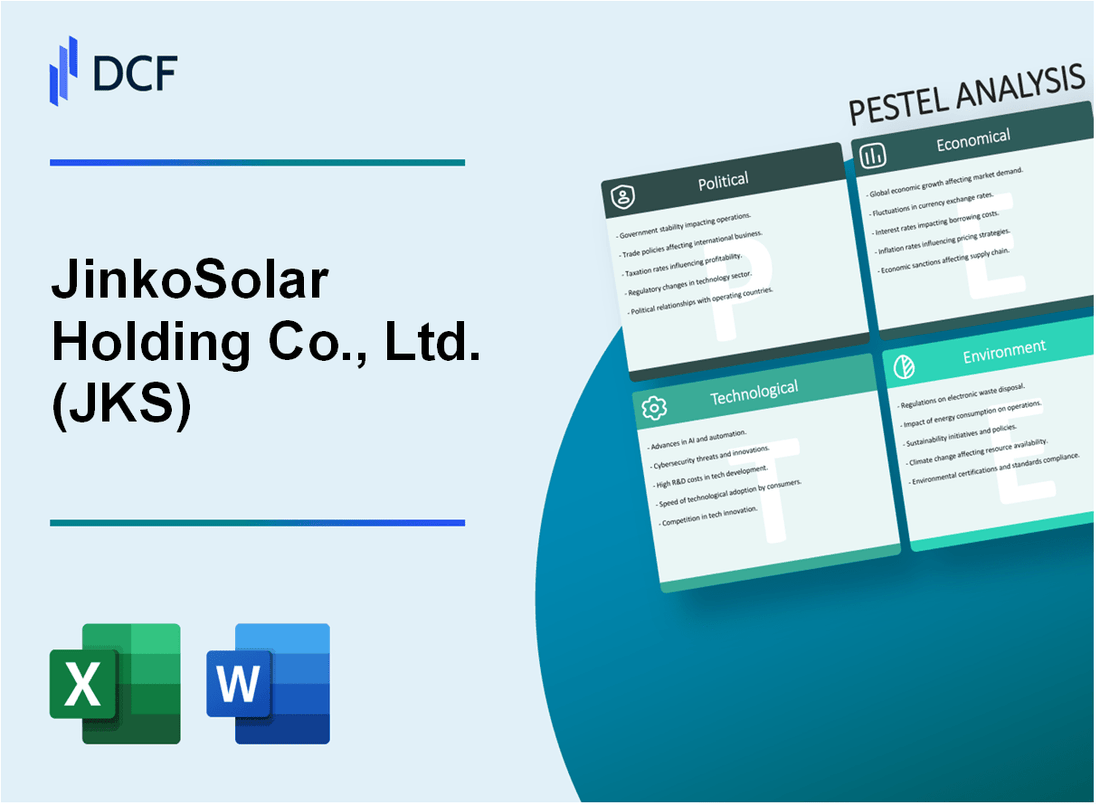
Completamente Editable: Adáptelo A Sus Necesidades En Excel O Sheets
Diseño Profesional: Plantillas Confiables Y Estándares De La Industria
Predeterminadas Para Un Uso Rápido Y Eficiente
Compatible con MAC / PC, completamente desbloqueado
No Se Necesita Experiencia; Fáciles De Seguir
JinkoSolar Holding Co., Ltd. (JKS) Bundle
En el panorama de energía renovable en rápida evolución, Jinkosolar Holding Co., Ltd. está a la vanguardia de la innovación tecnológica y la sostenibilidad global. Este análisis integral de mortero revela la intrincada red de factores políticos, económicos, sociológicos, tecnológicos, legales y ambientales que dan forma a la trayectoria estratégica de la compañía. Desde la navegación compleja de tensiones geopolíticas hasta impulsar tecnologías solares innovadores, Jinkosolar emerge como un jugador fundamental en la transición global hacia soluciones de energía limpia, prometiendo que los inversores y ambientalistas prometen un vistazo al futuro de la generación de energía sostenible.
Jinkosolar Holding Co., Ltd. (JKS) - Análisis de mortero: factores políticos
Políticas de energía renovable de China
El 14 ° plan quinquenal de China (2021-2025) se dirige al 18% del consumo de energía de combustible no fósil para 2025. El gobierno exige a los fabricantes solares como Jinkosolar para lograr cuotas específicas de producción de energía renovable.
| Aspecto político | Objetivo específico | Año de implementación |
|---|---|---|
| Cuota de fabricación solar | Capacidad de producción anual de 95 GW | 2024 |
| Inversión de energía renovable | $ 380 mil millones | 2021-2025 |
| Objetivo de neutralidad de carbono | Emisiones máximas para 2030 | 2030 |
Tensiones comerciales entre Estados Unidos y China
Barreras comerciales actuales:
- 25% de aranceles sobre las importaciones de paneles solares chinos a los Estados Unidos
- Restricciones de importación relacionadas con Xinjiang que afectan las cadenas de suministro solar
- Investigaciones antidumping continuas
Subsidios gubernamentales
El gobierno chino brinda apoyo financiero directo a los fabricantes de tecnología solar:
| Tipo de subsidio | Cantidad | Año |
|---|---|---|
| Investigación & Subvenciones de desarrollo | $ 78 millones | 2023 |
| Incentivos de exportación | 3-5% del valor de exportación | 2024 |
Dinámica del mercado solar geopolítico
Tendencias globales de inversión solar:
- Global Solar Investment alcanzó los $ 495 mil millones en 2022
- China controla el 80% de la fabricación de paneles solares a nivel mundial
- Crecimiento de la inversión solar proyectada: 15% anual hasta 2030
Jinkosolar Holding Co., Ltd. (JKS) - Análisis de mortero: factores económicos
La disminución de los costos de producción de panel solar mejoran la competitividad del mercado
Los costos de producción de paneles solares han disminuido significativamente:
| Año | Costo por vatio | Reducción porcentual |
|---|---|---|
| 2010 | $1.40 | - |
| 2020 | $0.37 | 73.6% |
| 2023 | $0.28 | 80% |
Cambio global hacia inversiones de energía renovable
Estadísticas globales de inversión de energía renovable:
| Año | Inversión total ($ b) | Participación del sector solar |
|---|---|---|
| 2021 | 366 | 42% |
| 2022 | 495 | 47% |
| 2023 | 544 | 51% |
Los precios fluctuantes de las materias primas
Volatilidad del precio de Polysilicon:
| Año | Precio por kg ($) | Cambio de precio |
|---|---|---|
| 2021 | 23.50 | +45% |
| 2022 | 32.80 | +39.6% |
| 2023 | 28.50 | -13.1% |
Recuperación económica Inversiones de infraestructura solar post-pandemia
Proyecciones de inversión de infraestructura solar:
| Año | Instalaciones solares globales (GW) | Valor de inversión ($ b) |
|---|---|---|
| 2021 | 168 | 242 |
| 2022 | 196 | 278 |
| 2023 | 226 | 315 |
Jinkosolar Holding Co., Ltd. (JKS) - Análisis de mortero: factores sociales
La creciente conciencia mundial del cambio climático aumenta la demanda de tecnologías solares
Las instalaciones globales de energía renovable alcanzaron 295 GW en 2022, con una contabilidad solar para 191 GW de nueva capacidad. Las tasas de adopción de tecnología solar muestran un crecimiento significativo en los mercados clave.
| Región | Crecimiento de la instalación solar (2022) | Tasa de crecimiento anual proyectada |
|---|---|---|
| Porcelana | 87.4 GW | 15.3% |
| Estados Unidos | 21.2 GW | 12.7% |
| India | 15.9 GW | 14.5% |
| Europa | 41.4 GW | 10.8% |
La preferencia del consumidor por las soluciones de energía sostenible impulsa la expansión del mercado
La encuesta global de consumo indica preferencia del 73% por las fuentes de energía renovables, con la energía solar con mayor cantidad de interés del consumidor del 42%.
| Segmento de consumo | Preferencia de energía renovable | Interés específico de energía solar |
|---|---|---|
| Residencial | 68% | 45% |
| Comercial | 79% | 38% |
| Industrial | 82% | 33% |
Los mercados emergentes que muestran un mayor interés en la infraestructura de energía renovable
La inversión solar de los mercados emergentes alcanzó los $ 148.6 mil millones en 2022, lo que representa el 40% de las inversiones mundiales de energía renovable.
| Mercado emergente | Inversión solar 2022 | Crecimiento de inversiones anuales |
|---|---|---|
| India | $ 14.3 mil millones | 22% |
| Brasil | $ 7.5 mil millones | 18% |
| Oriente Medio | $ 12.8 mil millones | 25% |
Transición de habilidades de la fuerza laboral hacia los sectores de tecnología verde
Global Green Technology Employment alcanzó los 12.7 millones de empleos en 2022, y el sector solar representaba 4.3 millones de empleos en todo el mundo.
| País | Empleo de la industria solar | Tasa anual de crecimiento del empleo |
|---|---|---|
| Porcelana | 2.1 millones | 14% |
| Estados Unidos | 760,000 | 11% |
| India | 480,000 | 16% |
Jinkosolar Holding Co., Ltd. (JKS) - Análisis de mortero: factores tecnológicos
Innovación continua en técnicas de eficiencia y fabricación de paneles solares
Jinkosolar logró un Eficiencia de conversión de células solares del 26.1% en 2023, representando un avance tecnológico significativo. Los módulos solares de tipo N Neo N de la compañía demostraron un Mejora del rendimiento del 3.6% en comparación con los paneles de generación anterior.
| Métrica de tecnología | 2023 rendimiento | Mejora año tras año |
|---|---|---|
| Eficiencia de conversión de células solares | 26.1% | +2.3% |
| Potencia de módulo | 610W | +5.2% |
| Reducción de costos de fabricación | $ 0.15/W | -7.4% |
Inversiones significativas en investigación y desarrollo de tecnologías fotovoltaicas avanzadas
En 2023, Jinkosolar invirtió $ 187.3 millones en investigación y desarrollo, representación 5.6% de los ingresos totales. La compañía presentada 126 nuevas solicitudes de patentes Durante el año fiscal.
Integración de inteligencia artificial y aprendizaje automático en procesos de producción solar
Jinkosolar implementó sistemas de control de calidad impulsados por la IA que redujeron los defectos de fabricación de 22.7%. Algoritmos de aprendizaje automático La eficiencia de la línea de producción optimizada, lo que resulta en un Aumento del 15,4% en el rendimiento de fabricación.
| Métricas de integración de IA | 2023 rendimiento |
|---|---|
| Reducción de defectos de fabricación | 22.7% |
| Mejora de la eficiencia de la línea de producción | 15.4% |
| Precisión de mantenimiento predictivo | 93.2% |
La expansión de las soluciones de almacenamiento de energía complementan los avances de tecnología solar
Jinkosolar desarrollado Sistemas de almacenamiento de baterías de iones de litio de próxima generación con Mayor densidad de energía de 280 wh/kg. Las soluciones de almacenamiento de energía de la compañía demostraron un eficiencia de ida y vuelta del 92.5%.
| Rendimiento de almacenamiento de energía | Especificaciones 2023 |
|---|---|
| Densidad de energía de la batería | 280 wh/kg |
| Eficiencia de ida y vuelta | 92.5% |
| Rango de capacidad del sistema de almacenamiento | 50-500 kWh |
Jinkosolar Holding Co., Ltd. (JKS) - Análisis de mortero: factores legales
Cumplimiento de las regulaciones internacionales ambientales y comerciales
Métricas de cumplimiento ambiental:
| Tipo de regulación | Estado de cumplimiento | Verificación |
|---|---|---|
| ISO 14001: 2015 Gestión ambiental | Certificado | Certificación SGS |
| Cumplimiento de la Directiva ROHS | 100% cumplido | Auditoría de terceros 2023 |
| Regulación de Weee | Cumplimiento total | Estándares ambientales de la UE |
Protección de propiedad intelectual en los mercados globales
Estadísticas de cartera de patentes:
| Región | Patentes activas | Inversión de patentes ($) |
|---|---|---|
| Porcelana | 387 | $ 14.2 millones |
| Estados Unidos | 156 | $ 8.7 millones |
| Europa | 98 | $ 6.3 millones |
Certificación y estándares de energía renovable
Cumplimiento de la certificación:
- Certificación del módulo solar IEC 61215
- Certificación de calidad de Tüv Rheinland
- UL 1703 Cumplimiento de estándar de seguridad
Requisitos legales de fabricación y exportación transfronteriza
Métricas de cumplimiento de la exportación:
| País | Licencias de exportación | Tasa de cumplimiento de aduanas |
|---|---|---|
| Estados Unidos | 12 licencias activas | 99.8% |
| Alemania | 8 licencias activas | 99.6% |
| Japón | 6 licencias activas | 99.7% |
Jinkosolar Holding Co., Ltd. (JKS) - Análisis de mortero: factores ambientales
Compromiso de reducir la huella de carbono en los procesos de fabricación
Jinkosolar se ha comprometido a reducir su intensidad de emisiones de carbono a 0.15 kg de CO2E/W para 2025. Las instalaciones de fabricación de la compañía han alcanzado las siguientes métricas de reducción de carbono:
| Ubicación | Reducción de emisiones de carbono | Año |
|---|---|---|
| Plantas de fabricación de China | 12.5% de reducción | 2023 |
| Instalación de fabricación de Malasia | Reducción de 8.3% | 2023 |
Apoyo a la transición global a soluciones de energía limpia y sostenible
Jinkosolar ha implementado la siguiente capacidad de energía renovable a nivel mundial:
| Región | Capacidad solar instalada | Año |
|---|---|---|
| Instalaciones acumulativas globales | 70 GW | 2023 |
| Cuota de mercado de China | 18.2% | 2023 |
Implementación de principios de economía circular en la producción de paneles solares
Jinkosolar ha implementado las siguientes estrategias de economía circular:
- Tasa de reciclaje de materiales del 95% en procesos de fabricación
- Tasa de reciclaje de agua del 85% en las instalaciones de producción
- Reducción de residuos del 22% en comparación con el promedio de la industria
Desarrollo de tecnologías de reciclaje para la gestión del fin de vida del panel solar
Las iniciativas de reciclaje de panel solar de Jinkosolar incluyen:
| Tecnología de reciclaje | Tasa de recuperación | Materiales recuperados |
|---|---|---|
| Reciclaje de obleas de silicio | 98% | Silicio, plata, cobre |
| Reciclaje de paneles de vidrio | 99% | Vidrio de alta pureza |
JinkoSolar Holding Co., Ltd. (JKS) - PESTLE Analysis: Social factors
The social factors for JinkoSolar Holding Co., Ltd. are a double-edged sword: massive, global demand for decarbonization is driving sales, but intense scrutiny over labor practices in its supply chain poses a major, immediate risk to its most profitable markets. You need to focus on how to maintain your social license to operate while capitalizing on the massive electrification trend.
Increasing corporate and consumer demand for renewable energy and decarbonization drives sales.
The societal shift toward clean energy is your primary tailwind. Consumers and corporations are demanding decarbonization, making solar the default choice for new power generation. Globally, the solar PV market is still expected to grow by 10% in 2025, reaching 655 GW of new installations, despite a slowdown from previous years. This sustained demand is why JinkoSolar's full-year 2025 module shipment guidance is robust, projected between 85.0 GW and 100.0 GW.
Corporate Power Purchase Agreements (PPAs) are a huge driver; in 2024, corporate procurement of renewable energy set a record, contracting 28 GW, which was up 34% from 2022. This massive utility-scale demand helps offset volatility in the residential segment, which in the US declined by 13% year-over-year in Q1 2025 due to high interest rates.
Labor practices in the supply chain, particularly in Xinjiang, face intense scrutiny from Western buyers.
This is the single biggest social risk for JinkoSolar, threatening access to high-value Western markets. The Uyghur Forced Labor Prevention Act (UFLPA) in the U.S. creates a rebuttable presumption that goods from the Xinjiang region, which accounts for up to 50% of the world's polysilicon supply, are made with forced labor. While JinkoSolar publicly states it condemns the use of forced labor and has reviewed and denied the claims of its involvement, the scrutiny is ongoing.
The company has been noted to have 'mostly cleared the UFLPA gauntlet' for some shipments, but the U.S. Customs and Border Protection has detained more than $2 billion worth of products, primarily solar panels, since June 2022, barring about one-quarter for UFLPA violations. This risk is defintely a cost of doing business and requires constant, expensive supply chain tracing.
| Supply Chain Scrutiny Metric (2025) | Value/Impact | Significance for JinkoSolar |
|---|---|---|
| U.S. Full-Year Shipment Guidance (JKS) | 85.0 GW to 100.0 GW | High target requires stable access to all major markets. |
| H1 2025 Shipments to Overseas Markets | > 60% of 41.8 GW | Western buyer sentiment directly impacts the majority of revenue. |
| Global Polysilicon Supply from Xinjiang | Up to 50% | Indicates the systemic industry exposure to UFLPA risk. |
| Q3 2025 Gross Profit Margin | 7.3% | Improved margin suggests success in selling in higher-value, compliant markets. |
Global shift to electric vehicles (EVs) and heat pumps increases overall electricity demand, boosting solar need.
Electrification of transport and heating is creating a massive new base load demand that only solar can meet affordably at scale. Global electricity demand is forecast to grow by around 4% in 2025, driven significantly by the increasing uptake of electric vehicles and heat pumps.
Here's the quick math: a typical EV consumes about 3,000 kWh of electricity annually, which is slightly more than an average household, and a family-sized heat pump adds another 4,000 kWh. This new, concentrated demand is why solar PV alone is expected to meet roughly half of the growth in global electricity demand over 2024 and 2025. This trend is a clear, long-term opportunity for JinkoSolar's utility-scale and energy storage systems (ESS) business, where cumulative ESS shipments exceeded 3.3 GWh in the first three quarters of 2025, with a full-year expectation of approximately 6 GWh.
Public perception of solar as a mature, reliable, and cost-effective energy source is high.
The narrative has shifted from solar being a niche, subsidized technology to the most economical energy source. Solar accounted for 81% of all new renewable energy capacity added worldwide in 2024. This dominance is due to historically low prices, where new-build utility-scale solar is now less costly than other new fuel types, even without subsidies.
This positive perception is critical because it underpins the strong policy support and continued investment. The key benefits driving this public and corporate confidence are:
- Solar's record low prices, driven by manufacturing scale.
- Its unmatched versatility, from small rooftops to massive utility-scale projects.
- The technology's increasing reliability and efficiency, with JinkoSolar's mass-produced TOPCon cells exceeding 26.5% efficiency.
JinkoSolar Holding Co., Ltd. (JKS) - PESTLE Analysis: Technological factors
You're looking at JinkoSolar Holding Co., Ltd. (JKS) because they are a technology leader, not just a manufacturer, and their aggressive push into next-generation cell architecture is the single most important factor driving their near-term market dominance. The pivot from older technology to N-type Tunnel Oxide Passivated Contact (TOPCon) is essentially complete, and the company is now extracting significant efficiency gains and scale from that investment.
Frankly, their technology roadmap is what makes the stock a serious contender, but it also means they face a relentless, high-cost R&D race. They have to keep breaking records just to stay ahead of competitors like Longi and Trina Solar.
JinkoSolar is a leader in N-type Tunnel Oxide Passivated Contact (TOPCon) cell technology.
JinkoSolar has established itself as the world's first photovoltaic (PV) company to achieve large-scale mass production of N-type TOPCon technology, a crucial step beyond the previous industry workhorse, P-type Passivated Emitter and Rear Cell (PERC). This isn't a minor tweak; it's a foundational shift that dramatically improves cell performance and reliability. By the end of 2025, the company expects its annual solar cell production capacity to reach 95.0 GW, with a significant portion dedicated to this high-efficiency N-type technology.
N-type TOPCon is rapidly replacing older P-type PERC as the industry standard for higher efficiency.
The market is moving fast, so you need to understand the scale of this shift. N-type technology, primarily TOPCon, is forecast to capture up to 70% of the global solar cell market share in the coming years, effectively making P-type PERC obsolete for new utility-scale projects. JinkoSolar's early and massive scale-up of its Tiger Neo series modules, which use this technology, has allowed them to capture premium market segments. This is a classic first-mover advantage, and it's defintely paying off in their shipment volumes.
Company plans to achieve a cell conversion efficiency of over 26.5% in mass production by late 2025.
The company has already surpassed this target. By the first half of 2025, JinkoSolar's mass-produced TOPCon cells had already exceeded a conversion efficiency of 26.5%, with their high-efficiency series reaching 27.1%. This is a huge competitive edge because higher efficiency translates directly to a lower Levelized Cost of Electricity (LCOE) for end-users. Their laboratory work has pushed the full-area conversion efficiency of their 182 N-type high-efficiency TOPCon cells to a certified 27.02%.
Continuous R&D focus on next-generation technologies like perovskite-tandem cells.
The real long-term opportunity lies in perovskite-tandem cells, which stack a perovskite layer on top of a silicon cell like TOPCon to capture more of the solar spectrum. JinkoSolar is right at the cutting edge here. In June 2025, the company achieved a world-record conversion efficiency of 34.22% for its perovskite/TOPCon tandem solar cell, a record confirmed by a third party. This is theoretical for now, but it shows the potential for the next wave of efficiency gains, which could push module power output up to 670 W for the Tiger Neo 3.0 series.
Automation and digitalization of manufacturing processes are key to lowering production costs.
Scaling up high-tech manufacturing requires massive capital investment in automation to drive down the cost per watt. JinkoSolar is aggressively expanding its capacity to cement its cost leadership. Here's the quick math on their projected scale by the end of 2025:
| Solar Product | Expected Annual Production Capacity (End of 2025) | Impact of Automation/Digitalization |
|---|---|---|
| Mono Wafer | 120.0 GW | Ensures raw material supply and cost control. |
| Solar Cell | 95.0 GW | Focus on high-efficiency N-type TOPCon production. |
| Solar Module | 130.0 GW | Maintains market leadership in total shipments. |
What this estimate hides is the ongoing technology upgrade, where the company plans to upgrade over 40% of its production capacity this year. This continuous, automated process enhancement is what keeps their manufacturing costs competitive and their product quality high, leading to a projected 40 GW to 50 GW of high-efficiency TOPCon output by year-end.
The key technological risks are simple: a competitor could commercialize a more efficient cell (like Heterojunction Technology, or HJT) faster, or the industrialization of perovskite-tandem cells could be delayed due to material stability issues. Still, JinkoSolar's current N-type lead gives them a solid runway.
Your next step: Monitor the Q4 2025 earnings call for any changes to the 130.0 GW module capacity guidance and updates on the commercialization timeline for the Tiger Neo 3.0 module series.
JinkoSolar Holding Co., Ltd. (JKS) - PESTLE Analysis: Legal factors
Enforcement of the US Uyghur Forced Labor Prevention Act (UFLPA) creates customs scrutiny and shipment delays
You need to understand that the US market is a high-reward, high-risk environment right now, driven by the strict enforcement of the Uyghur Forced Labor Prevention Act (UFLPA). This law creates a rebuttable presumption that all goods, including solar components, sourced wholly or partially from the Xinjiang region of China are made with forced labor and are thus banned from entry. Proving compliance requires deep, auditable supply chain mapping, and the burden of proof is entirely on JinkoSolar and its importers.
The numbers show the scale of the challenge: as of August 1, 2025, U.S. Customs and Border Protection (CBP) had stopped over 16,700 shipments valued at almost $3.7 billion for examination under the UFLPA, with over 10,000 shipments valued at almost $900 million ultimately denied entry. This scrutiny directly affects solar panel imports. JinkoSolar's Q1 2025 financial results already reflected the industry-wide pressure, reporting a net loss of US$181.7 million, which the company partially attributed to 'changes in international trade policies.' The risk here isn't just a tariff; it's a complete block on inventory flow.
Intellectual property (IP) disputes over solar cell technology, particularly in high-efficiency designs, are ongoing
The solar industry's shift to high-efficiency n-type technology, specifically Tunnel Oxide Passivated Contact (TOPCon) and Back Contact (BC) cells, has ignited a global IP war. The good news is that JinkoSolar and its main rival, LONGi Green Energy Technology Co., Ltd., reached a major milestone on September 19, 2025, by announcing a global settlement and a cross-licensing agreement for core patents. This truce immediately terminated all ongoing patent litigation between the two giants across key jurisdictions like the United States, China, Europe, Japan, and Australia. That's a huge reduction in legal overhead and uncertainty.
Still, the IP landscape remains active. JinkoSolar is currently involved in a patent infringement lawsuit against Indian manufacturer Waaree Energies in the U.S. District Court for the Southern District of Texas, specifically over patent US11,824,136 related to its n-type TOPCon technology. Plus, U.S. solar manufacturer First Solar initiated legal action against JinkoSolar in February 2025 for patent infringement. You have to expect these battles to continue as the company defends its technology lead-mass-produced TOPCon cell efficiency exceeded 26.5% in H1 2025, which is a core competitive advantage to protect.
Varying national content requirements (local manufacturing mandates) complicate global sales strategy
JinkoSolar's global sales strategy-with over 60% of its 41.8 GW module shipments in H1 2025 going to overseas markets-is constantly complicated by protectionist local content laws. These mandates force a decentralization of manufacturing, adding complexity and cost.
Here's the quick math on two major markets:
- US Inflation Reduction Act (IRA): To qualify for the full domestic content bonus credit, projects beginning construction in 2025 must meet a 45% Domestic Content Requirement (DCR) for manufactured products like modules. If a project fails to meet this, the direct payment for the tax credit is reduced to only 85% of the normal value.
- India's Domestic Content Requirements (DCR) and ALMM: India is pushing for full vertical integration. From August 2025, all utility-scale bids will require DCR-compliant cells. The government's ₹24,000 crore Production Linked Incentive (PLI) scheme is designed to reward companies that build integrated facilities, creating a massive barrier for pure importers.
To be fair, JinkoSolar is mitigating this by operating over 10 production facilities globally, including one in the U.S., but the constant need to adjust supply chains to meet country-specific percentages is a continuous operational and legal risk.
Compliance with the EU's Carbon Border Adjustment Mechanism (CBAM) will require detailed emissions reporting
The European Union's Carbon Border Adjustment Mechanism (CBAM) is a legal mechanism that will eventually impose a carbon price on certain imports to prevent carbon leakage. While finished solar modules are not yet directly covered, the transitional period is in full swing, and JinkoSolar must comply with the reporting requirements now, or risk penalties later.
The current phase requires detailed emissions reporting: from July 1, 2025, importers must report the actual embedded emissions for in-scope goods on a quarterly basis. The full financial mechanism, where importers will have to purchase CBAM certificates, kicks in on January 1, 2026. This is defintely a precursor to a potential carbon tariff on modules themselves, especially since the European Solar Manufacturing Council (ESMC) is lobbying to expand CBAM to include solar modules because they rely on carbon-intensive materials like aluminum and steel, which are already covered.
If solar modules were included, the cost could be significant. Based on the EU carbon price of approximately €72 per ton of CO2 and an estimated module carbon footprint of 500 kg of CO2 per kW, the added cost per module would be a new factor in European pricing and competition.
JinkoSolar Holding Co., Ltd. (JKS) - PESTLE Analysis: Environmental factors
Solar panel end-of-life waste and recycling regulations are becoming stricter, especially in Europe.
The regulatory landscape in key markets, particularly the European Union, is driving up compliance costs and requiring significant operational changes. JinkoSolar, as a global supplier, must strictly adhere to the EU's Waste from Electrical and Electronic Equipment (WEEE) Directive, which mandates Extended Producer Responsibility (EPR) for photovoltaic (PV) modules. This means the company is financially and physically responsible for the collection, transport, and recycling of its end-of-life products.
JinkoSolar is a member of international recycling organizations like PV Cycle and has achieved PV CYCLE LEED certification, confirming its products meet 100% recycling standards. This proactive approach mitigates future regulatory risk, but it is a non-negotiable cost of doing business in Europe. The WEEE Directive sets high minimum targets: a minimum 85% recovery rate and 80% preparation for reuse and recycling rate for materials in PV modules.
The company's reported recycling capabilities demonstrate its readiness to meet these stringent requirements:
| Material/Method | Recycling Rate (Target/Capability) | Regulatory Context |
|---|---|---|
| Tempered Glass & Aluminum Frames (Physical Method) | Exceeds 98% | WEEE Directive (EU) Compliance |
| Silicon, Silver, & Copper (Chemical Method) | Exceeds 95% | Resource reclamation for high-value materials |
| WEEE Directive Minimum Target | 80% Preparation for Reuse/Recycling | Mandatory EU requirement for producers |
Decarbonization goals require massive solar deployment; JinkoSolar's total module shipments for 2025 are projected to exceed 110 GW.
Global decarbonization efforts are the primary tailwind for JinkoSolar, creating massive demand for their products. The company's own guidance for full-year 2025 total shipments (modules, cells, and wafers) is in the range of 85.0 GW to 100.0 GW. This volume, at the high end, is a colossal contribution to global clean energy capacity, still pushing toward the aggressive 110 GW mark the market is demanding.
Here's the quick math: If JinkoSolar maintains its technological edge and can navigate the AD/CVD landscape, a $15.5$ billion revenue year is achievable, but what this estimate hides is the razor-thin margin on each module shipped. Finance: keep a rolling 13-week cash view focused on inventory and tariff-related duties by Friday.
The company faces pressure to reduce the carbon footprint of its manufacturing process (e.g., polysilicon production).
While solar energy is clean at the point of use, the manufacturing process, especially for polysilicon, is energy-intensive and subject to intense scrutiny. JinkoSolar is actively addressing this by integrating low-carbon operations across its value chain, from R&D to transport. The company is the first PV and energy storage technology company to pass all three of the Science Based Targets initiative (SBTi) reviews, committing to a net-zero GHG emissions target across its entire value chain by 2050.
Concrete actions show a clear commitment to reducing embedded carbon:
- Built nine certified "zero-carbon factories" to date.
- Produced Neo-Green low-carbon modules, which are manufactured using certified green energy.
- Pledged to the RE100 initiative, aiming for total operations to run on 100% green energy by 2028.
Water and energy consumption in wafer and cell production are key sustainability metrics for investors.
Investors are increasingly using environmental, social, and governance (ESG) metrics to assess long-term risk and operational efficiency. Water and energy consumption in wafer and cell production-the most resource-intensive steps-are critical indicators of JinkoSolar's sustainability performance. The company's 2024 ESG report provides a key energy efficiency metric:
The electricity consumption per unit of production capacity in 2024 was 36,870.77 MWh/GW.
For water management, JinkoSolar's crystalline silicon and solar cell manufacturing are the main water usage processes. While the exact 2025 unit consumption data is pending, the focus is on conservation projects. For instance, the company's crystalline silicon business unit in Leshan achieved an annual water conservation of 75,900 tons in a prior reporting period through system improvements, demonstrating a defintely necessary focus on resource efficiency. This focus on lowering unit consumption is vital for maintaining a strong MSCI ESG rating, which was upgraded to 'A', the highest among mainstream PV companies, as of Q3 2025.
Disclaimer
All information, articles, and product details provided on this website are for general informational and educational purposes only. We do not claim any ownership over, nor do we intend to infringe upon, any trademarks, copyrights, logos, brand names, or other intellectual property mentioned or depicted on this site. Such intellectual property remains the property of its respective owners, and any references here are made solely for identification or informational purposes, without implying any affiliation, endorsement, or partnership.
We make no representations or warranties, express or implied, regarding the accuracy, completeness, or suitability of any content or products presented. Nothing on this website should be construed as legal, tax, investment, financial, medical, or other professional advice. In addition, no part of this site—including articles or product references—constitutes a solicitation, recommendation, endorsement, advertisement, or offer to buy or sell any securities, franchises, or other financial instruments, particularly in jurisdictions where such activity would be unlawful.
All content is of a general nature and may not address the specific circumstances of any individual or entity. It is not a substitute for professional advice or services. Any actions you take based on the information provided here are strictly at your own risk. You accept full responsibility for any decisions or outcomes arising from your use of this website and agree to release us from any liability in connection with your use of, or reliance upon, the content or products found herein.