

|
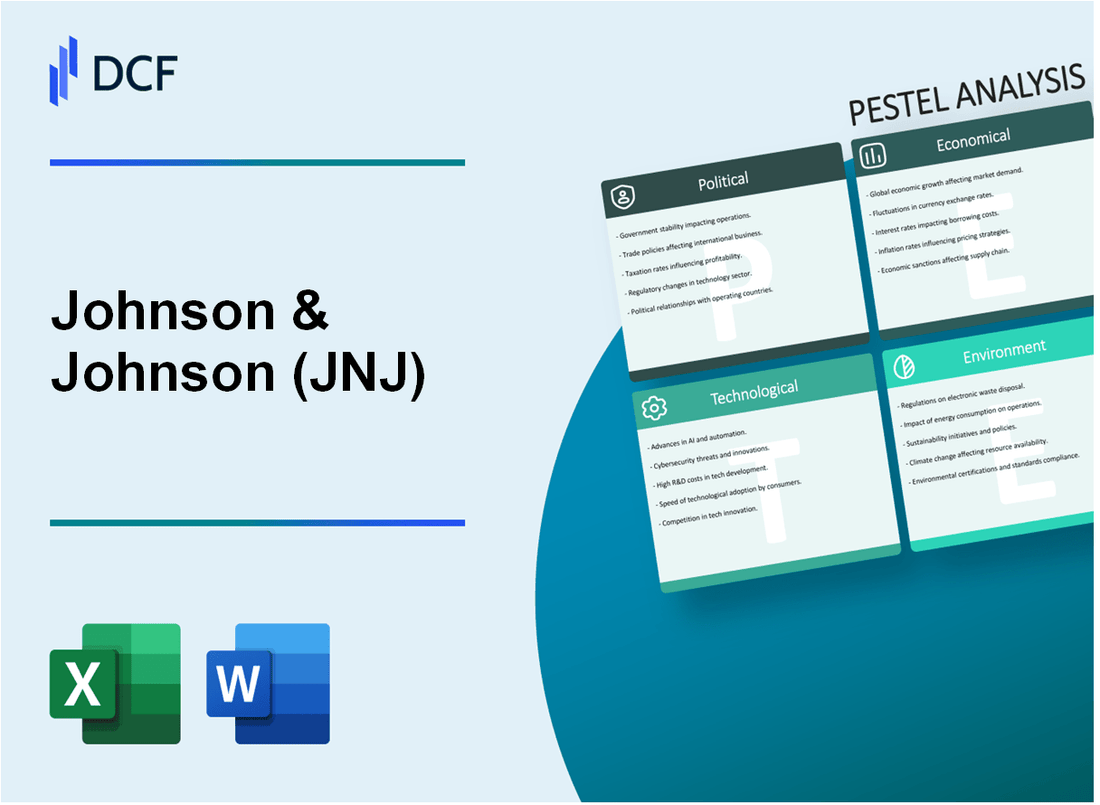
Johnson & Johnson (JNJ): PESTLE Analysis [Apr-2026 Updated] |
Completamente Editable: Adáptelo A Sus Necesidades En Excel O Sheets
Diseño Profesional: Plantillas Confiables Y Estándares De La Industria
Predeterminadas Para Un Uso Rápido Y Eficiente
Compatible con MAC / PC, completamente desbloqueado
No Se Necesita Experiencia; Fáciles De Seguir
Johnson & Johnson (JNJ) Bundle
You're looking at Johnson & Johnson (JNJ) in late 2025, post-Kenvue spin-off, and the investment thesis is now simpler but the risks are sharper. The core Pharmaceutical and MedTech businesses are poised for high-margin growth, projecting total revenue around $88.0 billion, fueled by a massive R&D commitment of nearly $16.5 billion. But, you defintely can't ignore the twin realities of increased global drug pricing scrutiny and the multi-billion dollar legal overhang from the talc litigation, plus the constant pressure from geopolitical tensions. We need to map these Political, Economic, Sociological, Technological, Legal, and Environmental forces right now to see where the real action-and risk-lies.
Johnson & Johnson (JNJ) - PESTLE Analysis: Political factors
Increased global scrutiny on drug pricing and reimbursement policies.
You are seeing an unprecedented political focus on drug costs, and it's hitting Johnson & Johnson's Innovative Medicine business hard. The core issue is the Inflation Reduction Act (IRA) and its Medicare drug price negotiation mechanism, which, while not fully in effect until 2026, is driving massive lobbying efforts right now.
JNJ dramatically escalated its federal lobbying spend in Q1 2025 to $3.34 million, a significant jump from the $1.52 million spent in Q4 2024. This money is defintely being spent to challenge the IRA's provisions and push for favorable patent legislation.
Also, the threat of a Most-Favored-Nation (MFN) pricing model, introduced via a May 2025 Executive Order, is a major risk. This policy aims to base US drug prices on the lower prices paid by other developed countries, directly challenging the high-margin US market that currently accounts for a substantial portion of JNJ's global revenue.
US government pressure on pharmaceutical supply chain resilience and domestic production.
The US government is actively pushing for pharmaceutical supply chain resilience, demanding less reliance on foreign Active Pharmaceutical Ingredients (APIs). As of 2025, only about 10% of APIs by volume for US-used drugs are manufactured domestically, creating a clear national security vulnerability that JNJ must address.
The pressure comes in two forms: incentives and penalties. Incentives include Executive Orders (like EO 14293 and EO 14297) to streamline regulatory approvals for new domestic manufacturing plants and the creation of a Strategic Active Pharmaceutical Ingredients Reserve (SAPIR). Penalties are the tariffs.
Here's the quick math on the tariff impact for the 2025 fiscal year:
| Factor | Estimated 2025 Financial Impact | JNJ Action |
|---|---|---|
| Existing Tariffs (China, Steel, Aluminum) | $400 million in tariff-related costs (primarily MedTech) | CEO has publicly warned against new pharma tariffs. |
| Domestic Manufacturing Investment | $55 million US investment announced in March 2025 | Increase domestic capacity to mitigate supply chain risk. |
| Proposed Pharma Tariffs (Risk) | Could start at 15% and ratchet up to 250% | Focus lobbying on tax policy over tariffs as a better incentive. |
Geopolitical tensions impacting clinical trial access and global market entry approvals.
Geopolitical instability is no longer a distant risk; it's an immediate operational challenge. The World Economic Forum's Global Risks Report 2025 identifies geopolitical confrontation as a top short-term concern, which directly affects JNJ's global clinical trial footprint and market access strategy.
The most visible headwind is in China, where the CFO stated in January 2025 that the region would remain a headwind through 2025 for the MedTech division due to government-led anti-corruption drives and policies favoring local manufacturers. Furthermore, new US political moves are increasing scrutiny on Chinese clinical trial data, which complicates JNJ's ability to in-license or partner on promising assets from that market.
This forces JNJ to be more selective about where it runs trials and where it seeks regulatory approvals, increasing the time and cost for global product launches.
Regulatory alignment post-Kenvue spin-off simplifies lobbying efforts on core segments.
The separation of the Consumer Health business into Kenvue allows JNJ to achieve a cleaner regulatory profile. The company is now purely focused on the high-value, high-regulation Pharmaceuticals and Medical Devices (MedTech) segments.
This streamlining is evident in the lobbying shift. The political agenda is no longer diluted by consumer product issues like the talc litigation; instead, the entire focus is on core issues that protect the Innovative Medicine pipeline, such as:
- Defending intellectual property (patent protection).
- Mitigating the impact of the IRA's price controls.
- Securing favorable tax treatment for domestic R&D.
The market seems to appreciate this strategic clarity; JNJ raised its 2025 sales forecast to a midpoint of $92.0 billion, reflecting confidence in the streamlined, higher-growth core business.
Johnson & Johnson (JNJ) - PESTLE Analysis: Economic factors
Projected 2025 total revenue for the remaining JNJ is around $93.7 billion, focusing on high-margin segments.
You need to know the core business is performing exactly as planned post-Kenvue spin-off. The focus on Innovative Medicine and MedTech-the high-margin segments-is paying off. Johnson & Johnson has revised its full-year 2025 reported sales forecast to a range of $93.5 billion to $93.9 billion, with the midpoint landing at $93.7 billion. This is a strong, upward revision, demonstrating the resilience of their core pharmaceutical and medical device franchises.
This increased guidance is driven by blockbuster performance in key areas, particularly Oncology. For example, the Innovative Medicine segment saw worldwide sales of $15.6 billion in Q3 2025 alone, despite the significant headwind from biosimilar competition for Stelara.
Here's the quick math on the core business strength:
- Innovative Medicine (Pharmaceuticals) sales growth is robust, led by products like Darzalex, which grew 19.9%.
- MedTech sales are also up, driven by new product performance in Cardiovascular, including the Shockwave acquisition.
- The company's gross margin stands at a healthy 67.92% as of the trailing twelve months, reflecting the high-value nature of their focused portfolio.
High interest rates increase the cost of capital for major MedTech M&A activities.
The Federal Reserve's monetary policy is a direct factor in Johnson & Johnson's inorganic growth strategy, specifically for MedTech mergers and acquisitions (M&A). While the company is sitting on a strong balance sheet, the cost of debt is defintely higher than in previous cycles. The Federal Funds Rate target range is currently set at 3.75% to 4.00% following the October 2025 cut, which translates to a higher borrowing cost for large deals.
For context, the effective yield on the ICE BofA Single-A US Corporate Index-a proxy for JNJ's high-grade corporate borrowing-is around 4.67% as of November 2025. This elevated cost of capital means every major deal needs to clear a higher hurdle rate to be accretive (profitable). JNJ is still active, though, recently acquiring Halda Therapeutics for $3.05 billion in cash to bolster its oncology pipeline. The company has executed around 60 small and big M&A deals in the last 18 months, showing they are still leaning in, but the cost of financing remains a critical filter.
Strong US dollar creates currency headwinds, reducing international sales value.
A strong US dollar is a classic headwind for any multinational like Johnson & Johnson, which generates a significant portion of its sales outside the United States. When JNJ translates foreign currency sales back into US dollars, the stronger dollar reduces the reported value, even if local sales volumes are strong. The CFO has been transparent about this, estimating the strengthening dollar would impact the 2025 full-year top line by about $1.7 billion and reduce earnings per share (EPS) by approximately $0.25.
This is a real-world drag on reported numbers. For example, in Q2 2025, while U.S. sales grew by 7.8%, international sales growth was only 0.6%, clearly illustrating the currency translation effect. This means operational performance is actually stronger than the reported numbers suggest, but investors only see the latter.
| Economic Factor | 2025 Impact/Metric | Financial Effect |
|---|---|---|
| Full-Year Reported Sales Guidance (Midpoint) | $93.7 billion | Strong top-line growth in core Innovative Medicine and MedTech. |
| US Corporate A Effective Yield (Cost of Capital) | ~4.67% (Nov 2025) | Increases the hurdle rate for M&A; makes debt financing more expensive. |
| Currency Headwind (Strong USD) | ~$1.7 billion on top line; $0.25 on EPS | Reduces the reported value of international sales. |
Healthcare inflation drives up operational costs, particularly for complex manufacturing.
The rising tide of healthcare inflation is a direct cost pressure, even for a giant like Johnson & Johnson. The cost of providing employee healthcare is expected to climb by an estimated 5.8% in 2025 for employers, which is a significant component of JNJ's operating expenses globally. Plus, the complexity of manufacturing advanced pharmaceuticals and MedTech devices means raw material and specialized labor costs are highly sensitive to inflation.
Beyond general inflation, JNJ is also managing specific trade-related costs. The company anticipates a MedTech tariff impact for 2025 of approximately $200 million, which is a direct operational cost hitting the MedTech segment, primarily related to products shipped into China. While the company is focused on margin improvement, with a strong operating margin of 26.2%, these inflationary and tariff-related expenses require constant cost-control efforts to prevent margin erosion.
Johnson & Johnson (JNJ) - PESTLE Analysis: Social factors
The social environment for Johnson & Johnson is shifting toward two major, opposing forces: a huge demographic tailwind from the aging population, and a significant headwind from public and political pressure on drug pricing and health equity. Your exposure to the MedTech and Innovative Medicine segments positions you perfectly for the former, but you must defintely manage the political and reputational risks of the latter.
Growing demand for personalized medicine and advanced biologics in developed markets.
The shift from one-size-fits-all drugs to personalized medicine, or precision medicine, is a massive social trend that plays directly into Johnson & Johnson's Innovative Medicine strategy. The global personalized medicine market is a huge opportunity, projected to be valued between $393.9 billion and $654.46 billion in 2025, with an expected Compound Annual Growth Rate (CAGR) of around 8.10% to 9.5% over the next few years.
Your oncology portfolio, which is the heart of this trend, is performing strongly. In Q1 2025, the Innovative Medicine segment saw operational sales growth of 4.2%, driven by key personalized treatments. For instance, your bispecific antibodies like Tecvayli and Talevy, and the CAR-T cell therapy Carvykti, are at the forefront of this shift, with Carvykti sales more than doubling in Q1 2025. This is a high-margin business, so the focus here is right.
Here's the quick math on the market size:
| Market | Projected Global Value (2025) | Projected CAGR (2025-2034) |
|---|---|---|
| Personalized Medicine | Up to $654.46 billion | 8.10% - 9.5% |
Aging global population increases the market for orthopedic and cardiovascular devices.
The demographic reality is that people are living longer, and that means more chronic, age-related conditions, particularly in orthopedics and cardiology. The global medical devices market, which is where your MedTech segment plays, is expected to be valued at $678.88 billion in 2025. This is a clear, long-term tailwind. Specifically, the orthopedic devices market is projected to exceed $55.0 billion by 2025, and the global cardiovascular devices market is expected to grow from $8.4 billion in 2025.
Your MedTech business is capitalizing on this, posting 4.1% operational sales growth in Q1 2025. This growth is largely fueled by recent acquisitions like Abiomed and Shockwave, which focus on high-growth cardiovascular intervention. You're making smart, targeted acquisitions to capture this demographic wave. The MedTech segment accounts for around 36% of Johnson & Johnson's total revenues, so this is a critical growth lever.
Public sentiment remains sensitive to drug pricing, influencing brand reputation and policy.
Honesty, drug pricing is a social issue that quickly becomes a political and legal risk. Public sentiment in the US remains highly critical of pharmaceutical costs, and this is directly translating into policy action, such as the Inflation Reduction Act (IRA). Johnson & Johnson is actively fighting this. You reported spending $3.34 million on federal lobbying in Q1 2025, a nearly 120% increase from the prior quarter, specifically to influence drug pricing and patent legislation.
What this estimate hides is the potential long-term revenue impact if the IRA's drug price negotiation provisions are fully implemented. The lobbying spend is essentially a defensive investment to protect your Innovative Medicine portfolio's pricing power. This sensitivity is a constant threat to your brand reputation, even with strong clinical data like the 83% reduction in risk of progression for your multiple myeloma combination treatment in a recent trial.
Increased focus on health equity drives investment in diverse patient populations for trials.
The social drive for health equity-ensuring that medical innovations benefit all populations-is pushing the industry to address the historical lack of diversity in clinical trials. This isn't just a moral imperative; it's becoming a regulatory requirement, with the FDA issuing strong guidance. Johnson & Johnson is addressing this with a data-driven approach.
Your strategy involves:
- Using Artificial Intelligence (AI) to increase diversity in 100 clinical trials, a plan set in 2024.
- Implementing Diversity, Equity, and Inclusion (DE&I) modeling to set specific diversity targets based on disease prevalence.
- Collaborating with over 100 community-led health organizations in the United States to improve access to care.
To be fair, this focus is yielding results: your Janssen unit successfully made one clinical trial more inclusive, attracting nearly 44,000 participants from eight countries by strategically selecting sites in diverse communities. This is a clear action that mitigates future regulatory and social risk.
Johnson & Johnson (JNJ) - PESTLE Analysis: Technological factors
The technological landscape for Johnson & Johnson (JNJ) in 2025 is defined by a massive capital commitment to internal innovation and a strategic pivot toward Artificial Intelligence (AI) and advanced robotics. The clear takeaway here is that JNJ is transforming from a traditional pharmaceutical and device company into a data-driven, MedTech powerhouse, but this shift introduces significant new cybersecurity vulnerabilities.
Investment in Research & Development (R&D) is projected to be nearly $16.5 billion in 2025, fueling the pipeline.
You should view JNJ's R&D spending not just as an expense, but as a strategic moat against generic and biosimilar competition. The company's focused investment is defintely a core part of their long-term value proposition. For the twelve months ending September 30, 2025, Johnson & Johnson's R&D expenses were reported at $15.711 billion. This aggressive spending is directed at high-growth areas like oncology, neuroscience, and immunology, ensuring a robust pipeline of next-generation medicines.
Beyond the annual R&D budget, the company has announced a broader U.S. investment of more than $55 billion over four years (starting 2025) across manufacturing, R&D, and technology. This capital deployment supports new facilities, including a state-of-the-art biologics manufacturing site in North Carolina, which will manufacture complex medicines for cancer and neurological diseases.
| Investment Category | Commitment (2025-2028) | Strategic Focus |
|---|---|---|
| U.S. Manufacturing, R&D, & Technology | More than $55 billion | Pipeline acceleration, supply chain resilience, and digital health integration. |
| R&D Expenses (TTM Sep 2025) | $15.711 billion | Oncology, Immunology, Neuroscience, and Advanced MedTech. |
Rapid adoption of Artificial Intelligence (AI) for drug discovery and clinical trial optimization.
JNJ is moving past simple AI experimentation, shifting to high-impact applications, which they call Augmented Intelligence-combining AI with human expertise. The goal is to dramatically cut the time and cost associated with bringing a new drug to market by leveraging machine learning (ML) to process vast datasets.
In drug discovery, AI is helping scientists identify promising molecular compounds and biological targets much faster than traditional methods. For clinical trials, the technology is now a critical tool for identifying and recruiting eligible patients, a process so effective it has more than doubled enrollment in some cases.
- Accelerate drug discovery by designing novel molecules and chemical processes.
- Improve clinical trial recruitment by identifying specific patient cohorts.
- Analyze operating room footage via the Polyphonic™ ecosystem to refine surgeon techniques.
- Identify 75,000 U.S. patients with unmet needs across seven disease areas, including oncology, using Medical Engagement AI.
Advancements in robotic-assisted surgery and minimally invasive MedTech procedures.
The company's MedTech segment is aggressively challenging the market leader, Intuitive Surgical, with its next-generation robotic platforms. The key launch is the OTTAVA™ Robotic Surgical System, a multi-specialty soft-tissue robot. The first clinical trial cases, including a Roux-en-Y gastric bypass surgery, were successfully completed in April 2025.
What makes OTTAVA a potential game-changer is its unified architecture: the four robotic arms are integrated directly into the operating table, which frees up critical space in the operating room (OR) and allows for greater patient access. This system is expected to join JNJ's existing robotic portfolio, which includes the MONARCH Platform for lung biopsy and the VELYS Robotic-Assisted Solution for orthopedics.
Cybersecurity threats to patient data and intellectual property (IP) remain a major risk.
As JNJ digitizes its entire value chain-from AI-driven drug discovery (IP) to robotic surgery (patient data)-the surface area for cyberattacks expands significantly. The risk is real and immediate. For instance, in 2023, a technical flaw led to unauthorized access to personal information within the Janssen CarePath patient assistance program, which is managed by IBM.
The compromised data included sensitive personal information like names, contact information, date of birth, health insurance details, and medication information for patients. A breach of this magnitude not only creates massive legal and financial liabilities but also erodes the patient and provider trust that is foundational to the healthcare business model. Here's the quick math: a single major breach can cost hundreds of millions in remediation, fines, and lost business.
Johnson & Johnson (JNJ) - PESTLE Analysis: Legal factors
The legal environment for Johnson & Johnson in 2025 is dominated by extraordinary mass tort liability and significant intellectual property (IP) defense battles. You are looking at a company with a formidable legal exposure that directly impacts its balance sheet and forward-looking pharmaceutical revenue projections. The near-term risks require a clear-eyed assessment of multi-billion dollar financial obligations and the structural erosion of key drug sales.
Ongoing, significant legal exposure from the talc litigation, with potential liabilities in the tens of billions.
The talcum powder litigation remains the single largest legal risk, with the company's efforts to resolve the matter through bankruptcy failing repeatedly in 2025. As of November 2025, there are over 67,000 lawsuits pending in the federal multidistrict litigation (MDL) alone, with some reports citing over 90,000 total claims. The company's third attempt to channel these claims into a trust with a proposed settlement of up to $9 billion was rejected by a bankruptcy judge in March/April 2025, forcing the cases back into the civil tort system.
This return to individual trials has led to massive, high-profile jury verdicts in 2025, signaling the financial risk is far from contained. The legal strategy is not working; the litigation is accelerating.
- A California jury awarded a family a $966 million verdict in October 2025.
- Another jury ordered a nearly $1 billion verdict, including $950 million in punitive damages, also in October 2025.
- An analyst estimate suggests the ultimate cost to resolve all current and future claims could reach up to $11 billion.
Stricter global data privacy regulations (like GDPR) impacting patient data handling.
As a global healthcare giant, Johnson & Johnson handles massive volumes of sensitive patient data, making it a prime target for global privacy enforcement. Compliance with the European Union's General Data Protection Regulation (GDPR) and the California Consumer Privacy Act (CCPA), as amended by the California Privacy Rights Act (CPRA), demands continuous, resource-intensive investment in IT infrastructure and legal controls.
While no specific, major fine has been levied against Johnson & Johnson in 2025, the cost of compliance is a fixed operating expense. For large global firms, the average annual budget for GDPR compliance is estimated at $13 million. Furthermore, the penalty structure for non-compliance is escalating. In California, CCPA fines increased in 2025 to up to $7,988 per intentional violation, up from $7,500 previously, which is a clear sign of the growing regulatory teeth.
Patent cliff risks for key pharmaceutical products necessitate aggressive IP defense.
The most immediate and quantifiable legal headwind is the loss of market exclusivity (LOE) for the blockbuster immunology drug, Stelara (ustekinumab). Johnson & Johnson was able to delay the U.S. patent cliff through legal settlements, but biosimilar competition has now arrived in 2025.
Here's the quick math on the exposure:
| Product | Therapeutic Area | U.S. Sales (2024) | Patent Event (2025) | 2025 Sales Impact (9-Month) |
|---|---|---|---|---|
| Stelara (Ustekinumab) | Immunology | $6.72 billion | U.S. Loss of Exclusivity and Biosimilar Launch | Sales declined around 40% |
| Darzalex (Daratumumab) | Oncology | N/A (Multi-Billion) | Key patent expiration by 2029 | Focus of aggressive life-cycle management |
| Imbruvica (Ibrutinib) | Oncology | N/A (Blockbuster) | Composition of Matter patent expires in 2027 | IP defense critical to extend exclusivity to 2028 |
The 40% sales decline for Stelara in the first nine months of 2025 demonstrates the immediate revenue erosion that aggressive IP defense only temporarily postponed. The company must now shift its legal focus from defense to securing new indications and defending secondary patents for its next-generation blockbusters like Darzalex.
Increased regulatory hurdles for new drug approvals, particularly in oncology and immunology.
Beyond the traditional FDA approval process, new legal and regulatory frameworks are creating financial hurdles for the entire pharmaceutical portfolio. The most significant is the Inflation Reduction Act (IRA), specifically the Medicare Part D redesign.
Johnson & Johnson expects a negative impact of approximately $2 billion in sales in 2025 due to the Medicare Part D redesign, which affects high-volume, high-cost drugs across its Innovative Medicine segment, including Stelara, Tremfya, and Erleada. This is a direct, legislated constraint on pricing power and revenue. To counter this, the company is pushing a deep pipeline, with key 2025 regulatory events focused on high-growth, high-unmet-need areas:
- Oncology: FDA approval for INLEXZO (bladder cancer) and Fast Track designation for pasritamig (prostate cancer).
- Immunology: Planned 2025 submissions for nipocalimab (Warm Autoimmune Hemolytic Anemia) and new indications for TREMFYA (ulcerative colitis).
The legal team's job is now twofold: to manage the fallout from the IRA's price negotiation mechanism and to ensure flawless regulatory submissions to justify the massive R&D investment in these new, high-value assets.
Johnson & Johnson (JNJ) - PESTLE Analysis: Environmental factors
You need to recognize that environmental factors are no longer soft public relations issues; they are hard, non-negotiable financial risks and opportunities. Johnson & Johnson's aggressive 2025 targets, particularly on renewable energy and waste, are setting the near-term capital expenditure agenda, and the pressure from investors is only increasing.
Finance: Track Q4 2025 R&D spend versus budget by month-end to ensure the $16.5 billion investment is on target for pipeline acceleration.
Pressure from investors and regulators to meet aggressive Scope 1 and 2 carbon neutrality targets.
The market is demanding a clear path to decarbonization, and JNJ is responding with concrete, near-term targets. While the ultimate goal for operational carbon neutrality (Scope 1 and 2) is 2030, the 2025 milestone for renewable electricity is the most immediate, critical metric. The company aims to source 100% of its electricity needs from renewable sources by 2025 globally.
As of 2024, JNJ was already sourcing approximately 88% of its global electricity from renewables, having already achieved 100% in key markets like Europe, the United States, and Canada. This progress is the result of significant capital allocation, including the $800 million invested between 2016 and 2023 in environment, health, and safety programs to support decarbonization and sustainable manufacturing. The long-term ambition is a full net-zero emissions across the entire value chain (Scopes 1, 2, and 3) by 2045.
| Climate Action Target | Goal | Deadline | Status / Key Metric (as of 2024) |
|---|---|---|---|
| Renewable Electricity Sourcing | 100% of global electricity needs from renewable sources | 2025 | Achieved approx. 88% globally; 100% in U.S., Europe, and Canada. |
| Operational Carbon Neutrality (Scope 1 & 2) | Achieve carbon neutrality for operations | 2030 | Reduced Scope 1 & 2 GHG emissions by 34% between 2016 and 2021. |
| Absolute GHG Reduction (Scope 1 & 2) | Reduce absolute emissions 44% from a 2021 base year | 2030 | Validated by the Science Based Targets initiative (SBTi). |
Focus on reducing pharmaceutical waste and improving the sustainability of medical device packaging.
The sheer volume of medical and pharmaceutical waste is a material risk, and JNJ is tackling it through circular economy initiatives. The 'Health for Humanity 2025' goal for consumer products is to make 100% of packaging recyclable, reusable, or compostable.
In the Innovative Medicine (pharmaceutical) segment, the 'Safe Returns' program is operational in the U.S. and parts of Europe, allowing patients to return used self-injectable devices (pens and syringes) for recycling. For MedTech, the company is collaborating with hospitals to recycle components from single-use instruments. For example, a project in Switzerland successfully returned over 63,000 disposable medical instruments to the resource cycle by March 2024, collecting over 8.4 tonnes of material and saving more than 46 tonnes of CO2.
- Replaced plastic trays with fiber-based, recyclable trays in secondary packaging for many immunology self-injectable devices.
- Recycling efforts for MedTech devices target a recyclability rate of 70 to 80 percent for analyzed disposable instruments.
- The focus is on closed-loop systems, minimizing the environmental footprint of high-value, single-use products.
Water scarcity risks in key manufacturing locations, requiring capital investment in conservation.
Water stewardship is a critical operational risk, especially in manufacturing-heavy regions. JNJ's explicit 2025 goal is to replenish 100% of the water it uses in water-stressed regions. This target necessitates significant capital investment in advanced water treatment, recycling technologies, and conservation infrastructure at manufacturing sites.
While a specific 2025 capital expenditure figure for water conservation is not isolated in public reports, the company's overall Capital Expenditures (CapEx) for the twelve months ending September 28, 2025, is approximately $4.6 billion. A portion of this CapEx is dedicated to modernizing and expanding manufacturing facilities, which includes integrating water efficiency measures and low-carbon technologies to mitigate the financial risk of water-related production disruptions.
Enhanced Environmental, Social, and Governance (ESG) reporting standards drive transparency.
Investor and regulatory scrutiny has pushed ESG reporting from voluntary disclosure to a core component of financial transparency. JNJ's commitment is demonstrated by its comprehensive reporting against global frameworks, which is now a baseline expectation for institutional investors.
JNJ's annual 'Health for Humanity Report' details progress against its 2025 goals and aligns with multiple enhanced reporting standards:
- Sustainability Accounting Standards Board (SASB).
- Task Force on Climate-related Financial Disclosures (TCFD).
- Global Reporting Initiative (GRI).
The company also integrates sustainability metrics into executive compensation and is expanding third-party assurance across its environmental data, which is a key signal of accountability to the market. The latest Sustainalytics ESG Risk Rating for JNJ was updated as of September 3, 2025, indicating continuous, near-real-time scrutiny from major rating agencies. This enhanced transparency is defintely a strategic necessity to maintain a favorable cost of capital.
Disclaimer
All information, articles, and product details provided on this website are for general informational and educational purposes only. We do not claim any ownership over, nor do we intend to infringe upon, any trademarks, copyrights, logos, brand names, or other intellectual property mentioned or depicted on this site. Such intellectual property remains the property of its respective owners, and any references here are made solely for identification or informational purposes, without implying any affiliation, endorsement, or partnership.
We make no representations or warranties, express or implied, regarding the accuracy, completeness, or suitability of any content or products presented. Nothing on this website should be construed as legal, tax, investment, financial, medical, or other professional advice. In addition, no part of this site—including articles or product references—constitutes a solicitation, recommendation, endorsement, advertisement, or offer to buy or sell any securities, franchises, or other financial instruments, particularly in jurisdictions where such activity would be unlawful.
All content is of a general nature and may not address the specific circumstances of any individual or entity. It is not a substitute for professional advice or services. Any actions you take based on the information provided here are strictly at your own risk. You accept full responsibility for any decisions or outcomes arising from your use of this website and agree to release us from any liability in connection with your use of, or reliance upon, the content or products found herein.