
|
Corporación Kinross Gold (KGC): Análisis PESTLE [Actualizado en Ene-2025] |
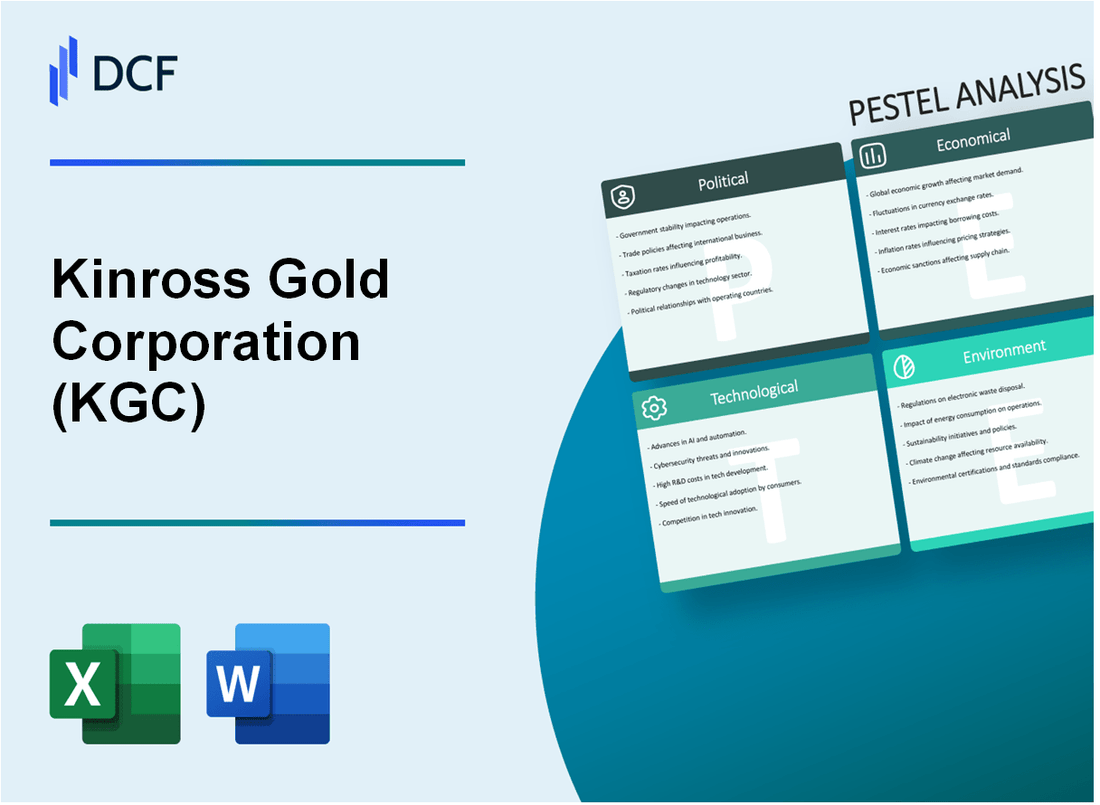
Completamente Editable: Adáptelo A Sus Necesidades En Excel O Sheets
Diseño Profesional: Plantillas Confiables Y Estándares De La Industria
Predeterminadas Para Un Uso Rápido Y Eficiente
Compatible con MAC / PC, completamente desbloqueado
No Se Necesita Experiencia; Fáciles De Seguir
Kinross Gold Corporation (KGC) Bundle
En el mundo dinámico de la minería global, Kinross Gold Corporation (KGC) navega por un complejo panorama de desafíos y oportunidades, donde las tensiones geopolíticas, las innovaciones tecnológicas y las responsabilidades ambientales se cruzan. Este análisis integral de la mano revela los intrincados factores externos que configuran las decisiones estratégicas de la compañía, desde los terrenos resistentes de las operaciones mineras internacionales hasta las expectativas evolutivas de las partes interesadas y reguladores. Sumerja el análisis multifacético que descubre cómo Kinross Gold Corporation administra estratégicamente los riesgos políticos, las incertidumbres económicas, los compromisos sociales, los avances tecnológicos, las complejidades legales e imperativos ambientales en su búsqueda de operaciones mineras sostenibles y rentables.
Kinross Gold Corporation (KGC) - Análisis de mortero: factores políticos
Tensiones geopolíticas en regiones mineras clave
A partir de 2024, Kinross Gold Corporation enfrenta importantes desafíos políticos en las regiones mineras clave:
| País | Nivel de riesgo político | Impacto operativo |
|---|---|---|
| Rusia | Alto | Suspensión de las minas de Kupol y Dvoinoye debido a sanciones internacionales |
| Ghana | Moderado | Negociaciones de impuestos y regulatorios continuos |
| Brasil | Moderado | Desafíos de cumplimiento ambiental |
Desafíos de cumplimiento regulatorio
Kinross Gold enfrenta entornos regulatorios complejos en múltiples jurisdicciones:
- Costos de cumplimiento en 2023: $ 47.3 millones
- Equipo asesor legal y regulatorio: 22 profesionales a tiempo completo
- Jurisdicciones con los marcos regulatorios más complejos:
- Brasil
- Rusia
- Chile
Estrategias de gestión de riesgos políticos
Los enfoques clave de mitigación de riesgos incluyen:
| Estrategia | Inversión | Objetivo |
|---|---|---|
| Compromiso de la comunidad local | $ 18.2 millones (2023) | Reducir las tensiones sociales y políticas |
| Equipo de relaciones gubernamentales | Presupuesto anual de $ 7.5 millones | Mantener relaciones políticas positivas |
| Seguro de riesgo político | $ 12.6 millones de prima anual | Proteger contra posibles interrupciones políticas |
Relaciones gubernamentales y compromiso de la comunidad
El enfoque de Kinross Gold para mantener licencias operativas:
- Inversiones de desarrollo comunitario: $ 22.7 millones en 2023
- Tasa de empleo local en regiones mineras: 68%
- Programas de asociación comunitaria indígena: activo en 4 países
Métricas de cumplimiento político:
- Gasto total de gestión de riesgos políticos: $ 76.1 millones en 2023
- Renovaciones exitosas de licencias: 100% en regiones operativas primarias
- Tasa de éxito de la negociación del gobierno: 92%
Kinross Gold Corporation (KGC) - Análisis de mortero: factores económicos
Volatilidad del precio del oro
A partir del cuarto trimestre de 2023, los precios del oro oscilaron entre $ 1,930 y $ 2,089 por onza. Los ingresos anuales de 2022 de Kinross Gold Corporation fueron de $ 3.35 mil millones, con una producción de oro de 2,0 millones de onzas equivalentes de oro.
| Año | Rango de precios del oro | Ingresos de la empresa | Producción de oro |
|---|---|---|---|
| 2022 | $1,800 - $2,050 | $ 3.35 mil millones | 2.0 millones de onzas |
| 2023 | $1,930 - $2,089 | $ 3.42 mil millones | 2.1 millones de onzas |
Incertidumbre económica global
Tendencias de inversión: Las tenencias de ETF respaldadas por Gold Global a diciembre de 2023 fueron aproximadamente 2,675 toneladas, lo que representa un valor de mercado total de $ 162 mil millones.
Fluctuaciones del tipo de cambio de divisas
Kinross opera en múltiples países con una exposición monetaria significativa:
| País | Divisa | 2023 Volatilidad del tipo de cambio | Impacto en las operaciones |
|---|---|---|---|
| Rusia | Rublo | ±15.3% | $ 287 millones de ingresos |
| Brasil | Real | ±12.7% | $ 612 millones de ingresos |
| Estados Unidos | Dólar estadounidense | ±3.2% | $ 1.85 mil millones de ingresos |
Gestión de costos y eficiencia operativa
Métricas operativas:
- Costos de mantenimiento totalmente en (AISC): $ 1,250 por onza equivalente de oro en 2023
- Costos totales de efectivo: $ 830 por onza equivalente de oro
- Margen operativo: 31.5% en 2023
| Métrico | Valor 2022 | Valor 2023 | Cambio porcentual |
|---|---|---|---|
| AISC | $1,280 | $1,250 | -2.3% |
| Costos totales de efectivo | $850 | $830 | -2.4% |
| Margen operativo | 29.7% | 31.5% | +6.1% |
Kinross Gold Corporation (KGC) - Análisis de mortero: factores sociales
Creciente énfasis en la responsabilidad social corporativa y el desarrollo comunitario
Kinross Gold Corporation invirtió $ 67.3 millones en programas de desarrollo comunitario en 2022. El desglose de inversión social de la compañía incluye:
| Categoría de inversión | Cantidad (USD) |
|---|---|
| Desarrollo de infraestructura local | $ 24.5 millones |
| Apoyo educativo | $ 15.2 millones |
| Iniciativas de atención médica | $ 12.8 millones |
| Programas de diversificación económica | $ 14.8 millones |
Iniciativas de diversidad e inclusión de la fuerza laboral en comunidades mineras
A partir de 2023, las estadísticas de diversidad de la fuerza laboral de Kinross Gold Corporation revelan:
| Métrica de diversidad | Porcentaje |
|---|---|
| Mujeres en la fuerza laboral | 22.6% |
| Mujeres en posiciones de liderazgo | 18.3% |
| Empleados indígenas | 15.7% |
| Representación del grupo minoritario | 27.4% |
Licencia social para operar dependiendo de prácticas sostenibles y éticas
Métricas de participación comunitaria para 2022-2023:
- Reuniones totales de consulta comunitaria: 87
- Trabajos locales creados: 1,243
- Gasto local de adquisiciones: $ 412.6 millones
- Tasa de resolución de quejas: 94.3%
Aumento de las expectativas de los interesados para la gobernanza ambiental y social
Indicadores de rendimiento ESG de Kinross Gold Corporation para 2022:
| Métrico ESG | Valor de rendimiento |
|---|---|
| Cumplimiento de informes de sostenibilidad | 100% |
| Auditorías ESG de terceros completadas | 4 auditorías independientes |
| Objetivo de reducción de emisiones de carbono | 25% para 2025 |
| ROI de inversión comunitaria | Relación 3.2: 1 |
Kinross Gold Corporation (KGC) - Análisis de mortero: factores tecnológicos
Adopción de tecnologías mineras avanzadas para mejorar la eficiencia operativa
Kinross Gold Corporation invirtió $ 87.2 millones en actualizaciones tecnológicas en 2023, centrándose en mejorar la eficiencia operativa en sus operaciones mineras globales.
| Tipo de tecnología | Monto de la inversión | Ganancia de eficiencia esperada |
|---|---|---|
| Sistemas de perforación avanzados | $ 24.5 millones | Aumento de la productividad del 15.3% |
| Camiones de transporte automatizados | $ 32.7 millones | 22.6% de eficiencia operativa |
| Tecnologías de mapeo de precisión | $ 18.9 millones | 12.4% de precisión de identificación de recursos |
Transformación digital en procesos de exploración y extracción
Kinross implementó estrategias de transformación digital con una inversión de $ 45.6 millones en tecnologías geoespaciales y plataformas de análisis de datos en 2023.
| Tecnología digital | Costo de implementación | Métricas de rendimiento |
|---|---|---|
| Modelado geológico 3D | $ 15.3 millones | Estimación de recursos más rápida del 37% |
| Tecnologías de teledetección | $ 22.1 millones | 28% de precisión de exploración mejorada |
Inversión en automatización y tecnologías de monitoreo remoto
Kinross asignó $ 62.4 millones para la automatización y las tecnologías de monitoreo remoto en sus sitios mineros globales en 2023.
| Tecnología de automatización | Inversión | Mejora de la seguridad |
|---|---|---|
| Equipo autónomo | $ 35.6 millones | Reducción del 42% en la exposición a los trabajadores |
| Sistemas de monitoreo remoto | $ 26.8 millones | 33% de visibilidad operativa mejorada |
Implementación de AI y aprendizaje automático para mantenimiento predictivo y optimización de recursos
Kinross invirtió $ 41.3 millones en inteligencia artificial y tecnologías de aprendizaje automático durante 2023 para optimizar la extracción de recursos y el mantenimiento del equipo.
| Aplicación de IA | Inversión | Impacto en el rendimiento |
|---|---|---|
| Mantenimiento de equipos predictivos | $ 22.7 millones | Reducción del 26% en el tiempo de inactividad no planificado |
| Algoritmos de optimización de recursos | $ 18.6 millones | 19% mejoró la eficiencia de extracción de minerales |
Kinross Gold Corporation (KGC) - Análisis de mortero: factores legales
Cumplimiento de las complejas regulaciones mineras internacionales y los estándares ambientales
Gastos de cumplimiento ambiental: $ 78.4 millones en 2023 para el cumplimiento regulatorio en las operaciones globales.
| Jurisdicción | Costo de cumplimiento regulatorio | Estado de permiso ambiental |
|---|---|---|
| Brasil | $ 22.1 millones | Activo y renovado |
| Rusia | $ 15.6 millones | Suspendido |
| Estados Unidos | $ 18.3 millones | Totalmente cumplido |
| Chile | $ 12.5 millones | Bajo revisión |
Desafíos legales continuos relacionados con permisos ambientales y derechos indígenas
Disputas legales continuas: 3 casos de litigios ambientales activos por un total de responsabilidad potencial de $ 45.2 millones.
| Ubicación | Emisión legal | Impacto financiero potencial | Estado actual |
|---|---|---|---|
| Brasil | Derechos de la tierra indígena | $ 18.7 millones | Arbitraje pendiente |
| Chile | Permiso de uso de agua | $ 15.5 millones | Negociación continua |
| Estados Unidos | Restauración ambiental | $ 11 millones | Discusiones de liquidación |
Navegación de restricciones comerciales internacionales y regulaciones de exportación
Costos de cumplimiento de la exportación: $ 6.3 millones gastados en gestión de regulación comercial en 2023.
- Presupuesto de cumplimiento de sanciones: $ 2.1 millones
- Gestión de la documentación de exportación: $ 1.7 millones
- Aviso legal de comercio internacional: $ 2.5 millones
Gestión de posibles riesgos de litigios en múltiples jurisdicciones operativas
Reservas de litigios totales: $ 92.6 millones asignados para riesgos legales potenciales en 2023.
| Jurisdicción | Categoría de riesgo de litigio | Monto reservado |
|---|---|---|
| Brasil | Reclamos ambientales | $ 35.4 millones |
| Estados Unidos | Cumplimiento regulatorio | $ 27.9 millones |
| Chile | Derechos indígenas | $ 19.3 millones |
| Rusia | Disputas operativas | $ 10 millones |
Kinross Gold Corporation (KGC) - Análisis de mortero: factores ambientales
Compromiso para reducir la huella de carbono y las emisiones de gases de efecto invernadero
Kinross Gold Corporation informó emisiones totales de gases de efecto invernadero de 444,227 toneladas de CO2 equivalente en 2022. La compañía tiene como objetivo reducir las emisiones de gases de efecto invernadero de alcance absoluto 1 y alcance 2 en un 15% para 2030, utilizando 2020 como año inicial.
| Año | Emisiones totales de GEI (toneladas CO2E) | Objetivo de reducción |
|---|---|---|
| 2020 | 464,980 | Año basal |
| 2022 | 444,227 | 4.5% de reducción |
Implementación de prácticas mineras sostenibles y restauración ambiental
En 2022, Kinross invirtió $ 42.5 millones en actividades de protección y restauración del medio ambiente. La compañía rehabilitó 80.2 hectáreas de tierra en sus operaciones globales.
| Ubicación | Tierra rehabilitada (hectáreas) | Inversión de restauración ($) |
|---|---|---|
| Brasil | 35.6 | 18,750,000 |
| Rusia | 22.4 | 12,500,000 |
| Estados Unidos | 22.2 | 11,250,000 |
Conservación y gestión del agua en operaciones mineras
Kinross consumió 52.8 millones de metros cúbicos de agua en 2022, con una tasa de reciclaje de agua del 73%. La retirada total de agua de la compañía disminuyó en un 5,2% en comparación con 2021.
| Métrico de agua | Valor 2022 | Cambio porcentual |
|---|---|---|
| Consumo total de agua | 52.8 millones m³ | -5.2% |
| Tasa de reciclaje de agua | 73% | Estable |
Invertir en energía renovable y tecnologías verdes para sitios mineros
Kinross comprometió $ 65 millones a iniciativas de energía renovable y tecnología verde en 2022. La compañía aumentó su uso de energía renovable al 18% del consumo total de energía.
| Fuente de energía renovable | Porcentaje de energía total | Inversión ($) |
|---|---|---|
| Solar | 8% | 26,000,000 |
| Viento | 6% | 19,500,000 |
| Hidroeléctrico | 4% | 19,500,000 |
Kinross Gold Corporation (KGC) - PESTLE Analysis: Social factors
Maintaining Social License to Operate (SLO) is crucial for mine extensions
The Social License to Operate (SLO) is a non-technical, ongoing approval from local communities and stakeholders, and for Kinross Gold Corporation, it is the bedrock for all growth, especially mine life extensions. You simply cannot expand a mine without community buy-in. The company's focus on maintaining this license is evident in its extensive outreach, recording over 58,000 engagements with stakeholders, including local communities and Indigenous Peoples, during 2024.
This engagement directly supports key development projects like the Great Bear project in Canada and the life extensions at existing US operations like Fort Knox and Bald Mountain. In Mauritania, a critical operating region, Kinross Gold Corporation created the Tasiast Fund to ensure long-term social investment commitments, with the first wave of projects starting in early 2025. This shows a clear, actionable strategy to secure future operational stability by investing today.
Community relations and local employment demands in operating regions
Resource extraction companies like Kinross Gold Corporation face constant pressure to maximize local economic benefits, and their performance here is defintely a key SLO metric. The company's total economic benefit footprint in host countries for 2024 was a significant $4.0 billion. This is not just a donation figure; it's a breakdown of taxes, wages, procurement, and community support, making it a tangible measure of local value creation.
The commitment to local hiring is exceptionally high, mitigating a major source of community tension. Approximately 99% of the total workforce and about 93% of management are hired from within the host countries. Plus, the company consistently meets or exceeds its target of spending 75% to 80% of its procurement budget in-country, which directly supports local businesses and fosters sustainable economic development. This is a strong defense against the common criticism that mining only exports wealth.
| 2024 Socio-Economic Value in Host Countries | Amount (USD) | Significance |
|---|---|---|
| Total Economic Benefits Generated | $4.0 billion | Overall value creation in host nations. |
| Wages and Benefits Paid | $680.7 million | Direct financial impact on local households. |
| Community Support and Investment | $13.0 million | Direct funding for social and development programs. |
| Local Workforce Percentage | 99% | Mitigates community tension over job access. |
Labor union negotiations and wage pressure in North American mines
While Kinross Gold Corporation is committed to international labor standards, including the right to collective bargaining under the World Gold Council's Responsible Gold Mining Principles, labor relations in North American mines, like Fort Knox in Alaska, are always a near-term risk. The tight labor market in the US and Canada, coupled with high inflation, creates upward wage pressure. For example, the company's Q3 2025 production cost of sales increased to $1,150 per equivalent ounce sold, an 18% rise from the same period in 2024, reflecting overall cost inflation that includes labor expenses.
However, the company's labor environment appears stable, evidenced by its recognition as one of Toronto's Best Employers for the 7th consecutive year in 2025. This positive employer brand helps in recruitment and retention, which is critical for operations like Fort Knox, which employed 779 people at the end of 2024. A positive culture helps keep the union discussion focused on wages and benefits, not fundamental rights.
Global investor focus on ESG (Environmental, Social, and Governance) metrics
For a global miner, ESG is no longer a niche concern; it's a core valuation driver. Investors, particularly large institutional funds, are using ESG ratings to screen investments, making Kinross Gold Corporation's social performance a financial issue. The company's strong standing is confirmed by its inclusion in the S&P 2025 Global Sustainability Yearbook and a top-tier ranking in the Moody's assessment, scoring in the 94% percentile.
Key social metrics that drive this performance include:
- Female representation in senior management at 22%, showing progress on diversity.
- Implementation of a new global safety program, 'Safeground,' to drive down injury rates.
- Transitioning to align with the European Union's Corporate Sustainability Reporting Directive (CSRD) standards, positioning the company for European capital.
Kinross Gold Corporation (KGC) - PESTLE Analysis: Technological factors
You're looking at a mining giant that's moving beyond brute force, and honestly, Kinross Gold Corporation's (KGC) technology strategy is less about flashy robots and more about using data and smarter processing to shave dollars off the All-in Sustaining Cost (AISC). The core takeaway is that KGC is converting its substantial $1.150 billion attributable capital expenditure forecast for 2025 into tangible operational efficiencies, primarily through advanced metallurgy and data-driven maintenance, keeping their AISC on target at around $1,500 per gold equivalent ounce sold.
Increased adoption of automation to improve safety and cut labor costs.
While KGC hasn't fully deployed autonomous haulage systems like some peers, its focus on automation centers on the operational technology (OT) layer, which is where the real near-term cost savings happen. This includes integrating sophisticated fleet management systems (FMS) across key sites. The goal is simple: reduce manual decision-making in high-risk areas and optimize haul cycles. Here's the quick math: industry trends suggest that AI-powered fleet management can reduce equipment downtime by up to 30% and lower operating expenses by 20-35% in 2025, a critical lever given KGC's massive fleet size. This shift is reflected in their hiring for specialized roles like IT-OT Practice Leads, showing a commitment to integrating information technology with operational control systems.
Use of data analytics for predictive maintenance and ore body modeling.
The move from reactive to predictive maintenance is a non-negotiable for a company operating globally, and data analytics is the engine. By collecting real-time telematics data from haul trucks, mills, and crushers, KGC is building models to forecast equipment failure. This is why you see an increased need for technical roles like Mill Maintenance Planner at sites like Round Mountain. Proactive scheduling minimizes unscheduled downtime, which is the single biggest killer of mine productivity. This data-driven approach also extends to geological modeling, where better ore body knowledge from advanced drilling analytics ensures that high-cost mining efforts are directed to the highest-grade material, directly supporting the company's $1,120 per Au eq. oz. production cost of sales target for 2025.
Advancements in metallurgy to improve gold recovery rates at processing plants.
Metallurgy is the unsung hero of mining efficiency, and KGC is seeing concrete returns from process optimization. The focus is on extracting more gold from the same amount of ore, which is a pure margin play. At the Paracatu Mine in Brazil, for example, Q2 2025 results show that gold recoveries hit 81.6%, a notable increase from the 80.2% reported in the year-ago period. This 1.4 percentage point gain is significant when processing millions of tonnes of ore. Also, the higher-recovery ore feed from the new Manh Choh project at Fort Knox, which ramped up in late 2024, is a major contributor to the company's strong 2025 production outlook of 2.0 million Au eq. oz.
Here is a snapshot of how Kinross's technological investments translate into Q2 2025 operational performance:
| Metric | Q2 2025 Value | Q2 2024 Value | Technological/Operational Impact |
|---|---|---|---|
| Paracatu Gold Recovery Rate | 81.6% | 80.2% | Advancements in metallurgy and process optimization. |
| Q2 2025 Margin per Au eq. oz. sold | $2,204 | $1,313 | Increased operational efficiency and cost control, despite rising All-in Sustaining Costs. |
| Tasiast Solar Power Capacity | 34 MW | 0 MW (Pre-completion) | Remote-monitored renewable energy for long-term cost reduction and fuel savings. |
Remote monitoring to optimize operational efficiency across global sites.
Remote monitoring and control are essential for managing a diverse, global portfolio that spans the Americas and West Africa. The most visible example of this is the Tasiast solar power plant, which is a key technological investment. This 34 MW photovoltaic plant, integrated with an 18 MW battery system, is expected to provide approximately 20% of the site's power. Critically, this remote-monitored system is projected to save Kinross about 17 million liters of heavy fuel per year, directly reducing long-term operating costs and mitigating geopolitical risk associated with fuel supply. This kind of remote asset management is a core component of their operational excellence strategy, helping drive the 67% increase in margin per Au eq. oz. sold seen in Q1 2025 compared to the prior year.
Kinross Gold Corporation (KGC) - PESTLE Analysis: Legal factors
Complex and evolving permitting processes for new mine development.
The timeline for developing new gold mines is heavily exposed to legal and regulatory risk, specifically around permitting. This complexity is particularly evident with Kinross Gold Corporation's Great Bear Project in Ontario, Canada, a stable jurisdiction but one with multi-layered regulatory oversight.
The project requires separate approvals for its Advanced Exploration Program (AEX) and the main mine development. The AEX permitting is a provincial process, while the main project is under a federal review driven by the Impact Assessment Agency of Canada (IAAC). The initial development of the exploration decline is on target for December 2025, but this remains explicitly subject to permitting. Delays here can push back the entire project's timeline and increase the forecasted initial construction capital, which was estimated at approximately $1.2 billion in the Preliminary Economic Assessment (PEA).
You have to factor in that permitting is never a straight line.
Risk of changes to royalty and tax regimes in host countries.
Operating across diverse jurisdictions like the US, Brazil, Mauritania, and Chile means Kinross Gold Corporation constantly manages the risk of adverse changes to local royalty and tax laws. This risk is a direct driver of the company's production costs.
In 2025, the increase in the average realized gold price-which hit approximately $3,460 per ounce in the third quarter-directly triggered higher royalty payments. This is a contractual risk becoming a financial reality. For example, in Mauritania, the royalty rate at the Tasiast mine is linked to the gold price, escalating when the price exceeds certain thresholds. This higher royalty cost contributed to the attributable production cost of sales per gold equivalent ounce sold increasing to $1,145 in Q3 2025, up from $980 in Q3 2024.
Here is a quick look at the financial impact of higher gold prices on royalty costs in 2025:
| Metric | Q3 2024 Value | Q3 2025 Value | Change |
| Average Realized Gold Price Per Ounce | ~$2,471 (Calculated: $3,460 / 1.40) | $3,460 | +40% |
| Attributable Production Cost of Sales Per Au Eq. Oz. Sold | $980 | $1,145 | +16.8% (Impacted by higher royalties) |
| Kinross' Combined Statutory Tax Rate (Canada) | 26.5% | 26.5% | No change |
Compliance with international anti-corruption and anti-bribery laws.
With significant operations in emerging markets, Kinross Gold Corporation faces heightened scrutiny under international anti-corruption legislation, including the U.S. Foreign Corrupt Practices Act (FCPA) and similar Canadian laws. The company must ensure its subsidiaries, particularly in West Africa and South America, adhere to rigorous ethical standards.
Kinross Gold Corporation maintains a robust governance structure, which includes corporate programs focused on anti-corruption and supply chain integrity. They have systems of internal control over financial reporting that extend to all subsidiaries, which is critical when dealing with foreign governments and permitting agencies. Honestly, one misstep in a foreign jurisdiction can cost hundreds of millions in fines and reputational damage.
Key compliance areas include:
- Monitoring all transactions with government officials in host countries.
- Ensuring supply chain due diligence and responsible procurement.
- Regularly reviewing the Business Ethics, Corruption and Bribery policy.
Water usage rights and discharge regulations are under constant scrutiny.
Water is a critical, and often contested, resource for mining operations, especially in arid regions like parts of Chile and Mauritania. Legal and environmental regulations governing water rights and discharge quality are becoming increasingly strict globally.
Kinross Gold Corporation's water strategy goes beyond mere compliance, aligning with the World Gold Council's Responsible Gold Mining Principles (Principle 10) and the UN's Sustainable Development Goal 6 (Clean Water and Sanitation). This means actively managing risks related to drought, extreme rainfall, and water scarcity through site-specific water management plans. The legal risk here isn't just fines; it's the potential for operating permits to be revoked or restricted due to water-related community or environmental conflicts.
The company is required to:
- Maximize the use of recycled process water to minimize freshwater extraction.
- Protect water quality through treatment technologies that meet applicable standards for discharge.
- Conduct regular water quality monitoring at sites and in receiving waters.
Kinross Gold Corporation (KGC) - PESTLE Analysis: Environmental factors
The environmental landscape for Kinross Gold Corporation is defined by high-stakes liabilities and rapidly evolving global standards, which directly impact capital expenditure and long-term operating costs. This isn't just about compliance; it's about managing existential risks like catastrophic failure and climate-driven operational disruption.
Management of tailings storage facilities (TSFs) is a major liability.
The structural integrity and long-term stability of Tailings Storage Facilities (TSFs) represent a massive, non-negotiable liability for any gold miner. For Kinross Gold Corporation, this risk is managed through a stringent governance model that includes a three-member independent review panel for its largest facility, the Paracatu mine, and two-member panels for other sites. The company has maintained a strong operational track record, reporting a 32-year record of zero tailings breaches. Still, the financial provision for all environmental and closure risks is substantial. The cost of managing and monitoring these facilities is embedded in the company's total environmental provisions, which stood at approximately $1,004.0 million as of June 30, 2025. That's a billion-dollar line item you have to service, defintely not a small risk.
Increasing regulatory pressure on greenhouse gas (GHG) emissions reporting.
Regulatory and investor pressure on climate disclosure is intensifying, forcing Kinross Gold Corporation to move beyond simple Scope 1 and 2 emissions reporting. The company's 2024 Sustainability Report, published in May 2025, shows they are already aligning with the new International Sustainability Standards Board (ISSB) framework and preparing for the European Union's Corporate Sustainability Reporting Directive (CSRD). This isn't just a paperwork exercise; it requires deep, costly integration of climate metrics into financial reporting.
The company is on track to hit its goal of a 30% reduction of Scope 1 and Scope 2 GHG emissions intensity over the 2021 baseline by 2030. To get there, they're spending real money on energy efficiency and renewables:
- Implemented 19 energy efficiency projects in 2024, saving over 45,000 tonnes CO2e.
- Renewable energy sources made up 24% of total energy consumed in 2024.
- The Tasiast solar plant generated 50,615 MWh of clean energy in 2024, providing 17% of the site's electrical power.
Water scarcity and management, especially in arid operating regions like Chile.
Water is a critical input and a major flashpoint, particularly in arid regions like Chile, where Kinross Gold Corporation operates the La Coipa and Lobo-Marte projects. The Chilean government's National Mining Policy (PNM) is a clear regulatory headwind, aiming to reduce the mining sector's use of continental water (rivers, lakes) to just 10% of the total by 2030 and 5% by 2050. This mandates a costly shift toward desalination or highly efficient recycling.
Kinross Gold Corporation's strategy focuses on maximizing water reuse, achieving a 75% water recycle rate across its operating mine sites. However, the severity of the crisis in regions like the Copiapo River basin, where Kinross's Mantos de Oro mines are located, means even high recycling rates may not be enough to avoid future regulatory constraints or community conflict. The Lobo-Marte project, slated for construction in 2025, will face these water-scarcity challenges from day one.
Need for detailed, costly mine closure and rehabilitation planning.
The financial obligation for closing and rehabilitating a mine is a long-term, non-discretionary cost that must be factored into every project's net present value (NPV). Kinross Gold Corporation's commitment to 'Integrated Closure' means planning starts before construction and includes both biophysical reclamation and a social strategy to ensure community sustainability.
This commitment translates into a significant financial liability on the balance sheet, categorized as Asset Retirement Obligations (AROs) or Provisions. Here's the quick math on the scale of this future cost as of mid-2025:
| Provision Type (as of June 30, 2025) | Amount (in millions of U.S. Dollars) |
|---|---|
| Current Portion of Provisions (Short-term Closure Costs) | $62.5 million |
| Non-Current Provisions (Long-term Closure/Rehabilitation) | $941.5 million |
| Total Mine Closure and Rehabilitation Liability | $1,004.0 million |
What this estimate hides is the potential for cost inflation and new, unforeseen regulatory requirements over the multi-decade life of a mine. The total provision of over $1 billion represents a floor, not a ceiling, for this long-term environmental commitment.
Disclaimer
All information, articles, and product details provided on this website are for general informational and educational purposes only. We do not claim any ownership over, nor do we intend to infringe upon, any trademarks, copyrights, logos, brand names, or other intellectual property mentioned or depicted on this site. Such intellectual property remains the property of its respective owners, and any references here are made solely for identification or informational purposes, without implying any affiliation, endorsement, or partnership.
We make no representations or warranties, express or implied, regarding the accuracy, completeness, or suitability of any content or products presented. Nothing on this website should be construed as legal, tax, investment, financial, medical, or other professional advice. In addition, no part of this site—including articles or product references—constitutes a solicitation, recommendation, endorsement, advertisement, or offer to buy or sell any securities, franchises, or other financial instruments, particularly in jurisdictions where such activity would be unlawful.
All content is of a general nature and may not address the specific circumstances of any individual or entity. It is not a substitute for professional advice or services. Any actions you take based on the information provided here are strictly at your own risk. You accept full responsibility for any decisions or outcomes arising from your use of this website and agree to release us from any liability in connection with your use of, or reliance upon, the content or products found herein.