
|
Kroger Co. (KR): Análisis PESTLE [Actualizado en Ene-2025] |
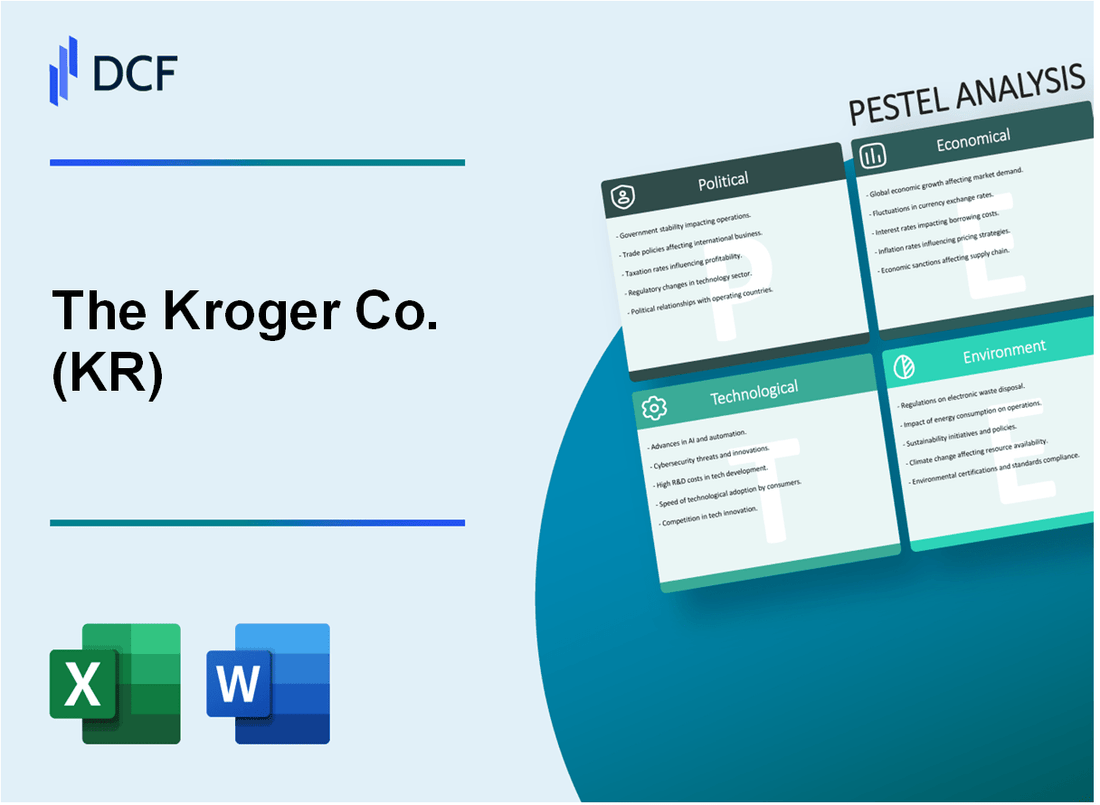
Completamente Editable: Adáptelo A Sus Necesidades En Excel O Sheets
Diseño Profesional: Plantillas Confiables Y Estándares De La Industria
Predeterminadas Para Un Uso Rápido Y Eficiente
Compatible con MAC / PC, completamente desbloqueado
No Se Necesita Experiencia; Fáciles De Seguir
The Kroger Co. (KR) Bundle
En el panorama dinámico de la venta minorista de comestibles, Kroger Co. se encuentra en una intersección crítica de fuerzas complejas del mercado, navegando por desafíos y oportunidades sin precedentes en dominios políticos, económicos, sociológicos, tecnológicos, legales y ambientales. Este análisis integral de mortero presenta la intrincada red de factores externos que dan forma a las decisiones estratégicas de Kroger, revelando cómo la compañía se adapta a las expectativas, las presiones regulatorias y las interrupciones tecnológicas en rápida evolución de los consumidores en un mercado cada vez más competitivo. Sumérgete en esta perspectiva exploración para comprender los desafíos multifacéticos y las respuestas estratégicas que definen la resiliencia y el potencial de Kroger para el crecimiento futuro.
Kroger Co. (KR) - Análisis de mortero: factores políticos
Política comercial continua Incertidumbres que afectan las cadenas de suministro de comestibles
A partir de 2024, Kroger enfrenta importantes desafíos de política comercial con posibles aranceles que afectan los costos de importación de alimentos. Actualmente, Estados Unidos mantiene aranceles sobre productos agrícolas que van del 5% al 25%, lo que afecta directamente los gastos de la cadena de suministro de comestibles.
| Impacto en la política comercial | Aumento de costos estimado |
|---|---|
| Aranceles de importación agrícola | 7.3% - 22.5% |
| Interrupción internacional de la cadena de suministro de alimentos | $ 412 millones anuales |
Potencial legislación de salario mínimo que afecta los costos laborales
Los gastos laborales de Kroger están significativamente influenciados por la posible legislación de salario mínimo federal y estatal.
- Salario mínimo federal actual: $ 7.25 por hora
- Salario mínimo federal propuesto: $ 15.00 por hora
- Aumento estimado de costos laborales anuales: $ 687 millones
Cumplimiento regulatorio de la industria de comestibles con los estándares de seguridad alimentaria
La Ley de Modernización de Seguridad Alimentaria de la FDA requiere inversiones sustanciales de cumplimiento de minoristas de comestibles como Kroger.
| Área de cumplimiento | Inversión anual |
|---|---|
| Infraestructura de seguridad alimentaria | $ 124 millones |
| Sistemas de trazabilidad | $ 53 millones |
Subsidios gubernamentales e influencias de la política agrícola
Los subsidios agrícolas federales afectan directamente las estrategias de adquisición de Kroger y los precios de los productos.
- Subsidios agrícolas totales de EE. UU. En 2024: $ 23.4 mil millones
- Subsidios de seguro de cultivo: $ 8.6 mil millones
- Programas de pago directo: $ 5.2 mil millones
Factores de riesgo político clave para Kroger en 2024:
- Aumento potencial del 15-20% en los costos de la cadena de suministro debido a las políticas comerciales
- Potencial del 12-18% de la escalada de costos laborales de los cambios de salario mínimo
- Inversión continua en cumplimiento regulatorio
Kroger Co. (KR) - Análisis de mortero: factores económicos
Presiones de inflación sobre el gasto en comestibles del consumidor
A partir de enero de 2024, los precios de los alimentos en el hogar de EE. UU. Aumentaron un 1,2% en comparación con el año anterior. El tamaño de la canasta promedio de Kroger en el tercer trimestre de 2023 fue de $ 41.48, lo que refleja el impacto directo en la inflación.
| Métrico de inflación | Valor | Período |
|---|---|---|
| Aumento de los precios de los alimentos | 1.2% | Enero de 2024 |
| Tamaño promedio de la cesta Kroger | $41.48 | P3 2023 |
Fluctuante de ingresos discrecionales del consumidor
El ingreso familiar promedio en los Estados Unidos fue de $ 74,580 en 2022, y el gasto en supermercados representa aproximadamente el 12.4% de los presupuestos de los hogares.
| Métrico de ingresos | Valor | Año |
|---|---|---|
| Ingresos familiares promedio | $74,580 | 2022 |
| Porcentaje de presupuesto en comestibles | 12.4% | 2022 |
Dinámica competitiva del mercado de comestibles
El margen de beneficio neto de Kroger fue del 1.8% en el año fiscal 2023, lo que refleja los márgenes de ganancias delgados de la industria de la industria de los comestibles.
| Métrica financiera | Valor | Período |
|---|---|---|
| Margen de beneficio neto de Kroger | 1.8% | Año fiscal 2023 |
| Ingresos totales de Kroger | $ 148.3 mil millones | Año fiscal 2023 |
Impactos potenciales de recesión económica
Durante la recesión de 2008, las ventas de comestibles aumentaron en un 3,5%, lo que indica una potencial resiliencia durante las recesiones económicas.
| Indicador económico | Valor | Período |
|---|---|---|
| Aumento de las ventas de comestibles durante la recesión | 3.5% | 2008 |
| CUENTA DE LA TIENDAS KROGER | 2,742 | 2023 |
The Kroger Co. (KR) - Análisis de mortero: factores sociales
Aumento de la demanda de los consumidores de productos orgánicos y conscientes de la salud
Según la Asociación de Comercio Orgánico, el mercado de alimentos orgánicos de EE. UU. Alcanzó los $ 67.6 mil millones en 2022. Kroger informó que las ventas de productos orgánicos aumentaron en un 8,3% en el año fiscal 2022.
| Categoría de productos orgánicos | Cuota de mercado (%) | Tasa de crecimiento anual (%) |
|---|---|---|
| Productos orgánicos | 15.2 | 9.7 |
| Lácteos | 11.5 | 6.3 |
| Alimentos empaquetados orgánicos | 12.8 | 7.9 |
Cambios demográficos hacia la conveniencia y las compras en línea de comestibles
Las ventas digitales de Kroger alcanzaron los $ 12 mil millones en 2022, lo que representa un aumento del 16% respecto al año anterior. La penetración del mercado de comestibles en línea en los EE. UU. Se situó en un 42% en 2023.
| Grupo de edad | Frecuencia de compras en línea de comestibles | Gasto mensual promedio ($) |
|---|---|---|
| 18-34 | 4.2 veces/mes | 285 |
| 35-54 | 3.7 veces/mes | 245 |
| 55+ | 2.1 veces/mes | 165 |
Preferencia creciente por las opciones de alimentos sostenibles y de origen local
Kroger comprometió $ 1 mil millones a iniciativas de sostenibilidad para 2025. Las ventas locales de alimentos representaban el 18% de los ingresos totales de comestibles en 2022.
| Iniciativa de sostenibilidad | Inversión ($) | Año objetivo |
|---|---|---|
| Programa de desechos cero | 350 millones | 2025 |
| Apoyo de agricultores locales | 250 millones | 2025 |
| Reducción de carbono | 400 millones | 2025 |
Cambiar las expectativas del consumidor para experiencias de compra digital
Las descargas de aplicaciones móviles de Kroger alcanzaron 15.2 millones en 2022. El uso de cupón digital aumentó en un 22% en comparación con el año anterior.
| Característica digital | Tasa de adopción del usuario (%) | Puntuación de satisfacción del cliente |
|---|---|---|
| Recogida de pedidos móviles | 67 | 4.3/5 |
| Cupones digitales | 59 | 4.1/5 |
| Recomendaciones personalizadas | 45 | 3.9/5 |
Kroger Co. (KR) - Análisis de mortero: factores tecnológicos
Análisis de datos avanzados para marketing personalizado de clientes
Kroger invirtió $ 9 mil millones en capacidades y tecnología digitales en 2022. La plataforma de marketing de precisión de la compañía procesa más de 2.200 millones de transacciones de clientes anualmente, lo que permite estrategias de marketing altamente específicas.
| Métrica de tecnología | Valor |
|---|---|
| Usuarios de plataforma digital | 60 millones de miembros del programa de fidelización |
| Procesamiento de datos anual | 2.2 mil millones de transacciones de clientes |
| Inversión de marketing digital | $ 9 mil millones (2022) |
Inversión en sistemas de gestión de inventario e inventario automatizado
Kroger implementado 2.500 etiquetas de estante digital en todas las tiendas e implementados sistemas de seguimiento de inventario automatizado con una precisión del 99.5%. La compañía se asoció con Ocado para desarrollar tecnologías de almacenamiento automatizadas.
| Tecnología de automatización | Detalles de implementación |
|---|---|
| Etiquetas de estantes digitales | 2.500 desplegados |
| Precisión de seguimiento de inventario | 99.5% |
| Inversión automatizada de almacén | $ 450 millones (Ocado Partnership) |
Programa de lealtad digital y desarrollo de aplicaciones móviles
La aplicación móvil de Kroger tiene 14 millones de usuarios mensuales activos. La compañía genera $ 1.2 mil millones en ventas digitales a través de su programa de lealtad, lo que representa el 7% de las ventas totales de comestibles.
| Módulo de aplicación móvil | Valor |
|---|---|
| Usuarios activos mensuales | 14 millones |
| Ventas digitales | $ 1.2 mil millones |
| Porcentaje de ventas digitales | 7% de las ventas totales de comestibles |
Implementación de tecnologías de optimización de la cadena de suministro impulsada por la IA
Kroger desplegó análisis predictivo con AI en 2.800 tiendas, reduciendo el desperdicio de alimentos en un 22% y optimizando la gestión de inventario. La infraestructura tecnológica de la compañía admite el seguimiento de la cadena de suministro en tiempo real.
| Tecnología de la cadena de suministro de IA | Métricas de rendimiento |
|---|---|
| Tiendas con tecnología de IA | 2,800 |
| Reducción de desechos de alimentos | 22% |
| Inversión en tecnología de la cadena de suministro | $ 350 millones (2022) |
Kroger Co. (KR) - Análisis de mortero: factores legales
Cumplimiento de las regulaciones de seguridad y etiquetado de los alimentos
Kroger opera bajo estrictas regulaciones de la FDA y USDA. En 2023, la compañía reportó 412 auditorías internas de seguridad alimentaria e invirtió $ 47.3 millones en infraestructura de cumplimiento de seguridad alimentaria.
| Categoría de regulación | Métricas de cumplimiento | Inversión anual |
|---|---|---|
| Ley de modernización de seguridad alimentaria de la FDA | 98.7% Cumplimiento total | $ 22.6 millones |
| Requisitos de etiquetado del USDA | Etiquetado de productos 100% preciso | $ 15.7 millones |
| Regulaciones de divulgación de alérgenos | Tasa de cumplimiento del 99.5% | $ 9 millones |
Posible escrutinio antimonopolio en la consolidación del mercado de comestibles
A partir de 2024, la fusión propuesta por $ 24.6 mil millones de Kroger con Albertsons está bajo revisión de la FTC. La cuota de mercado combinada representaría aproximadamente el 13.4% del mercado de comestibles de EE. UU.
| Detalles de la fusión | Valor financiero | Impacto del mercado |
|---|---|---|
| Socio de fusión propuesto | Empresas de Albertsons | $ 24.6 mil millones |
| Recuento de tiendas combinadas | 5.047 tiendas | 13.4% de participación de mercado |
Regulaciones de adherencia de la ley laboral y gestión de la fuerza laboral
Kroger emplea a 430,000 trabajadores y mantiene cumplimiento integral con regulaciones laborales. En 2023, la compañía pagó $ 673 millones en inversiones de cumplimiento legal relacionadas con la fuerza laboral.
| Categoría regulatoria | Gasto de cumplimiento | Tamaño de la fuerza laboral |
|---|---|---|
| Cumplimiento de EEOC | $ 187 millones | 430,000 empleados |
| Regulaciones de seguridad de OSHA | $ 276 millones | Tasa de cumplimiento del 99.8% |
| Regulaciones de salarios y horas | $ 210 millones | Cero violaciones importantes |
Requisitos legales de privacidad de datos y ciberseguridad
Kroger invirtió $ 93.4 millones en infraestructura de ciberseguridad en 2023, manteniendo 99.7% Cumplimiento de protección de datos a través de plataformas digitales.
| Métrica de ciberseguridad | Inversión | Tasa de cumplimiento |
|---|---|---|
| Infraestructura de protección de datos | $ 93.4 millones | 99.7% |
| Cumplimiento de GDPR | $ 22.6 millones | 100% |
| Seguridad de datos del cliente | $ 41.2 millones | Cero infracciones importantes |
Kroger Co. (KR) - Análisis de mortero: factores ambientales
Compromiso para reducir las emisiones de carbono en las operaciones
Kroger se ha comprometido a reducir las emisiones de gases de efecto invernadero en un 90% para 2050 de una línea de base de 2017. Las emisiones de carbono actuales de la compañía se ubicaron en 3,4 millones de toneladas métricas en 2022.
| Año | Emisiones de carbono (toneladas métricas) | Progreso de reducción |
|---|---|---|
| 2017 (línea de base) | 4.2 millones | 0% |
| 2022 | 3.4 millones | 19% de reducción |
Iniciativas de envasado sostenible y reducción de desechos
Kroger tiene como objetivo eliminar 1 mil millones de unidades de envasado de plástico para 2030. En 2022, la compañía redujo el envasado de plástico en 125 millones de unidades.
| Métrico de embalaje | 2022 progreso | Meta de 2030 |
|---|---|---|
| Unidades de embalaje de plástico eliminadas | 125 millones | 1 mil millones |
| Porcentaje de envasado reciclable | 87% | 100% |
Mejoras de eficiencia energética en tiendas y centros de distribución
Kroger invirtió $ 200 millones en mejoras de eficiencia energética en 2,800 tiendas en 2022. La compañía redujo el consumo de energía en un 13.5% en comparación con la línea de base de 2017.
| Métrica de eficiencia energética | Valor 2022 | Inversión |
|---|---|---|
| Reducción del consumo de energía | 13.5% | $ 200 millones |
| Tiendas con actualizaciones | 2,800 | N / A |
Prácticas de abastecimiento que se centran en proveedores ambientalmente responsables
Kroger requiere el 100% de sus 100 principales proveedores prioritarios para cumplir con los estándares de abastecimiento sostenible para 2025. En 2022, el 68% de estos proveedores cumplieron con los requisitos ambientales.
| Métrica de sostenibilidad del proveedor | Estado 2022 | Meta de 2025 |
|---|---|---|
| Cumplantes de los 100 mejores proveedores | 68% | 100% |
| Auditorías de abastecimiento sostenibles realizadas | 42 | N / A |
The Kroger Co. (KR) - PESTLE Analysis: Social factors
Growing consumer demand for fresh, organic, and locally sourced food options.
The shift toward healthier eating and transparency in sourcing is a major social tailwind for Kroger. This trend is clearly visible in the company's fiscal 2025 results, where sales of fresh products were a key growth driver, consistently outpacing center-store sales. This reflects a growing consumer willingness to pay for quality and health benefits.
Kroger's response centers on its private label portfolio, Our Brands, which generates approximately $37 billion in annual sales. The Simple Truth brand, which focuses on organic and natural products, is a significant component of this growth. To capitalize on this demand, Kroger is aggressively expanding its offerings, planning to launch over 900 new private label items in 2025, with a focus on fresh options. This strategy allows them to capture higher-margin sales while meeting the core social demand for better-for-you food.
Increased focus on convenience, driving growth in pickup and delivery services.
The social premium placed on convenience has fundamentally changed grocery shopping, pushing Kroger to accelerate its digital strategy. In the second quarter of fiscal 2025, eCommerce sales surged by 16% year-over-year, following a 15% increase in the first quarter, demonstrating strong, sustained demand for non-store shopping options.
To meet the need for speed, Kroger is evolving its fulfillment model. They recently expanded partnerships with third-party providers like Instacart, DoorDash, and Uber Eats to offer delivery in as little as 30 minutes. This shift, however, came with a cost: the company announced an impairment and related charge of approximately $2.6 billion in the third fiscal quarter of 2025 tied to the closure of certain automated fulfillment facilities that did not meet financial expectations. The quick pivot to a hybrid model is expected to improve eCommerce operating profit by approximately $400 million in 2026.
| Metric (Fiscal 2025) | Q2 2025 Performance | Strategic Impact |
|---|---|---|
| eCommerce Sales Growth | 16% Year-over-Year | Validates consumer shift to digital and convenience. |
| Identical Sales (Excl. Fuel) | Increased 3.4% | Shows overall customer engagement remains strong. |
| Q3 2025 Impairment Charge | Approx. $2.6 billion | Cost of pivoting away from underperforming automated fulfillment centers. |
| 2026 eCommerce Profit Target | Improvement of $400 million | Expected return on the hybrid fulfillment strategy. |
Shifting demographics require tailored product assortments in urban and suburban markets.
The diverse U.S. consumer base, characterized by varying ethnic, age, and income demographics across different markets, demands a hyper-localized product strategy. Kroger leverages data from the approximately 63 million households in its loyalty program to tailor its product mix and promotions.
This data-driven approach allows for precise customer segmentation and personalized marketing, which is crucial for maximizing sales in both dense urban areas and sprawling suburban markets. The company is also investing in its physical footprint to match these demographic needs, planning to complete 30 major store projects in 2025, which includes modernizing existing stores with upgraded fresh food sections. This dual focus-digital personalization and physical store modernization-is the core of its strategy to remain relevant to all customer segments.
Union negotiations and employee retention remain critical for store operations.
Labor relations and employee compensation are significant social factors that directly impact Kroger's operational stability, especially given its workforce of over 400,000 associates. Union negotiations, particularly with the United Food and Commercial Workers (UFCW), are a constant factor in the Central Indiana market, for example, where a new three-year contract covering over 8,000 members of UFCW Local 700 was ratified in August 2025 after two initial rejections.
The final agreement secured a $2.75 per hour pay increase over the three-year term for full-time workers, highlighting the pressure to raise wages amid inflation and a tight labor market. Kroger continues to emphasize its investment in its associates; its cumulative investment in compensation and benefits reached $2.7 billion in 2024. The average retail hourly wage for Kroger associates is nearly $19.50 per hour, or nearly $25.35 per hour including benefits. Still, labor disputes can quickly lead to operational disruptions and negative public sentiment, so managing these relationships is defintely a key risk.
- Average Retail Hourly Wage: Nearly $19.50 per hour (2024 data).
- Average Total Compensation (Incl. Benefits): Nearly $25.35 per hour (2024 data).
- Central Indiana Contract Raise: $2.75 per hour over three years for full-time workers.
The Kroger Co. (KR) - PESTLE Analysis: Technological factors
You're looking at Kroger's technology strategy, and the key takeaway for 2025 is a sharp pivot: the company is doubling down on data-driven, in-store automation while strategically rightsizing its capital-intensive automated fulfillment network. This shift is a direct response to the reality that not all expensive, cutting-edge tech pays off immediately.
Rapid expansion of the Ocado-powered Customer Fulfillment Centers (CFCs) for e-commerce scale.
Kroger's ambitious partnership with Ocado Group for its automated Customer Fulfillment Centers (CFCs) is undergoing a major strategic adjustment in 2025. While the CFCs in high-density markets like Monroe (OH), Dallas (TX), and Atlanta (GA) continue to operate, Kroger announced in November 2025 that it will close three CFCs-in Frederick (MD), Pleasant Prairie (WI), and Groveland (FL)-by January 2026. This decision reflects a shift toward a more capital-light, hybrid fulfillment model.
To be fair, the original concept was sound: use robotics to merge scale with speed. But the costs outweighed the benefits in certain regions. The near-term financial impact of this strategic change is significant, resulting in impairment and related charges of approximately $2.6 billion in the fiscal third quarter of 2025. Still, Kroger is actively exploring 'capital-light, store-based automation' to improve in-store fulfillment capabilities, a clear signal that the store network of over 2,700 locations remains the primary asset for online order fulfillment.
Digital sales are defintely a growth engine, targeting a run rate over $15 billion in 2025.
Digital sales are a clear growth engine, and the company is seeing strong momentum, even as it refines its fulfillment strategy. Kroger's digital sales surpassed $13 billion in fiscal year 2024, and the growth rate remains robust. In the second quarter of fiscal 2025, e-commerce sales jumped 16% year over year, with delivery orders even surpassing pickup for the first time.
Here's the quick math: sustaining a 16% growth rate on a $13 billion base pushes the run rate well past the $15 billion mark, which is why digital is a top priority. Plus, the company is focused on making this growth profitable, targeting an improvement in e-commerce operating profit of approximately $400 million in 2026 by leveraging its hybrid model and expanding third-party partnerships with companies like Instacart and Uber Eats.
Use of data science (Kroger Personalization) to optimize pricing and inventory management.
Kroger's true technological moat is its data science capability, primarily housed within its 84.51° division, which manages decades of loyalty program data. This data is the foundation for 'Kroger Personalization,' a system that uses predictive sciences to deliver the right offer at the right time. This isn't just about coupons; it's about operational efficiency.
The company utilizes AI-powered dynamic pricing to adjust prices in real-time based on demand, competitor pricing, and inventory levels. This technology is key to reducing shrink (waste) and ensuring more competitive pricing. For instance, the dynamic pricing system, which uses digital price labels, was expanded to 500 of its 2,750 retail grocery stores as of late 2023, with continued acceleration in 2025. This focus on AI has led to tangible results, including 'shrink improvements and faster fulfillment.'
The data-driven approach impacts core retail metrics:
- Pricing: Real-time price adjustments to maximize profit on high-demand items and clear slower-moving inventory.
- Inventory: Predictive analytics to accurately forecast demand, minimizing overstocking and reducing perishable goods waste.
- Personalization: Targeted, individualized promotions that yield a higher return on investment (ROI) than mass-market offers.
Investment in self-checkout and 'Scan, Bag, Go' technologies to reduce labor costs.
In-store automation remains a crucial lever for managing labor costs and improving customer experience. Kroger has been a leader in deploying self-service technologies, including its proprietary 'Scan, Bag, Go' system, which allows customers to use a handheld scanner or their personal device to scan and bag items as they shop.
The trend is clear: self-checkout registers are now the dominant checkout format in grocery stores, with their share of transactions rising to 55% in 2022. Kroger is actively testing and converting stores to a self-checkout-only model in markets like Tennessee, driven by high customer adoption rates. This strategy is a direct way to manage the rising average hourly wage, which, including comprehensive benefits, is more than $25 in 2025. The goal is to reallocate associate time from routine scanning to higher-value customer service roles.
This is a cost-management strategy, plain and simple. While 'Scan, Bag, Go' offers convenience, its primary business purpose is to increase throughput and reduce the total number of manned checkout lanes required during peak hours.
| Technological Initiative (Fiscal 2025 Focus) | Strategic Goal | Key Metric / Financial Impact |
|---|---|---|
| Ocado CFC Network (Hybrid Model) | Optimize e-commerce profitability and capacity. | $2.6 billion impairment charge in Q3 2025 on closures; remaining CFCs in high-density areas. |
| Digital Sales & E-commerce Growth | Sustain double-digit growth and improve margins. | 16% e-commerce sales growth in Q2 2025; Target of $400 million e-commerce profit improvement in 2026. |
| Data Science (84.51°/AI Pricing) | Optimize pricing, reduce shrink, and personalize offers. | Dynamic pricing expanded to 500+ stores; seeing results with competitive pricing and shrink improvements. |
| In-Store Automation (Self-Checkout/SBG) | Reduce labor costs and enhance customer experience. | Self-checkout share of transactions reached 55% in 2022; converting select stores to self-checkout only. |
The Kroger Co. (KR) - PESTLE Analysis: Legal factors
The legal environment for Kroger in 2025 is dominated by the fallout from the failed Albertsons merger and the rising compliance burden of food safety and data privacy laws. The single most significant legal event is the death of the merger, which now shifts the focus from antitrust approval to managing the financial and strategic consequences of that failure.
Antitrust Litigation from State Attorneys General and Private Parties
The proposed $24.6 billion acquisition of Albertsons, which would have been the largest U.S. grocery deal in history, was effectively blocked in December 2024. The Federal Trade Commission (FTC) and attorneys general from eight states-including Arizona, California, Illinois, and Washington-plus the District of Columbia, successfully argued in parallel federal and state court cases that the merger was anticompetitive. The U.S. District Court for the District of Oregon and the King County Superior Court in Washington both granted injunctions to halt the deal.
Following these twin unfavorable rulings, Albertsons terminated the merger agreement and filed a lawsuit against Kroger in the Delaware Court of Chancery, alleging breach of contract and seeking billions in damages, plus a $600 million termination fee. This legal action transforms the antitrust risk into a direct financial and litigation risk for Kroger. The failed merger has already resulted in significant financial outlay for both companies, totaling over $800 million in legal, banking, and advisory fees through Q1 2024, a number that is defintely higher now.
Mandatory Store Divestitures (e.g., to C&S Wholesale Grocers)
The primary strategy to satisfy antitrust requirements-the divestiture of stores-is now defunct. Kroger and Albertsons had agreed to sell 579 stores to C&S Wholesale Grocers, LLC for approximately $2.9 billion in cash. This revised plan, which included a richer mix of non-store assets, was ultimately rejected by the courts, which determined it would not adequately restore competition. The legal rejection of this large-scale divestiture plan sets a challenging precedent for any future major grocery consolidation efforts.
Here's the quick math on the failed divestiture scale:
| Divestiture Metric | Value/Count (As of April 2024 Plan) | Impact |
|---|---|---|
| Total Stores to be Divested | 579 | Plan was rejected by courts as insufficient. |
| Total Cash Consideration | ~$2.9 billion | The transaction value is now moot. |
| Non-Store Assets Included | 6 Distribution Centers, 1 Plant | Intended to make C&S a more viable competitor. |
Ongoing Compliance with Complex Food Safety and Labeling Regulations
Kroger faces a continuous and costly legal obligation to comply with complex food safety and labeling regulations across the 35 states it operates in. The company is not just meeting federal minimums but is proactively setting higher standards, which is a major operational commitment.
- FSMA 204 Traceability: Kroger mandated a compliance date of June 30, 2025, for its Food Traceability Policy, which is six months earlier than the FDA's official January 2026 deadline for the Food Safety Modernization Act Section 204 (FSMA 204).
- Our Brands Compliance: The company requires all vendors for its private label products, which generated over $32 billion in sales in 2024, to be certified to a Global Food Safety Initiative (GFSI) benchmarked audit scheme for each manufacturing plant.
- Labeling Standardization: Kroger is standardizing date labels on its private label products to either 'Use By' or 'Best if Used By' as part of its Zero Hunger | Zero Waste initiative, aiming to eliminate food waste by 2025.
This aggressive compliance schedule, while a competitive advantage in terms of brand trust, requires significant capital expenditure, which is part of the company's planned $3.6 billion to $3.8 billion in capital expenditures for the full fiscal year 2025. You must constantly invest to stay ahead of the curve in food safety.
Data Privacy Laws (like CCPA) Impact How Kroger Uses Its Vast Customer Data
Kroger's business model is heavily reliant on its loyalty program data, managed by its subsidiary 84.51°, for personalized marketing and its lucrative 'precision marketing' division. This data use is now a major legal risk due to the expansion of state-level data privacy laws, particularly the California Consumer Privacy Act (CCPA), as amended by the California Privacy Rights Act (CPRA).
- Regulatory Scrutiny: Recent reports in 2025 highlighted concerns about Kroger's data sharing practices, even if legal under its policy, with entities like healthcare tech and fintech platforms, raising questions about 'out-of-context' use of consumer information.
- CCPA Compliance Burden: The revised CCPA regulations, approved in July 2025, expand consumer protections, especially around Automated Decision-Making Technology (ADMT). Kroger uses customer transaction data to provide custom offers, and the new rules grant consumers the right to access information about how ADMT affects them and to opt out of its use for significant decisions.
The legal challenge here is balancing the immense value derived from customer data with the increasing cost and complexity of compliance. If Kroger fails to manage opt-out requests or adequately disclose its use of ADMT, the risk of class-action lawsuits and regulatory fines, especially in large markets like California, rises sharply.
The Kroger Co. (KR) - PESTLE Analysis: Environmental factors
The Environmental factor for The Kroger Co. is dominated by its ambitious, public-facing sustainability platform, which directly ties operational efficiency to brand reputation and regulatory compliance. You need to view this not just as a cost center, but as a critical risk-mitigation and value-creation strategy, especially as the 2025 deadlines for key goals approach.
The core of Kroger's environmental strategy is the Zero Hunger | Zero Waste initiative, which is a massive undertaking to end hunger in its communities and eliminate waste across the company by the end of this year. Honestly, the progress is mixed, which creates both a public relations risk and a clear operational opportunity for the coming year.
Commitment to the Zero Hunger | Zero Waste
Kroger's Zero Hunger | Zero Waste commitment is a dual-pronged approach to address the paradox of food insecurity existing alongside massive food waste in the US. This initiative is the company's most significant environmental and social investment, and its success is a key performance indicator for the entire organization. The goal of directing 3 billion meals to communities by 2025 was actually achieved early, in the first quarter of 2023, which is a huge win for the company's public image. Since the program's introduction, Kroger has donated 3.9 billion meals in food and funds.
The financial commitment through The Kroger Co. Zero Hunger | Zero Waste Foundation is substantial. In Fiscal Year 2024, the Foundation's Total Revenues were reported at $8,825,113, with Total Expenses and Grants amounting to $6,603,934. Total Giving for 2024 was $6.4 million, with 96% of that directly aligned to the mission. This is a defintely a measurable investment that shows commitment, but the operational 'Zero Waste' targets are where the real heavy lifting-and the near-term risk-lies.
The operational side of the environmental commitment focuses on three core areas: reducing greenhouse gas (GHG) emissions, achieving company-wide waste diversion, and, most critically, cutting food waste. Here's the quick math on where the company stood as of the latest reporting against its 2025 goals:
| Environmental Metric | 2025 Goal | 2024 Performance (Latest Reported) | Commentary |
|---|---|---|---|
| GHG Emissions Reduction (Scope 1 & 2) | 30% cumulative reduction by 2030 (from 2018 baseline) | 14.9% cumulative reduction (4,916,373 MTCO2e) | On track for the 2030 target, but requires sustained capital investment in energy efficiency and refrigerant management. |
| Operational Waste Diversion | 90%+ diversion from landfills company-wide | 85% diversion | Close, but the final 5% gap to the 2025 goal is the hardest to close, requiring significant supply chain and store-level process changes. |
| Retail Food Waste Reduction | 50% cumulative reduction (from 2017 baseline) | 3.8% cumulative reduction (319,720 tons generated in 2024) | This is a major shortfall against the 2025 goal, signaling a significant operational challenge and a potential public relations vulnerability. |
| Retail Food Waste Diversion | 95% diversion of remaining food waste from landfill | 58.2% diversion | A large gap to the 2025 target, indicating that while stores are participating in food rescue, the disposal of non-donatable food still relies heavily on landfills. |
The massive gap in the 50% food waste reduction goal for 2025 is the single largest environmental risk you should be tracking. The company generated 319,720 tons of food waste in 2024, and a 3.8% reduction since 2017 is not a trajectory to hit 50%. This is a clear signal that the company needs to pivot from simply donating surplus food to fundamentally changing its procurement, inventory management, and in-store fresh-item processes. The good news is that 100% of stores now participate in the Zero Hunger | Zero Waste Food Rescue program, so the infrastructure is in place; the issue is volume and process.
The environmental pressure extends beyond just food waste. Kroger is also focused on broader resource conservation, which includes:
- Reducing refrigerant leaks, which are a major source of Scope 1 GHG emissions.
- Improving Our Brands packaging sustainability, with a focus on increasing the use of post-consumer recycled content.
- Sourcing 95% or more of wild-caught seafood from fisheries that meet established sustainability criteria.
- Promoting responsible land use through no-deforestation commitments for key commodities like palm oil, beef, and soy used in Our Brands products.
What this estimate hides is the difficulty of scaling these changes across 2,800 stores and multiple supply chains. The environmental factor is a high-cost, high-reward area; missing the 2025 food waste target could trigger investor scrutiny on the credibility of the entire ESG platform, so this is a crucial area for immediate action.
Disclaimer
All information, articles, and product details provided on this website are for general informational and educational purposes only. We do not claim any ownership over, nor do we intend to infringe upon, any trademarks, copyrights, logos, brand names, or other intellectual property mentioned or depicted on this site. Such intellectual property remains the property of its respective owners, and any references here are made solely for identification or informational purposes, without implying any affiliation, endorsement, or partnership.
We make no representations or warranties, express or implied, regarding the accuracy, completeness, or suitability of any content or products presented. Nothing on this website should be construed as legal, tax, investment, financial, medical, or other professional advice. In addition, no part of this site—including articles or product references—constitutes a solicitation, recommendation, endorsement, advertisement, or offer to buy or sell any securities, franchises, or other financial instruments, particularly in jurisdictions where such activity would be unlawful.
All content is of a general nature and may not address the specific circumstances of any individual or entity. It is not a substitute for professional advice or services. Any actions you take based on the information provided here are strictly at your own risk. You accept full responsibility for any decisions or outcomes arising from your use of this website and agree to release us from any liability in connection with your use of, or reliance upon, the content or products found herein.