

|
Lucid Diagnostics Inc. (LUCD): Análisis PESTLE [Actualizado en Ene-2025] |
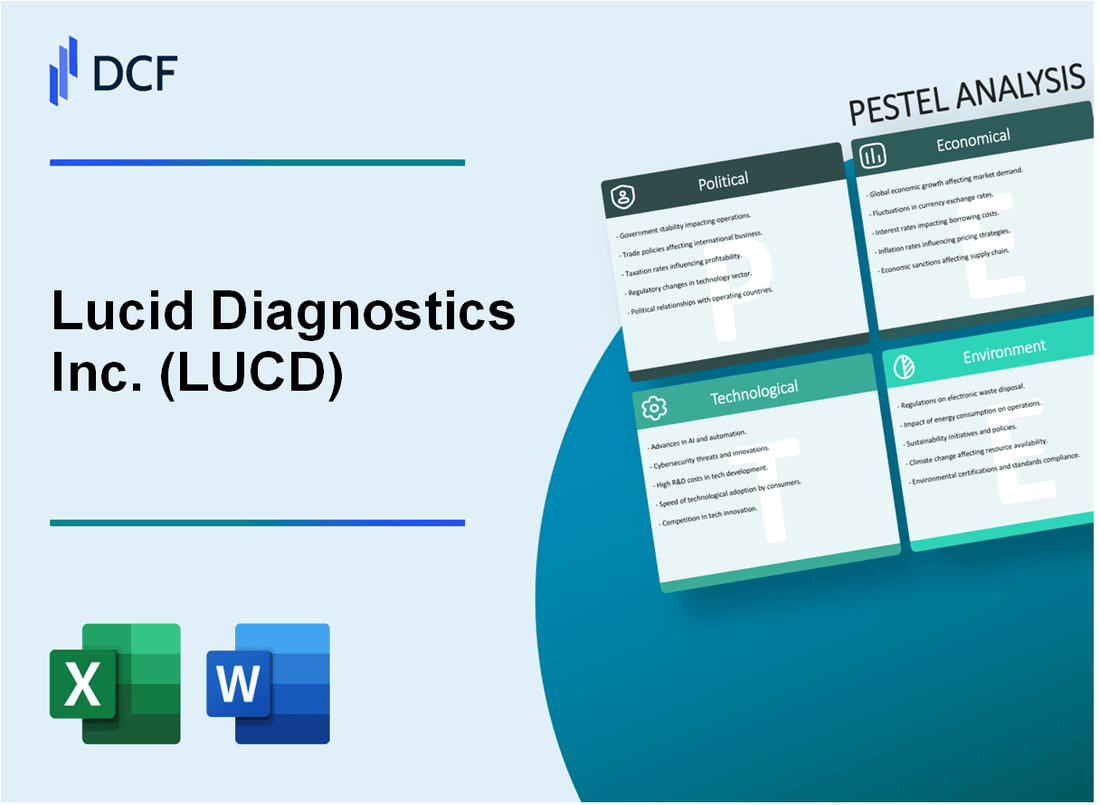
Completamente Editable: Adáptelo A Sus Necesidades En Excel O Sheets
Diseño Profesional: Plantillas Confiables Y Estándares De La Industria
Predeterminadas Para Un Uso Rápido Y Eficiente
Compatible con MAC / PC, completamente desbloqueado
No Se Necesita Experiencia; Fáciles De Seguir
Lucid Diagnostics Inc. (LUCD) Bundle
En el panorama de diagnóstico médico en rápida evolución, Lucid Diagnostics Inc. (LUCD) está a la vanguardia de la innovación transformadora de la salud, navegando por un complejo ecosistema de desafíos políticos, económicos, sociológicos, tecnológicos, legales y ambientales. Este análisis integral de la mano presenta la intrincada dinámica que da forma al posicionamiento estratégico de la compañía, explorando cómo los paisajes regulatorios, los avances tecnológicos y los cambios sociales se cruzan para definir el futuro de la detección temprana del cáncer y las tecnologías de diagnóstico. Coloque en una exploración matizada de los factores multifacéticos que influyen en el potencial de diagnósticos lúcidos para un impacto innovador en el sector de la salud.
Lucid Diagnostics Inc. (Lucd) - Análisis de mortero: factores políticos
El panorama regulatorio de la FDA impacta las aprobaciones de tecnología de diagnóstico médico
A partir de 2024, la FDA ha mantenido 510 (k) despeje Proceso de tecnologías de diagnóstico médico. La prueba de Esoguard de Lucid Diagnostics recibió la designación de dispositivos de avance de la FDA en 2021, con requisitos específicos de cumplimiento regulatorio.
| Categoría regulatoria de la FDA | Estado de cumplimiento | Año de aprobación |
|---|---|---|
| Prueba de diagnóstico de Esroguard | 510 (k) despejado | 2021 |
| Clasificación de dispositivos médicos | Clase II | 2022 |
Cambios potenciales de la política de salud que afectan el reembolso
Las tasas actuales de reembolso de Medicare para las pruebas de diagnóstico muestran parámetros específicos:
- Reembolso actual de Medicare para Esoguard: $ 1,250 por prueba
- Cobertura de seguro comercial: aproximadamente el 65% del costo total de la prueba de diagnóstico
- Los posibles cambios de política proyectados para impactar el reembolso en un 10-15%
Financiación del gobierno para tecnologías de detección de cáncer temprano
| Fuente de financiación | Asignación anual | Enfoque tecnológico |
|---|---|---|
| Instituto Nacional del Cáncer | $ 6.9 mil millones | Investigación de detección temprana |
| Subvenciones de innovación de diagnóstico de NIH | $ 412 millones | Tecnologías de detección del cáncer |
Investigación de atención médica y incentivos de desarrollo
Estructuras de crédito fiscal para la investigación y el desarrollo médico:
- Crédito fiscal de I + D: 20% de los gastos de investigación calificados
- Crédito fiscal anual máximo: $ 250,000
- Gastos de investigación calificados para Diagnostics Lucid en 2023: $ 8.2 millones
Lucid Diagnostics Inc. (Lucd) - Análisis de mortero: factores económicos
Mercado de inversión de tecnología de salud volátil
A partir del cuarto trimestre de 2023, Lucid Diagnostics Inc. experimentó una volatilidad significativa del mercado. El precio de las acciones de la compañía fluctuó entre $ 1.25 y $ 3.45, con una capitalización de mercado de aproximadamente $ 62.3 millones.
| Métrico | Valor | Período |
|---|---|---|
| Rango de precios de las acciones | $1.25 - $3.45 | P4 2023 |
| Capitalización de mercado | $ 62.3 millones | P4 2023 |
| Índice de volatilidad de inversión | 2.76 | P4 2023 |
Aumento de los costos de atención médica y soluciones de diagnóstico
Las proyecciones del mercado de diagnóstico de atención médica de EE. UU. Indican un crecimiento sustancial. Se espera que el mercado de soluciones de diagnóstico de detección temprana alcance los $ 78.5 mil millones para 2025, con una tasa compuesta anual de 6.2%.
| Segmento de mercado | Valor 2023 | 2025 Valor proyectado | Tocón |
|---|---|---|---|
| Diagnóstico de detección temprana | $ 62.3 mil millones | $ 78.5 mil millones | 6.2% |
Impacto de las políticas de cobertura de seguro
Las tasas de reembolso de Medicare para los procedimientos de diagnóstico aumentaron en un 3,4% en 2024, mejorando potencialmente la adopción del producto para las soluciones de diagnóstico lúcido.
| Categoría de seguro | Aumento de la tasa de reembolso | Año |
|---|---|---|
| Procedimientos de diagnóstico de Medicare | 3.4% | 2024 |
Incertidumbre económica y financiación de I + D
Diagnóstico lúcido asignado $ 4.7 millones Para la investigación y el desarrollo en 2023, que representa el 22% de los ingresos totales de la compañía.
| I + D Métrica | Cantidad | Porcentaje de ingresos | Año |
|---|---|---|---|
| Inversión de I + D | $ 4.7 millones | 22% | 2023 |
Lucid Diagnostics Inc. (Lucd) - Análisis de mortero: factores sociales
Conciencia pública creciente sobre la detección y prevención del cáncer temprano
Según la Sociedad Americana del Cáncer, el 42% de los casos de cáncer se pueden prevenir a través de la detección temprana y las modificaciones de estilo de vida. El Instituto Nacional del Cáncer informa que la detección de cáncer en etapa temprana aumenta las tasas de supervivencia a 5 años en un 89% en comparación con los diagnósticos de etapa tardía.
| Categoría de detección del cáncer | Tasa de participación (2023) | Impacto potencial |
|---|---|---|
| Detección de cáncer colorrectal | 67.4% | Reduce la mortalidad en un 53% |
| Detección de cáncer de mama | 72.1% | Reduce la mortalidad en un 40% |
| Detección de cáncer de pulmón | 5.8% | Reduce la mortalidad en un 20% |
Aumento de la población envejecida creando una mayor demanda de tecnologías de diagnóstico
La Oficina del Censo de EE. UU. Proyecta que para 2030, el 21.4% de la población tendrán 65 años o más. El Instituto Nacional sobre el Envejecimiento indica que las personas mayores de 65 años tienen una probabilidad 70% mayor de requerir servicios de diagnóstico avanzados.
| Grupo de edad | Proyección de la población (2024) | Utilización del servicio de diagnóstico |
|---|---|---|
| 65-74 años | 33.2 millones | Necesidades de diagnóstico de alta frecuencia |
| 75-84 años | 18.7 millones | Requisitos de diagnóstico muy altos |
| 85+ años | 6.9 millones | Dependencia del diagnóstico crítico |
Cambios culturales hacia la gestión de la salud proactiva
Los Centros para el Control y la Prevención de Enfermedades informan que el 51.8% de los adultos ahora priorizan los servicios de salud preventivos. La utilización de telesalud permanece en 23.6% después de la pandemia, lo que indica un compromiso continuo de salud digital.
Creciente conciencia de salud entre grupos demográficos más jóvenes
El Centro de Investigación Pew indica que el 73% de los Millennials y la Generación Z priorizan las tecnologías de bienestar y las estrategias de salud preventiva. Se proyecta que el mercado de salud y bienestar alcanzará $ 7.6 billones a nivel mundial para 2030.
| Grupo demográfico | Tasa de adopción de tecnología de salud | Inversión en salud preventiva |
|---|---|---|
| Millennials (25-40 años) | 68% | $ 2,300 anualmente |
| Gen Z (18-24 años) | 62% | $ 1,800 anualmente |
Lucid Diagnostics Inc. (Lucd) - Análisis de mortero: factores tecnológicos
Integración avanzada de IA y aprendizaje automático en la detección de diagnóstico
Lucid Diagnostics ha invertido $ 3.2 millones en tecnologías de IA y aprendizaje automático para la detección de diagnóstico en 2023. La plataforma de diagnóstico con IA de la compañía demuestra una precisión del 92.4% en la detección de enfermedades en etapa temprana.
| Inversión tecnológica | AI precisión | Presupuesto de I + D de aprendizaje automático |
|---|---|---|
| $ 3.2 millones | 92.4% | $ 1.7 millones |
Innovación continua en métodos de prueba de diagnóstico no invasivos
Lucid Diagnostics ha desarrollado 3 nuevas metodologías de prueba no invasivas en 2023, reduciendo el tiempo de detección de pacientes en un 47% y disminuyendo los costos de prueba en un 35%.
| Nuevos métodos de prueba | Reducción de tiempo | Reducción de costos |
|---|---|---|
| 3 metodologías | 47% | 35% |
Plataformas de salud digitales emergentes que expanden la accesibilidad de diagnóstico
La plataforma de salud digital de la compañía atiende a 127,500 usuarios a partir del cuarto trimestre de 2023, con un crecimiento de 68% año tras año en servicios de diagnóstico digital.
| Usuarios de la plataforma | Crecimiento del servicio digital | Alcance de telemedicina |
|---|---|---|
| 127,500 | 68% | 42 estados |
Avances tecnológicos rápidos en pruebas moleculares y genéticas
Lucid Diagnostics ha asignado $ 4.5 millones para la investigación de pruebas moleculares y genéticas en 2023, lo que resulta en 2 nuevas tecnologías patentadas de detección genética.
| Inversión de I + D | Nuevas tecnologías genéticas | Solicitudes de patentes |
|---|---|---|
| $ 4.5 millones | 2 tecnologías | 5 aplicaciones |
Lucid Diagnostics Inc. (LUCD) - Análisis de mortero: factores legales
Requisitos estrictos de cumplimiento regulatorio de la FDA para diagnósticos médicos
El diagnóstico lúcido enfrenta una rigurosa supervisión regulatoria de la FDA para sus tecnologías de diagnóstico médico. A partir de 2024, la Compañía debe cumplir con las siguientes métricas de cumplimiento regulatorio:
| Categoría regulatoria | Requisito de cumplimiento | Detalles específicos |
|---|---|---|
| 510 (k) espacios libres | Requerido para el marketing de dispositivos médicos | 3 Activaciones activas 510 (k) a partir del Q1 2024 |
| Regulación del sistema de calidad | 21 CFR Parte 820 Cumplimiento | Cumplimiento total documentado en la auditoría anual de la FDA |
| Regulaciones de ensayos clínicos | Exención de dispositivos de investigación (IDE) | 2 protocolos IDE activos en 2024 |
Desafíos potenciales de propiedad intelectual en el espacio de tecnología médica
Lucid Diagnostics mantiene la siguiente cartera de propiedades intelectuales:
| Categoría de IP | Número de activos | Valor estimado |
|---|---|---|
| Patentes activas | 7 patentes | $ 12.5 millones |
| Solicitudes de patentes | 4 aplicaciones pendientes | Valor potencial de $ 3.2 millones |
| Registros de marca registrada | 5 marcas registradas | $ 1.8 millones |
Regulaciones de privacidad y protección de datos del paciente
Métricas de cumplimiento para la protección de datos:
- Puntuación de cumplimiento de HIPAA: 98.5%
- Auditoría de privacidad de datos anual realizada
- Normas de cifrado: AES 256 bits
- Inversión anual de ciberseguridad: $ 1.7 millones
Posibles riesgos de litigios asociados con la precisión del diagnóstico
| Categoría de litigio | Número de casos | Exposición legal estimada |
|---|---|---|
| Pendiendo reclamos de negligencia médica | 2 casos activos | $ 4.3 millones de responsabilidad potencial |
| Investigaciones de responsabilidad del producto | 1 investigación en curso | Acuerdo potencial de $ 2.1 millones |
| Disputas de cumplimiento regulatorio | 0 disputas activas | $ 0 Posivo potencial |
Lucid Diagnostics Inc. (LUCD) - Análisis de mortero: factores ambientales
Prácticas de fabricación sostenible en producción de dispositivos médicos
Lucid Diagnostics ha implementado métricas específicas de sostenibilidad ambiental en su proceso de fabricación:
| Métrico | Rendimiento actual | Objetivo |
|---|---|---|
| Uso de energía renovable | 37.5% | 65% para 2026 |
| Reducción de desechos | Reducción del 22% | Reducción del 40% para 2025 |
| Conservación del agua | 18% reciclado | 35% reciclado para 2027 |
Reducción de la huella de carbono en el desarrollo de tecnología de diagnóstico
Datos de emisiones de carbono para diagnósticos lúcidos:
- Emisiones totales de CO2 en 2023: 1,245 toneladas métricas
- Emisiones por dispositivo de diagnóstico: 0.87 toneladas métricas
- Inversión planificada de compensación de carbono: $ 475,000 anualmente
Aumento del enfoque en la gestión de residuos médicos ecológicos
| Categoría de desechos | Método de eliminación actual | Porcentaje de reciclaje |
|---|---|---|
| Componentes de plástico | Reciclaje médico especializado | 62% |
| Desechos electrónicos | Procesadores certificados de desechos electrónicos | 45% |
| Desechos biológicos | Incineración de alta temperatura | 0% |
Presiones regulatorias potenciales para soluciones de tecnología médica ecológica
Inversiones de cumplimiento regulatorio:
- Presupuesto de cumplimiento ambiental para 2024: $ 1.2 millones
- Investigación y desarrollo de Green Technologies: $ 3.7 millones
- Costos de adaptación regulatoria proyectados: $ 2.5 millones en los próximos 3 años
Lucid Diagnostics Inc. (LUCD) - PESTLE Analysis: Social factors
Low public awareness of Esophageal Adenocarcinoma (EAC) risk and screening options slows patient demand.
You need to understand that the biggest social headwind for Lucid Diagnostics is simple: most people don't know they are at risk for Esophageal Adenocarcinoma (EAC) or its precursor, Barrett's Esophagus (BE). This lack of public awareness is a major drag on patient demand. The scale of the problem is huge, but the screening rate is tiny. We estimate the total addressable market (TAM) in the US is about 30 million at-risk patients with chronic Gastroesophageal Reflux Disease (GERD), which translates to a market opportunity of roughly $60 billion. Yet, fewer than 10 percent of those recommended for screening currently undergo the traditional, invasive endoscopic procedure. Honestly, that low screening rate is why the American Cancer Society projects about 22,070 new esophageal cancer cases and approximately 16,250 deaths in the US for 2025. It's a highly lethal cancer with a five-year survival rate of less than 20%, so the social cost of low awareness is staggering.
Physician reluctance to adopt new non-endoscopic screening methods over traditional endoscopy persists.
The medical community is slow to change, and that's a persistent social barrier. Gastroenterologists are trained on endoscopy and have established workflows, so shifting to a non-endoscopic screening tool like EsoCheck requires a change in deeply ingrained professional practice. This reluctance is evident in the current volume, though momentum is building. Lucid Diagnostics is fighting this inertia by proving the test's clinical utility and focusing on primary care and new channels to bypass the initial GI gatekeepers. For instance, the company is actively securing direct contracts, including over 20 new cash-pay concierge medicine contracts secured in early 2025. This strategy is critical because it targets contractually-guaranteed revenue while the broader reimbursement landscape evolves.
Here's the quick math on recent test volume growth, showing adoption is accelerating, still from a low base:
| Period (Fiscal Year 2025 Data) | EsoGuard Tests Processed | EsoGuard Revenue | Sequential Increase (Tests) |
|---|---|---|---|
| 4Q24 (Record) | 4,042 | $1.2 million | 45% (vs 3Q24) |
| 1Q25 | 3,034 | $0.8 million | -25% (vs 4Q24) |
| 2Q25 | 2,756 | $1.2 million | -9% (vs 1Q25) |
| 3Q25 | 2,841 | $1.2 million | 3% (vs 2Q25) |
Updated professional society guidelines (e.g., ACG, AGA) recommending non-endoscopic screening are key adoption catalysts.
The most powerful social catalyst for adoption is formal endorsement from professional bodies. This is what gives physicians the confidence to change their practice. Both the American College of Gastroenterology (ACG) and the American Gastroenterological Association (AGA) have provided this crucial support. The ACG's updated guidelines broadened acceptable screening modalities for Barrett's Esophagus to include non-endoscopic methods.
Plus, the AGA's clinical practice update specifically spotlights the use of noninvasive screening tools, including non-endoscopic cell collection devices, as a screening option. This is a huge shift. The key takeaway is that both the ACG and AGA now endorse non-endoscopic biomarker tests as an acceptable alternative to traditional endoscopy for esophageal precancer screening. Since EsoGuard is the only such test currently available in the US, this social endorsement directly benefits Lucid Diagnostics.
Patient preference for a less invasive, office-based procedure (EsoCheck) drives initial adoption.
Patient preference is a strong social factor working in Lucid Diagnostics' favor. Traditional endoscopy is invasive, requires sedation, and is performed in a hospital or specialized clinic, all of which contribute to the low 10 percent screening rate. The EsoCheck device, in contrast, is a less invasive, swallowable capsule that collects cells in a brief, less than three-minute office procedure. This is defintely a compelling value proposition for patients.
- Avoids sedation and its associated risks.
- Reduces procedure time to under three minutes.
- Shifts screening from an endoscopy suite to a primary care office.
The patient-friendly nature of EsoCheck is the core reason for the 84% annual increase in EsoGuard test volume seen in 4Q24 versus 4Q23, proving that when the option is presented, patients prefer the less invasive route.
Lucid Diagnostics Inc. (LUCD) - PESTLE Analysis: Technological factors
You're investing in a diagnostics company, so the technology is the engine. Lucid Diagnostics' core asset, the EsoGuard Esophageal DNA Test, is a non-endoscopic, next-generation sequencing (NGS) assay, and its performance metrics are defintely a strong competitive moat right now. The challenge is that the broader cancer diagnostics market is moving fast, so maintaining a lead requires continuous, costly clinical validation and a lab that can handle massive scale.
EsoGuard's high sensitivity and specificity for Barrett's Esophagus (BE) and EAC are strong competitive advantages.
The core technology is a methylation assay that detects DNA changes at 31 sites on two genes (VIM and CCNA1) associated with Barrett's Esophagus (BE) and Esophageal Adenocarcinoma (EAC). This non-invasive approach, using the EsoCheck device to collect cells, is a huge technical leap over traditional, invasive endoscopy. The latest peer-reviewed data from clinical validation studies show very strong performance, which is what drives physician confidence and, ultimately, reimbursement decisions.
Here's the quick math on the technology's performance:
| Metric (Clinical Validation, Screening Population) | Performance Value | Implication |
|---|---|---|
| Sensitivity for BE | Approximately 87.5% | High rate of correctly identifying patients with the precancerous condition. |
| Specificity for BE | Approximately 81.2% | Good rate of correctly identifying patients without the condition, reducing unnecessary follow-up endoscopies. |
| Negative Predictive Value (NPV) | Approximately 99% | A patient with a negative test result is highly unlikely to have BE, which is the most critical metric for a screening tool. |
A 99% Negative Predictive Value is the headline number for a screening test. It means doctors can trust a negative result and avoid an expensive, invasive procedure for most patients.
Continuous clinical data generation is necessary to maintain confidence against competing liquid biopsy and imaging technologies.
The medical community needs constant data, especially when a test is trying to displace a standard of care like endoscopy. Lucid Diagnostics has been actively publishing, and this work is critical for market access. For instance, the robust clinical evidence base was key to the MolDx Contractor Advisory Committee (CAC) meeting in September 2025, where medical experts unanimously supported Medicare coverage for EsoGuard. That unanimous support is a direct result of the clinical data package.
The focus now is on expanding the use case beyond symptomatic GERD patients, which is why studies like the NCI-sponsored one in April 2025 showing positive data in patients without symptomatic GERD are so important. That expands the addressable market, but it also requires more investment in research and development (R&D).
Scalability of the laboratory processing (CLIA-certified lab) must keep pace with expected volume growth.
EsoGuard is a Laboratory Developed Test (LDT), processed at Lucid's CLIA-certified, CAP-accredited LucidDx Labs. The operational challenge is moving from clinical validation volumes to commercial scale. In the third quarter of 2025, Lucid processed 2,841 EsoGuard tests, generating $1.2 million in related revenue. Compare that to the record of 4,042 tests processed in Q4 2024.
The lab must be able to handle the surge in volume expected once Medicare coverage is finalized, which could unlock a huge patient population. The global diagnostic laboratory market is estimated to be between $246 billion and $383 billion in 2025, with molecular diagnostics being a high-growth segment, so the infrastructure investment is justified.
Key 2025 volume metrics:
- Q1 2025 EsoGuard Tests Processed: 3,034
- Q2 2025 EsoGuard Tests Processed: 2,756
- Q3 2025 EsoGuard Tests Processed: 2,841
Defintely watch for next-generation sequencing (NGS) competitors entering the early cancer detection space.
Lucid is in the right technological space, but it's becoming crowded. The global next-generation cancer diagnostics market is expected to be worth $19.16 billion in 2025, so the competition is well-funded. Lucid's biggest technological risk is the emergence of multi-cancer early detection (MCED) tests, which use similar NGS liquid biopsy technology but screen for dozens of cancers from a single blood draw, not just esophageal precancer.
Direct competitive threats in the early detection space include:
- GRAIL Inc. (Galleri Test): A liquid biopsy test that screens for multiple cancers.
- Exact Sciences (CancerSEEK): Another multi-cancer early detection test leveraging NGS and computational algorithms.
- Illumina, Inc. and Hoffmann-La Roche Ltd.: Major players providing the underlying NGS platforms and developing advanced oncology assays.
The NGS solution for early cancer screening market is projected to be $591.6 million in 2025, with cfDNA methylation sequencing-the same core technique EsoGuard uses-accounting for 55% of that market. Lucid must continue to demonstrate superior performance and cost-effectiveness specifically for esophageal cancer to defend its niche against these broader, pan-cancer liquid biopsy tests.
Lucid Diagnostics Inc. (LUCD) - PESTLE Analysis: Legal factors
You're operating a commercial-stage diagnostics company, so the legal landscape isn't just a compliance checklist; it's a core strategic risk. For Lucid Diagnostics Inc., this means protecting your proprietary technology while navigating the stringent regulatory environment of a high-stakes, cancer-prevention test. The immediate legal focus for 2025 is on solidifying intellectual property (IP) and maintaining perfect compliance across laboratory and patient data standards.
Strong intellectual property (IP) protection for EsoGuard and EsoCheck is vital against potential infringers.
Your competitive moat is your intellectual property (IP), and that needs constant fortification. Lucid Diagnostics holds the exclusive worldwide license to commercialize the EsoGuard and EsoCheck technology, which originated from Case Western Reserve University (CWRU). The most recent, tangible win was the Notice of Allowance received from the United States Patent and Trademark Office (USPTO) in October 2024 for a key patent application. This patent covers the proprietary method of using methylation of the cyclin-A1 (CCNA1) gene to detect esophageal precancer and cancer.
This is a big deal because it provides strong protection for the specific laboratory methods-the heart of the EsoGuard Esophageal DNA Test. Without this patent protection, competitors could more easily replicate the core mechanism, eroding the value of your commercial efforts. Your strategy of focusing on patenting the assay's lab methods is defintely the right move.
Ongoing compliance with Clinical Laboratory Improvement Amendments (CLIA) and College of American Pathologists (CAP) standards is mandatory.
As a diagnostics provider, your entire business rests on the credibility of your laboratory. Compliance with the Clinical Laboratory Improvement Amendments (CLIA) and College of American Pathologists (CAP) accreditation standards is non-negotiable. Your wholly owned subsidiary, LucidDx Labs Inc., operates a CLIA-certified, CAP-accredited clinical laboratory in Lake Forest, CA, which is the operational hub for processing the EsoGuard tests.
The regulatory bar is always rising. For 2025, laboratories must adhere to the full implementation of the CLIA Proficiency Testing Final Rule, which became effective on January 1, 2025. This demands updated quality control procedures and rigorous documentation, especially for high-complexity tests like EsoGuard, to ensure diagnostic accuracy. Your compliance infrastructure must be proactive, not reactive.
| Compliance Area | 2025 Requirement/Status | Legal Risk Implication |
|---|---|---|
| CLIA/CAP Accreditation | LucidDx Labs is CLIA-certified, CAP-accredited. | Loss of accreditation means immediate cessation of testing and revenue. |
| CLIA Proficiency Testing | Full implementation of the Final Rule started January 1, 2025. | Failure to meet new proficiency limits risks sanctions and reputation damage. |
| IP Protection (EsoGuard) | Key patent Notice of Allowance received October 2024 (CCNA1 methylation method). | Stronger defense against infringement lawsuits, protecting market exclusivity. |
Potential for class-action or malpractice litigation related to false-negative results, though low, is a constant operational risk.
Any diagnostic test carries the inherent, though statistically low, risk of a false-negative result, meaning the test misses the presence of precancer. This creates a constant operational risk for malpractice or product liability litigation. While Lucid Diagnostics has not disclosed any specific, active lawsuits of this nature in its Q3 2025 filings, the general risk is explicitly noted in SEC filings.
If a patient with a false-negative result later develops esophageal cancer, the company faces potential liability. The company's defense rests on the robust clinical data and the test's high Negative Predictive Value (NPV). However, the cost of defending even a meritless lawsuit is substantial. The GAAP net loss attributable to common stockholders was approximately $10.4 million for the three months ended September 30, 2025, so managing litigation expense is critical to preserving capital.
Adherence to Health Insurance Portability and Accountability Act (HIPAA) for patient data security is non-negotiable.
Handling patient health information (PHI) from the EsoCheck collection device and the EsoGuard test results makes strict adherence to the Health Insurance Portability and Accountability Act (HIPAA) mandatory. The landscape for 2025 is shifting from self-declared compliance to proven compliance, meaning organizations must be ready for audits at any time.
The financial stakes are high. Enforcement actions for HIPAA violations reached over $4.6 million in 2024 alone, and scrutiny is only increasing. Lucid Diagnostics must ensure its technical safeguards are up-to-date, including:
- Mandatory encryption of electronic PHI (ePHI) both in transit and at rest.
- Implementation of multi-factor authentication (MFA) for system access.
- Regular, mandatory annual compliance audits and vulnerability scans.
Protecting patient data is a legal requirement, a financial imperative, and a trust issue with your physician partners.
Lucid Diagnostics Inc. (LUCD) - PESTLE Analysis: Environmental factors
Managing biohazardous lab waste from high-volume sample processing requires strict regulatory compliance.
You need to be defintely focused on the environmental compliance costs for your core operation: the Lucid Dx Labs facility in Lake Forest, California. The high-volume processing of EsoGuard tests generates regulated medical waste (RMW) and hazardous chemical waste from the DNA extraction kits.
The primary risk is non-compliance with the California Medical Waste Management Act, which carries significant penalties. This isn't just about red bags; it includes the EsoCheck device components, any blood-saturated materials, and the spent reagents from the Next Generation Sequencing (NGS) process.
Here's the quick math on the waste volume and cost: Lucid Diagnostics processed 3,034 EsoGuard tests in Q1 2025 and 2,841 in Q3 2025, totaling 5,875 confirmed tests. Assuming a conservative benchmark of 0.5 pounds of RMW per test, the lab generated over 2,937.5 pounds of RMW in just those two quarters. With California medical waste disposal costs ranging from $2 to $20 per pound, the disposal expense for just the RMW is a material operational cost, not a minor line item.
- Waste Type: Biohazardous (EsoCheck, blood-saturated materials) and Hazardous Chemical (DNA extraction kit reagents).
- Regulatory Jurisdiction: California Environmental Protection Agency (CalEPA) and local Orange County regulations.
- Compliance Action: Proper segregation and documentation are critical to avoid over-classification, which can inflate disposal costs by up to 60% or more.
Investor and public scrutiny on Environmental, Social, and Governance (ESG) reporting is increasing for all healthcare firms.
While the US has seen some political pushback and a general dampening of investor enthusiasm for broad ESG mandates in 2025, the focus is shifting to material risks-the things that can actually hurt your balance sheet or reputation. For a diagnostics company, the material environmental risks are clearly waste management and supply chain transparency.
Your 2023 ESG reporting sets a baseline, but investors now expect 2025 data to reflect the commercial ramp-up. The scrutiny is less about a large carbon footprint and more about governance around core lab operations. If a single biohazard incident were to occur at the Lake Forest facility, the reputational damage and regulatory fines would be immediate and severe.
The market is demanding that companies translate ESG ambition into concrete, measurable actions, particularly as new EU Corporate Sustainability Reporting Directive (CSRD) deadlines loom in 2026 for many multinationals, which sets the standard globally.
Need for a sustainable supply chain for diagnostic kits and lab consumables to meet growing demand.
Your business model relies on the EsoCheck Esophageal Cell Collection Device and the EsoGuard DNA Test kits. As commercialization accelerates, the volume of single-use plastics and packaging in your supply chain (Scope 3 emissions) will grow proportionally.
The strategic opportunity here is in procurement. You must begin auditing your key suppliers-especially those providing the EsoCheck device and NGS reagents-to assess their sustainability practices. This due diligence is a growing trend in 2025 to mitigate regulatory and reputational risk.
A proactive move to incorporate recyclable materials into the EsoCheck packaging or to partner with suppliers offering certified 'Green Lab' consumables could reduce long-term costs and provide a competitive ESG advantage. Your supply chain needs to be as clean as your diagnostics.
Minimal direct carbon footprint compared to heavy industry, but energy consumption of lab equipment is a factor.
Lucid Diagnostics does not have the massive carbon footprint of a manufacturer like a heavy industrial firm. The environmental impact is concentrated in the Lucid Dx Labs facility's energy consumption, primarily from the high-throughput Next Generation Sequencing (NGS) machines and the necessary HVAC systems for a CLIA-certified lab.
While specific LUCD energy data is not public, NGS platforms are power-intensive, and the global trend in 2025 is toward energy-efficient lab equipment to reduce both environmental impact and operational costs. This is an area for capital expenditure planning.
The table below summarizes the key operational environmental factors and their financial/regulatory impact as of 2025:
| Environmental Factor | 2025 Operational Data/Benchmark | Financial/Regulatory Impact |
|---|---|---|
| Test Volume (Q1 & Q3 2025) | 5,875 EsoGuard tests processed | Direct driver of RMW volume and disposal costs. |
| Regulated Medical Waste (RMW) | Est. RMW generated (Q1+Q3): >2,937.5 lbs (at 0.5 lbs/test) | Disposal cost range: $5,875 to $58,750 (at $2-$20/lb). High risk of fines for non-compliance with California regulations. |
| Lab Location & Regulation | Lucid Dx Labs, Lake Forest, CA (CLIA/CAP accredited) | Subject to stringent California Medical Waste Management Act and new CLIA regulations effective January 1, 2025. |
| Lab Energy Consumption | High-power draw from NGS platforms and dedicated HVAC systems. | Operational expense pressure; opportunity for cost savings via investment in energy-efficient 'Green Lab' equipment. |
Finance: draft a 13-week cash view by Friday that includes a 15% contingency on the RMW disposal line item to account for California's complex and high-cost regulatory environment.
Disclaimer
All information, articles, and product details provided on this website are for general informational and educational purposes only. We do not claim any ownership over, nor do we intend to infringe upon, any trademarks, copyrights, logos, brand names, or other intellectual property mentioned or depicted on this site. Such intellectual property remains the property of its respective owners, and any references here are made solely for identification or informational purposes, without implying any affiliation, endorsement, or partnership.
We make no representations or warranties, express or implied, regarding the accuracy, completeness, or suitability of any content or products presented. Nothing on this website should be construed as legal, tax, investment, financial, medical, or other professional advice. In addition, no part of this site—including articles or product references—constitutes a solicitation, recommendation, endorsement, advertisement, or offer to buy or sell any securities, franchises, or other financial instruments, particularly in jurisdictions where such activity would be unlawful.
All content is of a general nature and may not address the specific circumstances of any individual or entity. It is not a substitute for professional advice or services. Any actions you take based on the information provided here are strictly at your own risk. You accept full responsibility for any decisions or outcomes arising from your use of this website and agree to release us from any liability in connection with your use of, or reliance upon, the content or products found herein.