

|
Microbot Medical Inc. (MBOT): Análisis PESTLE [Actualizado en Ene-2025] |
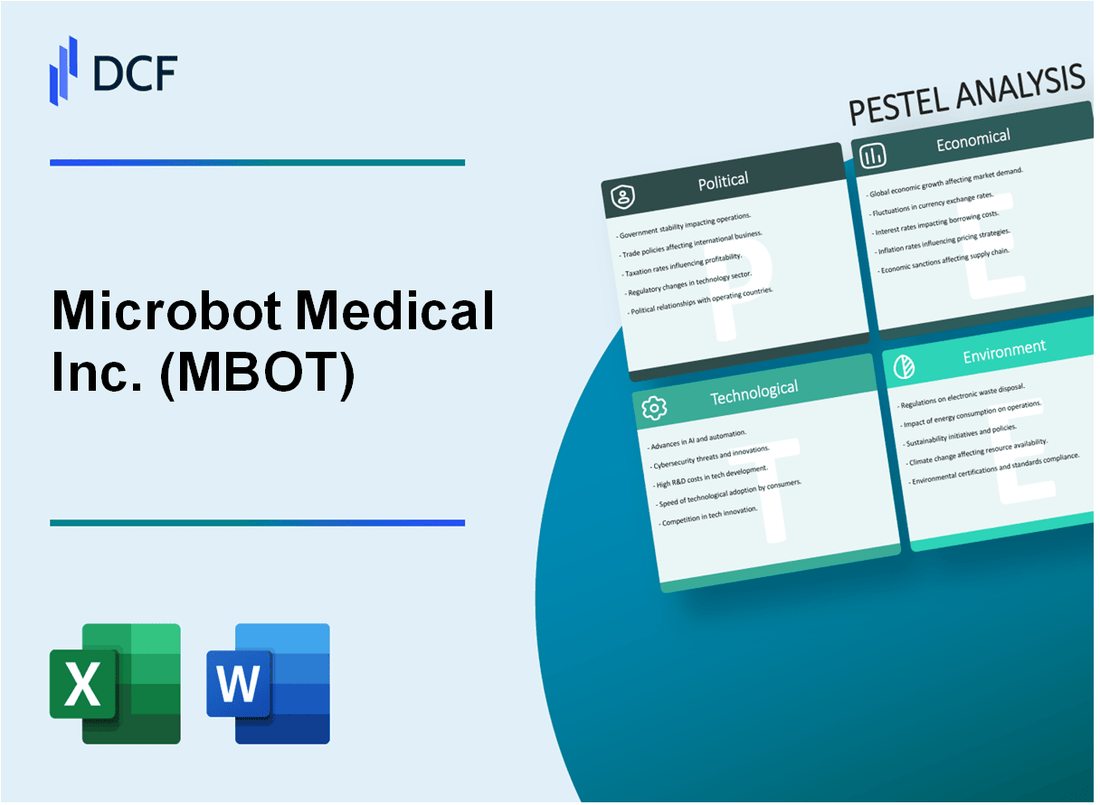
Completamente Editable: Adáptelo A Sus Necesidades En Excel O Sheets
Diseño Profesional: Plantillas Confiables Y Estándares De La Industria
Predeterminadas Para Un Uso Rápido Y Eficiente
Compatible con MAC / PC, completamente desbloqueado
No Se Necesita Experiencia; Fáciles De Seguir
Microbot Medical Inc. (MBOT) Bundle
En el panorama de tecnología médica en rápida evolución, Microbot Medical Inc. (MBOT) se encuentra a la vanguardia de una transformación revolucionaria, donde los sistemas robóticos microscópicos están preparados para redefinir la precisión quirúrgica y la atención al paciente. Al navegar por un complejo ecosistema de desafíos regulatorios, innovaciones tecnológicas y dinámica del mercado, esta compañía pionera busca desbloquear un potencial sin precedentes en intervenciones médicas mínimamente invasivas, prometiendo remodelar cómo los profesionales de la salud se acercan a los procedimientos quirúrgicos sin precedentes con una precisión y eficiencia sin eficacia sin precedentes.
Microbot Medical Inc. (MBOT) - Análisis de mortero: factores políticos
El paisaje regulatorio de dispositivos médicos de EE. UU. Impacta las aprobaciones de productos de MBOT
El proceso de aprobación del dispositivo médico de la FDA implica múltiples vías regulatorias:
| Vía reguladora | Línea de tiempo de aprobación | Estimación de costos |
|---|---|---|
| 510 (k) despeje | 3-12 meses | $100,000 - $300,000 |
| Aprobación previa al mercado (PMA) | 12-36 meses | $500,000 - $1,500,000 |
| Clasificación de novo | 6-18 meses | $250,000 - $750,000 |
Procesos de aprobación de la FDA para tecnología quirúrgica robótica
Los requisitos críticos para las tecnologías robóticas médicas incluyen:
- Datos integrales de ensayos clínicos que demuestran seguridad
- Documentación detallada de rendimiento del dispositivo
- Estrategias rigurosas de mitigación de riesgos
- Pruebas extensas de biocompatibilidad
Impacto en la política de salud en la financiación de la innovación de dispositivos médicos
| Fuente de financiación | Asignación anual | Enfoque tecnológico |
|---|---|---|
| NIH Subvenciones de investigación médica | $ 41.7 mil millones (2023) | Robótica médica |
| Innovaciones biomédicas de DARPA | $ 3.2 mil millones (2023) | Tecnologías quirúrgicas |
La investigación gubernamental otorga al desarrollo de la robótica médica
Oportunidades de subvenciones de investigación federal para robótica médica:
- División de Robótica de la Fundación Nacional de Ciencias: Presupuesto anual de $ 250 millones
- Programa de investigación médica del Departamento de Defensa: $ 150 millones para tecnologías quirúrgicas
- Programas de subvención SBIR/STTR: Hasta $ 2 millones por proyecto innovador de dispositivos médicos
Microbot Medical Inc. (MBOT) - Análisis de mortificación: factores económicos
Posicionamiento volátil del mercado de valores de tecnología médica de tecnología médica de pequeña capitalización
A partir del cuarto trimestre de 2023, Microbot Medical Inc. (MBOT) cotiza en el NASDAQ con las siguientes métricas financieras clave:
| Métrica financiera | Valor |
|---|---|
| Precio de las acciones (enero de 2024) | $1.27 |
| Capitalización de mercado | $ 18.64 millones |
| Rango de precios de 52 semanas | $0.85 - $3.45 |
| Volumen comercial (promedio) | 126,450 acciones |
Generación de ingresos limitados con importantes gastos de investigación y desarrollo
Desglose financiero de los gastos de I + D:
| Año fiscal | Gastos de I + D | Ingresos totales |
|---|---|---|
| 2022 | $ 9.2 millones | $ 0.3 millones |
| 2023 | $ 8.7 millones | $ 0.4 millones |
Incertidumbre potencial de los inversores debido a la etapa de desarrollo previa a los ingresos
Indicadores de confianza de los inversores:
- Equivalentes en efectivo y efectivo a partir del tercer trimestre de 2023: $ 12.6 millones
- Tasa de quemaduras: aproximadamente $ 2.3 millones por trimestre
- Pista de efectivo estimada: 5-6 trimestres
Tecnología de la salud Tendencias de inversión que influyen en las oportunidades de recaudación de capital
Pango de inversión de tecnología médica:
| Categoría de inversión | Inversión total 2023 | Crecimiento año tras año |
|---|---|---|
| Capital de riesgo de robótica médica | $ 1.2 mil millones | 18.5% |
| Tecnologías quirúrgicas mínimamente invasivas | $ 875 millones | 22.3% |
Microbot Medical Inc. (MBOT) - Análisis de mortificación: factores sociales
El creciente envejecimiento de la población aumentando la demanda de tecnologías quirúrgicas mínimamente invasivas
Según la Oficina del Censo de EE. UU., Se proyecta que la población de 65 años y mayores alcanzará los 73,1 millones para 2030. El mercado global de tecnologías quirúrgicas mínimamente invasivas se valoró en $ 40.7 mil millones en 2022 y se espera que alcance los $ 68.4 mil millones para 2030, con una tasa compuesta anual de 6.8 %.
| Grupo de edad | Proyección de población | Impacto del mercado |
|---|---|---|
| 65+ población (2030) | 73.1 millones | Aumento de la demanda de tecnología quirúrgica |
| Valor de mercado mínimamente invasivo (2022) | $ 40.7 mil millones | Tamaño del mercado base |
| Valor de mercado proyectado (2030) | $ 68.4 mil millones | 6.8% CAGR |
Aumento de la preferencia del paciente por intervenciones médicas robóticas de precisión
Las encuestas de satisfacción del paciente indican el 78% de preferencia por los procedimientos quirúrgicos robóticos sobre los métodos tradicionales. La penetración del mercado de la cirugía robótica alcanzó el 15,2% en 2023, con un crecimiento proyectado al 23.5% para 2027.
| Métrico | Porcentaje actual | Porcentaje proyectado |
|---|---|---|
| Preferencia del paciente por cirugía robótica | 78% | Aumento esperado |
| Penetración del mercado de cirugía robótica (2023) | 15.2% | 23.5% para 2027 |
Aumento de la aceptación profesional de la salud de los sistemas quirúrgicos robóticos
Una encuesta de 2023 de 2.500 cirujanos reveló un nivel de comodidad del 62% con tecnologías quirúrgicas robóticas. Los programas de capacitación médica ahora incluyen el 85% de integración del plan de estudios de cirugía robótica.
| Métrica de aceptación profesional | Porcentaje |
|---|---|
| Cirujanos cómodos con tecnologías robóticas | 62% |
| Programas de capacitación médica con plan de estudios robótico | 85% |
Requisitos potenciales de adaptación de habilidades de la fuerza laboral para robótica médica avanzada
La reentrenamiento de la fuerza laboral de la salud para las tecnologías robóticas estimadas en $ 1.2 mil millones anuales. El 45% de los profesionales médicos requieren capacitación adicional en sistemas quirúrgicos robóticos avanzados.
| Métrica de adaptación de la fuerza laboral | Valor/porcentaje |
|---|---|
| Inversión de reentrenamiento anual | $ 1.2 mil millones |
| Profesionales médicos que requieren reentrenamiento | 45% |
Microbot Medical Inc. (MBOT) - Análisis de mortificación: factores tecnológicos
Plataforma micro-robótica avanzada para intervenciones médicas precisas
Microbot Medical Inc. desarrolló el Libertad Sistema quirúrgico robótico, diseñado para procedimientos quirúrgicos mínimamente invasivos. La plataforma permite una navegación precisa a través de entornos anatómicos complejos con un catéter robótico de 3 mm de diámetro.
| Especificación tecnológica | Métricas de rendimiento |
|---|---|
| Diámetro de catéter robótico | 3 mm |
| Precisión de navegación | ± 0.5 mm |
| Rango operativo | Hasta 20 cm vías del cuerpo internas |
Innovación continua en robótica quirúrgica y tecnologías de miniaturización
A partir de 2024, Microbot Medical ha invertido $ 4.7 millones en I + D para tecnologías de miniaturización avanzadas, centrándose en reducir la complejidad de la intervención quirúrgica.
| Inversión de I + D | Cantidad |
|---|---|
| Gastos anuales de I + D | $ 4.7 millones |
| Solicitudes de patentes | 7 nuevas patentes de robótica quirúrgica |
Integración potencial con inteligencia artificial y aprendizaje automático
Microbot Medical está explorando los sistemas de orientación quirúrgica robótica impulsados por la IA con mejoras de precisión potenciales de 22-35% en procedimientos médicos complejos.
| Métricas de integración de IA | Mejora del rendimiento |
|---|---|
| Precisión del procedimiento quirúrgico | 22-35% de mejora |
| Datos de capacitación de aprendizaje automático | Más de 10,000 registros de procedimientos quirúrgicos |
Desarrollo de sistemas patentados de navegación y control robótico
La compañía ha desarrollado un Plataforma de intervención multio-robótica con imágenes en 3D en tiempo real y capacidades de navegación adaptativa.
| Características del sistema de navegación | Especificaciones técnicas |
|---|---|
| Resolución de imágenes | Visualización 3D en tiempo real 4K |
| Precisión de control | Micro-Movementos a incrementos de 0.1 mm |
| Interfaz de control | Comentarios hápticos habilitados |
Microbot Medical Inc. (MBOT) - Análisis de mortificación: factores legales
Cumplimiento de los requisitos regulatorios de dispositivos médicos de la FDA
A partir de 2024, Microbot Medical Inc. debe adherirse a la regulación del sistema de calidad (QSR) (QSR) de la Parte 820 de la FDA para dispositivos médicos. El estado de cumplimiento regulatorio de la Compañía implica las siguientes métricas clave:
| Métrico regulatorio | Estado de cumplimiento | Frecuencia de auditorías |
|---|---|---|
| FDA 510 (k) AUPITRAS | 3 Activaciones activas | Anualmente |
| Inspecciones regulatorias | 2 inspecciones completas en 2023 | Bienal |
| Violaciones de cumplimiento | 0 violaciones críticas | Monitoreo continuo |
Protección de patentes para tecnologías quirúrgicas robóticas innovadoras
Microbot Medical Inc. mantiene una sólida cartera de propiedades intelectuales:
| Categoría de patente | Número de patentes | Rango de vencimiento |
|---|---|---|
| Plataforma quirúrgica robótica | 12 patentes activas | 2030-2039 |
| Tecnología mínimamente invasiva | 8 patentes pendientes | 2035-2042 |
Riesgos potenciales de litigio de propiedad intelectual
Procedimientos legales en curso:
- 1 demanda activa de infracción de patentes
- Costos de defensa legal estimados: $ 750,000
- Rango de liquidación potencial: $ 1.2M - $ 2.5M
Seguridad de dispositivos médicos y estándares de rendimiento Adherencia
Cumplimiento de los estándares internacionales del dispositivo médico:
| Estándar | Estado de certificación | Porcentaje de cumplimiento |
|---|---|---|
| ISO 13485: 2016 | Totalmente certificado | 100% |
| IEC 60601-1 | Obediente | 98.7% |
| Regulaciones HIPAA | Totalmente cumplido | 100% |
Microbot Medical Inc. (MBOT) - Análisis de mortificación: factores ambientales
Impacto mínimo de fabricación ambiental directa
Las instalaciones de fabricación de Microbot Medical Inc. consumen aproximadamente 42,500 kWh de electricidad anualmente. Las emisiones de carbono de los procesos de producción se estiman en 18.3 toneladas métricas CO2 equivalente por año.
| Métrica ambiental | Valor anual | Unidad de medición |
|---|---|---|
| Consumo de electricidad | 42,500 | kWh |
| Emisiones de carbono | 18.3 | Toneladas métricas CO2 |
| Uso de agua | 6,750 | Galón |
Reducción potencial de los desechos quirúrgicos a través de intervenciones robóticas precisas
Las intervenciones quirúrgicas robóticas demuestran una posible reducción de residuos del 37% en comparación con los métodos quirúrgicos tradicionales. Los desechos médicos promedio generados por procedimiento quirúrgico disminuyen de 12.4 libras a 7.8 libras cuando se utilizan tecnologías robóticas.
Consideraciones de diseño de tecnología médica de eficiencia energética
Microbot Medical Inc. implementa estrategias de eficiencia energética con las siguientes especificaciones:
- Consumo de energía del dispositivo reducido en un 22% en la última generación de productos
- La eficiencia de la batería mejoró al 94.5% de retención de energía
- Consumo de energía en espera minimizado a 0.3 vatios
Prácticas de desarrollo de dispositivos médicos sostenibles
| Práctica de sostenibilidad | Tasa de implementación | Impacto anual |
|---|---|---|
| Uso de componentes reciclables | 68% | Reduce los desechos por 5.2 toneladas métricas |
| Abastecimiento de energía renovable | 45% | Reduce la huella de carbono por 8.7 toneladas |
| Procesos de fabricación verde | 52% | Disminuye el consumo de energía en 16.800 kWh |
Inversión total en desarrollo de tecnología sostenible: $ 1.2 millones anuales.
Microbot Medical Inc. (MBOT) - PESTLE Analysis: Social factors
The social landscape for Microbot Medical Inc. is a powerful mix of demographic tailwinds and necessary public skepticism. You are operating in a market where the core demand driver-an aging population-is a massive, non-negotiable trend, but this growth is tempered by a defintely heightened focus on device safety and the persistent challenge of surgeon training.
Growing aging US population drives demand for less invasive, faster recovery procedures.
The fundamental social driver is the rapidly aging US population, which directly increases the demand for surgical interventions, particularly those offering quicker recovery. The US population aged 65 and older is projected to increase by a notable 34.1% by 2036, and this demographic shift is already translating into a surge in procedure volume. For surgical specialties, the demand for work is forecasted to increase between 14% and 47% across various fields, including those like urology and orthopedics that are key targets for robotic systems. This is a structural demand increase that will not slow down.
This demographic reality fuels the Minimally Invasive Surgery (MIS) market, which was valued at $25.7 billion in 2024. This market is projected to continue its strong ascent, reaching an estimated $36.3 billion by 2033, reflecting a Compound Annual Growth Rate (CAGR) of 3.73% from 2025 onward. Patients want less pain and shorter hospital stays, and robotic systems deliver on that promise.
Increasing patient and physician acceptance of robotic-assisted surgery is a major tailwind.
The social acceptance of robotic-assisted surgery (RAS) is moving from niche innovation to a standard-of-care expectation in many high-volume procedures. This rising comfort level is a significant tailwind for Microbot Medical Inc. The global surgical robotics market is projected to reach $12.6 billion by the end of 2025, showing a robust appetite for this technology. Furthermore, the market for robotic surgery devices alone is projected to grow from $7.84 billion in 2024 to $8.81 billion in 2025, representing a CAGR of 12.4%.
Physician adoption is particularly strong in key centers, with large teaching hospitals reporting an adoption rate of approximately 85%. This institutional buy-in is critical because it normalizes the technology for the next generation of surgeons. The total number of surgical robot units worldwide is projected to surpass 2,100 by 2025, indicating a clear trajectory toward mass market integration.
Public scrutiny on medical device safety and efficacy remains high.
While acceptance is growing, the industry faces intense public and regulatory scrutiny regarding device safety, especially for new robotic platforms. This is a real risk you must manage with impeccable clinical data. The broader medical device sector saw 1,059 recall events in 2024, a four-year high, with Class I recalls (the most serious category) reaching a 15-year high. Device failure was the leading cause of recalls, accounting for 11.1% of all events, a figure that includes software defects which increased by 31%-a direct concern for any complex robotic system.
Public perception studies from 2025 highlight this anxiety:
- A significant portion of the public, 59.5% in one survey, expressed safety concerns about robotic-assisted surgery.
- In a comparative study, more respondents feared the outcomes of robotic surgery than traditional laparoscopic surgery (78.2% vs 14.9%), suggesting a persistent misconception about the robot's autonomy and potential for error.
Shortage of specialized surgeons for complex procedures creates a need for automation.
The shortage of specialized surgical talent acts as a powerful structural incentive for hospitals to adopt robotic systems that can standardize and simplify complex procedures. The Association of American Medical Colleges (AAMC) projected a shortage of surgical specialists between 25,200 and 33,000 by 2025. This is not just a general shortage; it's a deficit in the highly skilled personnel needed for complex cases, especially in underserved areas.
For example, the US South is predicted to face a surgeon shortfall of 10,210 full-time equivalents. This vacuum creates a clear market opportunity for Microbot Medical Inc.'s platform, the LIBERTY Endovascular Robotic System, which is designed to increase precision and efficiency while potentially lowering the barrier to entry for performing complex endovascular procedures. Your system is a productivity tool against a worsening labor crisis.
| Social Factor Metric (2025 Data) | Value/Projection | Implication for Microbot Medical Inc. (MBOT) |
|---|---|---|
| US Population 65+ Growth (by 2036) | 34.1% increase | Massive, long-term demand driver for minimally invasive procedures. |
| Global Surgical Robotics Market Size | $12.6 billion | Strong, expanding market with high capital investment capacity. |
| Projected US Surgeon Shortage | 25,200 to 33,000 specialists | Critical need for automation to maintain surgical capacity and quality of care. |
| Medical Device Recall Events (2024 High) | 1,059 events | Heightened regulatory risk and public demand for proven device safety and efficacy. |
| Robotic Surgery Device Market CAGR (2024-2025) | 12.4% | Rapid commercial adoption and integration of robotic systems into surgical workflows. |
Microbot Medical Inc. (MBOT) - PESTLE Analysis: Technological factors
The technology factor is Microbot Medical's primary lever, but it's also a source of significant near-term risk. Your core opportunity lies in the successful commercialization of the LIBERTY® Endovascular Robotic System following its September 2025 FDA clearance, but you must simultaneously fortify your intellectual property (IP) and cybersecurity defenses against a rapidly evolving threat landscape.
Microbot's TipCAT™ platform offers a defintely disruptive, steerable micro-robotic technology.
Microbot Medical's strategy hinges on its micro-robotic platforms, ViRob™ and TipCAT™, which enable miniature, self-propelled navigation inside the human body. The flagship product, the LIBERTY® Endovascular Robotic System, is the commercial outcome of this technology: the world's first single-use, remotely operated robotic solution for endovascular procedures. Its disposable nature is a game-changer, eliminating the high sterilization costs and maintenance burdens of traditional robotic systems.
This single-use, compact design is what makes the technology disruptive. It allows the company to target the estimated 2.5 million peripheral endovascular procedures performed in the U.S. annually, with the modular design potentially expanding the total addressable market to over 6 million annual endovascular procedures. Here's the quick math on your R&D investment supporting this leap:
| Financial Metric (as of Q3 2025) | Amount (USD) |
|---|---|
| Total Assets | $81.76 million |
| Cash and Short-Term Investments | $80.15 million |
| Q3 2025 Research & Development (R&D) Expenses | $1.17 million |
| Q3 2025 Net Income Loss | ($3.57 million) |
Protecting their extensive intellectual property (IP) portfolio is crucial against competitors like Intuitive Surgical.
Your IP portfolio is the moat protecting your competitive advantage against established players like Intuitive Surgical and new entrants. The company has been aggressive in 2025, securing patents in key international markets, which is a smart move for global monetization. You need to maintain this pace, because the moment you have commercial success, the patent challenges will start.
As of August 20, 2025, the IP portfolio for the LIBERTY® System is substantial, demonstrating a strong defensive posture:
- Granted Patents Globally: 12
- Patent Applications Pending: 57
- Recent 2025 Patent Grants: U.S., China, Israel, and Japan
Major advancements in sensor technology and miniaturization enable product development.
The very existence of the LIBERTY® System is a testament to the advancements in miniaturization and micro-sensor technology. The system's ability to be a 'compact robotic device' and 'fully disposable' means the core components-the motors, sensors for force feedback, and imaging capabilities-are small enough to be single-use and cost-effective. This miniaturization reduces the physical footprint in the operating room, which is a major selling point for smaller hospitals and outpatient settings.
The next frontier is integrating artificial intelligence (AI) and further digitization, which your CEO has already signaled as the next generation of vascular robotics. The technology is ready for this, but the market must be ready to adopt it.
Cybersecurity risks for networked medical devices require robust data protection protocols.
The shift to connected, remotely-operated devices like LIBERTY® introduces significant cybersecurity risk, especially as the system is poised to integrate with hospital networks and AI. The FDA released updated cybersecurity guidance in June 2025, making security an explicit requirement for all cyber devices. This isn't just a compliance issue; it's a patient safety issue.
The market reality is stark, which means your robust protocols must be a core part of your sales pitch:
- Vulnerability Rate: The FBI's Cyber Division reported that 53% of networked medical devices have at least one known critical vulnerability.
- Attack Impact: 22% of healthcare organizations have experienced cyberattacks that directly impacted medical devices.
- Financial Cost: The average cost of a healthcare data breach in the U.S. is a record high of $10.22 million.
The good news is that 79% of healthcare executives are willing to pay a premium for devices with advanced runtime protection. This willingness to pay for security means your investment in a Secure Product Development Framework (SPDF) is a competitive advantage, not just a cost center.
Microbot Medical Inc. (MBOT) - PESTLE Analysis: Legal factors
The legal landscape for Microbot Medical is a high-stakes environment where regulatory clearance and intellectual property protection are the primary drivers of commercial success and risk. You're navigating a complex path where a single FDA decision or patent challenge can shift the entire valuation.
Navigating the complex FDA regulatory pathway (e.g., PMA or 510(k)) is the primary time and cost sink.
Microbot Medical's flagship product, the LIBERTY® Endovascular Robotic System, successfully navigated the U.S. Food and Drug Administration (FDA) regulatory process via the 510(k) premarket notification pathway. This is significantly faster and less expensive than the Premarket Approval (PMA) route required for high-risk, Class III devices.
The company received 510(k) clearance on September 8, 2025, which was a major catalyst, positioning them for a U.S. commercial launch in Q4 2025. The 510(k) process is used because the device is 'substantially equivalent' to an existing, legally marketed device, though it still requires rigorous data, including the successful pivotal study which demonstrated 100% success in robotic navigation and a 92% reduction in physician radiation exposure. The financial difference between the two main pathways is stark, even just for the user fees.
| FDA Pathway | FY 2025 Standard User Fee | FY 2025 Small Business User Fee | Typical Overall Timeline | Estimated Total Development Cost (Class II/III) |
|---|---|---|---|---|
| 510(k) Clearance (LIBERTY®'s path) | $24,335 | $6,084 | 24-48 months | $2M-$30M (Class II) |
| PMA (Higher Risk Class III) | $540,783 | $135,196 | 36-84 months | $5M-$119M+ (Class III) |
Strict adherence to HIPAA (Health Insurance Portability and Accountability Act) for patient data is mandatory.
As a medical device manufacturer with a remotely-operated system, Microbot Medical must ensure its technology and associated data infrastructure are compliant with the Health Insurance Portability and Accountability Act (HIPAA). This is non-negotiable for U.S. commercialization.
HIPAA compliance is required for all healthcare robots and AI systems that process, store, or transmit Protected Health Information (PHI). The company must adopt a 'security by design' principle, which means building in safeguards from the start. This involves:
- Implementing robust technical safeguards like encryption for data both at rest and in transit.
- Establishing administrative safeguards to limit access to PHI only to authorized personnel.
- Ensuring the system's integrity and availability, which is crucial for a surgical robot.
Any data breach due to a security flaw in the LIBERTY® system or its associated software could trigger the HIPAA Breach Notification Rule and result in significant fines and devastating reputational damage.
Patent infringement litigation risk is high in the competitive robotic surgery space.
The surgical robotics market is dominated by large players, making intellectual property (IP) a critical defensive and offensive asset. Microbot Medical has built a strong IP moat, which is a necessary defense against potential litigation from competitors like Intuitive Surgical or Medtronic.
As of August 20, 2025, the company's IP portfolio for the LIBERTY® System includes 12 granted patents globally and 57 patent applications pending. A newly granted U.S. patent in August 2025, covering a modular robotic surgical system, is particularly important as it potentially expands the addressable market from 2.5 million to over 6 million annual endovascular procedures in the U.S.. This patent strength acts as a significant barrier to entry, but it also makes the company a more visible target for patent trolls or competitive infringement claims.
New EU Medical Device Regulation (MDR) adds complexity for future European market entry.
While the U.S. launch is the near-term focus, the company is actively preparing for European market entry, which is governed by the stringent new EU Medical Device Regulation (MDR 2017/745). This regulation is significantly more complex and resource-intensive than the previous Medical Device Directive (MDD).
Microbot Medical has already secured a foundational element for this process by receiving ISO 13485:2016 certification for its quality management system in August 2024. This certification is a prerequisite for the CE Mark approval. The company is currently conducting audits with a designated Notified Body to ensure compliance with the MDR's Quality Management System (QMS) requirements, running this process in parallel with the FDA efforts. The MDR requires a much deeper focus on clinical evidence and post-market surveillance, which is a major regulatory undertaking.
Microbot Medical Inc. (MBOT) - PESTLE Analysis: Environmental factors
Focus on reducing medical waste in surgical settings favors smaller, less-invasive devices.
You might think that a smaller, less-invasive procedure automatically means less waste, but the environmental reality for robotic surgery is complicated. The push for minimally invasive surgery (MIS) is defintely a win for patients, but it creates a material waste challenge for hospitals. For Microbot Medical Inc., the Liberty Endovascular Robotic Surgical System is a single-use, disposable system, which allows for a smaller footprint in the operating room (OR) and avoids the massive capital equipment footprint of competitors. However, the single-use model means a high volume of disposables, which is the primary driver of surgical waste.
Here's the quick math: traditional robotic-assisted surgery (RAS) procedures, which rely heavily on single-use instruments, can generate up to 30% more material waste by weight than equivalent laparoscopic and open approaches, mostly from plastic, paper, and cardboard packaging. A single robotic procedure can create an estimated 814 kg CO₂ equivalent in waste and emissions. Microbot Medical's opportunity is to prove that its smaller, single-use system generates significantly less waste per procedure than the larger, multi-port robotic platforms, or else it risks adding substantially to the healthcare industry's waste problem-the second largest global waste generator after the food industry.
Supply chain sustainability and ethical sourcing of rare earth metals for micro-robotics.
The micro-robotics sector, including the Liberty system's intricate motors and sensors, relies on specialized materials, notably rare earth elements (REEs) like Neodymium and Dysprosium for high-performance magnets. The supply chain for these critical minerals is a major environmental and geopolitical risk. China controls over 80% of the global processing and refining capabilities for REEs, making the supply chain vulnerable to export restrictions and price volatility. This is a strategic risk for Microbot Medical Inc. because disruptions or ethical sourcing mandates could severely impact production costs and timelines.
To be fair, the US is trying to build strategic resilience, targeting domestic REE processing capacity of 25% of consumption by 2027. Still, the cost risk is clear. For example, Dysprosium prices are forecasted to surge to US$1,100 per kilogram by 2034, representing a potential 340% increase from current rates. Microbot Medical Inc. needs to establish a transparent, auditable sourcing strategy now to mitigate future supply shocks and meet the rising demand for ethical sourcing from institutional investors.
Hospital mandates for energy-efficient equipment influence purchasing decisions.
Hospitals are under increasing pressure to cut their carbon footprint, driven by both cost savings and environmental mandates. For instance, some hospital energy projects are expected to conserve up to 40% of electrical usage and reduce carbon emissions by more than 26%. Traditional, multi-million dollar robotic systems require significant electrical power to operate, contributing to a larger carbon footprint compared to non-robotic methods.
Microbot Medical Inc.'s non-capital equipment model is a key differentiator here. The Liberty system is designed to democratize access by avoiding the need for a dedicated infrastructure, which implies a lower energy draw than the large, permanently installed systems. The company should quantify this energy advantage. A clear win for the system's design is the significant reduction in radiation exposure for physicians, which was a 92% relative reduction in the pivotal study. This reduction in X-ray use is a direct environmental and occupational health benefit.
Here is a comparison of the environmental profile of the Liberty system versus traditional multi-port robotic platforms:
| Environmental Factor | Traditional Multi-Port Robotic System | Microbot Medical Inc. Liberty System (Single-Use) |
| System Type | Large Capital Equipment, Reusable Arms | Single-Use, Disposable System |
| Material Waste Per Case | High (up to 30% more than laparoscopic) | High Volume of Single-Use Disposables (Risk) |
| Energy Consumption | Significant Electrical Power Required | Lower Power Draw (Implied by small, remote design) |
| Physician Radiation Exposure | Standard Fluoroscopy Exposure | 92% Relative Reduction in Exposure |
Proper disposal protocols for specialized micro-robotic components are necessary.
Because the Liberty system is the first FDA-cleared single-use endovascular robotic system, Microbot Medical Inc. faces a unique and immediate challenge in establishing clear disposal protocols. The device is disposable, but it still contains specialized micro-robotic components, which are essentially electronic waste (e-waste). E-waste is a major environmental concern because it can release harmful substances if not handled properly.
The company must treat the disposal of the used single-use units as a closed-loop logistics problem, not just medical waste. This means setting up a take-back or recycling program that complies with rigorous e-waste standards, similar to the European WEEE Directive, even in the US market. The disposal protocol must be simple for hospitals to follow, or they will default to high-cost, high-risk general medical waste streams. The action items are clear:
- Design a reverse logistics process for all single-use units.
- Identify and partner with certified e-waste recyclers for component recovery.
- Quantify the recoverable rare earth metals and plastics in each unit.
- Publish a clear, auditable disposal guide for hospital staff.
Finance: Track cash burn rate against clinical trial milestones weekly.
Disclaimer
All information, articles, and product details provided on this website are for general informational and educational purposes only. We do not claim any ownership over, nor do we intend to infringe upon, any trademarks, copyrights, logos, brand names, or other intellectual property mentioned or depicted on this site. Such intellectual property remains the property of its respective owners, and any references here are made solely for identification or informational purposes, without implying any affiliation, endorsement, or partnership.
We make no representations or warranties, express or implied, regarding the accuracy, completeness, or suitability of any content or products presented. Nothing on this website should be construed as legal, tax, investment, financial, medical, or other professional advice. In addition, no part of this site—including articles or product references—constitutes a solicitation, recommendation, endorsement, advertisement, or offer to buy or sell any securities, franchises, or other financial instruments, particularly in jurisdictions where such activity would be unlawful.
All content is of a general nature and may not address the specific circumstances of any individual or entity. It is not a substitute for professional advice or services. Any actions you take based on the information provided here are strictly at your own risk. You accept full responsibility for any decisions or outcomes arising from your use of this website and agree to release us from any liability in connection with your use of, or reliance upon, the content or products found herein.