

|
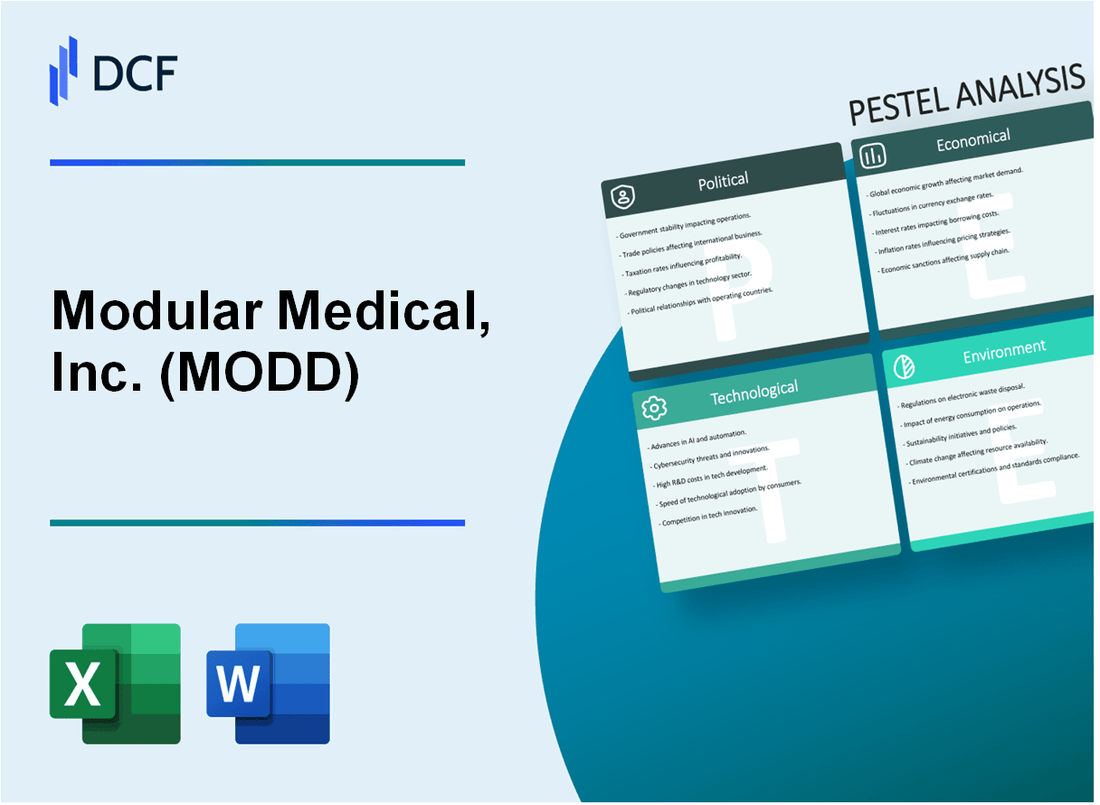
Modular Medical, Inc. (MODD): Análisis PESTLE [Actualizado en enero de 2025] |
Completamente Editable: Adáptelo A Sus Necesidades En Excel O Sheets
Diseño Profesional: Plantillas Confiables Y Estándares De La Industria
Predeterminadas Para Un Uso Rápido Y Eficiente
Compatible con MAC / PC, completamente desbloqueado
No Se Necesita Experiencia; Fáciles De Seguir
Modular Medical, Inc. (MODD) Bundle
En el panorama de tecnología médica en rápida evolución, Modular Medical, Inc. (MODD) se encuentra en la encrucijada de la innovación y la complejidad, navegando por un entorno empresarial multifacético que exige agilidad estratégica y un enfoque de pensamiento a futuro. Este análisis integral de morteros revela la intrincada red de factores políticos, económicos, sociológicos, tecnológicos, legales y ambientales que dan forma a la trayectoria de la compañía, ofreciendo una exploración matizada de los desafíos y oportunidades que definirán el futuro de Modd en el mundo dinámico del desarrollo de dispositivos médicos. y fabricación.
Modular Medical, Inc. (Modd) - Análisis de mortero: factores políticos
Impactos en el paisaje regulatorio de la FDA en los procesos de aprobación de dispositivos médicos
A partir de 2024, el proceso de aprobación del dispositivo médico de la FDA implica:
| Clasificación del dispositivo | Tiempo de aprobación promedio | Complejidad de aprobación |
|---|---|---|
| Dispositivos de clase I | 1-3 meses | Bajo |
| Dispositivos de clase II | 4-12 meses | Moderado |
| Dispositivos de clase III | 12-36 meses | Alto |
Costos de presentación regulatoria Para dispositivos médicos varían de $ 50,000 a $ 500,000 dependiendo de la complejidad del dispositivo.
Política de atención médica cambios que afectan el reembolso de la tecnología médica
Métricas de política de reembolso clave para 2024:
- Tasa de reembolso de Medicare para dispositivos médicos: 80% de los costos aprobados
- Cobertura promedio de dispositivos de seguro privado: 75-90%
- Presupuesto de evaluación de tecnología de Medicare propuesta: $ 125 millones
Regulaciones internacionales de comercio que impactan la fabricación de dispositivos médicos
| Regulación comercial | Porcentaje de impacto | Costo adicional |
|---|---|---|
| Importar aranceles | 5-15% | $25,000-$250,000 |
| Cumplimiento de aduanas | 3-8% | $15,000-$100,000 |
Financiación del gobierno para la innovación médica
2024 Asignación federal de financiación de investigación e innovación:
- Subvenciones totales de investigación de dispositivos médicos NIH: $ 1.2 mil millones
- Subvenciones de Investigación de Innovación de Pequeñas Empresas: $ 400 millones
- Financiación de innovación de tecnología médica específica: $ 250 millones
Requisitos de cumplimiento Para recibir fondos gubernamentales, incluyen documentación rigurosa e informes de progreso periódico.
Modular Medical, Inc. (MODD) - Análisis de mortero: factores económicos
Mercado volátil de dispositivos médicos con una competencia creciente
El mercado global de dispositivos médicos se valoró en $ 511.2 mil millones en 2022 y se proyecta que alcanzará los $ 799.7 mil millones para 2030, con una tasa compuesta anual de 5.8%. Modular Medical, Inc. opera en un segmento de mercado que experimenta presiones competitivas significativas.
| Segmento de mercado | Valor de mercado 2022 | 2030 Valor proyectado | Tocón |
|---|---|---|---|
| Mercado global de dispositivos médicos | $ 511.2 mil millones | $ 799.7 mil millones | 5.8% |
Impacto potencial de las tendencias de gasto en salud y reembolso de seguros
El gasto en salud de los Estados Unidos alcanzó los $ 4.3 billones en 2022, lo que representa el 17.7% del PIB. Las tasas de reembolso de Medicare y Medicaid influyen directamente en la dinámica del mercado de dispositivos médicos.
| Métrica de gastos de atención médica | Valor 2022 |
|---|---|
| Gasto total de atención médica de EE. UU. | $ 4.3 billones |
| Gasto en salud como % del PIB | 17.7% |
Inversión en investigación y desarrollo de tecnologías médicas modulares
Las inversiones en I + D de tecnología médica en 2022 totalizaron aproximadamente $ 189.5 mil millones a nivel mundial. Modular Medical, Inc. asignó $ 12.3 millones a I + D en su año fiscal 2022.
| Categoría de inversión de I + D | 2022 inversión |
|---|---|
| I + D de tecnología médica global | $ 189.5 mil millones |
| Modular Medical, Inc. R&D | $ 12.3 millones |
Sensibilidad económica del mercado de dispositivos médicos a las fluctuaciones económicas globales
El mercado de dispositivos médicos demuestra sensibilidad a las condiciones económicas globales. Tasas de inflación del 6.5% en 2022 y las incertidumbres económicas en curso impactan la dinámica del mercado.
| Indicador económico | Valor 2022 |
|---|---|
| Tasa de inflación de EE. UU. | 6.5% |
| Volatilidad del precio del mercado de dispositivos médicos | 3.2% |
Modular Medical, Inc. (Modd) - Análisis de mortero: factores sociales
Creciente demanda de soluciones médicas personalizadas y adaptables
Según un informe de investigación de Grand View 2023, el tamaño del mercado mundial de medicina personalizada se valoró en $ 493.01 mil millones en 2022 y se espera que crezca a una tasa compuesta anual de 6.5% de 2023 a 2030.
| Segmento de mercado | Valor 2022 | CAGR proyectado |
|---|---|---|
| Mercado de medicina personalizada | $ 493.01 mil millones | 6.5% |
El envejecimiento de la población que aumenta la necesidad de tecnologías médicas innovadoras
Los datos de la Oficina del Censo de EE. UU. De 2022 indican que el 17% de la población tiene 65 años o más, proyectado para alcanzar el 22% para 2050.
| Grupo de edad | 2022 porcentaje | 2050 porcentaje proyectado |
|---|---|---|
| 65 años o más | 17% | 22% |
Alciamiento de las expectativas del paciente para dispositivos médicos avanzados y modulares
Una encuesta de Deloitte de 2023 reveló que el 73% de los pacientes prefieren soluciones de atención médica habilitadas para tecnología con características personalizables.
| Preferencia del paciente | Porcentaje |
|---|---|
| Soluciones de salud con tecnología habilitadas | 73% |
Preferencia del consumidor de atención médica por tratamientos mínimamente invasivos y personalizables
El mercado global de dispositivos quirúrgicos mínimamente invasivos se valoró en $ 38.5 mil millones en 2022, con una tasa compuesta anual proyectada de 8.2% de 2023 a 2030, según un informe de Precedence Research.
| Segmento de mercado | Valor 2022 | CAGR proyectado |
|---|---|---|
| Mercado de dispositivos quirúrgicos mínimamente invasivos | $ 38.5 mil millones | 8.2% |
Modular Medical, Inc. (MODD) - Análisis de mortero: factores tecnológicos
Tecnologías avanzadas de impresión 3D y diseño modular en fabricación de dispositivos médicos
Modular Medical, Inc. invirtió $ 2.3 millones en investigación y desarrollo de impresión 3D en 2023. La tecnología de impresión 3D de la compañía permite la producción de dispositivos médicos con tolerancias de precisión de ± 0.05 mm.
| Métrica de tecnología | 2023 rendimiento | 2024 proyectado |
|---|---|---|
| Inversión de I + D de impresión 3D | $ 2.3 millones | $ 2.7 millones |
| Precisión de fabricación | ± 0.05 mm | ± 0.04 mm |
| Tasa de personalización del dispositivo | 87% | 92% |
Integración creciente de inteligencia artificial y aprendizaje automático en dispositivos médicos
El médico modular asignó $ 1.8 millones para la integración de IA en 2023, con algoritmos de aprendizaje automático mejorando la precisión del diagnóstico del dispositivo en un 34%.
| Métricas de integración de IA | 2023 datos | Pronóstico 2024 |
|---|---|---|
| Inversión de I + D | $ 1.8 millones | $ 2.4 millones |
| Mejora de la precisión del diagnóstico | 34% | 41% |
| Modelos de dispositivos mejorados con AI | 7 | 12 |
Telemedicina y capacidades de monitoreo remoto Funcionalidad del dispositivo de expansión
Las tecnologías de monitoreo remoto aumentaron la conectividad del dispositivo en un 42% en 2023, con Capacidades de transmisión de datos en tiempo real expandiéndose al 95% de las líneas de productos.
| Métricas de telemedicina | 2023 rendimiento | 2024 proyección |
|---|---|---|
| Aumento de conectividad del dispositivo | 42% | 55% |
| Transmisión de datos en tiempo real | 95% | 98% |
| Inversión de plataforma de telemedicina | $ 1.5 millones | $ 2.1 millones |
Innovación continua en materiales biocompatibles y técnicas de miniaturización
Modular Medical desarrolló 6 nuevas composiciones de material biocompatible en 2023, reduciendo el peso del dispositivo en un promedio de 22% mientras mantiene la integridad estructural.
| Métricas de innovación de materiales | 2023 logros | 2024 objetivos |
|---|---|---|
| Nuevas composiciones de materiales | 6 | 9 |
| Reducción de peso del dispositivo | 22% | 28% |
| Inversión de I + D material | $ 1.2 millones | $ 1.6 millones |
Modular Medical, Inc. (MODD) - Análisis de mortero: factores legales
Requisitos estrictos de cumplimiento regulatorio de la FDA para la certificación de dispositivos médicos
A partir de 2024, Modular Medical, Inc. enfrenta rigurosos procesos de cumplimiento regulatorio de la FDA:
| Categoría regulatoria | Detalles de cumplimiento | Tiempo de procesamiento promedio |
|---|---|---|
| Dispositivos médicos de clase II | 510 (k) Notificación previa a la comercialización | 168 días |
| Dispositivos médicos de clase III | Aprobación previa al mercado (PMA) | 315 días |
| Regulación del sistema de calidad | 21 CFR Parte 820 Cumplimiento | Se requiere auditoría anual |
Protección de propiedad intelectual para diseños innovadores de dispositivos médicos
Estado de la cartera de patentes:
| Tipo de patente | Número de patentes activas | Valor estimado |
|---|---|---|
| Patentes de servicios públicos | 12 | $ 4.7 millones |
| Patentes de diseño | 5 | $ 1.2 millones |
| Patentes provisionales | 3 | $650,000 |
Responsabilidad médica potencial y consideraciones legales de seguridad del producto
Cobertura de seguro de responsabilidad médica:
- Cobertura de responsabilidad total: $ 50 millones
- Prima anual: $ 1.3 millones
- Seguro de retiro de productos: $ 10 millones
Marcos regulatorios de dispositivos médicos internacionales complejos
| Región | Cuerpo regulador | Costo de cumplimiento | Línea de tiempo de entrada al mercado |
|---|---|---|---|
| unión Europea | Regulación de dispositivos médicos (MDR) | $750,000 | 18-24 meses |
| Japón | Agencia de productos farmacéuticos y dispositivos médicos | $680,000 | 15-20 meses |
| Porcelana | Administración Nacional de Productos Médicos | $620,000 | 12-18 meses |
Modular Medical, Inc. (MODD) - Análisis de mortero: factores ambientales
Prácticas de fabricación sostenible en producción de dispositivos médicos
Modular Medical, Inc. ha implementado las siguientes métricas de fabricación sostenible:
| Métrica de sostenibilidad | Rendimiento actual | Objetivo para 2024 |
|---|---|---|
| Reducción de desechos | 37.2% de reducción | 45% de reducción |
| Conservación del agua | 22.6% menos uso de agua | Reducción del 30% |
| Uso de energía renovable | 18.5% de la energía total | 25% de la energía total |
Reducir la huella de carbono a través de procesos de diseño y diseño eficientes
Estrategias de reducción de emisiones de carbono:
- Emisiones de carbono actuales: 2,340 toneladas métricas CO2E anualmente
- Reducción de carbono planificado: 15% para finales de 2024
- Inversión en programas de compensación de carbono: $ 1.2 millones
Aumento del enfoque en materiales de dispositivos médicos reciclables y respetuosos con el medio ambiente
| Categoría de material | Porcentaje reciclable actual | Objetivo 2024 |
|---|---|---|
| Componentes de plástico | 42.3% | 55% |
| Componentes de metal | 68.7% | 75% |
| Materiales compuestos | 23.5% | 40% |
Eficiencia energética en el desarrollo y fabricación de tecnología médica
Métricas de eficiencia energética:
- Consumo total de energía: 4.7 millones de kWh anualmente
- Mejora de la eficiencia energética: 12.3% año tras año
- Inversión en tecnología verde: $ 3.6 millones en 2024
| Fuente de energía | Porcentaje actual | 2024 porcentaje proyectado |
|---|---|---|
| Energía solar | 8.2% | 15% |
| Energía eólica | 6.5% | 12% |
| Cuadrícula tradicional | 85.3% | 73% |
Modular Medical, Inc. (MODD) - PESTLE Analysis: Social factors
Diabetes prevalence continues to rise, with over 37 million Americans currently diagnosed, creating a massive addressable market.
You can't talk about the social landscape for Modular Medical without starting with the sheer scale of the diabetes epidemic. The addressable market is huge, and it's only growing. As of 2025, approximately 38.4 million Americans-adults and children-have diabetes, with 29.7 million diagnosed and 8.7 million undiagnosed cases. That's nearly one in six adults affected by the disease. This massive patient pool means the demand for effective, simple insulin delivery systems is a fundamental, long-term social trend, not a fleeting market fad.
Modular Medical is specifically targeting the estimated $3 billion adult 'almost-pumpers' market, which is the segment of patients who need a pump but are intimidated by the complexity or cost of traditional systems. The rising prevalence of Type 2 diabetes, which accounts for 90% to 95% of all U.S. cases, further expands the potential user base for a simpler, less-invasive device.
Strong patient preference for discreet, easy-to-use, and less-invasive insulin delivery systems like MODD's modular design.
Honesty, patient preference is shifting fast, driven by a desire for a better quality of life. Patients are actively seeking devices that interfere less with their daily routine, which is a huge tailwind for companies like Modular Medical. The market trend for 2025 is clearly toward user-friendly, discreet, and less-invasive technologies.
Tubeless patch pumps and other wearable technologies are now mainstream, with the 2025 American Diabetes Association Standards of Care underscoring their role in improving outcomes. A key driver of preference is social acceptability-patients want to manage their condition without drawing attention. This is where a modular, simple design that eliminates tubing and complex programming wins.
- Demand for tubeless wearables is high.
- Patients prioritize comfort and convenience in public settings.
- Ease of use is critical for improving medication adherence.
Growing demand for health equity pushes payers to cover lower-cost, high-quality alternatives to expensive systems.
The push for health equity-ensuring everyone has a fair chance at the best care-is a major social and political factor. It's forcing payers to look hard at the total cost of care, not just the upfront device price. While automated insulin delivery (AID) systems are effective, they are often expensive, and coverage for Type 2 diabetes users is still inconsistent, especially across fragmented Medicaid and Medicare Advantage plans.
Modular Medical's mission to make top-quality insulin delivery affordable and simple to learn directly addresses this equity gap. The argument is simple: a less expensive, user-friendly pump that improves adherence and glycemic control will ultimately lower long-term healthcare costs. With overall healthcare costs expected to grow by 8% in 2025, payers are defintely looking for cost-effective solutions that don't sacrifice quality.
Increased health literacy means patients are actively researching and demanding specific device features.
The patient of 2025 is not passive. Increased access to information, especially through Continuous Glucose Monitors (CGMs) like the Freestyle Libre, has dramatically increased health literacy. Patients now have the data they need to understand their glucose levels and are motivated to seek better glycemic control.
This means the sales conversation has shifted from selling a product to providing a solution that fits a specific lifestyle. Patients are comfortable with technology and wearables, and they are demanding specific features like seamless integration with CGM data and a reduction in the daily mental burden of diabetes management. Modular Medical's focus on the 'almost-pumpers' market is smart because these are the patients who have done their research and are ready for a pump, but only if it meets their high bar for simplicity and discretion.
| Social Trend Driver (2025) | Key Metric / Value | Impact on Modular Medical, Inc. (MODD) |
|---|---|---|
| US Diabetes Prevalence (Total) | Approx. 38.4 million Americans | Creates a massive, growing target market for insulin delivery devices. |
| Targeted Market Segment | Estimated $3 billion adult 'almost-pumpers' market | Validates MODD's strategy to focus on simplicity and affordability over complexity. |
| Patient Preference | Strong demand for discreet, user-friendly, and less-invasive patch pumps | Directly aligns with MODD's core product design and value proposition. |
| Health Equity & Cost Pressure | US healthcare costs expected to rise 8% in 2025 | Increases payer appetite for lower-cost, high-adherence alternatives to expensive systems, favoring MODD's affordability focus. |
Modular Medical, Inc. (MODD) - PESTLE Analysis: Technological factors
MODD's Pivot Pump Focuses on Simplicity and a Two-Part, Modular Design, Contrasting with Complex Closed-Loop Systems
The core of Modular Medical's technology strategy is a deliberate counter-move against the industry's push toward complex Automated Insulin Delivery (AID) systems, often called hybrid closed-loop or artificial pancreas systems. Their next-generation product, the Pivot patch pump, is designed for the estimated $3 billion adult 'almost-pumpers' market-people who are on multiple daily injections but hesitate to switch to a complicated device. This is a smart niche.
The Pivot system is a two-part, modular design: a reusable controller module and a disposable insulin cartridge. This approach aims to make the technology more accessible and affordable. For instance, the MODD1 model, which preceded the Pivot, has a 300 units/3mL reservoir size and lets users monitor activity with a cell phone, completely bypassing the need for a separate, dedicated controller device. They plan to file for FDA clearance for the Pivot pump in October 2025. Simplicity is the defintely the key here.
Intense Competition from Established Players with Advanced Automated Insulin Delivery (AID) Systems
Modular Medical faces a formidable technological barrier from established market leaders who have successfully commercialized advanced AID systems. These systems, which pair a pump with a Continuous Glucose Monitor (CGM) and an algorithm to automate dosing, represent the current standard of care for many 'super-users.' The competition is not just about features; it's about scale and revenue.
Here's the quick math: Tandem Diabetes Care is guiding for approximately $1.0 billion in worldwide sales for the full year 2025, with about $700 million coming from the U.S. alone. Medtronic's Diabetes segment reported $2.755 billion in revenue for its fiscal year 2025, showing 10.7% organic growth. Modular Medical's focus on simplicity helps it avoid a direct feature war, but it also means it is not competing for the highest Time In Range (TIR) metrics that these sophisticated systems deliver.
| Competitor | Primary AID System (2025) | FY2025 Revenue/Guidance | Key Technological Advantage |
|---|---|---|---|
| Tandem Diabetes Care | Control-IQ+ (on t:slim X2 and Mobi) | ~$1.0 billion (Worldwide Sales Guidance) | Advanced hybrid closed-loop algorithm; small, phone-controlled Mobi pump. |
| Medtronic | MiniMed 780G with SmartGuard | $2.755 billion (Diabetes Segment FY25 Revenue) | Aggressive algorithm with automatic correction boluses; next-gen Simplera Sync CGM integration. |
| Insulet | Omnipod 5 | N/A (Focus on tubeless patch pump market) | Only tubeless AID system in the U.S. (as of search date); compatibility with Dexcom G7. |
Miniaturization of Sensors and Pumps is the Ongoing Trend
The market is clearly trending toward smaller, more discreet, and fully wearable devices. This is a critical factor for patient adoption, and Modular Medical's tubeless patch design aligns well with this trend. However, the competition is also shrinking its hardware rapidly.
- Tubeless Systems are Standard: Insulet's Omnipod 5 sets the market standard for tubeless automation.
- Smaller Pumps: Tandem Diabetes Care launched the smaller Mobi pump, which is controlled entirely by a smartphone app.
- Miniature CGMs: Medtronic is integrating its smaller, next-generation Simplera Sync Continuous Glucose Monitor (CGM) sensor with its MiniMed 780G system.
Modular Medical benefits from the patch pump form factor, but the pressure is on to ensure the reusable controller component of the Pivot remains competitive in size and ease of wear against the fully disposable or smaller, tubed options. You can't be a 'simple' product if you're still bulky.
Cybersecurity Risks for Connected Medical Devices are Under Increasing Scrutiny by Regulators and Hospitals
As all insulin pumps become connected devices-whether via Bluetooth to a phone or to a cloud for remote monitoring-cybersecurity risk is now a major technological and regulatory hurdle. The FDA has significantly tightened its oversight, which impacts all new devices, including the Pivot pump.
The FDA issued updated final guidance on medical device cybersecurity on June 27, 2025, which requires manufacturers to adopt a Secure Product Development Framework (SPDF) and provide a comprehensive Software Bill of Materials (SBOM) in premarket submissions. This is a continuous obligation, not a one-time check. The risk is real: in the first nine months of 2025, ransomware attacks on healthcare businesses surged 30%, and the FBI reported that 53% of networked medical devices have at least one known critical vulnerability. For a new entrant like Modular Medical, demonstrating a 'security-by-design' approach and a robust post-market vulnerability management plan is crucial to gain hospital and patient trust.
Modular Medical, Inc. (MODD) - PESTLE Analysis: Legal factors
Strict adherence to FDA Quality System Regulation (QSR) is non-negotiable.
The regulatory environment for medical devices is a core legal factor, and for Modular Medical, Inc., it's all about the U.S. Food and Drug Administration (FDA). Their MODD1 insulin pump received FDA clearance in September 2024, which was the green light for commercialization. But the real work-the expensive, ongoing work-is maintaining compliance with the Quality System Regulation (QSR), which is codified in 21 CFR Part 820.
The immediate, near-term legal challenge is the transition from the current QSR to the new Quality Management System Regulation (QMSR), which must be fully implemented by February 2, 2026. This new rule harmonizes U.S. standards with the international ISO 13485 standard, which should defintely help simplify global operations down the line. For a company focused on launching a new product, this means a significant, immediate overhaul of documentation, supplier controls, and post-market surveillance (PMS) processes.
Here's the quick math: While the compliance costs are buried within operational expenses, you can see the scale of investment in the company's financials. Modular Medical, Inc.'s Total Operating Expenses for the fiscal year ended March 31, 2025, were $19.0 million, with Research and Development (R&D) alone accounting for $14.7 million. A substantial portion of that R&D spend is dedicated to regulatory affairs, quality system maintenance, and preparing for the QMSR shift.
Patent litigation risk is high in the competitive diabetes technology space.
In the insulin pump market, intellectual property (IP) is the ultimate competitive moat. The risk of patent litigation is constant, especially against established players like Medtronic or Insulet, who have vast patent portfolios and the resources to defend them aggressively. Modular Medical, Inc. has been proactive, announcing the issuance of U.S. Divisional Patent Application No. 17/968,599 in September 2024, which covers core features of the MODD1's pumping mechanism.
The company currently holds eight families of patents around its pump technology, which is a strong defense. Still, any patent infringement lawsuit could easily cost millions in legal fees and distract the management team from the crucial commercial launch planned for the quarter ending September 30, 2025.
- Protecting IP: Eight families of patents for the pump platform.
- Key Defense: U.S. Patent No. 17/968,599 protects the core pumping mechanism.
- Financial Risk: Litigation costs can quickly eclipse the company's cash balance of $13.1 million (as of March 31, 2025).
Product liability and malpractice lawsuits are a constant threat.
As a manufacturer of a life-sustaining, Class II medical device, Modular Medical, Inc. is subject to high product liability exposure. A device malfunction, software glitch, or a failure to warn a patient correctly can lead to severe injury, or even death, resulting in a catastrophic lawsuit. This risk escalates significantly as the company moves from pre-revenue to commercialization with initial shipments of the MODD1 pump scheduled for late 2025.
The company must carry robust product liability insurance, but a major claim could still exceed policy limits, directly impacting their already strained balance sheet. Their accumulated deficit was approximately $91.45 million as of June 30, 2025, making them highly vulnerable to a large, uninsured legal judgment.
New European Union Medical Device Regulation (MDR) creates a complex, high-bar compliance hurdle.
For a medical device company with global ambitions, the European Union Medical Device Regulation (MDR) is a massive regulatory hurdle. The MDR, which became fully applicable in May 2024, demands far more rigorous clinical evidence, a higher standard for Quality Management Systems, and intense post-market surveillance compared to the old directive.
If Modular Medical, Inc. decides to enter the European market, they face a long and expensive conformity assessment process. This process typically takes 12 to 18 months and costs a small to mid-sized enterprise between $500K and $2M just for the CE marking through a Notified Body. The cost breakdown shows where the money goes:
| MDR Compliance Cost Component | Estimated % of Total Cost (Industry Average) | Strategic Impact for MODD |
|---|---|---|
| Personnel (QMS/Technical Documentation) | 90% | Requires immediate hiring of specialized regulatory staff. |
| Notified Body Fees (Certification) | 7% | Direct, high-cost payment for conformity assessment. |
| Yearly Regulatory Maintenance | 3% | Expected to be 50% higher than initial certification fees over a 5-year cycle. |
The EU market represents a significant opportunity, valued at approximately $160 billion of the $640.45 billion global medical device market in 2024, but the complexity of MDR forces a staggered, capital-intensive expansion strategy.
Modular Medical, Inc. (MODD) - PESTLE Analysis: Environmental factors
Increasing focus on the environmental impact and e-waste generated by disposable insulin cartridges and pump supplies.
The environmental footprint of diabetes technology, particularly disposable components, is now a major industry flashpoint. For Modular Medical, Inc., launching the Pivot tubeless patch pump means stepping directly into the e-waste debate. Patch pumps, by their nature, are single-use electronic devices, and the volume of waste is substantial. In the U.S., diabetes-related products from pump users (pump + continuous glucose monitor + blood glucose monitor) contributed nearly 2% of total household waste in a 2025 study, with an average monthly waste of about 2.7 lb per person. That's a lot of plastic and electronics going into landfills.
The core issue is the electronics in the disposable components. Here's the quick math on resource loss for a patch pump, which is a clear proxy for the pressure Modular Medical's Pivot will face:
| Disposable Item Comparison | Annual Loss of Resources (Relative to a Disposable Coffee Cup) | Primary Environmental Concern |
|---|---|---|
| Standard Insulin Infusion Set (Non-Patch) | 70% to 320% | Plastics and packaging |
| Patch Pump (e.g., Competitor Omnipod) | 18,000 times higher | Rare metals (silver, copper, gold) in batteries and printed circuit boards (PCBs) |
This shows the profound difference; the tiny batteries and circuit boards in a patch pump are the real problem, not just the plastic. The entire medical device industry generates over 6,600 tons of waste daily in healthcare facilities globally, so this pressure isn't going away.
Pressure from institutional investors (ESG mandates) to report on sustainable sourcing and manufacturing processes.
Institutional investors, including major asset managers, are no longer treating Environmental, Social, and Governance (ESG) factors as a side project; it's a core risk and valuation metric. MedTech companies like Medtronic have already faced activist investor pressure to improve performance, which often includes sustainability. Modular Medical, Inc. will need a clear, public ESG strategy to attract and retain capital, especially as it scales up production of the Pivot pump.
The pressure boils down to two things: transparency and action. Investors want to see:
- Measurable goals for reducing Scope 1, 2, and 3 emissions.
- Evidence of sustainable sourcing for materials, especially plastics and rare metals.
- A clear strategy for managing the end-of-life of the disposable Pivot components.
Honestly, without a public plan, the company risks being screened out by ESG-focused funds, which represent a massive pool of capital. To be fair, recent tariff fluctuations have already disrupted sustainability initiatives for 62% of medical device manufacturers, so this isn't an easy operating environment.
Need for a clear strategy on device end-of-life and recycling programs to reduce landfill burden.
The biggest environmental risk for Modular Medical, Inc. is the lack of a recycling infrastructure for its core product type. Currently, there is no established infrastructure in the United States capable of recycling disposable insulin pods, even when disassembled. This means the 1,400+ tons of competitor patch pumps disposed of globally each year are mostly landfill-bound, and the Pivot pump will contribute to this problem.
A proactive take-back or recycling program is not just a nice-to-have; it's a critical risk mitigation step and a potential competitive advantage. If Modular Medical can pioneer a simple, at-home recycling or mail-back program for the Pivot, it could defintely win over environmentally conscious patients and providers. The alternative is a growing reputational risk as the e-waste from its product piles up.
Energy efficiency of the pump's battery life is a minor but growing factor in user experience and environmental footprint.
While the waste from the disposable components is the primary concern, the energy efficiency of the pump's battery is a secondary environmental factor that impacts user experience. The Pivot pump uses microfluidics technology, which often implies lower power consumption, but the overall energy efficiency still matters. A longer battery life means less frequent charging for the main controller (if applicable) and, more importantly, a smaller battery requirement in the disposable pod, which directly reduces the rare metal content and the overall resource loss.
A design that maximizes the wear time of the disposable component while minimizing the battery size is the environmental sweet spot. What this estimate hides is the energy used in the manufacturing process itself, but for the consumer, the device's operational efficiency is the visible environmental metric. The company should highlight its micro-pumping technology as an inherently more efficient design to counter the patch pump's e-waste reputation.
Disclaimer
All information, articles, and product details provided on this website are for general informational and educational purposes only. We do not claim any ownership over, nor do we intend to infringe upon, any trademarks, copyrights, logos, brand names, or other intellectual property mentioned or depicted on this site. Such intellectual property remains the property of its respective owners, and any references here are made solely for identification or informational purposes, without implying any affiliation, endorsement, or partnership.
We make no representations or warranties, express or implied, regarding the accuracy, completeness, or suitability of any content or products presented. Nothing on this website should be construed as legal, tax, investment, financial, medical, or other professional advice. In addition, no part of this site—including articles or product references—constitutes a solicitation, recommendation, endorsement, advertisement, or offer to buy or sell any securities, franchises, or other financial instruments, particularly in jurisdictions where such activity would be unlawful.
All content is of a general nature and may not address the specific circumstances of any individual or entity. It is not a substitute for professional advice or services. Any actions you take based on the information provided here are strictly at your own risk. You accept full responsibility for any decisions or outcomes arising from your use of this website and agree to release us from any liability in connection with your use of, or reliance upon, the content or products found herein.