
|
ArcelorMittal S.A. (MT): Análisis PESTLE [Actualizado en enero de 2025] |
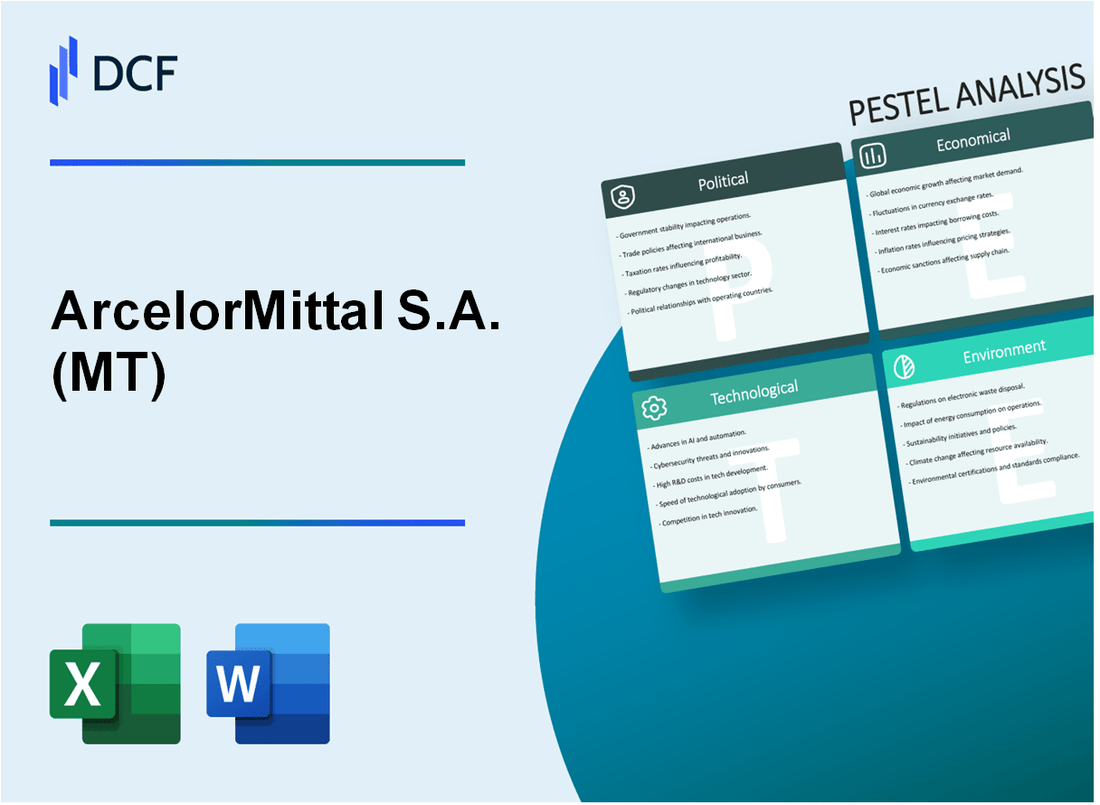
Completamente Editable: Adáptelo A Sus Necesidades En Excel O Sheets
Diseño Profesional: Plantillas Confiables Y Estándares De La Industria
Predeterminadas Para Un Uso Rápido Y Eficiente
Compatible con MAC / PC, completamente desbloqueado
No Se Necesita Experiencia; Fáciles De Seguir
ArcelorMittal S.A. (MT) Bundle
En el panorama dinámico de la producción mundial de acero, ArcelorMittal S.A. se encuentra en una encrucijada crítica, navegando por los complejos desafíos que abarcan dominios políticos, económicos, sociológicos, tecnológicos, legales y ambientales. Como el fabricante de acero más grande del mundo, la compañía enfrenta presiones sin precedentes de las tensiones comerciales globales, las demandas de sostenibilidad e interrupción tecnológica, transformando la producción de acero tradicional en un juego estratégico de ajedrez estratégico de innovación, cumplimiento y adaptabilidad. Este análisis integral de la mano revela la intrincada red de factores externos que dan forma a la toma de decisiones estratégicas de ArcelorMittal, ofreciendo una inmersión profunda en los desafíos y oportunidades multifacéticas que definirán la trayectoria futura de la compañía en un mercado global cada vez más complejo.
ArcelorMittal S.A. (MT) - Análisis de mortero: factores políticos
Tensiones comerciales globales Impacto estrategias de importación/exportación de acero
En 2023, ArcelorMittal enfrentó desafíos significativos de las tensiones comerciales mundiales, particularmente con las tarifas de la Sección 232 de EE. UU. Y las medidas de salvaguardia de la UE Steel. Los volúmenes de exportación de acero de la compañía se vieron directamente afectados por estas limitaciones políticas.
| Región | Restricciones de exportación de acero | Impacto arancelario (%) |
|---|---|---|
| Estados Unidos | 25% de tarifas de acero | 15.2 |
| unión Europea | Restricciones basadas en cuotas | 12.7 |
| Porcelana | Controles de exportación de licencias | 8.5 |
Los riesgos geopolíticos en los mercados emergentes afectan las decisiones de inversión
La cartera internacional de ArcelorMittal enfrenta desafíos geopolíticos complejos en los mercados emergentes.
- El conflicto de Ucrania redujo la inversión en € 450 millones en 2022
- La inestabilidad política en Kazajstán impactó 4,7 millones de toneladas de producción de acero
- El entorno político de Brasil creó el 12% de incertidumbre de inversión
Las políticas de descarbonización del gobierno impulsan la transformación estratégica
El acuerdo verde de la Unión Europea y la reducción de carbono influyen directamente en la planificación estratégica de ArcelorMittal.
| Política | Objetivo de reducción de carbono | Compromiso de inversión |
|---|---|---|
| Deal verde de la UE | 55% de reducción para 2030 | 3.200 millones de euros |
| Ley de Protección Climática de Alemania | Reducción del 65% para 2030 | 1.500 millones de euros |
Las presiones regulatorias sobre las emisiones de carbono influyen en la planificación operativa
Las estrictas regulaciones de emisión de carbono requieren modificaciones operativas sustanciales.
- Mecanismo de ajuste de borde de carbono (CBAM) Impacto del costo estimado: € 750 millones anuales
- Costos de cumplimiento del sistema de negociación de emisiones (ETS): € 500 millones por año
- Inversiones proyectadas de tecnología verde: € 2.3 mil millones para 2025
ArcelorMittal S.A. (MT) - Análisis de mortero: factores económicos
Las fluctuaciones de la demanda de acero cíclica desafían la estabilidad de los ingresos
ArcelorMittal informó envíos de acero global de 65.3 millones de toneladas métricas en 2023, lo que refleja una disminución del 4.5% de 2022. Los ingresos para 2023 fueron de $ 68.3 mil millones, en comparación con $ 75.4 mil millones en 2022.
| Año | Envíos de acero (millones de toneladas métricas) | Ingresos (mil millones de dólares) |
|---|---|---|
| 2022 | 68.4 | 75.4 |
| 2023 | 65.3 | 68.3 |
La desaceleración económica global afecta a los sectores de infraestructura y construcción
El crecimiento global de la industria de la construcción fue de 3.1% en 2023, por debajo del 4.2% en 2022. El EBITDA de ArcelorMittal para 2023 fue de $ 6.1 mil millones, en comparación con $ 8.2 mil millones en 2022.
| Sector | Tasa de crecimiento 2022 | Tasa de crecimiento 2023 |
|---|---|---|
| Construcción global | 4.2% | 3.1% |
| ArcelorMittal Ebitda (mil millones de dólares) | 8.2 | 6.1 |
La volatilidad del tipo de cambio de divisas afecta el desempeño financiero internacional
En 2023, ArcelorMittal experimentó pérdidas de cambio de divisas de aproximadamente $ 312 millones, lo que afectó el ingreso neto que fue de $ 3.8 mil millones en comparación con $ 4.6 mil millones en 2022.
| Métrica financiera | 2022 | 2023 |
|---|---|---|
| Pérdidas de cambio de divisas (millones de dólares) | 276 | 312 |
| Ingresos netos (mil millones de dólares) | 4.6 | 3.8 |
La recuperación económica continua influye en los precios del acero y la dinámica del mercado
Los precios mundiales de acero promediaron $ 700 por tonelada métrica en 2023, por debajo de $ 850 por tonelada métrica en 2022. El precio de venta promedio de ArcelorMittal disminuyó en un 12.5% durante este período.
| Métrico | 2022 | 2023 |
|---|---|---|
| Global Steel Price (USD/Metric Ton) | 850 | 700 |
| Disminución del precio | N / A | 12.5% |
ArcelorMittal S.A. (MT) - Análisis de mortero: factores sociales
Aumento de las iniciativas de diversidad e inclusión de la fuerza laboral
A partir de 2022, ArcelorMittal reportó una representación femenina del 25% en su fuerza laboral global. La compañía invirtió $ 12.5 millones en programas de diversidad e inclusión en sus regiones operativas.
| Métrica de diversidad | Porcentaje | Inversión ($) |
|---|---|---|
| Representación de la fuerza laboral femenina | 25% | 12,500,000 |
| Diversidad de gestión | 18% | 5,300,000 |
| Programas de inclusión global | 12 países | 7,200,000 |
Creciente demanda de consumidores de producción de acero sostenible
En 2023, ArcelorMittal comprometió $ 1.8 mil millones para reducir las emisiones de carbono, con el 62% de los clientes que exigían una producción de acero sostenible.
| Métrica de sostenibilidad | Valor |
|---|---|
| Inversión de reducción de emisiones de carbono | $1,800,000,000 |
| Demanda de acero sostenible | 62% |
| Capacidad de producción de acero verde | 3.5 millones de toneladas/año |
Desafíos de atracción de talento en los sectores de fabricación tradicionales
ArcelorMittal experimentó una dificultad de adquisición de talento del 14% en los roles de fabricación, con costos promedio de reclutamiento que alcanzan $ 4,200 por empleado técnico.
| Métrico de reclutamiento | Valor |
|---|---|
| Dificultad de adquisición de talento | 14% |
| Costo de reclutamiento de empleados técnicos | $4,200 |
| Tiempo de contrato promedio | 72 días |
Cambiando las expectativas de la fuerza laboral hacia la tecnología e innovación verde
ArcelorMittal asignó $ 375 millones para programas de capacitación e innovación de tecnología verde en 2023, con el 48% de los empleados que expresan interés en los roles centrados en la sostenibilidad.
| Métrica de innovación | Valor |
|---|---|
| Inversión en tecnología verde | $375,000,000 |
| Interés de los empleados en los roles de sostenibilidad | 48% |
| Participantes del programa de innovación | 2.600 empleados |
ArcelorMittal S.A. (MT) - Análisis de mortero: factores tecnológicos
Inversiones significativas en transformación digital e industria 4.0
ArcelorMittal invirtió $ 289 millones en iniciativas de transformación digital en 2023. La compañía implementó 47 proyectos de transformación digital en sus operaciones globales, apuntando a una mejora del 15% en la eficiencia operativa.
| Categoría de inversión digital | Monto de inversión (USD) | Ganancia de eficiencia esperada |
|---|---|---|
| Infraestructura de computación en la nube | $ 87 millones | 12% de eficiencia operativa |
| AI y aprendizaje automático | $ 62 millones | 18% de mejora de mantenimiento predictivo |
| IoT y tecnologías de sensores | $ 53 millones | Mejora de monitoreo en tiempo real del 16% |
| Actualizaciones de ciberseguridad | $ 41 millones | 22% de mejora de seguridad digital |
Automatización avanzada e implementación de IA en procesos de fabricación
ArcelorMittal desplegó 127 sistemas robóticos impulsados por la IA en sus instalaciones de fabricación en 2023. Estos sistemas lograron una reducción del 22% en los costos laborales manuales y un aumento del 19% en la precisión de producción.
| Tecnología de automatización | Número de sistemas implementados | Mejora del rendimiento |
|---|---|---|
| Sistemas de soldadura robótica | 43 sistemas | 25% de precisión de soldadura |
| Control de calidad automatizado | 38 sistemas | Tasa de detección de defectos del 18% |
| Automatización de logística | 46 sistemas | 20% de eficiencia de manejo de materiales |
Desarrollo de tecnologías de producción de acero baja en carbono
ArcelorMittal comprometió $ 675 millones a la investigación de producción de acero baja en carbono en 2023. La tecnología de hierro reducido directo basado en hidrógeno (DRI) de la compañía tiene como objetivo reducir las emisiones de CO2 en un 41% en comparación con los métodos de fabricación de acero tradicionales.
| Tecnología baja en carbono | Inversión de investigación (USD) | Objetivo de reducción de emisiones de carbono |
|---|---|---|
| DRI basado en hidrógeno | $ 275 millones | 41% de reducción de CO2 |
| Tecnología de horno de arco eléctrico | $ 198 millones | 35% de eficiencia energética |
| Tecnologías de captura de carbono | $ 142 millones | Captura de emisiones del 29% |
Análisis de datos mejorado para la eficiencia operativa y el mantenimiento predictivo
ArcelorMittal implementó plataformas avanzadas de análisis de datos en 82 instalaciones globales, lo que resultó en una reducción del 26% en el tiempo de inactividad de equipos no planificados y un ahorro de costos de $ 113 millones en los gastos de mantenimiento.
| Aplicación de análisis de datos | Número de instalaciones | Impacto en el rendimiento |
|---|---|---|
| Análisis de mantenimiento predictivo | 82 instalaciones | 26% de reducción del tiempo de inactividad |
| Monitoreo del rendimiento en tiempo real | 76 instalaciones | Aumento de la productividad del 19% |
| Optimización de la cadena de suministro | 64 instalaciones | 22% de eficiencia logística |
ArcelorMittal S.A. (MT) - Análisis de mortero: factores legales
Cumplimiento de las regulaciones ambientales internacionales
ArcelorMittal enfrenta estrictos requisitos de cumplimiento ambiental en múltiples jurisdicciones. En 2023, la compañía invirtió $ 487 millones en iniciativas de protección ambiental y sostenibilidad.
| Jurisdicción | Costo de cumplimiento de la regulación ambiental | Sanciones regulatorias (2023) |
|---|---|---|
| unión Europea | $ 162 millones | $ 3.2 millones |
| Estados Unidos | $ 98 millones | $ 1.7 millones |
| India | $ 74 millones | $ 1.1 millones |
Marcos legales transfronterizos complejos
ArcelorMittal opera en 18 países, administrando 214 entidades legales con complejos requisitos regulatorios transfronterizos.
| Región | Número de entidades legales | Presupuesto de cumplimiento legal (2023) |
|---|---|---|
| Europa | 76 | $ 42.3 millones |
| América | 58 | $ 35.6 millones |
| África/Asia | 80 | $ 28.9 millones |
Protección de propiedad intelectual
ArcelorMittal mantiene 1.237 patentes activas a nivel mundial, con un gasto anual de protección de propiedad intelectual de $ 64.5 millones en 2023.
| Categoría de patente | Número de patentes | Gasto de protección |
|---|---|---|
| Procesos de fabricación | 487 | $ 25.3 millones |
| Tecnología material | 392 | $ 21.7 millones |
| Eficiencia energética | 358 | $ 17.5 millones |
Cumplimiento del comercio internacional
ArcelorMittal administra el cumplimiento del comercio en 46 países, con un presupuesto dedicado de cumplimiento del comercio de $ 22.8 millones en 2023.
| Región comercial | Volumen de exportación | Costo de cumplimiento de la importación |
|---|---|---|
| unión Europea | 12.4 millones de toneladas | $ 7.6 millones |
| América del norte | 8.7 millones de toneladas | $ 5.9 millones |
| Asia-Pacífico | 6.2 millones de toneladas | $ 4.3 millones |
ArcelorMittal S.A. (MT) - Análisis de mortero: factores ambientales
Comprometido con objetivos ambiciosos de reducción de carbono para 2050
ArcelorMittal ha establecido un Objetivo de reducción de CO2 del 35% para 2030 en sus operaciones globales. Las emisiones totales de carbono de la compañía en 2022 fueron 196.1 millones de toneladas de CO2.
| Año | Objetivo de emisión de carbono | Año basal |
|---|---|---|
| 2030 | 35% de reducción | 2017 |
| 2050 | Emisiones netas cero | 2017 |
Implementación de principios de economía circular en la producción de acero
ArcelorMittal invertido $ 1.1 mil millones en iniciativas de economía circular en 2022. alcanzó la tasa de reciclaje de acero de la compañía 85% en sus operaciones europeas.
| Métrica de economía circular | Valor 2022 |
|---|---|
| Volumen de acero reciclado | 12.4 millones de toneladas |
| Inversión en economía circular | $ 1.1 mil millones |
Invertir en tecnologías de energía renovable y acero verde
ArcelorMittal cometido $ 1.5 mil millones para el desarrollo de tecnología de acero verde. La cartera de energía renovable de la compañía incluye:
- Capacidad de energía solar: 150 MW
- Capacidad de energía eólica: 200 MW
- Proyectos piloto de producción de acero basados en hidrógeno en 3 países
Desarrollo de prácticas de producción y minería sostenible
Reducción del consumo de agua lograda 15% en las operaciones mineras. Las inversiones de protección de la biodiversidad totalizaron $ 45 millones en 2022.
| Métrica de sostenibilidad | Rendimiento 2022 |
|---|---|
| Reducción del consumo de agua | 15% |
| Inversión en biodiversidad | $ 45 millones |
Abordar el impacto ambiental en la cadena de suministro global
ArcelorMittal realizado 287 auditorías ambientales En su cadena de suministro global en 2022. La tasa de cumplimiento de la sostenibilidad del proveedor alcanzó 92%.
| Métrica ambiental de la cadena de suministro | Valor 2022 |
|---|---|
| Auditorías ambientales | 287 |
| Cumplimiento de la sostenibilidad del proveedor | 92% |
ArcelorMittal S.A. (MT) - PESTLE Analysis: Social factors
You're looking at ArcelorMittal's social landscape and what you see is a complex mix of structural growth drivers and immediate, high-stakes labor challenges. Simply put, urbanization in key developing markets is a massive long-term tailwind, but near-term labor unrest and the massive reskilling required for the green transition are critical risks that demand a clear, proactive strategy.
Labor negotiations and potential strikes in European and North American plants affect production capacity.
The social environment in core European and North American operations is volatile, driven less by traditional wage disputes and more by the structural crisis in the European steel sector. While overt strikes are a constant risk, the immediate impact is seen in capacity rationalization and job losses.
For example, late in 2024, the company announced site closures in France, including Reims and Denain, resulting in the loss of 136 jobs. This is not a strike impact, but a direct consequence of low demand and global overcapacity, which fuels labor disputes and union negotiations across the region. This instability impacts morale and productivity, and any full-scale strike action in a major North American facility would immediately hit the company's ability to maximize returns from the relatively stronger US market, where the new 1.5 million-tonne Electric Arc Furnace (EAF) in Calvert, Alabama, is a key growth asset.
Growing public and investor demand for ethical sourcing and responsible supply chain management.
Investor and public scrutiny on ethical sourcing (Environmental, Social, and Governance or ESG) is no longer optional; it's a cost of capital issue. ArcelorMittal has responded by embedding the ResponsibleSteel™ standard across its operations.
As of late 2024, the company had achieved ResponsibleSteel™ certification for 42 of its steel production facilities. This is a significant competitive advantage, representing roughly 50% of all core site certifications issued globally by ResponsibleSteel™. To formalize this commitment for 2025, the company is launching a new Responsible Sourcing policy and an updated Code of Responsible Sourcing. This policy applies to all suppliers and contractors, mandating adherence to standards derived from the OECD Due Diligence Guidance for Responsible Supply Chains of Minerals.
Here's the quick math: Ethical sourcing reduces supply chain risk, which is crucial when your raw material transport expenses were inflated by 45% in 2024 due to shipping disruptions (a number that could easily jump again).
Urbanization in developing markets continues to drive long-term structural demand for steel products.
The long-term structural demand for steel, particularly in emerging economies, remains a powerful positive social factor. Global urbanization drives massive infrastructure and construction needs, and ArcelorMittal is strategically positioned to capture this growth in high-demand markets like India and Brazil.
The global steel products market is projected to grow from $437.06 billion in 2024 to $450.21 billion in 2025, a Compound Annual Growth Rate (CAGR) of 3.0%. The company's expansion plans reflect this trend:
| Region | Project/Asset | Capacity/Target | Timeline/Status (as of 2025) |
|---|---|---|---|
| India (AMNS India) | Hazira Expansion | 15 Mtpa (Million tonnes per annum) | On track by end of 2026 |
| India (AMNS India) | New Greenfield Site (Andhra Pradesh) | 7.3 Mtpa (Initial Capacity) | Land acquisition initiated |
| United States | Calvert EAF Commissioning | 1.5 Mtpa | Operational in 2025 |
This expansion strategy in India and Brazil is explicitly designed to increase shipped volumes and profitable market share, capitalizing on the structural growth fueled by continued infrastructure development and urbanization.
Focus on workforce reskilling is crucial for transitioning to lower-carbon steel production technologies.
The move to lower-carbon steel production, while an environmental factor, has a profound social dimension in the form of workforce reskilling. The company's decarbonization pathway requires a shift from traditional coal-based blast furnaces, which still account for 87% of its ironmaking capacity, to new technologies like hydrogen-based Direct Reduced Iron (DRI) and Electric Arc Furnaces (EAFs).
This transition demands new skills in hydrogen handling, advanced process control, and electrical systems maintenance. ArcelorMittal has allocated between $0.3 billion and $0.4 billion in capital expenditure for decarbonization initiatives in 2025. This CapEx is directly tied to social change, as projects like the Sestao plant in Spain, which is slated to produce 1.6 million tonnes of zero-carbon steel by the end of 2025, will require a fundamentally different skillset from the current workforce.
The company addresses this through a continuous, flexible learning model:
- Utilize an internal university for personalized learning journeys.
- Prioritize experiential development and mentorship.
- Partner with local communities for vocational training and talent pipeline development.
The biggest risk here is a skills gap that delays the commissioning of new, green assets. The long-term success of the $0.3 billion to $0.4 billion investment defintely hinges on the speed and quality of this reskilling effort.
ArcelorMittal S.A. (MT) - PESTLE Analysis: Technological factors
You're looking at ArcelorMittal's technology strategy and seeing a massive, multi-billion-dollar bet on decarbonization, but the near-term reality is a complex, phased rollout. The core technological shift is moving from traditional Blast Furnace/Basic Oxygen Furnace (BF-BOF) steelmaking to a lower-carbon mix of Direct Reduced Iron (DRI) and Electric Arc Furnace (EAF) production, but the speed of this transition is being dictated by external market and policy factors, not just internal ambition.
Significant capital is being allocated to Direct Reduced Iron (DRI) and Electric Arc Furnace (EAF) projects.
ArcelorMittal has estimated a total gross investment of approximately $10 billion globally for carbon-reduction solutions to meet its 2030 targets, with about 35% of that capital, or roughly $3.5 billion, originally slated for deployment by the end of 2025. However, the company has had to scale back or halt several large-scale Direct Reduced Iron (DRI) and Electric Arc Furnace (EAF) projects in Europe in 2025. The planned DRI-EAF projects in Bremen and Eisenhüttenstadt, Germany, for instance, which were tied to a substantial €1.3 billion in German government subsidies, were formally notified as unfeasible due to high energy costs and a lack of commercially viable green hydrogen.
Still, the transition is moving forward in a phased approach. The focus is now on projects with a clearer, shorter-term business case, primarily EAFs. Construction is underway on a new 1.1 million tonne EAF at the Gijón plant in Spain, which is expected to reduce CO2 emissions by 1 million tonnes. Also, the EAF capacity at Sestao, Spain, is being expanded to reach 1.6 million tonnes by 2026, boosting the production of their low-carbon XCarb® steel. This phased approach will increase the total achievable EAF crude steel capacity in the European business from 19% to 28%. It's a pragmatic pivot: focus on what you can build now, not what you hope to build later.
ArcelorMittal is investing billions in hydrogen-ready steel production to meet 2030 targets.
The company's long-term strategy is fundamentally based on shifting to hydrogen-ready technology, but the near-term economic viability is a major headwind in 2025. The core of their low-carbon route is building DRI facilities that can initially run on natural gas and then transition to green hydrogen as it becomes more available and cost-competitive. The problem is that the transition to green hydrogen as a viable fuel source is evolving very slowly.
Here's the quick math: The company's initial expectations for green hydrogen costs were around $1.50/kg by 2030, but current European estimates are much higher, with some assessments suggesting the price needs to fall below $1/kg to compete with gas-based DRI without factoring in CO2 costs. This cost disparity is why final investment decisions on some large-scale hydrogen-ready projects have been delayed, despite the long-term commitment. In the meantime, the company is actively pursuing its two breakthrough carbon-neutral technology routes:
- Smart Carbon: Uses circular carbon sources like sustainable biomass and bio-waste, coupled with Carbon Capture, Utilization, and Storage (CCUS).
- Innovative DRI-based route: Utilizes Direct Reduced Iron and Electric Arc Furnaces, transitioning from natural gas to green hydrogen.
Digitalization of mills, using AI for process optimization, aims to cut energy use and boost yield.
Beyond the huge capital projects, the company is quietly driving efficiency through digitalization and Artificial Intelligence (AI) across its global steel plants. These AI algorithms are instrumental in optimizing production schedules and resource allocation, which directly translates into lower energy consumption and operational costs. This is where fast, incremental wins happen.
Concrete examples show the immediate impact of this technology:
- At the Hamburg wire rod plant, AI implementation resulted in a 20% reduction in trim scrap.
- At the Belval site in Luxembourg, an AI-driven project on a beam furnace, which consumes about €5 million of gas per year, achieved real energy savings of more than 3% on the annual energy bill, equating to approximately €150,000 in savings and a reduction of 9 GWh in annual energy consumption.
- AI is also used for dynamic process optimization at the Eisenhüttenstadt plant, improving the surface quality of automotive-grade steel sheets by minimizing defects.
The company is targeting a 35% CO2 emissions reduction in Europe by 2030 via new tech adoption.
The headline target for ArcelorMittal Europe is a 35% CO2 emissions intensity reduction by 2030, with an ultimate ambition of being carbon neutral by 2050. This target is a significant commitment that underpins their technology roadmap. To be fair, the company's absolute emissions from European operations have already reduced by 28.2% since 2018, but this is largely due to lower production from weak market demand, which is not a sustainable technological solution.
The real technological progress is measured in the shift in production capacity. The table below summarizes the key technological shifts and their associated financial/emissions impact as of the 2025 fiscal year.
| Technological Initiative | 2030 Target/Goal | 2025 Status/Investment Data | Impact/Benefit |
|---|---|---|---|
| Global Decarbonization Investment | Achieve 25% global CO2 reduction by 2030 | Gross investment estimated at $10 billion. Approximately $3.5 billion (35%) expected to be deployed by 2025. | Funds the two breakthrough technology routes (Smart Carbon and Innovative DRI). |
| European CO2 Reduction Target | 35% CO2 emissions intensity reduction by 2030 in Europe. | Absolute emissions already reduced by 28.2% since 2018 (mostly due to lower production). | Aligns with EU Green Deal and Paris Agreement commitments. |
| DRI/EAF Project Status (Germany) | Phase out BF-BOF with hydrogen-ready DRI/EAF facilities. | DRI-EAF projects in Bremen/Eisenhüttenstadt halted in 2025, forfeiting €1.3 billion in subsidies. | Highlights the challenge of high energy costs and uncompetitive green hydrogen (cost needs to be below $1/kg). |
| EAF Expansion (Spain) | Increase low-carbon steel production capacity. | New 1.1 million tonne EAF under construction in Gijón. EAF capacity at Sestao expanding to 1.6 million tonnes by 2026. | Increases European EAF crude steel capacity from 19% to 28%. Reduces CO2 by 1 million tonnes at Gijón. |
| AI/Digitalization | Optimize production, cut energy use, and boost yield. | AI led to a 20% reduction in trim scrap at Hamburg. Saved €150,000 (9 GWh) on the annual energy bill at Belval. | Drives immediate operational efficiencies and cost reduction, with a return on investment in less than six months in some cases. |
ArcelorMittal S.A. (MT) - PESTLE Analysis: Legal factors
The EU's Carbon Border Adjustment Mechanism (CBAM) is transitioning, raising compliance costs for non-EU imports.
You need to be ready for the real financial impact of the European Union's Carbon Border Adjustment Mechanism (CBAM) because the transitional phase ends on December 31, 2025. Right now, you are only reporting embedded emissions quarterly, but the obligation to purchase and surrender CBAM certificates-the actual carbon levy-begins in January 2026.
This is a fundamental shift that will dramatically increase the compliance cost for non-EU steel imports, which is a net positive for ArcelorMittal's European operations. The mechanism effectively levels the playing field by imposing a carbon price on imports that reflects the costs European producers already incur under the EU Emissions Trading System (ETS). Provisional benchmarks for steel hot-rolled coil (HRC) show a clear cost spread: the benchmark for carbon-intensive Blast Furnace/Basic Oxygen Furnace (BF/BOF) production is 1.530 tCO2 per tonne, versus just 0.288 tCO2 per tonne for scrap-based Electric Arc Furnace (EAF) routes. This reinforces the business case for ArcelorMittal's lower-carbon production lines.
The company is betting on this, expecting the combination of CBAM and new trade measures to help capacity utilization rates in Europe rise from an unsustainable ~65% to a more viable 80-85%. That's a huge operational lever.
Stricter anti-dumping regulations in the US and EU protect domestic steel producers but complicate global trade.
Trade protectionism is a double-edged sword: it shields your domestic markets but fragments the global supply chain. In September 2025, the European Commission imposed definitive anti-dumping duties on hot-rolled flat products from Egypt (11.7%), Japan (6.9%-30%), and Vietnam (12.1%), a direct win for domestic producers like ArcelorMittal.
The US is also tightening the screws. The US Department of Commerce (Commerce) issued final affirmative determinations in August 2025 on anti-dumping and countervailing duties for Corrosion-Resistant Steel Products (CORE). For instance, ArcelorMittal Dofasco in Canada was hit with an anti-dumping rate of 5.59% in the preliminary findings, showing that even North American operations are not immune to trade enforcement actions. Plus, the US reimposed Section 232 tariffs on Canadian and Mexican steel imports in 2025, a move that has already been linked to a rise in US domestic raw steel production of over 1.4 million short tons from January to September 2025 compared to the prior year.
The European Union is also replacing its existing steel safeguard measure (set to expire in June 2026) with a new, long-term trade measure. This proposal, announced in October 2025, aims to limit tariff-free import volumes to 18.3 million tonnes per year (a 47% reduction from 2024 quotas) and double the out-of-quota tariff to 50%. This is a clear legal framework designed to force higher domestic steel prices.
Antitrust regulations globally limit M&A activity, forcing organic growth strategies.
The era of mega-mergers in the steel industry is constrained by increasingly vigilant antitrust regulators globally. While ArcelorMittal successfully completed the acquisition of the remaining 60% of Brazilian pipe producer Tuper S.A. in the first half of 2025 after securing approval from the Brazilian antitrust authority (CADE), this was a bolt-on deal, not a major consolidation.
The general regulatory climate for multi-jurisdictional M&A is more challenging than ever, with authorities in the EU and UK increasingly scrutinizing deals based on non-traditional theories of harm. This forces large players like ArcelorMittal to focus on organic growth and strategic joint ventures rather than transformative acquisitions. The political-legal environment adds another layer of risk, with a French parliamentary committee even approving a proposal in November 2025 to nationalize ArcelorMittal's operations in the country-a geopolitical risk that can instantly derail any European investment strategy.
New safety and health standards in mining and steelmaking require continuous capital upgrades.
Compliance with evolving global safety and health laws is a continuous, non-negotiable capital drain. The Mine Safety and Health Administration (MSHA) in the US, for example, finalized a rule on Respirable Crystalline Silica, which mandates lowering the permissible exposure limit (PEL) from 100 to 50 µg/m³ (8-hour TWA). For ArcelorMittal's mining segment, compliance with this new standard will require capital-intensive upgrades to ventilation and dust suppression systems, with the deadline for metal/nonmetal mines set for April 8, 2026.
The company's overall safety performance shows the constant pressure: the Lost Time Injury Frequency rate (LTIF) was 0.68x in Q2 2025. To address this, the company is in the process of a three-year safety transformation program. While the full-year 2025 capital expenditure guidance is a substantial $4.5-$5.0 billion, the cost of mandatory safety and maintenance upgrades is embedded within the normative capex, which totaled $2.7 billion in the 12 months leading up to March 31, 2025. You defintely have to budget for this as a fixed, ongoing cost of doing business.
ArcelorMittal S.A. (MT) - PESTLE Analysis: Environmental factors
You need to understand the environmental side of ArcelorMittal S.A. because it's the single biggest risk factor to their long-term cost structure and a major point of friction with institutional capital. The core takeaway is this: while the company has ambitious, industry-leading targets, their actual capital expenditure (CAPEX) in 2025 is defintely lagging, creating a significant gap between ambition and execution.
Decarbonization Investment: The $10 Billion Gap
ArcelorMittal is committed to spending approximately $10 billion globally on decarbonization by 2030, a massive number that shows the scale of the transition. The original plan called for deploying about 35% of that, or roughly $3.5 billion, by the end of 2025. Here's the quick math: the company's total decarbonization spending between 2021 and 2024 was only $1 billion. For the 2025 fiscal year, the planned CAPEX for decarbonization projects was cut to just $0.3 billion to $0.4 billion, out of a total planned CAPEX of $4.5 billion to $5 billion. That's a huge slowdown, and it's why the company is warning it is 'increasingly unlikely' to meet its 2030 carbon intensity targets.
The company's absolute Scope 1 and 2 emissions stood at 102 million tonnes in 2024, a figure comparable to the emissions of an industrialized nation like Belgium. This is the number they must shrink, but a lack of supportive policy and high energy costs are slowing down final investment decisions on key Direct Reduced Iron (DRI) projects in Europe.
Investor Pressure and Paris Agreement Alignment
The pressure from institutional investors to align production with the Paris Agreement's 1.5°C scenario is not just a talking point; it's a real financial risk. Major shareholders, including signatories to the Climate Action 100+ initiative, are demanding a clear, time-bound plan to phase out coal. The company's medium-term targets (2026-2035) were found to be not aligned with the 1.5°C goal in a 2022 assessment.
The core conflict for investors is the simultaneous investment in high-carbon assets. For example, the joint venture ArcelorMittal Nippon Steel (AM/NS) India is bringing two new coal-based blast furnaces online by 2026, which will add approximately 12 million tonnes of CO2 equivalent emissions annually if running at full capacity. This kind of dual strategy-green in Europe, high-carbon in emerging markets-is what makes investors nervous about stranded assets and long-term climate integrity.
Shifting to Scrap-Based Steelmaking (EAF)
Shifting to scrap-based steelmaking, primarily via the Electric Arc Furnace (EAF) route, is the most direct way to reduce primary resource extraction and energy intensity. It's a no-brainer. This method has a far lower emissions intensity of about 0.68 tonnes of CO2 per tonne of crude steel, compared to 2.0 to 2.2 tonnes of CO2 per tonne of steel for the traditional Blast Furnace-Basic Oxygen Furnace (BF-BOF) route.
ArcelorMittal has a significant existing low-carbon capacity, but it is not enough to offset the BF-BOF reliance.
| Low-Carbon Asset | Capacity | Role in Decarbonization |
|---|---|---|
| Electric Arc Furnaces (EAFs) | 24 million tonnes per year (28 units) | Uses steel scrap and electricity; low-carbon footprint. |
| Direct Reduced Iron (DRI) Modules | 10.3 million tonnes per year (11 units) | Prepares iron for EAF; can be powered by natural gas or, eventually, green hydrogen. |
Water Usage and Waste Management
Water usage and waste management regulations are tightening, particularly in water-stressed regions, which is a major operational risk. The company has a strong focus on a circular economy approach, which is critical for reducing environmental liability.
- Water Recirculation: ArcelorMittal Brasil, for instance, has a water recirculation rate of approximately 98%, which is a benchmark for the industry.
- Waste as Resource: By-products like blast furnace slag and steelmaking slag are extensively reused in the construction industry, reducing the need for virgin aggregates.
- Compliance: The company reports that 98% of its industrial operations are certified under the ISO 14001 management system, which mandates continuous improvement of environmental impacts.
The focus here is on process optimization and compliance, which helps mitigate the financial impact of stricter environmental fines and resource scarcity.
Finance: Draft a 13-week cash view by Friday, specifically modeling the impact of a 10% rise in coking coal costs and the projected 2025 Carbon Border Adjustment Mechanism (CBAM) compliance costs.
Disclaimer
All information, articles, and product details provided on this website are for general informational and educational purposes only. We do not claim any ownership over, nor do we intend to infringe upon, any trademarks, copyrights, logos, brand names, or other intellectual property mentioned or depicted on this site. Such intellectual property remains the property of its respective owners, and any references here are made solely for identification or informational purposes, without implying any affiliation, endorsement, or partnership.
We make no representations or warranties, express or implied, regarding the accuracy, completeness, or suitability of any content or products presented. Nothing on this website should be construed as legal, tax, investment, financial, medical, or other professional advice. In addition, no part of this site—including articles or product references—constitutes a solicitation, recommendation, endorsement, advertisement, or offer to buy or sell any securities, franchises, or other financial instruments, particularly in jurisdictions where such activity would be unlawful.
All content is of a general nature and may not address the specific circumstances of any individual or entity. It is not a substitute for professional advice or services. Any actions you take based on the information provided here are strictly at your own risk. You accept full responsibility for any decisions or outcomes arising from your use of this website and agree to release us from any liability in connection with your use of, or reliance upon, the content or products found herein.